To the Editor—Routine feedback of surgeon- and procedure-specific rates of surgical site infections (SSIs) reduces subsequent SSI rates.Reference Berrios-Torres, Umscheid and Bratzler1–Reference Haley, Culver and White3 In fact, SSI surveillance and feedback are cornerstones of SSI prevention.Reference Anderson, Podgorny and Berríos-Torres4 Most hospitals in the United States use National Healthcare Safety Network (NHSN) surveillance definitions for SSI, which include 3 categories: superficial incisional, deep incisional, and organ-space infections.5, Reference Horan, Andrus and Dudeck6
Practical SSI surveillance definitions are integral to collecting data and providing meaningful feedback. Hospital infection prevention programs most commonly use culture-based surveillance for SSI. Deep incisional and organ-space SSIs are relatively easy to identify because they usually lead to hospital readmission, return trips to the operating room, and the use of intravenous antibiotics.Reference Ming, Chen, Miller and Anderson7 In contrast, accurate and complete surveillance data on superficial incisional SSIs are harder to collect due to surveillance bias and because they are commonly diagnosed in outpatient settings. Because wound cultures are not routinely obtained from many patients with superficial incisional SSIs, most infection prevention programs fail to detect many superficial incisional SSIs.
Although the NHSN recommends the reporting of superficial incisional SSIs, only 1 of 3 standardized infection ratio (SIR) models used by the NSHN include superficial SSIs cases. Additionally, SSI data reported to CMS do not include superficial incisional SSI cases.8
Superficial incisional SSIs vary widely in severity and clinical importance to both patients and their surgeons.Reference Kao, Ghaferi, Ko and Dimick9, Reference Lawson, Hall and Ko10 Some superficial incisional SSIs lead to serious morbidity, including readmission, surgical debridement in operating rooms, and long-term antibiotic therapy. We believe that including patients with serious superficial incisional SSIs (SSISSIs) in standard SSI surveillance could enhance and improve the benefit of surveillance and feedback of data to surgeons and better estimate the risk of harm when informing patients who are weighing the benefits and risks of surgery. The objectives of this study were to describe this group of patients and to outline our rationale for proposing a new category of SSIs.
Methods
We performed a retrospective analysis of prospectively collected data on 7 categories of surgical procedures performed over a 4-year period (July 2013–December 2017) at 3 Duke University Health System (DUHS)–affiliated hospitals. This cohort included adult patients who underwent craniotomy, spinal fusion, laminectomy, hip arthroplasty, knee arthroplasty, and cardiac bypass surgeries. Trained infection preventionists reviewed the cases for SSI using current NHSN definitions. Surveillance for SSIs was primarily culture-based in all 3 hospitals.
All patients identified as having a superficial incisional SSI were reviewed by infectious disease specialists with training in infection prevention. We defined a SSISSI as a superficial incisional SSI that (1) required debridement in an operating room and/or (2) led to a hospital readmission within 30 days of surgery. The DUHS Institutional Review Board approved this study.
Results
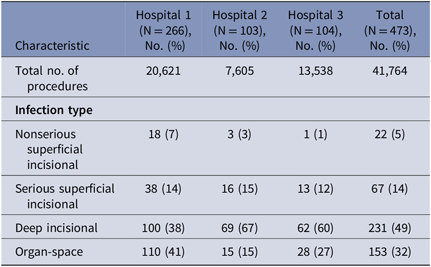
A total of 41,764 selected surgical procedures were performed during the study period; an SSI occurred in 473 procedures (1.1%). Infection preventionists categorized 89 (18.8%) of the SSIs as superficial incisional during routine surveillance (Table 1). Of the 89 superficial incisional SSIs identified in our dataset, 67 (75%) met the definition of a SSISSI. Moreover, 63 of these patients (71%) were readmitted within 30 days, and 49 patients (55.1%) required debridement in an operating room within 30 days. The average length of stay for readmission was 9.2 days (SD, 9.0).
Table 1.Number of Superficial, Deep Incisional, and Organ Space Infections at 3 Duke-Affiliated Hospitals for Hip Arthroplasty, Knee Arthroplasty, Craniotomy, Cardiac Bypass, Laminectomy, Spinal Fusion, and Hysterectomy Surgeries
Discussion
Currently, only deep incisional and organ/space SSIs are included in the SIR calculation used by the CMS for the Hospital Acquired Condition Reduction Program. However, 67 of 473 patients (14%) who developed SSIs after the preceding selected procedures met our proposed definition of a SSISSI. Failure to include data on these patients with clinically significant infection in the SIR calculation used by NHSN underestimates the actual harm to patients. Thus, we believe that modifying surveillance procedures to identify patients who are readmitted or who return to the operating room within 30 days of their index surgical procedure would substantially improve the accuracy of outcome data reported to the NHSN and data locally fed back to surgeons and ultimately to their patients. Further, our empirically derived but practical definition could be implemented using current hospital-based surveillance systems for SSIs.
Our study has several weaknesses. Our proposed definition of a SSISSI requires readmission to a hospital or debridement in an operating room. Therefore, patients with SSISSIs who undergo debridement in an urgent care, outpatient surgical center or at another hospital system may escape detection. However, this problem also exists for patients with deep incisional SSIs. Like many hospital systems, the surveillance system used at our 3 Duke-affiliated hospitals depends on detection of positive cultures to identify SSIs. Therefore, we may have failed to recognize SSISSIs if cultures were not obtained. Also, we do not know the true number of superficial incisional SSIs in the total surgical cohort, as we do not yet have a technical solution in place to identify patients who met criteria for purulent drainage and/or clinical diagnosis of superficial incisional SSI. Finally, we do not ask our surgeons to routinely report minor superficial incisional infections treated in the outpatient setting.
Future research should compare the outcomes of patients with SSISSIs to the outcomes of patients with deep and organ/space SSIs. Also, further studies should prospectively apply our definition of SSISSIs to additional categories of surgery such as hysterectomies, colon surgeries, breast surgery, and Cesarean sections. We encourage other investigators to corroborate the practicality and utility of our proposed new definition and collect additional data on the outcome of patients with SSISSI. Finally, if the utility of our new surveillance definition is validated, its inclusion with currently reported data on deep incisional and organ-space SSI rates would better inform surgeons and patients of the actual risk of all serious SSIs.





 You have
Access
To the Editor—Routine feedback of surgeon- and procedure-specific rates of surgical site infections (SSIs) reduces subsequent SSI rates.Reference Berrios-Torres, Umscheid and Bratzler1–Reference Haley, Culver and White3 In fact, SSI surveillance and feedback are cornerstones of SSI prevention.Reference Anderson, Podgorny and Berríos-Torres4 Most hospitals in the United States use National Healthcare Safety Network (NHSN) surveillance definitions for SSI, which include 3 categories: superficial incisional, deep incisional, and organ-space infections.5, Reference Horan, Andrus and Dudeck6
Practical SSI surveillance definitions are integral to collecting data and providing meaningful feedback. Hospital infection prevention programs most commonly use culture-based surveillance for SSI. Deep incisional and organ-space SSIs are relatively easy to identify because they usually lead to hospital readmission, return trips to the operating room, and the use of intravenous antibiotics.Reference Ming, Chen, Miller and Anderson7 In contrast, accurate and complete surveillance data on superficial incisional SSIs are harder to collect due to surveillance bias and because they are commonly diagnosed in outpatient settings. Because wound cultures are not routinely obtained from many patients with superficial incisional SSIs, most infection prevention programs fail to detect many superficial incisional SSIs.
Although the NHSN recommends the reporting of superficial incisional SSIs, only 1 of 3 standardized infection ratio (SIR) models used by the NSHN include superficial SSIs cases. Additionally, SSI data reported to CMS do not include superficial incisional SSI cases.8
Superficial incisional SSIs vary widely in severity and clinical importance to both patients and their surgeons.Reference Kao, Ghaferi, Ko and Dimick9, Reference Lawson, Hall and Ko10 Some superficial incisional SSIs lead to serious morbidity, including readmission, surgical debridement in operating rooms, and long-term antibiotic therapy. We believe that including patients with serious superficial incisional SSIs (SSISSIs) in standard SSI surveillance could enhance and improve the benefit of surveillance and feedback of data to surgeons and better estimate the risk of harm when informing patients who are weighing the benefits and risks of surgery. The objectives of this study were to describe this group of patients and to outline our rationale for proposing a new category of SSIs.
Methods
We performed a retrospective analysis of prospectively collected data on 7 categories of surgical procedures performed over a 4-year period (July 2013–December 2017) at 3 Duke University Health System (DUHS)–affiliated hospitals. This cohort included adult patients who underwent craniotomy, spinal fusion, laminectomy, hip arthroplasty, knee arthroplasty, and cardiac bypass surgeries. Trained infection preventionists reviewed the cases for SSI using current NHSN definitions. Surveillance for SSIs was primarily culture-based in all 3 hospitals.
All patients identified as having a superficial incisional SSI were reviewed by infectious disease specialists with training in infection prevention. We defined a SSISSI as a superficial incisional SSI that (1) required debridement in an operating room and/or (2) led to a hospital readmission within 30 days of surgery. The DUHS Institutional Review Board approved this study.
Results
A total of 41,764 selected surgical procedures were performed during the study period; an SSI occurred in 473 procedures (1.1%). Infection preventionists categorized 89 (18.8%) of the SSIs as superficial incisional during routine surveillance (Table 1). Of the 89 superficial incisional SSIs identified in our dataset, 67 (75%) met the definition of a SSISSI. Moreover, 63 of these patients (71%) were readmitted within 30 days, and 49 patients (55.1%) required debridement in an operating room within 30 days. The average length of stay for readmission was 9.2 days (SD, 9.0).
Number of Superficial, Deep Incisional, and Organ Space Infections at 3 Duke-Affiliated Hospitals for Hip Arthroplasty, Knee Arthroplasty, Craniotomy, Cardiac Bypass, Laminectomy, Spinal Fusion, and Hysterectomy Surgeries
Discussion
Currently, only deep incisional and organ/space SSIs are included in the SIR calculation used by the CMS for the Hospital Acquired Condition Reduction Program. However, 67 of 473 patients (14%) who developed SSIs after the preceding selected procedures met our proposed definition of a SSISSI. Failure to include data on these patients with clinically significant infection in the SIR calculation used by NHSN underestimates the actual harm to patients. Thus, we believe that modifying surveillance procedures to identify patients who are readmitted or who return to the operating room within 30 days of their index surgical procedure would substantially improve the accuracy of outcome data reported to the NHSN and data locally fed back to surgeons and ultimately to their patients. Further, our empirically derived but practical definition could be implemented using current hospital-based surveillance systems for SSIs.
Our study has several weaknesses. Our proposed definition of a SSISSI requires readmission to a hospital or debridement in an operating room. Therefore, patients with SSISSIs who undergo debridement in an urgent care, outpatient surgical center or at another hospital system may escape detection. However, this problem also exists for patients with deep incisional SSIs. Like many hospital systems, the surveillance system used at our 3 Duke-affiliated hospitals depends on detection of positive cultures to identify SSIs. Therefore, we may have failed to recognize SSISSIs if cultures were not obtained. Also, we do not know the true number of superficial incisional SSIs in the total surgical cohort, as we do not yet have a technical solution in place to identify patients who met criteria for purulent drainage and/or clinical diagnosis of superficial incisional SSI. Finally, we do not ask our surgeons to routinely report minor superficial incisional infections treated in the outpatient setting.
Future research should compare the outcomes of patients with SSISSIs to the outcomes of patients with deep and organ/space SSIs. Also, further studies should prospectively apply our definition of SSISSIs to additional categories of surgery such as hysterectomies, colon surgeries, breast surgery, and Cesarean sections. We encourage other investigators to corroborate the practicality and utility of our proposed new definition and collect additional data on the outcome of patients with SSISSI. Finally, if the utility of our new surveillance definition is validated, its inclusion with currently reported data on deep incisional and organ-space SSI rates would better inform surgeons and patients of the actual risk of all serious SSIs.
Financial support
No financial support was provided relevant to this article.
Conflicts of interest
All authors report no conflicts of interest relevant to this article.