An 8-week-old girl presented to her local hospital with 2 weeks of fever, maculopapular rash, conjunctivitis, and irritability. She was treated with antibiotics, but had no clinical improvement. Later, she developed ischaemic changes in her limbs and autoamputation of several digits.
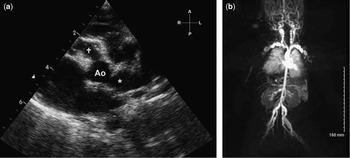
Following transfer to our hospital on day 20 of the illness, an echocardiogram demonstrated aneurysm formation in the left (11 mm) and right coronary arterial systems (7 mm) (Fig 1a). Cardiac magnetic resonance angiography demonstrated saccular dilatation and beading of the external, common, and internal iliac, femoral, renal, subclavian, and internal carotid arteries (Fig 1b), in keeping with extensive systemic arterial aneurysms. A clinical diagnosis of Kawasaki disease was made, and she was treated with intravenous immunoglobulin and high-dose aspirin (100 mg/kg/day).
(a) Transthoracic echocardiogram parasternal short-axis view demonstrating coronary arterial aneurysm involvement of the left coronary artery (asterix) and right coronary artery (cross). (b) Cardiac magnetic resonance angiography demonstrating saccular dilatation and beading of the external, common, and internal iliac, femoral, renal, subclavian, and internal carotid arteries.

Our patient demonstrated severe disease, which was refractory to two doses of intravenous immunoglobulin. She was treated with high-dose methylprednisolone, and later cyclophosphamide, with good effect. After 7 weeks of the onset of illness, the patient developed cardiogenic shock following thrombus formation within the left main coronary artery, despite anticoagulation with low-molecular-weight heparin and aspirin. She required ventilation and inotropic support but eventually recovered. Follow-up CT scan one year later demonstrated the left coronary artery aneurysm reduced to 8 mm and the right coronary artery normalised to 2 mm. The patient is 2 years old at present and is seen on a 6-month basis for clinical examination and echocardiography. She is asymptomatic. She developed bleeding complications on warfarin and remains on aspirin and enoxaparin anticoagulation.
Systemic arterial aneurysms are an important manifestation of severe Kawasaki disease in infants. They develop in up to 2% of untreated cases, typically within the first 8 months of life.Reference Hoshino and Tsuda 1 They may be palpable on clinical examination and are best visualised with magnetic resonance angiography. As in this reported case, patients with systemic arterial aneurysms are more likely to have severe cardiac sequelae such as giant coronary aneurysms and require careful clinical follow-up. Where Kawasaki disease is refractory to intravenous immunoglobulin therapy, methylprednisolone and cyclophosphamide may be used to reduce acute vascular inflammation.Reference Freeman and Shulman 2
Acknowledgement
The authors are grateful to Prof. Karina Butler for her assistance in the care of this child.
Conflicts of Interest
None.
Ethical Standards
The authors assert that all work reported complies with the ethical standards of the Helsinki convention, and consent for publication has been granted by the patient’s family.