Introduction
Europe is the continent with the most explored lichen flora and, at the same time, is an area with an exceptionally long and intensive history of human impact (Ozenda Reference Ozenda1994; Ellenberg & Leuschner Reference Ellenberg and Leuschner2010). Southern Europe is a hot spot of diversity and endemism for many organisms (Olson & Dinerstein Reference Olson and Dinerstein2002), including lichenized Ascomycota of the family Umbilicariaceae (Frey Reference Frey1936b).
This family was long considered to be composed of two genera: Umbilicaria Hoffm. and Lasallia Mérat. Bendiksby & Timdal (Reference Bendiksby and Timdal2013) extended the family circumscription by including two new genera, Xylopsora Bendiksby & Timdal and Fulgidea Bendiksby & Timdal, and Davydov et al. (Reference Davydov, Peršoh and Rambold2017) reduced Lasallia to a subgenus of Umbilicaria and suggested seven additional subgenera.
Umbilicaria subg. Papillophora Davydov et al. is phylogenetically the most basal subgenus and includes species with a mostly Holarctic distribution, and European, East Asian and South American endemic elements (Davydov et al. Reference Davydov, Peršoh and Rambold2017, Reference Davydov, Yakovchenko, Urbanavichene, Konoreva, Chesnokov, Kharpukhaeva and Obermayer2020b). Several species of Umbilicaria subg. Papillophora are distributed mainly (U. crustulosa (Ach.) Lamy, U. grisea Hoffm., U. spodochroa Hoffm.) or exclusively (U. josiae Frey) in Europe (Frey Reference Frey and Zahlbruckner1933, Reference Frey1936a; Byazrov Reference Byazrov1986; Wei & Jiang Reference Wei and Jiang1993; Davydov et al. Reference Davydov, Ahti and Sennikov2020a). In the present paper we focus on the taxon currently referred to Umbilicaria crustulosa var. badiofusca Frey, a European endemic restricted in its known distribution to the Western Alps, the Massif Central of France, the Pyrenees, the Iberian Mountains and Corsica (Frey Reference Frey and Zahlbruckner1933, Reference Frey1936b; Etayo & Breuss Reference Etayo and Breuss1996; Nimis Reference Nimis2016; Roux et al. Reference Roux, Poumarat, Monnat, Van Haluwyn, Gonnet, Gonnet, Bauvet, Houmeau, Boissière and Bertrand2020).
Umbilicaria crustulosa var. badiofusca was described from France and Switzerland (Frey Reference Frey and Zahlbruckner1933) and is distinguished by its black-brown lower surface and apothecial ontogeny (Frey Reference Frey and Zahlbruckner1933, Reference Frey1936a) from the type variety, U. crustulosa var. crustulosa, which is more widespread in Europe (Frey Reference Frey and Zahlbruckner1933; Krzewicka Reference Krzewicka2004; Nimis Reference Nimis2016; Roux et al. Reference Roux, Poumarat, Monnat, Van Haluwyn, Gonnet, Gonnet, Bauvet, Houmeau, Boissière and Bertrand2020). This taxon has also been discussed in the context of the taxonomic value of the apothecial type in Umbilicariaceae (Scholander Reference Scholander1934; Llano Reference Llano1950). Scholander (Reference Scholander1934) was the first to suggest species rank for U. crustulosa var. badiofusca but he did not have enough material for a final conclusion. Scholander's generic system of Umbilicariaceae included four genera, according to four apothecial types, which are distinguishable by the characteristic patterns of sterile parts in the apothecia. Therefore U. crustulosa var. badiofusca, having gyrose apothecia, does not fit into Scholander's system, being at the subspecific rank of a species with omphalodisc apothecia (i.e. Omphalodiscus crustulosus (Ach.) Schol.). Accordingly, Scholander treated U. crustulosa var. badiofusca as a possible new species most closely related to U. cinereorufescens (Schaer.) Frey because of its gyrodisc apothecia and muriform ascospores. He proposed a new variety, Gyrophora cinereorufescens var. badiofusca (Frey) Schol. ad interim (Scholander Reference Scholander1934: 28), which had no practical implications for the further taxonomy and nomenclature. Codogno (in Nimis Reference Nimis1993) stressed the need to further investigate the status of this taxon, suspecting that it may well be a distinct species.
One of the taxa treated by Frey (Reference Frey and Zahlbruckner1933) as a synonym of his new variety U. crustulosa var. badiofusca was Umbilicaria hirsuta var. meizospora Harm., described by Harmand (Reference Harmand1910) from France. Choisy (Reference Choisy1950) raised its rank to species level, Gyrophoropsis meizospora (Harm.) M. Choisy, and therefore established priority for this name at the species level. His combination, however, was not accepted by other researchers and the taxon is classically listed in regional compilations as U. crustulosa var. badiofusca (= Umbilicaria hirsuta var. meizospora), a lichen still poorly known (Poelt & Vězda Reference Poelt and Vězda1981; Nimis Reference Nimis2016; Nimis et al. Reference Nimis, Hafellner, Roux, Clerc, Mayrhofer, Martellos and Bilovitz2018; Roux et al. Reference Roux, Poumarat, Monnat, Van Haluwyn, Gonnet, Gonnet, Bauvet, Houmeau, Boissière and Bertrand2020).
One specimen of U. crustulosa var. badiofusca was included in a comprehensive phylogenetic analysis of Umbilicariaceae (Davydov et al. Reference Davydov, Peršoh and Rambold2017), where it clustered within Umbilicaria subg. Papillophora, but separate from U. crustulosa. The phenotypic and phylogenetic evidence for the species status of this taxon, as well as the typification and synonymization of related names, is proposed in the present paper. The distribution and ecology of the species are also outlined.
Materials and Methods
Sampling
Thirty-nine collections of fresh material of Umbilicaria meizospora were made by the second author between 2007 and 2017, and deposited in his private herbarium; some duplicates were deposited in ALTB. At each location, a set of thalli of different sizes (including the largest accessible) was collected from the sampled boulder or rock face. For each collection, the following were recorded: GPS coordinates, elevation, general slope aspect, surrounding environment, nature of substratum, aspects of the thalli and angle of substratum. Additionally, specimens were studied from the herbaria ANGUC, G and GZU, and the private herbaria of C. Bauvet, J.-M. Houmeau and J.-M. Sussey.
Morphology and anatomy
Morphological observations were made using a stereomicroscope (Zeiss Stemi 2000-C). Apothecia and thalli were hand-sectioned with a razor blade and observed with a compound microscope (Zeiss Axio Lab.A1.) after mounting in water. Ascospore length and width were measured from the same ascospore to derive the Q-value (length/width). Measurements were recorded to the nearest 0.5 μm. A total of 543 spores from 23 specimens were measured. Measurements of ascospores are presented in the format: (lowest specimen mean)–M–(highest specimen mean) [SD], where M is the arithmetic mean of the mean values of the 23 specimens and SD its standard deviation. Measurements of pycnoconidia are presented as follows: (smallest value recorded–) (x̄ − SE) – x̄ – (x̄ + SE) (–largest value recorded), where x̄ is the (arithmetic) sample mean, and SE is the sample standard error. Other measurements are presented as: (extreme minimum) minimum – maximum (extreme maximum).
Chemical analyses
Lichen substances were studied using spot tests with potassium hydroxide solution (K), sodium hypochlorite solution (C) and 1,4-p-phenylendiamine (PD), and by thin-layer chromatography (TLC) with solvent systems A, B' and C following Orange et al. (Reference Orange, James and White2001). High performance liquid chromatography (HPLC) analysis was performed as described in Davydov et al. (Reference Davydov, Blum, Kashevarov and Grakhov2019).
DNA extraction, amplification and sequencing
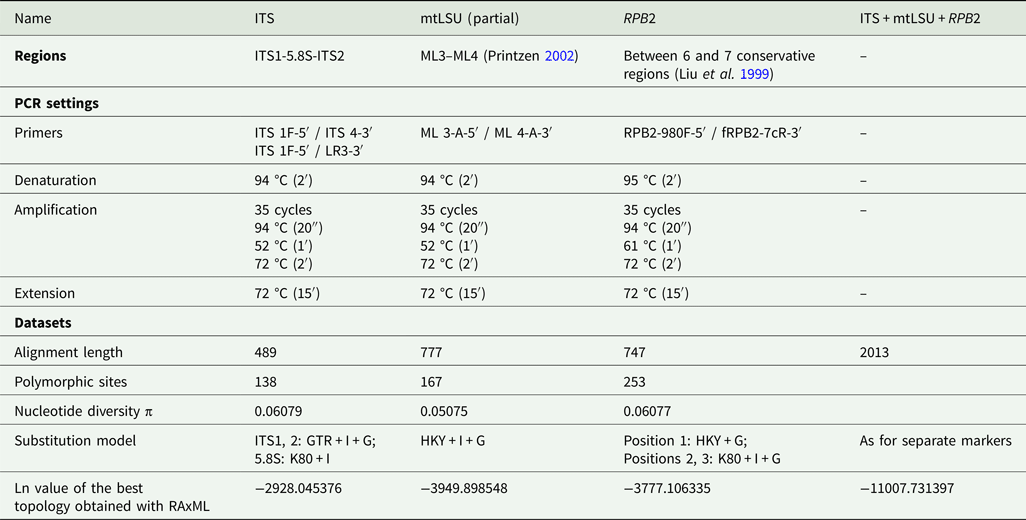
Single thallus parts (100–200 mg) or 3–4 apothecia were carefully checked for fungal infections and thoroughly cleaned of extraneous matter. DNA extraction, amplification and sequencing followed the methods of Davydov & Yakovchenko (Reference Davydov and Yakovchenko2017) as outlined in Table 1. The program Geneious 6.0 (Biomatters Ltd, New Zealand) was used for assembling partial and complementary sequences. Consensus sequences were exclusively compiled from double-stranded parts of the sequences.
Summary statistics, PCR settings and substitution models used for the different datasets of the single and concatenated gene regions.

Sequence alignment and phylogenetic analyses
All newly generated sequences of U. meizospora were supplemented with sequences obtained during a study of Umbilicariaceae phylogeny (Davydov et al. Reference Davydov, Peršoh and Rambold2017, Reference Davydov, Yakovchenko, Urbanavichene, Konoreva, Chesnokov, Kharpukhaeva and Obermayer2020b), representing different subgenera with an emphasis on Umbilicaria subg. Papillophora; Xylopsora friesii (Ach.) Bendiksby & Timdal was used as the outgroup. This selection is based on the studies of Wedin et al. (Reference Wedin, Wiklund, Crewe, Döring, Ekman, Nyberg, Schmitt and Lumbsch2005), Bendiksby & Timdal (Reference Bendiksby and Timdal2013) and Davydov et al. (Reference Davydov, Peršoh and Rambold2017), in which Xylopsora forms the sister clade to Umbilicaria. GenBank Accession numbers are provided in Table 2. The sequences were aligned in Geneious 6.0 (Biomatters Ltd, New Zealand) using the MUSCLE algorithm (Edgar Reference Edgar2004) and visible deviations in position homology were then manually optimized.
Sample codes, voucher information and GenBank Accession numbers for Umbilicaria species used in the phylogenetic analyses in this study. New sequences are shown in bold. Xylopsora friesii is the outgroup.

Three single-gene datasets were assembled for this study: the internal transcribed spacer region of nuclear ribosomal DNA (ITS), the large subunit of the mitochondrial ribosomal DNA (mtLSU), and RNA polymerase II between six and seven conserved parts (RPB2). For combining sequences into a joint ITS + mtLSU + RPB2 data matrix, the unambiguously alignable regions were used to calculate single-marker phylograms (not shown) using RAxML 8.0.26 (Stamatakis Reference Stamatakis2014), which were then tested for conflicts among datasets. There were no well-supported (BS ≥ 70%) incongruences and so the datasets were concatenated into a combined dataset. As phylograms were similar regarding well-supported clades and lacking conflicts, all sequences were combined into 3-marker matrices and used for RAxML and Bayesian analyses. Optimal substitution models and partitions (Table 1) were inferred for the following subsets using PartitionFinder v.1.1.1 (Lanfear et al. Reference Lanfear, Calcott, Ho and Guindon2012): ITS1, 5.8S, ITS2, RPB2 1st, 2nd and 3rd codon positions, and mtLSU. Summary statistics, PCR settings and substitution models used for the different datasets are summarized in Table 1. The most likely tree and 1000 rapid bootstrap replicates were calculated using RAxML 8.0.26 (Stamatakis Reference Stamatakis2014) implemented in raxmlGUI software v.1.3.1 (Silvestro & Michalak Reference Silvestro and Michalak2012). Bayesian inference with the Markov chain Monte Carlo (BMCMC) method (Larget & Shimon Reference Larget and Shimon1999) was performed using MrBayes 3.2.3 (Ronquist et al. Reference Ronquist, Teslenko, van der Mark, Ayres, Darling, Höhna, Larget, Liu, Suchard and Huelsenbeck2012). Three parallel analyses, each with six incrementally heated chains using the default heating factor of 0.2, were run for 40 million generations and every 200th generation was sampled until the average standard deviation (ASD) of split frequencies had dropped to 0.001. This was the case after 9.2 M generations. Initially we set ASD at 0.01 but the calculation stopped after 0.2 M generations; therefore, the number of sampled trees after burn-in was not enough to calculate the relevant consensus tree. The first 40% of trees was discarded as burn-in and a 50% majority-rule consensus tree was calculated from the remaining trees of the three runs with the sumt command implemented in MrBayes 3.2.3.
Statistics
Statistical analyses of the ecological data were performed using spreadsheets available at www.anastats.fr.
Results
The phylogenetic study
For the phylogenetic analyses, we used original sequences generated during this study as well as those obtained in earlier investigations (Davydov et al. Reference Davydov, Peršoh and Rambold2017, Reference Davydov, Yakovchenko, Urbanavichene, Konoreva, Chesnokov, Kharpukhaeva and Obermayer2020b) and deposited in GenBank (Table 2). To test the monophyly and phylogenetic relationships of species, three markers were used as single-gene matrices and in combined datasets. Summary statistics are provided in Table 1. ITS and mtLSU sequences were successfully obtained from five specimens, and ITS, mtLSU and RPB2 for three specimens of Umbilicaria meizospora. Sequences of U. meizospora were combined in a well-supported clade (100% BS; 1.0 PP; ML, ITS + mtLSU + RPB2) in all single marker (not shown) and combined phylograms (Fig. 1). Umbilicaria meizospora clustered within the well-supported clade combining U. spodochroa, U. cinereorufescens and U. cf. koidzumii M. Satô (RAxML: 100%; BS MrBayes: 1.0 PP), separate from U. crustulosa. Umbilicaria cf. koidzumii is sister to U. meizospora (RAxML: 100%; BS MrBayes: 1.0 PP).
Phylogenetic relationships amongst Umbilicaria species, based on a maximum likelihood analysis (RAxML) of ITS1-5.8S-ITS2, mtLSU and RPB2. The reliability of each branch was tested by ML and Bayesian methods. Numbers at tree nodes indicate bootstrap values of ML (left) and BMCMC posterior probabilities (right). Thicker branches indicate when both the bootstrap value of ML is ≥ 70% and the BMCMC posterior probability is ≥ 0.95. GenBank Accession numbers are listed in Table 2. Branch lengths represent the estimated number of substitutions per site assuming the respective models of substitution. An exception is the branch with a black dot, which was shortened to reduce the overall figure size. Xylopsora friesii is used as the outgroup. In colour online.

Taxonomy
In the original description of Umbilicaria crustulosa var. badiofusca, Frey (Reference Frey and Zahlbruckner1933) included in the synonyms for his new taxon Umbilicaria hirsuta var. meizospora, previously described by Harmand (Reference Harmand1910) in his catalogue ‘Lichens de France’. Morphological observation of original material of U. crustulosa var. badiofusca and U. hirsuta var. meizospora led us to conclude that both taxa are indeed identical and well distinguished from U. crustulosa var. crustulosa. Anatomical, morphological, chemical and phylogenetic data support elevating the variety proposed by Harmand or Frey to species status. Choisy (Reference Choisy1950) raised U. hirsuta var. meizospora to the species Gyrophoropsis meizospora (Harm.) M. Choisy. This name therefore has priority at the species level. The genus Gyrophoropsis Elenkin & Savicz is not currently acceptable. We treated it as a synonym of Lasallia (Davydov et al. Reference Davydov, Peršoh and Rambold2010), and then downgraded the rank of Lasallia to subgenus of Umbilicaria. Original descriptions of U. crustulosa var. badiofusca (Frey Reference Frey and Zahlbruckner1933) and U. hirsuta var. meizospora (Harmand Reference Harmand1910) were based on material from few localities. Morphological circumscription and diagnostic characters (Table 3) were re-evaluated using much more study material.
Principal differences between Umbilicaria meizospora and related species.

Umbilicaria meizospora (Harm.) D. M. Masson & Davydov comb. nov.
MycoBank No.: MB 839862
Umbilicaria hirsuta var. meizospora Harm. (Harmand Reference Harmand1910 [‘1909’]: 697).—Gyrophora hirsuta var. meizospora (Harm.) H. Olivier (Reference Olivier1921: 515).—Gyrophoropsis meizospora (Harm.) M. Choisy (Reference Choisy1950: 70); type: France, Ardèche, rochers au dessus du chemin de Loubaresse, 1450 mètres, 1903, G. Couderc (ANGUC!—lectotype, designated here, MycoBank Typification no.: MBT 10002768); syntypes seen: France, Ardèche, rocher au dessus du vieux chemin de Loubaresse, commune de Banne [sic; in fact Borne and not Banne], à environ 1450 mètres, G. Couderc (ANGUC!); sommet du Tanargue voisin du Bès, août 1902, G. Couderc 214 (ANGUC!); Pyrénées-Orientales, Canigou, vers 2400 m, août 1906, G. Parrique 13 (ANGUC!); Switzerland, Valais, vallée de Zermatt, sur un bloc de granit, P. Gave (ANGUC!).
Umbilicaria crustulosa (Ach.) Frey var. badiofusca Frey (Reference Frey and Zahlbruckner1933: 264); type: Switzerland, Valais, val d'Hérens, Arolla, Bergsturzblöcke hinter Hotel Viktoria, 1900 m, 1929, E. Frey 450 (G00129446!—lectotype, designated here, MycoBank Typification no.: MBT 10003344); syntypes seen: France, Isère, Saint-Christophe-en-Oisans, la Bérarde, 1800 m, 1930, A. Schmidt [Migula, Kryptogamae Germaniae, Austriae et Helveticae exsiccatae no. 268] (G 111319!); Pyrénées-Orientales, M. Canigou, Schaerer s. n. (G!); Pyrenäen, Canigou (G111320!); Switzerland, Valais, Val d'Hérens, Arolla hinter dem Hotel Viktoria, 1900 m, 7.8.1929, E. Frey (G129445!); St. Niklaus b. Zermatt, 1868, Laurer, ex. hb. Berlin, ex hb. Ed. Frey Nr. 1020 (G!).
Umbilicaria meizospora. A–D, lectotype of U. meizospora (ANGUC). A, upper surface. B, lower surface. C, original label. D, gyrose apothecia on the upper surface. E, apothecia of the undated specimen from the same locality as the lectotype. Scales: A & B = 2 cm; D & E = 1 mm. In colour online.

Thallus of middle size, 2–15 cm diam. (fertile thalli) and 0.2–0.4 mm thick, umbilicate, monophyllous, rigid, orbicular to irregular in shape, slightly elevated over umbo and sometimes moderately undulating with several broad folds fading peripherally, the margins first entire, later incised and reflexed downwards. On senescent thalli, secondary lobes can develop around submerged apothecia, and rarely can protrude from the centre of old apothecia. With age, a network of cracks forms at the periphery of the thallus on the upper surface: apothecia are separated from the thallus by a crack, and also the cracks radiate from the apothecia and connect with a network. Vegetative propagules, pores and pseudocyphellae absent. Upper surface dull, smooth to scabrous, minutely rimose to areolated and coarsely cracked, pruinose; grey to brownish grey, central part usually paler, beige to light grey, periphery darker with brown or violet tint. Lower surface areolate to papillate, often prominently protruding under apothecia, with bumpy appearance; grey-brown to black-brown, lighter (pale grey with brownish tint) at the periphery with abundant rhizinomorphs; trabeculae emerging from the umbilicus often present in radius c. 1 cm. Rhizinomorphs abundant, sometimes sparse or lacking at the central part, usually lighter, or of the same colour as the lower surface and getting darker towards tips, dense, rather long 1.5–2.0(–3) mm, smooth to finely papillate, c. 100–150 μm diam. Rhizinomorphs at first simple or once isotomically or anisotomically branched, sabre-shaped, curved, and then tree-like branched, with one main thick axis being few or many times iso- or anisotomously branched. Branching is at an acute angle (c. 45–90°), the branches dense and closely intertwined. Thalloconidia absent. Upper cortex paraplectenchymatous, brownish in the outer part and hyaline within, 20–35 μm thick, epicortex to 15–30 μm thick, algal layer continuous, 50–80 μm thick, algal cells trebouxioid. Medulla colourless, more or less dense, 120–200 μm, arachnoid plectenchymatous of highly branched pachydermatous hyphae (of Vellea-type (Valladares & Sancho Reference Valladares and Sancho1995)). Lower cortex not clearly differentiated from medulla, scleroplectenchymateous with light brown opaque layer, 25–35 μm thick.
Apothecia usually present, common and abundant at the periphery of the thallus, 1–3 mm diam., immersed, gyrose; apothecial margin thin, c. 100–150 μm thick. Young apothecia immersed, flattened, sunken into deep depression in the thallus so the thalline surface is higher than the apothecium; margin distinctly divided by cracks into several (c. 6–10) fragments that are longer than wide. Central gyrus prominent, circular, soon dividing into 3–5 fragments similarly to the margin. Mature apothecia adnate by a wide base to the lower cortex and separated from the other thallus layers by a crack, so the black surface of the lower cortex is visible from above; flattened, becoming slightly angular or stellate, sunken into deep depression in the thallus well visible from the underside; apothecia becoming clearly gyrose, central and additional gyri often angular. Overmature apothecia often become convex, circular or angular, sometimes dividing into several angular pieces, organized as three to several concentric circles (gyrose type) or forming a more random pattern. Epihymenium light brown, 15–30 μm thick; hymenium hyaline 75–100 μm thick, hypothecium light brown, 25–50 μm thick; excipulum in inner part light brown, in outer part black-brown, composed of radiating thick-walled conglutinated hyphae with narrowly cylindrical to angular lumina; paraphyses septate, branched, 1.5–1.8 μm thick, sometimes slightly thickened at the tips, up to 1.8–2.0 μm; asci 55–75 × 15–28 μm, 8-spored; ascospores hyaline to brown, simple to submuriform, mean size (15.4)–17.90–(21.1) [1.478] × (9.2)–11.46–(13.3) [1.006] μm, Q-values (1.41)–1.58–(1.75) [0.089].
Pycnidia common at the periphery of the thalli, 150–190 μm diam., semi-immersed with black prominent ostiole, wall brown, 20–25 μm thick; pycnoconidia bacilliform, (4.0–)4.5–5.0–5.5(–6.0) × 1 μm (n = 30).
Chemistry
Thallus K−, C+ red, KC+ red, Pd−, UV−; crustinic, gyrophoric and lecanoric acids detectable by TLC and HPLC. All specimens examined have been shown by TLC to contain crustinic acid as major compound, and gyrophoric and lecanoric acids as minor compounds. HPLC also revealed the presence of trace amounts of methyl lecanorate, which is probably an artefact arising during extraction with methanol.
Lectotypification of Umbilicaria hirsuta var. meizospora
Harmand (Reference Harmand1910) cited six localities in the protologue, five from France and one from Switzerland. Five specimens from four localities mentioned in the protologue relating to Umbilicaria hirsuta var. meizospora were found in ANGUC. Two of them relate to the same locality. Those two specimens fully correspond to the description and have handwritten labels by Harmand matching the first locality cited in the protologue: ‘Ardèche: Sur un rocher, au dessus du vieux chemin de Loubaresse, commune de Banne, à 1450 mètres’. One of the two labels is marked ‘1903’ after the name of the collector (Fig. 2C); it could be a collector number or a year of collection. Georges Couderc (1850–1928) studied the lichens of his region from 1903 to 1910 and formed a rich herbarium (Chevalier Reference Chevalier1929), now preserved in the Natural History Museums of Besançon (Lerond et al. Reference Lerond, Van, Asta and Lamy1987) and Aix-en-Provence (Vila et al. Reference Vila, Lamy and Verlaque2010). Although the year of collection is not mentioned in the protologue, the reference to ‘1903’ most probably refers to the date of collection. The collection locality is the same in both cases but there is no evidence that the two specimens were collected in the same year. The fact that the initial determinations on the labels are different (‘Umbilicaria vellea’ in one case and ‘Umbilicaria spodochroa var. gyrina’ in the other) suggests that the two collections were made at different times. We selected the dated specimen as the lectotype to be sure that it belongs to the original material.
Lectotypification of Umbilicaria crustulosa var. badiofusca
The protologue has several references to the original material: 1) the specimen from the locality ‘Arolla (Wallis) 1800 m’ was selected for the photograph (Frey Reference Frey and Zahlbruckner1933: 264); 2) several figures were mentioned in the synonyms paragraph (the title ‘Ferner’ [Furthermore] (Frey Reference Frey and Zahlbruckner1933: 265) is treated by us as synonyms because of the context and because it was placed before the taxon description); 3) in the ‘distribution’ chapter, Frey (Reference Frey and Zahlbruckner1933: 268–269) mentioned his collection of Umbilicaria crustulosa var. badiofusca from the Massif Central (‘Puy Mary und Aigoual’) and cited several collections of ‘typisch’ [typical] U. crustulosa var. badiofusca by other collectors, namely ‘Walliser Alpen, Val d'Hérens, Val de Bagnes und Aostatal (Herb. Boissier und Delessert in Genf), ferner bei Champex (leg. Dr. Schmidt, Paris), Westalpen, la Bérarde und Bonneval (leg. Schmidt)’. Specimens close to U. crustulosa var. badiofusca are also reported from the Pyrenees (Canigou, leg. Schaerer) and Asturias (Durieu, Plantae sel. hispano-lusitan. 1835 coll. Nr. 61), but these were later assigned to U. spodochroa f. hiberica Frey (Frey Reference Frey1936a). We examined several specimens from these collections. We propose to select as the lectotype a collection from Arolla (Valais, Switzerland) because it corresponds to the description and a collection from this location was selected by Frey as an illustration (Frey Reference Frey and Zahlbruckner1933: plate IV, photographs 1–3). We did not find the specimens presented in the photographs, but selected the collection from the same locality at an elevation of 1900 m.
Ecology
Umbilicaria meizospora has been recorded from 985–2490 m a.s.l. but it seems to prefer medium elevations (Fig. 3B). This elevational range covers three vegetation belts: upper collinean (9%), montane (59%) and subalpine belt (32%). The surrounding areas are 65% wooded (Fig. 3A), mainly beech-fir forests and pine forests with Pinus uncinata, P. sylvestris or P. nigra subsp. laricio. In these forested habitats, U. meizospora occurs in well-lit sites (e.g. clearings, roadsides) but never in very shady ones. The species grows on siliceous rocks, on very coherent substrata such as granite and gneiss (Fig 3E), mostly in vertical colonies on the upper part of large boulders and rock walls (Fig. 3C), often in areas of temporary water seepage, on steeply inclined, sometimes slightly overhanging surfaces (Fig. 3F). The local aspects do not differ from the general aspects (χ2 = 3.42, df = 3, P = 0.33) and there is no significantly predominant aspect (χ2 = 7.18, df = 3, P = 0.07) (Fig. 3D). The size of the largest thallus collected is highly correlated with mean annual precipitation (rainfall data log-transformed, Pearson's r = 0.5737, df = 37, P = 0.0001). The large thalli are mainly found in localities with the most rain, for example in the Tanargue massif in Ardèche (locus classicus, annual rainfall of over 2 m), where the largest thallus of this species ever recorded (23 × 20 cm) was collected by Couderc (Harmand Reference Harmand1910: 697).
Habitat characteristics of Umbilicaria meizospora. A, major vegetation types surrounding the collection locations. B, elevational distribution of the collection locations. C, types of rock support. D, local aspects of the collected thalli and general aspects of the localities. E, nature of the rock substratum. F, slopes of the rock faces inhabited by the collected thalli.

Umbilicaria meizospora is often found in monospecific stands (56% of cases, n = 39), but it can be mixed with U. crustulosa s. lat. (15%), U. vellea (L.) Hoffm. (13%), U. subglabra var. pallens (Nyl.) Frey (10%), U. cylindrica (L.) Delise ex Duby (10%), U. pustulata (L.) Hoffm. (8%), U. josiae (5%), U. hirsuta (Sw. ex Westr.) Hoffm. (3%), U. polyphylla (L.) Baumg. (3%), and even with Nephroma parile (Ach.) Ach. (3%) or Lobarina scrobiculata (Scop.) Nyl. ex Cromb. (3%).
Distribution
Umbilicaria meizospora is endemic to south-western Europe and distributed in the Alps (Austria, France, Italy, Switzerland), the Massif Central (France), Pyrenees (France, Spain), Iberian Mountains (Spain) and Corsica (Fig. 4). Until now, this lichen has been reported only from the Western Alps (France, Italy and Switzerland), but a previously unnoticed specimen (e.g. Hafellner Reference Hafellner2008) from the Koralpe in Austria (in GZU) extends its distribution well into the Eastern Alps. The species seems to be rather localized, except in the eastern part of the Pyrenees where it is quite widespread.
Distribution of Umbilicaria meizospora in south-western Europe (from Harmand (Reference Harmand1910), Frey (Reference Frey and Zahlbruckner1933), Etayo & Breuss (Reference Etayo and Breuss1996), Piervittori & Isocrono (Reference Piervittori and Isocrono1997), Isocrono & Piervittori (Reference Isocrono and Piervittori2008), Roux et al. (Reference Roux, Masson, Bricaud, Coste and Poumarat2011), GBIF (2021) and the present work). Circles = examined specimens; squares = unexamined specimens. Scale = 300 km. In colour online.

Selected specimens examined (see also lectotypes and syntypes above)
Austria: Steiermark: Koralpe, E. Heinricher (hb. Palla) (GZU).—France: Ardèche: Borne, Chazalettes, 44°37′N, 4°01′E, 1010 m, 2017, D. Masson 07.5199 (hb. Masson); Valgorge, Le Fréjar, 44°36′N, 4°07′E, 1230 m, 2017, D. Masson 07.5197 (hb. Masson). Ariège: Aulus-les-Bains, Agneserre, 42°46′N, 1°22′E, 1095 m, 2011, D. Masson 09.3750 (hb. Masson); Auzat, between Pradières-d'en-Bas and la Prime, GR10, 42°43′N, 1°29′E, 1160 m, 2016, D. Masson 09.5195 (hb. Masson); Mérens-les-Vals, étang de Comte, 42°38′N, 1°47′E, 1750 m, 2012, D. Masson 09.4205 (hb. Masson, ALTB); Orlu, haute vallée d'Orlu, 42°39′N, 1°58′E, 1345 m, 2012, D. Masson 09.4575 (hb. Masson); Savignac-les-Ormeaux, Les Esquers de dessus, 42°40′N, 1°46′E, 1385 m, 2012, D. Masson 09.4569 (hb. Masson); Sentenac-d'Oust, pâturage de l'Auze, 42°51′N, 1°07′E, 1640 m, 2009, D. Masson 09.3219 (hb. Masson); Suc-et-Sentenac, sentier de l’étang d'Arbu, 42°48′N, 1°26′E, 1465 m, 2016, D. Masson 09.5190 (hb. Masson). Haute-Corse: Ghisoni, crête de Ghufidu, 42°04′N, 9°09′E, 1430 m, 2011, D. Masson 2B.3733 (hb. Masson, ALTB). Gard: Génolhac, Mont Lozère, Serre Fageolle, 44°21′N, 3°55′E, 1260 m, 2016, D. Masson 30.5183 (hb. Masson). Haute-Garonne: Oô, Neste d'Oô, 42°44′N, 0°29′E, 1490 m, 2010, D. Masson 31.3631 (hb. Masson, ALTB). Pyrénées-Atlantiques: Sainte-Engrâce, col de Lacurde, 43°01′N, 0°50′W, 1370 m, 2009, D. Masson 64.3120 (hb. Masson, ALTB). Pyrénées-Orientales: Les Angles, Lac d'Aude, c. 2000 m, 1987, J.-M. Houmeau 87-55/A10 (hb. Houmeau); Casteil, Terreros, 42°30′N, 2°24′E, 1430 m, 2010, D. Masson 66.3395 (hb. Masson, ALTB); Corsavy, les Collettes, 42°28′N, 2°31′E, 1355 m, 2008, D. Masson 66.2884 (hb. Masson); Escaro, pic de Très Estelles, 42°30′N, 2°19′E, 2010 m, 2010, D. Masson 66.3476 (hb. Masson); Eyne, Vallon du Riu d'Eina, 42°26′N, 2°07′E, 2075 m, 2009, D. Masson 66.3177 (hb. Masson); Jujols, roc des Mollères, 42°35′N, 2°16′E, 1635 m, 2007, D. Masson 66.3212 (hb. Masson); Nyer, Gorges de Nyer, 42°31′N, 2°17′E, 1255 m, 2007, D. Masson 66.2801 (hb. Masson); Porté-Puymorens, les Caunyes, 42°33′N, 1°53′E, 1860 m, 2009, D. Masson 66.3196 (hb. Masson, ALTB); Porté-Puymorens, Porteilla de Querforc, Coma d'en Garcia, 42°34′N, 1°49′E, 2490 m, 1891, Marcailhou d'Ayméric (G 00111318); Py, Ravin de Ratte Negada, 42°29′N, 2°19′E, 1915 m, 2010, D. Masson 66.3466 (hb. Masson); Vernet-les-Bains, Porteilla de Dalt, 42°32′N, 2°25′E, 1265 m, 2010, D. Masson 66.3447 (hb. Masson).—Italy: Alpi Pennine, Piemonte: Val. Anzasca, sulle grande rupi presso Opaco, c. 1300 m, 1958, H. Ullrich [Lichenes Alpum No. 92] (G, LE-L5410).— Switzerland: see syntypes.
Discussion
Phylogenetic position
The phylogenetic position of Umbilicaria meizospora within Umbilicaria subg. Papillophora was initially determined based on previous molecular phylogenetic analyses (Davydov et al. Reference Davydov, Peršoh and Rambold2017). Umbilicaria meizospora is part of the U. vellea group and fully corresponds to this group phenotypically by having a medium-sized to large rigid grey thallus with a smooth to areolate, never pustulate or reticulate upper thallus surface; a lower surface with trabeculae emerging from the umbilicus, and with the lower surface and rhizinomorphs being characteristically papillose or areolate; simple to submuriform ascospores.
Umbilicaria meizospora is sister to U. cf. koidzumii (Fig. 1). Umbilicaria koidzumii was described from Japan (Satô Reference Satô1935) where it is thought to be endemic (Ohmura & Kashiwadani Reference Ohmura and Kashiwadani2018) based on the type specimens and several additional collections identified by the first author in TNS. To determine the conspecificity of U. koidzumii and U. cf. koidzumii from the Kola Peninsula, sequence data of U. koidzumii from Japan is required and the distribution of this species is undergoing further investigation. The relationship of U. meizospora both to U. spodochroa, proposed by Frey (Reference Frey and Zahlbruckner1933), and to U. cinereorufescens, proposed by Scholander (Reference Scholander1934), is supported by our phylogenetic reconstruction (Fig. 1). We also note that the chemistry of U. meizospora is identical to that of U. cinereorufescens, with crustinic acid being the major compound in both species. This chemical feature appears to be rare in the genus Umbilicaria and is shared, as far as is known, only by one chemotype of U. crustulosa (Posner et al. Reference Posner, Feige and Huneck1992; Narui et al. Reference Narui, Culberson, Culberson, Johnson and Shibata1996; Seriña et al. Reference Seriña, Arroyo, Manrique and Sancho1996).
Diagnostic traits
Umbilicaria meizospora is similar to U. koidzumii in the type of apothecia and simple to submuriform ascospores of similar size, but the latter species has multicellular thalloconidia on rhizinomorphs (Davydov et al. Reference Davydov, Yakovchenko, Urbanavichene, Konoreva, Chesnokov, Kharpukhaeva and Obermayer2020b). Umbilicaria meizospora resembles U. crustulosa and U. spodochroa but differs from both species by gyrodisc apothecia, and additionally from U. crustulosa by the brown lower surface and black rhizinomorphs, and from U. spodochroa by the smaller ascospores. Harmand (Reference Harmand1910) mentioned that ascospores of U. meizospora are often brownish and septate but we have observed that they often remain hyaline.
Distribution and ecology
Two other calcifuge saxicolous lichenized fungi have a roughly similar ecology and distribution in south-western Europe: Parmelina atricha (Nyl.) P. Clerc (Alps, Massif Central, Pyrenees, Corsica?) (Clerc & Truong Reference Clerc and Truong2008; Hawksworth et al. Reference Hawksworth, Divakar, Crespo and Ahti2011; Nimis et al. Reference Nimis, Hafellner, Roux, Clerc, Mayrhofer, Martellos and Bilovitz2018; Roux et al. Reference Roux, Poumarat, Monnat, Van Haluwyn, Gonnet, Gonnet, Bauvet, Houmeau, Boissière and Bertrand2020) and Umbilicaria josiae (Massif Central, Pyrenees) (Frey Reference Frey1936a, Reference Freyb; Sancho Reference Sancho and Llimona1991; Roux et al. Reference Roux, Poumarat, Monnat, Van Haluwyn, Gonnet, Gonnet, Bauvet, Houmeau, Boissière and Bertrand2020).
The ecology of U. meizospora seems to be quite similar to that of U. vellea (Frey Reference Frey and Zahlbruckner1933; Crespo & Sancho Reference Crespo and Sancho1978; Krzewicka Reference Krzewicka2004), a related species, but with a much wider distribution which we sometimes found mixed with U. meizospora on the same rock face. Unlike U. vellea, which is more abundant in the rainier parts of the Alps (Frey Reference Frey and Zahlbruckner1933), U. meizospora seems curiously most widespread in the eastern part of the Pyrenees, where rainfall is lower. Elsewhere (western Pyrenees, Massif Central, Corsica), although the thalli generally reach larger sizes in accordance with the more abundant precipitation, the species seems much more localized. Some of Frey's old data (1933) could not be confirmed (e.g. Aigoual and Puy Mary in the Massif Central) either by herbarium specimens or by recent surveys. Most of the Alpine data (especially from Switzerland and France) are old and the current status of the species in the Alps remains unknown.
Acknowledgements
We are grateful to Dr Christian Printzen for the opportunity to sequence a part of the material in his laboratory; to Dr Philippe Clerc (G) for his hospitality during the visit of ED to Geneva and for arranging loans of material to DM; to Dr Elisabeth Lambert (ANGUC) and Dr Dagmar Triebel (M) for their assistance during the visits of DM to Angers and ED to Munich, respectively; to Corinne Bauvet, Jean-Michel Houmeau and Jean-Michel Sussey for providing us with French additional material; and to Prof. B. McCune and an anonymous reviewer for improving the text.
Author ORCIDs
Evgeny A. Davydov, 0000-0002-2316-8506; Didier Masson, 0000-0002-3340-5472.