Introduction
The death of music festival patrons due to recreational drugs in Australia has been widely reported in the news media. Deaths represent only a small proportion of the need for medical care due to recreational drugs at music festivals. Less-severe presentations are common and are often managed by medical resources at event sites. The six deaths at music festivals represent only a small proportion of the overall burden of amphetamine-induced deaths, with 108 deaths reported in the community in the year ending in August 2018 across Australia.1,Reference Byard, Gilbert, James and Lokan2 Well-organized and efficient on-site treatment at music festivals may reduce the risk of death for these patients.
One of the feared consequences of ingestion of recreational drugs is the development of sympathomimetic or serotonin toxicities (SST).Reference Green, Mechan, Elliott, O’Shea and Colado3–Reference Richards, Albertson, Derlet, Lange, Olson and Horowitz5 While traditionally these concepts have been separated, they are clinically difficult to distinguish and represent different emphases within a spectrum of disease.Reference Rusyniak and Sprague4 This disease is caused by the ingestion of sympathomimetic drugs, typically amphetamines and their chemical derivatives, and presents with a toxidrome of sympathetic activation and neurological hyper-excitability.Reference Richards, Albertson, Derlet, Lange, Olson and Horowitz5,Reference Gowing, Henry-Edwards, Irvine and Ali6
The key risk to life comes from profound hyperthermia that occurs as a result of complex physiological changes driven by the sympathomimetic properties of these drugs.Reference Rusyniak and Sprague4,Reference Gowing, Henry-Edwards, Irvine and Ali6
Drug effects that contribute to severe hyperthermia, leading to morbidity and death, include delaying the onset of exhaustion beyond usual temperature set-points; profound vasoconstriction that leads to a reduction in peripheral heat loss; activation of brown fat triggering non-shivering thermogenesis; inhibition of gamma-butyric acid receptors that increases neuronal hyper-excitability causing seizures, clonus, and coma; and in extreme cases, the development of mitochondrial “uncoupling” that results in profound heat production.Reference Isbister, Buckley and Whyte7–Reference Rusyniak, Tandy and Hekmatyar9
Problems that are seen as a consequence of extreme temperature elevation include progressive rhabdomyolysis, the development of coagulopathy,Reference Levi10 and the development of heart failure with reduced ejection fractionReference Levine, Truitt and O’Connor11,Reference Paratz, Cunningham and MacIsaac12 and vasodilation.Reference Tek and Olshaker13
Early identification and treatment of SST reduces morbidity.Reference Goldstein and Richards14 In the absence of treatment, severe SST is often fatal.Reference Foong, Patel, Kellar and Grindrod15 The severity of SST can be graded based on physiological observations and temperature.Reference Dunkley, Isbister, Sibbritt, Dawson and Whyte16 The most commonly used diagnostic criteria are the Hunter criteria.Reference Isbister, Buckley and Whyte7
While many recommendations exist regarding the prehospital and event-based treatment of SST, there are no published evaluations of the safety or efficacy of on-site treatment guidelines. The objective of this study was to evaluate the safety and efficacy of an on-site treatment protocol for patients presenting with SST delivered by a team of critical care trained paramedics, doctors, nurses, and first aiders.
Methods
An audit was conducted of patients presenting with SST at mass gatherings in Victoria (Australia) during 2018–2019. The audit was conducted using a database of patient presentations owned by Event Medical Services Australia (Moonee Ponds, Victoria, Australia). The database contains summary-level reports, and did not contain individually identifiable or re-identifiable patient data.
Ethical approval was provided by the Edith Cowan University (Joondalup, Western Australia, Australia) Human Research Ethics Committee in February 2019.
Patients were included in the audit if they were diagnosed with SST by the medical practitioner caring for them, using the Hunter criteria.Reference Isbister, Buckley and Whyte7 Patients were diagnosed with SST if they presented with hyperthermia (core temperature >37.5 degrees Celsius), sympathetic activation (either tachycardia or hypertension), and neurological hyperexcitability (clonus, nystagmous, altered conscious state, hyper-reflexia, or rigidity). Patients were excluded if they did not present with SST.
Data were initially entered into the database by one of the authors (ND), as part of the organization’s clinical governance activity. Data validation was conducted during the initial entry process.
The study period was chosen to cover the revision and deployment of a revised treatment guideline for managing SST by the provider. The revised guideline was developed in reference to existing guidelines for the management of SST published by the Austin Hospital, which hosts the Victorian Poison’s Information Centre (Heidelberg, Victoria, Australia), the literature, and the clinical experience of the doctors working for the provider. Essential elements of the guideline can be broken into personnel, recognition and escalation of SST, non-drug therapy, and drug therapy.
Personnel elements included the 24-hour provision of critical care doctors, including anesthetists, intensive care physicians, and rural generalists with sub-specialization in emergency medicine, as well as intensive care and Advanced Life Support paramedics. Phone support from toxicology specialists via the state poisons information center was available when required. First aid qualified staff members conducted triage activity, and conducted initial vital sign assessments, histories, and examinations.
Recognition elements included screening all patients presenting to the medical service for SST. Patients were classified as having mild SST if their temperature was at or below 37.9 degrees Celsius, moderate if the temperature was between 38 and 38.5 degrees Celsius, and severe if the temperature was 38.6 degrees Celsius or above.
Non-drug therapy for SST included cooling, using misting, fanning, ice packing of the groins and axillae, and the use of cold (four degree Celsius) IV fluid at a dose of 20–40mls/kg.
Drug therapy focused on the early use of benzodiazepines to reduce movement, promote sedation, and prevent seizures. For mild SST, 5–10mg of oral diazepam was recommended. For moderate and severe SST, 0.1mg/kg of intravenous (IV) midazolam was recommended. For severe toxicity-specific treatment including IV clonidine 1-2microg/kg for sympathomimetic features, and either or both of IV chlorpromazine at a dose of 25–50mg or cyproheptadine 8mg orally or via nasogastric tube for patients with serotonergic features, was recommended. Patients received continuous ECG, NIBP, EtCO2, and SpO2 monitoring until their Glasgow Coma Score (GCS) returned to normal in a dedicated high-acuity area within the event medical center, or they were transported to hospital.
Escalation elements included a rule that patients with a temperature above 38 degrees Celsius needed to be reviewed immediately by a senior clinician and that all patients with suspected SST needed to be reviewed by a medical practitioner before discharge. The escalation plan emphasized the availability and approachability of senior clinical staff to reduce hierarchical barriers. The provider redesigned the patient care record so that observations were recorded using a “track and trigger” design, as recommended by the Australasian Council on Quality and Safety in Health Care (Sydney, New South Wales, Australia), providing a visual prompt for escalation to staff. Clinical staff were briefed every six hours, where graded assertiveness training was delivered by senior staff, as well as reminders and feedback on the use of the protocol.
Patients who deteriorated despite initial therapy were recommended to be intubated using rapid sequence induction, avoiding the use fentanyl (due to its potential serotonergic effects) and ketamine (due to its sympathomimetic effects). Recommended induction agents were midazolam 0.2mg/kg and propofol 2mg/kg and rocuronium 1.2mg/kg. Intubation was only authorized for practitioners who were experienced in airway management and intubation, who had completed at least six months of anesthetic experience (including a competency assessment for rapid sequence intubation for doctors), or who were authorized by the ambulance service to perform rapid sequence intubation.
Patients who improved after initial management, including patients who received IV midazolam, were able to be managed on-site with close observation of vital signs and temperature. After patient’s physiology normalized, patients were assessed by a medical practitioner for safety for discharge. Those patients who were safe were able to return to the event after information and counselling about their presentation and were advised not to use recreational drugs again. Patients who required intubation were mandated to be transported to hospital, as were patients who deteriorated during treatment.
The protocol was developed within the provider’s clinical governance program in recognition of the threat posed to patrons by SST. Education on the protocol was delivered by email to all staff members, and direct face-to-face education was delivered at the events in question. Staff who deviated from the protocol received immediate and specific feedback at the time of identification of the deviation.
For each presentation, key diagnostic, treatment, and outcome information were collected from the presentation database. Presentation information consisted of the patient’s vital signs on presentation (heart rate, respiratory rate, blood pressure, temperature, and level of consciousness as assessed using the GCS) and reported ingestion where available. Treatment information included the dose and type of benzodiazepine administered, the time interval between presentation and administration of benzodiazepine, the dose of cold IV fluid, cooling interventions used, the need for airway intervention including device used, the use of rapid sequence intubation, the need for specific drug therapy (including chlorpromazine, clonidine, and cyproheptadine), and the need for resuscitation.
Outcomes information included the time required in the care of the on-site medical team, the need for hospital transport by ambulance, and the discharge destination of all patients (returned to event, home via private car, or ambulance transport to hospital).
The primary outcome was the need for ambulance transport to hospital.
The results are presented descriptively and were not normally distributed, and are therefore presented as a median for continuous variables and proportions for binary variables.
The objective of the study was to evaluate the safety of the protocol. Safety was prospectively defined as fewer than 10% of patients with mild or moderate SST requiring transport to hospital by ambulance after being treated on-site. Patients with severe SST were presumed to require immediate transport to hospital and consequently no safety definition was made for those patients.
This threshold for safety was derived based on the previous experience of the provider, that approximately 15% of patients with drug-related presentations required transport to hospital via ambulance. The threshold of 10% was chosen to provide a safety margin from the previously observed rate of transport.
An author (ND) reviewed the reports, and where uncertainty existed about the classification of a presentation on any of the variables, the support of an additional author on reaching a decision was sought.
Results
Complete data for 20 patients were available for analysis.
For the primary outcome, three of the 20 patients required transport to hospital via ambulance and 17 of the 20 were treated on-site. Analyzing this outcome by the severity of illness, one patient of seven in the moderate group and two patients of seven in the severe group required transport to hospital. None of the six patients in the mild group required transport to hospital. Consequently, only one patient of 13 (7.7%) patients with mild or moderate SST required transport to hospital.
The combined total attendance for the events surveyed was approximately 110,000 person-days, giving at transport to hospital rate for this problem of 0.02%.
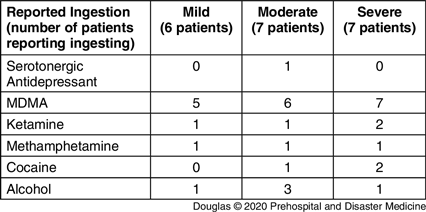
Patients were treated for SST regardless of reported ingestion if their toxidrome was consistent with SST. Most patients reported ingestion of multiple sympathomimetic substances, as shown in Table 1, or multiple doses of a single substance. Most patients had concomitantly ingested alcohol. One patient reported the use of serotonergic antidepressant medication.
Reported Ingestions

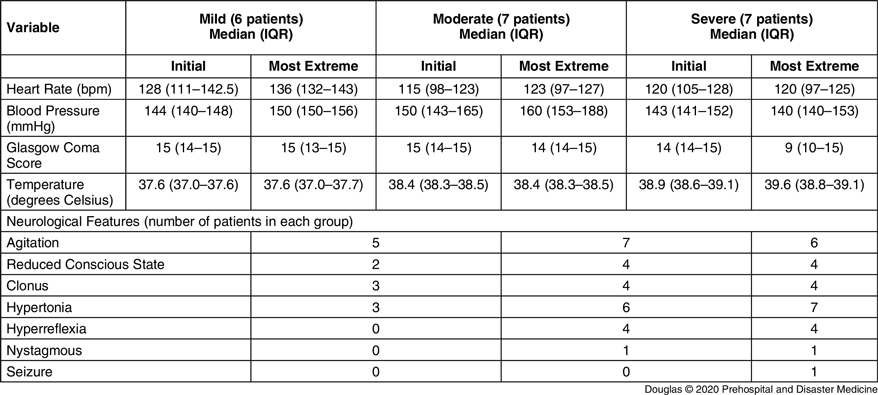
The presentation and physiological observations are displayed in Table 2. All of the patients included in the study displayed one or more neurological sign, the frequencies of which are displayed in Table 2. All patients displayed a temperature of more than 37.5 degrees Celsius and all displayed a tachycardia. Eighteen of 20 patients were hypertensive. On the basis of these observations, six patients had mild, seven had moderate, and seven displayed severe SST.
Median Physiology of Patients Presenting with SST

Abbreviation: SST, serotonin and sympathomimetic toxicity.
Of the six mild patients, all received oral diazepam as first line treatment. Two subsequently received cold IV fluid. None required specific therapies. Of the moderate patients, all seven received IV midazolam and cold IV fluid as first line treatment. None subsequently required intubation or resuscitation or specific drug therapies. The seven patients in the severe group received IV or intramuscular midazolam and cold IV fluid. One patient in this group received IV chlorpromazine for extended clonus.
No patients died. There was no ability to follow-up patients after transport to hospital.
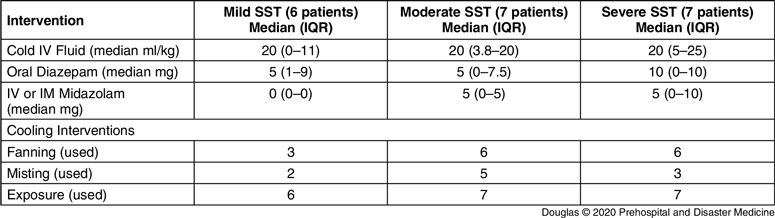
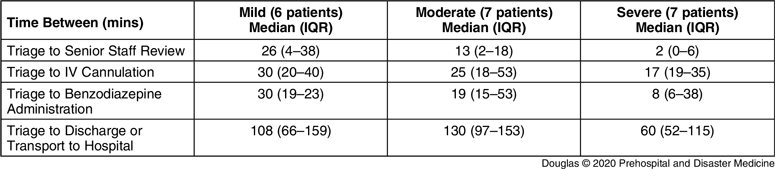
The doses and type of the administered benzodiazepines and cold IV fluid, and the utilized cooling strategies, are shown in Table 3. The time in the care of the medical team and discharge destinations are shown in Table 4.
Interventions Provided

Abbreviations: IM, intramuscular; IV, intravenous; SST, serotonin and sympathomimetic toxicity.
Time to Process Events during Care

Abbreviation: IV, intravenous.
Discussion
The high proportion of patients able to be successfully treated on-site, which was higher than the pre-specified safety threshold, demonstrates that selected patients may be able to be safely treated using this protocol. The results for the mild group indicated that oral diazepam, rest, and fanning are usually sufficient for this group, given that none subsequently deteriorated.
The results for the moderate group show that the majority improved with the rapid implementation of basic interventions such as benzodiazepines and cold IV fluid. The fact that these patients were able to be discharged back to the event indicates that simple care done well is the key to preventing deterioration.
The results of the severe group show that in highly selected circumstances, on-site treatment is possible, but that transport to hospital may well be required. Patients should only be considered for on-site treatment if there they are immediately administered IV midazolam and cold IV fluid, and there is rapid improvement in vital signs, as demonstrated in these data. If initial therapy fails, patients should be transported to hospital.
The three patients who required hospital transport all had high temperatures and reduced consciousness on presentation, suggesting that their disease process had progressed significantly before presentation. This highlights that early access and treatment are important to reducing the risk posed by SST.
It is worth reflecting on the elements of the protocol that were important to its success. Given the fact that triage was conducted by first aid staff, and short times between presentation and the institution of interventions such as IV cannulation and the administration of cold IV fluid and benzodiazepines reported, it is likely the educational interventions and organizational work to reduce hierarchical barriers were effective. The availability of senior clinical staff, including those skilled in airway management and confident in delivering IV benzodiazepines, was important. The availability of modern monitoring equipment to continuously monitor vital signs was also important in safely delivering the protocol.
Building on this report, there is an urgent need for multi-provider collaborative research work to establish standards of care for SST in this industry, including the establishment of registries and agreed best practice protocols incorporating the principles of early recognition, treatment, and escalation where required.
Limitations
This research has been subject to a number of limitations. The small number of patients presenting with SST and subsequently included in the audit is a limitation, as is the lack of a control group that was not exposed to the protocol. It is possible that these patients would have improved without treatment. However, given the known risk of death of SST and the lack of significant side effects of the treatment protocol seen in this trial, it does not seem ethical to expose patients to the risks of non-treatment.
Conclusion
This study demonstrates that for patients with mild to moderate SST, on-site treatment at an event venue may be a safe, efficacious, and efficient alternative to urgent transport to hospital. The keys to success of the protocol tested included inclusive and clear education of staff at all levels of the organization, robust referral pathways to senior clinical staff, and the rapid delivery of therapies aimed at rapidly lowering body temperature. Event planners and regulators should give consideration to the establishment of efficient protocols to ensure patients have access to early effective treatment, including at the event site itself. Organizations implementing such protocols should ensure robust clinical governance systems and staffing models are in place to ensure safety for patients. There is an urgent need for multi-site, multi-provider collaborative research in this area to determine the most effective treatment models for patients with SST.
Conflicts of interest
none