Introduction
The death of a child is a particularly stressful life event, found to be associated with higher mortality (Li et al. Reference Li, Precht, Mortensen and Olsen2003), including completed suicide (Runeson & Asberg, Reference Runeson and Asberg2003) and psychiatric morbidity (e.g. affective disorder and drug-related disorders; Kreicbergs et al. Reference Kreicbergs, Valdimarsdottir, Onelov, Henter and Steineck2004; Li et al. Reference Li, Laursen, Precht, Olsen and Mortensen2005; Bolton et al. Reference Bolton, Au, Leslie, Martens, Enns, Roos, Katz, Wilcox, Erlangsen, Chateau, Walld, Spiwak, Seguin, Shear and Sareen2013), among bereaved parents. The loss of a child may influence mental health outcomes of mothers and fathers differently, with higher observed risks for mothers (Vance et al. Reference Vance, Foster, Najman, Embelton, Thearle and Hodgen1991; Rubinstein, Reference Rubinstein2004; Li et al. Reference Li, Laursen, Precht, Olsen and Mortensen2005). However, it is uncertain if the excess risk of psychiatric disorder among bereaved parents is related primarily to the loss of a child in general or if the cause of death is important. Furthermore, because prior studies have failed to control for measured (e.g. socio-economic status) and unmeasured confounders (e.g. shared genetic factors), our understanding of the mechanisms underlying observed associations remains limited.
Prior findings indicate that the impact of child bereavement on parental outcomes differs depending on the type of bereavement. Worsened outcomes have been observed for bereavement due to unexpected compared to expected deaths (Parkes & Weiss, Reference Parkes and Weiss1983; Harwood et al. Reference Harwood, Hawton, Hope and Jacoby2002). In particular, parents bereaved through suicide are found to have more feelings of guilt and rejection (Bailley et al. Reference Bailley, Kral and Dunham1999; Jordan, Reference Jordan2001; Groot et al. Reference Groot, Keijser and Neeleman2006) and offspring death from suicide might be even more strongly related to parental suicide risk (Qin & Mortensen, Reference Qin and Mortensen2003; Runeson & Asberg, Reference Runeson and Asberg2003), but whether offspring suicide has an impact on parents' mental health has not been thoroughly investigated (Sveen & Walby, Reference Sveen and Walby2008).
Findings from family and adoption studies suggest that genetic factors substantially influence completed suicide (Tidemalm et al. Reference Tidemalm, Runeson, Waern, Frisell, Carlstrom, Lichtenstein and Langstrom2011; von Borczyskowski et al. Reference von Borczyskowski, Lindblad, Vinnerljung, Reintjes and Hjern2011). Such genetic factors might reflect a general vulnerability to psychiatric morbidity within families (Qin & Nordentoft, Reference Qin and Nordentoft2005; Tidemalm et al. Reference Tidemalm, Langstrom, Lichtenstein and Runeson2008; Ilgen et al. Reference Ilgen, Bohnert, Ignacio, McCarthy, Valenstein, Kim and Blow2010), or clustering of personality traits such as impulsivity and aggression, which might mediate the familial transmission of suicidal behavior (Brent & Mann, Reference Brent and Mann2006; Savitz et al. Reference Savitz, Cupido and Ramesar2006; Brent & Melhem, Reference Brent and Melhem2008). Thus, it remains uncertain whether unmeasured familial factors confound the association between offspring death, particularly from suicide, and subsequent parental psychiatric morbidity (Li et al. Reference Li, Laursen, Precht, Olsen and Mortensen2005).
Building on prior literature (Li et al. Reference Li, Laursen, Precht, Olsen and Mortensen2005), we aimed to investigate in a population-based nationwide 1960–2008 cohort the impact of offspring death or suicide in adolescence and young adulthood on psychiatric morbidity among bereaved parents. Importantly, to address possible mechanisms, that is whether any observed association was consistent with a causal interpretation, we applied two family-based designs (Rutter, Reference Rutter2007) using stepfamilies and siblings differentially exposed to offspring death.
Method
Data sources and participants
Data originated from a record linkage of several Swedish longitudinal, nationwide registers. The Swedish Multi-Generation Register (MGR) links all children born in Sweden since 1932 (and who were alive and living in the country in 1961) to their biological or adoptive parents. The personal identification number, unique for all residents, enabled linkage of all individuals in the MGR with data from the National Patient Register (containing information on all psychiatric hospitalizations, 1973–2008), the Cause of Death Register (with information on all deceased persons from 1969 to 2008, including completed suicides), the Library and Information Science Abstracts (LISA) database (based on a merge of annually updated registers of health insurance and labor market since 1990), and the Migration Register.
We identified a cohort of 3 114 564 parents born in Sweden and their children from the MGR and all parents immigrating before 1973 from the Migration Register. The cohort was restricted to parents whose offspring were recorded as alive at the year of their first biological child's 12th birthday, during follow-up in 1960–2008.
Offspring usually continue to live with their mothers when parents separate. Therefore, stepfamilies were identified from mothers having children with two different fathers. Similar to the total parental sample, the cohort of stepfamilies only included stepfathers whose stepchildren were alive at the year of the oldest stepchild's 12th birthday, and whose (if any) biological offspring had survived to at least age 25 years.
From the MGR, we also identified a subgroup of siblings with at least one offspring (both full and half-siblings). Again, siblings had to have their offspring alive at the year of their first offspring's 12th birthday.
Measures
We used two types of exposures: completed offspring suicide (both definite and uncertain), defined by the International Classification of Diseases (ICD) and identified in the Cause of Death Register (ICD-8 and ICD-9 codes: E950–E959, E980–E989; ICD-10 codes: X60–X84, Y10–Y34); and any cause of offspring death (including completed suicide), defined as any death record in the Cause of Death Register. To investigate the effects of offspring death and suicide during adolescence and young adulthood, we restricted these events to those occurring between 12 and 25 years of age. Suicidal behavior is exceedingly rare before age 12 and, to reduce possible misclassification bias, this age was set as a lower limit. To increase the probability that offspring had recently lived together with their parents, age 25 was chosen as the upper cut-off.
As outcome, we used in-patient discharge diagnoses with any psychiatric disorder in parents (ICD-8 and ICD-9 codes: 290–315; ICD-10 codes: F00–F99) from the National Patient Register. We also investigated two subcategories of psychiatric disorder: affective disorders (bipolar disorder, depression and affective personality disorders: ICD-8 codes: 296, 298.0, 298.1, 301.1, 300.4; ICD-9 codes: 296, 298A, 298B, 301B, 300E, 311; ICD-10 codes: F30–F39), where we excluded individuals with any lifetime co-occurring schizophrenia (ICD-8 and ICD-9 codes: 295; ICD-10 code: F20); and substance use disorder (alcohol and drug abuse or dependence (ICD-8 codes: 303, 304; ICD-9 codes: 303, 304, 305A, 305X; ICD-10 codes: F10–F19), excluding those with psychotic symptoms occurring immediately after or during drug use, such as hallucinations (ICD-10 codes: F1x.5).
Statistical analysis
We estimated relative risks (RRs) as the incidence rate ratio of hospital admission for any psychiatric disorder between exposed and non-exposed parents by fitting a log-linear Poisson regression model to the data. Parents were followed from the year of their first-born offspring's 12th birthday until the year of first diagnosis of psychiatric disorder, death, emigration, a follow-up time of more than 25 years or the end of 2008 (end of register coverage), whichever came first. We excluded families where the father was ‘unknown’. We also excluded parents who died, emigrated, or were diagnosed with any psychiatric disorder before the start of follow-up. Parents whose offspring died from suicide or other causes of death during the follow-up contributed with person-years to the exposed group from the date of the event. Among all cohort members who lost more than one offspring, the year of the first event was set as the start of exposure. Poisson regression is commonly used in survival analysis and gives approximately the same parameter estimates and likelihood ratios as Cox proportional hazards regression when the length of follow-up is split into finer intervals (here we used 5-year intervals) (Whitehead, Reference Whitehead1980).
The Poisson regression modeling was performed using SAS version 9.3 (SAS Institute Inc., USA), with offspring age as the underlying timescale. We used person-years as an offset variable in the models and handled correlation between the observations within each family with standard generalized estimating equation methods to obtain robust standard errors. The models were adjusted for parental age together with time (5-year periods) since start of follow-up. To simplify the models, we used the parental mean age in each family. We further adjusted for parental gender, highest attained education (elementary education: < 10 years, secondary education: 10–12 years, and higher education: > 12 years), parental mean age at offspring suicide, and number of children at start of follow-up (1, 2, ⩾3). A small proportion of parents (∼1.0%) lacked information regarding education and were excluded from the adjusted models. We performed separate analyses for offspring suicide, any cause of death (including suicide), and any cause of death excluding suicide (to evaluate whether the risk of parental psychiatric hospitalization could be entirely explained by suicide). In addition, we stratified the analyses by mothers and fathers and studied affective and substance use disorders separately.
Family-based designs
We used two family-based designs to investigate further if any observed association was consistent with a causal interpretation. First, we fitted a log-linear Poisson regression as described earlier to a subsample of stepfamilies. Stepfathers were followed from the year of their oldest stepchild's 12th birthday or from the year they were recognized as stepfathers (the year of birth of his and the mother's first biological child), whichever came last. Stepfathers whose stepchild died during follow-up contributed with person-years to the exposed group from the date of the event. If an increased risk of hospitalization for psychiatric disorders among parents exposed to offspring death were present also among stepfathers (exposed to the death of their biologically unrelated stepchild), this would support a causal, environmental, relationship.
Second, we used stratified Cox proportional hazard regression models to estimate the risk of parental psychiatric hospitalization within siblings differentially exposed to offspring death, a design that controls for genetic and environmental factors shared by the siblings. Siblings had to have at least one biological child, and be alive and without any psychiatric in-patient diagnosis at their first offspring's 12th birth year. We also allowed for several siblings within one family. We corrected for the dependency between repeated observations of siblings in the same cluster by stratifying on family. If the relative risk among differentially exposed siblings is the same as the relative risk in the general population, this would support a causal interpretation; that is, that offspring death is a causal risk factor for parental psychopathology. By contrast, a substantial attenuation of the relative risk among differentially exposed siblings would indicate unmeasured familial confounding. The study was approved by the Regional Ethics Committee at Karolinska Institutet.
Results
The 3 114 564 parents included (51.8% mothers and 48.2% fathers) were followed for 53 212 181 person-years and had 151 076 first-time hospitalizations for psychiatric disorder. Overall, 41 111 parents (1.3% of the cohort) were censored due to emigration or death. We registered 3284 suicides and 14 095 any cause deaths among the offspring during follow-up. In addition, we followed a subgroup of 277 570 parents within stepfamilies for 4 986 825 person-years, resulting in 10 097 first-time psychiatric hospitalizations among biological mothers and 8336 among stepfathers.
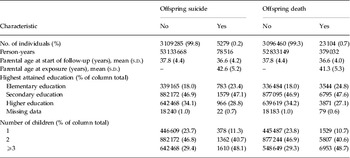
The characteristics of the parents are presented in Table 1. Parents exposed to offspring death and suicide did not differ much compared to unexposed parents, with a mean age at start of follow-up of about 37 years. However, unexposed parents had higher education and fewer children compared with exposed parents.
Characteristics of Swedish parents, 1960–2008, by exposure to offspring suicide or death between 12 and 25 years of age

s.d., Standard deviation.
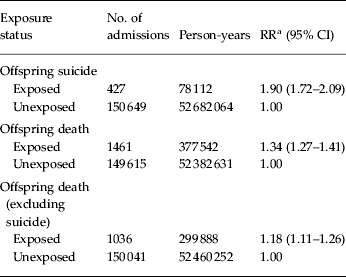
Exposed parents had a statistically significantly increased risk of any hospitalization for psychiatric disorder compared to unexposed parents, after adjusting for parental age, parental gender, educational level, parental age at exposure, and number of children (Table 2). Importantly, the increased risk of psychiatric morbidity among parents following offspring loss from any cause of death was considerably lower [RR 1.34, 95% confidence interval (CI) 1.27–1.41] than the risk associated with offspring suicide (RR 1.90, 95% CI 1.72–2.09) or definite suicide (RR 1.90, 95% CI 1.71–2.11). The association was further attenuated after excluding suicide from any cause of death in offspring (RR 1.18, 95% CI 1.11–1.26). The same pattern was observed in analyses stratified by type of psychiatric diagnosis (affective and substance use disorder) and parental gender (see online Supplementary Tables S1 and S2).
Relative risk (RR) of any psychiatric disorder among Swedish parents, 1960–2008, following exposure to offspring suicide or death

CI, Confidence interval.
a Risk estimates were adjusted for mean parental age, gender, educational level, age at exposure and number of children at start of follow-up.
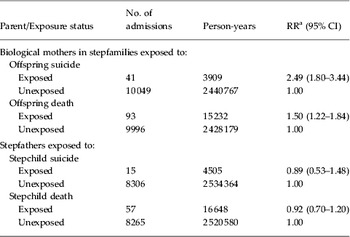
The relative risk of any psychiatric disorder among mothers who experienced the suicide of a biological child in the subsample of stepfamilies (RR 2.49, 95% CI 1.80–3.44; Table 3) was similar to that observed among all biological mothers (RR 1.95, 95% CI 1.69–2.25, data not shown). By contrast, there was a statistically non-significant association of psychiatric hospitalization among stepfathers exposed to stepchild suicide compared to stepfathers who did not lose a stepchild from suicide (RR 0.89, 95% CI 0.53–1.48; Table 3). These results were different from the increased risk of psychiatric hospitalization among fathers who lost a biological child from suicide (RR 1.68, 95% CI 1.46–1.94, data not shown). We found similar estimates for parents in stepfamilies exposed to stepchild (or biological offspring) death from any cause: stepfathers exposed to their stepchild's death (RR 0.93, 95% CI 0.68–1.20) had lower relative risk than stepfathers who lost a biological child (RR 1.18, 95% CI 1.09–1.27), whereas mothers in the subsample of stepfamilies had the same risk of psychiatric hospitalization as all biological mothers exposed to the death of their biological child (RR 1.50, 95% CI 1.22–1.84 and RR 1.48, 95% CI 1.37–1.59 respectively).
Relative risk (RR) of any psychiatric disorder among stepfamilies, 1960–2008, following exposure to offspring/stepchild suicide or death

CI, Confidence interval.
a Risk estimates were adjusted for mean parental age, gender, educational level, age at exposure and number of children at start of follow-up.
We further elucidated the observed risk among stepfathers by applying two sensitivity analyses. First, we repeated the stepfamily analyses using only definite completed suicide as exposure to detect potential effects of the exclusion of an uncertain measure of completed suicide. The results of these analyses were consistent with the results given in Table 3; we found no statistically significant risk among stepfathers exposed to their stepchildren's suicide (RR 0.91, 95% CI 0.51–1.60) whereas the relative risk among mothers who experienced the definite suicide of a biological child was still statistically significantly increased (RR 2.53, 95% CI 1.77–3.63). Second, to increase the chance that stepfathers had become emotionally attached to their stepchildren, we further investigated stepfathers' involvement empirically by examining the association among stepfathers involved since the stepchild was 7 years of age (reflective of longer time to become attached; 46% of the total stepfamily sample). Consistent with the results using all stepfamilies, we found similar risk estimates for stepfathers (RR 0.54, 95% CI 0.20–1.46) and mothers (RR 1.75, 95% CI 0.92–3.35) involved since the child was at least age 7.
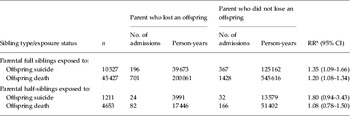
To explore further the mechanisms underlying the association between offspring death and parental hospitalization of psychiatric disorders, we estimated the risk within siblings differentially exposed to offspring death. We identified differentially exposed full siblings (10 527 for suicide and 45 427 for any death) and half-siblings (1211 for suicide and 4653 for any death). Table 4 presents the risk of psychiatric hospitalization among siblings exposed to offspring suicide and any death compared to their siblings who did not lose a child for each exposure and sibling type. The risks for psychiatric hospitalization among exposed full siblings (offspring suicide: RR 1.35, 95% CI 1.09–1.66; any offspring death: RR 1.20, 95% CI 1.08–1.34) were notably lower than the risk estimates in the total cohort of parents (offspring suicide: RR 1.90; any offspring death: RR 1.34; Table 2). However, we did not have enough power to draw conclusions from the risk of psychiatric hospitalization among half-siblings differentially exposed to offspring death (any offspring death: RR 1.08, 95% CI 0.78–1.50; offspring suicide: RR 1.80, 95% CI 0.94–3.43).
Age-adjusted relative risks (RRs) for any psychiatric disorder among full and half-siblings, 1960–2008, differentially exposed to offspring suicide or death

CI, Confidence interval; n, number of siblings.
a The risk of psychiatric admission in parents who lost an offspring compared to their sibling who did not lose an offspring to suicide or death.
Discussion
Although some previous studies have examined the death of one's offspring as a risk factor for psychiatric morbidity among parents (Li et al. Reference Li, Laursen, Precht, Olsen and Mortensen2005; Bolton et al. Reference Bolton, Au, Leslie, Martens, Enns, Roos, Katz, Wilcox, Erlangsen, Chateau, Walld, Spiwak, Seguin, Shear and Sareen2013), the knowledge of possible underlying mechanisms remains sparse. There are three main findings of the present study. First, our data from a large Swedish national cohort of parents over more than 30 years suggest that the increased risk of psychiatric hospitalizations among bereaved parents was almost entirely confined to parents whose offspring died from suicide between 12 and 25 years of age. Second, the increased risk of parental psychiatric ill-health disappeared when comparing stepfathers differentially exposed to the death of their biologically unrelated stepchild. Third, we found only a small increased risk of psychiatric hospitalizations among full siblings and no increased risk among half-siblings exposed to offspring death compared to their siblings who did not lose an offspring. Overall, although offspring suicide is likely to increase psychiatric ill-health and contact with mental health services among affected parents, no direct causal mechanism from offspring suicide to parental psychiatric hospitalization was supported by our data.
The stronger link to parental psychiatric hospitalization following offspring suicide compared to death from any cause is consistent with a previous study focusing on depression among parents whose offspring died from suicide (Brent et al. Reference Brent, Moritz, Bridge, Perper and Canobbio1996). However, it disagrees with a systematic review that found no differences regarding psychiatric morbidity between individuals, albeit not specifically parents, bereaved from suicide and those bereaved from other causes of death (Sveen & Walby, Reference Sveen and Walby2008). This might be explained by limitations of previous research such as low response rates and small sample sizes (Sveen & Walby, Reference Sveen and Walby2008). Unfortunately, prior large register-based studies investigating parental bereavement and risk of psychiatric hospitalizations did not separate offspring suicide from any death (Li et al. Reference Li, Laursen, Precht, Olsen and Mortensen2005). Nevertheless, our finding that offspring suicide is linked more strongly to parental psychiatric hospitalization than death from other causes may not be entirely surprising because past research has stressed that suicide might be related to more severe grief reactions in survivors than other types of bereavement (Ellenbogen & Gratton, Reference Ellenbogen and Gratton2001; Jordan, Reference Jordan2001; Schneider et al. Reference Schneider, Grebner, Schnabel and Georgi2011).
Separate analyses also indicated higher risk associated with affective and substance use disorders among parents exposed to offspring suicide or any cause of death respectively. These findings agree with those of a Danish study of parents exposed to any cause of death in offspring who found that the association was not restricted to affective disorders (Li et al. Reference Li, Laursen, Precht, Olsen and Mortensen2005). In addition, we found no statistically significant parental gender differences of either affective or substance use disorders among bereaved parents. These results are in line with previous research (Li et al. Reference Li, Laursen, Precht, Olsen and Mortensen2005) that similarly found no statistically significant parental gender effects of child death on parental risk of affective disorder. By contrast, they found that bereaved mothers had a higher relative risk of being hospitalized for substance abuse disorder than bereaved fathers. However, their findings should be interpreted with caution because their comparisons were based on small numbers, especially for fathers (Li et al. 2005).
Mechanisms behind the association between offspring death and parental psychiatric disorder
We also tried to determine whether the found associations between offspring death and parental psychiatric disorder were consistent with a causal association; that is, if the death of a child is causally related to hospitalization for psychiatric disorders. Surprisingly, the results from the family-based analyses provided little support for a causal relationship between offspring death and parental psychiatric hospitalization.
First, we did not observe an increased risk of psychiatric hospitalization among stepfathers exposed to the death of their stepchild. Because most children stay with their biological mother upon parental separation, stepfathers would share the family environment with their stepchildren but have no biological link. This can be interpreted as an argument against a strong causal relationship. An alternative interpretation of these results would be that the death of a biologically unrelated child might be less devastating than the loss of a biological child, and that stepfathers therefore are not emotionally involved in their stepchildren. We tried to address this by performing sensitivity analyses on stepfathers who had been living with the child since at least 7 years of age, and found that even in those relationships there was no increased risk of psychiatric hospitalizations among the stepfathers. Thus, although the results are not proof of non-causal relationships, they do not provide any evidence for a direct effect of offspring death on parental psychiatric hospitalization.
Second, we studied differentially exposed full and half-siblings. The idea is that if the familial confounding is due to simple familial (e.g. genetic) transmission of risk of psychiatric disorders, we would expect increased risk of hospitalizations, but lower than the risks when the exposed parents are compared to non-exposed parents in the general population. The additional attenuation of risks in exposure-discordant full siblings (who are more closely related and thus share more familial susceptibility) again indicated familial confounding and did not support a causal relationship between offspring death and parental psychiatric disorder. However, these analyses are indirect and different interpretations are possible. The reduced association among differentially exposed siblings may indicate familial confounding, but could also be explained by a direct environmental effect that cuts across the extended family. That is, siblings to parents who lost an offspring could also be influenced by the death of their niece/nephew. However, if the absence of effect in exposed stepfathers suggests a special bond between parents and their biological children, this also suggests that siblings would be less affected by the death of their niece/nephew.
Thus, a reasonable interpretation of our results could be that the association between offspring death and parental psychiatric disorder is at least partly due to familial confounding. Our data did not support a causal effect, although such an effect cannot be fully excluded. This interpretation is in line with several family and adoption studies indicating that familial transmission of suicidal behavior is partly, but not entirely, attributable to genetic factors (Tidemalm et al. Reference Tidemalm, Runeson, Waern, Frisell, Carlstrom, Lichtenstein and Langstrom2011; von Borczyskowski et al. Reference von Borczyskowski, Lindblad, Vinnerljung, Reintjes and Hjern2011). Furthermore, as individuals with a history of psychiatric morbidity have high rates of suicidal behavior (Goldacre et al. Reference Goldacre, Seagroatt and Hawton1993; Harris & Barraclough, Reference Harris and Barraclough1997; Qin & Nordentoft, Reference Qin and Nordentoft2005; Ilgen et al. Reference Ilgen, Bohnert, Ignacio, McCarthy, Valenstein, Kim and Blow2010; Nock et al. Reference Nock, Hwang, Sampson and Kessler2010), a shared genetic liability for psychiatric disorder probably explains most of the increased psychiatric hospitalization risk among parents exposed to offspring suicide.
Strengths and limitations
The present study was based on nationwide registers with excellent coverage, allowing for follow-up of the entire Swedish population. The use of register data, in contrast to self-reports, minimized non-responding and made it possible to avoid misclassification due to recall bias. Furthermore, our definition of suicide included offspring from age 12 years, which reduced possible misclassification bias that might occur with younger children. We were able to adjust for several important predictors of offspring suicide such as socio-economic status and parental age. Importantly, by using relationships with different genetic relatedness such as stepfamilies, we could investigate familial (genetic and early environmental) confounding.
The study design also involved some limitations. To cover all psychiatric hospitalizations, our choice of study population was restricted by the start of the National Patient Register in 1973. First, although the Cause of Death Register had started in 1969, reverse causation should be minimal because the absolute majority (98%) of the sample was included after 1973. Second, although Swedish death certificates have been validated (de Faire et al. Reference de Faire, Friberg, Lorich and Lundman1976), we could not entirely avoid possible misclassification; completed suicide might be underestimated because of misclassification as other causes of death. Nevertheless, because we have no reason to believe misclassification of exposure to be differential, this misclassification, if any, could decrease the precision of the estimates but would only bias the results towards the null. Third, psychiatric morbidity defined on the basis of hospitalization obviously limited assessments to those who received in-patient treatment. However, inhabitants of Sweden have access to generally available tax-financed health care that usually ensures equal access to in-patient care; hence, in-patients are probably equally representative of the general population across the country. Fourth, we cannot entirely exclude the possibility that hospitalization occurred more often if clinicians heard parents reporting bereavement from child suicide as compared to any death; any potential bias resulting from this differential misclassification of outcome would inflate the strength of the association between offspring suicide and parental psychiatric hospitalization. However, the absence of a risk increase among bereaved stepfathers and similar risks among differentially exposed siblings did not support strong bias of this type. Future studies should also address out-patient care or prescription data to delineate possible selection effects of parents bereaved from child suicide into in-patient care.
Fifth, each family-based design has particular strengths and limitations that can strengthen or weaken the causal inference (Rutter, Reference Rutter2007). Both the stepfamily design and sibling comparison design require large samples to detect associations. In this study we used a large population-based sample; nevertheless, the statistical power was limited because of the rare exposure of suicide. Another limitation of the stepfamily design is that, because the stepfathers share no biological relationship with their stepchildren, their psychological involvement might also be lower. Specifically, we have no knowledge of whether the stepfather does take on the father role for the mother's previous children, or whether the stepchildren do reside with their mother, which might reduce the chance for the stepfather becoming strongly emotionally attached to the child. However, according to Statistics Sweden (1994), 91% of the mothers receive payment from the other parent in custody of the child following parental separation. These numbers indicate that the offspring lives primarily with their mother following separation. Furthermore, when investigating this association empirically by comparing the relative risk among stepfathers involved with their stepchild from 7 years of age or earlier, we still found no increased psychiatric hospitalization risk among stepfathers exposed to the death of their stepchildren.
Finally, the findings from the sibling comparison design should be interpreted with some caution because siblings to parents who lost an offspring could also be influenced by the death of their niece/nephew. Previous studies have generally used sibling comparisons to test the causal inference regarding the association between maternal characteristics during pregnancies and offspring outcomes, which are more intuitive regarding exposed and non-exposed individuals (D'Onofrio et al. Reference D'Onofrio, Van Hulle, Goodnight, Rathouz and Lahey2012; Ellingson et al. Reference Ellingson, Rickert, Lichtenstein, Langstrom and D'Onofrio2012). However, we used the sibling comparison design as a complement to the stepfamily design. Future research should use other designs to control for familial confounding (such as the co-twin control design) to better understand the mechanisms underlying parental psychiatric morbidity following offspring death.
In conclusion, our results indicate that most of the association between offspring premature death (at 12–25 years of age) and subsequent parental psychiatric morbidity reflects offspring suicide. The increased risk of psychiatric hospitalization was not found among stepfathers, and was notably lower among siblings of bereaved parents. This suggests that the association between offspring suicide and parental hospitalization for psychiatric morbidity might be explained by a shared genetic liability for psychiatric disorder rather than a causal environmental mechanism. Regardless of the mechanism, the risk increase motivates extended psychosocial support and clinical attention for parents whose offspring committed suicide compared to those who lost a child from other causes.
Supplementary material
For supplementary material accompanying this paper, please visit http://dx.doi.org/10.1017/S0033291713002572.
Acknowledgments
This work was supported by grants from the Swedish Council for Working Life and Social Research, the National Institute of Child Health (NICHD: grant no. 061817-01A1) and the Swedish Research Council (SIMSAM: grant no. 80748301).
Declaration of Interest
None.