Introduction
It is widely believed that filial piety, as expressed by instrumental support for and affective bonding with parents, has decreased in western countries (Silverstein, Bengtson and Litwak Reference Silverstein, Bengtson, Litwak, Biggs, Lowenstein and Hendricks2003), and that if societal and economic modernisation has been the cause, the same trend will soon be evident in China (Wang Reference Wang and Ikels2004). Although there is theoretical support for the proposition that modernisation leads to the decay of filial piety (Aboderin Reference Aboderin2004b), evidence about the nature of the process and the key influences is sparse. It has been shown that agrarian, traditional and oriental societies have relatively high filial piety and inter-generational support (Ishii-Kuntz Reference Ishii-Kuntz1997), and also that increased education (particularly moral education) and appropriate legislation can sustain filial piety and inter-generational family support (Thomas Reference Thomas1990). Croll (Reference Croll2006) has suggested that filial piety has been resilient against modernisation in Asia because inter-generational exchanges of monetary and other forms of aid have adapted. Nevertheless, because the empirical evidence is meagre and inconsistent, how much increasing modernisation has eroded filial piety remains uncertain, not least in China (Whyte Reference Whyte and Ikels2004). Ascertaining the impact of modernisation is crucial because filial piety or support is an essential element of the care and wellbeing of older people both in western countries (Lawrence, Bennett and Markides Reference Lawrence, Bennett and Markides1992; Roberts and Bengtson Reference Roberts and Bengtson1990) and in China (Cheng and Chan Reference Cheng and Chan2006; Whyte Reference Whyte, Qin and Whyte2003). Promoting filial piety or preventing its decline is therefore widely accepted as beneficial for older people today and in the future and, given the ageing of national populations, has become a public policy objective (Gilliland and Havir Reference Gilliland, Havir, Biegel and Blum1990). It follows that more research on the impact of modernisation on filial piety is required to inform policy makers (e.g. Silverstein and Bengtson Reference Silverstein and Bengtson1997; Strom et al. Reference Strom, Strom, Shen, Li and Sun1996).
The objectives of this study are to test if city-level modernisation has eroded the residents' filial piety and if this erosion is lower for citizens with higher education. These objectives address both the contextual negative effects of modernisation and whether they are mediated by personal choice. These issues are important because modernisation may either reduce filial piety or, as the Chinese socialist view maintains, enhance it (Yao Reference Yao2001). The latter proposition argues that the increased economic resources and education that accompanies modernisation provides a greater capacity to practise filial piety. Education in China has traditionally emphasised moral precepts, and is known (in translation) as ‘the cultivation of spiritual civilisation’ (Yao Reference Yao2001). It does appear to have a crucial socialising role and to inculcate the normative acceptance and practice of filial piety (Fu and Chiu Reference Fu and Chiu2007). Apart from clarifying the effect of modernisation, this study has also examined the practical implications for elderly parents when the financial support of elderly parents by their adult children is reduced. The lowered financial support would require greater public expenditure on income-support, which is why these issues are a prominent policy concern.
Modernisation and filial piety
In its contemporary meaning in East Asia, filial piety refers to unconditional material and emotional support for parents. Its expressions include caring for parents and showing respect and obedience, providing financial support, and greeting and pleasing them (Ng Reference Ng and Nelson2002; Ng et al. Reference Ng, Loong, Liu and Weatherall2000). It provides therefore not only financial support and instrumental care, the widely recognised forms of filial obligation and responsibility (Ishii-Kuntz Reference Ishii-Kuntz1997), but also the filial virtues specified by Confucianism: (a) taking care of parents, (b) not being rebellious, (c) showing love and respect, (d) being courteous, (e) concealing or ignoring the parents' faults, and (f) mourning a parent's death in persistent, spontaneous, cohesive and mutually consented ways (Lin Reference Lin1992). Moreover, these virtues and the associated behaviours should be willingly and freely practised, not a result of authoritarian commands or coercion. These last elements, once associated with the practice of rituals and submission to parental authority, are no longer elements of the contemporary conception of filial piety (Cheng and Chan Reference Cheng and Chan2006; Cheung, Lee and Chan Reference Cheung, Lee and Chan1994; Ho Reference Ho and Bond1996).
In China, there is widespread concern about the resilience of filial piety particularly given the pace of economic modernisation (Zhan Reference Zhan2004a, Reference Zhan2004b; Whyte Reference Whyte, Qin and Whyte2003). The concern is evident in state support for and legislation concerning filial support, and more broadly in the rehabilitation of Confucianism (Xu and Ji Reference Xu and Ji1999). The state's concern, however, arises principally from the determination to promote economic development and therefore to restrain the growth of public expenditure and personal taxation, and is not inspired by considerations of ‘social welfare’ (Chen Reference Chen1996). There are, however, discrepant views about the stability and erosion of filial piety (Chen Reference Chen1996; Lam Reference Lam2006; Zhan Reference Zhan2004a), and some criticise the policy goal of promoting filial piety, and instead argue for generational equality (Wang Reference Wang and Ikels2004; Williams et al. Reference Williams, Ota, Giles, Pierson, Gallois, Ng, Lim, Ryan, Somera, Maher, Cai and Harwood1997). The dissenting views make clear that strong filial piety in China is not universal, but rather a variable trait that needs to be investigated and understood. One supposed influence on its level is modernisation, as manifested in urbanisation and new types of housing that disperse extended families across scattered small households – a process that some adduce as a primary mechanism eroding filial piety (Yang and Chandler Reference Yang and Chandler1992).
The structural-functionalist view of the impacts of modernisation
Up to this point we have in essence described the structural-functionalist view that modernisation brings about social structures and changed aspirations that weaken people's acceptance of the norms of filial piety and their practice of its obligations (for an extended discussion see Aboderin Reference Aboderin2004b). The relevant societal changes are those associated with industrialisation, urbanisation and the increasing participation of women in waged and salaried employment (Dioale and Seda Reference Dioale and Seda2001). These changes are instigated by economic incentives, socialisation and social control that require the population to conform to new modes of production and ways of life (Swenson Reference Swenson2004). The socialisation pressures are through education, propaganda, sermons and other persuasions to accept and collaborate in the modernisation process (Cicirelli Reference Cicirelli1993). People are extolled to pursue the collective interest by internalising social norms. New divisions of labour also promote inter-personal dependency. During modernisation, individuals are reassigned to different but interdependent roles. Structural-functionalist theory even holds that filial piety is unnecessary or even unfit for modernisation because of the reduced productive roles of elders and the extended family (Aboderin Reference Aboderin2004a, Reference Aboderin2004b). Given the new division of labour, older people can no longer depend on their offspring for material support, and moreover it is inimical to economic growth for them to do so. Instead, they can and should depend on professional or formal care, which society's increased resources enable.
The level of a city's modernisation is measured in this study as an aggregate score from three indicators: gross domestic product per capita, the average wage, and the proportion of the labour force employed in the service sector, all three of which can be related to structural-functionalist theory. The average wage indicates the extent to which production and earnings are outside the home (viz. not domestic production). The more that production is separated from the domestic sphere, the more likely that offspring are drawn away from taking care of their elderly parents. In addition, a higher wage level would have a negative effect on engagement in volunteer activity (Menchik and Weisbrod Reference Menchik and Weisbrod1986). Turning to gross domestic product per capita, economic development provides the resources to establish formal care facilities and to train and remunerate formal carers, which may reduce people's need to practise filial piety (de Ruijter Reference de Ruijter2004). Finally, the level of service employment, at least partly, reflects the availability of caring services for elderly parents.
In recent years, many researchers and commentators have considered the effects of modernisation on inter-generational support and how the interactions can be modified. Levande, Hernick and Sung (Reference Levande, Hernick and Sung2000) suggested that in South Korea, the unavailability of formal services is a factor in the high level of filial piety. Silverstein, Bengtson and Litwak (Reference Silverstein, Bengtson, Litwak, Biggs, Lowenstein and Hendricks2006) argued that in China the availability of better-paid employment in cities led many to work and live far away from their parents, thereby reducing opportunities to practise filial piety (see also Deutsch Reference Deutsch2004; Zhan Reference Zhan2004b). Others have emphasised that under modernisation, the family production unit no longer rewards young talent (Aboderin Reference Aboderin2004b), and, as mentioned, that new types of housing are designed for nuclear households and divide extended families (Sheng and Settles Reference Sheng and Settles2006), therefore diminishing the feasibility of filial piety.
Alternative views about modernisation's effects
An alternative view, based on dialectical-materialist or socialist theory, denies that modernisation erodes filial piety (Yao Reference Yao2001). The argument rests on two propositions: that the actual practice of filial or inter-generational support requires material resources as well as an ideological or attitudinal basis; and that the increases in economic resources and education brought about by modernisation enable filial piety. It is argued that these outcomes will occur in a socialist society that instils and promotes filial piety and inter-generational solidarity. This is done both to raise the citizens' productive capability and to sustain ‘socialist relations of production’, by which is meant mutual help among family members and in communities that minimises alienation and exploitation. These relations require that the normative ideology discourages the pursuit of personal interest and encourages efforts that promote family and community interests. Such an ideological basis is established through education, which explicitly creates the socialist personality characterised by mutual help and filial piety (Hou, Zhang and Huang Reference Hou, Zhang and Huang2003). The theory nonetheless admits that the modernised economy alienates people from their natal families and localities so that their productive potential is realised in jobs away from their original homes, which lessens the practicability of filial piety (Silverstein, Bengtson and Litwak Reference Silverstein, Bengtson, Litwak, Biggs, Lowenstein and Hendricks2006; Yao Reference Yao2001). The dampening effect would neutralise the facilitating effect of expanded economic resources and more education. On balance, the dialectical-materialist or socialist theory posits that modernisation has no effect on filial piety in general, but has a positive effect on filial piety among educated people.
Another alternative view generally holds that education enables one to resist the contextual effects of modernisation. The underlying proposition is that education enhances the person's individuality or self-determination, which counters negative contextual influences (Levande, Hernick and Sung Reference Levande, Hernick and Sung2000; Sotirovic Reference Sotirovic2000; Xiao Reference Xiao2000). A key aspect of the thesis of individualisation is that people increasingly pursue self-expression, personal tastes and inter-personal responsibilities as opposed to conforming to societal norms (Beck and Beck-Gernsheim Reference Beck and Beck-Gernsheim2002; Inglehart and Welzel Reference Inglehart and Welzel2005; Yang and Zhang Reference Yang, Zhang, Jiang, Lu and Dan2001). At the same time, the educated or individualised person is less susceptible to the contextual blights of modernisation. Both the thesis of individualisation and socialist theory therefore maintain that education attenuates the impact of city-level modernisation on filial piety; that is, more education moderates or counters the negative impacts.
The principal hypotheses
The underlying hypothesis examined in this paper was derived from structural-functionalist theory; it is that the level of modernisation of a city has a strong influence on the residents' practise of filial piety, particularly the level of adult children's financial support or cash payments to parents (Ng et al. Reference Ng, Loong, Liu and Weatherall2000; Treas and Chen Reference Treas and Chena2000). The presumption, which is not contentious in China, is that an important expression of filial piety is financial support for elderly parents. In the past, such support has been encouraged by physical closeness or proximity, which in turn correlates with emotional closeness (Bengtson et al. Reference Bengtson, Harootyan, Kronebusch, Lawton, Schlesinger, Silverstein and Vorek1994; Mitchell, Vister and Gee Reference Mitchell, Vister and Gee2002; Whyte and Qin Reference Whyte, Qin and Whyte2003). As modernisation increases the geographical separation of successive generations, it may reduce parents' financial contributions to their young adult offspring, which through the principle of reciprocity may later reduce children's support of their parents in old age (Chen Reference Chen2003; Hermalin and Shih Reference Hermalin, Shih and Whyte2003). Modernisation may also empower offspring to support themselves without relying on their parents: increased education (Chen Reference Chen2003; Whyte and Qin Reference Whyte, Qin and Whyte2003), waged employment (Hermalin and Shih Reference Hermalin, Shih and Whyte2003), and increased public welfare (Bawin-Legros Reference Bawin-Legros2001) have been cited as inducing this effect. From our review and understanding of the theoretical ideas and the empirical evidence, we haveformulated the following four operational hypotheses to examine the associations between the level of modernisation and the practice of filial piety:
H1: A higher level of modernisation in a city reduces the inhabitant's filial piety.
H1.1: The reduction in filial piety arising from city-level modernisation is smaller for residents with higher education.
H2: A higher level of modernisation in a city reduces the residents' cash payments to elderly parents.
H2.1: The reduction in cash payments to parents arising from city-level modernisation is smaller for residents with higher education.
In testing these hypotheses, we controlled for a number of background characteristics, namely age, gender, education, income, marital status, the number of children, and size of the population. Several of these variables are clearly independent predictors of filial piety; for example, having more children of one's own would tend to lower financial support for elderly parents (Hermalin and Shih Reference Hermalin, Shih and Whyte2003; Lee, Netzer and Coward Reference Lee, Netzer and Coward1994). Age may have a positive or a negative effect on filial piety (Holroyd and Mackenzie Reference Holroyd and Mackenzie1997; Ikkink, Tilburg and Knipscheer Reference Ikkink, Tilburg and Knipscheer1999). With increasing age, an older parent is less likely to have children living in the same household (Esping-Andersen et al. Reference Esping-Andersen, Gallie, Aemerijck and Myles2002). It has also been suggested that the older the adult child, the less financial support they provide for elderly parents (Lin et al. Reference Lin, Goldman, Weinstein, Lin, Gorrindo and Seeman2003). Gender is also related to the practice of filial piety in intricate ways (Ganong et al. Reference Ganong, Coleman, McDaniel and Killian1998; Rossi and Rossi Reference Rossi, Rossi, Pillemer and McCartney1991). Daughters generally appear to provide more financial support to elderly parents than sons (Chen Reference Chen2003). Similarly, different studies have shown that education has positive and negative effects on filial piety or support (Whyte Reference Whyte, Qin and Whyte2003; Zhan Reference Zhan2004a, Reference Zhan2004b). More education appears to raise the valuation of one's own children, to increase the number of children in a family (Esping-Andersen et al. Reference Esping-Andersen, Gallie, Aemerijck and Myles2002; Wu and MacNeill Reference Wu and MacNeill2002), and to reduce financial support to elderly parents (Whyte and Qin Reference Whyte, Qin and Whyte2003). Being married may also raise or lower filial piety and support, partly because of its association with having children (Laditka and Laditka Reference Laditka and Laditka2001; Schulz Reference Schulz, Biegel and Blum1990). Married daughters appeared to provide less financial support to elderly parents than unmarried daughters (Lin et al. Reference Lin, Goldman, Weinstein, Lin, Gorrindo and Seeman2003). Likewise, personal income has been shown to have both positive and negative effects (Lee, Netzer and Coward Reference Lee, Netzer and Coward1994; Treas and Chen Reference Treas and Chena2000; Whyte and Qin Reference Whyte, Qin and Whyte2003). At the city level, population size tends to have a positive effect on filial piety or support (Coleman and Ganong Reference Coleman and Ganong1997), which may or may not be attributable to modernisation. The evidence and the assertions are inconsistent and require detailed research. For the present purpose, we controlled for a wide range of socio-demographic characteristics.
Methods
Individual-level data were collected by surveys during early 2002 of 1,130 residents aged at least 40 years and with one or both parents alive in the six national or provincial capital cities of China (165 in Beijing, 310 in Guangzhou, 124 in Nanjing, 353 in Shanghai, 87 in Xiamen, and 91 in Xian). They were a sub-sample of 3,973 randomly sampled adult residents of all ages (600 in Beijing, 888 in Shanghai, 600 in Nanjing, 685 in Guangzhou, 600 in Xiamen and 600 in Xian). The cities are scattered across China, with Beijing in the north, Guangzhou in the south, Shanghai in the east, and Xian in the west. Importantly, Beijing is the national capital and the other five are all provincial or regional capitals. Together they cover that part of China that has embodied its culture and nationhood for the longest period. The city surveys used a random sampling procedure that was structured around street committees, the smallest local government administrative unit in urban China. At the first step, street committees were randomly sampled from each of the six cities, and then the committees provided residents' lists for a second stage of random sampling. As is usual (Shi Reference Shi1996), the administrative approval and support produced a very high response rate (over 90%). It should be noted that the household registration system that exists across mainland China means that inhabitants do not freely change their residences. The system thus helps perpetuate differences among cities and justifies the examination of the influences of city-level factors on the inhabitants' filial piety practice.
The measures
The items for the individual's perception of the practice of filial piety in society (i.e. in the city of residence) and his or her own filial piety practice were rated in five categories that were allocated to a scale from ‘0’ to ‘100’ (0 for ‘very little’, 25 for ‘rather little’, 50 for ‘average’, 75 for ‘rather a lot’, and 100 for ‘very much’). The six items referred to various aspects of the adult child's interactions with their elderly parents: caring, respecting, greeting, pleasing, obeying and providing financial support – these dimensions have proved useful and reliable (Ng Reference Ng and Nelson2002; Ng et al. Reference Ng, Loong, Liu and Weatherall2000). More precisely, the filial piety practice questions asked the respondents how often they had engaged in each of six practices during the previous three months. Similarly, the societal filial piety practice questions asked the respondents how often he or she believed that other people in the city engaged in the six practices over three months. The questions about filial piety practice in society preceded those about the individual's practice. The measure of filial piety, as a composite of six items, exhibited a reliability (α) coefficient of 0.92 (on the assumption that the items approximated interval variates).
The respondents also indicated the average amount of cash provided monthly to their parents. Because the distribution of the amounts was positively skewed, a logarithmic transformation was performed for subsequent analysis. Spearman's correlation between the payments and the filial piety score was 0.32 (p<0.001). The indicators of modernisation and other conditions of the city in 2001 were drawn from official statistical yearbooks (Chen Reference Chen2003; Li Reference Li2002). They included gross domestic product (GDP) per capita, the average annual wage, and the proportion of the labour force employed in the service sector. The three indicators were combined in the modernisation score, which had an internal consistency reliability (α) score of 0.79.
Analytic procedure
The analysis used Cox's regressions and linear structural equation modelling by Mplus to construct models respectively of variations in filial piety and cash payments to parents.Footnote 1 The models first estimated the factors that influenced occurrences of the highest rank (of filial piety or cash payments), then proceeded to estimate the factors that influence occurrences of the second highest rank, and so on (SAS Inc. 1995). An exponential model represented the factors influencing the frequencies of each of the ranks. In the present application, the Cox's regression model examined the impacts on filial piety of both city-level modernisation measures and individual-level background variables. Because the model treated the lowest score as the highest rank, it was necessary to reverse the scoring of filial piety. Importantly, Cox's regression modelling was insensitive to the scale used and produced the same results for any variation of the scale.Footnote 2 In the present application, cash paid to parents was the outcome variable, the city-level modernisation indicators identified a latent predictor, and the individual's background characteristics were other predictors.
The results
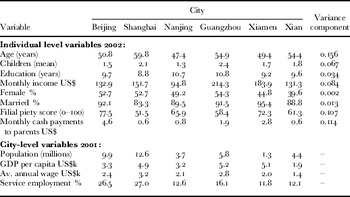
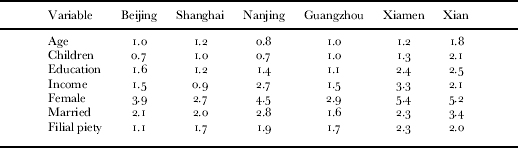
The mean age of the analysis sample was 54.6 years (see Table 1), and there was considerable variation by city, from 47.4 years in Nanjing to 59.8 years in Shanghai (the variance component based on standard scores was 0.156, and no other variable had greater variation by city). About one-half of the respondents were female (52.9%), and the great majority were married (88.4%). Shanghai had the largest urban population, with 12.6 million people in 2001, and Xiamen had the smallest, with 1.3 million (Chen Reference Chen2003; Li Reference Li2002). Shanghai also had the highest average wage, highest gross domestic product per capita and most service employment, while Xian and Xiamen had the lowest. In sharp contrast, Shanghai had the lowest filial piety (M=51.5) and Beijing the highest (M=77.5).
Variable means and variance components by city, six Chinese cities

Notes: Estimation of the variance component used standard scores and could range from 0 to 1, representing the proportion of the variance explained by the city. The estimation did not apply to city-level variables. The estimation assumed that filial piety scores were an interval variable, as the rating scale was a good approximation of an interval scale (Borgatta and Bohrnstedt Reference Borgatta, Bohrnstedt, Borgatta and Bohrnstedt1981; Kampen and Swyngendouw Reference Kampen and Swyngendouw2000; Velleman and Wilkinson Reference Velleman and Wilkinson1993).
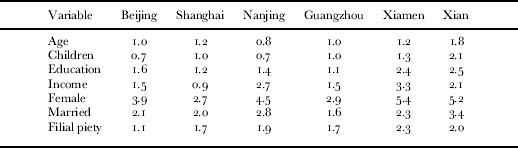
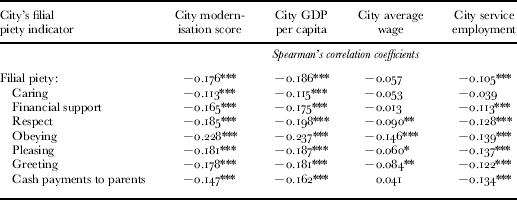
The means of the filial piety scores reflected the population characteristics of the six cities, and the standard error was less than 2.3 percentage points (see Table 2). Moreover, the standard errors of all the individual-level variables included in the study were typically less than five per cent of the possible range of the variate. Hence, the means were able to describe the population characteristics of the cities, despite the apparently small sample sizes. The overall filial piety score was not particularly high (n.b. 100 was the possible maximum). Spearman's correlation coefficients (without adjustments for background and city effects) showed preliminary support for the hypotheses about the negative impacts of city-level modernisation on filial piety and cash payments to parents (see Table 3). The strongest negative correlations were between the average wage and obeying, respecting and greeting parents (r s<−0.2).
Standard errors of variables as percentages of possible ranges by city
Associations between filial piety measures and modernisation indicators for the six study cities, China
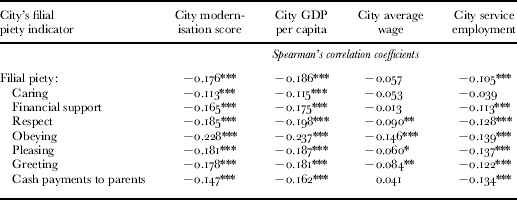
Significance levels: * p<0.05, ** p<0.01, *** p<0.001.
Predicting filial piety
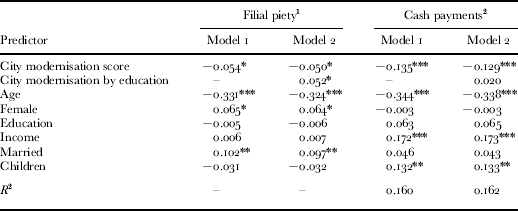
The Cox's regression models showed that city-level modernisation, its interaction with individual-level education, and age, gender and marital status generated significant effects on the inhabitant's filial piety score. Among them, the negative effect of modernisation supported Hypothesis 1 (β=−0.054 based on standardised scores), and the positive effect of the interaction between city-level modernisation and individual-level education supported Hypothesis 1.1 (β=0.052). It was also shown that filial piety was higher when the inhabitant was younger, female and married.
Predicting cash payments to parents
Structural equation modelling based on Mplus was used to estimate the effects on the level of cash payments. The resultant model attained a very good fit to the complex two-level data, which supported the credibility of the estimated factor loadings and the specified causal paths.Footnote 3 The causal models incorporate measurement and structural relation elements. The measurement part identified the city-level modernisation factor loadings, namely 0.95 for average wages, 0.74 for the service employment percentage, and 0.51 for GDP per capita. The identified factor was one of the predictors of cash payments. The variables that significantly predicted cash payments were city-level modernisation and the respondent's age, income and number of children. The modernisation score had a negative effect (β=−0.135) on cash payments, which provided support for Hypothesis 2 (Table 4). The effect of the interaction between city-level modernisation and the respondent's education was positive but not significant. Hence, there was no support for Hypothesis 2.1. It was also shown that cash payments to parents were greater when the resident was younger, had higher income and had more children.
Standardised effects on filial piety and cash payments to parents
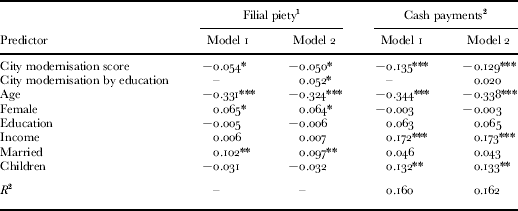
Notes: 1. Estimated by Cox's regression. 2. Estimated by Mplus structural equation models (see text). The reference category in all models was ‘not married men’.
Significance levels: * p<0.05, ** p<0.01, *** p<0.001.
Discussion
Most of our hypotheses about the impacts of city-level modernisation and its interaction with the Chinese citizen's education received support from the analysis. In essence, the city-level contextual effects were found to be independent of those associated with personal attributes. The city-level modernisation score displayed consistently negative effects on both filial piety and cash payments to parents. This finding shows that modernisation is an influence on Chinese people's filial piety, even after controlling for the competing hypothesis about the impacts of personal resources and having children (Aboderin Reference Aboderin2004a, Reference Aboderin2004b). This finding is consistent with the propositions that modernisation induces ageism (Palmore Reference Palmore1990), disrespect for older workers (Chiu et al. Reference Chiu, Chan, Snape and Redman2001), conflict with older people (Williams and Nussbaum Reference Williams and Nussbaum2001), living away from elderly parents (Chattopadhyay and Marsh Reference Chattopadhyay and Marsh1999), the proliferation of nuclear households (Gutmann Reference Gutmann1987), and the erosion of traditional social norms (Savelsberg Reference Savelsberg2002). More particularly, the findings support the notion that when Chinese adult children take up jobs and live in places far away from their parents, filial piety is reduced (Sheng and Settles Reference Sheng and Settles2006; Silverstein, Bengtson and Litwak Reference Silverstein, Bengtson, Litwak, Biggs, Lowenstein and Hendricks2006). Because previous findings about the effects of modernisation have been so inconsistent (Chattopadhyay and Marsh Reference Chattopadhyay and Marsh1999; Lee, Netzer and Coward Reference Lee, Netzer and Coward1994), the present findings are important evidence of the negative impact of modernisation.
City-level modernisation appeared to have stronger negative influence on the filial piety of those with lower education. Such a differential education effect supports Hypothesis 1.1 and, to a lesser extent, Hypothesis 2.1 about cash payments. The secondary hypotheses drew on propositions about the effects of socialist education and individualisation. The first is that, consistent with the role of education in cultivating filial piety in China over many centuries, Chinese-socialist education sustains the virtue of filial piety even through modernisation (Fu and Chiu Reference Fu and Chiu2007). Again, according to dialectic-materialist theory, importantly this enables and encourages educated Chinese people to practise filial piety (Yao Reference Yao2001), which explains why the interaction effect involving modernisation and education but not the main effect of education was a significant contributor to filial piety. The main effect of education was favourable to filial piety, a finding which is distinctive to China (Zhan Reference Zhan2004a, Reference Zhan2004b) and not found in the west (Laditka and Laditka Reference Laditka and Laditka2001). The thesis of individualisation also predicted the positive interaction effect. The hypothesised mechanism is that more educated and self-reliant or individualised people are able to counter or circumvent the negative contextual influences of modernisation. This is also consistent with the insignificant main effect of education on filial piety. In this case, education weakens the negative contextual effects of modernisation rather than directly cultivates the valuation of filial piety. This argument is consistent with research findings about the insusceptibility of educated people's behaviour to social and contextual influences such as discrimination (Kessler, Michelson and Williams Reference Kessler, Michelson and Williams1999), marriage (Barrett Reference Barrett1999) and social contacts (Keith Reference Keith2003).
Nevertheless, it was found that education and its interaction with city-level modernisation were not adequate to raise Chinese people's cash payments to parents, which is consistent with the mixed findings of previous studies, that have included evidence of both positive effects (Hermalin and Shih Reference Hermalin, Shih and Whyte2003; Yang Reference Yang and Bond1996) and negative effects (Chen Reference Chen2003; Whyte and Qin Reference Whyte, Qin and Whyte2003) about the association. These findings suggest that, unlike filial piety in general, monetary support was less sensitive to education or other socialisation factors, which may be because it principally depends on material resources (Aboderin Reference Aboderin2004a). Available resources constrain the amount paid to parents, whatever the individual's sense of filial piety and their concordance with the normative influence of education (Whyte and Qin Reference Whyte, Qin and Whyte2003; Yan, Chen and Yang Reference Yan, Chen, Yang and Whyte2003).
Although income affected cash payments to parents, it did not have a significant effect on filial piety, which again is consistent with the mixed findings of previous studies (Lee, Netzer and Coward Reference Lee, Netzer and Coward1994; Treas and Chen Reference Treas and Chena2000). Apparently, filial piety is not entirely determined by moral education and material resources. In contrast, the negative effects of age on filial piety and cash payments to parents were relatively strong. Older children probably have fewer opportunities and less capability to practise filial piety despite their ageing parents' increasing needs. For one thing, older children are less likely to live with their parents (Mitchell, Vister and Gee Reference Mitchell, Vister and Gee2002), which reduces the opportunities for filial piety actions. It was also found that women (i.e. daughters) practised filial piety more than sons. This may result from the assignment of the caring role to daughters and their socialisation (Finley Reference Finley1989; Spitze and Logan Reference Spitze and Logan1990). Married people also displayed more filial piety practices than others, which may be because they have more social resources (Ishii-Kuntz Reference Ishii-Kuntz1997; Wilson Reference Wilson2000).
In contrast, the filial piety score was significantly reduced by having more children, which is consistent with the hypothesis about role conflict for those in the middle of three generation families (Aboderin Reference Aboderin2004a, Reference Aboderin2004b). Nonetheless, the respondents with more children paid more cash to their parents. One possibility is that those with more children make higher cash payments in exchange for their parents' greater involvement in grand-parenting (Chen Reference Chen2003). This is consistent with the view about the transformed inter-generational contract (Croll Reference Croll2006). Nevertheless, such a contract deviates from the conception of filial piety in the Chinese sense, which emphasises respect and affection more than financial support (Lin Reference Lin1992). The maintenance of the inter-generational contract may therefore simply conceal the erosion of filial piety in association with modernisation.
Priorities for further research
The findings of the present study are inconclusive without further research and more data. Particularly useful would be prospective designs that investigate more aspects of the process of modernisation in a more diverse sample of cities or regions. Further research needs to ascertain the causal role of city-level modernisation by establishing whether (1) the level of individual filial piety before modernisation affects city-level modernisation, or (2) the impact of city-modernisation on filial piety is independent of pre-modernisation filial piety. There is little evidence on these relationships because theory and research typically assume that macro-level conditions affect the micro-level (Coleman Reference Coleman1986; Kohn Reference Kohn1989). Additional measures of modernisation should also be developed to represent its ideological and behavioural manifestations, including individualisation, rationalisation, universalism and scientism at both individual and societal levels (Brand Reference Brand1999; Broaded, Cao and Inkeles Reference Broaded, Cao and Inkeles1994). The mediation of modernisation by individual attributes is probably contingent on social norms, the division and specialisation of labour, and other factors. Social norms depend, in turn, on socialisation, education, propaganda and other forms of persuasion. Apart from such normative mediating processes, role arrangement, specialisation and differentiation and other factors indicative of the division of labour are important concerns. Analyses of these and other factors, such as conflicts for the individual (Bengtson et al. Reference Bengtson, Giarrusso, Marby and Silverstein2002) and stagnation in society (Green, Preston and Stoke Reference Green, Preston and Sabutes2003), are needed to understand a ‘lack of fit’ between filial piety and modernisation.
As well as new research to develop improved models of the socio-economic transformations associated with modernisation, other work is required to substantiate the proposition that a modernising society needs to preserve filial piety. The necessary direction is to break out of the conservative framework of structural-functionalist theory. A promising line of inquiry would be to investigate further the moderating effect of education on the negative impact of modernisation on filial piety. More needs to be known about the ways in which people with higher education practise filial piety without compromising their fitness for or performance of ‘modern roles’. Besides, further research can investigate the facilitation of the fit of filial piety to modernisation, such as employment and other economic and cultural engagements, by the offspring's health (Seike and Shimada Reference Seike, Shimada, Noguchi and Wise1994), receiving social support (Kanfer, Wanberg and Kantrowitz Reference Kanfer, Wanberg and Kantrowitz2001), group and community engagement (Aguilero Reference Aguilero2002), and other factors.
Implications of the findings
It has been shown that in contemporary China, city-level modernisation erodes filial piety and cash payments to elderly parents, although the effects are weak. On the assumption that filial piety is desirable and effective for maintaining the wellbeing of elderly parents and their offspring (Chen Reference Chen1996; Cheng and Chan Reference Cheng and Chan2006; Gupta and Pillai Reference Gupta and Pillai2002), the erosion signifies a need to mitigate modernisation's impacts. This study points to such a means, education. Accordingly, raising people's education and capacity for self-determination would relieve the negative influence of modernisation on their filial piety. Moral education therefore can play a role in sustaining filial piety in a modern society (Thomas Reference Thomas1990).
A different implication of the findings is that more measures are needed to compensate for the decline in filial piety. Most obviously these would involve new types of ‘formal care’ personell and services to take on more of the tasks of eldercare (Levande, Hernick and Sung Reference Levande, Hernick and Sung2000). Ideally, such services should follow a family-like model and take care of older people just as their offspring would (Curtis et al. Reference Curtis, Sales, Sullivan, Gary and Hedrick2005). As such, professional care providers will need to behave like the care recipients' offspring, in a way that maximises respect and love (Gummesson Reference Gummesson, Brown, Gummesson, Edvardsson and Gustavsson1991; Vernon and Hazel Reference Vernon and Qureshi2000).
Acknowledgements
Financial support for this study came through a grant by the City University of Hong Kong (#9030911). The authors thank Sik Hung Ng for collaborative support and Sheung-tak Cheng for invaluable advice.