For decades before the coup of 1973, the Chilean Congress played a decisive lawmaking role and served as an arena for partisan compromise and the accommodation of political elites.Footnote 1 Its membership was quite stable, and the committee system was strong. Chilean presidents, constantly lacking single-party majorities in both chambers, were regularly forced to bargain with congressional parties to pass their policy programmes. As Federico Gil remarked in his classic The Political System of Chile, Congress exercised ‘legislative vigour and independence capable of influencing the formation of public policy’.Footnote 2 Since the early 1940s the traditional give-and-take of Chilean politics had fostered a closely linked congressional membership, with a vast array of cross-partisan connections on electoral and policy matters. These connections facilitated the actions of individual legislators by promoting information and trust, and by reducing the transaction costs associated with reaching stable agreements. This was particularly valuable given the fragmented party system and the ideological dispersion of partisan elites and voters.
By the early 1970s, however, the ability of the Chilean Congress to generate consensus was drastically weakened. The bargaining and compromise that had characterised traditional Chilean politics began to fade, and political institutions became increasingly divided.Footnote 3 Congress, the symbol of the Chilean pluralistic tradition, no longer seemed a cradle for elite accommodation. Inter-branch conflict escalated and daily political battles came to dominate legislative politics.Footnote 4 The path of political confrontation changed course abruptly in September 1973, when the military staged a coup that closed Congress and installed a military dictatorship that would rule the country for almost 17 years.
The main explanation for the end of the politics of ‘accommodation and compromise’ inside Congress points to institutional changes spearheaded by the Christian Democratic administration of Eduardo Frei Montalva (1964–70), which limited clientelistic legislation and strengthened the prerogatives of the executive branch.Footnote 5 This argument, which has influenced several subsequent works on Latin American political institutions, is not only important for understanding the role of Congress at a crucial historical period in Chilean history, but also significant for contemporary legislative politics.Footnote 6 If the sources of decline in bargaining and compromise stemmed from the institutional strength of the executive and from stringent limits on particularistic legislation, then evidence of the detrimental influence of these factors should be present throughout the post-1990 period, given that those basic institutional traits have continued. However, reasons exist to question the basic premises behind this conventional explanation.
This article revisits this conventional wisdom with systematic evidence of the changing patterns of intra-legislative connections. It argues that congressional decay was not the result of institutional engineering on the part of the Christian Democrats but rather the result of the political polarisation of legislative politics, itself a reflection of the polarisation of society widely noted in the literature on Chilean politics.Footnote 7 This article evaluates the implications of both theoretical narratives for illuminating the causes of change within the Chilean Congress.
Most arguments about continuity and change in the Chilean Congress restrict themselves to contemporary data such as roll-call votes (in which every member's vote is recorded), which are generally unavailable for the earlier period. This article challenges the leading institutional explanation of congressional decay with an empirical analysis of both congressional eras. It focuses on the analysis of policy networks derived from the co-authorship of legislation. Authoring legislation with a fellow member of Congress usually requires not only a degree of policy congruence, but also a professional bond of trust and expectations of future interaction. To examine the changing patterns of legislative connections, the analysis centres on an original database of all legislation introduced by members of the Chamber of Deputies from mid-1961 to early 2006. Techniques associated with social network analysis are then used to describe connections among legislators and test a series of implications derived from alternative explanations of congressional decay. The analysis shows that, although particularistic benefits, ‘logrolling’ (the trading of favours or votes) and side-payments from the president may have promoted accommodation by greasing the wheels of lawmaking, a dense network of cross-partisan links can emerge despite strict limits on budgetary policy and ‘pork-barrel legislation’ (the allocation of central government funds to localised projects to the benefit of the representative of that district).
The rest of this article is divided into four sections. The first section presents two alternative views about congressional decay in Chile, while the second sets out a series of testable implications. The third part focuses on the empirical analysis of policy networks, and the fourth addresses some implications for contemporary Chilean democracy.
The Forces of Congressional Change
The first scholar to link the escalation of political conflict and democratic breakdown to changes in congressional incentives was Arturo Valenzuela, who blamed a series of institutional reforms that altered traditional clientelistic practices for undermining cross-partisan consensus.Footnote 8 This argument was further developed in a subsequent article with Alexander Wilde.Footnote 9 This perspective, which has become the conventional wisdom, is summarised below, together with an alternative perspective that focuses instead on partisan polarisation.
The impact of institutional reforms
The end of the politics of conciliation, according to Valenzuela and Wilde, began with the election of President Eduardo Frei Montalva and culminated in the constitutional reforms passed at the end of his term.Footnote 10 The Christian Democrats (DC) obtained the presidency at the end of 1964, along with a partisan majority in the Chamber of Deputies during subsequent elections. Taking advantage of this seemingly favourable context, the government pushed to expand executive discretion over the budget and disregarded traditional practices that allowed Congress to influence spending bills. This strategy antagonised the opposition parties – the Socialist and Communist parties to the left, the Radical Party in the centre, and the Liberal and Conservative parties to the right – which had a long history of parliamentary representation and were habituated to frequent logrolling with the government.Footnote 11
According to this view, the fundamental issue around which much of the politics of conciliation revolved was the attainment by groups and individuals of their so-called reivindicaciones, usually consisting of wage readjustments and locally targeted projects.Footnote 12 Since the furthering of a legislator's political career and the electoral support of parties depended partly on successful casework at the local level, significant attention was paid to extracting resources for individual clients. The achievement of these goals promoted frequent interaction with other legislators, rival parties and the executive branch in the pursuit of sufficiently large coalitions to secure pet projects.
The capacity of legislators to perform constituency work, according to Valenzuela and Wilde, was ‘based, above all, on their continuing influence within the budgetary process’.Footnote 13 This was the case despite congressional influence over budgetary resources being formally restricted by the constitutional amendment of 1943 (Article 45).Footnote 14 Also relevant for particularistic achievements were private laws providing pensions and other favours for individuals, and wide-ranging ‘omnibus’ bills known as leyes misceláneas. Given the lack of clear rules restricting amendments to the matter at hand, legislators were able to transform executive initiatives into more complex bills addressing a variety of new issues.Footnote 15
Valenzuela and Wilde remark that the Frei Montalva administration did not tolerate amendments with financial implications, used the partial veto often to eliminate opposition amendments, and further centralised the formation of budgetary policy.Footnote 16 In addition, the government refused to engage in universalistic logrolling associated with particularistic legislation. Instead of reaching out to the opposition, it seemed to be centralising authority in the executive branch and purposely disregarding long-held congressional practices.
The reformist impetus of the DC administration culminated with a series of constitutional amendments introduced in 1969 that sought to formalise those goals.Footnote 17 Among other things, the reforms passed in 1970 prohibited omnibus legislation and made the Constitutional Tribunal the arbiter on questions of applicability. They also granted the executive further authority to compel congressional action through urgency motions, and incorporated the use of plebiscites to resolve inter-branch disagreement on constitutional matters. More importantly, the constitutional reforms eliminated congressional initiative in ‘all matters – social security, salary adjustments, pensions, any compensation, in the private as well as in the public sector – which comprised the heart and soul of particularistic exchanges’.Footnote 18 From this perspective, the reforms undertaken during the presidency of Eduardo Frei Montalva represented a direct challenge to the traditional understandings that characterised congressional politics in Chile, and contributed to the breakdown of consensus which would lead to the collapse of the regime.
This argument made a clear impact on subsequent scholars in the literature of new institutionalism. For instance, Mainwaring's seminal article ‘Presidentialism in Latin America’ repeats the charge that broadening executive power in Chile led to an erosion of the space for negotiation and compromise.Footnote 19 And, in one of the most prominent books of the new institutionalist literature, Shugart and Carey remark:
Indeed, one could argue that, had the Eduardo Frei government not obtained a constitutional weakening of the Chilean Congress, the centre-right opposition in the early 1970s might have curbed Allende's program, and possibly prevented the crisis of 1973 from escalating to the point where the military was able to seize power with substantial civilian support.Footnote 20
Shugart and Carey endorse the argument that the constitutional reforms of 1970, together with other restraints on logrolling and budgetary influence (especially with regards to particularistic bills), sharply reduced the role of legislative bargaining and undermined the consensual basis of the Chilean presidential system.Footnote 21 Their book goes on to develop the more general hypothesis that presidentialism is especially problematic if the president is accorded significant legislative powers.
The polarisation of the party system
The decline of the Chilean congress as an arena for compromise can also be explained by factors beyond budgetary restraints and new presidential prerogatives. More fundamental partisan and ideological shifts had a profound effect on congressional politics during the 1960s. The polarisation of partisan positions and the gradual erosion of the democratic commitment of important political factions – both important themes in the literature on the Chilean party system – provide an alternative explanation for failures to find consensus and for the weakness of congressional connections in the early 1970s. In this respect, Valenzuela and Wilde's argument underestimates the degree to which congressional politics were influenced by more fundamental shifts in the political environment. As Obler appropriately remarks:
In the face of imminent and widespread collectivisation and redistribution of capital and land, it is highly unlikely that the continued capacity of the Congress to award modest favours to its sundry followers would have placated either those who opposed or those who were eager to accelerate the implementation of Allende's socialist order.Footnote 22
The beginnings of increased partisan polarisation in Chile can be traced back to political developments in the mid-twentieth century. At that time, the traditional electoral and legislative strategies of the political parties were challenged by two related changes: electoral reforms that expanded the body of voters and fundamentally altered patterns of competition, and ideological realignments within parties that affected bargaining over public policies and the commitment of some factions of the left and right to democratic institutions. These changes would further polarise an already fragmented party system, decreasing the likelihood of cross-partisan agreements on legislation and weakening legislators' incentives to pursue a dense network of links with other members of congress.
Several authors have emphasised the way in which electoral reforms deepened partisan polarisation in Chile.Footnote 23 According to Tapia Videla, for instance, the confrontational tendency in Chilean politics was given impetus by political reforms that encouraged the incorporation of the ‘previously excluded masses’ into the voting process.Footnote 24 For him, the process of social mobilisation was ‘further exacerbated by the strong ideological overtones accompanying it’.Footnote 25 Pablo Elorza makes a direct connection between the expansion of the electorate and congressional cohesiveness. He argues that this process led political parties to engage in fierce competition, which eroded their traditional esprit de corps and fostered the political warfare common inside Congress in the early 1970s.Footnote 26
The expansion of the electorate resulted from a series of reforms beginning with the constitutional amendments of 1949, which granted women the right to vote in presidential and parliamentary elections.Footnote 27 This was followed in 1958 by a series of reforms that improved secret ballot provisions, thereby releasing previously captive constituencies, particularly in the countryside.Footnote 28 The 1962 reform then made voter registration compulsory and created simpler procedures and new enforcement mechanisms to this end. Finally, the electoral reforms of 1970 reduced the voting age from 21 to 18 years old, and abolished literacy requirements. This increase in the number of eligible voters is captured in Figure 1, which plots changes from the election of 1932 to the election of 1973.Footnote 29
The Expansion of the Chilean Electorate. Source: Ricardo Cruz-Coke, Historia electoral de Chile 1925–1973 (Santiago, 1984).

As participation increased, patterns of party competition were profoundly altered. In the countryside, the advances made by the DC and leftist parties were particularly detrimental to the Liberals and Conservatives. Political control of major portions of the rural electorate by parties of the right dated back to the nineteenth century, and was largely based on suffrage restrictions and clientelism. From the late 1950s onwards, however, all parties would compete to capture the rural vote.Footnote 30 While these electoral changes hurt the careers of established Liberal and Conservative legislators, the programmatic goals sought by the DC administration threatened many of the political and economic privileges of their constituents. In addition, as noted by Gil and Parrish, President Frei's antagonism towards the politics of the traditional Chilean elite and attacks on the preceding administration of Arturo Alessandri often aroused profound animosity among the Chilean upper classes.Footnote 31 It was during the Frei administration that the traditional Liberal and Conservative parties founded in the nineteenth century eventually disbanded.
In the parliamentary election of 1969 the newly formed rightist National Party performed rather well. At this time, however, the partisan right re-emerged with a more nationalistic and authoritarian stance, with its leadership tilted toward reactionary nationalist groups to the detriment of the old Liberal–Conservative leadership.Footnote 32 Eventually right-wing politicians openly called for the military to intervene.Footnote 33
The electoral success of the DC also affected competition with the left. The DC challenged the left by pursuing working-class voters and organised labour.Footnote 34 The expansion of the electorate not only shattered the hegemonic position of the Communists and Socialists among working-class voters, but also served to reduce the overall weight of the union vote.Footnote 35 Competition was also intense in rural constituencies, where the DC and the left battled for the gains made available by the rightist retreat. Christian-inspired groups and their leaders mobilised thousands of peasants into new unions, farm committees and other political organisations, and in the process encouraged growing rural activism.Footnote 36
Through its own progressive legislation the DC sought to address many of the same social problems highlighted by the left. Frei himself had noted before his election: ‘there are two lefts – the marxist left and the democratic left. We are the democratic left. Chile wants reform but it does not want reform under dictatorship.’Footnote 37 The left, in turn, attempted to outbid the DC's programmatic impetus.Footnote 38 In this climate of heightened competition, both actors could claim to be holding their own – the DC became the largest party in the election of 1965 when it gained a majority in the Chamber of Deputies, while the left experienced electoral gains throughout the 1960s.
Changes in partisan competition and ideological escalation contributed to a re-evaluation of the left's programmatic agenda at a point when the Cuban revolution and Guevarist political strategies enjoyed substantial popularity among its rank and file. Beginning in the early 1960s, the factions within the left advocating an insurrectional strategy to subvert the so-called bourgeois political order began to increase both in numbers and prominence.Footnote 39 The shift to an extreme leftist position was more evident in the Socialist Party, where supporters of ‘legitimate revolutionary violence’ began to prevail over those pressing for change within existing democratic institutions. For instance, the evaluation of the 1964 presidential election by the party's Central Committee severely criticised the candidate of the socialist–communist alliance (FRAP), Salvador Allende, for his lack of a clear Marxist-Leninist stance and for his conciliatory efforts to attract more moderate support.Footnote 40 The process of radicalisation continued with the conventions of Linares (1965) and Chillán (1967), when the party's official stance recognised the inevitability of an armed confrontation to achieve its political goals. In the latter convention the party approved unanimously a declaration stating that socialist revolution required the destruction of the bureaucratic and military structure of the bourgeois state, and that electoral and ideological demands were limited tools of action that functioned only as part of a larger political process leading to inevitable armed struggle.Footnote 41 Even in the convention held at La Serena (1971), after the election of socialist candidate Salvador Allende, the Socialist Party continued to denounce the politics of ‘compromise and pacts with bourgeois parties’, which it blamed for past electoral defeats and failed public policies.Footnote 42
The inability of the DC administration to meet the high expectations fostered by the massive organisational drive it encouraged in the first half of the 1960s led to a highly politicised population with many militants dissatisfied at the slow pace of reform. By the end of the Frei administration a substantial growth in the number of union members and peasant cooperatives was coupled with a sharp increase in the number of strikes, factory occupations and land seizures.Footnote 43 During this period of time the number of political militants adhering to violent groups at both extremes of the ideological spectrum increased, and the country suffered the first major breach of military discipline in decades. This process of radicalisation deepened further after Allende won the presidential election with less than 37 per cent of the vote and embarked on a programme to change Chile into a socialist country.Footnote 44
In short, the expansion of the electorate and the emergence of a new successful reformist party at the centre of the political spectrum challenged established patterns of electoral competition. These changes signalled the beginning of a period of increased militancy and intense partisan competition, which coincided with a process of ideological radicalisation. As a result of these changes, which were exogenous to the institutional structure of government, consensus and accommodation within Congress became much more difficult after the early 1960s.Footnote 45
Implications and Testable Hypotheses
According to the conventional view, incentives for members of Congress to seek links with other legislators (in order to advance relevant particularistic legislation, build mutually beneficial logrolling, and develop the connections required to gain influence) diminished after the rise of the DC to power, and drastically weakened after the constitutional reforms of 1970. The alternative argument stresses the polarisation of partisan positions and shifts in electoral competition, which increased the distance between parties in a purely ideological dimension and undermined the influence of moderate consensus seekers. Thus far, studies of Chilean politics have yet to provide empirical evidence to show that the network of connections among legislators was actually shaken as the literature implies. However, even confirmation of such a collapse would be insufficient to discriminate among the alternative arguments presented above because both Valenzuela and Wilde's hypothesis and the alternative perspective summarised earlier in the article expect similar outcomes. Observational equivalency in the predictions of both arguments limits the conclusions that can be drawn from an analysis of legislative connections based only on the period before 1973.
One can, however, move forward in time and examine the implications of these arguments for legislative politics in the post-dictatorship era. This is informative because the main causal factor advanced by Valenzuela and Wilde and emphasised by Shugart and Carey can be held constant.Footnote 46 Prohibition on the initiation of spending legislation, omnibus bills, wage-setting proposals, individual pensions and related amendments continued into the democratic period that began in 1990. The formal prerogatives of the president have been modified in some aspects, but the overall institutional strength of the executive vis-à-vis Congress has not been significantly altered in the latter's favour.
The main changes from the pre-dictatorship era that are pertinent to this study lie in the positions of the major parties and patterns of electoral competition. A substantial partisan repositioning has narrowed ideological differences between the left and the centre, as well as between these latter factions and the right. This had the effect of decreasing the polarisation common to Chilean politics in the early 1970s. The left underwent a profound ideological transformation during the years of military rule and exile. The Socialist Party re-emerged with a social-democratic ideology, a far more pragmatic leadership, and rather moderate party militants. The new Party for Democracy (PPD), to which several former Socialists migrated, also adopted a pragmatic social-democratic posture. Both parties have also been part of a government coalition with the DC since the return to democracy. Their main competitors have been two new parties of the ideological right, the Unión Demócrata Independiente (UDI) and Renovación Nacional (RN), which also have formed an alliance. Compared to some party leaders of the right from the late 1960s onwards, the leadership of today's rightist parties has shown an impressive commitment to the interplay of congressional politics.
In addition, a new electoral system has contributed to the end of the fierce partisan competition of the earlier era. Before the 1973 coup, Chile employed proportional representation with a district magnitude of five for the Senate and between two and 18 (with an average of five) for the Chamber of Deputies.Footnote 47 This system created incentives for small parties to run their own candidates and discouraged the formation of stable electoral alliances at the national level. The replacement of medium-sized districts by uniform two-member districts lessened uncertainties and rivalry in the competition for legislative representation. Under this binominal system, voters pick one candidate from one list, with list totals determining how the two seats are allocated among lists, and rank within a list determining how seats are awarded to individual candidates. Parties or electoral alliances can present two candidates per list in each district, but can only win the two available seats if they achieve a plurality that doubles the vote of the list coming in second. As scholars have noted, the establishment of this voting system in a country characterised by four to five main parties encouraged the immediate formation of electoral pacts.Footnote 48 It also encouraged the proliferation of safe districts, where each coalition is assured one seat and the leading candidate is chosen through intra-coalition agreements. Consequently, legislators are rarely threatened by the performance of the opposite alliance, and re-election is instead a matter for discussion among coalition partners.
As a result of these fundamental changes in the party system, the connections between legislators should have gradually increased since 1990, eventually reaching or surpassing the levels found in the early 1960s. This strengthening of connections among legislators should have occurred despite continued severe restrictions on initiation of particularistic bills, and a relative imbalance of formal institutional prerogatives favouring the president. In terms of cross-partisan links, the passage of time since the return to democracy should also contribute to generating closer associations between ideological opposites.Footnote 49
To examine the patterns of conciliation and cooperation among legislators, the empirical section of this article focuses on the links derived from the joint authorship of legislation. These sponsorship patterns are a valuable source of information about the social connections that legislators develop within Congress. The joint introduction of a bill reflects a common effort to change policy, as well as an established working relationship. Initiating legislation and seeking partners to move policy proposals forward are important components of congressional life, and demand a proactive effort on the part of legislators. Co-authors usually spend time together writing their initiative, developing a professional bond that promotes the flow of information and the fostering of mutual trust. The configuration of these links among the membership is multidimensional, capturing some degree of ideological similarity as well as other sources of connectedness. In this regard, it differs from voting in the plenary, which tends to be more ideological and also constrained by partisan considerations.
These sponsorship ties, and resultant policy networks, reveal aspects of congressional politics that exemplify the arguments laid out above. To address these propositions, the next section examines seven congressional cohorts: three prior to the coup (1961–73) and four following the transition to democracy (1990–2006). The main expectations, as they apply to these sponsorship networks, can be summarised in four testable hypotheses:
1. Decay hypothesis: The cohesiveness of policy networks should decrease markedly from the early 1960s to the early 1970s.
2. Rigidity hypothesis: The Christian Democrats in the 1965–69 network should exhibit significantly fewer cross-partisan links than legislators from other parties.
3. Continuity hypothesis: The networks formed following the transition to democracy should not differ significantly from those of the mid-1960s and early 1970s.
4. Reconstitution hypothesis: The networks formed following the transition to democracy should reveal a marked increase in cohesiveness compared to those of the mid-1960s and early 1970s, even among ideological opposites.
The first hypothesis refers to conventional expectations derived from both of the perspectives summarised earlier, while the second hypothesis is highlighted in Valenzuela and Wilde's argument.Footnote 50 The final two hypotheses are rivals that reflect the irreconcilable implications for the post-1989 period.
Empirical Analysis of Policy Networks
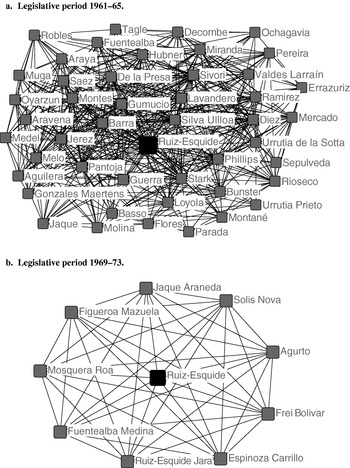
This empirical section examines the policy networks derived from the common authorship of legislation. When two or more legislators present a bill together, a sponsorship tie forms between them. The ties that exist among a legislative cohort comprise a policy network. Figure 2 provides a visual example of the links generated by co-authoring legislation.Footnote 51 It shows a subgroup of legislators, composed by all the deputies that presented legislation with Deputy Rufo Ruiz-Esquide in the periods 1961–65 (top panel) and 1969–73 (lower panel).Footnote 52 A line connecting two nodes (i.e., legislators) represents a sponsorship tie between them. Ruiz-Esquide was a conservative lawyer from the city of Concepción who served three terms in the Chamber of Deputies, originally as a member of the traditional Conservative Party and later as a member of the newly founded National Party. Over the 1961–65 period, Ruiz-Esquide (arbitrarily positioned in the centre of the figure) presented bills with a total of 46 other deputies. The maximum possible number of connections a deputy could have had in this period was 146, which is equal to the total number of deputies minus one. The number of sponsorship ties of deputy Ruiz-Esquide over the 1969–73 period is just nine. Figure 2 shows all of Ruiz-Esquide's connections, but does not show all the connections that the other deputies had; it only shows links with legislators who are connected to Ruiz-Esquide. The analysis presented below considers all legislators and the totality of connections that existed among members of seven different congressional cohorts.
Deputy Rufo Ruiz-Esquide's Connections.

Data on the authorship of bills introduced since 1990 are available electronically from the Chilean Congress. Data for the 1961–73 period were collected from an analysis of the daily congressional records (Diario de Sesiones) available at the Library of Congress in Santiago, Chile. A series of important descriptive measures is presented below and some statistical results that address the hypotheses previously specified are highlighted.
Network demographics
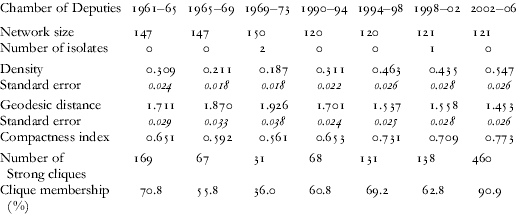
In the study of social networks, a variety of measures have been used to uncover the types of connections that actors develop. Table 1 presents a series of descriptive measures for all seven policy networks, conveying the density and compactness of each network as well as the prevalence of highly cohesive cliques.Footnote 53
The Cohesion of Sponsorship Networks (Network Demographics)
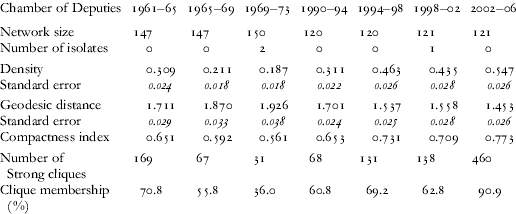
The first row in Table 1 indicates the number of legislators that formed the network. All legislators are included except those who, for exceptional reasons such as resigning or dying soon after being elected, were not present for most of the term. If a new legislator is added at some point during the term, he or she is also counted unless the inclusion occurred at the end of the term. The second row shows the number of isolates: legislators who did not sponsor any bills with other legislators in the network. As can be seen, isolates are rarely found in the networks that deputies develop – only two appear in 1969–73, and one in 1998–2002.
The third row in Table 1 presents the proportion of all possible ties that are actually present. This indicator is commonly known as the density of a network. In this case, a tie represents the joint sponsorship of at least one bill. Since there are n legislators in a network, a total of n(n-1)/2 possible unordered pairs of legislators exist. The density measure runs from 0 (when no ties are present) to 1 (where all actors have ties to all others), and reflects the mean proportion of ties present in the network. The associated standard errors (bootstrap method) are presented in the row below, and are constructed by drawing 5,000 random subsamples of the network and constructing a sampling distribution of density measures.Footnote 54
The next three rows in Table 1 present information about the distance between actors. This measure goes beyond adjacencies (that is, direct sponsorship links) and captures the way in which legislators are embedded in each network. When two legislators, L1 and L2, sponsor a bill together, the distance between them is said to equal 1. If a third legislator, L3, sponsored a bill with L2 but not with L1, then the distance between L3 and L1 equals 2 (i.e., the number of links between them). In social networks, it is likely that several paths exist between any pair of actors. The shortest path between a pair of actors in a network is commonly referred to as a geodesic, with the geodesic distance between them being the length of the shortest path. Table 1 presents the mean geodesic distance for each network, the associated standard error (bootstrap method), and the compactness index. This is a useful measure of distance ranging from 0 to 1, with higher numbers indicating a more compact configuration. The compactness index equals the sum of the reciprocals of the path length for all defined, off-diagonal entries in the distance matrix, divided by n(n-1).
The last rows of Table 1 capture the presence of cliques, or subsets of the network in which legislators are more closely linked to one another than to other members of the network. This measure is intended to tap into the substructure of the network. A clique is defined as a subset of three or more legislators that fulfils two conditions: (i) all members of the clique have ties with each other, and (ii) there are no other actors that also have ties to all members of the clique.Footnote 55 Since clique membership may overlap, the table presents information on the total number of cliques, as well as the percentage of legislators belonging to them. Since the goal is to identify groups with a very high level of connectivity, this measure examines the ‘strength’ of ties. This requires using additional information on how frequently legislators sponsored bills together, with a tie appearing only if legislators jointly sponsored more than a specific number of bills. For this indicator, the threshold is sponsoring at least four bills together.
Overall, the network demographics presented in Table 1 reveal significant changes over time. With regards to the decay hypothesis, all measures show the 1969–73 network to be less cohesive than the 1961–65 network. The proportion of ties dropped from nearly 31 per cent in the early 1960s to just below 19 per cent in the early 1970s, a statistically significant difference. The mean distance for the 1969–73 network (1.926) was significantly greater than the mean distance in the 1961–65 network (1.711), with the compactness index moving accordingly. The results also indicate an abrupt decline from the early 1960s to the early 1970s in the number of cliques, as well as the percentage of legislators belonging to them. In the early 1960s, 71 per cent of deputies belonged to a total of 169 different cliques. By the early 1970s, however, the number of cliques had fallen drastically, and the share of deputies participating in these cliques had shrunk to 36 per cent. The directions of all these changes were already evident during the second half of the 1960s.
In regards to the networks developed after the transition to democracy, the results provide strong support for the reconstitution hypothesis over the continuity hypothesis. They indicate a gradual increase in the proportion of ties present, a decrease in the mean distance, and a marked increase in both the number of cliques and the total legislators involved in them. The density indicators show all four networks to be significantly stronger than the 1969–73 network. The proportion of observed ties during 2002–06 was 55 per cent, considerably higher than the 31 per cent present in the early 1960s. In addition, the mean distance in the most recent networks is significantly smaller than the mean distance in the early 1960s. In the post-transition networks, about 91 per cent of deputies participated in strong cliques, representing the highest levels of involvement in any of the networks analysed.
Network statistics
To further examine the links between legislators, I analyse the probability of a tie between any two members of different partisan groups, and model the proportion and strength of individual ties after controlling for tenure, party and the size of ideological blocks.
An ANOVA model performing a randomisation test of autocorrelation for the different partisan blocks in the network helps reveal differences in tie density within each partisan group, and also tests whether ties within each partisan group differ from all ties not within the group. For networks prior to the breakdown of democracy in 1973, legislators are grouped into four partisan blocks: the left, composed of the Socialist and Communist parties;Footnote 56 the right, made up of the Liberal and Conservative parties and later the National Party; the Christian Democratic Party; and the Radical Party. For the networks developed since the transition to democracy, the focus rests on the two major coalitions: Concertación and Alianza.
The results indicate that connections within partisan blocks are always significantly stronger than cross-partisan connections, as expected given the importance of parties in Chile. More importantly for the purposes of this article, the model's intercept measures the probability of a dyadic tie between any two members of different groups. Figure 3 plots this value for all seven networks.
Probability of a Cross-Partisan Tie.

The results reflect a considerable decrease in cross-partisan connections after 1965. During the 1961–65 period, the probability of a tie between any two members of different partisan blocks was 24.8 per cent. By 1969–73, that probability had been reduced by about half. The drop in cross-partisan links was already evident in 1965–69, when it reached 11.3 per cent. Since the return to democracy the probability of a tie between a member from Concertación and one from Alianza increased progressively from 16.8 per cent during 1990–94 to a rather impressive 39.4 per cent in 2002–06.
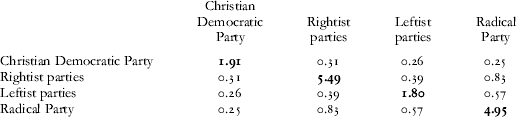
The information collected also permits an examination of the hypothesis that during the 1965–69 period the DC comprised a particularly ‘rigid’ block that shunned connections with other members of Congress (rigidity hypothesis). Here a relational contingency table of observed over expected tie counts provides revealing information. It compares a table of cross-classified frequencies of ties corresponding to the different partisan blocks to a table of expected values, assuming that ties are independent and randomly distributed. Table 2 reports for each cell the observed value divided by the corresponding cell in the expected value table.
Relational Contingency Table, 1965–69 Network (Observed/Expected Values)
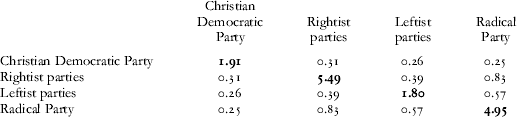
As expected, a strong tendency exists to seek links with fellow partisans. The values in the diagonal cell are always greater than 1, indicating a configuration that is unlikely to appear randomly. Intra-partisan ties inside the DC appear weaker than inside the Radical Party or the rightist group, but not substantively different from the level exhibited by the leftist group. With regard to cross-partisan links, the values are always smaller than 1, and are also unlikely to be randomly present. Members of the DC were generally less likely to seek cross-partisan links than members of the other three partisan groups. In fact, considering the relative size of each partisan block, the values for connections between the left and right are higher than those of the DC with any block.
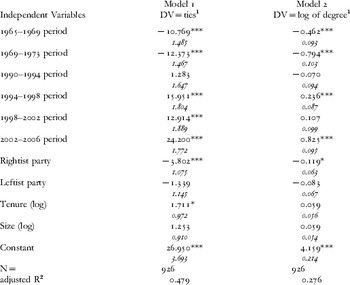
Next, I model the proportion and strength of individual ties after controlling for tenure, party and the size of ideological blocks. The first dependent variable is the proportion of ties which equals the number of others to whom a legislator is connected divided by the total number of possible connections. The second dependent variable is based on a legislator's degree, which in this case equals the sum of the ‘values’ of her/his ties.Footnote 57 The value of a tie between two legislators equals the number of bills they sponsored together.
The independent variables include a series of categorical variables indicating partisan affiliation and congressional cohort. Legislators are classified according to whether they belonged to parties positioned at the right, left or centre of the ideological spectrum.Footnote 58 The comparison groups are those that represent centrist legislators and the 1961–65 period. Two additional variables capture the tenure of the legislator and the size of her/his legislative group. Legislators with long tenure should have more established links with other members than newly elected legislators, and the seat share of the partisan group examines whether smaller factions have a tendency to develop fewer ties. The results from a fixed-effects OLS model appear in Table 3, with (bootstrap) standard errors shown below the coefficients.
The Presence and Strength of Legislative Ties, 1961–2006

i.Significance level: *=0.10; **=0.05; ***=0.01.
Regardless of whether the dependent variable is the proportion of ties or the log of degree, the coefficients for the 1969–73 and 1965–69 periods are significant and negative, as expected by the decay hypothesis. In terms of the strength of links, the predicted values after controlling for other factors are 4.34 (about 76 degrees) for the typical deputy in the 1961–65 period, 3.88 (about 47 degrees) for the 1965–69 period, and 3.55 (about 34 degrees) for the 1969–73 period.
The results for the post-transition periods again lend support to the reconstitution hypothesis over the continuity hypothesis. When the dependent variable is density, the last three periods appear with a positive and significant coefficient. These reflect the stronger connections present in the post-transition era vis-à-vis the early 1960s. When the log of degree is used as the dependent variable, similar results are present except during the 1998–2002 period, which shows no difference from the 1961–65 period. This indicates that, although the 1998–2002 cohort connected on average with more members than the 1961–65 cohort, there is no significant difference in the overall value of ties.
The control variables also reveal some interesting effects. Legislators from the rightist parties appear connected with a significantly smaller proportion of legislators than members of centrist parties. The value of these ties was also significantly weaker; however, no relevant difference exists in either measure between legislators from leftist and centrist parties.
The variable capturing the tenure of each legislator shows significant effects when the dependent variable is density. The coefficients maintain the expected sign, but lose significance when the dependent variable is the log of degree. This indicates that although more senior members are likely to sponsor bills with more legislators than newcomers, there is no significant difference in the overall number of bills sponsored with others. In addition, the variable capturing the size of the partisan group has the expected sign, but is not significant.
To sum up, the results show how policy networks weakened from the early 1960s onwards (decay hypothesis), and how they have re-emerged and strengthened since the early 1990s (reconstitution hypothesis). These changes are robust to the inclusion of several control variables. In addition, the results lend support to the proposition that in the mid-1960s legislators from the DC sought fewer cross-partisan links than legislators from other partisan groups (rigidity hypothesis). While evidence from the first era seems compatible with both of the arguments presented here, the evidence from the post-transition period casts doubt on the causal link emphasised by Valenzuela and Wilde and their followers and is compatible with the rival perspective articulated in this article.
Conclusion
The decay of the Chilean Congress as an arena of compromise and accommodation among political elites was evident by the early 1970s. The most influential interpretation of the path leading to this event argues that poor institutional manipulation severely undermined incentives for cooperation. As a result of these changes, Congress was predicted to become irrelevant or a blocking agent, with incentives for cross-partisan connections on legislation nearly vanishing. This article challenges this perspective by showing that a dense network of links among legislators (and partisan opposites) can emerge despite stringent limits on particularistic bills and presidents with wide formal prerogatives. The weakening of ties among legislators, according to this alternative interpretation, stemmed from the polarisation of the party system, particularly fierce electoral competition, and ideological radicalisation specific to that time period. This article elaborates on these alternative arguments, deriving testable implications and providing the first empirical comparison of legislative behaviour before and after the 1973 coup. The evidence appears incompatible with some important implications of the conventional wisdom. Instead, it illustrates how a dense network of legislative connections can emerge, even among partisan opposites, regardless of executive strength or legislators' ability to initiate particularistic bills.
The reforms long blamed for triggering congressional decay were championed by politicians who saw Chilean politics before the 1970s as plagued by excessive political clientelism. The institutional structure of contemporary Chile has imposed strict restrictions on many of these practices without an obvious negative impact on the policy bonds that members of Congress develop among themselves and, arguably, without undermining the relevance of Congress. It is certainly true that, formally, legislators can do a lot less to the president's budget bill today than in earlier times, but this is not evidence that the institutional relevance and bargaining power of Congress has decreased. There are different normative perspectives on the effect of clientelism on legislative politics, but one justification for the maintenance of some of these practices in Congress, that although they are in some aspects undesirable they are also necessary for the development of cross-cutting interests and the driving force behind cohesive policy networks, has been found wanting.
More generally, the findings of this article cast a positive light on the process of democratic consolidation in Chile. Ideological moderation and a context of electoral stability have contributed to the development of many policy commonalities among political elites, bridging the ideological division that once helped to make Chile a ‘nation of enemies’. The strengthening of policy networks in Congress and a related rise in cross-coalition ties reflect a political environment favourable to bargaining and compromise. Whether the cross-cutting interests that enable ideological opposites to work together are also prevalent in other non-legislative contexts remains to be examined.
Not only have dense policy networks emerged despite institutional arguments expecting few bonds, but other available evidence also suggests a parallel growth in the impact of legislators on substantive policy outputs (that is, initiating and amending bills). Although more research needs to be done to evaluate this matter more carefully, it seems that deterministic institutional arguments are inaccurate in this respect as well. Chile's Congress has not become a negative force relevant only for its ability to veto presidential moves. Instead, its policymaking relevance has grown despite a formal constitutional structure arguably biased in favour of the executive. A dense network of connections among the legislative membership should be an asset on the path to enhancing the institutional influence of Congress.
Lastly, the analysis presented in this article suggests some useful empirical strategies for Latin Americanists interested in researching the policy positions and connections developed by political elites. Although the lack of regularly recorded congressional votes before the 1970s might be a disappointment, since this is the information most commonly used in such studies, other revealing data are available for many Latin American legislatures and can be examined with modern statistical tools. Bill-initiation data, which allow us to examine the co-authoring links present between legislators, is one example of data that researchers would find available for many more historical periods than is the case for roll-call votes, as too with speeches given on the floor of Congress and the resultant word-data. This type of information gives the empirically oriented social scientist an opportunity to complement the existing historical narratives of critical political moments in the legislative history of a country, such as the period leading to the 1973 coup, with systematic evidence of the behaviour of parliamentary elites. Other significant cases of partisan polarisation in Congress and democratic breakdown that might be further illuminated by this type of analysis include, for example, the period leading from suffrage extension (1916) to the first military coup (1930) in Argentina, or the period from the election of Fernando Belaúnde Terry to the presidency of Peru (1963) to his overthrow by the military (1968).