INTRODUCTION
If they want to contribute to organizational performance, employees can promote innovative ideas that are likely to change and improve the current organizational situation (Schon, Reference Schon1963; Van de Ven, Reference Van de Ven1986; Howell & Boies, Reference Howell and Boies2004). Such idea championing is critical to innovation (Scott & Bruce, Reference Scott and Bruce1994) and can benefit not just the organization but also the idea champions themselves. That is, their efforts can fuel employees’ intra-organizational network building (Coakes & Smith, Reference Coakes and Smith2007), insights into decision-making (Van Laere & Aggestam, Reference Van Laere and Aggestam2016), and work performance (Howell & Shea, Reference Howell and Shea2001; Kissi, Dainty, & Tuuli, Reference Kissi, Dainty and Tuuli2013). Mobilizing support for innovative ideas can be challenging for idea champions though, especially if other organizational members regard their activities as upsetting or threatening (Markham, Reference Markham1998; Howell, Reference Howell2005; De Clercq, Castañer, & Belausteguigoitia, Reference De Clercq, Castañer and Belausteguigoitia2011). For example, actively promoting innovative ideas might seem highly political if it brings problems to the surface or threatens members who are directly linked to the identified problems (Day, Reference Day1994; Yuan & Woodman, Reference Yuan and Woodman2010).
We propose that for idea championing to occur, despite these challenges, employees need some control over how they do their jobs (Hystad, Eid, & Brevik, Reference Hystad, Eid and Brevik2011). Job control is a critical job resource, which employees can draw on to stimulate their personal development and performance (Hobfoll, Reference Hobfoll2001; Newton & Jimmieson, Reference Newton and Jimmieson2008; Park, Jacob, Wagner, & Baiden, Reference Park, Jacob, Wagner and Baiden2014). Previous research suggests that job control has positive effects on employees’ organizational commitment (Juhdi, Pa’wan, & Hansaram, 2013), job satisfaction (Bond & Bunce, Reference Bond and Bunce2003), and ability to learn new skills (Bond & Flaxman, Reference Bond and Flaxman2006), but few studies consider its potential influence on the active championing of innovative ideas, nor does extant literature detail other factors that might activate this process. We seek to address these important oversights by (1) theorizing that giving employees more control over how they do their jobs may enhance both their ability and their motivation to make other members aware of novel organizational improvements and (2) investigating the circumstances in which job control is likely to fuel such championing of innovative ideas. In so doing, we acknowledge that granting employees more autonomy can spur idea championing, but the extent to which this is the case may depend on the perceived necessity to find and sell innovative solutions for organizational problem situations.
The principal goal of this study therefore is to investigate how and when employees’ job control increases their propensity to try to make other organizational members enthusiastic about their innovative ideas. As our theoretical foundation, we use conservation of resources (COR) theory, according to which employees’ work behaviours are critically informed by anticipated resource gains and losses (Hobfoll, Reference Hobfoll1989). According to this theory, employees are more likely to engage in positive work behaviours to the extent they can leverage their existing job resources and achieve additional resource gains through these behaviours (Hobfoll, Reference Hobfoll2001; Boon & Kalshoven, Reference Boon and Kalshoven2014). Furthermore, COR theory suggests that securing such resource gains seems particularly beneficial, and thus is invigorated, in the presence of adverse work conditions that threaten future resource losses for employees (Hobfoll & Lilly, Reference Hobfoll and Lilly1993; Hobfoll, Reference Hobfoll2001; De Clercq & Belausteguigoitia, Reference De Clercq and Belausteguigoitia2017). To test this predicted invigorating role of workplace adversity, we consider both a cognitive source of work stress, due to opposing work role demands (Kahn, Reference Kahn1978; Fried & Tiegs, Reference Fried and Tiegs1995), and an emotional source that results from a sense of betrayal when the organization fails to keep its promises (Robinson & Morrison, Reference Robinson and Morrison2000; Suazo, Reference Suazo2009).
In short, we contribute to extant research by focusing on the hitherto underexplored role of employees’ job control in determining the extent to which employees mobilize support for their innovative ideas. By acknowledging how employees’ discretion over how to do their jobs can spur their idea championing, we provide new, critical insights into how employees’ capacity to make autonomous decisions functions as an important impetus for their discretionary efforts to improve the organizational situation, due to the resource gains they anticipate obtaining from these efforts (Van de Ven, Reference Van de Ven1986; Hobfoll, Reference Hobfoll2001). Moreover, we theorize that job control promotes idea championing most powerfully when employees face unfavourable work conditions, such as when they confront conflicting role obligations (Fried & Tiegs, Reference Fried and Tiegs1995) or suffer a betrayal of organizational promises (Robinson & Morrison, Reference Robinson and Morrison2000). Our proposals of these invigorating effects of role conflict and psychological contract violations extend previous research that tends to address only the direct negative effects of role stress and psychological contract infringements on positive work behaviours (e.g., organizational citizenship behaviour; Suazo, Reference Suazo2009; Eatough, Chang, Miloslavic, & Johnson, Reference Eatough, Chang, Miloslavic and Johnson2011). Our reliance on COR theory and focus on the triggering or invigorating effect of resource-draining work conditions for leveraging job control, in the form of enhanced championing behaviour, also complements previous studies that draw on the job demands-resources model to investigate how job resources, such as job control, might mitigate the negative impact of demanding job conditions on positive work outcomes (Bakker & Demerouti, 2007; Stiglbauer, Reference Stiglbauer2017).
THEORETICAL BACKGROUND AND HYPOTHESES
Mobilizing support for innovative ideas can bear fruit for both the organization and the champions, but these activities also have a dark side, in that targets of the efforts may believe that the ideas will undercut their current privileges or lead to reputation losses, to the extent that the problems that the innovative ideas are designed to solve reflect on them (Van de Ven, Reference Van de Ven1986; Markham, Reference Markham1998). Persistent championing efforts that push innovative ideas also can undermine the idea champion’s reputation, generating an image of the person as a nuisance who focuses on her or his own interests, at the expense of others (Milliken, Morrison, & Hewlin, Reference Milliken, Morrison and Hewlin2003). Therefore, it is critical to understand why some employees may be more likely than others to mobilize support for innovative ideas, despite the challenges.
On the basis of COR theory, we propose that employees’ propensity to invest significant time in championing efforts depends on the extent to which the organizational context offers resources that can facilitate additional resource gains (Hobfoll, Reference Hobfoll1989). We focus in particular on job control – or the extent to which employees have freedom in terms of how to do their jobs (Hystad, Eid, & Brevik, Reference Hystad, Eid and Brevik2011; Park et al., Reference Park, Jacob, Wagner and Baiden2014) – and acknowledge that this job resource may spur both their ability and their motivation to mobilize support for their innovative ideas (Jenssen & Jorgensen, Reference Jenssen and Jorgensen2004; Bond & Flaxman, Reference Bond and Flaxman2006). In turn, we draw from COR theory to propose that the gains that empowered employees expect from their idea championing efforts should be invigorated to the extent that they also work in stressful, resource-draining conditions (Hobfoll & Shirom, Reference Hobfoll and Shirom2000), whether that stress stems from cognitive sources (e.g., role conflict) or emotional sources (e.g., psychological contract violation).
In particular, role conflict arises when opposing expectations exist across different work responsibilities, such as when employees receive incompatible requests from different organizational stakeholders and must perform tasks that are acceptable to some but not others (Kahn, Reference Kahn1978; Fried & Tiegs, Reference Fried and Tiegs1995). Conflicting work role demands create significant stress, because employees are unsure how to meet their performance targets and satisfy the wishes of other organizational members (Ramudu & Fish, Reference Ramudu and Fish2006; Eatough et al., Reference Eatough, Chang, Miloslavic and Johnson2011). Psychological contract violations instead spark negative emotions, such as frustration and anger, when employees believe their organization fails to keep its promises (Morrison & Robinson, Reference Morrison and Robinson1997; Chiaburu, Peng, Oh, Banks, & Lomeli, Reference Chiaburu, Peng, Oh, Banks and Lomeli2013). A psychological contract implies tacit agreement between employer and employee about their mutual obligations (Robinson & Rousseau, Reference Robinson and Rousseau1994; Sonnenberg, Koene, & Paauwe, Reference Sonnenberg, Koene and Paauwe2011). Employees tend to experience psychological contract violations as highly stressful, because they sense that their organization has not followed through on previously made commitments to them (Turnley & Feldman, Reference Turnley and Feldman1998).
The proposed argument about the invigorating, instead of mitigating, roles of these two stressful work circumstances might seem counterintuitive, but it is consistent with the COR logic that the allocation of valuable resources to positive work behaviours has particularly strong value in the presence of resource-draining work conditions (Hobfoll & Lilly, Reference Hobfoll and Lilly1993; Hobfoll & Shirom, Reference Hobfoll and Shirom2000). For example, previous research indicates that employees’ tenacity is a particularly forceful catalyst of their voice behaviours in the presence of negative work conditions marked by low levels of goal congruence, trust, and support for change (De Clercq & Belausteguigoitia, Reference De Clercq and Belausteguigoitia2017). Similarly, we propose that leveraging job control into further resource gains, by championing innovative ideas that can lead to organizational improvements, should be perceived as particularly useful when these gains can help employees maintain adequate job performance despite the stress of coping with negative work circumstances (Hobfoll, Reference Hobfoll2001; Hobfoll & Shirom, Reference Hobfoll and Shirom2000).
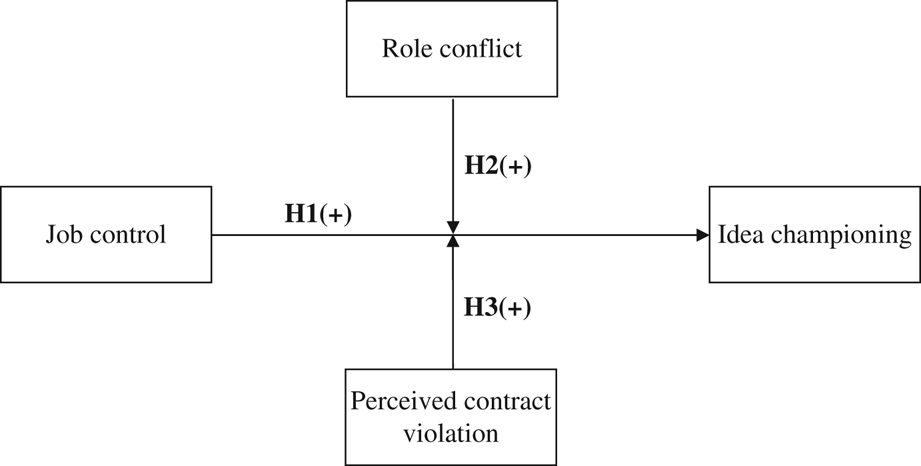
The theoretical framework and hypotheses in Figure 1 highlight the baseline relationship between employees’ job control and idea championing, as complemented by the possible moderation of role conflict and psychological contract violations. Consistent with COR theory, we propose that job control stimulates idea championing, and this effect should be invigorated in the presence of stressful, resource-draining work conditions.
Theoretical model

HYPOTHESES
Job control and idea championing
Our baseline hypothesis pertains to the positive relationship between employees’ job control and idea championing, for which we theorize both ability- and motivation-related mechanisms. First, job control functions as an energy-enhancing job resource, from which employees can draw to engage in discretionary work behaviours, such as idea championing (Weigl, Hornung, Parker, Petru, Glaser, & Angerer, Reference Weigl, Hornung, Parker, Petru, Glaser and Angerer2010). Because efforts to promote innovative ideas tend to lead to organizational changes (Liang, Farh, & Farh, Reference Liang, Farh and Farh2012), they often prompt scepticism, particularly among colleagues who may feel personally attacked by proposals for change. Previous research suggests that employees who draw from greater resource reservoirs are more persistent in undertaking work behaviours that run the risk of sparking resistance by other members (Howell & Boies, Reference Howell and Boies2004; Hobfoll, Reference Hobfoll2011). In the presence of greater job control, employees are better positioned to cope with possible resistance to their championing efforts, and they should have greater confidence that the resource gains they hope to obtain from these efforts are within their reach (Markham, Reference Markham1998; Jenssen & Jorgensen, Reference Jenssen and Jorgensen2004). In short, job control endows employees with a greater ability to mobilize others in support of their innovative ideas and persevere in the effort, even in the face of resistance.
Furthermore, greater job control may give employees the sense that their organization values their input and contributions (Bond & Bunce, Reference Bond and Bunce2003; Juhdi, Pa’wan, & Hansaram, Reference Juhdi, Pa’wan and Hansaram2013), such that they feel strongly motivated to reciprocate this signal of organizational support by devoting significant energy to championing efforts that promise to improve the organizational status quo (Eisenberger, Cummings, Armeli, & Lynch, Reference Eisenberger, Cummings, Armeli and Lynch1997). Similarly, job control may increase employees’ motivation to mobilize support for innovative ideas that contribute to organizational well-being, because their efforts serve as proof that they ‘deserve’ the level of job control assigned to them (Howell, Reference Howell2005). Finally, people who possess greater job control have a stronger intrinsic motivation to set ambitious goals for themselves and find ways to improve their current work situation (Wright & Cordery, Reference Wright and Cordery1999; Ryan & Deci, Reference Ryan and Deci2000), which they can realize by actively championing innovative ideas. If employees have less job freedom, they instead may give up on their innovative ideas and feel less motivation to mobilize support for those ideas.
Hypothesis 1: There is a positive relationship between employees’ job control and idea championing.
Moderating effect of role conflict
According to COR theory, employees’ exposure to adverse work conditions generates a fear of resource losses in them – as reflected in their concerns about their ability to meet their job obligations or their career situation in general (Hobfoll, Reference Hobfoll1989) – but the possibility of leveraging relevant job resources into further resource gains is instrumental for countering this fear (Hobfoll & Shirom, Reference Hobfoll and Shirom2000). Thus, this COR logic emphasizes an invigorating instead of mitigating effect of resource-draining work conditions on the perceived usefulness of applying valuable resources to positive work behaviours (De Clercq & Belausteguigoitia, Reference De Clercq and Belausteguigoitia2017). Similarly, we posit that when employees experience conflicting work role demands, which represent a critical threat to their job performance (Kahn, Wolfe, Quinn, Snoek, & Rosenthal, Reference Kahn, Wolfe, Quinn, Snoek and Rosenthal1964; Eatough et al., Reference Eatough, Chang, Miloslavic and Johnson2011), their propensity to leverage their autonomy to champion innovative, resource-enhancing ideas should increase. That is, employees should be particularly motivated to leverage their job control to champion innovative ideas because the anticipated implementation of these ideas promises performance gains, in the form of new pathways for accomplishing their work goals successfully (Park et al., Reference Park, Jacob, Wagner and Baiden2014).
In addition, the more challenging it is to comply with the conflicting expectations of different organizational stakeholders, the more valuable it may seem for employees to leverage their job control to engage others in finding solutions (Markham, Reference Markham1998; Howell, Reference Howell2005) and gain access to their resource bases (Hobfoll, Reference Hobfoll2001). The positive interaction effect of job control and role conflict on idea championing thus might also arise because the freedom to decide how to spend their time gives employees a useful means to convince organizational peers that they need collective solutions to incompatible job requests (Van Laere & Aggestam, Reference Van Laere and Aggestam2016). Finally, the propensity of empowered employees to spread their innovative ideas might promote a sense of ‘shared fate’ among those who experience conflict-laden role obligations, such that they feel like part of a collective and are strongly motivated to find novel solutions to the performance challenges that accompany unclear role descriptions (Nahapiet & Ghoshal, Reference Nahapiet and Ghoshal1998; Van Laere & Aggestam, Reference Van Laere and Aggestam2016). When empowered employees allocate significant energy to idea championing efforts, the solidarity between idea champions and their targets thus may have particular value in work conditions that make it difficult to meet role demands.
Hypothesis 2: The positive relationship between employees’ job control and idea championing is moderated by their perceptions of role conflict, such that the relationship is stronger at higher levels of role conflict.
Moderating effect of psychological contract violations
The premises of COR theory similarly suggest that the more disappointed employees are with their employer’s failure to meet its promises, the more valuable it may seem to leverage their job control in championing efforts that promote innovative ideas, in the anticipation that these ideas can help them overcome this unfavourable, resource-draining situation (Hobfoll & Shirom, Reference Hobfoll and Shirom2000). That is, employees who feel frustrated about how their organization has been treating them in terms of unmet expectations likely are motivated to leverage their job control by championing innovative ideas, in the belief that the ideas can generate solutions that will compensate for the unfavourable situation (Howell, Reference Howell2005). Similar to the case of role conflict, this invigorating effect is consistent with COR theory: When employees feel threatened in their ability to fulfil their job obligations or career aspirations, because their organization does not abide by its promises, they should be particularly keen to leverage the job control they possess and seek resource gains by championing ideas that might improve their employment situation (Hobfoll & Lilly, Reference Hobfoll and Lilly1993; Boon & Kalshoven, Reference Boon and Kalshoven2014).
Furthermore, when their organization appears not to meet its obligations, empowered employees may experience a strong need to invest their personal energy in convincing colleagues of the need for innovative approaches to the problem, with the hope that their collective efforts will lead the organization to treat members with more respect (Chiaburu et al., Reference Chiaburu, Peng, Oh, Banks and Lomeli2013). Mobilizing support for such innovative solutions even might trigger other members to share their expertise about how to cope with the situation (Coakes & Smith, Reference Coakes and Smith2007), such that leveraging personal job control to support championing behaviours becomes more useful (Hobfoll, Reference Hobfoll2001). Instead, if the organization has met most of its promises, employees likely have more positive perspectives on their employment situation (Suazo, Reference Suazo2009) and less need to use their job control to engage other organizational members to change it (Hobfoll & Shirom, Reference Hobfoll and Shirom2000).
Hypothesis 3: The positive relationship between employees’ job control and their idea championing is moderated by their psychological contract violation, such that the relationship is stronger at higher levels of psychological contract violation.
RESEARCH METHOD
Sample and data collection
We tested our hypotheses with survey data collected from a Mexican-based organization that operates in the chemical sector and produces plasticized films and fabrics. The organization faces a strongly competitive environment, in which multiple players seek to develop and maintain long-term relationships with business customers through innovative products and processes. We focus on a single organization in this competitive industry, which eliminates several potential external influences on employees’ innovation championing activities, such as the level of industry competition or technological intensity (Zahra & Garvis, Reference Zahra and Garvis2000). Moreover, to reduce the threat of social desirability and acquiescence bias, we guaranteed the participants complete confidentiality, repeatedly reminded them that there were no correct or false answers, and asked them to respond as honestly as possible (Spector, Reference Spector2006).
The survey was conducted in Spanish, and we applied the translation procedure suggested by Brislin, Lonner, and Thorndike (Reference Brislin, Lonner and Thorndike1973): a bilingual translator converted the English survey into Spanish, followed by a back-translation into English by another bilingual translator. After comparing the two English versions, we resolved any discrepancies and finalized the Spanish survey. We also undertook a pilot test of the survey with five employees who did not participate in the main study, which improved the readability of the questions. The survey was distributed to a random selection of 200 employees, and we received 157 responses (79% response rate). The sample included employees of different functions, both operational (e.g., production, quality control) and supportive (e.g., accounting, human resources), who operated at different levels, including those with supervisory responsibilities. Among the respondents, 40% were women, their average organizational tenure was 14 years, 47% worked in a primarily operational function, and 40% had supervisory responsibilities.
Measures
The items for the four focal constructs were based on previous research and applied 7-point Likert scales, ranging from 1=‘strongly disagree’ to 7=‘strongly agree’.
Idea championing
We assessed employees’ idea championing with a 3-item scale, drawn from Scott and Bruce (Reference Scott and Bruce1994), that captured the championing aspect of employees’ innovative work behaviours. The three items were ‘I often mobilize support for innovative ideas,’ ‘I often make important organizational members enthusiastic for innovative ideas,’ and ‘I often acquire approval for innovative ideas’ (Cronbach’s α=0.88). Supervisor assessments of idea championing might be useful, yet supervisors typically are not aware of the entire range of championing activities in which their employees engage (De Clercq, Castañer, & Belausteguigoitia, Reference De Clercq, Castañer and Belausteguigoitia2011), and the use of self-reported measures of these behaviours is therefore common (e.g., Markham, Reference Markham1998; Kissi, Dainty, & Tuuli, Reference Kissi, Dainty and Tuuli2013). Moreover, idea championing activities are intentional and goal directed (Schon, Reference Schon1963; Maidique, Reference Maidique1980; Howell & Boies, Reference Howell and Boies2004), so using assessments by the idea champions themselves has great merit, in that they come from the persons most knowledgeable about their actual involvement in these activities. When self-reports are appropriate, concerns about common method bias are largely mitigated (Conway & Lance, Reference Conway and Lance2010).
Job control
We measured job control with a 4-item scale that captured how much control employees have over how to do their jobs (Hystad, Eid, & Brevik, Reference Hystad, Eid and Brevik2011). Two sample items read, ‘I have general freedom to decide and plan my own work day’ and ‘I have the freedom to influence my own work pace’ (Cronbach’s α=0.84).
Role conflict
To assess the extent to which employees experience opposing role demands, we applied a 5-item scale used in previous studies (Rizzo, House, & Lirtzman, Reference Rizzo, House and Lirtzman1970; Fried & Tiegs, Reference Fried and Tiegs1995).Footnote 1 For example, respondents rated their agreement with two statements: ‘I often receive incompatible requests from two or more people’ and ‘I often do things that are apt to be accepted by one person and not accepted by others’ (Cronbach’s α=0.78).
Psychological contract violation
We measured employees’ perceptions of psychological contract violations with a 4-item scale from previous research (Robinson & Morrison, Reference Robinson and Morrison2000; Raja, Johns, & Bilgrami, Reference Raja, Johns and Bilgrami2011). Example items were, ‘I feel that my company has violated its contract with me’ and ‘I feel betrayed by my company’ (Cronbach’s α=0.95).
Control variables
To account for alternative explanations of employees’ idea championing, we included several control variables. We controlled for gender because men may exhibit a stronger tendency to voice their novel ideas compared with women (LePine & Van Dyne, Reference LePine and Van Dyne1998; Detert & Burris, Reference Detert and Burris2007). We also controlled for education (secondary, postsecondary non-university, or postsecondary university) and organizational tenure (in years), because more skilled or experienced employees may feel more confident about their capacity to find novel solutions to organizational problems (Detert & Burris, Reference Detert and Burris2007; Tangirala & Ramanujam, Reference Tangirala and Ramanujam2008; Gong, Kim, Lee, & Zhu, Reference Gong, Kim, Lee and Zhu2013). Finally, because the likelihood that employees develop and sell their innovative ideas may also depend on the nature and responsibilities of their jobs (Ibarra, Reference Ibarra1993; De Clercq & Belausteguigoitia, Reference De Clercq and Belausteguigoitia2017), we controlled for their job function (i.e., primarily operational and related directly to production or else more supportive, which provided the base category for the regression analysis) and whether they had supervisory responsibilities.
We assessed the validity of the four focal constructs by estimating a four-factor measurement model with confirmatory factor analysis (Anderson & Gerbing, Reference Anderson and Gerbing1988). The fit of the measurement model was good: χ2 (84)=144.80, Tucker–Lewis index (TLI)=0.93, confirmatory fit index (CFI)=0.95, and root mean squared error of approximation (RMSEA)=0.07. We found support for the convergent validity of the four constructs, in that the factor loadings of each measurement item were significant (t>2.0; Gerbing & Anderson, Reference Gerbing and Anderson1988). In support of discriminant validity, for each construct pair, we found significant differences between the χ2 values of the constrained models in which the correlations between the two constructs were set to equal 1 and their unconstrained counterparts in which the correlations were set free (Δχ2 (1)>3.84, Anderson & Gerbing, Reference Anderson and Gerbing1988).
To address possible concerns of common method bias in relation to the study’s focal variables, we undertook three post hoc tests. First, we applied Harman’s single-factor test, which relies on an exploratory factor analysis (Podsakoff & Organ, Reference Podsakoff and Organ1986). If common method bias were an issue, a single factor would account for the majority of the variance in the data, but the first factor explained only 29.80% of the variance, suggesting that such bias was not a major concern. Second, we performed a confirmatory factor analysis of a model in which every measurement item loaded on a single factor. The fit of that model was very poor (χ2 (90)=734.75, TLI=0.34, CFI=0.50, RMSEA=0.21), significantly worse than that of the four-factor model (Δχ2 (6)=589.95, p<.001), which further alleviated concerns about our reliance on a common source. Third, to control for common method variance directly, we undertook a test that included an unmeasured latent method factor (Podsakoff, MacKenzie, Lee, & Podsakoff, Reference Podsakoff, MacKenzie, Lee and Podsakoff2003). The comparison of the factor loadings of the model that included this unmeasured method factor and its counterpart without this factor revealed only very small differences, so any effect of common method variance was minimal (Carlson & Kacmar, Reference Carlson and Kacmar2000). Fourth, concerns about common method bias for this study are largely mitigated by the argument that such bias tends to be significantly lower for theoretical models that include moderating effects, as was the case here, because respondents are not likely to identify these effects when completing the survey (Simons & Peterson, Reference Simons and Peterson2000).
RESULTS
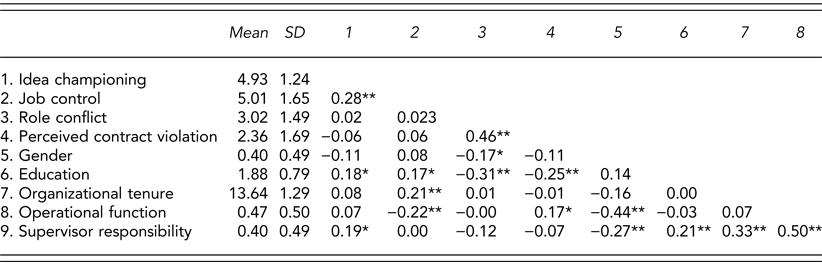
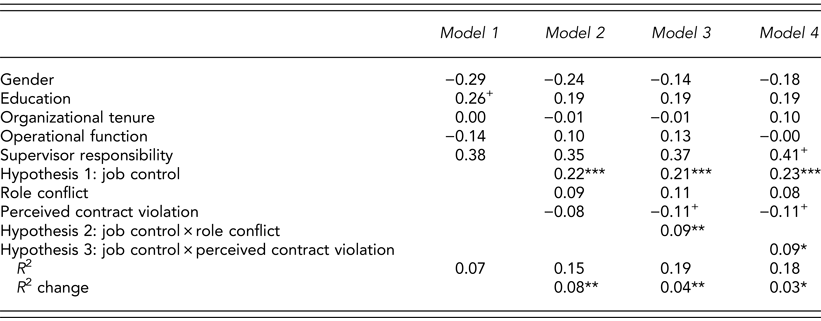
Table 1 presents the zero-order correlations and descriptive statistics, and Table 2 presents the regression results. Model 1 included the control variables, Model 2 added job control and the two moderators (role conflict and psychological contract violation), and Models 3 and 4 added the job control×role conflict and job control×psychological contract violation interaction terms, respectively. Previous studies indicate that it is appropriate to estimate multiple interaction terms in separate models, because the simultaneous inclusion of multiple interaction terms in one model can mask true moderating effects (e.g., Covin, Green, & Slevin, Reference Covin, Green and Slevin2006; De Clercq, Bouckenooghe, Raja, & Matsyborska, Reference De Clercq, Bouckenooghe, Raja and Matsyborska2014).
Descriptive statistics and correlations

Note: N=157.
*p<.05; **p<.01.
Regression results (dependent variable: idea championing)

Note: N=157.
*p<.05; **p<.01; ***p<.001; + p<.10 (two-tailed).
The results of the control Model 1 indicate somewhat more idea championing among more educated employees (β=0.26, p<.10). As we anticipated in our baseline prediction that job control fuels employees’ propensity to mobilize support for their innovative ideas, Model 2 reveals that this resource relates positively to idea championing (β=0.22, p<.001), in strong support of Hypothesis 1. Model 2 also reveals no significant relationships of role conflict and psychological contract violation with idea championing.
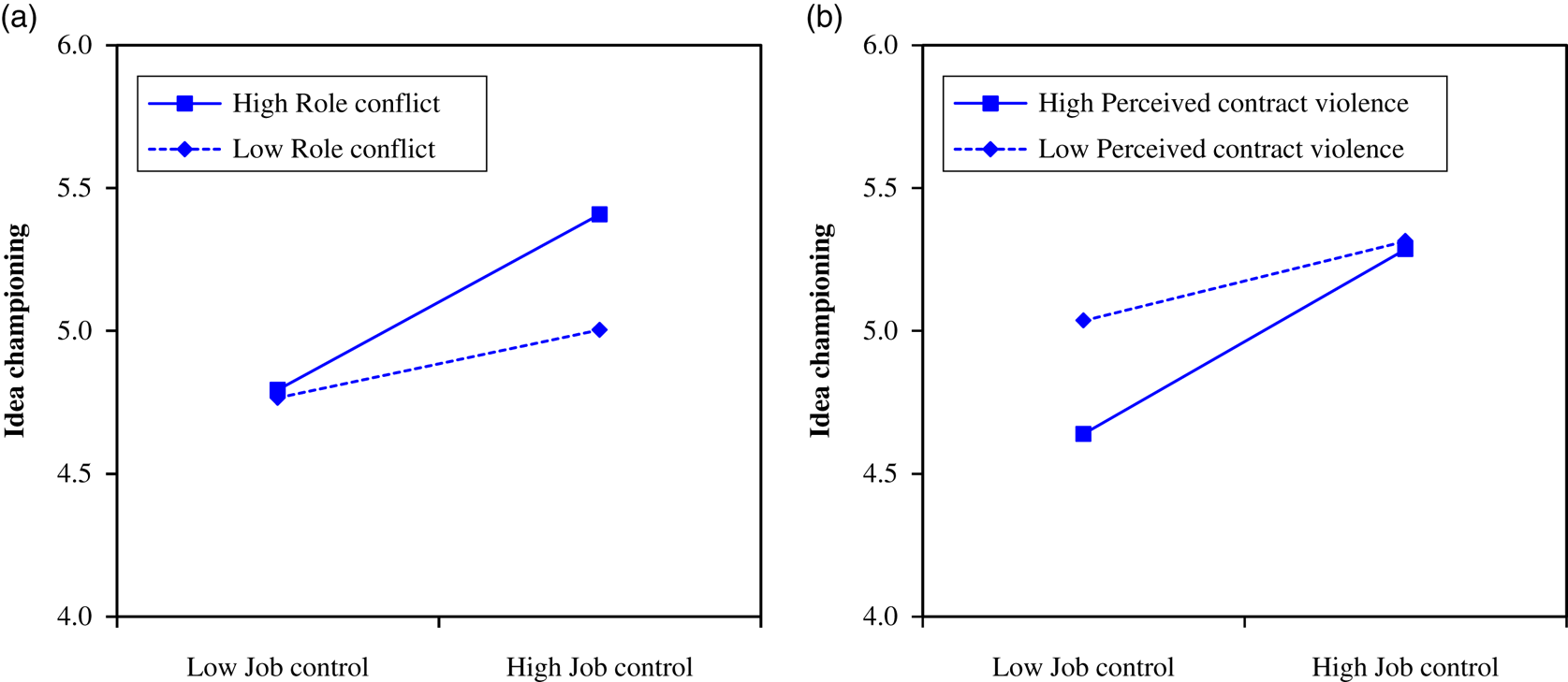
Models 3 and 4 support the hypothesized invigorating effects of the different sources of workplace stress. That is, the job control–idea championing relationship is stronger at higher levels of role conflict (β=0.09, p<.01) and psychological contract violation (β=0.09, p<.05), in support of Hypotheses 2 and 3. To clarify the nature of these interactions, we plot the effects of job control on idea championing for high and low levels of the two moderators in Figures 2a and 2b, combined with a simple slope analysis (Aiken & West, Reference Aiken and West1991). The results of the simple slope analysis reveal that the relationship between job control and idea championing is strongly significant when role conflict (β=0.31, p<.001) and psychological contract violation (β=0.32, p<.001) are high but much weaker when they are low (β=0.112, p<.10; β=0.14, p<.10, respectively), in further support of Hypotheses 2 and 3.
Moderating effect of (a) role conflict and (b) perceived contract violation on the relationship between job control and idea championing

DISCUSSION
This study adds to extant research by elaborating how employees’ job control influences the likelihood that they champion innovative ideas in work environments marked by varying levels of stress. Selling innovative ideas to other members can be critical for both idea champions and their organizations, but these challenging activities also may appear confrontational or threatening to other organizational members (Day, Reference Day1994; Markham, Reference Markham1998; Howell, Reference Howell2005). With our proposal that idea championing efforts are more likely when employees believe that their organization gives them more control over how to do their jobs (Park et al., Reference Park, Jacob, Wagner and Baiden2014), we draw from COR theory (Hobfoll, Reference Hobfoll1989, Reference Hobfoll2001) to anticipate how job control might spur idea championing efforts because of the resource gains expected from these efforts. We also predict, somewhat counter-intuitively but in line with this same COR theory (Hobfoll & Shirom, Reference Hobfoll and Shirom2000), that job control is more useful when employees face conflicting role demands or feel betrayed by their organization – two conditions that likely infuse significant stress in employees and deplete their resource reservoirs (Eatough et al., Reference Eatough, Chang, Miloslavic and Johnson2011; Singh, Suar, & Leiter, Reference Singh, Suar and Leiter2012). Our research provides empirical support for these theoretical arguments.
The successful mobilization of innovative ideas can be satisfying and contribute to employee performance (Howell & Shea, Reference Howell and Shea2001; Kissi, Dainty, & Tuuli, Reference Kissi, Dainty and Tuuli2013) but also prompt scepticism among other organizational members who fear that the innovative ideas might challenge their status or make them look bad. These challenges diminish to the extent that employees have greater job control. Consistent with COR theory, employees who enjoy more freedom in how to do their jobs invest significant energy to mobilize support for their innovative ideas, in pursuit of the resource gains associated with these activities (Hobfoll, Reference Hobfoll2001; Boon & Kalshoven, Reference Boon and Kalshoven2014). In this regard, we emphasize that both ability- and motivation-based mechanisms likely underlie this positive connection. That is, empowered employees may have great confidence that they can cope with possible resistance to their championing efforts, because of their discretion in how and when to spend their time (Weigl et al., Reference Weigl, Hornung, Parker, Petru, Glaser and Angerer2010). Furthermore, greater job control represents a signal of organizational respect, so these employees may be strongly motivated to contribute more to their employer’s well-being through their championing behaviours (Juhdi, Pa’wan, & Hansaram, Reference Juhdi, Pa’wan and Hansaram2013).
This beneficial effect of job control also is stronger when employees believe that the resulting resource gains protect them against the threat of resource losses due to workplace stressors (Hobfoll, Reference Hobfoll1989, Reference Hobfoll2001), such as conflicting role demands (Fried & Tiegs, Reference Fried and Tiegs1995) or frustration with the organization for failing to deliver on its promises (Raja, Johns, & Bilgrami, Reference Raja, Johns and Bilgrami2011). The moderating effect of workplace adversity that we identify extends previous research into the direct negative relationships between unfavourable work conditions (e.g., excessive time pressures, dysfunctional organizational decision-making) and innovative work behaviours (e.g., Monsen, Patzelt, & Saxton, Reference Monsen, Patzelt and Saxton2010; De Clercq, Dimov, & Belausteguigoitia, Reference De Clercq, Dimov and Belausteguigoitia2016). That is, we reveal that if employees face challenging work situations – receiving incompatible requests or suffering from unfulfilled employer obligations – then the relative value of job control resources for stimulating idea championing increases significantly.
The invigorating effects of these two sources of workplace stress – which seemingly run counter to the notion that job control might mitigate the negative effect of adverse work conditions (Stiglbauer, Reference Stiglbauer2017) – are consistent with the COR argument that the perceived benefits of leveraging relevant job resources toward the generation of additional resource gains are greater in the presence of possible resource depletion due to challenging work conditions (Hobfoll, Reference Hobfoll2001). In other words, the perceived value of applying job resources to positive work behaviours is contingent on the presence of workplace adversity (Hobfoll & Shirom, Reference Hobfoll and Shirom2000). In this study’s context, the extent to which employees receive incompatible requests from different organizational stakeholders or sense that their organization has violated its implicit agreement with them triggers them to use the job control that they are granted to champion their innovative ideas. Through these leveraging efforts, the detrimental performance consequences associated with the negative situations can be avoided or undone. Taken together, this study offers the important insight that the exploitation of job control into further resource gains, accomplished through innovative solutions to problem situations, is particularly salient in the presence of two negative work conditions: role conflict and psychological contract violation (Hobfoll, Reference Hobfoll2001).
Limitations, research directions, and practical implications
Our study has some limitations that suggest directions for further research. First, some caution is warranted in terms of causality; the relationship between job control and idea championing may be susceptible to reverse causality. For example, some employees who successfully convince their organization to implement their innovative ideas may be rewarded for their efforts, such that they receive more freedom in how to undertake their job tasks. Our conceptual arguments are embedded in the well-established COR framework (Hobfoll, Reference Hobfoll1989, Reference Hobfoll2001), but longitudinal studies could confirm the causal processes that link job control with idea championing explicitly, as well as the boundary conditions on this process. In a related vein, we theorized that the control that employees have over how to do their jobs may spur both their ability and motivation to dedicate significant efforts to idea championing, but we did not measure these mechanisms directly. Additional research could explicitly include corresponding mediators that underpin the relationship between job control and idea championing and thereby assess whether the ability- or motivation-based mechanisms are more prevalent.
Second, we focus on explaining employees’ idea championing efforts, rather than the contributions of such championing to the firm’s innovative performance. A logical extension of our study therefore would investigate whether and how employees’ efforts to mobilize support for innovative ideas, as informed by their job control, determines the innovative profile of their organization, as well as how various moderators might inform this causal process.
Third, whereas our parsimonious, conceptual model sought to provide a detailed understanding of the role of two distinct resource-draining contingency factors – factors that provide a comprehensive explanation, in that they cover both a cognitive source of work stress (role conflict) and an emotional one associated with a sense of betrayal (psychological contract violations) – additional research could consider other factors that might invigorate the positive relationship between job control and idea championing. Examples of such factors include unclear or ambiguous work role descriptions (Showail, McClean Parks, & Smith, Reference Showail, McClean Parks and Smith2013) or work–family conflicts (Grant-Vallone & Donaldson, Reference Grant-Vallone and Donaldson2001) as role stressors, as well as unfavourable work conditions such as unfair decision-making procedures (Greenberg, Reference Greenberg2004), a self-serving political climate (Abbas, Raja, Darr, & Bouckenooghe, Reference Abbas, Raja, Darr and Bouckenooghe2014), or excessive workloads (Russ-Eft, Reference Russ-Eft2001). To the extent that empowered employees encounter significant stress because of an unrealistic pace of work or severe time pressures for example, the expected value of sharing ideas about innovative solutions to these challenges may increase. Such research also might incorporate recent insights into the notion of a job ‘match’ and the associated role of personal control beliefs (Stiglbauer, Reference Stiglbauer2017). For example, the positive interplay between job control and resource-draining work conditions for spurring idea championing might be amplified to the extent that employees exhibit an internal locus of control (Ng, Sorensen, & Eby, Reference Ng, Sorensen and Eby2006).
Our investigation of the combined effects of job control and resource-draining work conditions for predicting idea championing also offers practical insights. Job control represents an important source of energy for employees to mobilize other members to support their innovative ideas, even if these championing efforts evoke scepticism or resistance (Markham, Reference Markham1998; Howell, Reference Howell2005). In particular, when some conflict between role demands cannot be avoided completely, due to organizational complexity, or when it is impossible for the organization to keep all of its promises, because of changing external competitive conditions, organizational decision makers can greatly benefit from providing employees with more control over how to do their jobs. To instil a sense of greater job control, they could adopt formal procedures that support autonomy and discretion, as well as implement informal measures, such as creating an organizational culture that stimulates personal initiative. Such measures, geared at stimulating a sense of job control, should be particularly useful when conflict between role demands is unavoidable or the organization is unable to fulfil all of its contractual obligations. In these settings, job control that stimulates idea championing efforts that then increase the likelihood of adequate job performance, despite workplace hardships, can be of great value.
Acknowledgements
The authors wish to express their sincere gratitude to the Editorial Team and two anonymous Reviewers for their insightful comments and constructive suggestions, which were instrumental for the quality of this article.