Hour after hour, box by box, and bag by bag, the team of students transferred the thousands of food items warehoused in a second-floor conference room at the Fletcher Library on Arizona State University's West campus. Employing techniques they had developed over the six weeks of a campus-wide food drive, they formed a chain, tossing food back from the conference room to a waiting cart, then down an elevator, to a 16-foot rental truck waiting at the library loading dock. There, another student team, most sweating profusely in the 95 degrees of a spring day in Phoenix, rolled the items into the truck and stacked them. Ultimately, the truck would sag under the weight of tens of thousands of food items beginning the first leg of a journey to a community center that serves hot lunches to children in some of the poorest shantytown neighborhoods of Nogales, Mexico.
The load-out was one component of a project of place-bound but still cross-border service learning conducted in the context of a political theory course in transnational justice. Students supported the international food drive by soliciting donations around campus and in the community, and by sorting and counting the food each week as part of a campus-wide competition among four colleges and the administration, as well as among student clubs. They also prepared presentation materials to educate those in other classes about the conditions in Nogales and other border cities that give rise to the need for assistance programs. Further, several service-track students took part in an experiential desert trip, on which they walked migrant trails, collected and categorized items left behind by unauthorized border crossers, and saw firsthand the arduous conditions endured by those attempting to escape grinding poverty in Mexico and farther south. They shared in class their photos and experiences from the trip.
All students in the course filled out pre- and post-surveys, including those who did not opt for the service track. Overall, service-track students reported the same kinds of gains in civic engagement and awareness of relevant issues as students taking part in study abroad programs that emphasize service learning at the overseas locale. Specifically, the Phoenix service-learning students reported becoming more aware of the needs of their community, more strongly believed that they could have a positive impact in their community, and were more likely to feel that everyone should find time to make contributions to his/her community. Results for the non-service students did not display the same pattern or levels of movement on key variables; however, by the end of the semester they also were more likely to feel that the course highlighted the importance of respect for others at the global level. The study suggests that even place-bound students, those unable to engage in international service learning because of cost, family obligations, or other issues, can experience significant gains in their sense of community engagement—from the most local to the global community—through participation in service-learning projects that have an international focus.
Background on Transborder Service Learning
Service learning across the disciplines has been aimed, especially in recent years, at promoting greater civic engagement by students (Saltmarsh 2005; Furco 2007). The practice has been viewed as particularly appropriate for political science courses because of its emphasis on encouraging more active and engaged forms of citizenship (Barber and Battistoni 1993; Markus, Howard, and King 1997; Ehrlich 1999; Hunter and Brisbin 2000). Students who have taken part in service-learning courses typically do demonstrate enhanced understanding of citizenship-related issues (Perry and Katula 2001). Additionally, they report an increased sense of duty and intention toward becoming more civically engaged in their lives outside the academy, though results are mixed on how far the latter intention translates into extensive involvement later in life (Campbell 2000; Hepburn, Niemi, and Chapman 2000; Kirlin 2002).
The study reported here was designed to explore whether students taking part in a transborder service-learning project would report similar gains in understanding and awareness of transborder issues, gains in a sense of obligation to address such issues, and gains in a sense of efficacy in being able to address them. Transborder service learning is understood here as an approach that involves place-bound students serving a population located across an international boundary. It can be distinguished from standard service-learning courses or programs, in which students serve in civic engagement projects or deliver specific kinds of aid to local organizations or populations (see Magid 2000). It also can be distinguished from two other approaches to service learning that have international or cross-cultural components. The first of these is most commonly called international service learning. It has become an increasingly significant approach in study abroad programs for undergraduate students. In international service learning, students travel to another country for a prescribed period of time in a discrete class or cohort, are hosted by an institution or agency, and serve in the host region for residents of that region (Silcox and Leek 1997; Grusky 2000; Tonkin and Quiroga 2004). Students are engaged in overseas service from as little as a few days or weeks to a full semester or longer (Lewis 2005; Smith-Paríolá 2006). Programs aim to promote a sense of cross-border obligation and commitment to global social justice through direct interaction with overseas communities in the service relationship (Monard-Weissman 2003; Kiely 2004). Some academic institutions, in particular the University of Louisville and the University of Denver, have formalized international service learning, creating stand-alone programs that connect students to service opportunities in Belize, El Salvador, India, Thailand, and other developing states (University of Denver 2008; University of Louisville 2008). In addition, more than 2,000 students from scores of colleges and universities have engaged in international service learning since the mid-1980s through the International Partnership for Service-Learning and Leadership (see Tonkin and Quiroga 2004; IPSL 2008).
The second international approach also involves experiences with persons from other countries or cultures. We will refer to this approach as place-bound interaction. In this approach to service learning, students' sense of civic engagement, as well as their understanding of international issues, is enhanced through rendering service to persons newly arrived to their own country. For example, Patterson (2000) discusses an upper-division international relations course in which students interacted with and provided aid to a Bosnian refugee family. They used a small pool of funds provided by their college to shop for goods to donate to the family. They also helped the family move into temporary housing and engaged in various forms of interaction through informal visits to the family's home several times during the semester. In the same vein, Koulish (1998) details a Citizenship Service Learning program at Bentley College in Massachusetts, in which students are encouraged to think more critically about their own roles and capacities as national citizens by assisting immigrants in the Boston area who are working through the process of applying for U.S. citizenship.
This article focuses on a specific effort in transborder service learning where students were place bound, but their service was oriented to a population located across an international border. Our working hypothesis was that, as in place-bound interaction, students' service experience would be enriched by their gaining specific knowledge about another culture and its political and economic context. In addition, because they were directly serving a population located across a national boundary, one that did not share their citizenship and was not working toward acquiring U.S. citizen status, we expected that some of the same results would be observed as in international service learning. Specifically, we expected the transborder service to promote the acceptance of a more transnational or cosmopolitan conception of obligation, where duties to aid and become engaged in issues of social justice are not so clearly delineated by national belonging or geographic locale (see Dower and Williams 2002; Hayden 2005).
The Service Project
Students participating in the transborder service-learning project were enrolled in an upper-division elective course in political science, Transnational Justice. In general, they had taken a number of lower- and upper-division courses in political science and related disciplines, and they had some familiarity with issues of global inequality and poverty in developing countries. Since the course was a special-topics elective and did not fulfill any specific degree, college, or university-wide requirements, students self selected into it. They were given the opportunity to choose between the service track and a non-service course track. Those choosing the service track were required to complete 20 hours of service and engage in reflective writing. They kept a journal, a minimum of 12 pages, documenting the specific service work they did and discussing how that work did or did not tie in to the political theory texts they were reading in the class on issues of transnational justice. Such reflective writing can promote deeper engagement with class material and discussions in general (Josefson 2005), and it can be particularly productive in encouraging service-learning students to critically pursue issues raised in their service to specific projects or populations (Eyler 2002). Of the 33 students enrolled, 26 chose the service-learning track and seven the non-service track. We say more below on the relatively small number of non-service students.
The service work was closely related to material presented in Cabrera's (the first author) Transnational Justice class. Cabrera encouraged students to weigh arguments for cosmopolitan approaches to foreign aid, immigration, and related issues (Carens 1992; Nussbaum 2002; Cabrera 2004) against arguments for more state-centric approaches, in which strong priority is presumed for co-citizens (R. Miller 1998; D. Miller 2004). Cabrera consistently emphasized potential links between the theoretical arguments and service work in lectures, class discussions, and prepared materials. The service-learning students had the option of contributing to the cross-border food drive we had organized and helped operate for the previous three spring terms at ASU West. Or, they could choose to contribute to some other internationally oriented service project. A few service-track students initially expressed interest in serving with international nongovernmental agencies (INGOs) with offices in the Phoenix area, but ultimately all chose to take part in the six-week food drive.
Since 2002, the food drive has delivered the equivalent of more than 100,000 cans of food to the Casa de la Misericordia (House of Mercy) community center in Nogales, Sonora. Since spring 2005, about one-third of the food also has gone to a Phoenix-area food bank to support a meals program for area children (see Anastasi and Cabrera 2005). The donations taken to Mexico support a hot-lunch program initiated by Nogales residents some 25 years ago. In the late 1990s, those residents partnered with Tucson, Arizona-based BorderLinks, a 501c3 nonprofit organization focusing on experiential education in the Mexican border region, and the lunch program now serves more than 300 children each weekday during the school-year. Center staff also provide low-cost child care and other services.
BorderLinks's executive board and staff are binational, and they make decisions on the lunch and other programs jointly. That, and the fact that the lunch program is operated by some of the same Nogales residents who first fed the children from their own limited personal funds years ago, make the service project particularly suited to promoting cross-border education and understanding. Such dynamics also help to mitigate concerns about paternalism and cultural sensitivity that can arise in service projects with an international component (Grusky 2000, 859). Much critical discussion remains, of course, concerning possible portrayals of the children served or their parents as victims, among other issues (see Hondagneu-Sotelo and Raskoff 1994). However, the program's local, grassroots character helps to lessen perceptions of dependency or personal inefficacy on the part of those receiving material aid.
Actual service work included the weekly sorting, counting, and storing of donated food on campus. Since we constructed the food drive as a competition between the campus units and student organizations at ASU West, each donated item had to be assigned a certain count, i.e., a certain number of points for a 10-pound sack of rice, beans, and so on. The count for each participating unit was recorded and reported to organizers. Service-track students also independently solicited donations at their churches, their workplaces, outside grocery stores, and by simply knocking on doors in various neighborhoods. One service-track student assumed the role of food drive coordinator, tracking the number of hours individual students worked and matching volunteers to tasks. Finally, a four-student “educational outreach team” conducted independent research on Nogales, Sonora, and the House of Mercy and prepared promotion materials, including a food drive brochure, informational poster, and a Microsoft Power Point presentation. They and several other service-track students showed the presentation in more than a dozen classes campus wide.
After spending their six service weeks—and in many cases volunteering considerably more than their required 20 hours—collecting and counting the food, service learners gathered to load it onto a rented truck. We then drove the truck two hours south to Tucson, where it was unloaded at the BorderLinks U.S. headquarters. BorderLinks staff delivered the food over a few weeks to the Nogales facility. Finally, shortly after the end of the drive, we invited all students in the course on the experiential learning trip to the southern Arizona desert. There they collected and recorded items discarded by unauthorized migrants in their journeys on foot from the border to vehicle pickup sites, or in many cases to Tucson, some 75 miles from the border crossing. Six Transnational Justice students took part, all of them on the service track, and they shared their experience with other students in class discussion, as well as by showing and explaining photos from the trip.
The Study
In order to evaluate the impact of the service-learning component, we administered a 56-item student survey at the beginning of the 16-week course, and again at the conclusion. Responses varied from 1 (Strongly Disagree) to 7 (Strongly Agree). Following the initial survey, students selected either the service-learning or the standard course track. The survey questions administered at the end of the semester were identical to those at the beginning except for changes in word tense. Survey questions were unique or were adopted and modified from existing instruments (Piper, DeYoung, and Lamsam 2000; California State University System 2002). Each of the questions included on the post-survey is in the appendix.
Results
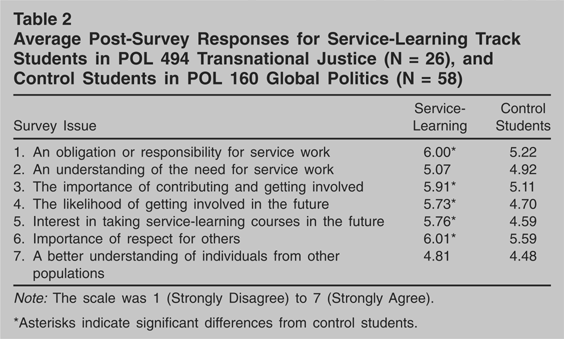
We evaluated the effectiveness of the service-learning component through the comparison of two sets of responses. First, we evaluated the changes in responses made by Transnational Justice service-track students from the pre-surveys given at the beginning of the semester to the post-surveys completed at the end of the semester. Table 1 provides the primary issues of interest that the survey addressed and the average survey responses for students in the service track. Second, since there were only seven non-service students in the Transnational Justice course, rendering any measurable changes non-significant in statistical terms, we also compared the service-track students' responses to responses offered by students in a comparable course, introductory Global Politics, which did not have a service-learning component. Table 2 presents the average post-survey responses for students in the Transnational Justice service track and the non-service control students in Global Politics.
Average Pre- and Post-Survey Responses for Service-Learning Track Students in POL 494 Transnational Justice (N = 26)

Average Post-Survey Responses for Service-Learning Track Students in POL 494 Transnational Justice (N = 26), and Control Students in POL 160 Global Politics (N = 58)

We discuss responses in terms of clusters of related questions, since many of the questions were at least partly duplicative of others, designed to probe aspects of the same general attitude areas. Clusters explore attitudes toward the following:
- A sense of obligation to do service work at the local, national, and global or transnational levels (Questions 1, 2, 3, 4, 5, and 6).
- An understanding of the need for such service work (Questions 7, 8, 9, 15, 16, 17, and 18).
- The importance of contributing and getting involved at the levels noted (Questions 11, 46, 47, 48, 52, 53, and 54).
- The likelihood of getting involved in the future at each of the three levels (Questions 10, 22, 23, 24, 28, 49, 50, and 51).
- Interest in taking service learning courses in the future (Questions 27, 42, and 45).
- Importance of respect for others (Questions 12, 13, 14, and 30).
- A better understanding of individuals from other populations (Questions 19 and 38).
Changes in Service-Learning Responses over the Semester
Transnational Justice students who selected the service-learning track showed a number of significant attitude changes over the course of the semester, in the direction of an increased sense of awareness and engagement with issues from the local to the global levels. These changes are similar to those found in other studies with students engaged in international service learning. For example, service-learning students showed an increase over the semester in their rated obligation to engage in service work, t(25) = 2.27, p = .02, where a p value of less than .05 represents a statistically significant difference. They also reported an increased appreciation of the importance of service work in general, t(25) = 3.55, p = .002. Further, they increased their ratings of the importance of getting involved themselves, t(25) = 3.08, p = .005, as well as the likelihood of getting involved in the future, t(25) = 3.28, p = .003.
Service-learning students showed significant increases in agreement that everyone should find time to contribute at the local [t(25) = 3.26, p = .003], national [t(25) = 2.38, p = .025], and global [t(25) = 2.77, p = .01] levels. Also worth noting is that students showed increases in their understanding of the various opportunities to contribute at the global level [t(25) = 2.08, p = .048] by the end of the class. They did not, however, show significant increases in their understanding of the various opportunities at the local and national levels. That the reported increase at the global level is greater than the other levels may be particularly salient in a study of transborder service learning, given the emphasis placed on contributing direct material aid across an international boundary. Additionally, service students' feelings that they could have a positive impact on issues at the local [t(25) = 1.14, p = .265], national [t(25) = 2.69, p = .013], and global [t(25) = 3.36, p = .002] levels also increased over the semester, although these increases were significant only for the national and global levels.
In summary, the service-learning experience appeared to significantly increase students' understanding of transborder service work, their likelihood of getting involved, and the perceived efficacy of such service work, particularly across international borders. We will note that the service work did not increase students stated ratings of respect for others, t(25) = 1.15, p = .26. Nor, somewhat counterintuitively, did students report an increased understanding of individuals from other populations, t(25) = 1.31, p = .20. The latter is discussed below in the context of the possible benefits of complementing transborder service learning with some forms of place-bound interaction, including inviting guest speakers from the served population.
Responses of Service-Learning vs. Similar Control Students
To reinforce, due to the low number of students who selected the standard track in the Transnational Justice course, we administered the survey to a political science class Cabrera taught. This course, Global Politics, addressed many of the same issues as the Transnational Justice course but did not include a service-learning component. The Global Politics course gave significant attention in terms of lecture time and assigned reading to universal human rights, global poverty and inequality, and to possibilities that those in affluent states could have strong obligations to transfer material resources and otherwise aid those in less-affluent states. For example, both groups of students were exposed to Peter Singer's core and quite demanding argument for increased distributions of resources to those in impoverished states from individuals within affluent states. The primary difference was that the Transnational Justice students encountered the argument in Singer's book-length treatment of global justice issues (Singer 2002), while the Global Politics students were introduced to it in an article aimed at a popular audience (Singer 1999), as well as in a class session devoted to discussion of it. Cabrera administered the post-survey to the entire 58-student Global Politics class at the conclusion of the semester.
Overall, the Transnational Justice service-learning students were more likely to feel an obligation to engage in service learning compared to the Global Politics control students, t(82) = 3.37, p = .001. The service-learning students also rated the importance of getting involved, as well as the likelihood of getting involved in service learning, higher than the control students, t(82) = 3.84, p < .001 and t(82) = 4.83, p < .001, respectively. Furthermore, the service-learning students seemed to reflect fondly on their service-learning experience, indicating a higher interest than control students in taking future service-learning courses, t(82) = 4.51, p < .001. The service-learning students also had higher ratings of the importance of respecting others compared to the control students, t(82) = 1.93, p = .05. Both groups of students, however, indicated that they had a good understanding of the need for service work and an equal understanding of individuals from other populations, ps > .47.
Thus, although both groups understood the need for service work and understood individuals from other populations, students who engaged in service learning felt an obligation to get involved. They thought getting involved was more important, and they reported that they were more likely to engage in service work in the future, than those who had not engaged in service work. The service-learning students also showed other advantages compared to control students. For example, the service-learning students indicated that they learned more from the assignments and experiences in the course compared to the control students, t(82) = 2.18, p = .033. They also indicated a better rapport with the instructor than the control students, t(82) = 3.92, p < .001, possibly due to the greater interaction they had with the instructor outside of normal class meeting times while working on the food drive.
Significance of Findings
The findings from this transborder service-learning project are consistent with findings from previous studies on ways in which international service learning can increase students' sense of engagement with issues and individuals across borders. For example, in a longitudinal study of students taking part in an international service-learning project with a social justice orientation, Kiely (2004) found significant transformation in perspectives, though students also reported difficulties or tensions in moving from heightened awareness of cross-border social issues to taking significant positive action to address such issues in their specific overseas service locales. Tonkin and Quiroga (2004) conducted a focus group study of 17 students taking part in international service-learning programs through the previously-noted International Partnership for Service-Learning and Leadership (IPSL) and observed that their student participants reported a greater sense of connectedness to global issues. Monard-Weissman (2003) reported similarly heightened awareness of global social issues and an increased sense of cross-border responsibility among IPSL students who participated in a service-learning program in Guayquil, Ecuador. Similar, though not systematic, observations are reported by Patterson (2000) in the place-bound interaction project involving aid to a Bosnian refugee family.
In sum, the findings for the current study indicate that place-bound students in a transborder service-learning class can realize many of the gains in understanding and engagement that are reported by students in international service learning, as well as by students in a place-bound interaction context. In addition, transborder service-learning students are able to make direct contributions of service and material aid similar to those participating in international service learning. In terms of enhanced understanding, the transborder students reported that they simply could not explain the need for the food drive without specific information on the economic context in Nogales, Mexico. Students reported being quizzed as they solicited donations in neighborhoods, outside grocery stores, and in campus classes, clubs, and other contexts, about why the bulk of the food collected was going to Mexico, especially as there was significant need much closer to home. Students were able to respond with information about low wages in the foreign-owned maquiladora factories where many of the recipient children's parents worked. They also offered information on a widespread lack of water, electricity, and other basic services in many Nogales neighborhoods, including some where the served children lived. In the process, their sense of connection with the recipient population was enhanced, and judging from survey results, so was their sense of obligation to such cross-border dwellers in need. The findings also reinforce an emerging literature on incorporating service-learning units into international relations, political theory, human rights (Krain and Nurse 2004), and more general philosophy courses (Lisman and Harvey 2000).
Limitations and Future Directions
The transborder service-learning model has potentially very wide application in higher education—in political science as well as a range of other disciplines. Classes at institutions located relatively near the border easily could replicate the food drive model, or another focusing on international transfers of material-aid, given the level of existing need and the relatively well developed networks of NGOs around the several large population centers on both sides of the border. Those situated elsewhere also could take advantage of NGO networks to deliver a range of tangible goods to overseas populations, including cash transfers directed to specific projects. For example, at ASU West campus, students in a political science course taught by Professor Julie Murphy Erfani were deeply impressed by the poverty they had witnessed on a BorderLinks experiential learning trip to some Nogales neighborhoods. They decided to launch a fundraising drive to support a financial initiative by BorderLinks' Nogales-based staffers. Students solicited donations over several months totaling more than $9,000, which provided base funding for a successful and still-expanding micro-credit program that BorderLinks launched in Nogales (Cutrer 2005).
Similar efforts could be undertaken with any of an increasingly large number of INGOs focusing on transborder issues, and they need not be limited to the collection and delivery of material aid. Thousands of U.S.-based organizations conduct informational or action-directed campaigns with international emphases. An excellent resource for locating such organizations, or for directing students interested in contributing service with a transborder focus, is the Idealist.org web site, which maintains a searchable database of tens of thousands of nonprofit organizations worldwide. Searches can be narrowed to organizations operating in particular cities, states, or provinces within the United States, Canada, and other countries.
The clearest limitation of this transborder service-learning study was the small number of non-service track students. This could be addressed through increasing the number of participants, possibly by increasing the enrollment size of the courses involved, permitting only a certain number of students to choose the service track, or having different sections of the same course select different tracks. Also, more contact with those who have direct knowledge of the populations being served could be incorporated into the classes or the service project. A guest speaker from the BorderLinks staff, for example, could provide important insider's insight to students, in addition to giving some indication of the actual uses aid can and is being put to.
In conclusion, transborder service learning provides a promising means of enhancing the engagement of place-bound students with the many communities they are embedded in, from the most local to the global. No claim is made here that a transborder service experience is fully substitutable for an international immersion, where students are not only serving a specific population, but living and engaging with that population in myriad ways for an extended period of time. As the results of this study suggest, however, place-bound students participating in service to a cross-border population can gain tremendously in their understanding of the special issues and problems faced by those in less-affluent countries. They can develop an enhanced sense of engagement and obligation to contribute, not only to those being served across borders, but to those in their local communities. The experience comes at a small fraction of the cost of an international service experience, and it is available to students whose family, work, or other circumstances keep them closer to home.
Author Bios
Luis Cabrera is lecturer in the department of political science and international studies at the University of Birmingham (UK). He is the author of Political Theory of Global Justice: A Cosmopolitan Case for the World State (2004). He has published articles on global distributive justice, trans-state democracy, and immigration ethics. He can be reached at a.l.cabrera@bham.ac.uk.
Jeffrey Anastasi is an assistant professor in the psychology department at Sam Houston State University. His current research focuses on cognitive psychology including topics such as illusory memories, face recognition, eyewitness memory, and the effects of information on food choice behavior. He can be reached at jeff.anastasi@shsu.edu.
Appendix