Background
Tuberculosis (TB) is a preventable infectious disease that remains an important clinical and public health problem among end-stage renal disease (ESRD) patients.Reference Hussein, Mooji and Roujouleh 1 Diagnosis of TB among ESRD patients may be challenging because of atypical findings such as lower-lobe infiltrates on chest radiography, negative tuberculin skin test, sputum specimens that have negative acid-fast bacilli smear results, and a high occurrence of extrapulmonary TB.Reference Richardson 2 Tuberculosis incidence rates are 6–25-fold higher among ESRD patients than the general population of TB patients.Reference Chia, Karim, Elwood and FitzGerald 3 – Reference Dobler, McDonald and Marks 8 Mortality prior to TB diagnosis or during treatment is 2–3 fold higher among ESRD patients.Reference Chitnis, Schecter, Cilnis, Robsky, Flood and Barry 9 , Reference Hannah, Miramontes and Gandhi 10 Because ESRD patients are at risk for developing TB disease due to transmission of Mycobacterium tuberculosis in dialysis facilities and due to reactivation of latent tuberculosis infection (LTBI), effective strategies to prevent TB in this population are needed.
In this article, we review the epidemiology of ESRD, TB, and LTBI among ESRD patients in the United States; investigations of TB exposures in US dialysis facilities; and published guidelines and evidence for TB prevention in the dialysis population. We apply this information to identify optimal screening and treatment strategies for decreasing TB among ESRD patients and in dialysis facilities.
Epidemiology
End-Stage Renal Disease
Annual estimates of the incidence, prevalence, and descriptive epidemiology of ESRD are published in the US Renal Data System (USRDS) Annual Report. 11 In this annual report, data from the Centers for Medicare and Medicaid Services (CMS) are used to identify ESRD patients who have started or are currently on renal replacement therapy such as dialysis or transplantation. 11 The USRDS Annual Report, however, does not include data on the number or proportion of non–US-born ESRD cases, 11 which is an important demographic factor used to characterize TB risk. During 1996–2006, the ESRD incidence rate adjusted for age, sex, and race or ethnicity increased from 328 per 1 million population to 387 per million, respectively; 11 however, during 2006–2014, the adjusted ESRD incidence rate decreased to 358 per million. 11 Most recently, during 2012–2014, the adjusted ESRD incidence rate was stable at 355 per million. 11 In contrast, age-, sex-, race/ethnicity-adjusted prevalence of ESRD increased annually from 1,283 per million in 1996 to 1,990 per million in 2014. 11 Among 678,383 ESRD cases in 2014, the most common treatment modalities for dialysis were hemodialysis (63%) followed by kidney transplant (30%) and peritoneal dialysis (7%). 11
For this paper, we limit our review to ESRD patients who receive hemodialysis because this is the most common treatment modality for US dialysis patients and because of infection prevention concerns regarding TB transmission in dialysis facilities. Although transplant patients are not discussed, these patients also have high TB incidence ratesReference Klote, Agodoa and Abbott 12 , Reference Lopez de Castilla and Schluger 13 and are also typically placed on immunosuppressive medications that increase the risk of developing TB.
Tuberculosis among ESRD patients
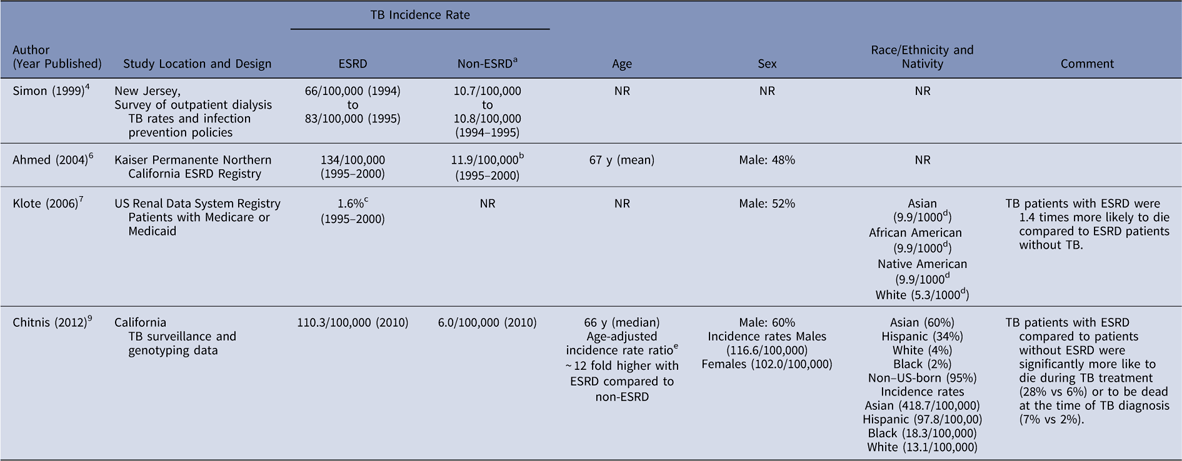
An increased risk of TB among ESRD patients may have been first documented in 1974 at a hospital in New York City.Reference Pradhan, Katz, Nidus, Matalon and Eisinger 14 Subsequently, to our knowledge, only 4 studies in the United States have used a population-based perspective to assess TB epidemiology among ESRD patients.Reference Simon, Paul, Wartenberg and Tokars 4 , Reference Ahmed and Karter 6 , Reference Klote, Agodoa and Abbot 7 , Reference Chitnis, Schecter, Cilnis, Robsky, Flood and Barry 9 These population-based studies are summarized in Table 1.
Epidemiology of Tuberculosis (TB) Among End-Stage Renal Disease (ESRD) Patients

Note. AFB, acid-fast bacilli; CXR, chest radiograph; ESRD, end-stage renal disease; LTBI, latent tuberculosis infection; NR, not reported; TB, tuberculosis; TST, tuberculin skin test.
a TB incidence rate in the general population of patients without ESRD.
b Average TB rate in California during 1995–2000.
c Cumulative TB incidence proportion among ESRD patients on hemodialysis; incidence proportion reported as 1.2% for patients on peritoneal dialysis.
d Incidence rate by race/ethnicity reported per 1,000 person-years at risk.
e Incidence rate ratio was calculated as follows: TB incidence rate in ESRD divided by TB incidence rate in non-ESRD population.
Most studies have utilized TB data from the late 1990s to 2000,Reference Simon, Paul, Wartenberg and Tokars 4 , Reference Ahmed and Karter 6 , Reference Klote, Agodoa and Abbot 7 and 1 study used TB data from 2010.Reference Chitnis, Schecter, Cilnis, Robsky, Flood and Barry 9 Also, 2 studies used data obtained at the state level,Reference Simon, Paul, Wartenberg and Tokars 4 , Reference Chitnis, Schecter, Cilnis, Robsky, Flood and Barry 9 1 study used regional data from a large health maintenance organization,Reference Ahmed and Karter 6 and 1 study used national data for ESRD patients.Reference Klote, Agodoa and Abbot 7 In these studies, a TB case was defined as a patient who (1) received treatment for active TB disease;Reference Simon, Paul, Wartenberg and Tokars 4 , Reference Ahmed and Karter 6 (2) had a Medicare claim for TB;Reference Klote, Agodoa and Abbot 7 or (3) had laboratory or clinical evidence of TB disease.Reference Ahmed and Karter 6 , Reference Chitnis, Schecter, Cilnis, Robsky, Flood and Barry 9 Overall, population-based TB incidence rates, defined as the number of TB cases per 100,000 population, were 6–18-fold higher among ESRD patients compared to patients without ESRD.Reference Simon, Paul, Wartenberg and Tokars 4 , Reference Ahmed and Karter 6 , Reference Chitnis, Schecter, Cilnis, Robsky, Flood and Barry 9 Age-adjusted TB incidence rates were calculated in 1 study,Reference Chitnis, Schecter, Cilnis, Robsky, Flood and Barry 9 and incidence rates were 12-fold higher among ESRD patients compared to patients without ESRD.Reference Chitnis, Schecter, Cilnis, Robsky, Flood and Barry 9 These TB incidence rates were not adjusted for the fraction of non–US-born people in the general population. Although TB rates were significantly higher among ESRD patients compared to the general population, the number of TB cases with ESRD was small—only 3.5% of TB patients had ESRD (83 ESRD patients among 2,327 TB cases in California).Reference Chitnis, Schecter, Cilnis, Robsky, Flood and Barry 9 Prevention of TB among ESRD patients, therefore, may not have an impact on the overall rates of TB and may not be a priority from a population health perspective. However, prevention of TB in the ESRD population remains an important problem for healthcare providers who care for these patients.
Most TB patients with ESRD were males, Asian, Hispanic, and African-Americans;Reference Klote, Agodoa and Abbot 7 , Reference Chitnis, Schecter, Cilnis, Robsky, Flood and Barry 9 persons in these demographic categories also had higher TB incidence rates compared to femalesReference Chitnis, Schecter, Cilnis, Robsky, Flood and Barry 9 and whites,Reference Klote, Agodoa and Abbot 7 , Reference Chitnis, Schecter, Cilnis, Robsky, Flood and Barry 9 respectively. Place of birth is an important epidemiologic factor because birth in a high-TB-burden country increases the likelihood of TB exposure and LTBI prior to arrival in the United States. Of all TB patients with ESRD, 95% were non–US-born, and nearly all of these patients arrived in the United States ≥5 years before the diagnosis of TB.Reference Chitnis, Schecter, Cilnis, Robsky, Flood and Barry 9 In addition, ~30% of TB patients with ESRD died prior to diagnosis or during treatment.Reference Ahmed and Karter 6 , Reference Chitnis, Schecter, Cilnis, Robsky, Flood and Barry 9 Consistent with other studies,Reference Richardson 2 TB patients with ESRD, compared to patients without ESRD, were less likely to have typical findings of TB disease including a positive tuberculin skin test (TST), acid-fast bacilli detected in sputum smears, and cavities on chest radiography (CXR).Reference Chitnis, Schecter, Cilnis, Robsky, Flood and Barry 9 Tuberculosis genotyping data were utilized in 1 study to determine whether TB among ESRD patients resulted from recent transmission or reactivation of LTBI.Reference Chitnis, Schecter, Cilnis, Robsky, Flood and Barry 9 The proportion of matching TB genotypes in this study was low (~20%), and no differences were detected in the proportion of matching genotypes among patients with and without ESRD (20% vs 23%).Reference Chitnis, Schecter, Cilnis, Robsky, Flood and Barry 9 These genotyping data suggest that only 20% of TB cases among ESRD may be a result of a recent TB transmission, and the remaining 80% of cases resulted from reactivation of LTBI due to remote TB exposure.Reference Chitnis, Schecter, Cilnis, Robsky, Flood and Barry 9
Tuberculosis infection prevention practices were systematically surveyed in 1 study.Reference Simon, Paul, Wartenberg and Tokars 4 Among 41 dialysis centers, 6 (15%) reported TB screening for ESRD patients; 1 center conducted TSTs for all new patients, while 5 centers used CXR for initial and follow-up TB screening.Reference Simon, Paul, Wartenberg and Tokars 4 Despite the fact these data are nearly 20 years old, they highlight the need for compliance and consistency with TB screening and treatment policies in dialysis facilities. Only 1 study collected data on results of TST screening prior to TB diagnosis.Reference Ahmed and Karter 6 Of 13 TB patients with ESRD, 2 (15%) had TST results documented in the medical record, and both patients had a positive TST result but had never received LTBI treatment.Reference Ahmed and Karter 6 Although these data are limited by the extent to which TST results were documented in the medical record, they provide evidence to suggest that ESRD patients may not be receiving LTBI treatment.
LTBI prevalence and screening
To our knowledge, no studies have assessed LTBI prevalence among US ESRD patients. Studies of LTBI among dialysis patients in low- and high-TB-burden countries have detected prevalences ranging from 20% to 70%.Reference Segall and Covic 15 The wide range of estimates may, in part, be due to (1) the use of the interferon-gamma release assay (IGRA) or the TST for LTBI detection, (2) background TB prevalence, (3) the degree of immunosuppression, and (4) the fraction of population from high-burden countries. Several systematic reviews and meta-analyses have been published on the performance of IGRAs and TSTs for LTBI diagnosis among ESRD patients, and findings from these studies recommend the use of IGRAs over TSTs.Reference Rogerson, Chen and Kok 16 – Reference Ayubi, Doosti-Irani and Sanjari Moghaddam 18 First, IGRAs had a higher sensitivity and specificity for LTBI diagnosis compared to TSTs. The pooled sensitivity of the QuantiFERON-TB Gold (QFT-G), compared to TST, was 53% versus 31%, and pooled specificity was 69% versus 63%. The T-SPOT.TB also had a higher sensitivity (50% vs 31%) and specificity (67% vs 63%) than TST.Reference Ferguson, Tangri and Macdonald 17 Second, a positive IGRA result, compared to a positive TST, was significantly more likely to be associated with clinical risk factors for LTBI including radiologic evidence of past TB disease and contact with a case of active TB disease.Reference Rogerson, Chen and Kok 16 Although these studies provide evidence to suggest that IGRAs may be preferred over TSTs for the diagnosis of LTBI among ESRD patients, a recent mathematical modeling study found that, driven largely by the limited life expectancy of ESRD patients, LTBI testing and treatment among non–US-born ESRD patients in the United States may not be cost-effective.Reference Tasillo, Salomon, Trikalinos, Horsburgh, Marks and Linas 19 In this study, the cost of an IGRA and TST were estimated based on Medicare-allowable fees as $84.35 and $7.87, respectively. Two important factors should be considered when interpreting the results of this cost-effectiveness study. First, as noted by the authors of the studyReference Tasillo, Salomon, Trikalinos, Horsburgh, Marks and Linas 19 and the accompanying invited commentary,Reference Flood and Barry 20 LTBI screening and treatment for non–US-born ESRD patients may be warranted for infection prevention reasons such as preventing the spread of TB in dialysis facilities. Second, the rate of LTBI reactivation for non–US-born ESRD patients used in cost-effectiveness modelsReference Tasillo, Salomon, Trikalinos, Horsburgh, Marks and Linas 19 may have underestimated the rate of reactivation in this population. The cost-effectiveness models assumed that non–US-born ESRD patients had 1.8 times the rate of TB reactivation compared to non–US-born patients without comorbidities.Reference Tasillo, Salomon, Trikalinos, Horsburgh, Marks and Linas 19 However, published studies in the United States have noted TB rates up to 12 times higher among ESRD patients compared to the general population,Reference Chitnis, Schecter, Cilnis, Robsky, Flood and Barry 9 and a meta-analysis that included studies outside of the United States found that rates among ESRD patients were 4 times higher than in the general population.Reference Al-Efraij, Mota, Lunny, Schachter, Cook and Johnston 21
Tuberculosis investigations in dialysis facilities
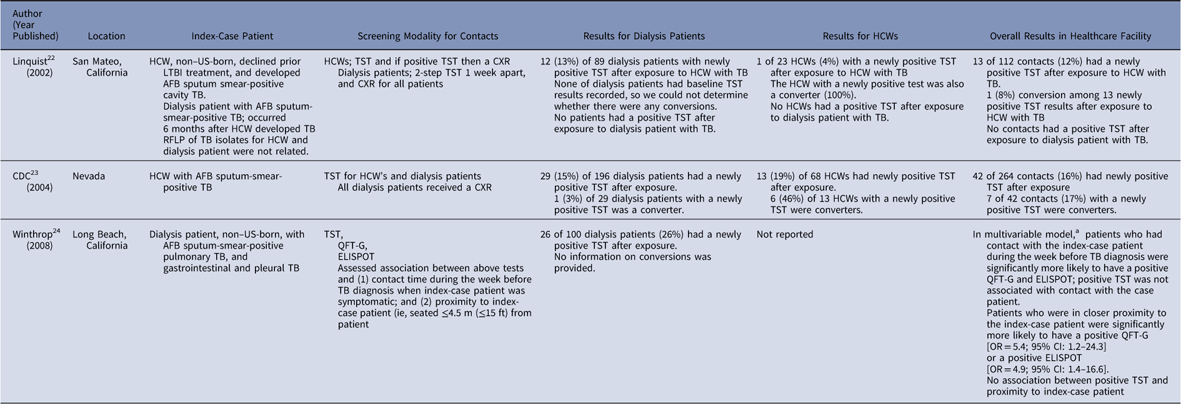
Although TB incidence among ESRD patients is high, few reports of TB contact investigations in dialysis facilities have been published.Reference Linquist, Rosaia, Riemer, Heckman and Alvarez 22 – Reference Winthrop, Nyendak and Calvet 24 Studies of TB contact investigations in US dialysis facilities are summarized in Table 2.
Tuberculosis (TB) Contact Investigations in Dialysis Facilities

Note. AFB, acid-fast bacilli; CDC, Centers for Disease Control and Prevention; CI, confidence interval; CXR, chest radiograph; ELISPOT, enzyme-linked immuno-spot assay; HCW, healthcare worker; LTBI, latent tuberculosis infection; OR, odds ratio; QFT-G, QuantiFERON-TB Gold test; RFLP, restriction fragment length polymorphism; TB, tuberculosis; TST, tuberculin skin test.
a Multivariable model controlled for age, non-US birth, and TST performed in the previous year.
The TB contact investigations were reported in 2 dialysis facilities in California counties,Reference Linquist, Rosaia, Riemer, Heckman and Alvarez 22 , Reference Winthrop, Nyendak and Calvet 24 and 1 contact investigation was conducted in a facility in Nevada. 23 Also, 2 contact investigations were conducted in response to an index-case patient who was a healthcare worker (HCW) with acid-fast bacilli (AFB) sputum-smear-positive pulmonary TB.Reference Linquist, Rosaia, Riemer, Heckman and Alvarez 22 , 23 The third published contact investigation was conducted in response to a dialysis patient with AFB sputum-smear-positive pulmonary TB.Reference Winthrop, Nyendak and Calvet 24
Two TB contact investigations provided information on testing and treatment outcomes for contacts.Reference Linquist, Rosaia, Riemer, Heckman and Alvarez 22 , 23 Both contact investigations classified dialysis patients as immunocompromised contacts, and these patients were evaluated for TB by conducting a review of symptoms, physical examination, TST, and CXR.Reference Linquist, Rosaia, Riemer, Heckman and Alvarez 22 , 23 The HCWs were considered immunocompetent, and they underwent a similar evaluation as dialysis patients, except a CXR was ordered only if an HCW had symptoms or a positive TST.Reference Linquist, Rosaia, Riemer, Heckman and Alvarez 22 , 23 A secondary case of TB was identified in 1 contact investigation;Reference Linquist, Rosaia, Riemer, Heckman and Alvarez 22 however, the genotypes for these cases did not match, which suggested that the cases were not related.Reference Linquist, Rosaia, Riemer, Heckman and Alvarez 22 Tuberculosis transmission as a result of exposure to the index case-patient was reported in both contact investigations.Reference Linquist, Rosaia, Riemer, Heckman and Alvarez 22 , 23 In both contact investigations, TB transmission was assessed in dialysis patients and the HCWs if they had a newly positive TST result (ie, no previous TST test recorded and then a positive TST result).Reference Linquist, Rosaia, Riemer, Heckman and Alvarez 22 , 23 Both contact investigations also assessed for conversions of TST results in HCWs from a negative TST result in the past to a positive TST result;Reference Linquist, Rosaia, Riemer, Heckman and Alvarez 22 , 23 however, only 1 contact investigation specifically defined a conversion as an increase in induration of ≥10 mm compared with a TST obtained during the 2-year period before exposure to the index-case patient. 23
In the first contact investigation, 12% of all contacts had a newly positive TST result, and 8% of contacts with a positive TST result were converters.Reference Linquist, Rosaia, Riemer, Heckman and Alvarez 22 Among ESRD patients, 13% had a newly positive TST result, and the percentage of conversions could not be calculated because these patients did not have baseline TST results recorded.Reference Linquist, Rosaia, Riemer, Heckman and Alvarez 22 For HCWs, 4% had a newly positive TST result; only 1 HCW had a newly positive TST result, and this patient also was a converter.Reference Linquist, Rosaia, Riemer, Heckman and Alvarez 22 In the second contact investigation, 16% of all contacts had a newly positive TST result, and 17% of contacts with a positive TST result were converters. 23 Among ESRD patients, 15% had a newly positive TST result, and 3% were converters. 23 For HCWs, 19% had a newly positive TST result, and 46% were converters. 23 The results from both contact investigations suggested that TB transmission in dialysis facilities may be an infrequent occurrence. There are a few possible explanations for this finding. First, ESRD patients often have several comorbidities and may be routinely seen by several healthcare providers. When ESRD patients develop respiratory symptoms suggesting TB, their healthcare providers may send them to hospitals or other healthcare facilities for evaluation, thus reducing the time they may spend in a dialysis facility prior to TB diagnosis. Second, cough frequency and dynamics of cough in ESRD patients may not favor TB transmission because ESRD patients are frequently AFB sputum-smear negative. Third, dialysis facilities may have effective infection prevention programs that require use of respiratory protection for symptomatic ESRD patients, and they may utilize environmental control measures to reduce the spread of TB.
The third contact investigation assessed the utility of using QFT-G, a laboratory-developed enzyme-linked immuno-spot assay (ELISPOT), or TST during an investigation that was limited to ESRD patients at a dialysis facility.Reference Winthrop, Nyendak and Calvet 24 This contact investigation evaluated the association between these 3 TB tests and contact time during the week before the index-case patient was diagnosed with TB and proximity to the index-case patient, which was defined as being seated within 4.5 m (~15 feet) of the index-case patient in the dialysis facility.Reference Winthrop, Nyendak and Calvet 24 This contact investigation did not report data on conversions for ESRD patients.Reference Winthrop, Nyendak and Calvet 24 A total of 100 ESRD patients who did not have a prior positive TST result or LTBI treatment were included in the investigation: 26% had a positive TST, 22% had a positive QFT-G, and 28% had a positive ELISPOT.Reference Winthrop, Nyendak and Calvet 24 No association between a positive TST and proximity in the dialysis facility and contact time to the index-case patient was detected.Reference Winthrop, Nyendak and Calvet 24 However, a significant association between a positive QFT-G and ELISPOT and contact time and proximity to the index-case patient was reported.Reference Winthrop, Nyendak and Calvet 24 These findings suggest that the negative predictive value of ruling out LTBI in the setting of a TB contact investigation in a dialysis facility may be high if an IGRA is used with a specific definition for a TB contact that includes proximity to the index-case patient. Although this study did not mention whether ESRD patients received a routine CXR or a CXR only if there was a positive TST or IGRA result,Reference Winthrop, Nyendak and Calvet 24 the findings from other TB contact investigations that did not find secondary cases of TB disease when routine CXRsReference Linquist, Rosaia, Riemer, Heckman and Alvarez 22 , 23 were obtained for all contacts, provide indirect evidence that routine CXRs are not needed for all ESRD patients identified as contacts in dialysis facilities. This assertion is also consistent with the most recent Centers for Disease Control and Prevention (CDC) guidelines for investigations of contacts with infectious TB. 25 In these CDC guidelines, contacts who have immunocompromising conditions, which rapidly increases the risk for progression from LTBI to TB disease (eg, human immunodeficiency virus infection (HIV) or receipt of tumor necrosis alpha antagonists, antirejection drugs for organ transplantation, or multiple cancer chemotherapy agents) require routine screening with a CXR. 25 ESRD impairs the immune system, in part, due to uremia,Reference Kato, Chmielewski and Honda 26 but the risk of progression from LTBI to TB disease is lower for ESRD compared to immunocompromising conditions such as HIV infection. 27 The CDC guidelines for the investigation of TB contacts, therefore, do not recommend that ESRD patients who are contacts undergo routine screening with a CXR. 25 The decision to obtain a routine CXR for ESRD patients identified as contacts should be considered if secondary cases of active TB disease are identified in other ESRD patients at a dialysis facility or there is evidence of transmission among sentinel persons including HCWs and household contacts.
Guidelines and evidence for TB prevention among ESRD patients
Current guidelines recommend that dialysis patients undergo LTBI screening upon ESRD diagnosis or on entry into a dialysis facility. 28 Subsequent LTBI screening would be indicated if a dialysis patient were exposed to a patient with infectious pulmonary TB disease. 28 Treatment options for LTBI recommended by CDC include (1) isoniazid plus rifapentine (INH+RPT) once a week for 12 weeks; (2) rifampin (RIF) daily for 4 months; and (3) INH taken daily for 6–9 months. 27 , 29
Few clinical trials of LTBI treatment among dialysis patients have been published.Reference John, Thomas, Thomas, Jeyaseelan, Jacob and Shastry 30 , Reference Vikrant, Agarwal and Gupta 31 To our knowledge, both published clinical trials have compared INH taken daily for 1 year to placebo among dialysis patients in India.Reference John, Thomas, Thomas, Jeyaseelan, Jacob and Shastry 30 , Reference Vikrant, Agarwal and Gupta 31 In both clinical trials, the INH arm had a 50% lower occurrence of TB disease than the placebo arm.Reference John, Thomas, Thomas, Jeyaseelan, Jacob and Shastry 30 , Reference Vikrant, Agarwal and Gupta 31 The most common reason for treatment discontinuation in both trials was elevated liver enzymes, and the proportion of patients discontinuing varied from 11% to 36% of patients in the placebo arms and from 17% to 36% in the INH treatment arms of the respective trials.Reference John, Thomas, Thomas, Jeyaseelan, Jacob and Shastry 30 , Reference Vikrant, Agarwal and Gupta 31 However, nearly 80% of patients who discontinued treatment due to elevated liver enzymes in both trials had a history or new diagnosis of hepatitis B or C virus infection.Reference John, Thomas, Thomas, Jeyaseelan, Jacob and Shastry 30 , Reference Vikrant, Agarwal and Gupta 31 These clinical trial data suggest that a majority of ESRD patients with LTBI may be able to tolerate treatment with INH, and close monitoring of these patients with, or at risk for, hepatitis B or C virus infection may be warranted.
As an alternative to 9 months of INH for LTBI treatment among patients aged 2 years or older, the CDC has recently recommended INH+RPT administered by directly observed therapy. 29 This recommendation has been guided by the results of 3 open-label randomized clinical trials.Reference Schechter, Zajdenverg and Falco 32 – Reference Sterling, Villarino and Borisov 34 These trials included patients with LTBI who were at high risk for progression of TB disease and included contacts to cases, TST converters, HIV-infected individuals, and persons with radiographic evidence of fibrosis, and they did not specifically exclude ESRD patients.Reference Schechter, Zajdenverg and Falco 32 – Reference Sterling, Villarino and Borisov 34 For each trial,Reference Schechter, Zajdenverg and Falco 32 – Reference Sterling, Villarino and Borisov 34 INH+RPT was administered by directly observed therapy, while the comparator arms were all self-administered and included either (1) RIF and pyrazinamide taken daily for 2 months;Reference Schechter, Zajdenverg and Falco 32 (2) INH taken daily for 6 months, (3) INH taken daily for up to 6 years (ie, continuously administered INH was included in this trial of HIV-infected patients in South Africa to determine whether it was more effective than other treatments, and it may have prevented reinfection in a setting where TB transmission is common); (4) INH and RIF (INH+RIF) taken twice weekly for 12 weeks;Reference Martinson, Barnes and Moulton 33 or (5) INH taken daily for 9 months.Reference Sterling, Villarino and Borisov 34 In a trial that had an INH comparator arm, TB incidence rates were not significantly different in those treated with INH+RPT (2.0 per 100 person years), those treated with INH+RIF taken twice weekly for 12 weeks (2.0 per 100 person years), and those treated with INH taken daily for up to 6 years (1.4 per 100 person years) compared to the INH taken daily for 6 months arm (1.9 per 100 person years) (P > .05 for all comparisons to those treated with INH taken daily). The proportions of patients who were adherent to medications (defined as reported taking or were observed taking >90% of medications) were 96% in those treated with INH+RPT, 95% in those treated with INH+RIF, 84% in those treated with INH daily for 6 months, and 61% among patients treated with INH for >3 years (who were randomized to taking INH daily for 6 years) (statistical comparisons not provided). A grade 3 or 4 hepatotoxicity adverse event occurred in 1.5% of patients in the INH+RPT arm, in 2.4% in the INH-RIF arm, in 5.5% in the INH daily for 6 months arm, and in 28.0% in the INH daily for 6 years arm (P<.001 for comparison of INH 6 months vs INH for 6 years; no other comparisons provided).
For the second trial with an INH arm, TB incidence rates were 0.07 per 100 person years in those treated with INH+RPT and 0.16 per 100 person years in those treated with INH taken daily for 9 months. The cumulative TB rate was 0.43% in the INH+RPT arm and 0.19% in the INH arm. This trial was a non-inferiority trial with a preset non-inferiority margin of 0.75% for the difference in cumulative TB rate, which was defined as the rate in the INH+RPT arm minus the rate in the INH arm. INH+RPT treatment was equivalent to INH treatment: the difference in cumulative TB rate was −0.24% (95% confidence interval [CI], −0.50% to 0.01%). The proportion of patients completing treatment was significantly higher in the INH+RPT arm than in the INH arm (82.1% vs 69.0%; P<.001). The proportion of patients with hepatoxicity attributed to the study drug was significantly higher in the INH arm than in the INH+RPT arm (2.7% vs 0.4%; P<.001).
Currently, the CDC recommends that patients with medical conditions associated with TB disease, such as ESRD, should be considered for the INH+RPT regimen on a case-by-case basis. 29 Adherence to the INH+RPT LTBI regimen may be high among ESRD patients because the administration of these medications and monitoring for side effects can be performed during dialysis sessions by healthcare providers. However, to our knowledge, no published data regarding the use of RPT in ESRD patients are available, and whether RPT is cleared by hemodialysis remains unknown. Additional studies evaluating the pharmacokinetics and feasibility of implementing INH+RPT among ESRD patients in dialysis facilities may help inform clinical decisions regarding utilization of this short-course regimen in this population. Although data on pharmacokinetics of RPT in dialysis patients are limited, several single-center studies have used INH+RPT in patients awaiting kidney transplant. In these studies, at least 40 ESRD patients on dialysis tolerated and completed treatment with INH+RPT.Reference De Castilla, Rakita, Spitters, Narita, Jain and Limaye 35 – Reference Simkins, Abbo, Camargo, Rosa and Morris 37
Rifampin is currently recommended as an option for LTBI treatment for patients intolerant to INH or patients exposed to an index-case patient with INH-resistant TB disease. 27 No data on RIF for LTBI in ESRD patients exists to our knowledge. In a murine model of LTBI, treatment with 3 months of RIF or had a higher bacteriologic clearance than treatment with 6 months of INH, and equivalent efficacy as treatment with 2 months of RIF plus pyrazinamide.Reference Lecoeur, Truffot-Pernot and Grosset 38 Despite these findings from murine models, only 1 published randomized clinical trial has evaluated efficacy of RIF for LTBI treatment. 39 In this trial, 679 elderly men in Hong Kong with pulmonary silicosis who had a positive TST, no previous TB treatment, and no evidence of active TB disease were randomized to placebo, treatment with 6 months of INH, 3 months of INH+RIF, or 3 months of RIF alone. 39 After 5 years of follow-up, active pulmonary TB disease developed in a significantly higher proportion of patients in the placebo arm than in the 3 active treatment arms (27% vs 13%). 39 There were no significant differences in the proportion of TB disease among patients randomized to receive treatment with 3 months of RIF (10%), 3 months of INH+RIF (13%), or 6 months of INH (16%). 39 The estimated effectiveness of treatment with 3 months of RIF in this trial was 65%. 39 These findings are also supported by a recent meta-analysis that reported comparable efficacy of treatment with 4 months of RIF to other regimens such as treatment with 6 months of INH or 3 months of INH+RIF.Reference Zenner, Beer, Harris, Lipman, Stagg and van der Werf 40 Regarding safety, the frequencies of adverse events were similar across all arms. 39 Although hepatic toxicity was only reported in 8 patients (1%) across all arms of the trial, none of the patients developed hepatic toxicity in the RIF arm; while 3 patients developed hepatic toxicity in the INH+RIF arm as well as 3 patients in the INH arm and 2 patients in the placebo arm. 39
Single-center studies,Reference Page, Sifakis and Montes de Oca 41 , Reference Lardizabal, Passannante, Kojakali, Hayden and Reichman 42 as well as randomized trialsReference Menzies, Dion, Rabinovitch, Mannix, Brassard and Schwartzman 43 , Reference Menzies, Long and Trajman 44 assessing safety end points, have also noted the lower occurrence of clinically significant, serious adverse events, or grade 3–4 adverse events of hepatotoxicity among patients who received treatment with 4 months of RIF compared to 9 months of INH. In addition, these studies also noted that a higher proportion of patients who received treatment with 4 months of RIF compared to 9 months of INH completed LTBI treatment.Reference Page, Sifakis and Montes de Oca 41 – Reference Menzies, Long and Trajman 44 A large multicenter open-label randomized clinical trial comparing the efficacy of treatment with 4 months of RIF to 9 months of INH as an LTBI treatment among adults with a positive TST was also completed in April 2017. 45 The results of this larger trial will provide more definitive evidence regarding the effectiveness of treatment with 4 months of RIF, 45 and whether this LTBI regimen has efficacy that is comparable to treatment with 9 months of INH.
Screening and treatment for TB in dialysis facilities
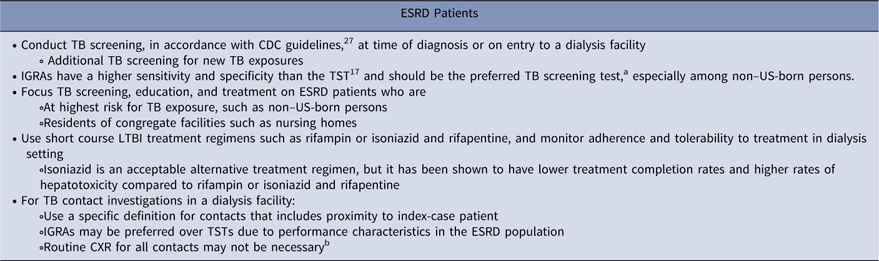
We propose a strategy for screening and treatment for TB based on our review of TB epidemiology among ESRD patients, contact investigations in dialysis facilities, and current TB and LTBI guidelines (Table 3). Because ESRD is a medical risk factor that increases the progression to TB disease, patients with ESRD should be screened for LTBI at or around the time of diagnosis of ESRD or upon entry to a dialysis facility. Infection prevention programs in dialysis facilities may consider focusing on TB education, screening, and treatment efforts upon entry to a facility for ESRD patients at high risk for TB exposure. These patients would include not only non–US-born persons but also residents of congregate settings, such as nursing homes. Combining the use of IGRAs in ESRD patients at highest risk for TB exposure with the use of short-course LTBI regimens may also be an effective strategy for identifying, treating, and preventing TB among ESRD patients.
Screening and Treatment Strategy for Preventing TB in Dialysis Facilities

Note. CDC, Centers for Disease Control and Prevention; CXR, chest radiograph; ESRD, end-stage renal disease; HCWs, healthcare workers; IGRA, interferon-gamma release assay; LTBI, latent tuberculosis infection; TB, tuberculosis; TST, tuberculin skin test.
a If a TST is used as a screening test, then 2-step testing is not routinely indicated for the initial screening test. Consider 2-step testing for patients who are going to be retested periodically (ie, nursing home residents).
b If secondary cases of active TB disease are identified in ESRD patients at a dialysis facility or there is evidence of transmission among sentinel persons including healthcare workers and household contacts, then consider obtaining routine CXRs on all ESRD patients who are identified as contacts.
Summary
Patients with ESRD have substantially higher TB incidence rates and mortality compared to the general population of TB patients. More than 90% of TB cases among ESRD patients occur among non–US-born persons, and most are due to reactivation of LTBI. Transmission of TB was rare in published contact investigations; we found no reports of secondary cases of TB because of exposure to an index-case patient and few reports of TB infections demonstrated by newly positive tuberculin skin tests (12%–16%) and conversions (8%–17%) among contacts. Prevention of TB in dialysis facilities requires screening ESRD patients at the highest risk for TB exposure (especially non–US-born persons), as well as treatment and targeted education regarding the importance of LTBI treatment among persons diagnosed with LTBI. Focusing TB prevention efforts on screening ESRD patients at highest risk for TB exposure upon entry to a dialysis facility through use of an IGRA and increasing the use of LTBI regimens like INH+RPT and RIF may be an effective strategy for reducing the burden of TB among ESRD patients and in dialysis facilities.
Acknowledgments
The authors acknowledge Cannika Nuth for editorial assistance.
Financial support
No financial support was provided relevant to this article.
Conflicts of interest
All authors report no conflicts of interest relevant to this article.