INTRODUCTION
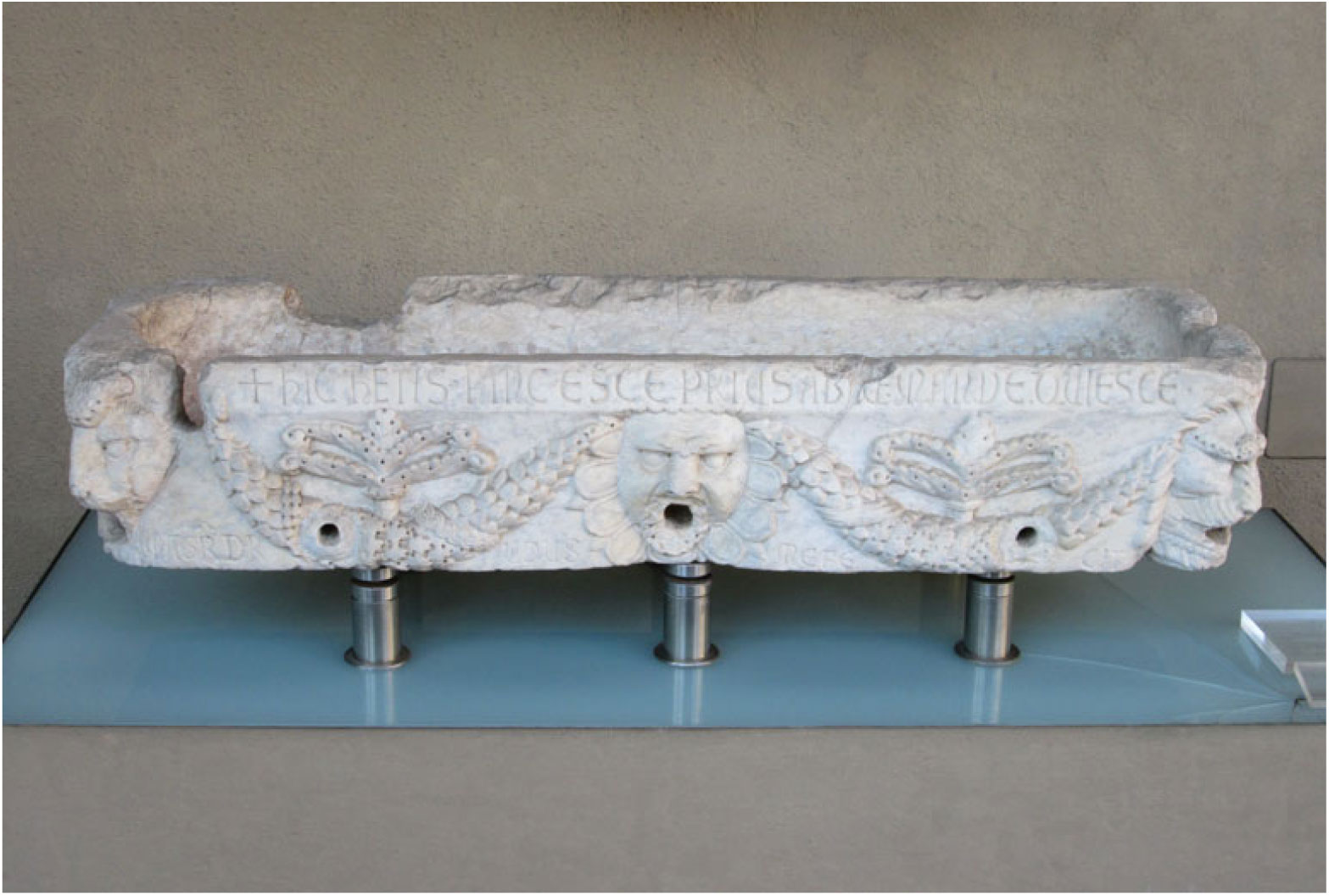
In the light of advances in our understanding of medieval art in Rome, the time is ripe for a reconsideration of a fountain basin sculpted by the marmorius Drudus de Trivio and which bears along its upper ledge the inscription ‘+HIC ThETIS hINC ESCE PRIVS ABLVE MANDE QVIESCE’. Of unknown provenance, this monument, now in the Museo di Palazzo Venezia in Rome, is a rare example of secular Romanesque sculpture. Decoration is confined to the front of the basin, which shows a satyr-like theatrical mask flanked by funerary garlands and ram and lion protomes, all of which are carved in a classicising manner (fig 1). Fashioned from marmo bianco, this fountain basin, measuring just 23cm in width, by 120cm in length and 36cm in depth, belongs to Drudus’s most inventive sculptural repertoire.Footnote 1
Drudus de Trivio, fountain basin, Museo di Palazzo Venezia, Rome. Photograph: © the author, 8 Dec 2016.

Scholarly interest has been focused on the signature along the base: ‘MAGISTER DRUDUS ME FECIT’. It was a well-established tradition for the Cosmati, and Roman artists generally, to sign their works, as Drudus does here.Footnote 2 Yet the fountain basin’s technical and stylistic features (for example, the distinctive drill-work) are so characteristic of Drudus that there would be no risk of misattribution even were it unsigned. The present paper investigates Drudus’s sources for the fountain basin, enquires into the derivation of his style and sets the piece in the context of other sculpture, primarily funerary, that Drudus is likely to have seen.
DRUDUS DE TRIVIO, MAGISTER
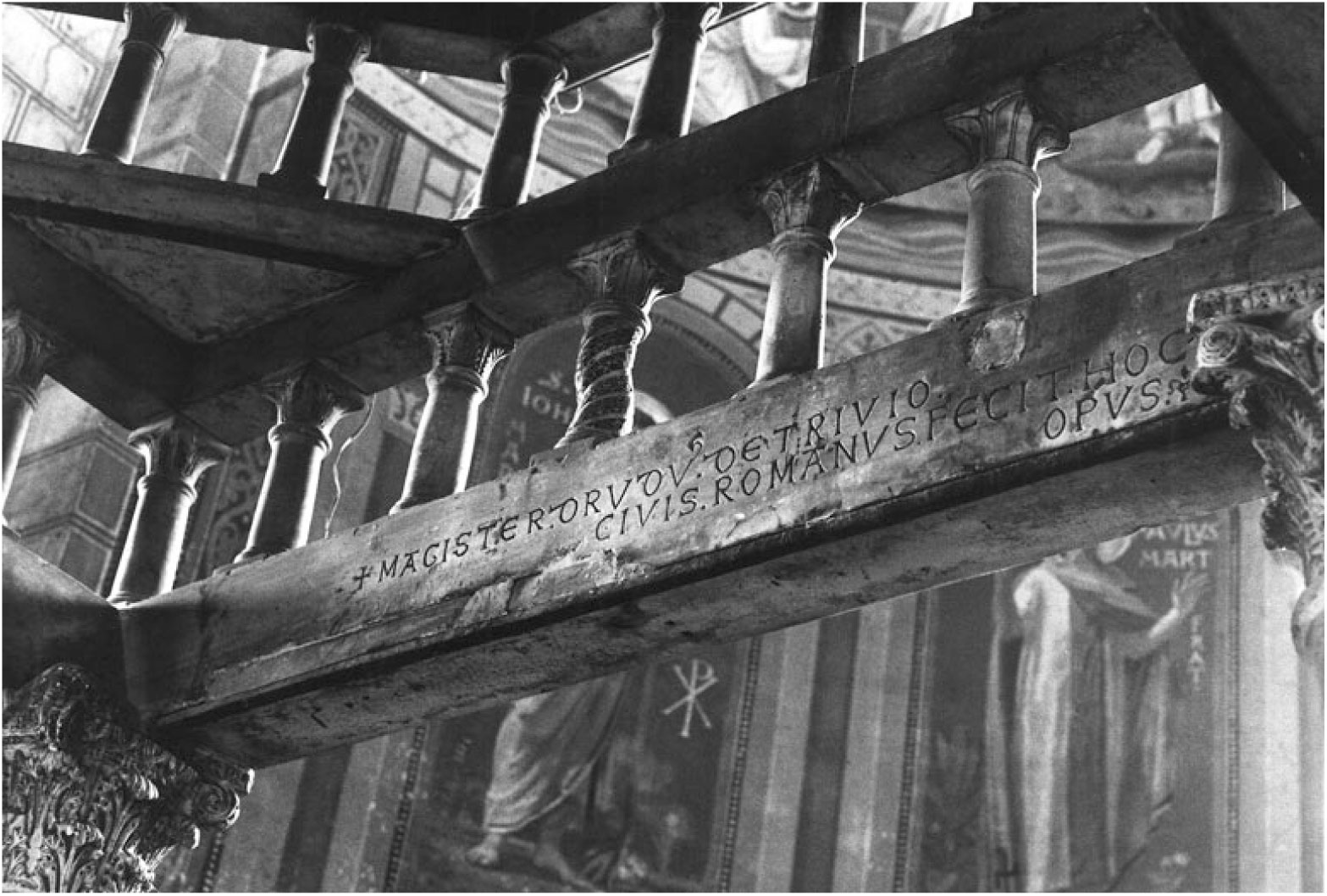
By way of introduction a few remarks are in order. Drudus de Trivio was a highly accomplished marble-worker active around the early to mid thirteenth century. He was his own master. On the ciborium at Ferentino, the most notable among his extant works, he describes himself as ‘MAGISTER DRVDV’ DE TRIVIO | CIVIS ROMANVS’, denoting out-of-town provenance (fig 2). Those who lived and worked in Rome were entitled to style themselves Civitus romanus; whereas Drudus’s toponymic de Trivio indicates his residence and probably the specific district of the city of Rome with which he wanted to be identified. As already noted, use of the appellation Magister, indicating an elevated professional position, was customary among the Cosmati and especially common between 1220 and 1240; moreover, it was by no means exceptional in the Duecento for sculptors to sign themselves as such in fountain inscriptions where, however, the toponymic is much less frequently encountered. One instance is Magister Lucas de Manoppello in the no longer extant fountain at Ortona (province of Chieti, 1251); his name with the same toponymic survives also in a fountain inscription in Teramo (1270).Footnote 3 But among the Cosmati marble-workers the use of the toponymic was standard practice and it is within a context of the major established Roman workshops that Drudus should be seen.Footnote 4
Ciborium, inscription on inner side of the architrave, Ferentino, Duomo. Photograph: © Conway Library, Courtauld Institute of Art, London.

These interconnected workshops of high-status marble-workers are best known for their mosaic stonework though they were sculptors too.Footnote 5 Yet Drudus’s oeuvre has even more in common with that of the Vassallectus marble-workers than with arte cosmatesca, as has been recognised.Footnote 6 He collaborated with a member of the workshop on the now lost interior décor of the collegiate church of Lanuvio.Footnote 7 It is not known exactly what assistance he received from his son Angelo de Trivio with whom he appears also to have worked. Further instances of his output will emerge in what follows. Since a largely autobiographical approach has been adopted by Peter Cornelius Claussen, who has placed his work within a broader early Duecento Roman framework, his career will not be charted in detail here.Footnote 8
THE FOUNTAIN BASIN
Sculptural context
It has long been acknowledged that the fountain basin owes much to the sculptural vocabulary of the newly completed cloisters of San Giovanni in Laterano and San Paolo fuori le mura, decorated by the Vassallectus workshops;Footnote 9 indeed, the basin’s relation to the imagery in these cloisters is indisputable. Just how Drudus drew on contemporary cloister sculpture in his fountain basin, without overtly echoing wider sculptural trends in Rome, will become clearer.Footnote 10 The fountain betrays an effort to assimilate marginal yet innovative cloister decoration into fountain design. The secular resonances of the imagery, in keeping with the non-Christian sculpture in the Lateran cloister, have not previously been highlighted. For instance, the two grotesque faces of the sphinxes, which guard the southern entrance in the Lateran cloister, are hardly the customary classical references; nor is Drudus’s sphinx, with its piercing gaze, at Cività Castellana.
The fountain basin has long been deemed an example of how Drudus takes up the sculptural vocabulary of sarcophagi (with their limited range of subjects), Roman grave furniture, cinerary urns, funerary altars and sculptured reliefs; however, the exact links have not yet been established. It will be argued that the fountain basin, with its vestigial tripartite composition, has more in common with tomb fronts and relief sculpture than with contemporaneous fountains.Footnote 11 In Rome there are no surviving examples of medieval public fountains. Indeed, the overall similarity of the fountain basin to a sarcophagus resulted in its being mislabelled as such in the celebratory exhibition at Castel Sant’Angelo in 1911.Footnote 12
In previous studies the iconography has been treated as a simple confection of elements derived from Antiquity and from contemporary decorative motifs originating in Roman cloister sculpture. The possibility that the manifestly secular inscription, with its reference to Thetis, might in some way reflect the fountain basin’s quotidian function has been neglected. The fountain basin’s literary background has been overlooked, though much more is known about its cultural backdrop. A satisfactory explanation for the inscription has not previously been advanced and this will be addressed later in the paper. The new translation of the inscription proposed here has implications for our understanding of the Cosmati. Examination of the inscription impels us to reassess the prevalent view that all Drudus’s extant work is liturgical – an interpretation corroborated by differential survival of secular and religious artefacts, illustrated by the widespread assumption that the output of the leading early fourteenth-century Italian painter, Giotto di Bondone (c 1266?–1337), was entirely religious.Footnote 13 As has been suggested, Thetis is a metonym for water, but this insight has not been explored adequately.Footnote 14 While not claiming to resolve this question here, we interrogate the specific reasons for Thetis’ inclusion. Moreover, by querying the accuracy of the hitherto unchallenged translation, it will be demonstrated that the fountain basin was never liturgical in function.
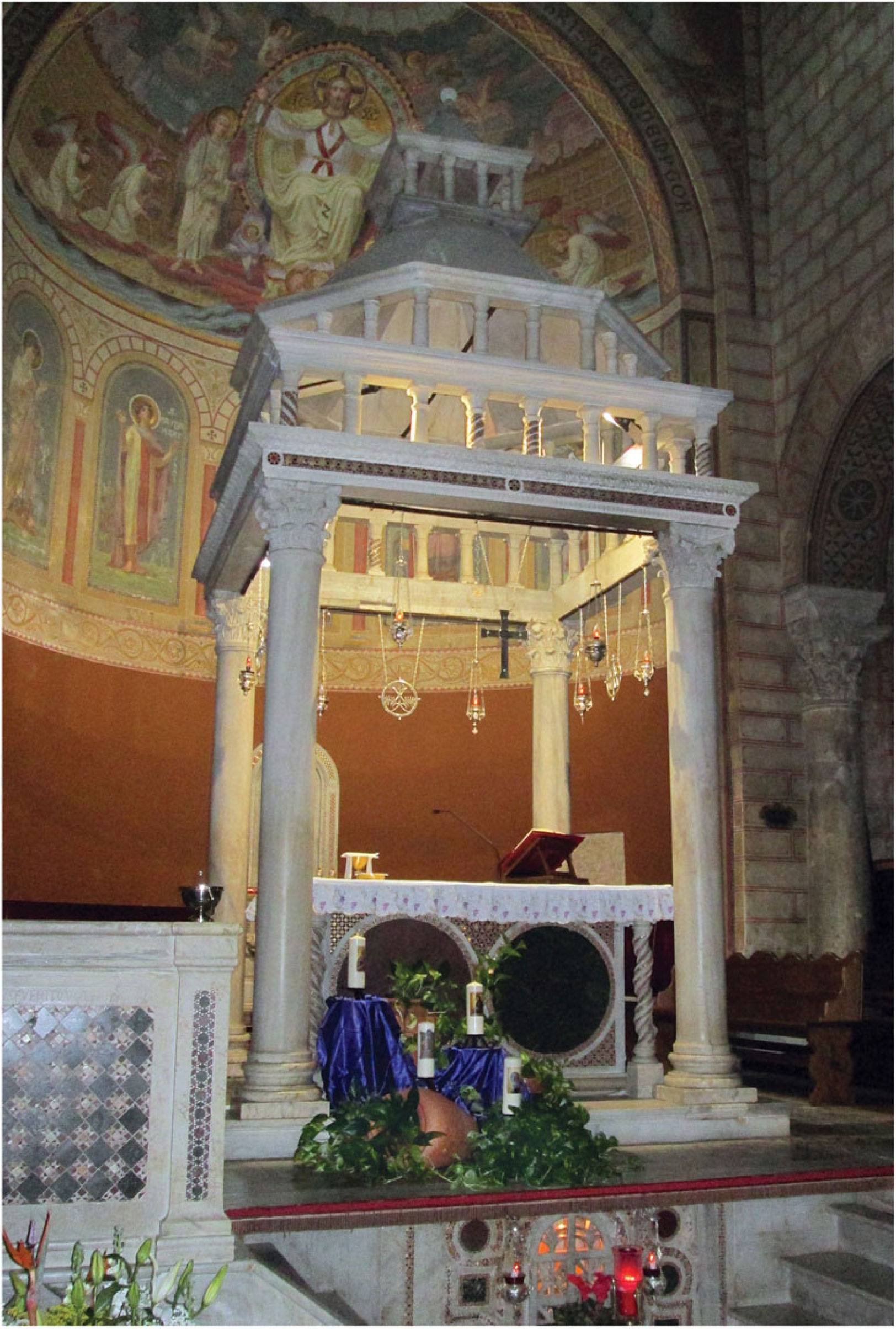
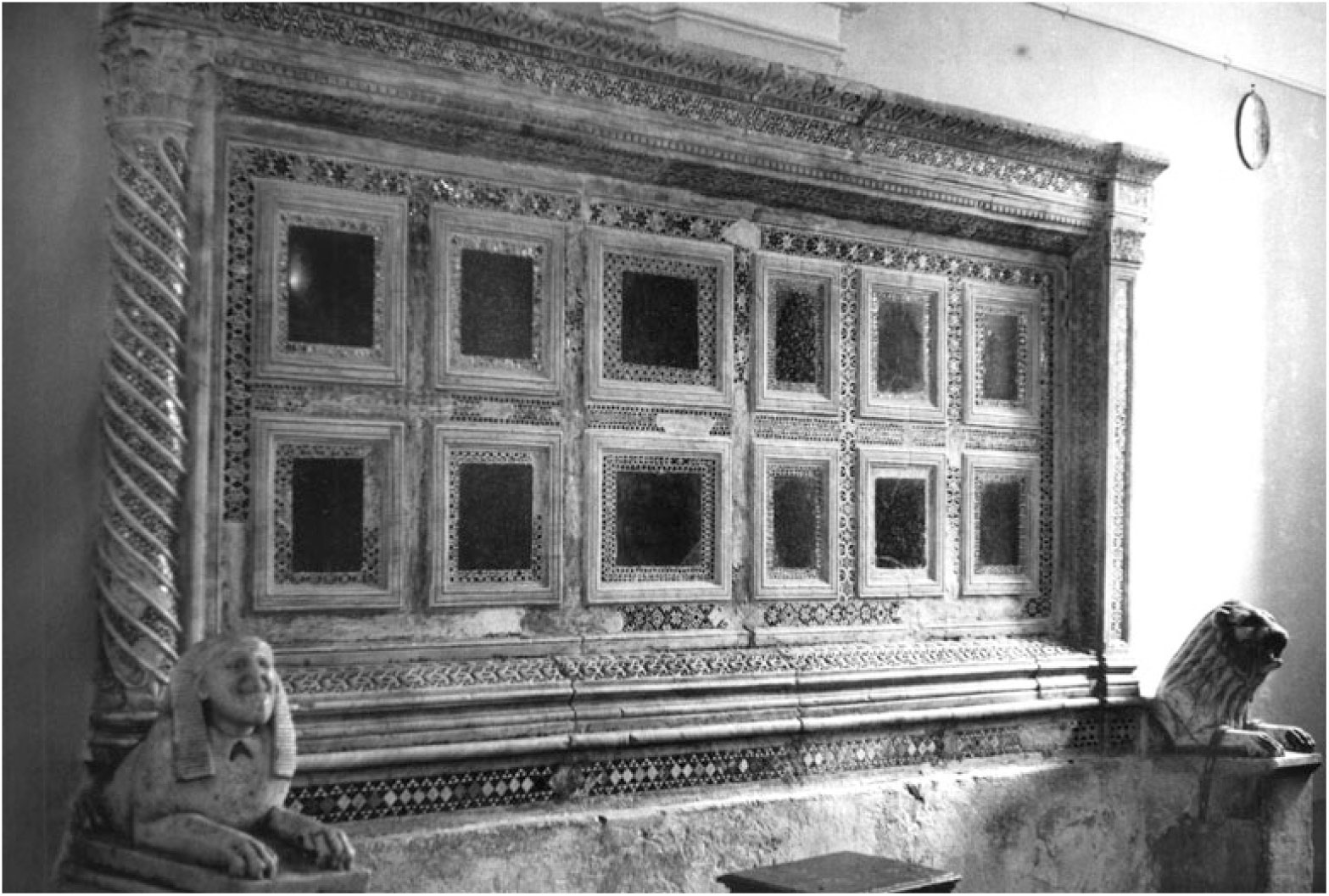
The fountain basin helps us to define the stages in tracing the sculptor’s career; fountains are the final signed works of both Nicola Pisano and Drudus de Trivio. Drudus, however, is not remembered principally as a sculptor of fountains. Preference has conventionally been given to analysing his major commission for Ferentino (fig 3) and, to a lesser extent, the choir-screen at Cività Castellana (Latinium) (c 1230) signed by Drudus and by Lucas Cosmati (fig 4).Footnote 15 Moreover, since Drudus’s reputation has come to repose upon the near-contemporary ciborium at Ferentino, the fountain has been sidelined, appearing altogether to have escaped the notice even of the early German connoisseurs and antiquarians. Conversely, the sculptural works executed by the Cosmati workshops, which ranged from ciboria, screens, ambos and thrones to Easter candlesticks, have received scrupulous attention.Footnote 16
Drudus de Trivio, ciborium, Ferentino, Duomo. Photograph: © the author, 7 Dec 2016.

Drudus de Trivio and Lucas Cosmati, choir-screen, Cività Castellana. Note the sphinx (bottom left) and lion (bottom right). Photograph: © Conway Library, Courtauld Institute of Art, London.

Discussion has dwelled on stylistic connections to the sculptural output of the Vassallectus workshops and the antique resonance that underscores the sculptor’s acquaintance with classical tombs. The first reliable description we have is that written by Gustave Giovanoni (1904), who can be credited with conscripting the fountain into the sculptor’s corpus.Footnote 17 Moreover, at a time when rather cursory treatment was the norm, Giovanoni stated that Drudus’s fountain basin is pervaded by ‘una certa originalità simpatico’ (‘a certain congenial originality’).Footnote 18 He likewise remarked that Drudus’s mastery in the definition of the carving of the ciborium at the Duomo at Ferentino – a point still frequently noted – was superior to that deployed in the fountain basin.Footnote 19
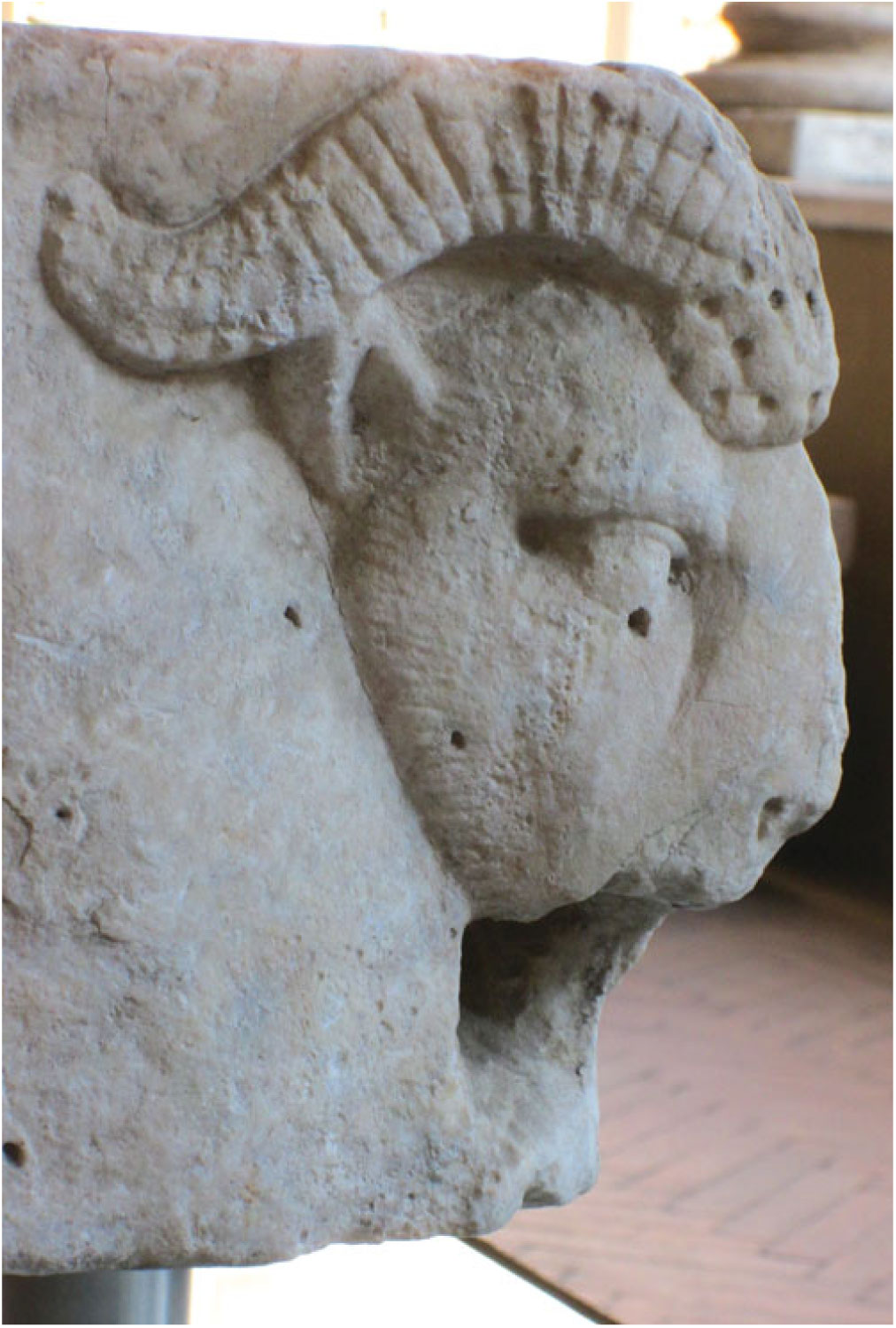
Nevertheless, greater precision is now required in the analysis of certain neglected technical aspects, in particular Drudus’s imaginative use of the drill, a technique inherited from antique practice. The drill holes, used to great effect, testify to a knowledge of Byzantine practice. They may also be the influence of Early Christian sarcophagi, giving rise to a contrast with the fountain’s wholly secular imagery.Footnote 20 Although most of the fountain holes are drilled, some are irregular – perhaps resulting from natural flaws in the stone. One example of this is the hole below the ram’s eye, though the majority of the other irregular holes appear on the same small end of the basin, as if the stone were of variable quality, and when dressed it was there that small pits were produced (fig 5).
Fountain basin: ram-head protome. Photograph: © the author, 8 Dec 2016.

Less instructive were the remarks made by Giovanoni’s peers and successors, who still made no mention of the inscription and furthermore failed to include photographs in their commentary.Footnote 21 At much the same time, in his discussion of the Cosmati, Adolfo Venturi mentioned ‘un lavabo’, as it was often to be described.Footnote 22 In 1948 Federico Hermanin described it tellingly as an ‘acquamanile di marmo bianco’.Footnote 23 This appellation is clearly wrong – but interestingly so, given that the fountain basin is not unrelated to rituals of hygiene. Such incidental comments about the fountain basin, often no more than short notices, are to be viewed within the context of the dismantling and reassembling of museum collections in Rome from the unification of Italy to the early twentieth century. Indeed, the fountain basin’s history as an exhibit cannot be extricated from the complex broader history of the museum collections.Footnote 24 Some discrepancies remain unresolved.
Placement
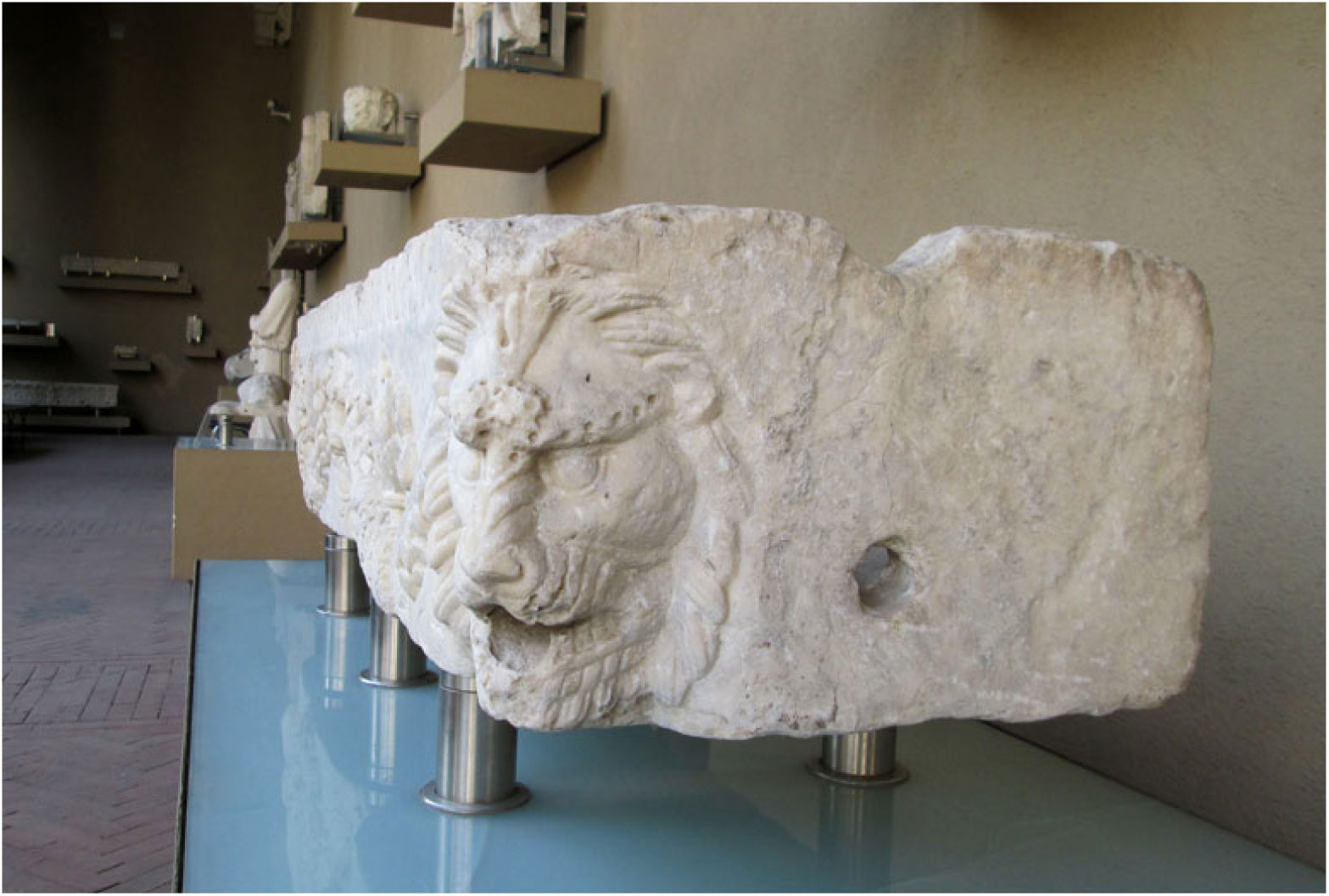
The view that the setting of the fountain basin was ecclesiastical rather than non-religious has been predicated on the fact that the Cosmati executed church furniture. That it is now exhibited free-standing does not mean that it was originally designed to be so. The possibility of a domestic setting, such as the courtyard of a private palace, cannot be excluded. Fountains are site-specific. Every palazzo must have had its fountain in the courtyard, the papal loggia fountain at Viterbo being the obvious example of this.Footnote 25 However, the abrasion on the short end of the fountain basin adjacent to the lion’s head might indicate that it was once set into a recess or was an element of a built-in wall fountain (fig 6). The plain back certainly suggests that it was designed to stand against a wall. But its original location is unknown. At some point between 1870 and 1889 – there is nothing to indicate the precise date – the fountain basin was conserved in the collections of the former Museo Nazionale Romano (now the Museo di Palazzo Massimo alle Terme).Footnote 26 It was first recorded in the possession of the Museo di Palazzo Venezia in 1920, where it still stands.Footnote 27 Since no early engravings or drawings of the fountain basin have come to light, nothing can be known of its earlier history. It may well be that the fountain basin was once the property of the Church – which would certainly account for its survival.
Fountain basin: lion-head protome, showing abrasion. Photograph: © the author, 12 Oct 2012.

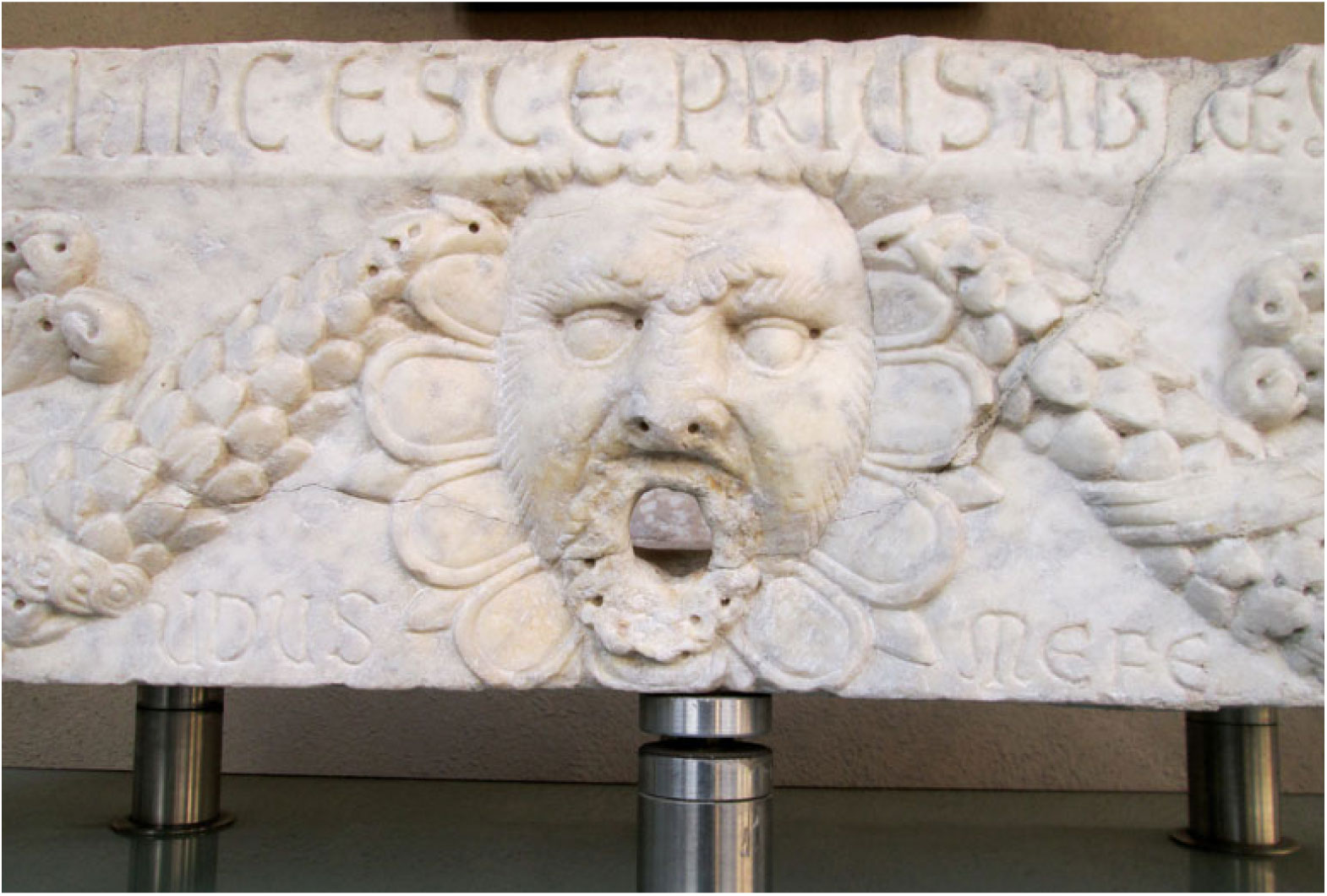
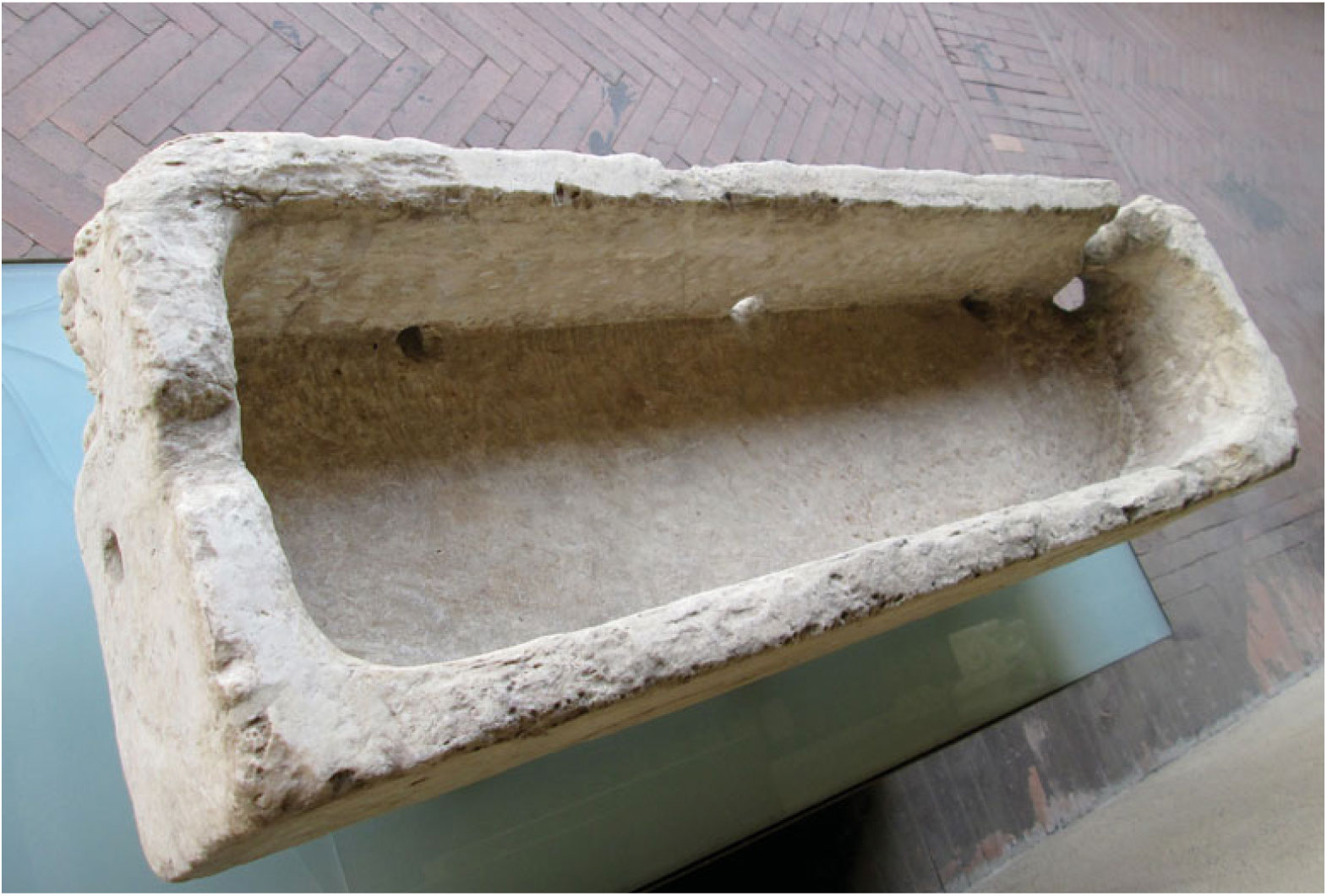
The holes added for further drainage along the base of the fountain basin suggest that it was moved at least once. Outlet holes added at a later date are not unusual. The roundels for the two holes drilled through the garlands must be secondary since they break the design and imply a less talented sculptor than Drudus. Further, they add an unintentionally farcical aspect to the grotesque face. The somewhat incongruous mouth with its roughly circular flower-like adornment is the only hole that was drilled carefully (fig 7). The two holes at the corners have been crudely enlarged and may represent a third phase, while the overflow notches on the rim may be later still (fig 8). These additions suggest that the fountain basin was moved to a new position where there was a stronger flow of water.
Fountain basin: satyr-like theatrical mask. Photograph: © the author, 12 Oct 2012.

Fountain basin, showing holes and overflow notches. Photograph: © the author, 12 Oct 2012.

Chronology
The lack of incontrovertible facts relating to the fountain basin has necessitated dating on grounds of style. Recent scholarship has often assigned the fountain basin to the later 1230s and the early 1240s, a dating based on the close technical similarities with the expertly sculpted capitals of the Ferentino ciborium, which is now dated to the early 1240s.Footnote 28 Apart from the evident stylistic parallels with Drudus’s own work, comparisons have been made with the contemporaneous Roman cloisters, which figure in almost all accounts of the basin. Its dating cannot be considered in isolation from the complex building phases of the cloisters of the Lateran and San Paolo fuori le mura. While the inherent chronological uncertainties cannot be resolved, it is worth restating that since the fountain basin clearly draws its inspiration from cloister décor, it is likely to have been sculpted very soon after the completion of these cloisters. However, there is no evidence to indicate when work on the northern side of the Lateran cloister (of the highest quality, and a source of inspiration for the fountain basin) was begun or completed.Footnote 29
Since it is indisputable that the fountain basin is stylistically closest to the capitals of the Ferentino ciborium – one of the most frequently cited comparisons – it seems likely that the fountain basin and ciborium were sculpted at approximately the same time. That the fountain basin was executed soon after the ciborium is altogether probable, though this cannot be finally demonstrated. Given that the ciborium was carried out in approximately 1240, a date in the early forties for the fountain basin would be more consistent. Even so, a date of 1240 for the ciborium cannot establish a terminus post quem for the fountain basin. The foregoing, however, confirms the impression that the fountain basin was sculpted towards the end of Drudus’s career.
Stylistic affinities
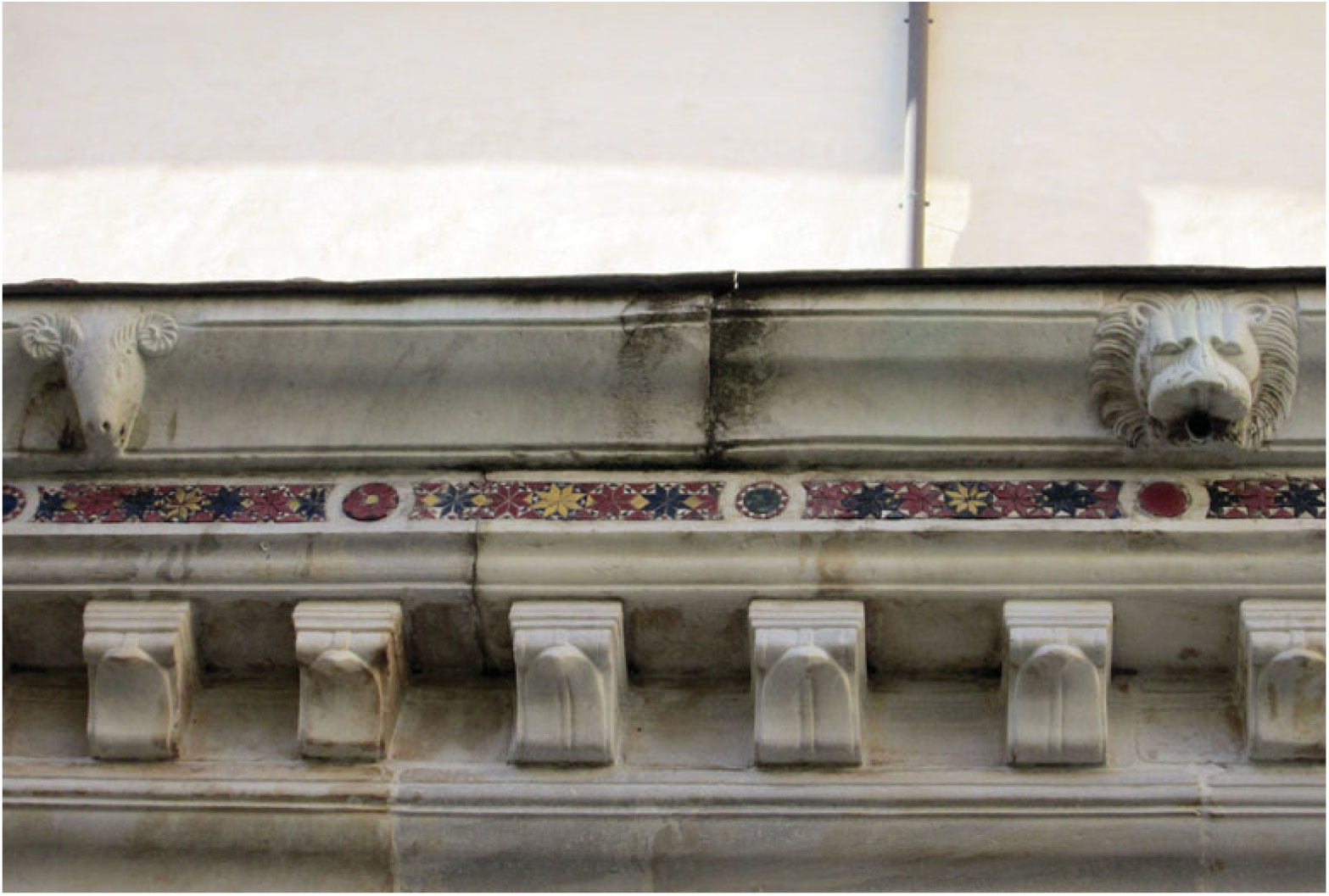
While close comparisons have been made, it can also be argued that the fountain basin’s classicising motifs were entirely consistent with the standard contemporary decorative repertoire.Footnote 30 However, rather than listing exhaustively the repetitive decorative features encountered in medieval fountain iconography, or providing a comparative classification of motifs deployed in medieval fountain iconography, it seems more useful to note that fountain iconography was conservative and based on antique models. Drudus had favoured ram- and lion-head protomes over foliage on a capital at Ferentino, while ram- and lion-head protomes are juxtaposed on the frieze of the west wing of the cloister of San Paolo fuori le mura (fig 9). Moreover, the resilient sculptural convention of protomes sculpted at the angles of the basin – conceived as water spouts: a lion’s head and a ram’s (like a boukranion) – are, even in their diagonal positioning, typical of animal-headed protomes in Duecento sarcophagi, where they form a quartet. The paratactic arrangement of animals with apotropaic associations was standard in tomb sculpture. Rams’ heads with garlands suspended go back to antiquity.Footnote 31
Cloister, west wing, San Paolo fuori le mura, Rome. Cornice, lion and ram protomes. Photograph: © the author, 9 Dec 2016.

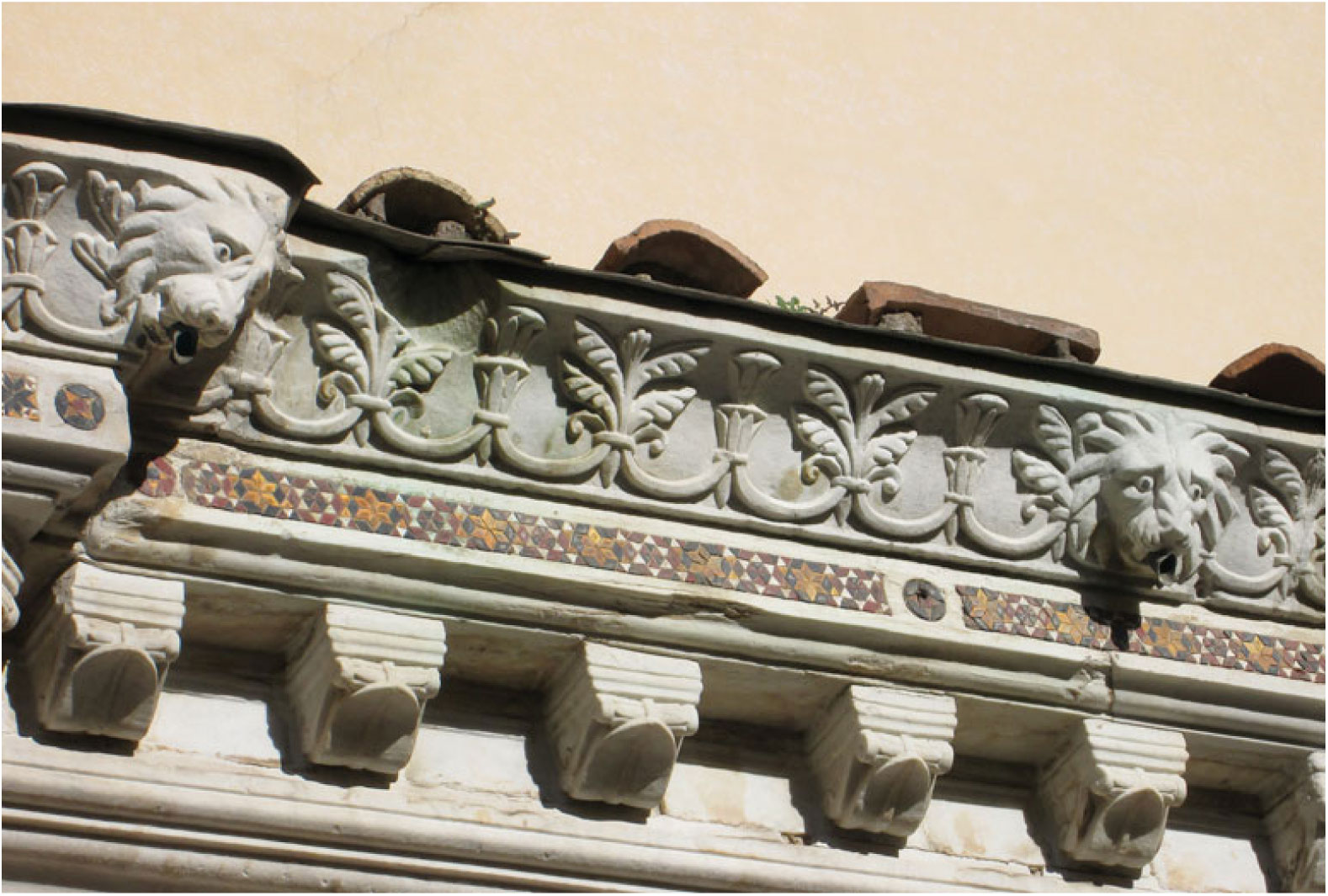
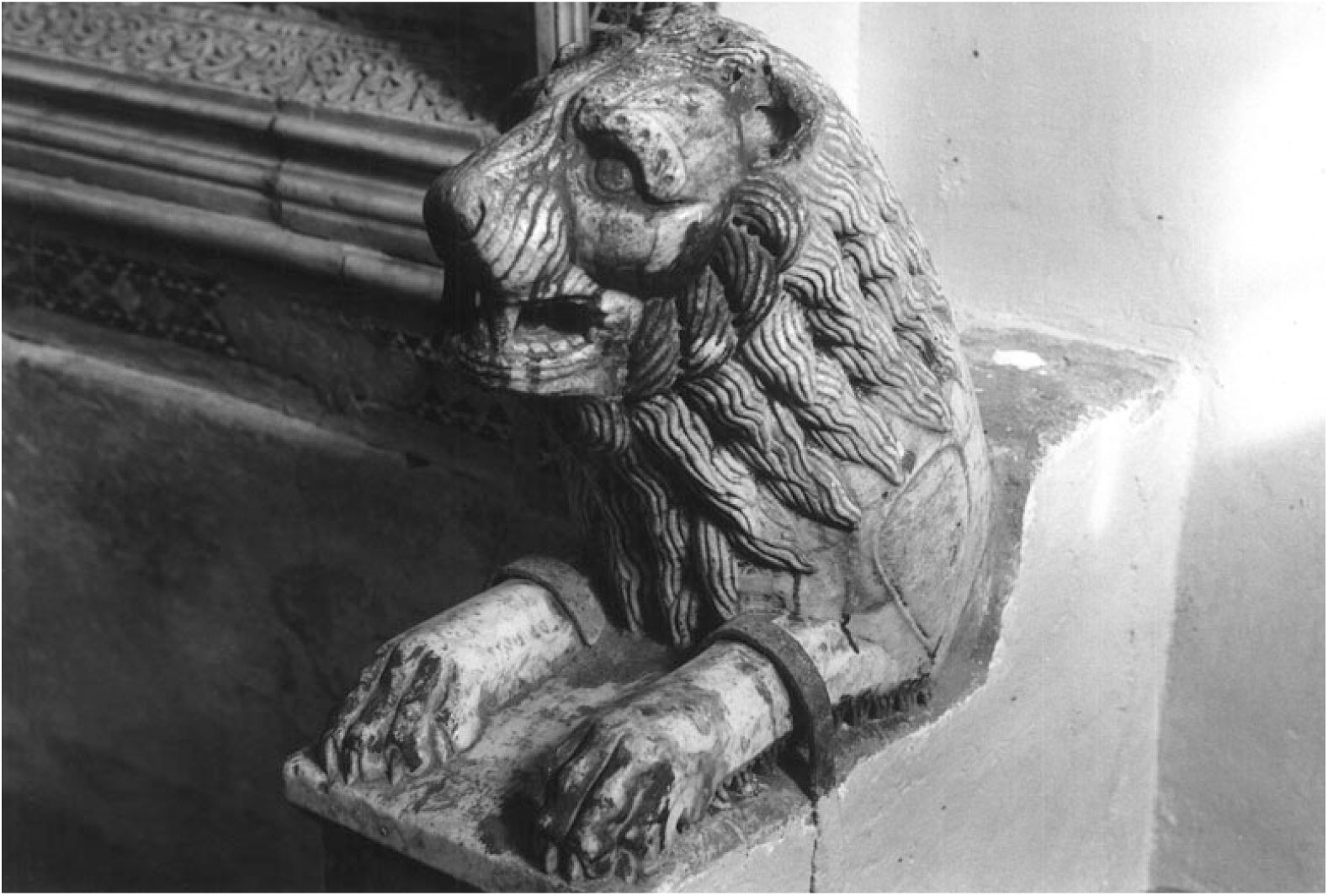
The large lion protome of the fountain basin is reminiscent of cloister gargoyles, elements that would have been familiar to Drudus (fig 10). Lion-head water spouts have clear antecedents in fountain sculpture.Footnote 32 Drudus’s experiments in diverse forms of lions, superbly demonstrated at Cività Castellana, culminate in this particular protome, which is half human and half beast in form and differs substantially from lions sculpted elsewhere.Footnote 33 Drudus probably began his career with lions and continued to sculpt them throughout. Strong stylistic affinities are to be found between, on the one hand, the slightly bulging and distinctively delineated eyelids of the lion (fig 11) and the sphinx (see fig 4) of the Cività Castellana choir-screen and, on the other hand, those of the lion protome on the fountain basin (see fig 6).Footnote 34 Although less technically refined than the garlands, the anthropomorphised lion’s face with twisted spiral fluting on the snout is imaginatively conceived. Despite the rough finish, this vigorously sculpted face is an instance of distinctive self-assured sculpting. It seems to emit a silent roar reminiscent of a chimaera or of bronze automata long fallen silent. It may well be that the face was inspired partly by bronze-work. Lions – whether stylobate, column-bearing, couchant or masks – are common in Italian Duecento sculpture and feature in the Cosmati and Vassallectus repertoire. Further, it is worth recalling that the sculpting of lions was left to specialists in Antiquity and the Middle Ages.Footnote 35 While this lion’s mask should not be invested with excessive leonine symbolism, the lion may have had a connotation of lordship legible to medieval Romans accordingly enhancing the owner’s status. Moreover, it is known that sovereigns and noble families possessed menageries. For example, the Roman aristocrat Cencio Frangipane kept a leopard at his domus in Rome. This consideration makes it more likely that the setting of the Drudus fountain was private.Footnote 36
Cloister, north side, San Paolo fuori le mura. Cornice, lion protomes. Photograph: © the author, 9 Dec 2016.

Drudus de Trivio (?), detail of the Cività Castellana choir-screen (see fig 4): lion. Photograph: © Conway Library, Courtauld Institute of Art, London.

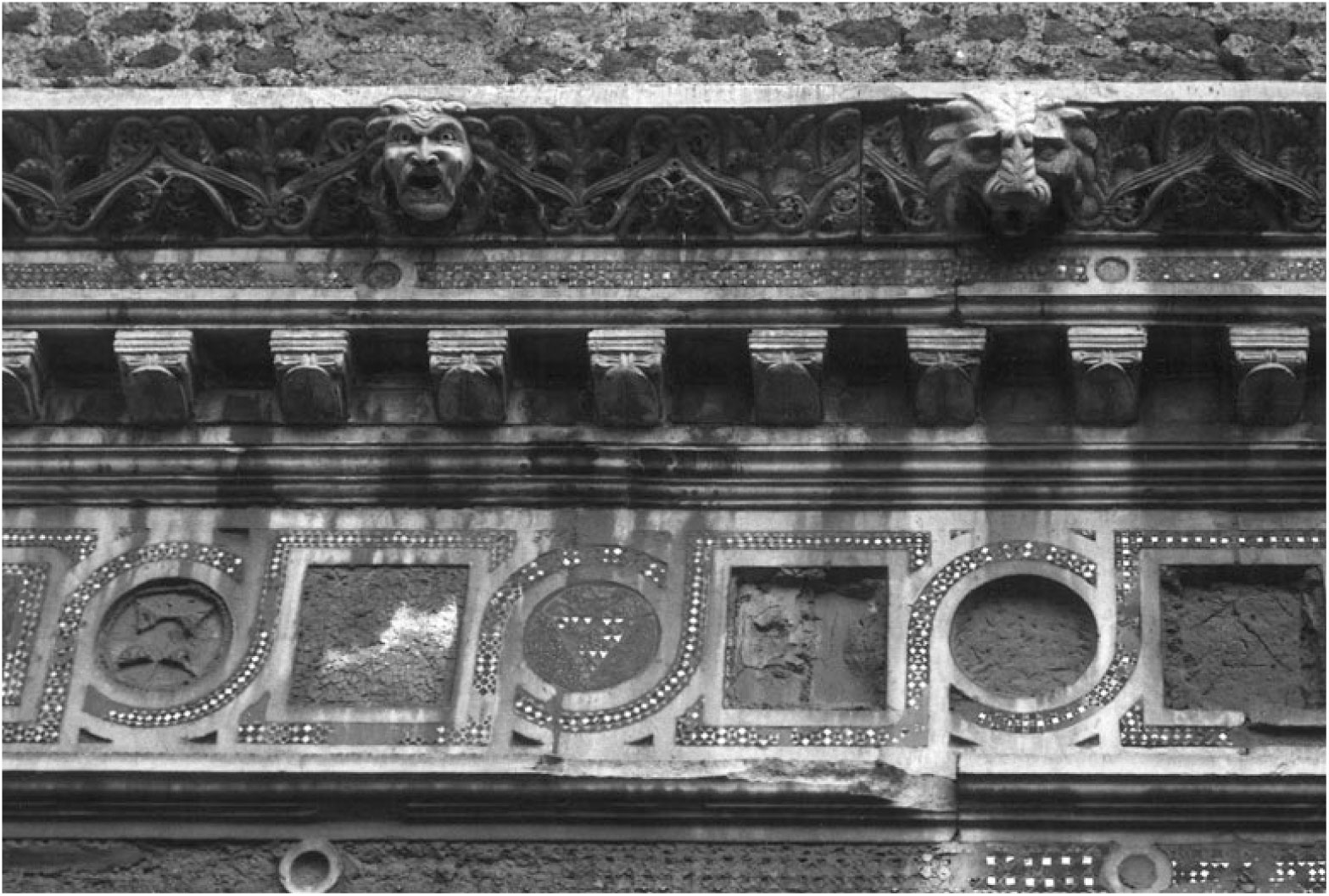
The centrally positioned grotesque face with its furrowed forehead and the curiously shaped vegetal eyebrows also derives in part from cloister décor (see fig 7). This face calls to mind a theatrical mask on the cornice along the east wing of the Lateran cloister (fig 12). A spout must once have protruded in a manner suggestive of cloister gargoyles. Theatrical masks form part of the standard décor in classical sarcophagi and were used also on city gates in a clearly secular way.Footnote 37 While to a twenty-first-century eye the snub nose and symmetrical pair of low-set nascent horned protuberances might appear somewhat comic, such a metamorphosis could have felt menacing to a medieval viewer. Just above the level of the temples, where we would expect the satyr’s horns or pointed ears to sprout, two garlands are suspended. The shallow-set eyes, with well defined eyelids, are characteristic of Drudus’s technique. The vacant gaze lends a jocular effect, also typical of the sculptor. Echoing Oceanus, this face relates to ancient prototypes. Satyrs’ mouths spouting water and, less commonly, kneeling satyrs supporting water basins each have their own forceful tradition in antique fountains, a case in point being a marble water basin supported by a satyr (c ad 15–40) from Pompeii.Footnote 38
San Giovanni in Laterano, Rome, east side. Cornice, lion and theatrical mask protomes. Photograph: © Conway Library, Courtauld Institute of Art, London.

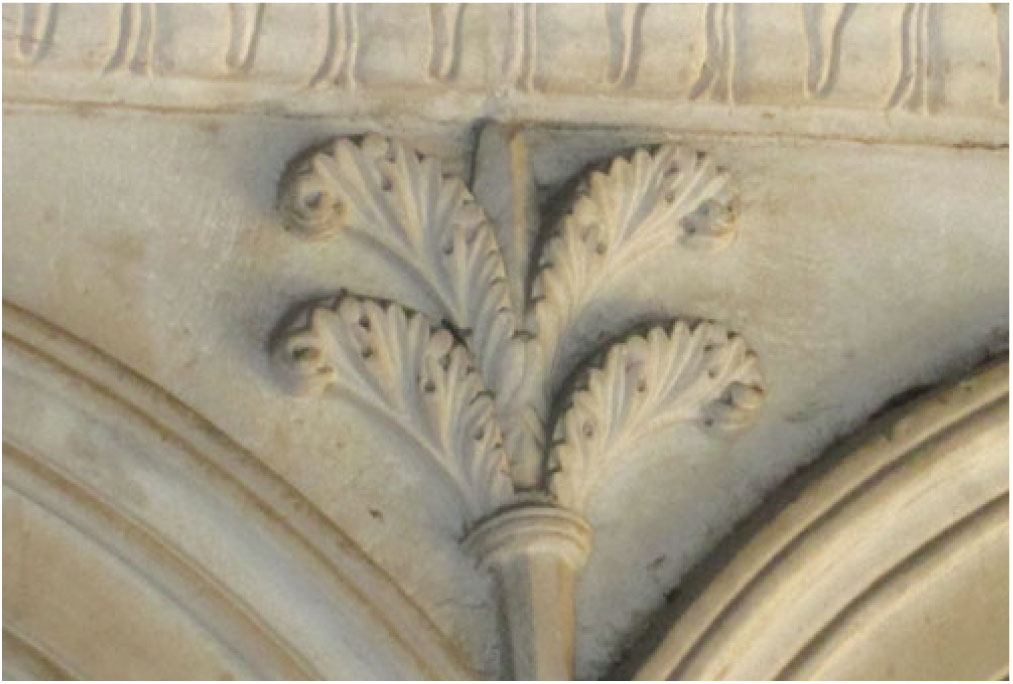
Unfurling palm fronds, once again enhanced by an abundance of drill-hole perforations, sprout from long stems sculpted at the centre of each be-ribboned garland: from just one of these palm fronds there hangs a decorative vertical band, accentuating the slightly overall asymmetrical arrangement of the fountain basin’s front. About ten years previously the sculptor had used palmette motifs along the borders of the Cività Castellana choir-screens, but without sacrificing proportion.Footnote 39 The palmette motifs along the cornice on the north side of the Lateran cloister are also entirely classical in inspiration.Footnote 40 A fine frieze of palmette motifs adorns also the northern side of San Paolo fuori le mura, while a single palmette – or highly stylised plant, appearing to be a conflation of a palmette and acanthus – embellishes a spandrel on the cornice of the same north side of the cloister (fig 13). In its use of an angular collared stem, this closely resembles the palmettes on the fountain basin – in particular, the one sculpted next to the lion protome. Given Drudus’s diligent rendering of the finely proportioned acanthus leaves beneath the volutes of the capitals of the Ferentino ciborium, it seems probable that he intended the decorative plant motifs on the fountain basin to be palm fronds, rather than acanthus, as has been claimed.Footnote 41
Cloister, north side, San Paolo fuori le mura, spandrel relief. Photograph: © the author, 9 Dec 2016.

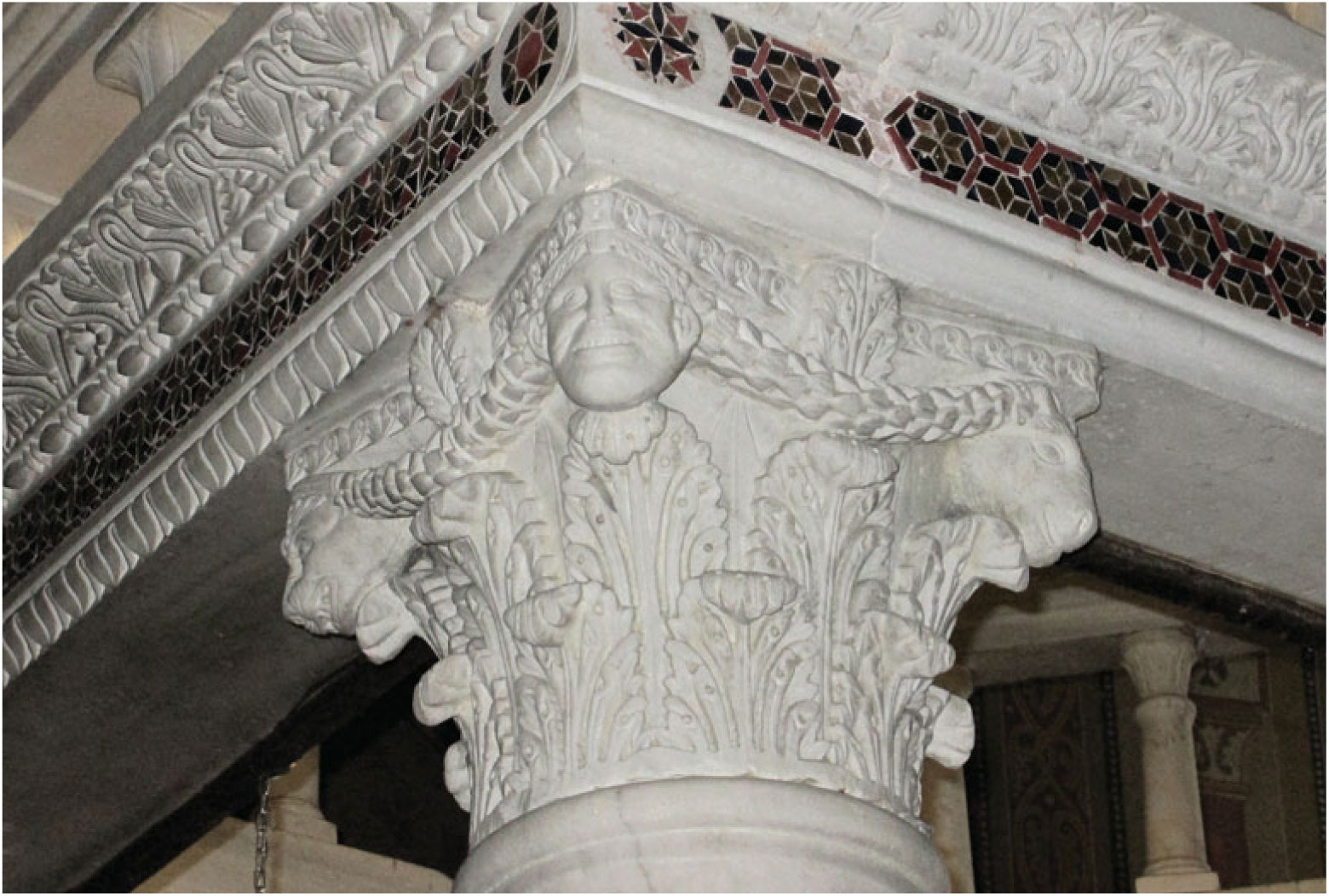
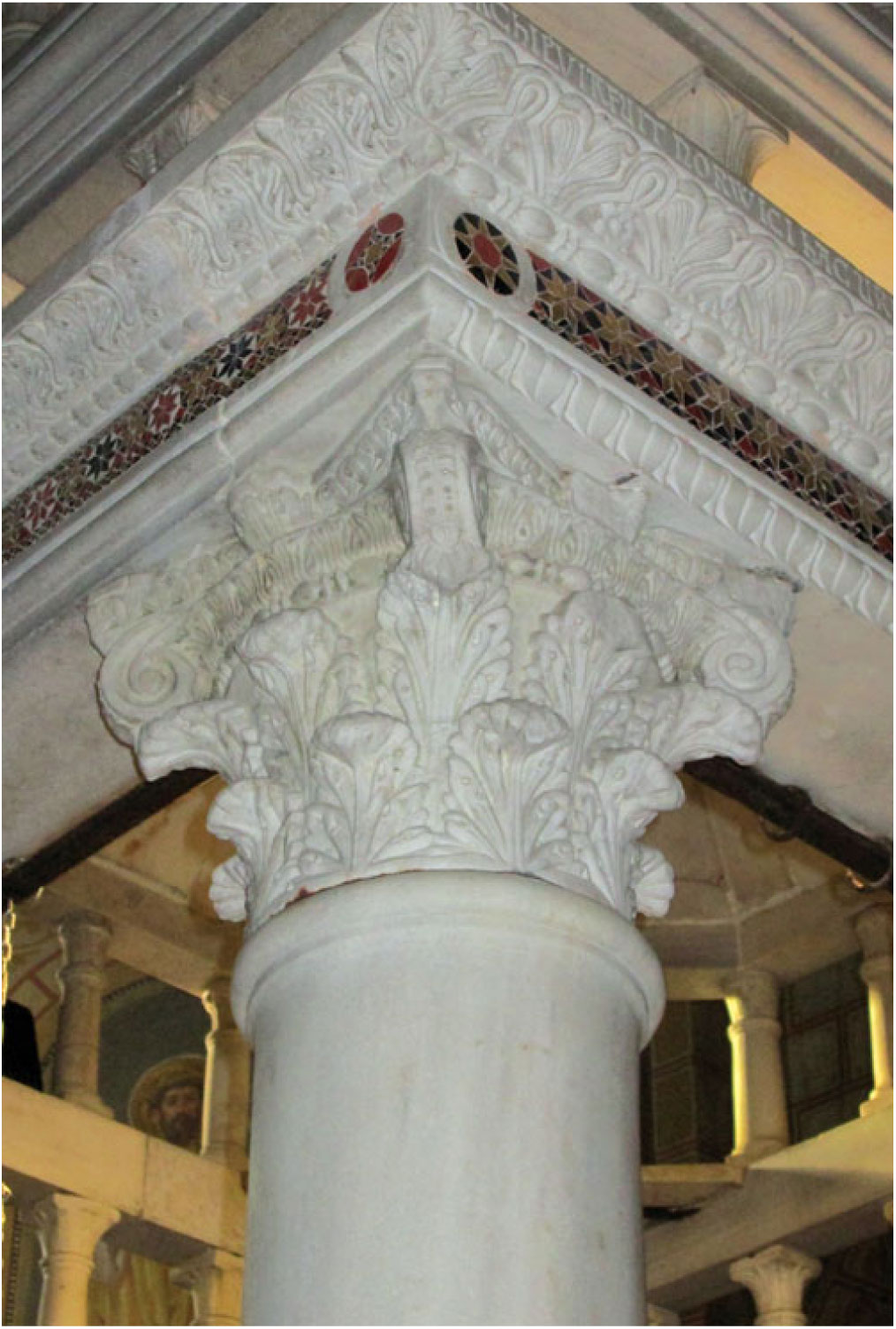
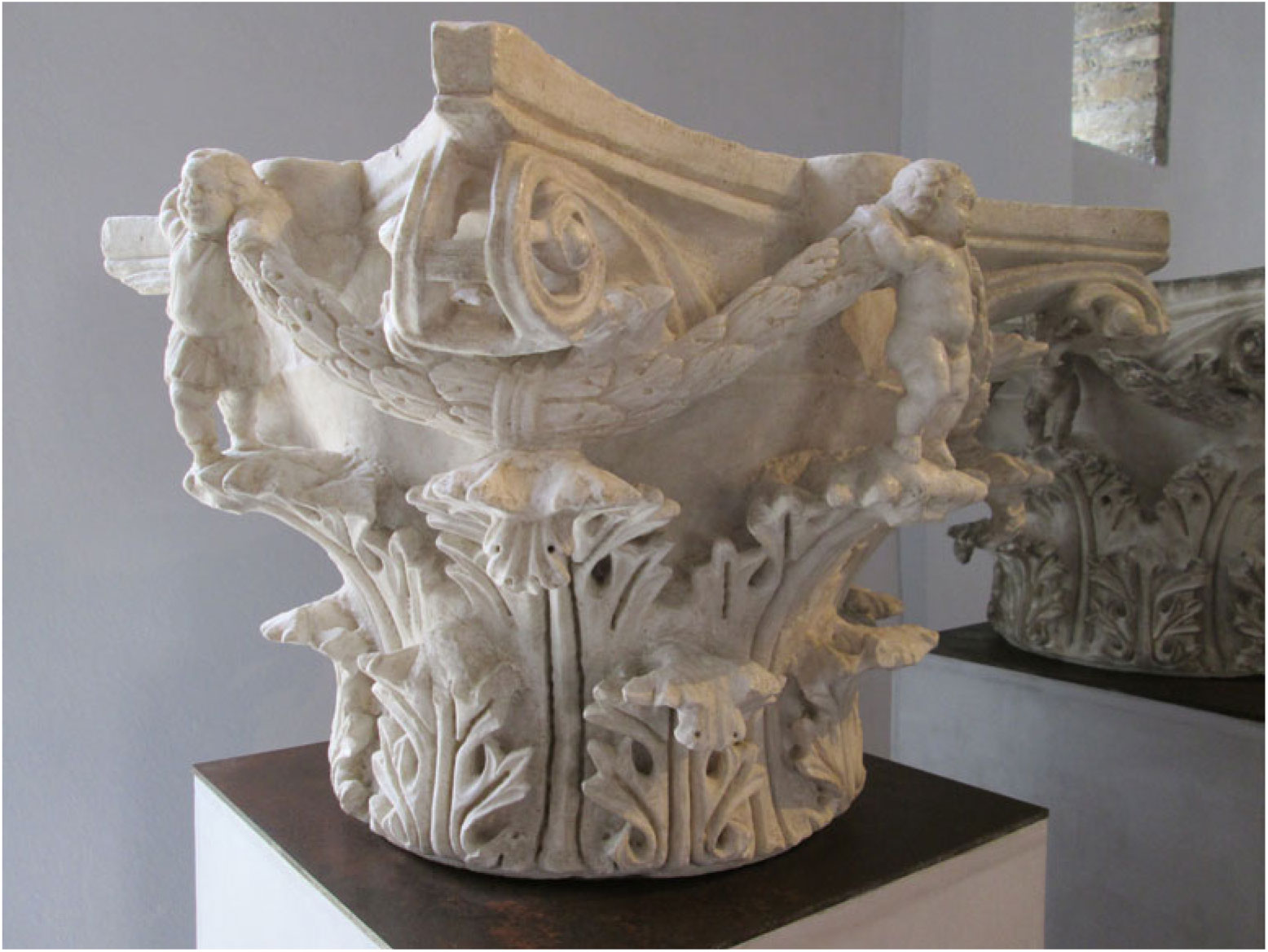
In its use of garlands, the fountain basin recalls classical sarcophagi where garlands typically flank a central clipeus medallion, a tabula ansata, a gorgoneion or an oceanus mask. It is well known that garlands are part of the standard decorative rhetoric in marine thiasoi and Nereid sarcophagi. The skilfully carved garlands on the fountain basin are remarkably similar to those embellishing the capital of the front right corner of the Ferentino ciborium (fig 14) – albeit lower slung – itself derived from classical antecedents that lend the fountain basin an antique inflection.Footnote 42 It is worth recalling Hutton’s statement that Cosmati work is inspired by the ‘direct study of the antique’, nowhere more evident than in these superlative ciborium capitals (fig 15).Footnote 43 The garlands, used ingeniously by Drudus in the ciborium capital, ultimately go back to classical sarcophagi, with which we can be certain he was conversant.
Ciborium capital, showing animal and human head protomes, Ferentino, Duomo. Photograph: © the author, 7 Dec 2016.

Ciborium, Ferentino, capital. Photograph: © the author, 7 Dec 2016.

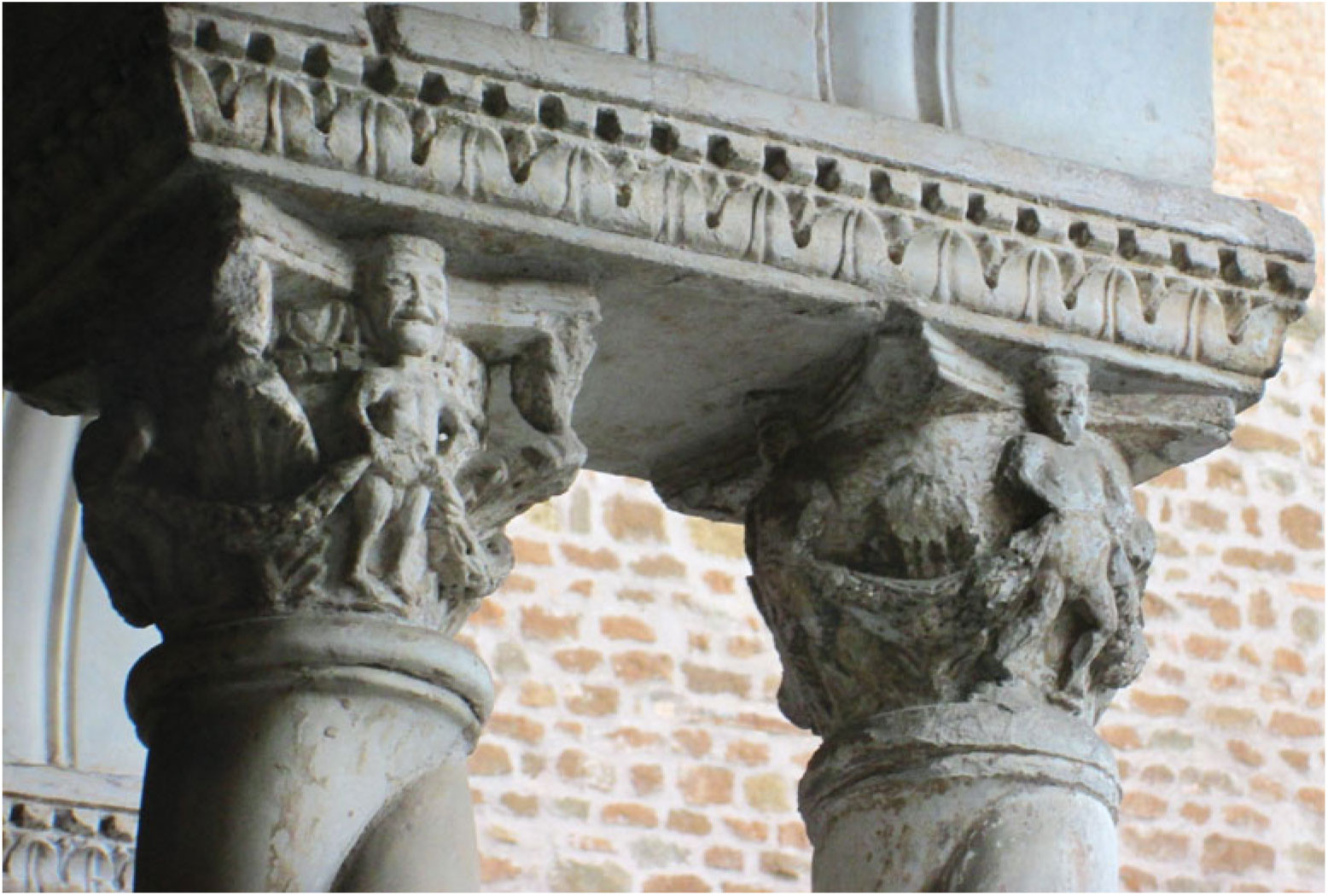
However, apart from the somewhat crudely executed garlands sculpted on two paired capitals on the north side of the Lateran cloister, there is no evidence for garlands having been used in earlier Cosmati work. These garlands, lacking finesse – borne by droll naked figures, one of whom is knock-kneed – are described by Claussen as ‘herkulische Gestalten’ (‘Herculean figures’) (fig 16).Footnote 44 A classical example of the motif of putti raising aloft garlands in this manner is found in a capital dated to the third or fourth century ad now in the Museo Nazionale di Ravenna (fig 17).Footnote 45 Prior to their introduction into Drudus’s ciborium and fountain basin, garlands are unknown in extant Cosmati work. The Roman senator Luca Savelli (d 1266) was aptly commemorated in an impressive third-century garland sarcophagus (in St Maria in Aracoeli), though this is dated appreciably later than the fountain basin.Footnote 46 Cosmati tombs before 1260–70 were often reused; the emphasis on wall tombs came only during the reign of Pope Nicholas iii (1277–80).Footnote 47 Likewise, the much cited tomb of Cardinal Guglielmo Fieschi (d 1256) in San Lorenzo fuori le mura, postdates the fountain basin.Footnote 48
San Giovanni in Laterano, north side. Figural capital. Photograph: © the author, 8 Dec 2016.

Capital: putti raising aloft garlands. Photograph: © the author, 20 Jun 2018 (courtesy of the Museo Nazionale di Ravenna).

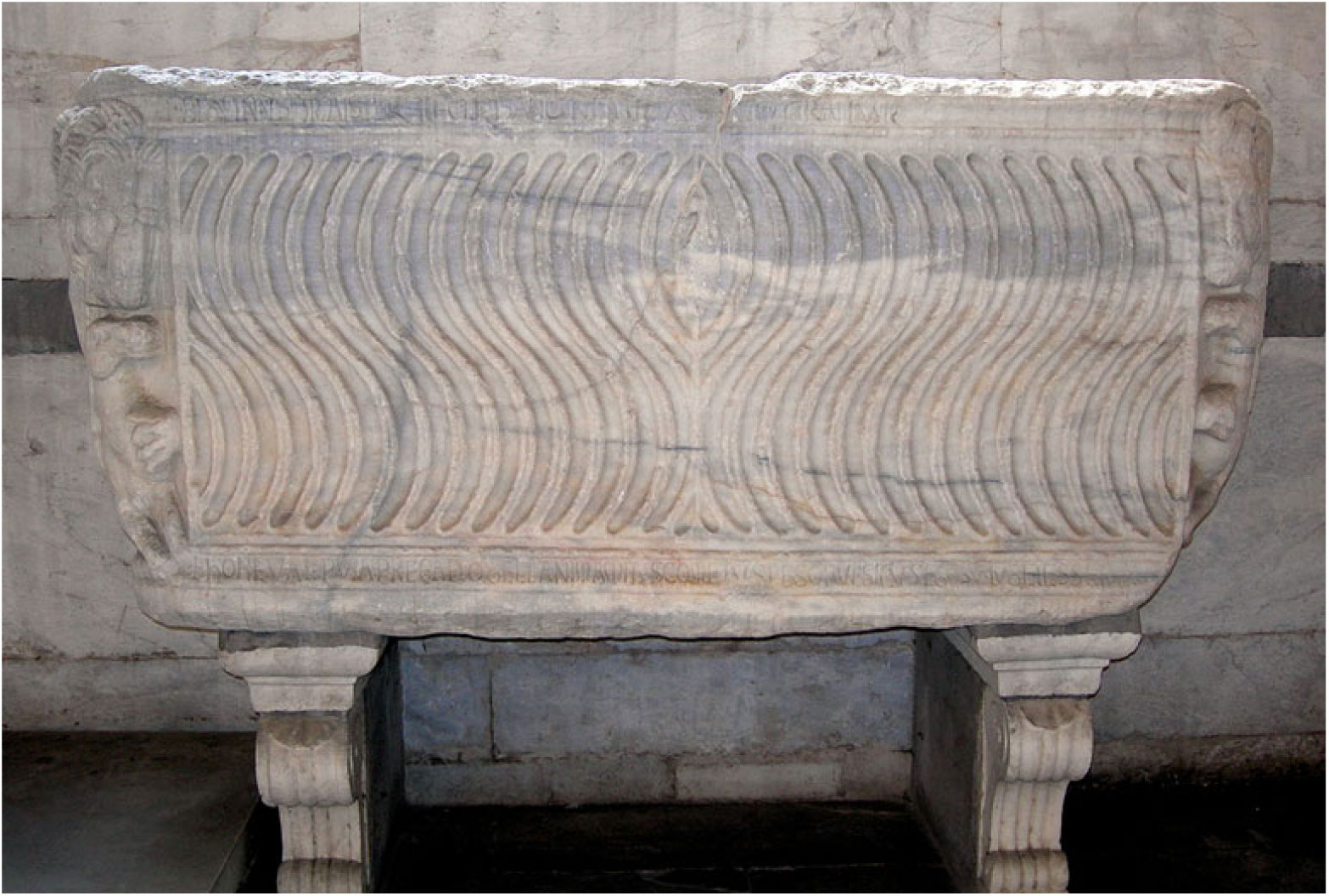
In other ways, too, the fountain basin’s composition was informed by Drudus’s knowledge of classical sarcophagi: the text is set out in two rows resembling a funerary epitaph. A similarly placed inscription can be seen on the upper and lower borders of the sarcophagus for the Pisan lawyer Giratto (dated 1170–6), signed by the architect and sculptor Biduinus (active in Pisa and Lucca).Footnote 49 The two parallel lines of text (not visible here) are separated by strigillated carving that symbolises water (fig 18). Since this impressive sarcophagus had been made for a civic leader and prominent layman and appears entirely secular in conception, a comparison may reasonably be made with the fountain basin.Footnote 50 It is a deliberate imitation of a sarcophagus of the lenos type, possibly one of the reused ancient ones now in the Camposanto in Pisa, and contemporaries would have seen it as such. It is virtually indistinguishable from the late antique sarcophagi that would have been familiar to Drudus. There were, of course, many sarcophagi in the region around Rome; and Pisa, which also boasted significant antiquity, was a city extraordinarily rich in Roman remains.Footnote 51 Both the tomb and Drudus’s fountain basin are modelled on antique sarcophagi.
Biduinus, tomb of Giratto, Camposanto in Pisa. Photograph: Wikimedia Commons, 30 Sept 2008.

The inscription: why Thetis?
Unlike the inscription in small capital letters on the left of the choir-screens at Cività Castellana (see fig 4), and still less the inscription on the ciborium at Ferentino (see fig 2), the fountain inscriptions were intended for display and to be legible at a distance. These two inscriptions are treated differently: the lower one, ‘MAGISTER DRUDUS ME FECIT’, in small majuscule letters, is fitted around the sculpturing and, in common with most inscriptions of its kind, extends along the base; the other, in a continuous band, accorded prime position along the top, appears more conspicuous. This latter inscription, with its unusual wording, is at once the most remarkable and most neglected aspect of the fountain basin; it reads ‘+HIC ThETIS hINC ESC(A)E PRIVS ABLVE MANDE QVIESCE’, which may be rendered as ‘Here is the water, hence the food; first wash it, eat and repose’. It has been translated by Claussen as ‘Hier ist das Wasser. Von hier iß, vorher wasche, kaue und ruhe’ (‘Here is the water. From here eat, first wash, chew and repose’). Even though in a footnote he pointed out that his translation was not definitive, it has been regarded as such by other scholars.Footnote 52 While full philological discussion is beyond the scope of this paper, it should be observed that Claussen has changed the noun esce, which stands for escae (Latin, nominative plural: ‘food’) into a verb. Arguably, to reiterate twice the idea of eating would be perverse, and the Latin verb esco, escare meaning ‘to eat’ is very rare. Since the inscription is a leonine hexameter, the second ‘e’ of esce (escae) must be long and the possibility that esce is a verb is therefore excluded.
What accounts for the reference to Thetis? One of the twenty-eight heads sculpted around the outer edge of the upper basin of the fountain that formerly stood in the cloister of the Abbey of St Denis represents Thetis, shape-shifting goddess and sea nymph.Footnote 53 This figure does not, however, occur in medieval fountain iconography and the temptation to invest her with mythological significance here should be resisted. While ancient Roman fountain iconography derives from antique literary sources, the same cannot reasonably be asserted for Drudus’s fountain basin. In funerary monuments Thetis sometimes stood as the embodiment of maternal sorrow, most notably in the Thetis and Peleus sarcophagus in the Villa Albani, Rome.Footnote 54 Although Thetis is sometimes associated with watery death, or occasionally depicted handing over weapons to her son, she is cast more often in her conjugal role, alongside Peleus. However, there is little evidence that the imagery of the fountain basin is intended to evoke a nuptial celebration, and still less that it is a female celebration of water, as was to be the case in the fontana maggiore at Perugia (begun in 1277), where, going beyond convention, all the personifications are women.Footnote 55
According to thirteenth-century grammarians, it was the lesser known goddess Tethys, mother of all rivers, wife of Oceanus and grandmother of Thetis, rather than the nymph Thetis, wife of Peleus and mother of Achilles, who was synonymous with water. Indeed, judging by the grammars in circulation, fresh water in a fountain inscription ought to be indicated by Tethys, rather than Thetis. If reference is made to Thetis, water is of little relevance and the meaning of the inscription is lost. In the entry under De nominibus femininis, in his Graecismus, Évrard de Béthune comments: Dic Thetis et Thetidis, sic mater habetur Achillis, / Si Tethys dicas, est dea Nereidum (‘Say “Thetis” and “of Thetis”, thus it is the mother of Achilles who is understood, / if you say “Tethys”, it is the goddess of the Nereids’).Footnote 56 A similar distinction occurs in the Doctrinale of the Flemish grammarian Alexander de Villa Dei.Footnote 57 The clear differentiation made between the two goddesses is reflected in the spellings. Thetis is incorrectly spelled in the inscription (at least according to the foremost grammarians of the time).
Therefore, it appears that the author of the inscription has confused Tethys with Thetis. However, the effect of the misattribution of identity should not be attributed to the author’s incompetence or carelessness, for even in Antiquity Thetis and Tethys were confused and this misunderstanding appears to have survived through the Middle Ages.Footnote 58 Tethys became identified with Thetis and both goddesses were a metonym for the sea.
At all events, the author of the inscription is unlikely to have consulted the above-mentioned grammars, which, although in circulation in Italy, were used as classroom textbooks.Footnote 59 Further, while the magistri doctissimi were accomplished, they were not Latinists.Footnote 60 Even though familiarity with classical authors can be assumed in thirteenth-century Rome, there is no evidence that the author of the fountain inscription had prior knowledge of Ovid, who would have been the most likely source for Thetis. It is most probable that he was just following the accepted contemporary usage of Thetis as a personification of water.Footnote 61 While Thetis is entirely appropriate to a fountain inscription, she does not evoke an antique water goddess.
Thus, the reference to ‘Thetis’ indicates that the author has used a refined old poetic word for water, whereby the sea goddess Thetis is no more than a distant mythological allusion. The perfectly composed leonine hexameter implies a scholastic education, without logically entailing a familiarity with the Latin classics. Moreover, the respect of metre shows that whoever composed the inscription was cultured and this would suggest an altogether more rarefied overall iconography than has hitherto been assumed.
The only remote parallel for this inscription has been drawn by Dietl, who notes an analogous formula in ‘Mensa submota prius ablue, postea pota’ (‘Having finished eating, first wash, then drink’).Footnote 62 However, apart from general similarities in rules of hygiene, this proverb would appear to be of little relevance to the inscription on the fountain basin, which amounts to an invitation to wash the food (escae) before eating it. Despite the substantial corpus of fountain inscriptions in the Italian peninsula in this period, there are no comparable examples.
Other fountain inscriptions
To investigate how and why Drudus’s fountain inscription differs fundamentally from inscriptions on civic fountains in the mid Duecento, a closer examination of at least a select choice of those inscriptions that do survive must be made. With the exception of the fontana maggiore at Perugia, which is a literary fountain par excellence, and therefore customarily invoked in the context of inscription-bearing fountains, the matter of the presence or absence of inscriptions on fountains has been largely overlooked.Footnote 63 The majority of extant inscriptions date from the second half of the thirteenth century, a time when civic fountains flourished. But reference will be made to the inscriptions close in date to Drudus’s fountain. It has become a truism to state that fountains in the Italian peninsula in the Duecento are expressions of civic identity and prestige, as reflected in the deployment of heraldry; the fountain house at Docciola (1245) – the oldest of Volterra’s civic fountains – is a precocious surviving example of this, displaying the communal coat of arms of that city. This iconography of civic aspirations was further amplified in the use of inscriptions that often recorded the names of those in charge of the installation and maintenance of fountains. Commemoration of the civic authorities responsible for overseeing their construction was a familiar convention in medieval fountain inscriptions, where those who oversaw the repair of fountains were also sometimes named.Footnote 64
The reasons for the preponderance of fountains, many of which bear inscriptions, may be explained by the rise of the communes and the consequences of incastellamento, a debate started by Pierre Toubert.Footnote 65 A corroborating factor in the proliferation of fountains in hill-towns in central Italy (especially Viterbo, Orvieto and Perugia) was the scarcity of water and its consequences; topography matters. Indeed, Heers has referred to ‘une politique des fontaines’.Footnote 66 The commune took charge of the city’s water supply. Fountains demonstrated civic pride and prosperity.
Unlike Drudus’s fountain basin, many of these civic fountains are much restored and perhaps not wholly accurate. Some are composite works and have yet further additions with possible later accretions – for example, the Fontana Fraterna at Isernia (Molise), where spolia were originally used in abundance, and which is heavily restored and has been relocated.Footnote 67 While some fountains have retained their original inscriptions, others have inscriptions added at a later date.
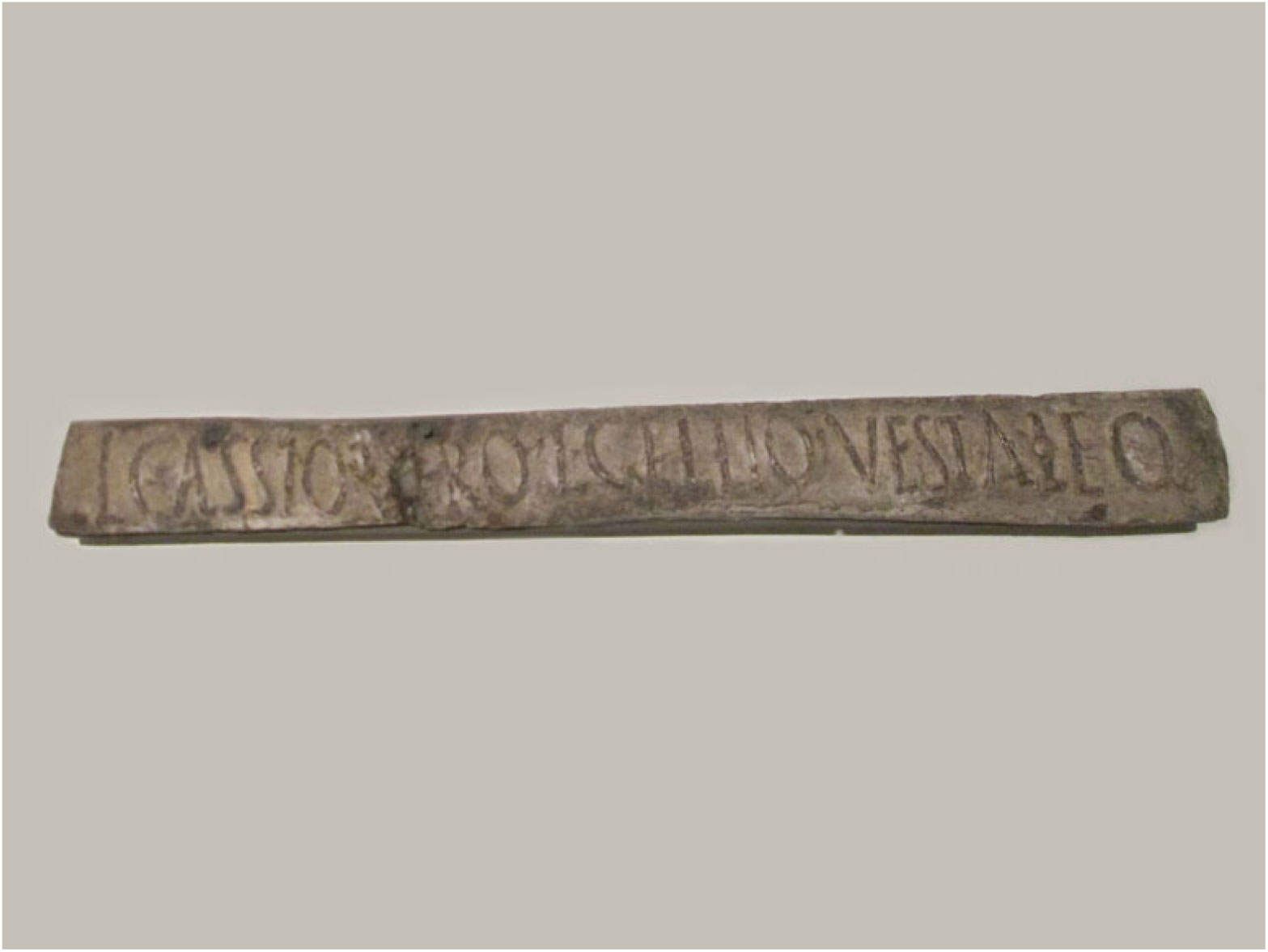
There is much to suggest continuity in fountain inscriptions. Ancient Roman lead pipes or fistulae were adorned with inscriptions to indicate the proprietor of the property to which the water flowed, the names of the makers and other useful information.Footnote 68 A Bolognese fistula, dated to the first century ad and now in the Museo Civico Archeologico di Bologna, is inscribed ‘CASSIO VERO L[UCIUS] GELLO VESTALE Q[uaestoribus]’ referring to the questore or city magistrate (fig 19). These officials controlled the flow rate in the pipes and were responsible for the calculation of water charges – all of which is relevant to later fountain inscriptions, which, as noted earlier, generally commemorate the commune. Often the podestà and/or the capitano del popolo or other prominent citizens as embodiments of the commune are named.
Section of lead pipe with inscription discovered in Via de’ Carbonesi no. 2. Photograph: © the author, 19 Jun 2018 (courtesy of the Museo Civico Archeologico di Bologna).

One such example is the inscription in the fountain house at Docciola, which is a contemporary acknowledgement of the role of Orlando Rustichelli de Podio, podestà of Volterra, under whom the works were carried out and who was in power in 1245, the date given in the inscription, which also records the name of a certain Magister Stefanus.Footnote 69 Likewise, the Fonte ai Canali at Piombino (1247) (in the province of Livorno) bears the name of Magister Dorgodorius.Footnote 70 This inscription states the fountain was executed during the time of Ugolino di Assopardo, the Capitanei plumbino (Capitano del popolo of Piombino), who served the commune of Pisa; the above-mentioned fountain at Ortona, dated 1251 by inscription, was made during the time of DOMINI RO/GERII DE PITIIS RECTORIS ORTONE.Footnote 71 Later comparable examples include an inscription on the Fontana Sepale or Fontana Grande (completed 1279) in which reference is made to Orso Orsini, podestà of Viterbo 1277–80.Footnote 72 Financed by the commune, the civic role of the capitano del popolo, Arturo, son of Pietro Monte Cocozzone, is also recorded here. Similarly, the Fontana delle Novantanove Cannelle at L’Aquila, dated by inscription to 1272 and built by Tancredo de Pentima, mentions the rector aquilem.Footnote 73
It is worth noting that the inscription in the Drudus fountain has very little in common with contemporary public fountain inscriptions, which explicitly celebrate the ideals of civic virtue. These, generally longer, inscriptions share with the Drudus fountain basin only the use of the leonine hexameter, which, however, was by no means confined to fountain inscriptions, as is testified by the survival of numerous monumental inscriptions between the tenth and thirteenth centuries (such as those adorning the uppermost parts of doorways).Footnote 74
The analogies most readily identified would seem to be less with fountain inscriptions than with contemporary cloister inscriptions, where the direct form of address was used to engage the spectator.Footnote 75 In its moral, indeed ‘instructional’, resonance, the fountain inscription is reminiscent of the succinct inscription on the architrave of the Lateran cloister, which admonishes the regular canons to observe the rules:
CANONICAM FORMAM SUMENTES DISCITE NORMAM
QUAM PROMISTISTIS HOC CLAUSTRUM QUANDO PETISTIS
DISCITE SIC ESSE TRIA VOBIS ADESSE NECESSE
NIL PROPRIUM MOREM CASTUM PORTANDO PUDOREM.Footnote 76
Thus, Drudus’s fountain basin may be seen as belonging more properly to the history of the Cosmati than to medieval fountains. The distant mythological reference with its edificatory function reinforces the idea that the Drudus fountain basin issued from a private, and in some sense domestic, space. While the misspelling of Thetis was widespread, it does perhaps imply secularity.
CONCLUSIONS
However tempting it may be to conclude that the fountain basin represents a significant departure from what we have understood as the oeuvre of the marmorari romani, whose work was largely confined to church furniture, we should remember that it is a survival and that it should be judged as such. Drudus’s fountain basin prefigures subsequent fountain design. The now dismantled fountain sculpted by Arnolfo di Cambio just two years after the completion of the celebrated fontana maggiore by the Pisani exemplifies the ostentatious public fountain in its guise as a rectangular trough. This second Perugian fountain was in turn a precursor to another rare documented commission, Jacopo della Quercia’s renowned Fonte Gaia (completed 1419). These two fountains underscored the provision of water for the public good. This civic aspect in which committees played a role distinguishes these fountains from the modest Roman fountain basin.
The sculptor has sought inspiration in a classical sarcophagus relief, adapting what he uncovered to produce a fountain basin, while experimenting with an unconventional arrangement of motifs in a fresh composition. Like his successors, Drudus uses the language of classical antiquity, the appropriation of which merits more prominence in the discussion of medieval fountain iconography and design. Study of the fountain basin serves primarily to remind us of the importance of inscriptions in medieval sculpture and of the irrelevance of typological classification. This fountain basin, designed on an intimate scale, embodies the sculptural conception of a technically accomplished marble-worker whose experience at Ferentino served him well. That the Roman fountain basin has no liturgical function may indicate that Drudus’s oeuvre is more wide-ranging than was previously thought.
ACKNOWLEDGEMENTS
The author is especially grateful to Julian Gardner for bringing the fountain basin to her attention and for reading and commenting on earlier drafts of this paper. Her sincere thanks go also to Peter Herring, who discussed a previous version. The author wishes also to thank Peter Hinton for his helpful comments. The author is grateful to the anonymous referees for their suggestions for improvement. Above all, the author is indebted to Giovanni Forni for his most generous and essential help with the Latin translations and for a probing discussion of the inscription. Travel to Rome was made possible by a grant from the Society of Antiquaries of London, to whom the author is also very grateful.