


Introduction
Internet-based cognitive behaviour therapy (ICBT) constitutes a credible format for disseminating effective treatments for psychiatric disorders (Andersson et al., Reference Andersson, Titov, Dear, Rozental and Carlbring2019). Several systematic reviews and meta-analyses indicate that ICBT is an effective way of treating mental health issues, both for specific disorders and those delivered within a transdiagnostic framework (Carlbring et al., Reference Carlbring, Andersson, Cuijpers, Riper and Hedman-Lagerlöf2018; Păsărelu et al., Reference Păsărelu, Andersson, Bergman Nordgren and Dobrean2017).
In most cases, guided ICBT is administered as an online treatment programme consisting of several modules, or chapters (Andersson, Reference Andersson2016). Given that the content is largely text-based and quite comprehensive, and that the guidance seldom includes more than asynchronous messaging, the demands imposed on the client are high. Drop-out, non-adherence and negative effects are therefore important aspects to consider (Andersson et al., Reference Andersson, Titov, Dear, Rozental and Carlbring2019).
In order to fully understand the potential obstacles of ICBT, a qualitative approach is warranted. Only by using interviews and open-ended questions can a better idea of the barriers to uptake and possible improvements be conceived. Although less explored than the benefits of treatment, a number of studies have recently investigated how ICBT is used and perceived by clients themselves. For instance, by implementing a semi-qualitative analysis of the interviews made with clients receiving ICBT for insomnia and depression, Blom et al. (Reference Blom, Jernelöv, Lindefors and Kaldo2016) found that about half of them were positive towards the treatment format, but that some also felt that the content was too difficult and onerous to go through.
As for treatments targeting transdiagnostic processes, few studies of a qualitative nature have been conducted. One notable exception is a thematic analysis of the experiences of clients that underwent ICBT for procrastination (Rozental et al., Reference Rozental, Forsström, Almquist Tangen and Carlbring2015a). The results identified a number of positive aspects related to treatment, for instance increased self-efficacy, gaining momentum, and acceptance. However, some clients also reported negative aspects, such as hopelessness, lacking motivation, burden, and, ironically, postponing the treatment. Additionally, specific elements of the treatment were discussed by the clients as problematic, including longing for something else (e.g. more feedback and increased support by their guide), individual tailoring (e.g. treatment being too manualized, generic responses from their guide, and wanting more concrete advice to their problems), and the treatment material (e.g. content being exhaustive and time-consuming). Moreover, in a study by Fernández-Álvarez et al. (Reference Fernández-Álvarez, Díaz-García, González-Robles, Baños, García-Palacios and Botella2017) of a transdiagnostic treatment for anxiety disorders and depression, results revealed that some clients quitted treatment prematurely as the content did not sufficiently address their specific concerns and that it lacked individualization. However, apart from these notable exceptions, there is still little research in relation to clients’ views of transdiagnostic treatments delivered via the internet. Additional investigations are therefore important in order to fully understand and overcome some of the potential barriers that exist to its dissemination.
The current study intended to explore how ICBT is experienced by clients undergoing a transdiagnostic treatment for perfectionism. This investigation was performed on a sample recruited as part of a clinical trial examining ICBT for perfectionism which included asynchronous guidance. As part of the assessment at post-treatment, these clients were asked to complete several open-ended questions of their experiences. The aim was to examine the positive aspects of the treatment and how the benefits were recognized by the clients, as well as what might have impeded progress and posed as obstacles for adherence and delivery.
Method
Participants
The current study was completed as part of a randomized controlled trial of ICBT for perfectionism that was conducted during 2016; see Shafran et al. (Reference Shafran, Wade, Egan, Kothari, Allcott-Watson, Carlbring and Andersson2017) for details of recruitment and inclusion/exclusion criteria. In total, 156 individuals were assessed for eligibility, of which 120 were included and randomized to ICBT (n = 62) or control (n = 58), the latter receiving a self-help book on perfectionism (Shafran et al., Reference Shafran, Egan and Wade2004). Hence, only clients that were assigned to ICBT were asked to respond to the open-ended questions regarding their experiences.
Ethics and clinical trial registration
The current study received ethical approval from the Research Ethics Committee at University College London (UCL), project ID 6222:001. The treatment was registered as a clinical trial on ClinicalTrials.gov (NCT02756871) and a study protocol was published prior to recruitment; see Kothari et al. (Reference Kothari, Egan, Wade, Andersson and Shafran2016). All clients provided informed consent prior to commencing treatment. The open-ended questions were administered via a secure online interface using an SSL certificate and a two-step verification procedure, similar to many banks and governmental agencies (Vlaescu et al., Reference Vlaescu, Alasjö, Miloff, Carlbring and Andersson2016).
Treatment
The clients received a treatment programme specifically developed to target problems that are related to perfectionism (Egan et al., Reference Egan, Wade, Shafran and Antony2014). This included eight modules distributed weekly during a treatment period of 12 weeks, including psychoeducation and exercises often used in cognitive behaviour therapy and aimed at maintaining mechanisms thought to reinforce perfectionism, e.g. cost-benefit analyses, behavioural experiments, identifying and changing perfectionistic beliefs, self-compassion, problem-solving, and relapse prevention. Each module involved texts, videos, audios, graphics and assignments to be completed weekly and submitted to an assigned guide (undergraduates up to doctoral candidates in clinical psychology). The guides gave feedback and offered guidance to the clients on at least one occasion every week. In addition, throughout the treatment period a supervisor also provided supervision to the guides and reviewed the replies before they were sent off to the clients.
Open-ended questions
At post-treatment, clients were asked to complete a number of self-report measures that were administered as part of the clinical trial, as well as several open-ended questions regarding their experiences of the treatment. These concerned positive and negative aspects of the specific modules, and effects on different areas of life, among other things (see the Supplementary Material online). Neither the self-report measures nor the open-ended questions were mandatory to complete.
Analysis
Descriptive statistics with regard to the clients’ characteristics as well as averages and frequencies of the responses to the open-ended questions, independent samples t-tests, and χ2-tests were analysed using jamovi version 0.9.2.9 (jamovi project, 2018). An inductive thematic analysis was then utilized to explore qualitative data, following the outline proposed by Braun and Clarke (Reference Braun and Clarke2006).
Researcher characteristics
The analyses in the current study were performed by the first authors, A.R. and R.K. Both are clinical psychologists engaged in research and the treatment of clients. A.R. is White Swedish and R.K. is of Asian British ethnicity. R.K. was involved in the coordination of the clinical trial from which data from the open-ended questions were drawn, while A.R. was involved in the coordination of a parallel clinical trial in Sweden. Neither R.K. nor A.R. have been involved in the development of the treatment program (Egan et al., Reference Egan, Wade, Shafran and Antony2014), or its adaptation to the internet.
Results
Client characteristics
In total, 30 out of 62 (48.4%) clients completed the open-ended questions at post-treatment. For a complete overview of the clients’ sociodemographics and pre-treatment scores on perfectionism, see Table 1. On average, the participants completed four out of eight modules (SD = 2.32). Those clients responding to the open-ended questions did not differ from the non-responders on any variable, except for how many modules they had completed [t (60) = 5.79, p < .001], indicating that those responding completed, on average, 2.81 additional modules.
Patients’ sociodemographics and pre-treatment scores on perfectionism

FMPS, Frost Multidimensional Perfectionism Scale. *Independent samples t-tests for the continuous variables and χ2-tests for the nominal variables.
Quantitative findings
In the Supplementary Material online, an overview of such aspects as ease of completion, understandability ratings, and which modules were found less helpful can be obtained.
Qualitative findings
The thematic analysis resulted in five distinct themes and ten sub-themes, as seen in Table 2. Overall, these were related to understanding one’s own difficulties and starting to implement specific techniques (Learning how to do things differently), the outcomes of treatment (Noticing the positives), the guidance provided by the therapists (Feeling safe to be honest), the internet-based treatment itself (A comfortable treatment format), and the obstacles experienced during treatment (Barriers to treatment). Presented below is a condensed overview of the results. For a complete review, please see the Supplementary Material online.
Themes and sub-themes
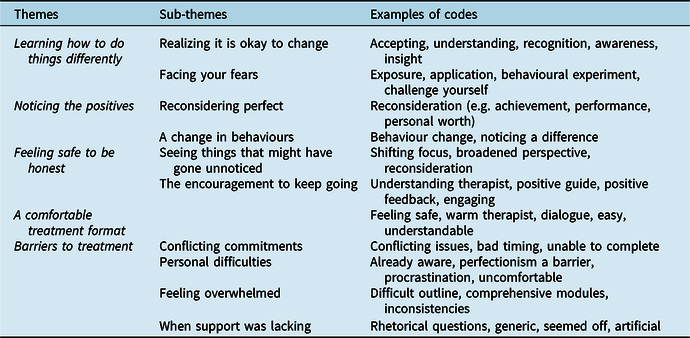
Learning how to do things differently
The clients perceived the treatment as being mostly a positive experience and were generally able to articulate the aspects they considered helpful. Some of the issues that were brought up conveyed the notion of becoming more aware of their own difficulties and a better understanding of the mechanisms that were driving their perfectionism. Many clients referred to this as a realization that it was okay and possible to change – Realizing it is okay to change.
‘It prompted me to broaden my view of success and meaning, such as through surveying people, and confronting my own beliefs about personal worth. It helped me recognize the importance of relaxing time and that I shouldn’t feel guilty about doing things that aren’t directly related to achievement.’ [Female, 20 years old]
A number of clients discussed the practical application of strategies that made it possible to change their behaviour. Some talked about facing their fears through the use of behavioural experiments and testing out their worst fears, and others enjoyed strategies that were more related to activity scheduling – Facing your fears.
‘… the behaviour experiments where we completely altered how we would normally do something. For myself, this was to not learn an entire script by heart like I would normally do, but instead only learn parts of it or focus more on the understanding.’ [Female, 24 years old]
Noticing the positives
The treatment appeared to have had a positive effect on the clients’ everyday life. Many aspects discussed revolved around the benefits that they experienced, such as being able to behave differently than before, or feeling less stressed about always having to perform or achieve a certain standard. The clients seemed to have broadened their perspective of what it means to be perfect, shifting focus away from the rigid application of certain rules to acting more flexibly – Reconsidering perfect.
‘They helped me to think differently … learn to be more compassionate on myself and also realize that trying to do everything to a very high standard does not mean your performance is better … so learning to be more relaxed in regards to your performance is certainly a worthwhile goal.’ [Female, 37 years old]
Another aspect of the benefit of treatment illustrates the clients’ realization that they were doing things differently. This seems to be related to three main categories: intrapersonal, interpersonal, and performance. First, many clients reported having noticed an effect on their overall well-being, such as being less strict about things in life. Second, several clients mentioned that treatment improved their relationships by making it possible to spend more time with family and friends, as well as becoming more spontaneous. Third, a number of clients discussed how their perception of performance had changed, such as being less afraid of making mistakes or to fail at work – A change in behaviours.
‘I’ve made a conscious effort to add more leisure activities to my days and weekends, and I’m noticing it gives me a lot more to look forward to and makes me less focused on striving for work and academic achievement.’ [Female, 25 years old]
Feeling safe to be honest
Having someone to turn to seems to have been crucial for many clients undergoing the treatment programme. This appears to not only have provided them with support and encouragement, but also valuable feedback on things that were essential for moving forward. Some also pointed out that they probably would have missed out on significant aspects related to the understanding of their ongoing problems without this feedback – Seeing things that might have gone unnoticed.
‘It was incredibly relieving to read commentary that did not involve criticisms. I’ve grown accustomed to constant criticisms (the mentality of my nation, I’ve told). This area is too sensitive for that.’ [Female, 24 years old]
Apart from gaining more insight into their difficulties, the guide also offered a lot of encouragement and the reinforcement to keep going. A number of clients for instance reported feeling prompted to continue by the messages sent to them. Others felt that it was helpful to have someone regularly check in on them to see if everything was going okay or if they needed any extra support – The encouragement to keep going.
‘I felt that […] really understood me and took the time to review my progress. She was very encouraging and pointed out the things I was doing well. When I had a “wobble” later on in the course, she was supportive and helped me get back on track and be compassionate with myself.’ [Female, 41 years old]
A comfortable treatment format
A number of clients described the treatment format as comfortable, easy to use and navigate, and that the secure online interface was well designed. Some clients also discussed the fact that they felt more relaxed about bringing up sensitive issues thanks to the anonymity it provided, and two clients even mentioned having made better progress in their internet-based treatment compared with a previous face-to-face contact.
‘Having attempted cognitive behavioural therapy with a therapist twice over the last 4 years (each time only lasting 2–3 sessions before dropping out), I can say I have made the most progress with the online modules here at overcoming perfectionism. I think the degree of anonymity that comes with doing a treatment online (with a guide to provide feedback) freed me to be more open/not omit things that were uncomfortable to acknowledge at first, which I think is essential to overcoming the root beliefs.’ [Female, 19 years old]
Barriers to treatment
The clients described a number of barriers to treatment, which hindered them from completing the exercises or understanding the content. Part of this appears to be associated with scheduling issues, such as not being able to follow through as planned. One of the most recurrent topics with regard to the barriers to treatment concerned the conflicting commitments many clients experienced. To some, this was related to a more general sense of having too much to do, while others struggled with more acute issues, like a relationship conflict – Conflicting commitments.
‘I really wanted to get involved in this study but I have just been through quite probably the most terrifying few months of my life and I did not have the head space for this at all.’ [Female, 25 years old]
A number of clients were able to reflect and discuss the personal difficulties they had in relation to undergoing treatment. This was linked to such issues as experiencing problems with regard to self-improvement in general. A few clients also pointed out that they already knew a lot about perfectionism, which made the treatment programme feel less informative and helpful. Meanwhile, some clients even believed perfectionism itself hindered them from engaging with treatment – Personal difficulties.
‘The only difficulty I had was to do with my own perfectionism in completing the course, everything else was fine.’ [Male, 21 years old]
A number of clients also felt overwhelmed by the sheer workload they needed to put in. These clients recommended that the larger modules be split into two and to use a more flexible and tailored outline. Moreover, some raised the issue of simplifying the content, to encourage smaller stretches, and to give hints about what was coming – Feeling overwhelmed.
‘I thought the cycle diagram was quite specific/rigid and felt at times that I had to squeeze my responses into boxes that didn’t fit very naturally. There was the option of representing our perfectionism cycle in our own way (drawing our own diagram) but it I found it challenging to come up with one.’ [Female, 19 years old]
Not all clients were content about the guidance they received during treatment. A few reported having difficulties contacting their guide, which impeded their progress. Sometimes clients wanted support more or less instantaneously in order to clarify questions they had about the reading material or exercises. Some clients also complained about the questions sent by their guide being rhetorical, rigid, or inhuman – When support was lacking.
‘Some of the conclusions about what I’ve written seemed off, making it feel a bit artificial. And in general, the responses felt a bit rigid, inhuman. The questions seemed rhetorical rather than to start a conversation.’ [Female, 24 years old]
Discussion
The current study investigated the experiences of undergoing ICBT for perfectionism, revealing a number of positive aspects as well as potential barriers for a successful uptake. First, it appears that treatment brought about a change in perspective by increasing knowledge of what perfectionism is and how it is being maintained. It also looks as if this realization made it acceptable to do things differently, thereby facilitating a behavioural change. Second, many clients were able to pinpoint specific techniques they found most useful in managing their problems, such as activity scheduling and behavioural experiments. They were also able to discuss some of the positive consequences these generated, particularly the ability to review what it means to be perfect, worry less about what others think of them, and to derive a sense of self-worth from more things in life than performance within just one or a few domains. These aspects are all stressed as key components in the cognitive behavioural treatment of perfectionism (Egan et al., Reference Egan, Wade, Shafran and Antony2014), suggesting that most clients understood the rationale and that the treatment programme probably targeted its intended mechanisms.
With regard to the support provided by the guides, the results are consistent with previous research on guidance in ICBT. Similar to Blom et al. (Reference Blom, Jernelöv, Lindefors and Kaldo2016), the clients in the current study appreciated having somebody to discuss the treatment programne with; in particular, to have someone point out important issues seemed to have been helpful, as it provided insights that may otherwise have gone unnoticed. Likewise, being encouraged to become more active, receiving praise, and getting some assistance in overcoming obstacles appear to have had a positive impact on adherence and satisfaction with treatment. This closely resembles the findings by Svartvatten et al. (Reference Svartvatten, Segerlund, Dennhag, Andersson and Carlbring2015), who found that identifying recurrent patterns and problem behaviours and highlighting positive consequences were related to better treatment outcome and an increased number of modules that were completed. It is thus reasonable to assume that the support from a guide is vital for many clients undergoing ICBT, including those experiencing difficulties with a treatment that targets such a transdiagnostic process as perfectionism.
However, as also pointed out by many of the clients in the current study, the guidance was sometimes perceived as insufficient. For some this seems related to unmet expectations as to what type of support it was possible to receive. For others, it appears to have been the amount of feedback that was insufficient or the fact that it was not always delivered immediately. This issue is not unique, rather something that is raised in many qualitative investigations. Rozental et al. (Reference Rozental, Forsström, Almquist Tangen and Carlbring2015a), for instance, found that among clients undergoing ICBT for procrastination, it was not uncommon to express a desire for a face-to-face contact. One way of overcoming this problem in ICBT could be to discuss what preconceptions clients hold in relation to receiving treatment via the internet, or tailor the degree of assistance provided so that it matches the amount of help a particular client requires.
Both the treatment programme in itself, and the fact that it was administered via the internet, seem to have been widely accepted by the clients, two even referring to it as better than their previous experiences of seeing a therapist face-to-face. Certain aspects, such as anonymity and flexibility are in fact regularly brought up in qualitative studies of ICBT, giving some credence to the idea of increasing outreach and targeting clients that might not have sought help otherwise.
In the current study, some clients also reported feeling overwhelmed by the content and exercises. Furthermore, certain modules were difficult to understand or complete due to different levels of complexity. This is in line with the clients’ experiences of undergoing ICBT for generalized anxiety disorder in a study by Burke et al. (Reference Burke, Richards and Timulak2019). Here, it was found that the reading material was sometimes seen as irrelevant or unhelpful. Similarly, finding the time to complete the modules or having conflicting commitments can severely impact adherence and make the clients feel stressed by the treatment programme, as seen in the current study. This issue can even become an unwanted or adverse event for some clients, as found in a study by Rozental et al. (Reference Rozental, Boettcher, Andersson, Schmidt and Carlbring2015b), investigating the negative effects of ICBT, implying that it might be important to review the amount of work each module requires. In addition, providing more support for those parts that may be hard to understand and offer the opportunity to expand certain sections could be useful. For example, it might be possible to give everyone the same basic outline with only the most essential elements of the treatment, and then having the option to explore the details if needed.
The current study is one of few examples investigating the clients’ experiences of ICBT for a transdiagnostic process and has rendered a number of important findings. However, there are several limitations that need to be considered when reviewing the results. First, although providing a lot of valuable insights in their responses, only 30 out of 62 (48.4%) clients actually completed the open-ended questions at post-treatment. This means that more than half did not share their view of the treatment programme. No differences were detected between the groups, but this does not preclude certain characteristics to have affected the response rate, such as lack of improvement. Second, the clients completed on average four out eight modules (SD = 2.32), meaning that there was some variability in terms of the treatment dosage received. This might also have had an impact on the responses provided, such as not being able to comment on the later parts of the treatment programme. Third, the clients in the current study may not be representative of everyone having problems and seeking help for perfectionism. Looking closely at the sociodemographics of the full sample reveal that a majority of the clients were female and well-educated and could limit the generalizability of the results. Fourth, the open-ended questions used in the current study did sometimes ask about very specific aspects related to the clients’ experiences of undergoing treatment, including pre-defined answers to some. Hence, it is possible that this affected their responses in a way that skewed their impression, such as causing social desirability (Krosnick, Reference Krosnick1999). Fifth, the thematic analysis was conducted by two of the authors, A.R. and R.K., but no form of inter-rater reliability check was applied in order to cross-validate the themes or sub-themes. Hence, there is a possibility that other researchers may have analysed the responses differently, which is why the findings should be replicated before any firm conclusions can be drawn.
Conclusion
The results from the current study suggest that clients receiving ICBT for perfectionism started noticing a change in perspective with regard to their perfectionism and that they began facing their fears and thinking and behaving differently. Most clients enjoyed the treatment programme and its format, including its flexibility, and appreciated that a therapist encouraged them and provided guidance. However, obstacles such as having conflicting commitments or personal difficulties, as well as seeing some of the modules as too comprehensive or expecting more support than was offered, were also reported.
Supplementary material
To view supplementary material for this article, please visit https://doi.org/10.1017/S1352465820000090
Acknowledgements
The authors would like to thank George Vlaescu for his excellent webmaster services.
Financial support
The current study was made possible thanks to a Professor’s grant from Linköping University to one of the authors (G.A.). It was also supported by the National Institute for Health Research Biomedical Research Centre at Great Ormond Street Hospital for Children NHS Foundation Trust and University College London. All research at Great Ormond Street Hospital NHS Foundation Trust and UCL Great Ormond Street Institute of Child Health is made possible by the NIHR Great Ormond Street Hospital Biomedical Research Centre. The views expressed are those of the author(s) and not necessarily those of the NHS, the NIHR or the Department of Health.
Conflicts of interest
None of the authors of the current study has any conflicts of interest to report.
Ethics statement
The current study received ethical approval from the Research Ethics Committee at University College London (UCL), project ID 6222:001.




Comments
No Comments have been published for this article.