

Previous research has shown that the expected costs of military action influence the public’s willingness to endorse the use of force. Military casualties are a particularly powerful determinant of public support (Mueller Reference Mueller1973; Gartner and Segura Reference Gartner and Segura1998; Gartner Reference Gartner2008), though other work suggests that citizens also consider the likelihood that armed force will succeed in achieving political and military objectives (Gelpi, Feaver, and Reifler Reference Gelpi, Feaver and Reifler2009).
Military technology can influence these costs, making their study of special relevance to scholars of conflict and electoral accountability. For example, the very high costs that a nuclear conflict would impose on all states may be one reason that there has not been a large-scale war between great powers since 1945 (Brodie Reference Brodie1946; Schelling Reference Schelling1966). More recently, we have seen the introduction or refinement of military technologies that reduce the costs of conflict. These weapons can launch attacks without placing military personnel at risk of physical harm from enemy combatants. Weapons such as armed drones, cruise missiles, and guided bombs achieve these effects through enhanced capacities to remotely collect intelligence on targets (such as high-resolution satellite images and the interception of electronic communications), global positioning systems that allow the precise geo-location of targets, and guidance systems that can accurately attack these targets (Gillespie Reference Gillespie2006).
By lowering the costs of conflict, scholars posit that these technologies may make the public more supportive of, or indifferent to, leaders’ decisions to initiate, escalate, or sustain armed conflict. Public opposition to losing soldiers and wars is a key restraint in democracies on the reckless initiation of conflict. As Kreps and Kaag (Reference Kreps and Kaag2012) put it, drone warfare “creates the possibility that leaders will no longer, in a prudential sense, have to obtain popular permission to go to war” (see also Brunstetter and Braun Reference Brunstetter and Braun2011).
These ideas have been subject to systematic investigation by Schneider and MacDonald (Reference Schneider and MacDonald2016), Walsh (Reference Walsh2015), and Walsh and Schulzke (2015; Reference Walsh and Schulzke2018). These studies undertake survey experiments that manipulate how otherwise identical attacks are carried out – by drones, crewed aircraft, or ground troops. They find that those who are told an attack was carried out by drones modestly increase their support for the use of force, but less than critics of the technology might expect. These findings are important because they suggest that the public takes into account other factors outside the costs that these military technologies reduce when deciding to support or oppose the use of force. This means that greater reliance on such technology, at least on its own, may not completely free political leaders to more frequently use force.
With the present research, we replicate experiments presented by Walsh and Schulzke (Reference Walsh and Schulzke2018), which are similar to others in the literature (Schneider and MacDonald Reference Schneider and MacDonald2016), but we address a potential problem with information equivalence. In addressing this, we find that the difference in support between the use of drones vis-à-vis ground troops disappears. Prior studies employ survey vignettes that randomize whether the attack is carried out by drones, aircraft, or ground troops. Scholars then treat the attacks as if they are otherwise similar. We argue that respondents might infer that the decision to use one type of force instead of another is itself influenced by the costs of conflict that political or military leaders anticipate. That is, respondents may not view the attack itself as otherwise equivalent beyond the differing military technology used. For example, respondents may believe that leaders prefer to attack “harder” targets that pose greater threat to ground troops with drones or cruise missiles. As prior scholarship notes, information equivalence poses an important threat to causal inference in survey experiments (Dafoe, Zhang, and Caughey Reference Dafoe, Zhang and Caughey2018). To address this, we report on a series of three survey experiments, two of which employ nationally representative samples, in which the use of military technologies (drones or ground troops) is presented to respondents as a random consequence of the weather rather than the deliberate choice of political and military leaders. We find no systematic difference in support across these treatments. This suggests that concern about military technologies reducing the costs of conflict and thus opening the door to using force more aggressively is overstated.
Experimental Design
We assert that the causal explanation often posited for the advantage of drone attacks – that such attacks are more popular among the American public because of the perceived lack of danger to U.S. military personnel – is perhaps not as strong as previously thought. We test this using three survey experiments – conducted as part of the 2016 and 2018 Cooperative Congressional Election Studies (CCES)Footnote 1 and on Amazon’s Mechanical Turk platform in 2019 – in which we account for issues of information equivalence in vignette experiments. This occurs when respondents, in light of an experimental manipulation, update their beliefs about the attributes of the situation being described, including elements beyond what was intended by the investigator (Dafoe et al. Reference Dafoe, Zhang and Caughey2018).
In our case, this can happen in vignette experiments that manipulate whether an attack is carried out by drones or ground troops. Previous experiments (Schneider and MacDonald Reference Schneider and MacDonald2016; Walsh and Schulzke Reference Walsh and Schulzke2018) randomly assign the type of force used in an attack. But they do not account for the fact that, in real decisions to use force, the type of force is not random. Instead, political and military leaders deliberately choose to use particular types of force. This choice may be informed by characteristics of the target, which respondents may infer from the type of force used.
If this is the case, such experimental designs might not be comparing treatments that differ only in terms of the type of force employed. For example, it is possible that respondents would infer that ground troops would be used against targets of higher value. This inference is not implausible. In the raid carried out by ground forces that killed Osama bin Laden in 2011, the president and his advisors considered but rejected the idea of attacking with drones or other stand-off weapons such as guided bombs. They decided to employ troops, despite the high risk of American casualties, for both political and military reasons. Troops could capture bin Laden or recover his body, providing definitive evidence that he was no longer leading Al-Qaeda. They also worried about the possibility that bin Laden would not be at the compound at the time of the attack. This created the possibility that drone strikes would kill innocent civilians. Ground troops were better positioned to positively identify the residents of the compound. Furthermore, bin Laden’s compound was deep inside Pakistan and beyond the zone where the Pakistani air force did not intercept American drones (Ackerman and Shachtman Reference Ackerman and Shachtman2011; McNeal Reference McNeal2011). This meant that drones could be shot down as they approached, which could also alert bin Laden that the Americans had identified his hideout.
Alternatively, respondents might infer that leaders are most likely to use drones against targets that are difficult to attack with ground forces at low risk or cost – what (Kreps and Kaag Reference Kreps and Kaag2012) term the “moral hazard” problem created by drone warfare. We account for these plausible inferences by crafting survey vignettes that tell respondents that the use of either drones or ground troops in carrying out an attack is essentially random. We modeled these vignettes to be nearly identical to those used by Walsh and Schulzke (Reference Walsh and Schulzke2018), with the only innovation being the exogenous conditions that determined the use of drones or ground troops.
In all three experiments, respondents are informed that they are reading about a hypothetical situation that closely resembles real events. They are told that the U.S. military is tracking a group of Islamic State militants (CCES 2018 and Mechanical Turk experiment) or a leader of the Islamic State (CCES 2016) in a foreign country. The military target is said to move frequently between compounds to avoid detection. The U.S. military has both ground troops and drones prepared to attack suspected compounds which the militants or leader might approach. Both types of units have an equal chance of successfully completing the mission. But poor weather – clouds and rain – makes it difficult for American satellites to track Islamic State movements, until a sudden break in the weather allows the satellites to determine which compound the militants or leader are approaching. A random subset of respondents is informed that the militants are located in a compound where drones are prepared to strike, while the rest are informed that the militants are located where ground troops are positioned to strike (we refer to these groups as the “drones condition” and the “troops condition”). Respondents are then told that military leaders authorize the strike.
By using this setup, respondents should have no expectation regarding the likelihood of success (which they are told is identical). Moreover, they should not be able to infer anything about military leaders’ decision to use drones or ground troops beyond random chance, as the decision to use troops/drones is exogenously imposed by the weather.
The first two experiments we examine were administered using the 2016 and 2018 Cooperative Congressional Election Study (CCES). The primary dependent variable of interest was approval of the attack.Footnote 2 This variable is measured on a 1–7 scale from “I very strongly oppose this attack” to “I very strongly support this attack.”Footnote 3
We administered a follow-up experiment in November 2019 on a sample of 922 via Amazon’s Mechanical Turk (Mturk). In this experiment, we added an additional sentence to the drones condition that explicitly informed respondents that “the use of drones means that no American military personnel would be placed at risk.” Although we believed respondents in the first two experiments understood that the use of drones would eliminate the risk to American troops, we added this sentence to make this connection apparent. In order to better gauge whether public support for military attacks are conditioned on the perception of threat to American military personnel, we include a follow-up question asking respondents how many military casualties they expect will result from the attack (ranging from 1 = “none at all” to 4 = “a lot”). For ease of interpretation, all response scales are recoded from 0 to 1, such that treatment effects can be interpreted as the percentage-point shift across the response scale. Because of the successful random assignment to drones and troops conditions in all three experiments, we analyze the results in the next section by comparing mean levels of support for the attack (Kinder and Palfrey Reference Kinder and Palfrey1993).Footnote 4
Results
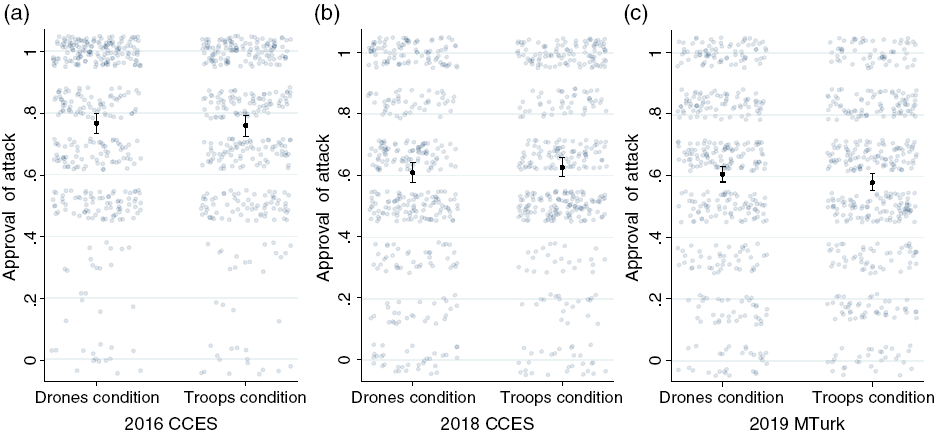
To assess whether news of drone strikes is received by Americans more favorably than attacks placing military personnel at risk, we look first at mean levels of support for the attacks across all three experiments. The results shown in Figure 1 are striking.Footnote 5 In none of the three survey administrations are the treatment effects substantively large or statistically significant. In all three surveys, the scenarios involved counter-terrorism operations. Gelpi, Feaver, and Reifler (Reference Gelpi, Feaver and Reifler2009) find that this policy objective receives the most support from the public, so it is not surprising that we find overall levels of support for military action to be high.Footnote 6 These high baseline levels of approval should make it easier, if anything, to find a drop in support when troops are used. Yet in none of the three experiments do we find that support for drones is appreciably higher than support for attacks involving ground troops.Footnote 7 On the 0–1 scale we use for these analyses, none of the differences are greater than 0.03 points and none are statistically significant. While it has been posited that the use of drones to shield American military personnel from harm should lower the potential costs military and political leaders face for launching an attack, we do not find that the use of drones matters to the public. This absence of a meaningful difference appears even in the 2019 Mturk experiment. Here respondents are explicitly informed that drone strikes would mean no soldiers’ lives would be put at risk. Despite deliberately making this advantage more salient, we find virtually unchanged support. By addressing issues of information equivalence in the research design, we find that drone strikes are no more popular than attacks carried out by troops.Footnote 8
(a-c) Mean Levels of Support for Attack by Treatment Condition.
Note: Differences between conditions are not statistically significant (α < 0.05). Error bars represent 95% confidence intervals.

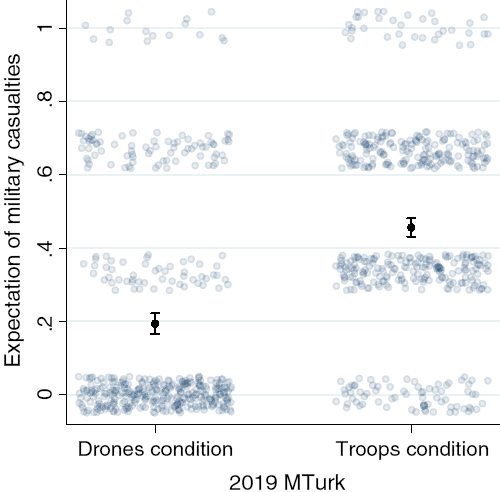
The question remains whether citizens understand or realize that the use of ground troops means that American soldiers’ lives will be placed at risk. If citizens did not make this connection, it would provide a rationale for why they are equally supportive regardless of the differing military technologies used in the attacks. In the administration of our 2019 Mturk experiment, we asked individuals a follow-up question about how many military casualties they expected would result from the attack.Footnote 9 The results in Figure 2 show the differences between the experimental conditions in terms of expected military casualties. We find that, despite there being no difference in support for the attack, there is a substantially large and statistically significant effect of the troops treatment on expectations of military casualties. To put these differences into perspective, 67 percent of those who read about an attack by unmanned drones recognized (correctly) that there would be no risk to military personnel, while only 16 percent of those in the troops condition said the same.Footnote 10 We therefore find that, although respondents in our surveys recognized that putting troops on the ground risked American military lives, that risk did not appreciably alter their support for the attack.
Expectation of Military Casualties by Condition.
Note: Differences are significant at α < 0.001, two-tailed test

Conclusion
Previous research finds that military casualties reduce support for the use of force. This raises the concern that weapons technologies such as drones will remove a powerful constraint on political leaders’ willingness to initiate and sustain military action. Our study is motivated by the possibility that respondents in survey experiments may not view the decision to employ a particular weapon and the costs of conflict as independent of each other. We develop a research design to account for this possibility, finding that weapons that eliminate the possibility of military casualties do not necessarily increase support for military action. In every condition, respondents are told that military leaders identified military targets and had resources in position to eliminate them, and we find that support for the attack is high regardless of whether drones or ground troops are used.
The findings importantly suggest that the worry often posed by scholars who study drone warfare – that the low cost of military intervention posed by advances in technology will effectively eliminate the costly disincentives to the use of military force – may be overstated. We find strong support for the attacks described in our vignettes even when Americans recognize the risk these attacks will pose to soldiers on the ground. The link between expected military casualties and support for an attack is therefore not supported by this research. The research design we employ might be fruitfully applied in future research, including studies that experimentally manipulate expected casualties (Gartner Reference Gartner2008) and the likelihood of success (Gelpi, Feaver, and Reifler Reference Gelpi, Feaver and Reifler2009), to better understand how these factors influence the public’s support for the use of force.
Supplementary material
To view supplementary material for this article, please visit https://doi.org/10.1017/XPS.2020.18