



Introduction
The onion (Allium cepa L.) is a versatile bulbous vegetable and spice crop, grown widely in the temperate and tropical climates of the world (Job et al., Reference Job, Bhakar, Singh, Tiwari, Sharma, Lakhawat and Sharma2016; Geries et al., Reference Geries, El-Shahawy and Moursi2021). In the global vegetable production scenario, it ranks second after potatoes. The plant is a member of the genus Allium in the Alliaceae family (Worku et al., Reference Worku, Jalata and Nandeshwar2020). It contains phenolic and flavonoid compounds that have potential anti-inflammatory, anti-cancer, anti-cholesterol and antioxidant values. Onion bulbs are rich sources of vitamins like A, B1, B2 and C, carbohydrates, proteins, minerals (K, Ca and Se), essential oils and pungent-smelling sulphur compounds (Salari et al., Reference Salari, Hansra and Saharawat2020). It is consumed mainly as fresh salads; however, the powdered, and dehydrated forms are also used in cooking and various cuisines to add flavour and texture (Pooja Rani et al., Reference Pooja Rani, Batra, Bhatia and Shiwani2018). Onion is grown worldwide in an area of 3.97 Mha with an annual production of about 97.7 Mt (Geries et al., Reference Geries, El-Shahawy and Moursi2021). India is the second largest onion producer after China among the global onion growing countries. In India, onion is cultivated in about 1.17 Mha, with a production of 18.94 Mt and a productivity of 16.13 t/ha (Tripathi et al., Reference Tripathi, Sankar and Lawande2017). The main reasons for low onion productivity in India compared to the Republic of Korea, China, the USA and Turkey are inadequate nutrition, non-availability or mismanagement of irrigation water, a lack of improved varieties and poor crop management (Kumar et al., Reference Kumar, Imtiyaz, Kumar and Singh2007a, Reference Kumar, Imtiyaz and Kumar2007b; Saxena et al., Reference Saxena, Singh, Srivastava and Gautam2008; Bijay, Reference Bijay2010; Bagali et al., Reference Bagali, Patil, Guled and Patil2012).
Onion is a shallow-rooted plant with most fibrous roots concentrated in the top 30 cm of soil depth, whereby it extracts fairly large amounts of water and nutrients (Patel and Rajput, Reference Patel and Rajput2009). It is susceptible to water stress and nitrogen inadequacy throughout the growth period. The traditional surface method of irrigation causes excessive losses of water through deep percolation, runoff, evaporation and conveyance, including considerable nutrient leaching. The problems of conventional irrigation methods can be eliminated using the micro-sprinkler irrigation technology that can apply water according to the crop demand to ensure the efficient use of irrigation water, increase water and crop productivity with substantial water-savings (Shock et al., Reference Shock, Feibert and Saunders2007; Kumar et al., Reference Kumar, Imtiyaz and Kumar2007b; Pereira da Silva et al., Reference Pereira da Silva, Coelho and de Miranda2013; Mane et al., Reference Mane, Kadam and Patil2014; Pawar et al., Reference Pawar, Dingre and Kale2020; Piri and Naserin, Reference Piri and Naserin2020). In limited-water conditions, a precise deficit irrigation management strategy with proper irrigation scheduling can maintain a favourable soil moisture regime in the root zone, alleviate plant water stress and enhance water use efficiency with minimal yield decline (Pejic et al., Reference Pejic, Gvozdanovi-Varga, Mili, Ignjatovi-Cupina, Krstic and Cupina2011; Pal et al., Reference Pal, Bam, Patra and Ray2021; Tolossa, Reference Tolossa2021). Likewise, nitrogen is considered the key essential nutrient, which is actively involved in the production process through several physiological and biochemical reactions of plant metabolism (Nawaz et al., Reference Nawaz, Ahmed, Hussain, Rizwan, Sarfraz, Wainse and Jamil2017). As onion is a nutrient-exhaustive plant, adequate nitrogen supplementation can improve growth, yield and bulb quality (Moursy et al., Reference Moursy, Khalifa, Attia, Sayed and Osman2007; Nemat et al., Reference Nemat, Abd El-Kader, Attia and Alva2011; Dhital et al., Reference Dhital, Shakya, Sharma and Dutta2015; Geries et al., Reference Geries, El-Shahawy and Moursi2021). It responds positively to incremental water and nitrogen application until the optimum yield level has been reached, which supports the necessity of planned irrigation and nitrogen management for achieving higher production (Abdissa et al., Reference Abdissa, Tekalign and Pant2011; Okumura et al., Reference Okumura, Mariano and Zaccheo2011; Fatideh and Asil, Reference Fatideh and Asil2012; Tsegaye et al., Reference Tsegaye, Bizuayehu, Woldemichael and Mohammed2016; Pawar et al., Reference Pawar, Dingre and Kale2020).
The onion is an emergent dietary cash crop grown extensively during the winter season in the Gangetic alluvial regions of India. Conventional irrigation and inadequate nitrogen fertilization, usually followed by farmers, results in declined yield, poor bulb quality and low input use efficiencies due to non-uniform water and nitrogen distribution around the root zone and the plant's exposure to varying water stress all along the growing period. No sufficient database information is available for water and nitrogen distribution patterns under micro-sprinkler irrigation and nitrogen fertilization in onion plants. A comprehensive understanding of the mechanism of spatiotemporal distribution of soil water and nitrogen and their movement in the onion root zone is essential for micro-sprinkler-based irrigation and nitrogen management strategies in the Indian subcontinent. The present investigation aimed to evaluate the water and nitrogen distribution at different growth stages of onion plants under different irrigation regimes through micro-sprinkler and nitrogen fertilization rates along with the bulb yield, water and N productivity. We hypothesized that micro-sprinkler irrigation with adequate watering and nitrogen fertilization could enhance soil water storage and N availability with greater water and N use efficiency for higher onion production and financial gains.
Materials and methods
Experimental site characteristics
Field trials were carried out on onion during the 2016–17 and 2017–18 winter seasons at the Central Research Farm of Bidhan Chandra Krishi Viswavidyalaya, Gayeshpur, West Bengal, India, located between the latitude of 22°58′31″ N and longitude of 88°26′20″ E at an average elevation of 9.75 m above mean sea level. The climate of this region is humid sub-tropical, with hot dry summers and cold winters. The mean annual rainfall is 1490 mm, of which 75% occurs during the monsoon season (June–September). Sporadic rainfall also happens during April–May and November–February. The amount of rainfall during the cropping periods of 2016–17 and 2017–18 was recorded at 25.5 and 16.9 mm, respectively. The atmospheric mean monthly temperature ranged from 25.4–37.6°C during the summer to 10.5–23.7°C during the winter. The average relative humidity for the season varied from 70 to 95%. The velocity of the wind was 0.20–3.69 km/h. Pan evaporation rate ranged from 0.9–1.4 mm/d for December–January to 4.2–4.6 mm/d for April–May. The depth of the water table remained 6.2–7.6 m below the ground surface. The soil at the experimental site had a sandy loam texture. Depth wise important physical and chemical soil properties are presented in Table 1.
Physical, hydro-physical and chemical properties of the experimental soil

BD, bulk density; SHC, saturated hydraulic conductivity; FC, field capacity; PWP, permanent wilting point; AW, available water; EC, electrical conductivity; SOC, soil organic carbon; Ava. N, available nitrogen; Ava. P, available phosphorus; Ava. K, available potassium.
Experimental design and treatments
The field trial was set in an augmented strip plot design with three replications per treatment. There were 13 treatments comprising three levels of crop evapotranspiration-based irrigation with micro-sprinkler at 0.6 ETc (M1), 0.9 ETc (M2) and 1.2 ETc (M3) as main factors and four levels of recommended dose of nitrogen at 0% (N0), 75% RDN (N1), 100% RDN (N2) and 120% RDN (N3) as sub-factors, including a control treatment (SN) having conventional surface irrigation at 40 mm CPE with 100% RDN.
Crop management practices
The experimental field was subdivided into 39 subplots, each measuring a size of 3 m × 3 m. A 1.5 m wide buffer strip was provided in between and across the subplots to eliminate seepage movement and micro-sprinkling effects from the neighbouring plots. In between two replications, a 1.0 m wide irrigation cum drainage channel was made, and irrigation water was carried through this channel. Forty-five-days old healthy seedlings of onion (A. cepa L.) cv. Suksagar were transplanted at 20 cm × 15 cm spacing on 10th of December 2016 and 18th of December 2017, accommodating 300 plants in each subplot. During bed preparation, farmyard manure at 15 t/ha was incorporated and properly mixed with the soil. The recommended dose of fertilizer, i.e., N: P2O5: K2O at 80: 40: 60 kg/ha in the region was applied during both seasons. In this study, the flexible dose of N was imposed at 0, 75, 100 and 120% of RDN, while the P and K doses remained the same. Full P and K doses were applied as basal to all plots during transplanting. N was top-dressed in three splits, one-half at transplanting and one-fourth each at 30 and 60 days after transplanting (DAT). Standard cultural operations, plant protection measures and agronomic management practices were equally performed in all plots. The entire plant was harvested at maturity, on 8th of April 2017 and 2nd of April 2018.
Irrigation scheduling
Micro-sprinkler irrigation was scheduled at 0.6, 0.9 and 1.2 ratios of ETc at 3-day intervals on onion in each experimental year. The amounts of water using micro-sprinkler irrigation were measured by the following formula (Zheng et al., Reference Zheng, Huang, Wang, Huang, Pereira, Xu and Liu2013):

where I is the irrigation amount (mm), ETc represents crop evapotranspiration (mm), Ep indicates 3-day cumulative pan evaporation (mm) recorded from a USDA class A pan evaporimeter, Kp is the pan coefficient, Kc denotes the crop coefficient, and Re specifies effective rainfall (mm). Kp was assumed to be 0.75 after considering relative humidity and rainfall (Doorenbos and Kassam, Reference Doorenbos and Kassam1979). Kc values chosen for onion during the irrigation period were 0.52, 0.85, 1.04 and 0.87 at the seedling, bulb initiation, bulb development, and maturity stages, respectively (Bandyopadhyay et al., Reference Bandyopadhyay, Mallick and Rana2003). Each micro-sprinkler had a designed discharge rate of 39 l/h at a pressure of 1.5 kg/cm2 and a wetted diameter of 3 m. The full irrigation amount applied through micro-sprinkler-based 100% ETc for onion was estimated by the following relationship:

where V is irrigation volume (L), A is subplot area (m2), ETc is crop evapotranspiration (mm), Re is effective rainfall (mm), and Em is irrigation efficiency of micro-sprinkler (85%). All plots were given a common irrigation of 40 mm depth one day before transplanting to overcome seedling injury, better seedling establishment, and to maintain uniform soil moisture. Groundwater was used as a source of irrigation, which was started at 7 DAT and suspended 10 days before harvesting in all treatments. The volumes of water applied for various irrigation treatments are shown in Table 2.
Effect of different levels of micro-sprinkler irrigation and nitrogen fertilization on bulb yield, water productivity and nitrogen productivity in onion (2-year pooled data)

M1, micro-sprinkler irrigation at 0.6 ETc, M2, micro-sprinkler irrigation at 0.9 ETc, M3, micro-sprinkler irrigation at 1.2 ETc; SN, surface irrigation with 100% RDN; N0, no-N; N1, 75% RDN; N2, 100% RDN; N3, 120% RDN; RDN, recommended dose of nitrogen; NS, not significant; s.e.m., standard error of mean; CD, critical difference.
Determination of actual evapotranspiration
Seasonal water consumption or actual evapotranspiration (ETa) for onion plants during the entire growing period was determined by the field water balance equation (Simsek et al., Reference Simsek, Tonkaz, Kacira, Comiekcioglu and Dogan2005):

where I is irrigation (mm), P is rainfall (mm), G is upward flux from groundwater (mm), R is surface runoff (mm), D is drainage below root zone (mm), and ±ΔSWS is soil water storage depletion from root zone profile (mm). The rainfall amount retained in the rooting depth and used for estimating plant evapotranspiration needs was taken as effective rainfall (Re). In this study, G, R and D were not considered for ETa calculation. Thus, the above Eqn. (3) became:

Water productivity
Water productivity for each treatment was calculated as the ratio of total bulb yield to seasonal ETa by the equation (Lipovac et al., Reference Lipovac, Stricevic, Cosic and Durovic2022):

where WP = water productivity (kg/m3), Y = bulb yield (kg/ha) and ETa = seasonal actual evapotranspiration (m3/ha).
Nitrogen productivity
Nitrogen productivity was determined by the equation (Haile et al., Reference Haile, Nigussie and Ayana2012):

Soil water studies
The periodic soil water contents at a depth of 0–0.15, 0.15–0.30, 0.30–0.45 and 0.45–0.60 m for each irrigation treatment, just before and 24 h after irrigation or rainfall, during planting and harvesting, and at 20-day intervals in each experimental year (December–March), were monitored using a soil profile probe device. In the micro-sprinkler system, soil water contents were measured at 100 cm away from the micro-sprinkler head along the lateral. Onion was reported to spread about 85–90% of its fibrous roots at 0.30 m, 8–9% at 0.45 m, and 1–2% at 0.60 m depth of the soil profile (Patel and Rajput, Reference Patel and Rajput2009). As most of the plant water requirement is extracted from a depth of 0.30 m and very little water is extracted beyond 0.60 m depth, the effective root zone depth of onion in this study was considered to be 0.30 m. The water percentage for each soil depth was converted into depth (cm) by multiplying the soil bulk density and thickness of the soil horizon to measure the soil water content in root zone depth. It was also expressed on volume basis in m3/m3.
Measurement of soil available nitrogen
For determination of available N contents in the soil for different N-fertilized and unfertilized plots under micro-sprinkler and surface irrigation, representative composite soil samples from different depths (0–0.15, 0.15–0.30 and 0.30–0.45 m) of the middle rows of each subplot were collected at vegetative (10–30 DAT), bulb development (60–90 DAT) and maturity (90–110 DAT) stages of onion plants in both cropping seasons. A soil auger was used for gathering soil samples, which were processed and analysed for available N content by the standard method.
Determination of plant nitrogen uptake
Five plants (including aerial and underground parts) were randomly collected from the middle rows of each subplot at vegetative (10–30 DAT), bulb development (60–90 DAT) and maturity (90–110 DAT) stages of the onion plants. These samples were washed first with tap water, followed by dilute hydrochloric acid and double distilled water. The washed plant samples at each sampling date were separated into leaves (above-ground parts) and bulbs with roots (underground parts). The leaves and bulbs were separately chopped into several small pieces, oven-dried at 65°C for 24 h and the dry matter yield of the tops and bulbs recorded. The dried samples were grounded into a fine powder, sieved through a 1-mm mesh and homogenized. The weighed samples were digested in tri-acid mixtures of 10:4:1 (v/v) of HNO3:HClO4:H2SO4 and the N in the extract was analysed by the titration method (Jackson, Reference Jackson1973). N uptake by the tops and bulbs was calculated by multiplying the N concentration with the corresponding dry weight of the tops and bulbs of the plants.
Initial soil analysis
The representative initial soil samples were processed and analysed for textural composition (Bouyoucos, Reference Bouyoucos1962), bulk density (Bodman, Reference Bodman1942), field capacity and permanent wilting point (Richards, Reference Richards1954) and hydraulic conductivity (Bouma, Reference Bouma1981) (Table 1). Soil pH and EC were measured in 1:2 soil–water suspensions (Jackson, Reference Jackson1973). Soil organic carbon was estimated by wet oxidation procedure (Walkley and Black, Reference Walkley and Black1934). The soil available N was determined by the alkaline permanganate method (Subbiah and Asija, Reference Subbiah and Asija1956). The soil available P was extracted with 0.5 M NaHCO3 and extracted P was determined by the ascorbic acid blue colour method (Olsen et al., Reference Olsen, Cole, Watanabe and Dean1954). Soil available K was extracted with neutral normal NH4OAc and K in the extract was estimated flame photometrically (Jackson, Reference Jackson1973) (Table 1). The soil available water was estimated by subtracting the permanent wilting point from field capacity.
Economic analysis
The economic assessment of onion cultivation under varied levels and methods of irrigation coupling with different nitrogen fertilization was worked out to select the better irrigation-nitrogen combination for a recommendation to the regional farmers. The economic assessment for onion in terms of gross income, net income and benefit cost ratio (BCR) was computed by averaging the 2016–17 and 2017–18 seasons' regional market prices for all inputs used, including labour costs and outputs (Special expert committee on cost estimates, GoI, New Delhi; Department of Consumer Affairs, Ministry of Consumer Affairs, Food and Public Distribution, Government of India, https://consumeraffairs.nic.in).
Statistical analysis
The growth stage-wise seasonal data recorded for water, soil and plant variables was processed by one-way analysis of variance using the statistical software SAS (Version 9.2, SAS, Inc., Cary, N.C.). The differences between the mean values of individual treatments and their interactions for each experimental season were compared using the Fisher's least significant difference (LSD) test at 5% level of probability (Gomez and Gomez, Reference Gomez and Gomez1984). Since the variabilities of data for the two seasons evaluated by Bartlett's χ 2 test were found to be homogeneous, and the interactive relationships between irrigation and N-fertilization were almost identical, the two seasons' data were pooled to draw conclusions.
Results
Onion yield, water and nitrogen productivity under different irrigation and N fertilizations
The yield of onion bulbs increased significantly as a result of increasing micro-sprinkler irrigation and N fertilization level combinations (Table 2). The interactive effect between M and N revealed that the M3N3 attained the maximum yield (11.3 t/ha), whereas the traditional SN recorded a bulb yield of 9.2 t/ha, which is considered to be a moderate yield. The yield increase for the MN combinations in comparison to the SN was 22.6, 12.9, 14.2 and 2.9% for M3N3, M3N2, M2N3 and M2N2, respectively.
Water productivity (WP) increased significantly with a decrease in micro-sprinkler irrigation levels and increased with an increase in nitrogen levels (Table 2). However, the highest WP (4.80 kg/m3) was recorded in M2N3. As compared with SN, WP increased by a range of 14.6–26.8% for N1, 31.9–47.1% for N2, and 42.7–62.7% for N3, with increasing irrigation levels from M1 to M3.
Likewise, increasing micro-sprinkler irrigation and decreasing nitrogen fertilization levels resulted in a consistently significant increase in nitrogen productivity. The M × N interaction effect demonstrated that nitrogen productivity significantly increased with increasing micro-sprinkler irrigation levels at a given N rate, while it was dramatically decreased with enhancing N rates at a specific irrigation level (Table 2). However, M3N1 registered the highest nitrogen productivity, followed by M2N1, and M3N2, contributing about 30.9, 16.2 and 12.9%, respectively, over the 115 kg bulb/kg N productivity of SN.
Root zone water content and its depletion rate during the growing period under different irrigation and N fertilizations
The average soil water content in different depths of the root zone profile during the cropping period from 10 to 110 DAT was influenced by various scheduling of micro-sprinkler irrigation and traditional surface irrigation with N fertilization (Fig. 1). Results indicated that soil water content in each irrigation treatment at all growth stages was at its minimum in the surface layer (0–0.15 m depth), which increased differently with the incremental depth of the root zone profile and attained its maximum at the lower layer (0.45–0.60 m depth). Likewise, soil water content decreased to different extents with increasing plant age from 31 to 70 DAT in all rooting depths at all irrigation regimes, suddenly increasing from 71 to 90 DAT, and thereafter decreasing at 91–110 DAT. Irrespective of growth stages, the overall increase in soil water content at 0–0.15, 0.15–0.30, 0.30–0.45 and 0.45–0.60 m depths of the root zone profile was 5.9, 5.8, 3.6 and 5.5% for M3, followed by 1.8, 1.5, 1.0 and 1.1% for M2, respectively, over those of SN. Contrarily, mostly a decrease in soil water content in each soil depth at all growth stages was observed in M1 compared to SN with the overall corresponding negative values being 1.1, 1.9, 1.2 and 1.8% for 0–0.15, 0.15–0.30, 0.30–0.45 and 0.45–0.60 m depths, respectively (Fig. 1). The root zone water stock at 10, 30, 50, 70, 90 and 110 DAT under various irrigation treatments followed almost similar pattern of distribution to those of the full rooting depths (Fig. 2). In most of the cases, the water stock among the irrigation treatments was lower in M1 across the soil depths at all growth stages. Over the cropping period, the average root zone water stock increased by 5.2% for M3 and 1.4% for M2, but decreased by 1.5% for M1 as compared to SN.
Depth-wise soil water content at different growth stages of onion plants under various micro-sprinkler irrigation scheduling at (a) 0.6 ETc, (b) 0.9 ETc, (c) 1.2 ETc, and (d) surface irrigation with nitrogen fertilization (SN) system.
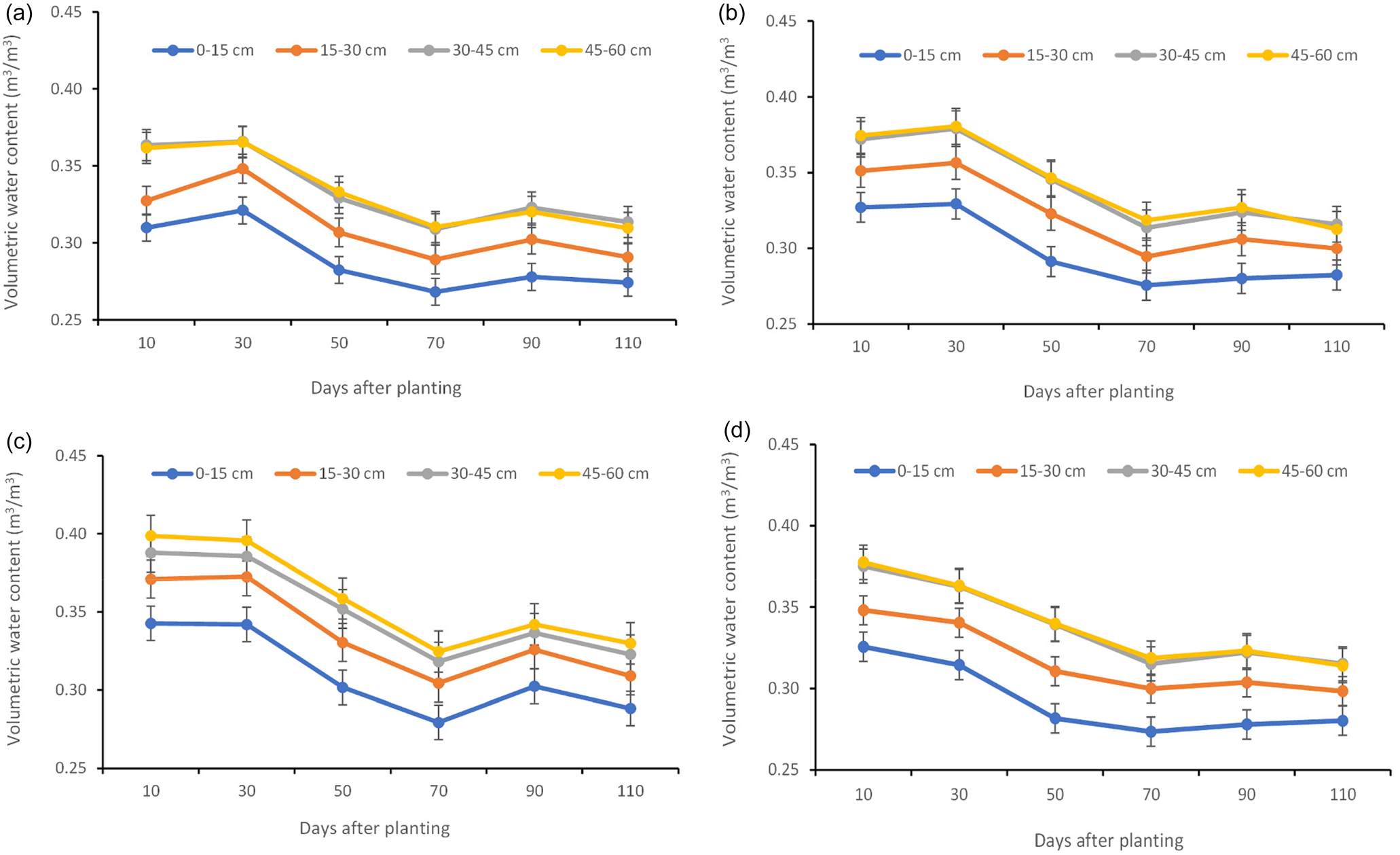
Root zone soil water content at different growth stages of onion plants under various micro-sprinkler scheduling and surface irrigation with nitrogen fertilization. (Error bars indicate ± Standard error of mean).

During the growing period, there was a variable pattern of depletion and gain of the root zone water content as a result of various irrigation treatments (Fig. 3). At 30 DAT, soil water depletion from the rooting depth was 3.2% for SN and 0.3% for M3; whereas there was a gain in water content of 2.8% for M1, followed by 1.5% for M2. At 31–50 and 51–70 DAT, the soil water depletion from the rooting depth at all irrigation treatments was variable, ranging from 6.0–10.7% for M1, 8.0–9.6% for M2, 8.6–10.2% for M3, and 5.1–7.9% for the SN regime and the declining trend was relatively higher in the latter than in the former growing period. In contrast, at 71–90 DAT, a gain in root zone water status was detected at all irrigation regimes, with a maximum of 6.5% for M3, followed by 4.0% for M1, 2.9% for M2, and a minimum of 1.6% for SN. With further advancement of the cropping period (91–110 DAT), the maximum depletion was noticed in M3 (4.3%), followed by M1 (2.9%), M2 (2.1%), and SN (1.6%). At the end of the growing season, the total depletion of root zone soil water content under different irrigation treatments was maximum in M3 (16.7%), followed by SN (15.3%), and M2 (15.0%) and the minimum in M1 (12.8%).
Root zone soil water depletion at different growth stages of onion plants under various micro-sprinkler scheduling and surface irrigation with nitrogen fertilization. (Error bars indicate ± Standard error of mean).

The average rate of root zone soil water depletion due to various irrigations at different stages of plant growth followed the same trend as in total soil water depletion from the rooting depth (Fig. 4). It is evident that the gain (+) and depletion (−) rates of root zone water along the growing period varied from +0.20 to −0.53% for M1; +0.14 to −0.48% for M2, +0.33 to −0.51% for M3, and +0.08 to −0.40% for SN, with an average of −0.13, −0.15, −0.17 and −0.16% for M1, M2, M3 and SN, respectively. The efficiency of the onion plant in removing soil water from the rooting depth in response to various irrigation treatments can be arranged in the order of M3 > SN > M2 > M1. It is also noted that the depletion rate of root zone soil water along the growth stages followed an inconsistent or asymmetrical pattern under various irrigation treatments.
Root zone soil water depletion rate at different growth stages of onion plants under various micro-sprinkler scheduling and surface irrigation with nitrogen fertilization. (Error bars indicate ± Standard error of mean).

Soil available nitrogen under different irrigation and N fertilizations
The average available N content in soil significantly increased with increasing levels of irrigation with micro-sprinkler along the root zone profile at all growth stages (Fig. 5). Averaging over the soil depths, the available N content for M2 and M3 increased by 2.1, 2.0 and 2.1%, and 3.7, 3.7 and 3.8% at the vegetative, bulb development, and maturity stages, respectively, above the N content of M1. Similarly, notwithstanding growth stages, the accumulation of available N contents at each irrigation regime was maximum at 0–0.15 m depth (169.1–199.4 kg/ha) and decreased steadily by 10.3 and 7.0%, 10.9 and 7.7% and 10.8 and 7.8% at 0.15–0.30 m and 0.30–0.45 m depths for M1, M2 and M3, respectively. Notably, at each irrigation treatment, the available soil N content was consistently reduced with incremental depth in the vegetative stage, whereas the same was first sharply decreased at 0.15–0.30 m depth, followed by an increase at 0.30–0.45 m depth in the bulb development and maturity stages.
Available soil N at (a) vegetative, (b) bulb development and (c) maturity stages of onion plants under different levels of micro-sprinkler and surface irrigation systems and rates of nitrogen fertilization (N0, no N; N1, 75; N2, 100 and N3, 120% of recommended nitrogen dose).
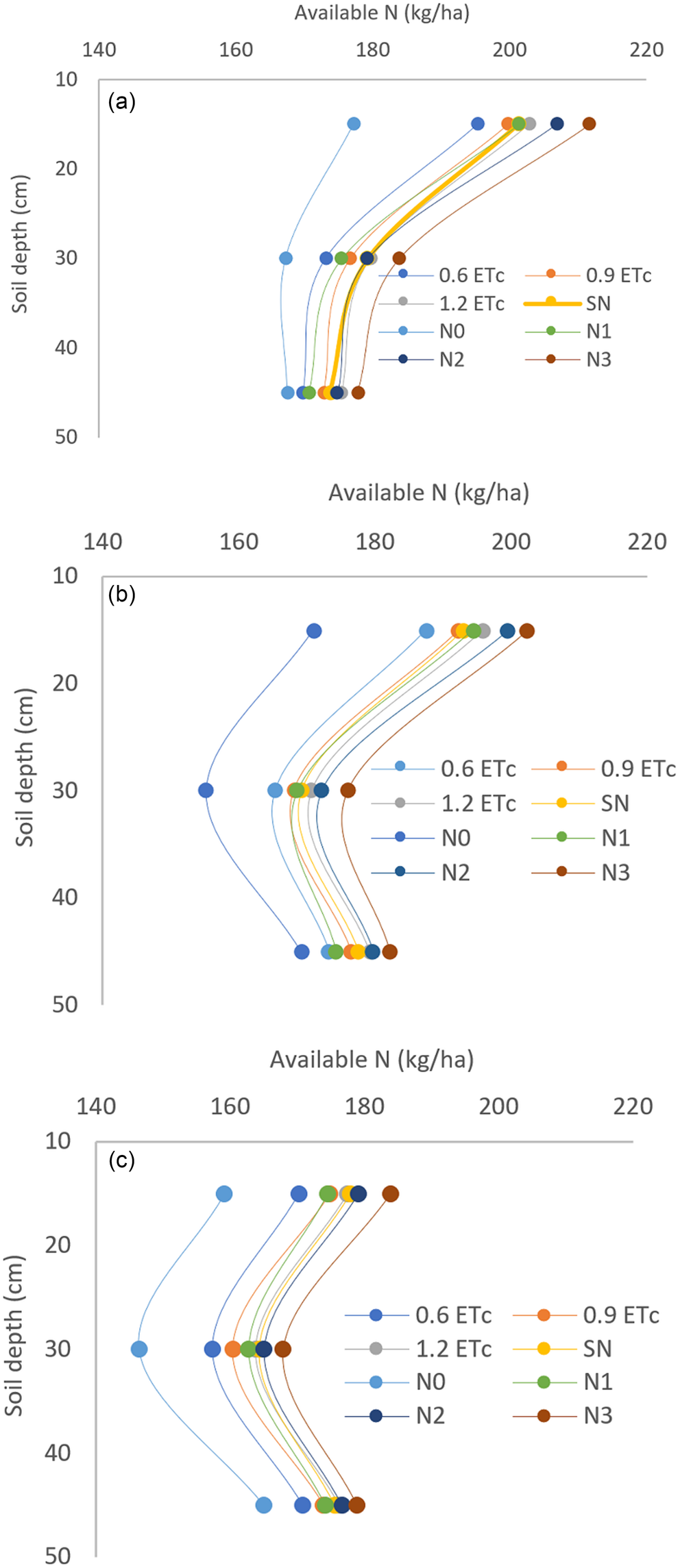
The average soil N content markedly increased due to increments of N fertilization in each rooting depth at all growth stages (Fig. 5). The maximum increase in soil N availability, disregarding the micro-sprinkler irrigations, was 12.0, 13.2 and 12.8% for N3, followed by 9.6, 11.4 and 10.7% for N2, and 7.0, 8.5, and 8.7% for N1 at the vegetative, bulb development, and maturity stages, respectively, over those of the unfertilized treatment, N0. Likewise, regardless of the growth stages, the available N contents due to different N-fertilizations were highest at 0–0.15 m depth (169–199 kg/ha), which were decreased by 11.8, 11.8, 11.1 and 7.6% at 0.15–0.30 m depth, and 9.9, 9.3, 8.9 and 1.1% at 0.30–0.45 m depth for N3, N2, N1 and N0, respectively. The availability of soil N increased with the increment of N doses, reaching its maximum at 0–0.15 m depth at all growth stages. However, the value reduced gradually with depth in the vegetative stage, while it sharply dropped at 0.15–0.30 m depth followed by a variable increase at 0.30–0.45 m depth in the bulb development and maturity stages. The highest available soil N content was found in N3, followed by that of N2, N1 and N0, at all soil depths and all growth stages. The relative increase in the soil available N over the unfertilized treatment N0 in the vegetative stage at 0–0.15 m, 0.15–0.30 m and 0.30–0.45 m depths was 13.7, 5.0, and 1.9% for N1; 16.7, 7.2, and 4.4% for N2, and 19.5, 10.0, and 6.1% for N3. The corresponding values for the bulb development stage were 13.7, 8.6 and 3.1% for N1, 16.8, 10.9 and 6.3% for N2, and 18.5, 13.4 and 7.7% for N3, and for the maturity stage, the values were 9.6, 11.2 and 5.6% for N1, 12.6, 12.7 and 7.1% for N2, and 15.5, 14.7 and 8.4% for N3.
The interactive relationship between M × N indicated that under a specific micro-sprinkler irrigation or N rate, the available N content consistently increased with increasing N rate or enhanced micro-sprinkling watering at all soil depths and growth stages (Table 3). The surface irrigation with 100% RDN (SN) also followed the same trend. Out of 12 MN combinations, eight treatments recorded a decrease, with some minor deviations, while four treatments displayed an increase in the mean availability of soil N at all soil depths and growth stages as compared with those of SN. The maximum increase in soil N content against SN along the root zone profile varied from 0.4–2.5, 1.5–3.6, and 0.2–1.1% for M2N2; 2.5–5.7, 2.7–4.8, and 2.0–3.8% for M2N3; 1.7–5.1, 3.1–6.0, and 2.1–2.6% for M3N2; and 3.8–7.4, 4.0–7.8, and 3.0–5.4% for M3N3 in the vegetative, bulb development, and maturity stages, respectively. Averaging over the soil depths and growth stages, a relative increase in soil N content over the SN treatment was 1.4, 3.4, 3.2 and 5.2% for M2N2, M2N3, M3N2 and M3N3, respectively.
Interaction effects of micro-sprinkler irrigation and N fertilization levels on soil available N contents at different growth stages of onion (pooled data of 2-year)
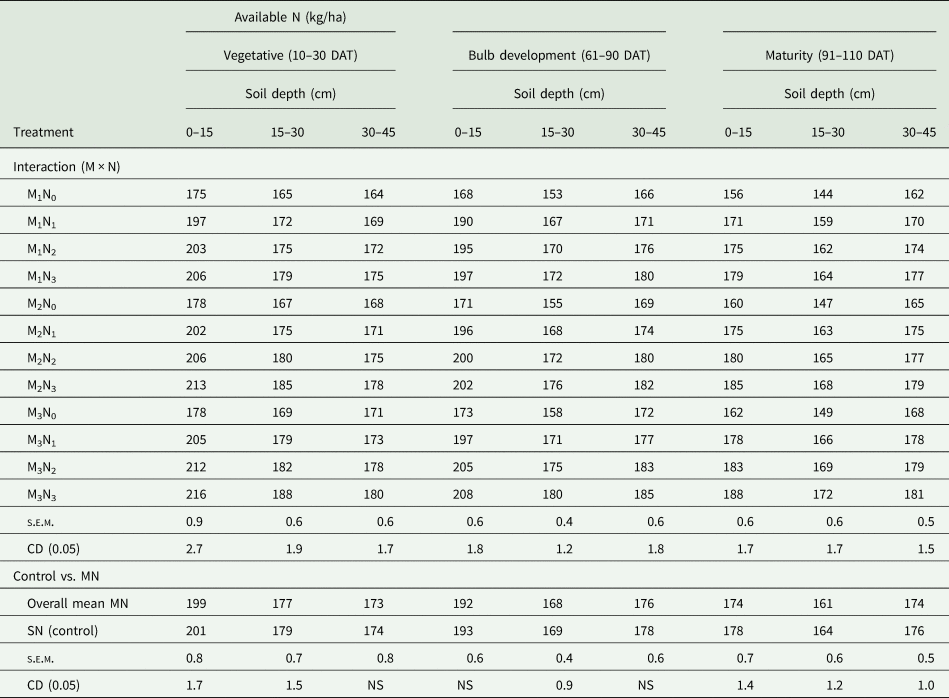
M1, micro-sprinkler irrigation at 0.6 ETc; M2, micro-sprinkler irrigation at 0.9 ETc; M3, micro-sprinkler irrigation at 1.2 ETc; SN, surface irrigation with 100% RDN; N0, no-N; N1, 75% RDN; N2, 100% RDN; N3, 120% RDN; RDN, recommended dose of nitrogen; DAT, days after transplanting; NS, not-significant; s.e.m., standard error of mean; CD, critical difference.
Plant nitrogen uptake under different irrigation and N fertilization
The mean N uptake by onion plants consistently and significantly increased with increments of micro-sprinkler irrigation and nitrogen fertilization combinations at all growth stages (Table 4). It is evident that plant top-N decreased while bulb-N increased by varying magnitudes with the advancement of the growing periods at all levels of micro-sprinkler irrigation and nitrogen combinations, and the effects were more obvious at the higher levels of irrigation N fertilization combinations than the lower levels. The interactive relationship between M × N showed that the M3N3 treatment recorded the highest plant N uptake of 39.3, 140 and 162 kg/ha at the vegetative, bulb development and maturity stages, respectively, being significantly superior to the remaining MN combinations (Table 4). The conventional SN practices exhibited moderate plant N uptake, corresponding to 33, 104 and 125 kg/ha at the vegetative, bulb development and maturity stages, respectively; these values were found to increase by 7.9, 19.4 and 15.1% for M2N3; 9.6, 20.2 and 15.5% for M3N2; and 19.0, 34.4 and 29.0% for M3N3, respectively. The other MN treatments recorded considerably lower values at all growth stages as compared to SN, except M2N2 at the bulb development stage, where plant N uptake showed a larger value (110 kg/ha).
Effect of micro-sprinkler irrigation and nitrogen fertilization levels on nitrogen uptake at different growth stages of onion (pooled data of 2-year)
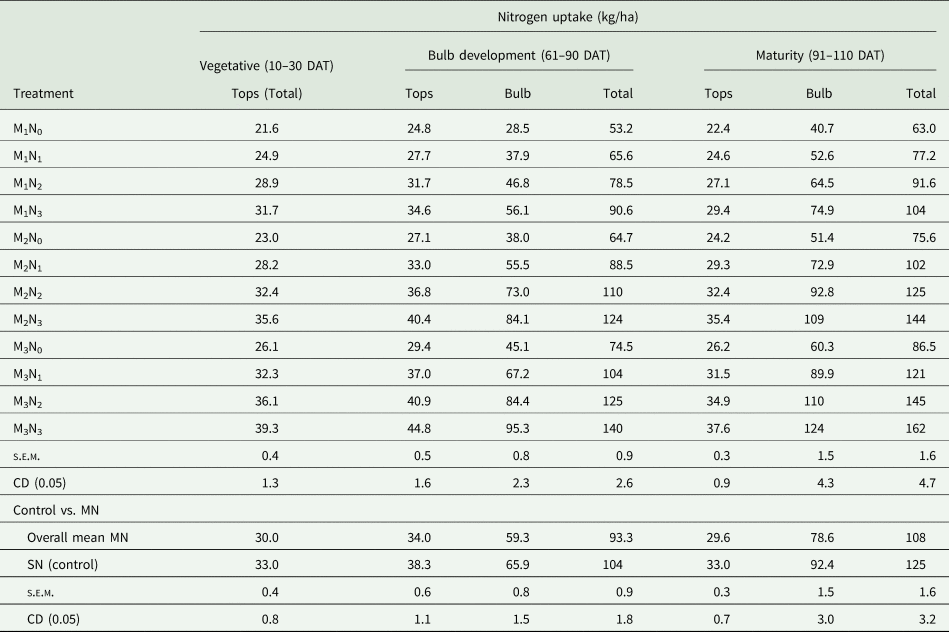
M1, micro-sprinkler irrigation at 0.6 ETc; M2, micro-sprinkler irrigation at 0.9 ETc; M3, micro-sprinkler irrigation at 1.2 ETc; SN, surface irrigation with 100% RDN; N0, no-N; N1, 75% RDN; N2, 100% RDN; N3, 120% RDN; RDN, recommended dose of nitrogen; DAT, days after transplanting; s.e.m., standard error of mean; CD, critical difference.
Economics of different irrigation and nitrogen management practices
Out of 12 micro-sprinkler irrigation-nitrogen management practices for onion production, three treatments were most suitable in terms of higher seasonal net income gains, and benefit-costs ratio (BCR) as compared to the surface irrigation-nitrogen combination (Table 5). The net income and BCR of $2570/ha and 3.2, respectively were observed to be the maximum in M3N3, followed by that of $2343/ha and 2.9 in M2N3, and $2307/ha and 2.9 in M3N2, while the conventional SN recorded the corresponding values of net income and BCR as $1967/ha and 2.5, respectively. The M2N2 and SN treatment combinations were almost competitive for monetary gains.
Economics of winter onion cultivation in USD ($) under different combinations of irrigation levels and nitrogen rates (average data of 2-year)

M1, micro-sprinkler irrigation at 0.6 ETc; M2, micro-sprinkler irrigation at 0.9 ETc; M3, micro-sprinkler irrigation at 1.2 ETc; SN, surface irrigation with 100% RDN; N0, no-N; N1, 75% RDN; N2, 100% RDN; N3, 120% RDN; RDN, recommended dose of nitrogen.
a Average marketing price of dry onion during the 2016–17 and 2017–18 seasons: $299.4/t.
Discussion
Effects of irrigation, nitrogen fertilization, and their interaction on yield, water, and nitrogen productivity of onion
The increased bulb yield under non-stressed irrigation (1.2 ETc) with a micro-sprinkler was attributed to the faster food material production in leaves due to the constant and adequate availability of moisture in plants and its translocation to bulbs (Tsegaye et al., Reference Tsegaye, Bizuayehu, Woldemichael and Mohammed2016; Worku et al., Reference Worku, Jalata and Nandeshwar2020). Application of 40% deficit irrigation with a micro-sprinkler (0.6 ETc) caused severe soil water stress as a result of the quick recession of plant-available water in the rhizosphere, which led to a decrease in photosynthetic area, insufficient assimilate production, restricted mobilization of the photosynthates to the bulbs, and thus, poor bulb expansion and the lowest yield (Kumar et al., Reference Kumar, Imtiyaz and Kumar2007b; Enchalew et al., Reference Enchalew, Gebre, Rabo, Hindaye, Kedir, Musa and Shafi2016). The increase in bulb yield at a higher rate of N (120% RDN) was likely caused by improved photosynthetic rate, greater assimilate production and partitioning into the bulbs, which might have increased the size and weight of onion bulbs (Tsegaye et al., Reference Tsegaye, Bizuayehu, Woldemichael and Mohammed2016; Nawaz et al., Reference Nawaz, Ahmed, Hussain, Rizwan, Sarfraz, Wainse and Jamil2017). Similarly, the maximum yield under higher irrigation level at 1.2 ETc through a micro-sprinkler combining with 120% RDN (M3N3) compared with the conventional method of surface irrigation and 100% RDN (SN) was attributed to the enhanced water and N availability in the root zone and plant utilization in an optimal soil water-nutrient environment. The results are consistent with the findings of Fatideh and Asil (Reference Fatideh and Asil2012) and Gebregwergis et al. (Reference Gebregwergis, Weldetsadik and Alemayhu2016).
WP for onion was significantly impacted by the amount of irrigation applied and the yield levels obtained. The highest WP (3.71 kg/m3) was achieved from micro-sprinkler irrigation both at 40% (0.6 ETc) and 10% (0.9 ETc) deficit irrigation levels, receiving low to nearly optimal water quantities. A significantly higher WP (6.40–12.12 kg/m3) under 40% deficit irrigation using micro-sprinklers in arid climates was noted by Kumar et al. (Reference Kumar, Imtiyaz and Kumar2007b) and Mane et al. (Reference Mane, Kadam and Patil2014). The lowest WP at full irrigation (100% ETc) and the highest at 75% deficit irrigation (25% ETc) throughout the onion growth stages in a semi-arid climate was recorded by Tolossa (Reference Tolossa2021). The results of this study suggest that, when water is limited, irrigation at 0.9 ETc with a micro-sprinkler can be the most appropriate irrigation strategy for higher bulb production, maximum WP, and considerable water savings. The probable reasons for higher WP with high to nominal deficit irrigation with micro-sprinkler are full utilization of water for yield enhancement because of intermittent controlled watering, minimum drainage and runoff losses, and a favourable water-nutrient environment in the rooting zone for encouraging better plant growth and yield. Increased WP with a higher N rate was specifically due to better N nutrition, as onion is a shallow-rooted, severe nutrient depleting plant requiring higher N for producing the highest bulb yield, which is in agreement with the findings of Nemat et al. (Reference Nemat, Abd El-Kader, Attia and Alva2011), Fatideh and Asil (Reference Fatideh and Asil2012), Dhital et al. (Reference Dhital, Shakya, Sharma and Dutta2015), and Piri and Naserin (Reference Piri and Naserin2020). Similarly, the increased WP (2.7–14.6%) under severe deficit to optimally high irrigation regime with micro-sprinkler, along with the sub-optimal to higher N rate as compared with the farmers' traditional irrigation and N fertilization practices, was due to higher water and nitrogen usage by the plants for production purposes, as also reported by Tsegaye et al. (Reference Tsegaye, Bizuayehu, Woldemichael and Mohammed2016).
The highest nitrogen productivity at the highest irrigation amounts using micro-sprinkler was due to the improvement in bulb production per unit of applied N. The lowest nitrogen productivity at severe deficit irrigation with micro-sprinkler was due to acute plant water stress, poor photosynthesis rate, and other biochemical activities, leading to reduced bulb production. These findings are in agreement with those of Mane et al. (Reference Mane, Kadam and Patil2014). Nitrogen productivity decreased with increasing levels of nitrogen fertilizer application. The interactions showed that, in contrast to SN, the greater N productivity resulting from a moderate deficit to optimal watering through a micro-sprinkler (0.9–1.2 ETc) combined with suboptimal to optimal N fertilization (75–100% RDN) was due to improved bulb output per unit of applied fertilizer N.
Spatiotemporal distribution of root zone water content, and its depletion rate during the growing period
Bandyopadhyay et al. (Reference Bandyopadhyay, Mallick and Rana2003) found that the increase in soil water content with rooting depth along the growing period with various irrigation treatments was due to the combined effects of successive irrigation events, the existence of earlier soil moisture regimes, and rainfall occurrence. Whereas the decreases in water content in different soil depths with the cropping period were ascribed to the differential soil water extraction by enlarged root mass at varied plant ages, and deep percolation loss beyond the rooting depth, as induced by different irrigation levels. In this study, the root zone water content at each soil depth, growth stage, and over the whole growing period was greater under micro-sprinkler irrigation with 1.2 ETc (200 mm), followed by nominal deficit irrigation with 0.9 ETc (150 mm) as compared to conventional irrigation using a larger amount of water (240 mm), which was explicitly due to the intermittent micro-sprinkler watering in small fractions according to the plant water need across the cropping season. The lower corresponding root zone water content under surface irrigation were because of excessive watering each time with longer intervals, thereby causing a maximum water loss in deep drainage below the root zone under gravitational force. The lowest water content under the severe deficit irrigation scheduling at 0.6 ETc through a micro-sprinkler was attributed to the minimum water application (100 mm), which resulted in acute water stress at all rooting depths along the growing period.
The higher soil water depletion under an unstressed irrigation regime at 1.2 ETc and marginal deficit irrigation at 0.9 ETc with micro-sprinkler was due to greater water absorption from the active root zone by plants for the higher vegetative and reproductive growth, and bulb production. Increased water depletion under surface irrigation was specifically due to augmented soil water storage with depth for a shorter duration with bulk water loading, followed by a rapid recession due to deep percolation without production purposes. The high water-stressed regime with micro-sprinkler at 0.6 ETc could lead to a decrease in water availability as well as depletion of root zone water content. Bandyopadhyay et al. (Reference Bandyopadhyay, Mallick and Rana2003) attributed marginal depletion or gain of root zone soil water in the vegetative stage to the mutual effects of slower plant evapotranspirative demand due to minimum foliage development, deep drainage from upper portions of the soil profile, as facilitated by coarse-textured soil with high hydraulic conductivity, and the incidence of low rainfall. Conversely, higher depletion of root zone soil water during bulbing, early bulb development and bulb maturation periods was ascribed to higher plant evapotranspiration demand with trace rainfall conditions. In this study, the gains in soil water status at all irrigation regimes during the peak bulb development period (80–90 DAT) were the result of sudden rainwater intrusion into soil already wetted from the preceding irrigation events. Further, as the onion has a shallow fibrous root system and its roots are spread within 0.45 m depth, the excess water that moved from the upper soil layers and accumulated at 0.45–0.60 m depth was not available to plants for production purposes.
The wet moisture regime with micro-sprinkler caused a greater depletion rate of root zone soil water, while the dry moisture regime with micro-sprinkler resulted in a lower depletion rate. The depletion rate in SN was intermediate between M2 and M3. The asymmetrical pattern of soil water depletion rate at different stages of growth cycles could be due to the differential soil water extraction by plant roots, the establishment of various soil water statuses as a result of different levels of irrigation imposition, unexpected rainwater entry onto the onion field, and variable losses of water via deep percolation.
Effects of irrigation, nitrogen fertilization, and their interaction on soil available nitrogen
The higher N content in the top-most soil layer compared to the layers below observed in this study agrees with the previous reports of micro-sprinkler fertigation (Rajput and Patel, Reference Rajput and Patel2006; Anita Fanish and Muthukrishnan, Reference Anita Fanish and Muthukrishnan2013; Archana and Maragatham, Reference Archana and Maragatham2017). The highest N availability at 0–0.15 m and 0.15–0.30 m depths along the growth stages indicated better N nutrition for onion plants. However, as the cropping period advanced and especially during the bulb development and maturity stages, there was a redistribution of available N in the root zone, where soil N contents decreased at 0–0.30 m depth and then increased at the 0.30–0.45 m depth. This reduction of soil N concentrations from the effective rooting depth (0–0.30 m) was attributed to plant uptake under higher soil moisture regimes, followed by N leaching with the downward moving water. Onion is a shallow, fibrous rooted nitrogen-loving plant that is likely to exhaust the maximum plant available N from a depth of 0–0.30 m. Amounts of adequate water in the active rooting depth also favour the mineralization and transportation of soil N. Substantial amount of available N was accumulated in the bottom layer at all growth stages (Fig. 5), which is out of reach of the plant roots for consumptive use. The vertical movement of soil N and thus the chances of N leaching were more evident at a higher level of watering with a micro-sprinkler at 1.2 ETc than at the lower level with 0.6 ETc. This is indicative of a close relationship between available N and water content in the soil, as also reported by Anita Fanish and Muthukrishnan (Reference Anita Fanish and Muthukrishnan2013). Archana and Maragatham (Reference Archana and Maragatham2017) explained that the soluble nitrate ion (NO3-N) has a greater tendency to leach downward with water movement, and a substantial portion is gathered in the deeper soil layers.
Sivasakthi et al. (Reference Sivasakthi, Khanna, Singh, Parihar, Singh, Kumar and Sahoo2014) reported that higher concentrations of available N in the topmost layer (0–0.15 m depth) than in the bottom layers of the root zone profile in response to increasing rates of N-fertilizer application throughout the growth period might be attributed to increased bacterial activity in the soil. Archana and Maragatham (Reference Archana and Maragatham2017) found that the downward movement of N from the surface to the deeper layers was the difference in concentration gradient developed due to mass flow, which causes the transfer of N from the maximum to the minimum concentration. There were increased concentrations of soil N of 1.9, 3.1 and 5.6% for N1; 4.4, 6.3 and 7.1% for N2; 6.1, 7.7 and 8.4% for N3; and 3.7, 5.0 and 6.4% for SN at the vegetative, bulb development and maturity stages, respectively (Fig. 5). These indicate the possibility of more N leaching from the soil available N pool beyond the active rooting depth at all growth stages, and it is more evident under a higher rate of N fertilization than a lower rate in this sandy loam soil. Thus, a higher rate of fertilizer N application beyond plant requirements at different phenological stages may be avoided to limit the leaching loss of N from the soil, promote efficient utilization of applied N, and thus reduce the environmental hazards of crop management.
Bhatti et al. (Reference Bhatti, Sharma and Kakar2019) reported the effect of increasing levels of micro-sprinkler irrigation coupled with increasing N rates on the greater availability of soil N along the rooting depths and growing periods as the positive and synergistic impact of controlled intermittent watering and N fertilization. The present study showed that the application of lesser amounts of water, by employing marginal deficit irrigation at 0.9 ETc, or optimally high irrigation at 1.2 ETc, with the micro-sprinkler in tandem with 100% N fertilization (M2N2 and M3N2) increased the soil available N contents by 1.4 to 3.2% compared with the farmers' traditional practices of surface irrigation with more water usage in association with 100% N fertilization (SN). Such relative values were increased to 3.4 to 5.2% when the same micro-sprinkler irrigation levels were combined with a 120% N application (M2N3 and M3N3). These results have given ample opportunities to the farmers to manage the marginal deficit or optimally high irrigation scheduling with the micro-sprinkler in coupling with the full or 20% higher dose of nitrogen, according to resource availability, for maximum utilization of water and nitrogen for higher onion production and profit gains. The moderate availability of soil N under surface irrigation with optimum N fertilization could be attributed to more N leaching loss from this sandy loam soil as facilitated by bulk water loading at every irrigation event, which eventually causes a moderate utilization of soil water and N by the plants with a reflection of moderate bulb yield. More leaching loss of N in nitrate form with the downward movement of water by the furrow method of irrigation was observed by Santos et al. (Reference Santos, Sousa and Smith1997) and Shedeed et al. (Reference Shedeed, Zaghloul and Yassen2009). Li et al. (Reference Li, Hong-yan, Li and Li2007) and Gholamhoseini et al. (Reference Gholamhoseini, Agha Alikhani, Modarres Sanavy and Mirlatifi2013) reported that the magnitudes of NO3-N leaching are related to the abundance of root zone NO3-N concentration, its quantity, and speed of water passing across the soil profile. In addition, coarse-textured soils are most influential for promoting seasonal N leaching (Gardenas et al., Reference Gardenas, Hopmans, Hanson and Simunek2005). Based on this evidence, the reduced availability of soil N in this study and the consequent lower uptake by the plants under SN treatment can be explained. Results further indicate that a sizable amount of available N was accumulated at 0.30–0.45 m soil layer along the growth stages, which is likely to be out of reach of the plant roots. The possibility of N leaching from the soil N pool of the effective rooting depth (0–0.30 m) was more marked under higher levels of N fertilization and micro-sprinkler irrigation. Thus, the application of fertilizer N in several splits in conjunction with intermittent watering with the micro-sprinkler matching plant requirements at different growth stages may be prudent to inhibit water loss and N leaching from this coarse-textured sandy loam soil.
Effects of irrigation, nitrogen fertilization, and their interaction on plant nitrogen uptake
The greater N uptake by the plant-tops and bulbs under unstressed (1.2 ETc) than mild and severe stressed (0.9 and 0.6 ETc, respectively) irrigations through the micro-sprinkler with increasing age of the plant was attributed to the favourable water regime in the root zone along the growing period as a result of frequently small quantity of watering, which is likely to have stimulated the better root mass growth, the higher availability and accessibility of native and applied N to the roots for efficient absorption, transfer to the leaves, higher food material production in the leaves, and subsequent allocation of food to other plant organs, which would be in agreement with Neeraja et al. (Reference Neeraja, Reddy, Reddy and Rao2001) and Bhatti et al. (Reference Bhatti, Sharma and Kakar2019). In contrast, the corresponding lower N uptake under the severe water stress condition attributed to the reduced root growth, lower N availability in the rhizosphere, less N absorption by the roots, low photosynthate production, and restricted movement of nutrients from the leaves (source) to the bulbs (sink), which ultimately results in decreased bulb yield, as explained by Thangasamy (Reference Thangasamy2016). The reduction of plant-top N uptake at maturity as compared to the bulb development stage under all irrigation and nitrogen treatments was due to the shedding of older leaves followed by remobilization and translocation of assimilate from source (leaves) to sink (bulbs) due to their higher mobility in the phloem (Thangasamy, Reference Thangasamy2016). Likewise, the increased plant-tops and bulb N uptake in response to the incremental N fertilization into the soil could be ascribed to the development of massive as well as deep root growth to absorb more labile N from a large volume of soil (Negash et al., Reference Negash, Mitiku and Yamoah2009), causing an increase in photosynthetic area (leaf number and leaf area) and accelerating the synthesis of more chlorophyll and amino acids (Neeraja et al., Reference Neeraja, Reddy, Reddy and Rao2001; Abdissa et al., Reference Abdissa, Tekalign and Pant2011) and subsequent partitioning of assimilate to storage organs, i.e., bulbs (Abdissa et al., Reference Abdissa, Tekalign and Pant2011; Zewdu, Reference Zewdu2014). The least N uptake by the plant-tops and bulbs under unfertilized N treatment was probably due to the reduction of fine root spread in the zones of low soil N availability and the decreased leaf and bulb dry matter production in onion plants (Kemal, Reference Kemal2013; Bhatti et al., Reference Bhatti, Sharma and Kakar2019). Likewise, in the present study, higher N uptake by plant-tops and bulbs under unstressed or nominally stressed irrigation regimes with the micro-sprinkler, accompanied by a 100% N or 120% N application (M2N3, M3N2 and M3N3) as compared with conventional surface irrigation with 100% N (SN) could result in the adequate plant available water and nitrogen in the rooting depths, more efficient absorption by the roots, the higher rate of photosynthesis and food material production, and its subsequent translocation to bulbs. In dry soil conditions due to a high deficit irrigation regime with suboptimal N fertilization, adequate amounts of plant-available N would not be available in the rooting area and thus hindered plant N nutrition (Brewster, Reference Brewster1994). In the present study, the moderate plant N uptake in the SN treatment was the result of more soil evaporation and deep percolation losses of water during and after the irrigation events, unregulated N leaching, frequent soil–water stress, and distortion in water and nutrients, especially nitrogen absorption by the stunted root mass, which collectively decreased the photosynthesis and other metabolic activities, reduced assimilate production and partitioning that led to the moderate yield.
Economic evaluation of different irrigation and nitrogen management practices
The economic viability of various irrigation-nitrogen fertilization management strategies showed that under the conditions of adequate water and nitrogen resource availability, micro-sprinkler-based irrigation at 1.2 ETc coupled with 120% RDN (M3N3) was the best treatment combination to increase the net income by 30.6% with maximum BCR over surface irrigation with 100% RDN (SN). When there is a shortage of water or nitrogen resources, deficit irrigation at 0.9 ETc with 120% RDN (M2N3) or high irrigation at 1.2 ETc through micro-sprinkler with 100% RDN (M3N2) was the alternative that increased net incomes (17.2–19.1%), and modest BCR over the traditional SN method. Under scarce water and nitrogen supply, micro-sprinkler deficit irrigation at 0.9 ETc with 100% RDN (M2N2) was preferred over SN due to marginally higher net income (3.5%) with 50% less water usage.
Conclusions
Micro-sprinkler irrigation at 120% of crop evapotranspiration (ETc) in combination with 120% of the recommended nitrogen (RDN) fertilization produced the maximum bulb yield, higher water productivity, highest income generation and greater retention of plant available soil water and nitrogen in the root zone during the growing periods. However, as this study was only based on two seasons, more field trials will be needed to confirm the optimum amount of water and nitrogen for winter onion. In the context of limited water and nitrogen supplies, micro-sprinkler-based mild deficit irrigation at 0.9 ETc with 100% RDN is a viable alternative to farmers' traditional surface irrigation with 100% RDN (SN) due to competitive yield performance, marginally higher financial gains and reduced water usage for onion production.
Data availability
The original data supporting this study are included in the article and if additional data required can be available on request from the corresponding author.
Acknowledgements
All authors are grateful to the Indian Council of Agricultural Research, New Delhi and Bidhan Chandra Krishi Viswavidyalaya, West Bengal, India for supporting necessary funds and providing adequate facilities during the entire research programme. We are grateful to the Editor for his valuable comments and suggestions, which substantially improved the quality of the manuscript.
Authors’ contributions
M. Banik performed formal analysis, data curation, wrote original draft; S.K. Patra conceived, designed the programme, supervised and edited the article; A. Datta reviewed, edited and configured the article.
Funding statement
This study was financed by the ICAR-Indian Institute of Water Management, Bhubaneswar through AICRP on Water Management, and the Government of West Bengal, India.
Competing interests
No competing interest among the authors for publication of this article.
Ethical standards
Not applicable.



