


Many older patients in our health care system are vulnerable due to increased age and the complexity and chronic nature of their health problems. These patients require integrated and evidenced informed care. Strong and compassionate nurse-patient relationships are one vehicle to promote the best possible delivery of nursing care (Fogarty, Reference Fogarty2012). An emphasis on a strong and compassionate nurse-patient relationship is particularly important when patients live in chronic care (CC) environments because of the length of time these patients spend in these facilities (Canadian Institute for Health Information [CIHI], 2009). For the purpose of this article, CC – also called skilled nursing – facilities refers to those facilities that provide complex care, defined as specialized, time-limited programs to care for patients with complex medical conditions who require a hospital stay with ongoing assessment and active care by an interprofessional team, with a goal to enhance the health and quality of life (CIHI, 2009). CC facilities differ from nursing or care homes in that CC provides specialized care critical to achieve high levels of medical recovery. Once recovery goals are met, most CC patients are transitioned home and/or to other appropriate levels of care along the continuum (Ontario Hospital Association [OHA], 2006).
Several researchers have demonstrated that the quality of life of older patients who live in CC facilities is determined to a considerable extent by the relationships they have with the nursing personnel caring for them (Jonas-Simpson, Mitchell, Fisher, Jones, & Linscott, Reference Jonas-Simpson, Mitchell, Fisher, Jones and Linscott2006; McGilton & Boscart, Reference McGilton and Boscart2007), whereby quality of life is defined as the degree to which a person enjoys the important possibilities of his or her life (Veenhoven, Reference Veenhoven and Delle Fave2013, chap. 11). Despite the pressing time and workload demands in clinical settings, good nurse-patient relationships can be developed and maintained (McNaughton, 2001). These relationships are described as “therapeutic” and are based on mutuality, commitment, and reciprocity (Berg, Skott, & Danielson, Reference Berg, Skott and Danielson2007). From an educational and professional perspective, nurses are strongly encouraged to develop therapeutic relationships with their patients (College of Nurses of Ontario [CNO], 2006; Registered Nurses Association of Ontario [RNAO], 2006), but interestingly, these concepts are rarely defined, causing difficulty in knowing if researchers and clinicians are attributing the same meaning to them. A literature review to identify tools to measure these nurse-patient relationships from a patient’s perspective did not reveal any reliable and valid instruments to use in a CC environment. This gap warranted the development of a tool that can measure these types of relationships from the patients’ viewpoint.
Therefore, we designed this study, therefore, to develop a valid and reliable scale to determine what characteristics of the relationships between cognitively competent patients and nursing personnel in CC settings were most important to older patients. The tool we developed and evaluated is called the Humanistic Relationship Importance Scale (HRIS). A second scale, the Humanistic Relationship Experience Scale (HRES) was developed to measure the patient’s experience with these qualities. In this article, we report on (1) the development of the HRIS; (2) the psychometric testing of the HRIS; (3) the dimensionality testing of the HRIS; and (4) the quality of the humanistic relationships from the perspective of older patients. The psychometric values of the HRES and the patients’ responses collected with the HRES are beyond the scope of this article and are reported elsewhere (Boscart, Reference Boscart2010).
Background
A deeply held assumption in nursing is that a close relationship between a nurse and a patient is at the very heart of nursing (Fogarty, Reference Fogarty2012; Watson, Reference Watson, Smith, Turkel and Wolf’s2012, chap. 16). It is stated that nurse-patient relationships are established to address the health needs of the patient and are a vital means to deliver individualized care in a compassionate manner (Ranheim, Kärner, & Berterö, Reference Ranheim, Kärner and Berterö2012; Roberts, Reference Roberts2013; Watson & Smith, Reference Watson and Smith2002). This premise is upheld by other health care professionals as well (Robinson, Callister, Berry, & Dearing, Reference Robinson, Callister, Berry and Dearing2008); however, the current economic state of the health care system has resulted in decreased lengths of stay for patients with increasingly complex conditions, implementation of higher nurse-patient ratios, and a gradual delegation of nursing tasks to other health care personnel (Reinhard, Young, Kane, & Quinn, Reference Reinhard, Young, Kane and Quinn2006) both in the acute and residential care settings. These seemingly cost-effective changes in the system cause countless reductions in the actual time that nurses spend with the patient, thereby limiting the development of nurse-patient relationships. Unfortunately, evidence indicates that decreased nursing time, and therefore less opportunity to form a nurse-patient relationship, is associated with negative patient outcomes such as pain, pressure ulcers, depression, malnutrition, and even mortality rates (Lang, Hodge, Olson, Romano, & Kravitz, Reference Lang, Hodge, Olson, Romano and Kravitz2004; Lankshear, Sheldon, & Maynard, Reference Lankshear, Sheldon and Maynard2005).
The emphasis on nurse-patient relationships is crucial when considering older patients who live in CC environments. CC facilities are designed to provide complex and continuing care to typically older patients with chronic illnesses or long-term functional disabilities, who require a range of therapeutic and medical care services (CIHI, 2009). Although the focus on caring for the entire person is part of the nursing scope of practice regardless of care setting, CC patients in particular present with a variety of physical, cognitive, and/or behavioral conditions, and require skilled nursing care to address health and restoration (CIHI, 2009). Relationships in these settings also involve achieving comfort, friendship, and creating meaningful moments over time (Pringle, Reference Pringle2003). Long-term stays, debilitating diagnoses, and a high death rate call for relationships to enhance the best possible quality of life. Several quality-of-life domains, such as comfort, meaningful activity, relationships, enjoyment, dignity, autonomy, individuality, and spiritual well-being should be equivalent to – and often prevail over – health and safety outcomes (Kane, Reference Kane2001).
In the past several decades, the growing realization of the importance of these nurse-patient relationships, combined with an expanding professionalism and accountability, has spurred a surge in empirical research and the development of strict standards and guidelines – by regulating professional organizations – for the nurse-patient relationships in a variety of settings. Regardless of the type of care setting, it is clear from the literature that nurse-patient relationships develop within a clinical setting and are maintained over time (Hartrick, Reference Hartrick1997; McNaughton, 2001; Ramos, Reference Ramos1992; Ranheim et al., Reference Ranheim, Kärner and Berterö2012; Watson, Reference Watson, Smith, Turkel and Wolf’s2012, chap. 16). Several authors have attempted to distinguish among different levels of nurse-patient relationships, based on the degree of involvement of the nurse (Morse, de Luca Havens, & Wilson, Reference Morse, de Luca Havens and Wilson1997; Moyle, Reference Moyle2003). Although these studies provide a basic overview of different levels of relationships, these authors do not recognize that a relationship can only take place when two beings are committed to a relationship; these researchers’ studies did not take into account the patients’ degree of involvement or engagement in the nurse-patient relationship.
The current state of knowledge on nurse-patient relationships is situated in the nurses’ perspective of the relationship. Existing guidelines for the development and maintenance of this relationship are based on the nurses’ perspective, excluding the patient’s point of view about the relationship’s value and qualities. When the relationship is considered a mutual process, as has been proposed by regulating (CNO, 2006) and professional (RNAO, 2006) organizations, patients must be equal partners. The older patient’s voice is essential to understand the nature of the nurse-patient relationship.
Others have described nurse-patient relationships from the underlying assumption that relationships are established through the means of verbal interaction. Morse (Reference Morse and Morse1992) and Morse et al. (Reference Morse, de Luca Havens and Wilson1997) described an integrated model of interactions and relationships and identified nursing actions as comforting strategies, styles of care, and patterns of relating. Yet Hartrick (Reference Hartrick1997) challenged the appropriateness of a mechanistic model of human relating that focuses on behavioral communication skills and presented an alternative approach that emphasizes the enhancement of relational capacity to explore the nurse-patient relationship. Although interesting additions to the body of knowledge on nurse-patient relationships, none of these models measure or assess the relational capacity needed from the older patient for the development of nurse-patient relationships.
Despite a large body of conceptual and theoretical work regarding the nurse’s role in the nurse-patient relationship, there is a lack of consensus about the very definition of the nurse-patient relationship (Boscart, Reference Boscart2010; Kane, Reference Kane2001). Therefore, the exact qualities of a nurse-patient relationship remain undefined and difficult to measure (Streiner & Norman, Reference Streiner and Norman2004). Furthermore, few scales are available that measure the nurse-patient relationship from the older patient’s perspective in a residential setting, and most of these scales lack psychometric testing (McGilton et al., Reference McGilton, O'Brien-Pallas, Darlington, Evans, Wynn and Pringle2003). Most importantly, existing measurement scales capture a single aspect of a nurse-patient relationship (Huss, Buckwalter, & Stolley, Reference Huss, Buckwalter and Stolley1988; Rieck, Reference Rieck2002). Both Rieck (Reference Rieck2002) and Huss et al. (Reference Huss, Buckwalter and Stolley1988) developed measures to examine the nurse-patient relationship in acute care, but Rieck focused on spirituality and Huss and colleagues measured trust. McGilton et al.’s (Reference McGilton, O'Brien-Pallas, Darlington, Evans, Wynn and Pringle2003) Relational Care Scale, developed for long-term care settings, has adequate psychometric properties, yet it deals only with the aspects of empathy and reliability, yielding a somewhat limited view of the nurse-patient relationship in CC. Several tools exist in the nursing literature to measure the concept of caring, a notion that is grounded in humanistic nurse-patient relationships. Watson’s (2012, chap. 16) extensive work in this domain provides a wealth of measures on nurses’ caring attributes and behaviors; yet none of the exiting measures captured the unique circumstances and population of CC.
Given the importance of these nurse-patient relationships, there is a lack of understanding of this type of relationship in a CC or more residential setting, where patients are generally older. The similarity of findings in multiple qualitative studies (Billeter-Koponen & Fredén, Reference Billeter-Koponen and Fredén2005; Kane et al., Reference Kane, Caplan, Urv-Wong, Freeman, Aroskar and Finch1997; Morse et al., Reference Morse, de Luca Havens and Wilson1997; Shattell, Reference Shattell2004) warrants the progression into quantitative research in order to further explore the nature of the nurse-patient relationship in these settings and to identify through measurement the specific qualities of nurse-patient relationships that are valued from an older patient’s perspective.
Conceptual Framework
To develop this new scale, it was necessary to select a theory that incorporated the complexity and breadth of the nurse-patient relationship in a CC setting. Several nursing theorists have described the phenomena of a nurse-patient relationship, and for the purpose of this study, we reviewed three of the more relevant nursing theories (Paterson & Zderad, Reference Paterson and Zderad1988; Peplau, Reference Peplau1952; Travelbee, Reference Travelbee1966).
Peplau (Reference Peplau1952) proposed the interpersonal nursing theory of the nurse-patient relationship, as a means to provide optimal care. Peplau, an interactionist, described the nurse-patient relationship as a helping relationship, one by which the nurse facilitates the patient’s personal growth by helping him/her to identify difficulties, experience emotions, and understand his/her own behaviour. Although this theory presents a strong framework to examine the nurse-patient relationship, the theory was initially developed to guide the nurses’ practice in mental health settings, and thus, several of the theory’s components and definitions are not relevant to the CC setting.
The second nursing theory relevant to this study is the human to human relationship model by Travelbee (Reference Travelbee1966). Travelbee’s experience in psychiatric nursing led her to believe that the care given in those institutions lacked compassion. She felt nursing needed a humanistic revolution and a renewed focus on caring as central to nursing. Consequently, Travelbee defined a nurse-patient relationship as a process which enables a nurse to establish a human-human relationship with a patient, thereby fulfilling the purpose of nursing in assisting individuals and families to prevent and cope with experiences of illness and suffering, and to assist in finding meaning in these experiences. Although this theory involves several essential components of the nurse-patient relationship, it is less comprehensive than the theory of Paterson and Zderad (Reference Paterson and Zderad1988), the third theory we considered.
The humanistic nursing theory (Paterson & Zderad, Reference Paterson and Zderad1988) was selected for its strong phenomenological foundation and its idea that nursing is a transactional relationship between a nurse and a patient who are both unique human beings. The theory suggests that patients seek to give meaning to their existence through the subjective day after day experience of relating with the people who give care (Paterson & Zderad, Reference Paterson and Zderad1988). An advantage of using this theory is its compatibility with a patient-centred approach in caring for older patients in CC environments. This theory also notes that some of the most exquisite nursing acts occur in situations where health, taken in its narrow sense as the absence of disease, is not feasible as an aim (Kleinman, Reference Kleinman, Parker and Smith2009). Nursing in CC does not focus on cure; rather, it is about living with as much freedom and autonomy as possible at every stage. In addition, the acknowledgement of uniqueness as a central aspect of a nurse-patient relationship offers the most appropriate structure to explore the relationship from the older patient’s point of view; therefore, the humanistic nursing theory formed the conceptual framework for this work.
Procedures for Instrument Development
When deciding to develop a new measure to examine the nurse-patient relationship in a CC setting from the perspective of the older patient, it became clear that two separate measures were necessary in order to capture both the preferences and the experiences of the patient. The literature review indicated a clear dichotomy between the relationship qualities that patients preferred and the actual experience of those qualities in the relationship (May & Purkis, Reference May and Purkis1995). To measure only the preferred or only the experienced qualities would not address the purpose of the overall study to understand, examine, and measure the humanistic relationships between cognitively competent patients and nursing personnel in CC settings. To have a better understanding of these relationships from the patient’s perspective, it is important to look at the preferred and the experienced humanistic qualities of the nurse-patient relationship – hence the decision to develop two Humanistic Relationship Scales. In this article, we report on the Humanistic Relationship Importance Scale (HRIS). We later developed a second scale, the Humanistic Relationship Experience Scale (HRES), to measure the patient’s experience with these qualities, reported elsewhere (Boscart, Reference Boscart2010).
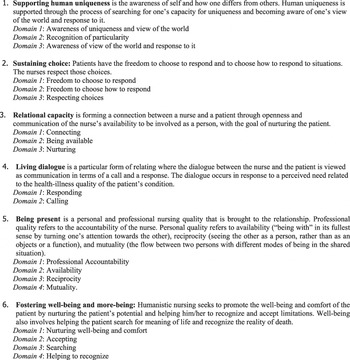
Developing an instrument to measure a subjective state – in this case, the state of the nurse-patient relationship from the patient’s perspective – requires a precise and careful process. We followed the principles of health measurement scale development by Streiner and Norman (Reference Streiner and Norman2004) in developing the scale and selected six concepts central to the humanistic nursing theory that capture the nurse-patient relationship: (a) supporting human uniqueness, (b) sustaining choice, (c) relational capacity, (d) living dialogue, (e) being present, and (f) fostering well-being and more-being. These concepts were interpreted from the patients’ perspective and operationally defined (Figure 1). These theoretical definitions were then used as a guide for item development (Fornaciari, Sherlock, Ritchie, & Dean, Reference Fornaciari, Sherlock, Ritchie and Dean2005). The principles of domain sampling were followed: we needed to construct the measure by randomly selecting a specified number of measures from a homogeneous, infinitely large item pool (Nunnally & Bernstein, Reference Nunnally and Bernstein1994). Our fundamental goal at this stage was to systematically sample all content potentially relevant to the key concepts of the nurse-patient relationship in CC. We developed a minimum of three items for each domain to ensure that the meaning of each concept was operationalized in a language that CC patients could understand. To create the items, author V. Boscart led a team of experts with experience with the setting and patient population. A total of 69 items was developed to represent the construct of a humanistic nurse-patient relationship in CC.
Operational definitions of six concepts based on the humanistic nursing theory (Paterson & Zderad, Reference Paterson and Zderad1988)

All items were evaluated by two panels of four scholarly experts and five patients who lived in a CC facility. Scholarly experts reviewed the content and relevance of the items on the basis of the underlying theory, following the content validation process described by Lynn (Reference Lynn1986), and recommended deleting 14 items. Following this assessment, patients were asked to rate the relevance and ease of understanding based on their lived experience, and recommended six more items. Upon completion of this content validation, the scale contained 49 items, with a content validity index of 1.00.
Description, Administration, and Scoring of the HRIS
The HRIS is designed to elicit the extent of the patient’s preferences for qualities (i.e., choice, presence, etc.) in a humanistic nurse-patient relationship. The patients were asked to rate the importance of each proposed item (n = 49) in the relationship with the nurses on a 5-point scale along a continuum from “not important” to “very important”. The potential scoring range for the total scale is 49 to 245. Higher scores indicate strong patient preferences’ for humanistic qualities in the nurse-patient relationship.
Methods
The psychometric testing of the HRIS was carried out in two different phases. The first phase aimed at examining the scale for internal consistency reliability and test-retest reliability with a sample of 40 patients. The second phase aimed at testing the dimensionality of the HRIS with a sample of 249 patients.
Phase 1: Psychometric Testing of the HRIS
Sample and Procedures
The aim of Phase 1 was to examine the HRIS for internal consistency and test-retest reliability. Data collection took place in one 276-bed CC facility in an urban setting. A convenience sample of 40 patients was selected by the nurses employed on the unit with the following criteria: (a) residing in the facility for at least three months; (b) being cognitively competent and oriented to person, place, and time (Cognitive Performance Score ≤ 3); and (c) having the ability to understand and speak English. A facilitating interview was conducted by the researcher, and the questionnaire (49 items) was administered to the patients. The interview was concluded with the collection of demographic information. Two weeks after the original administration of the questionnaires, the patients were contacted to complete the scale’s questionnaire a second time. The same researcher administered the questionnaire on both occasions. All data were entered electronically into a data entry template created in IBM’s Statistical Package for the Social Sciences (SPSS-17) (http://www-01.ibm.com/software/analytics/spss/) and analyzed.
Results
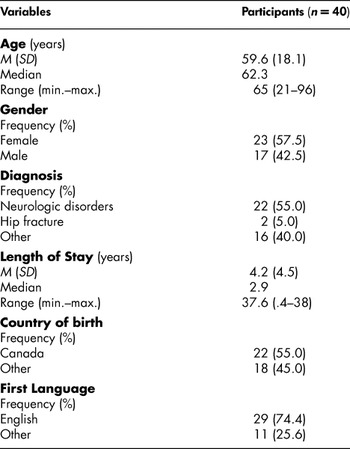
The 40 patients were on average 59.6 years of age, but the sample represented a very broad age range from 21 to 96 years, with an average CC length of stay of 4.2 years (Table 1). The questionnaire took 30 minutes to complete. Despite the extensive content validation process, three items did not perform well. Items “Most nurses understand where your beliefs come from”, “Most nurses are willing to be involved in the relationship”, and “Most nurses like to be with you”, presented with missing answers, and up to 75 per cent of the patients needed additional information to answer the items.
Demographic characteristics of Phase 1 participants

M = mean
SD = standard deviation
Internal consistency reliability was tested by calculating a Cronbach α reliability coefficient for the total score of the HRIS. The initial Cronbach α indicated a high level of redundancy (.97) which was expected at this stage of scale development. Several inter-item correlations were higher than .70 indicating these items were measuring very similar aspects of the concepts. An analysis of the item-to-total correlations also revealed several items with high correlations (> .70).
The test-retest reliability was assessed by calculating intraclass correlation (ICC) scores on the two administrations of the HRIS. The total test-retest ICC score for the HRIS was .73, indicating a high and positive relationship between the two sets of scores. Nine items had a low ICC (< .40) indicating they were unstable over a 14-day time interval.
Item Deletion Process
Based on the initial psychometric testing of the HRIS, we considered several items for elimination. These items were carefully assessed for interpretability, internal consistency reliability, test-retest reliability, variability, and their relation to the total scale. This process resulted in the deletion of 25 items. The revised 24-item scale now contained six concepts, each represented by 4 items.
Phase 2: Dimensionality Testing of the HRIS
Procedures
The aim of this phase was to explore the scale’s dimensions by means of a principal axis analysis (PAA). A PAA aims at explaining the uniqueness between items in terms of uncorrelated underlying factors or latent variables. To conduct a PAA, procedure was followed (Wood, Tataryn, & Gorsuch, Reference Wood, Tataryn and Gorsuch1996). An exploratory PAA was conducted, starting with factor extractions by identifying which items comprised each factor. The purpose of the factor extraction was to identify a series of linear combinations of the items to define each factor. A scree plot (Cattell, Reference Cattell1966) presenting eigenvalues greater than 1 was used to identify the number of factors. Factors were rotated when needed. The internal consistency reliability of the new scale was determined by calculating a Cronbach’s α reliability coefficient for each factor of the scale.
Setting and Sample
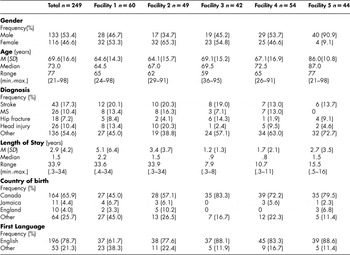
A total of 249 patients who met the same inclusion criteria of Phase 1, and who agreed to participate, were recruited by the nurses employed at five different CC urban facilities in Ontario, Canada. All facilities provided care to adult patients with chronic illnesses and varied in size from 119 beds to 535 beds (Table 2). Data collection procedures were the same as already described. All data were entered into the computer using a data entry template created in SPSS, v. 17. The template consisted of patient variables as well as the item variables of the HRIS. Data were analyzed to test the scale’s psychometric properties. The analysis for psychometric testing focused on testing the dimensionality of the HRIS (PAA) and the reliability (Cronbach’s α reliability coefficient) of the newly emerging factors.
Demographic characteristics of Phase 2 participants per facility

M = mean
SD = standard deviation
Results
A slight majority of the patients were male (53.4%), with an average age of 70, though a broad range of ages from 65 to 98 years (Table 2). There was no evidence of statistically significant difference between facilities in patient age (F 4,248 = 8.88, p value = 0.320). Participants had an average CC length of stay of 2.9 years with one facility’s patients having a longer average length of stay but, again, no statistically significant difference was found for this variable when the five facilities were compared (F 4,248 = 0.598, p value = 0.867). Admitting diagnoses included stroke, multiple sclerosis, and hip fracture. The sample used for the psychometric testing of the scale was younger (average of 59.6 years) and presented with a longer length of stay (4.2 years) when compared to the sample used for the dimensionality testing. Differences were statistically significant and the groups included the broad age range cared for in CC.
Dimensionality Testing
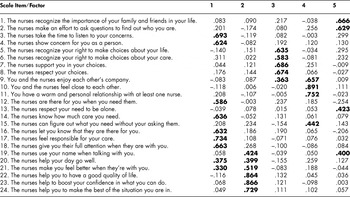
The PAA took place in several steps aimed at finding the factor solution with the greatest structural simplicity. The ultimate criteria for determining the number of factors were factor interpretability and usefulness both during the initial extraction procedures and after the factors had been rotated to achieve more clarity. An oblique rotation of the HRIS resulted in five factors and a total eigenvalue of 15.43 and provided the simplest solution while explaining the highest proportion of total variance at 64.28 per cent (Table 3). The variance was well distributed over the different factors and factorial complexity was kept to a minimum.
Oblique rotated factor loading matrix for the HRIS-24

Interpretation of the Factors
The five factors were named (1) relational availability, (2) promoting quality of daily life, (3) recognizing and supporting choice, (4) forming connections, and (5) supporting human uniqueness.
Factor 1, relational availability, described qualities of a connection that formed between a nurse and a patient through openness and listening in which the nurse’s availability and professional accountability are communicated. Attributes of this quality involve support, understanding, availability, and responsiveness. Factor 2, promoting quality of daily life, indicated a particular form of connecting in which the dialogue between the nurse and the patient aims at promoting the well-being and comfort of the patient by nurturing the older patient’s potential and helping him/her to recognize and accept limitations. Factor 3, recognizing and supporting choice, describes the nurses’ awareness of the patient’s freedom to choose and freedom to respond. Factor 4, forming connections, describes qualities such as the formation of a special bond with a nurse or nurses, and a willingness to let the other know you as an individual. The last factor, supporting human uniqueness, describes the awareness of self and how one differs from others including the attributes of listening, searching for human uniqueness, and recognition of one’s particularity.
Four of the five factors were named differently than the original six theoretical dimensions – Figure 1; (a) supporting human uniqueness, (b) sustaining choice, (c) relational capacity, (d) living dialogue, (e) being present, and (f) fostering well-being and more-being – because of the mixture of items in the factor analysis which were different from the original theoretical dimensions and led to a revised conceptualization for the HRIS scales.
Reliability Testing
The results of the reliability testing are displayed in Table 4. Four of the five HRIS factors had Cronbach’s α coefficients between .80 and .90, indicating that these factors can detect discriminations between the items designed to assess the construct (Streiner & Norman, Reference Streiner and Norman2004). The fifth factor had a low Cronbach α coefficient (.49). The overall alpha for the total HRIS was .92 which is slightly higher than the accepted .90. HRIS inter-item correlations for factors one, three, and four were all within .30 and .70. For factor 2, these correlations were mostly within .30 and .70. The exceptions were items 22, 23, and 24 which had slightly higher inter-item correlations, pointing to some redundancy among these three items. In factor 5, item 13 had low inter-item correlations with all other items indicating that this item measures a different aspect of the concept – supporting human uniqueness. Based on these findings, item 13 was deleted resulting in factor 5 inter-item correlations between. 30 and .70; an increase in the Cronbach’s alpha coefficient from .49 to .67; and a drop in the overall alpha for the total HRIS from .92 to .87 (Table 4).
Cronbach’s α and descriptive statistics per factor for the HRIS 23

HRIS = Humanistic Relationship Importance Scale
HRIS Frequencies
Using the final version of the HRIS scale, descriptive statistics for each factor were calculated. They demonstrated high means (Table 4) with standard deviations within acceptable boundaries. Factor 1, relational availability, had the highest mean score (4.34), indicating that this factor is most important to CC patients in the humanistic nurse-patient relationship.
Discussion
The HRIS was a new scale developed to elicit patients’ preferences for a humanistic relationship with nurses in a CC setting. Psychometric testing demonstrated that the HRIS is valid and reliable: that is, it measures the nurse-patient relationship from the patient’s perspective with a good degree of accuracy. The scale demonstrated a high level of internal consistency and stability, and the construct validity was supported through factor identification (Streiner & Norman, Reference Streiner and Norman2004). The factor analysis revealed that the items developed to reflect the original six concepts reorganized themselves into five factors. Four of these five factors were labeled differently than the original six theoretical dimensions from Paterson and Zderad (Reference Paterson and Zderad1988) because the items in these four factors were a mix of items developed and led to a somewhat revised conceptualization of their theory. The five dimensions of the HRIS indicate that older patients are able to support these five distinct factors in reflecting on the importance of humanistic qualities in the nurse-patient relationship.
The factor relational availability, which received the highest score from patients, described qualities of the nurse-patient relationship in which both the nurse and the patient are involved as unique individuals. Patients strongly value relationships where the nurse is available and aware of the particularity of the patient and willing to listen, understand, and support the patient. The clinical significance of this factor is supported by the frequent indications in the literature that nurses must relate well according to older patients’ preferences in order to provide tailored care (Forchuk & Reynolds, Reference Forchuk and Reynolds2001; McGilton et al., Reference McGilton, O'Brien-Pallas, Darlington, Evans, Wynn and Pringle2003; Watson, Reference Watson, Smith, Turkel and Wolf’s2012, chap. 16). This idea was further embraced by Liaschenko (Reference Liaschenko1998) who stated that the focus on the person involves recognition that patients are more than their disease or illness, and as such, involves the nurse’s commitment to form a connection with the patient as a unique person.
Factor 2, promoting quality of daily life, describes the dialogue between the nurse and the patient aimed at promoting the well-being, comfort, and quality of life of the older patient. The nurse nurtures the patient’s potential and helps them to make the most of their capabilities regardless of how compromised they might be. The role of the nurse in encouraging the patient to perform activities that contribute to the patient’s well-being and enhance the patient’s quality of life is a recurrent theme in literature focused on caring for chronically ill older patients and is especially central in CC settings (Kane, Reference Kane2001; Roberts, Reference Roberts2013; Watson, Reference Watson, Smith, Turkel and Wolf’s2012, chap. 16).
Factor 3, recognizing and supporting choice, emphasizes the patient’s freedom to make decisions. Providing choices is essential to older patients in chronic care environments and an important quality of a nurse-patient relationship (Forchuk & Reynolds, Reference Forchuk and Reynolds2001; Ranheim et al., Reference Ranheim, Kärner and Berterö2012). The latter investigators found a significant positive correlation (r = .54; p = .01) between the amount of choice patients perceive they have and their quality of life. A relevant study by Kane et al. (Reference Kane, Caplan, Urv-Wong, Freeman, Aroskar and Finch1997) demonstrates that both nursing home residents and nursing assistants attach importance to choice and control over daily matters such as bedtime, rising time, or food, although in actuality, residents were not very satisfied with their control and choice, and nursing assistants recognized that residents were unlikely to experience any control and choice in daily situations.
The fourth factor, forming connections, describes the humanistic relating process between a nurse and a patient. Berg et al. (Reference Berg, Skott and Danielson2007) referred to caring connections as an encounter that goes beyond the individual nurse and patient and includes a reaching out, an engagement, and a showing of respect for each other. Kane (Reference Kane2001) argued for “natural” relationships between nursing home residents and staff to promote quality-of-life domains such as comfort, enjoyment, and well-being. These natural relationships promote a more consumer-centred emphasis on quality of life, where the patient decides on what is considered a good quality of life.
The last factor, supporting human uniqueness, describes the process of the nurse’s search for the older patient’s uniqueness and the awareness of the patient’s perspective. The patient’s perspective of his/her experiences, life history, and context leads to a singular viewpoint of seeing the world. This uniqueness leads the patient to see, hear, feel, taste, and experience the world in a particular way. Nurses are to recognize this particularity through listening and attentiveness to the patient’s individual uniqueness (Fogarty, Reference Fogarty2012; Watson & Smith, Reference Watson and Smith2002). Through the shared willingness of nurse and patient to search for the patient’s uniqueness and to become aware of his/her view of the world, relatedness is created.
An interesting observation of the conceptualization of the humanistic nurse-patient relationship is that Paterson’s and Zderad’s (Reference Paterson and Zderad1988) concept of presence is woven throughout most of the other dimensions, indicating that presence is an essential aspect of every humanistic quality of the nurse-patient relationship. Paterson and Zderad portrayed the moments when nurses are present as “being there for and with the patient”. Presence indicates that nurses turn their attention towards the patient, are aware of and open to the situation, whatever it is, and communicate their availability to the patient (Paterson & Zderad, Reference Paterson and Zderad1988). This finding has theoretical implications for the refinement of theories or tool development in order to explore the concept of presence.
The responses of the patients to the HRIS indicated that they perceived all five dimensions (i.e., relational availability, promoting quality of daily life, recognizing and supporting choice, forming connections, and supporting human uniqueness) as important in the relationship with nurses in CC but relational availability was the most important quality from their perspective. This perceived importance of relational availability is consistent with the current qualitative studies on nurse-patient relationships in residential and CC environments (Billeter-Koponen & Fredén, Reference Billeter-Koponen and Fredén2005; Forchuk & Reynolds, Reference Forchuk and Reynolds2001; Jonas-Simpson et al., Reference Jonas-Simpson, Mitchell, Fisher, Jones and Linscott2006). Although this work was completed in a CC environment, many patient particularities are similar to those residing in nursing home settings – CC patients have similar care complexities and extended lengths of stay in the facility.
Patients in residential settings strongly value relationships in which the nurse is available and aware of the particularity of the patient. Wadenstein and Carlsson (Reference Wadenstein and Carlsson2003) explored nursing staff’s descriptions of good encounters with patients and found that nurses described their connection as caring relationships with an emphasis on the uniqueness of each patient. They described the importance of developing a partnership, in which the nurse is willing to perceive each patient as a unique person. McGilton and Boscart (Reference McGilton and Boscart2007) have documented nurse-patient relationships in which both the nurse and older patient relate to each other as persons, experiencing reciprocity and a caring and genuine dialogue during their daily encounters. Not only are these encounters taking place between two unique individuals, there is the strong assumption that one chooses to relate to another with a willingness to place oneself completely in the relationship to see the subjective other. When a nurse truly meets the other person, a feeling of responsibility to alleviate the patient’s suffering is created, and nurses place themselves completely in the relationship and choose to communicate in truly human ways (Paterson & Zderad, Reference Paterson and Zderad1988).
Two aspects of study validity bias are worth discussing in the context of this study: systematic bias and social desirability bias (Fisher & Katz, Reference Fisher and Katz2000; King & Bruner, Reference King and Bruner2000). The data for this study were collected from a convenience sample of patients residing in five large CC facilities in Ontario, Canada, and the participants of these facilities could have varied in some specific way which makes them different from the population of CC patients as a whole. For example, the participants of the selected facilities might have presented with different demographics, cultural backgrounds, or care needs as compared to patients in other CC facilities. The occurrence of this is highly unlikely, as the profile of the patients in the selected facilities was similar to that of patients in other CC settings (CIHI, 2009). Social desirability bias could have been induced by the presence of the researcher when participants completed the questionnaire (King & Bruner, Reference King and Bruner2000). This bias was addressed by following a strict data collection procedure to assure that questions were posed objectively (Streiner & Norman, Reference Streiner and Norman2004). Future studies could limit the risk of social desirability by using data collectors blinded to the purpose of the instrument and study.
Finally, the study is limited to the factors that might have influenced the nurse-patient relationship. Gender, communication style, first language spoken, culture, and nurse characteristics were not accounted for as this was not the purpose of our study. These factors will be explored in subsequent research.
Conclusion
This study aimed to develop and test a valid and reliable instrument to determine the quality of the humanistic relationships between patients and nursing personnel in CC settings. The scale can now be used as a psychometrically sound instrument to accurately measure health professionals’ relationships in these types of settings. Further research using the scale is recommended to explore how the construct of humanistic relationships relates to intrapersonal variables such as quality of life, well-being and level of comfort, and satisfaction with care. Lastly, further refinement and testing of the scale is recommended. In particular, the high Cronbach’s α of the HRIS indicates a need to remove redundancy among the items.
Findings of this study have implications for regulatory guidelines and standards, theory development, practice and education, and future research. From a regulatory perspective, the construct of the nurse-patient relationship is described as based on trust, respect, power, and professional intimacy with the client (CNO, 2006); yet concepts such as “choice”, “uniqueness”, or “quality of daily life” are barely mentioned, and the particular dimensions of an extended relationship are neglected. The scale developed in this study could be of great interest in reconsidering the regulatory and professional standards and guidelines for health care professionals caring for older patients. Theoretical implications of this nurse-patient relationship conceptualization are numerous. The content of items identified by the factor analysis is of considerable theoretical interest in the understanding of the nurse-patient relationship. This conceptualization informs the humanistic nursing theory and other theories about the complex network of theoretical dimensions underlying the nurse-patient relationship, and they could be further explored in future research or theory testing.
A second theoretical implication of this study is directly related to Paterson’s and Zderad’s theory (Reference Paterson and Zderad1976, Reference Paterson and Zderad1988). Although Paterson and Zderad do not directly address nursing care in a chronic care setting in their theoretical descriptions, the strong existential roots of this theory and the focus on the human experience and being creates the potential to further inform this type of nursing. Because the humanistic nursing theory is based on the idea that nursing is a transactional relationship between a nurse and a patient, the theory is an ideal vehicle to describe the everyday experiences between nurses and patients and could be suitable for exploring several other aspects of interprofessional care delivered in CC settings.
Since the conceptualization of the nurse-patient relationship is a revision of an existing theory, discussion related to practice is premature. Nevertheless, the theory development, the concepts identified as relevant to the nurse-patient relationship, and the HRIS can be employed to ensure patients have the opportunity to experience and participate in the highest possible degree of humanistic relationships.
A growing population of patients requires the complex care that is delivered in chronic care settings. These older patients not only need skilful nursing care to meet their physical needs, but also they need strong relationships to communicate and negotiate daily care and needs related to their quality of life and well-being. Sometimes they just need social interaction. Nurses’ humanistic relationship skills and behaviors are essential in fostering close, affectionate, and warm relationships with patients who spend an extended time in these settings. This scale can be used to assess actual relationships and has the potential to inform interventions aiming to enhance relational care and optimize relationships.