Introduction
Freely accessible communication technologies and the availability of fast data connections and seemingly unlimited data storage opportunities are undoubtedly one of the most significant technical achievements of the past decades. However, this enormous technologization also has a few downsides. The spread of the internet has created new opportunities for the sexual exploitation of children. The production and distribution of child sexual exploitation material (CSEM) is just one of them.Reference Kloess, Beech and Harkins1
Since the early 2000s, there has been a significant increase in criminal charges and convictions related to CSEM offenses. In the United States, the number of individuals facing criminal charges related to CSEM grew from 169 in 1996 to 2539 in 2006. In the same year, about 69% of sexual offenses against children prosecuted nationwide were CSEM-related.Reference Motivans and Kyckelhahn2 The numbers in England and Wales grew from 238 convictions in 1999 for CSEM-related crimes to 1296 in 2005.Reference Middleton, Mandeville-Norden and Hayes3 A similar development can be observed in the German-speaking countries: In Germany, the numbers increased significantly within 2 years, from 3753 criminal charges for CSEM in 2015 to 6512 in 2017.4, 5 According to the Austrian criminal statistics, the number of criminal charges for CSEM-related crimes quadrupled between 2015 and 2022. While 465 criminal charges were filed in 2015, there were already 2061 in 2022.6, 7
The increasing number of CSEM offenses has led to a growing body of research on this group of offenders. While questions regarding the characteristics and motivations of offenders were central from the outset, they remain difficult to answer, given the anonymity that the internet provides.Reference Seto8 Most available research relies on data from individuals convicted of CSEM offenses but it must be assumed that far more people encounter CSEM than is actually known.Reference Seto, Hermann, Kjellgren, Priebe, Svedin and Långström9, Reference Dombert, Schmidt and Banse10 Nevertheless, some characteristics of this population have been reliably demonstrated across multiple studies. A widely accepted hypothesis is that individuals convicted of CSEM offenses represent a distinct group of persons who—unlike individuals convicted of contact sexual offenses—have better self-management skills and more stable lifestyles in terms of occupation, education, and a lack of criminal convictions. Furthermore, they are more likely to be young white males, and are less likely to have experienced severe childhood problems such as neglect or physical and sexual abuse.Reference Babchishin, Hanson and VanZuylen11-Reference Henshaw, Ogloff and Clough13
However, there are not only sociodemographic characteristics that distinguish individuals with CSEM-related offenses from other sexual offending groups. In terms of motivation, there is clear evidence that sexual deviance plays an even more important role in CSEM offending than in other sexual offending behaviors. Seto et al.Reference Seto, Cantor and Blanchard14 found in their study of 685 men that those convicted for CSEM offenses showed significantly more sexual arousal for children compared to other sexual offending groups. The authors argued that a history of CSEM offenses is a valid diagnostic indicator of pedophilia. Indeed, a significant association between pedophilia and CSEM offending has been confirmed in further studies.Reference Babchishin, Hanson and VanZuylen11, Reference Babchishin, Karl Hanson and Hermann12 Furthermore, a preoccupation with sexual content appears to be highly associated with CSEM offending, as are problems with sexual self-regulation.Reference Babchishin, Karl Hanson and Hermann12 Kuhle et al.Reference Kuhle, Schlinzig and Kaiser15 demonstrated that even among offenders diagnosed with a pedophilic disorder, CSEM offenders show significantly higher sexual preoccupation than individuals who committed contact sexual offenses.
Although sexual interest in children and hypersexual behavior are two empirically supported risk factors for sexual offending,Reference Hanson and Morton-Bourgon16, Reference Gregório-Hertz, Rettenberger, Turner, Briken and Eher17 previous research has found that CSEM offenders have a much lower risk of recidivism compared to individuals convicted of contact sexual offenses. Furthermore, only a very small proportion has offended with a contact sexual offense against children after the commission of a CSEM-related offense.Reference Seto, Karl Hanson and Babchishin18, Reference Goller, Jones, Dittmann, Taylor and Graf19 Eke et al.Reference Eke, Seto and Williams20 even found a negative correlation between a history of CSEM offenses and contact sexual recidivism. This is related to the fact that individuals who committed online-based offenses are generally less likely to exhibit antisocial behaviors and have at the same time better self-management skills and more empathy, which likely prevents them from committing contact offenses.Reference Babchishin, Hanson and VanZuylen11, Reference Elliott, Beech, Mandeville-Norden and Hayes21 However, all these findings apply to individuals who committed only CSEM-related offenses and no further crimes from other offense categories.
On the contrary, dual offenders, who have both CSEM offenses and contact sexual offenses on their criminal record, are a particularly high-risk group. This group is up to 3 times more likely to commit new sexual offenses than CSEM-only offenders.Reference Goller, Jones, Dittmann, Taylor and Graf19, Reference Elliott, Mandeville-Norden, Rakestrow-Dickens and Beech22 Compared to other groups with offending behaviors, dual offenders are considered more sexually deviant in terms of a more salient pedophilic preference and are deemed to have greater deficits in their sexual regulation capacities.Reference Babchishin, Karl Hanson and Hermann12 Additionally, dual offenders can be distinguished from CSEM-only offenders based on measures of sexual preoccupation.Reference Kuhle, Schlinzig and Kaiser15 However, their most important distinguishing features are characteristics typically associated with antisociality such as impulsivity, rule-breaking behavior, lack of empathy, and a history of violent offending.Reference Babchishin, Hanson and VanZuylen11, Reference Babchishin, Karl Hanson and Hermann12 The combination of antisocial traits and sexually deviant motives makes them a particular high-risk group for sexual recidivism.Reference Seto8
The difference in risk between the two groups can be explained using the motivational–facilitation model, which was developed by Michael Seto to explain sexual offenses against children.Reference Seto23 The model basically distinguishes between motivational and facilitation factors, the latter being either state or trait factors. According to the model, the main motivation for committing sexual offenses is to be found in a person’s individual sexuality. In the case of pedophilic disorders, sexual desire is characterized by a strong sexual interest in children. Regardless of paraphilic sexual interests, a person can also have a very strong sex drive which, if uncontrolled, can lead to sexual acts being performed on vulnerable victims without their consent. Combined with state-facilitating factors such as deficits in self-regulation, or situational facilitating factors such as drug intoxication, sexual offenses eventually become more likely. According to this model, CSEM-only offenders who are pedophilically motivated but have good self-regulation skills have a lower risk of committing sexual offenses than dual CSEM offenders who are less able to regulate their sexual impulses or show antisocial behavior. Clinically, the relevant risk factors are characteristics of paraphilic disorders or personality disorders, that is, mental disorders that are significantly associated with violent or sexual recidivism.Reference Biedermann, Eher, Rettenberger, Gaunersdorfer and Turner24 Therefore, to better understand the risk and possible treatments for these offender groups, knowledge of mental health, specifically the prevalence rates of mental disorders, is needed.
However, with regard to clinical features, there are many unanswered questions. Previously published study findings on this topic suggested that individuals convicted of CSEM offenses have a high need for treatment, with significantly higher utilization of mental health services compared to the general population.Reference Babchishin, Hanson and VanZuylen11, Reference Henshaw, Ogloff and Clough13 Krueger et al.Reference Krueger, Kaplan and First25 used structured clinical interviews in their study of 60 men with internet-related sexually motivated offenses against children. Thirty-eight of them were arrested for possession of CSEM, and the other 22 for attempting to meet children. The authors found a high prevalence (70%) of Axis I disorders for the total sample. The authors did not report prevalence rates for personality disorders but showed that 31% of their sample had a pedophilia diagnosis. Additionally, they found evidence of a hypersexual disorder in 33%. Prat and JonasReference Prat and Jonas26 examined forensic reports from a sample of French offenders arrested for CSEM offenses and who were therefore subjected to psychiatric evaluation. In contrast to Krueger et al.Reference Krueger, Kaplan and First25, only 1 of 5 participants showed a psychiatric medical history. Less than 10% had an Axis II diagnosis and only about 25% obtained an Axis I diagnosis. Pedophilia was the most common diagnosis with a prevalence rate of 25%. Although both studies examined forensic populations of CSEM offenders referred for psychiatric evaluation under court order, the results varied substantially. Given the methodological differences between both studies, there remains a clear need for further research about the mental health status of individuals convicted of CSEM-related offenses by using structured clinical instruments.
Method
The Austrian prison system stipulates that every person incarcerated because of the commission of a sexual offense—and this includes CSEM offenses—must be reported to the Federal Evaluation Center for Violent and Sexual Offenders (FECVSO). The FECVSO is a scientific institution of the Austrian Ministry of Justice that specialized in clinical, forensic, and risk assessment of individuals convicted of sexual offenses. Each case goes through a risk-related and file-based screening process conducted by specially trained clinical psychologists. Individuals (Reference Kloess, Beech and Harkinsa) who either committed a previous sexual offense, who (Reference Motivans and Kyckelhahnb) sexually assaulted an unrelated minor child, (Reference Middleton, Mandeville-Norden and Hayesc) have been sentenced to 4 years or more in prison, (d) are younger than 25 years of age, or (e) have a Static-99Reference Rettenberger and Eher27 total score of more than 5 must undergo an in-depth clinical evaluation. This comprehensive forensic examination is conducted directly at the institution and takes about 2 weeks. During this time, each person is assessed using the German version of the Structured Clinical Interview for Axis I and Axis II Disorders (SCID I and SCID II).Reference Wittchen, Wunderlich, Gruschwitz and Zaudig28, Reference Fydrich, Renneberg, Schmitz and Wittchen29 In addition, trained clinical psychologists and psychiatrists conduct clinical interviews about the sexual and general biography, in order to assess paraphilic interests and sexuality-related disorders.Reference Eher30
First, all cases of individuals convicted of CSEM-related offenses who have served a prison sentence since the FECVSO records began in 2002 were identified, which resulted in an initial sample of n = 221. The data were completely anonymized and did not contain any personal information. The study was conducted with the approval of the Federal Ministry of Justice of the Republic of Austria. These cases were then screened for duplicates: if an individual was repeatedly recorded due to multiple convictions, only 1 entry was used. Of the remaining n = 116, only cases that underwent an on-site assessment were selected for this study. The final sample consists of n = 66 individuals who served a prison sentence for a CSEM-related offense between 2002 and 2020. The mean age of the sample was M = 44.11 (SD = 12.38), with a range between 19 and 71. Thirty-five participants (53.0%) were never married, 8 (12.1%) were married and n = 21 (31.8%) were divorced (data on marital status were not available for 2 participants). Information on prior convictions was not available for the total sample. Thirteen (19.7%) individuals had been reported to the FECVSO at an earlier date, indicating a prior incarceration for a sexually motivated offense. For a more differentiated analysis, two subgroups were formed based on the index offense: Thirty-eight (58.0%) participants were convicted because of CSEM-only offenses, whereas n = 28 (42.0%) participants committed an additional violent or sexual contact offense.
For the purpose of the present study, the diagnoses of Axis I and II disorders were grouped into the following categories: Mood disorders, anxiety disorders, psychotic disorders, impulse control disorders, and substance use disorders. Personality disorders were further divided into clusters A, B, and C. Due to the particular scientific and clinical interest, sexual disorders and paraphilic disorders were presented separately. In addition, symptoms of hypersexual disorder were recorded. These were defined as compulsive masturbation, promiscuity, and pornography addiction and combined in an additional category. Differences in prevalence rates between the two abovementioned groups were analyzed using χ 2-tests. When frequencies were too low, Fisher’s exact test was calculated. Statistical analysis was performed using SPSS31 version 20.
Results
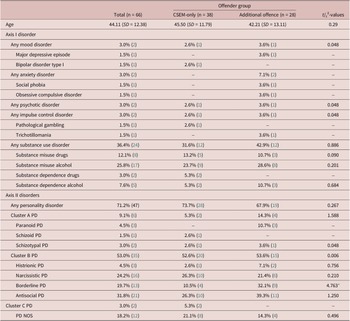
The prevalence of Axis I and Axis II disorders of the total sample is presented in Table 1: Twenty-seven (40.9%) were diagnosed with at least one Axis I disorder. Substance use disorders accounted for the largest proportion (n = 24; 36.4%), with alcohol misuse being diagnosed most frequently. Regarding Axis II disorders, n = 47 (71.2%) were diagnosed with at least one personality disorder. Cluster B personality disorders were found most frequently: Specifically, n = 21 (31.8%) were diagnosed with antisocial personality disorder, n = 16 (24.2%) with narcissistic personality disorder, and n = 13 (19.7%) with borderline personality disorder. In contrast, the prevalence of cluster A (n = 6; 9.1%) and cluster C personality disorders (n = 2; 3.0%) was comparatively low. Offenders with additional violent or sexual offenses tended to have more mental health problems, specifically related to Axis I disorders, while CSEM-only offenders had slightly more personality disorders. However, group comparisons revealed no significant differences (Table 1).
Prevalence of Axis I and Axis II Disorders in CSEM Offenders

Note: Individuals can have multiple entries.
* p ≤ .05.
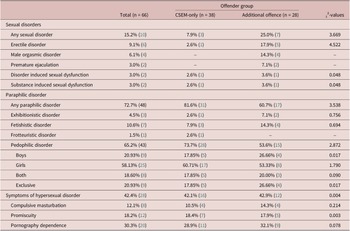
The prevalence of sexual and paraphilic disorders is shown in Table 2. Of the total sample, n = 10 (15.2%) individuals were diagnosed with at least one sexual disorder with erectile dysfunction (n = 6; 9.1%) and male orgasmic disorders (n = 4; 6.1%) as the most common sexual disorders. Forty-eight (72.7%) persons were diagnosed with at least one paraphilic disorder. With a prevalence rate of 65.2% (n = 43) pedophilia was the most frequent paraphilic disorder in the present sample. Most pedophilic offenders (n = 25, 37.9%) showed a sexual preference for female children, 9 (13.6%) showed a sexual preference for male children, and 8 (12.1%) for both sexes. Within the group of pedophile offenders, 9 (13.6%) had a diagnosis of an exclusive pedophilic disorder. Finally, 28 (42.4%) showed indicators of a hypersexual disorder: 8 participants (12.1%) showed signs of compulsive masturbation, 12 (18.2%) of promiscuity, and 20 (30.0%) of pornography addiction. More paraphilic disorders were found among CSEM-only offenders, although no statistically significant differences were found between the groups.
Prevalence of Sexual and Paraphilic Disorders in CSEM Offenders

Note: Individuals can have multiple entries.
Discussion
Despite intensive research in recent years, knowledge about the mental health of individuals convicted of CSEM-related offenses is still limited. Sexual interest in children, deficits in self-regulation, and an antisocial lifestyle are among the most important risk factors for sexual offending against children and are clearly associated with CSEM offending.Reference Babchishin, Hanson and VanZuylen11, Reference Hanson and Morton-Bourgon32 Clinically, these risk factors are expressed in personality disorders or paraphilic disorders, that is, mental disorders that are significantly associated with violent or sexual recidivism.Reference Biedermann, Eher, Rettenberger, Gaunersdorfer and Turner24 However, the prevalence rates of these disorders are unknown. The present study aims to address this gap by evaluating data from n = 66 men convicted of a CSEM-related offense, who served a prison sentence between 2002 and 2020 and underwent a comprehensive clinical assessment.
Concerning Axis I disorders, more than one-third (36.4%) of the sample had a substance use disorder, with alcohol abuse being the most common diagnosis. This finding confirms previously published studies on this offender population.Reference Henshaw, Ogloff and Clough13, Reference Krueger, Kaplan and First25, Reference Aslan and Edelmann33 However, our data showed relatively low rates of mood disorders, anxiety disorders, and impulse control disorders (about 3%). This was unexpected as it has been hypothesized that emotional dysregulation may play an important role in the etiology of sexual offendingReference Ward and Beech34 and the prevalence of mood disorders was significantly higher in a previous study on the mental health of CSEM offenders.Reference Krueger, Kaplan and First25 In fact, in another Austrian sample of convicted men with sexual offenses involving adult and child victims, a similarly low prevalence rate for mood and anxiety disorders (about 6% each) was found.Reference Eher, Rettenberger and Turner35 Just like in our study, the clinical assessment in this sample was conducted at the beginning of the prison sentence. These results suggest that mood or anxiety disorders are rather not a typical feature of CSEM offenders. However, it is not possible to determine whether the symptoms of these disorders were already present at the time of the offenses.
The high rate of personality disorders presents a salient characteristic of our sample: More than two-thirds (71%) were diagnosed with at least one personality disorder, which is substantially higher than the lifetime prevalence of personality disorders in the nonforensic population (39.5%-51.1%) and the prison population in general (65%).Reference Loranger, Sartorius and Andreoli36, Reference Fazel and Danesh37 While based on previous research increased rates were expected,Reference Babchishin, Hanson and VanZuylen11, Reference Goller, Jones, Dittmann, Taylor and Graf19, Reference Klein, Schmidt, Turner and Briken38 the prevalence of antisocial personality disorder in our sample was considerably higher than in a study of individuals convicted of contact sexual offenses. Eher et al.Reference Eher, Rettenberger and Turner35 used structured clinical interviews to examine the prevalence of mental disorders in a sample of 1511 male sex offenders incarcerated in Austrian prisons between 2001 and 2017. About one-third of their sample had a cluster B personality disorder, most of which were antisocial (20.4%) and borderline personality disorder (17.9%). In contrast, more than half of our sample had a cluster B personality disorder and one-third had an antisocial personality disorder. The high prevalence of personality disorders in our sample may suggest that the true number of CSEM-only offenders is underrepresented, assuming that indicators of antisociality are significantly more common among dual offenders than among CSEM-only offenders.Reference Babchishin, Hanson and VanZuylen11 In any case, however, this is a high-risk sample. An alternative explanation could be that only those with very serious CSEM-related offenses would serve a prison sentence as first-time offenders.
Sexual deviance, such as pedophilia, is known to be an important risk factor for sexual offending. Previous research on this topic has provided robust evidence that pedophilic interest in children is significantly more prevalent among individuals convicted of CSEM offenses than among persons who committed contact sexual offenses.Reference Seto, Karl Hanson and Babchishin18 This is especially true for so-called dual offenders who represent a particularly high-risk offender group.Reference Babchishin, Hanson and VanZuylen11 For this reason, it has been argued that CSEM use might be a more valid indicator of a pedophilic disorder than a contact sexual offense against a child.Reference Seto, Cantor and Blanchard14, Reference Seto, Reeves and Jung39 Supporting the relevance of our findings, approximately two-thirds of our sample had a paraphilic disorder, with pedophilia being the most frequently found diagnosis of this disorder group at a rate of 65%. Group comparisons also revealed that CSEM-only offenders tended to be diagnosed with pedophilia more frequently than participants with an additional violent or sexual offense. The prevalence of pedophilia in our study was significantly higher than in Krueger et al.Reference Krueger, Kaplan and First25 who examined clinical characteristics in CSEM offenders and so-called solicitation offenders. However, our findings did not suggest a higher prevalence of paraphilia diagnoses than has been reported for individuals convicted of contact sexual offenses.Reference Eher, Rettenberger and Turner35
Finally, hypersexuality is a known comorbidity in individuals with paraphilic disorders.Reference Kafka and Hennen40 It is also an empirically supported risk factor for the etiology of sexual offending behaviors and is considered a motivational factor in CSEM-related offenses.Reference Hanson and Morton-Bourgon32, Reference Seto23 Consistent with the idea that hypersexuality plays a role in online sexual offending, nearly half of our sample showed symptoms of hypersexual disorder, with pornography dependence being the most prevalent at a rate of 30%. While Krueger et al.Reference Krueger, Kaplan and First25 reported that CSEM-only offenders would be identified as having a hypersexual disorder with pornography dependence, this was not the case in this sample. Nonetheless, our findings suggest that individuals convicted of CSEM are highly sexually preoccupied, which could be considered a treatment target.
An important caveat of this study was the unavailability of information on prior offenses or convictions. Consequently, pre-existing convictions for other offences cannot be ruled out. In fact, CSEM-only offenders are believed to be underrepresented for one simple reason: A person without prior convictions facing trial for the first time is much more likely to be sentenced to conditional imprisonment, especially if it is only for possession of CSEM. This is probably reflected in the large degree of overlap between the two groups. However, a tendency is apparent in group comparison, namely that CSEM-only offenders are more likely to be diagnosed with paraphilic disorders, whereas offenders with an additional contact sexual offense are more likely to have substance abuse, antisocial, and borderline personality disorder. This would support the view that CSEM-only offenders are more likely to be motivated by sexual deviance and are clinically distinct from other offender groups. The sample is representative of incarcerated CSEM offenders. However, it is unclear to what extent the results of this study can be generalized to CSEM offenders who have not been sentenced to prison.
Furthermore, due to the study design, no statement can be made on the extent to which CSEM offending is related to mental disorders. This is especially true for Axis I disorders. Since there is no control group design in our work, it is also possible that experienced symptoms of anxiety disorders or mood disorders are a consequence of imprisonment. In addition, we do not know for how long the symptoms had been present at the time of the assessment. However, compared to a study of contact sex offenders with a related study design,Reference Eher, Rettenberger and Turner35 similarities were found in the prevalence of Axis I disorders. Although the results suggest that, for example, symptoms of affective disorders are neither a typical feature of CSEM offenders nor a consequence of incarceration, this cannot be ruled out.
Conclusion
Using the motivational–facilitation model,Reference Seto23 a high proportion of motivational factors in the form of a high prevalence of paraphilic disorder was demonstrated for the total sample. Furthermore, 1 in 2 individuals was found to show symptoms of hypersexual disorder. These risk characteristics combine with facilitating factors, most clearly in the form of an unexpectedly high prevalence of antisocial personality disorder. The results of this study suggest that individuals serving a prison sentence for a CSEM offense may have an increased prevalence of several clinical characteristics that are known risk factors for sexual offending and therefore should not be underestimated in terms of their risk of recidivism. This should be considered when planning appropriate risk management. In general, however, we share the opinion that further research is needed with clinically and psychometrically sound diagnostic instruments.
Financial support
This research received no specific grant from any funding agency, commercial or not-for-profit sectors.
Author contribution
Conceptualization: A.S., M.R.; Data curation: A.S., R.E.; Formal analysis: M.R.; Methodology: A.S., M.R.; Project administration: A.S., M.R., R. E.; Supervision: M.R., D. T., R. E.; Visualization: A.S.; Writing—original draft: A.S.; Writing—review and editing: A.S., R.E., D.T., M.R.
Disclosure
The authors report no financial or other relationship relevant to the subject of this article. The study was conducted as part of the authors’ professional activities.
Competing interest
We have no conflicts of interest to disclose.