INTRODUCTION
Apoptosis is an important process, which physiologically occurs in throughout of mammalian life. It has been indicated as one type of programmed cell death, which enables organisms to eliminate injured cells from the body (Devitt and Marshall, Reference Devitt and Marshall2011). Also, it plays an essential role in tissue homoeostasis and fundamental processes of the immune system such as central and peripheral tolerance, setting up immunological memory, and negative selection (Opferman, Reference Opferman2008). During the process of apoptosis, several intracellular signalling pathways are triggered, which results in recruitment and activation of a series of proteases known as caspases (Devitt and Marshall, Reference Devitt and Marshall2011).
Different pathogens including viruses, bacteria and protozoa have developed strategies to induce apoptosis in both host immune and non-immune cells (Luder et al. Reference Luder, Gross and Lopes2001; Herold et al. Reference Herold, Ludwig, Pleschka and Wolff2012). Listeria monocytogenes, for example, is able to trigger apoptosis in host lymphocytes as an important mechanism for survival (Carrero and Unanue, Reference Carrero and Unanue2006). Intracellular pathogens, such as Toxoplasma gondii and Leishmania can also heighten their infectivity by deriving apoptosis-related signalling (Bienvenu et al. Reference Bienvenu, Gonzalez-Rey and Picot2010).
Worms are adept at bypassing host immunity, as during many helminth infections the host immune responses are modulated and quietly suppressed. Notably, a number of investigations imply that induction of apoptosis by helminths is likely to play an important role in dampening host immunity (Chen et al. Reference Chen, Lee, Lai, Hsu, Wang and Liu2008; Gazzinelli-Guimaraes et al. Reference Gazzinelli-Guimaraes, Souza-Fagundes, Cancado, Martins, Dhom-Lemos, Ricci, Fiuza, Bueno, Miranda, Guatimosim, Gazzinelli, Correa-Oliveira, Bartholomeu and Fujiwara2013). Promotion of host cell death, especially in immune cells facilitates the parasite proliferation, as well as increases the longevity of helminths within the host through lowering the quantity of immune cells (Chow et al. Reference Chow, Brown and Pritchard2000).
Helminths and their products have been found to trigger apoptosis pathways and anergy in host immune cells including T lymphocytes (Chow et al. Reference Chow, Brown and Pritchard2000; O'Connor et al. Reference O'Connor, Jenson, Osborne and Devaney2003; Smith et al. Reference Smith, Walsh, Mangan, Fallon, Sayers, McKenzie and Fallon2004; Chen et al. Reference Chen, Lee, Lai, Hsu, Wang and Liu2008), antigen presenting cells (APCs), natural killer cells (NK cells) and eosinophils (Moreau and Chauvin, Reference Moreau and Chauvin2010; Babu and Nutman, Reference Babu and Nutman2012). Besides immune cells, non-immune cells such as intestinal epithelial cells (Cliffe et al. Reference Cliffe, Potten, Booth and Grencis2007) are also targeted by helminths and their products for apoptosis.
Two general pathways are involved in apoptosis process including the death receptor pathway and mitochondrial pathway (Devitt and Marshall, Reference Devitt and Marshall2011). Stimulation of these pathways by helminths indicates that these macroparasites during their complex interactions with host immunity have evolved complex mechanisms to promote their lifespan within the host. Some helminths migrate throughout the host body and their large size can induce stress signals and local inflammation in afflicted tissues.
It seems that their main purpose of killing immune cells is likely dampening inflammatory responses raised against them. Thus, it is not surprising to hypothesize induction of apoptosis is a telling mechanism to suppress inflammation and pave the way for immunoevasion.
Undoubtedly, unravelling the principal pathways through which helminths manipulate viability of host cells will represent new insights into their immunoregulatory functions, leading us to the development of new approaches for fighting helminth infections. On the other hand, recognition of bioactive molecules whereby helminths induce apoptosis may offer potential drugs to combat diseases such as cancers in which aberrant cell division and long lifespan are the major problems (Vasilev et al. Reference Vasilev, Ilic, Gruden-Movsesijan, Vasilijic, Bosic and Sofronic-Milosavljevic2015).
This review aims to highlight the recent findings concerning the interactions between helminths and host cells resulting in apoptosis as a powerful and salient mechanism for immunosuppression.
APOPTOSIS
Apoptosis is regarded as a complex process recruiting different intracellular molecules to drive involved cells toward programmed death. Development of biochemical interaction between upstream and a key family of downstream cysteine proteases known as caspases enables an organism to eliminate afflicted and old cells via this irreversible process. Apoptosis plays a pivotal role not only in development and homoeostasis of the immune system, but also in generation and maintenance of immunologic tolerance to antigens (Kushwah and Hu, Reference Kushwah and Hu2010).
Generally, the main routes triggering apoptosis are categorized into two divergent pathways called the intrinsic (mitochondrial) and the extrinsic (death receptor) pathways. The major activators of the intrinsic pathway are factors making DNA damage and endoplasmic reticulum stress (ERS). But, the extrinsic pathway is triggered by a ligand–receptor interaction between tumour necrosis factor (TNF) family including TNFα, TRAIL (TNF-related apoptosis-inducing ligand) and Fas ligand and the surface receptors known as TNF receptor (TNFR) superfamily such as TNFR1 and 2, death receptor 4/5 and Fas. Both pathways eventually lead to activation of caspases (Bai and Wang, Reference Bai and Wang2014).
The intrinsic pathway is triggered upon any stimulation inducing mitochondrial outer membrane permeability (MOMP) due to pore formation. In fact, MOMP is the central player, which mediates subsequent events including the release of cytochrome c and second mitochondria-derived activator of caspases (SMAC) as proapoptotic proteins to the cytoplasm. Cytochrome c actively contributes to the formation of the caspase-9-activating complex known as the apoptosome via binding to the adaptor protein apoptotic protease-activating factor 1 (APAF-1). Upon constitution of apoptosome, caspases 3 and 7 are activated, which ultimately results in DNA fragmentation and emergence of other apoptosis-related signs. In the extrinsic pathway, engagement of death receptor leads to the formation of a multiprotein complex called death-inducing signal complex that activates caspase 8. Subsequently, caspase 8 is able to cleave and activate caspase 3 and 7, the executor caspases in programmed cell death (Fernald and Kurokawa, Reference Fernald and Kurokawa2013).
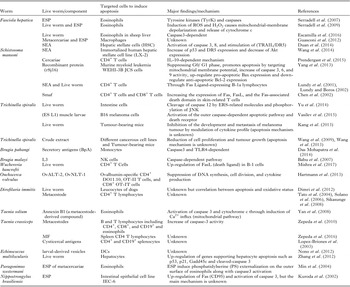
In this review, the association of helminths and immune system apoptosis is detailed below according to the parasite species, taking in turn trematodes (Fasciola and Schistosoma), nematodes (Filarial and Trichinella) and the cestodes (Taenia and Echinococcus). A summary of the pathways and mechanisms through which helminths target mainly immune cells to undergo apoptosis has been referred in Table 1.
Major mechanisms and involved pathways during induction of host cell apoptosis by helminths and their products

SEA, soluble antigens of eggs; ERS, endoplasmic reticulum stress, OvALT-2, Onchocerca volvulus abundant larval transcript-2; OvNLT-1, Onchocerca volvulus novel larval transcript-1; Smaf, S. mansoni-derived apoptosis-inducing factor; MF, metacestode factor, L3, live infective-stage larvae.
TREMATODES
Fasciola hepatica
Fasciola hepatica involves a wide range of animals, including ruminants, rodents and humans (Robinson and Dalton, Reference Robinson and Dalton2009). This worm infects through the duodenum and intestinal wall, enters the peritoneal cavity where it penetrates in the liver capsule and resides there (Robinson and Dalton, Reference Robinson and Dalton2009; Cwiklinski et al. Reference Cwiklinski, O'Neill, Donnelly and Dalton2016). In spite of insulting various tissues and eliciting immune responses, F. hepatica can survive in the host for a long time. Induction of host cell apoptosis by F. hepatica and its products has been well recognized as an efficacious mechanism to suppress host immunity (Serradell et al. Reference Serradell, Guasconi, Cervi, Chiapello and Masih2007, Reference Serradell, Guasconi and Masih2009; Guasconi et al. Reference Guasconi, Serradell and Masih2012; Escamilla et al. Reference Escamilla, Bautista, Zafra, Pacheco, Ruiz, Martinez-Cruz, Mendez, Martinez-Moreno, Molina-Hernandez and Perez2016). In this regard, excretory-secretory products (ESP) from F. hepatica are able to induce eosinophil apoptosis via triggering a series of mitochondrial-dependent pathways. The most upstream pathway activated by ESP that results in eosinophil apoptosis is tyrosine kinases (Tyr K) pathway, as inhibition of this pathway abrogates apoptotic effects of ESP (Serradell et al. Reference Serradell, Guasconi, Cervi, Chiapello and Masih2007).
Serradell et al. (Reference Serradell, Guasconi and Masih2009) studied the main mechanism through which both live worm and its ESP mediate eosinophil apoptosis. In this investigation, it was revealed that ESP through increasing the production of reactive oxygen species (ROS), in particular, H2O2 causes mitochondrial-membrane depolarization evolving to release of cytochrome c and consequently activation of caspase cascade (Serradell et al. Reference Serradell, Guasconi and Masih2009). Intraperitoneal administration of catalase as H2O2 scavenger enzyme to rats infected with F. hepatica inhibited the eosinophil apoptosis, as well as exposing ESP-treated eosinophil to catalase suppressed apoptosis, suggesting the critical role of H2O2 in ESP and F. hepatica-mediated apoptosis. ESP also was found to stimulate eosinophil apoptosis through caspase-dependent manner. The critical caspases involved in ESP-induced apoptosis are caspase3, 8 and 9 (Serradell et al. Reference Serradell, Guasconi and Masih2009). To confirm the involvement of caspase pathway in ESP-induced apoptosis, Z-VAD-fmk as a caspase inhibitor was used, which could forestall apoptosis of eosinophil. Further experiments by Serradell et al. (Reference Serradell, Guasconi and Masih2009) showed that carbohydrate components present in ESP crude antigens are responsible for induction of eosinophil apoptosis.
Evaluation of F. hepatica-induced apoptosis in the liver of sheep, as the most important natural host of this worm, has recently provided interesting findings. Migration of the worm in the liver of sheep orally infected with metacercariae can result in apoptosis of liver eosinophils. Based on immunohistochemistry and transmission electron microscopy findings (Escamilla et al. Reference Escamilla, Bautista, Zafra, Pacheco, Ruiz, Martinez-Cruz, Mendez, Martinez-Moreno, Molina-Hernandez and Perez2016), the presence of abundant caspase 3+ and nuclear-fragmented eosinophils at the necrotic sites of liver and bile ducts shows that F. hepatica can efficiently induce apoptosis in both migratory and biliary stages (Escamilla et al. Reference Escamilla, Bautista, Zafra, Pacheco, Ruiz, Martinez-Cruz, Mendez, Martinez-Moreno, Molina-Hernandez and Perez2016).
Besides eosinophils, macrophages also have been shown to be killed by ESP through apoptosis. Guasconi et al. (Reference Guasconi, Serradell and Masih2012) during an in vitro study evaluated the effects of FhESP on peritoneal macrophages and cells obtained from mice infected with metacercaria. In this study, propidium iodide (PI) staining was used to confirm the presence of hypodiploid nuclei in cells exposed to FhESP (Guasconi et al. Reference Guasconi, Serradell and Masih2012). High levels of hypodiploid cells were detected in macrophages treated with FhESP and cells derived from mice infected with metacercaria. Induction of apoptosis was further confirmed when the results of annexin-V assay showed a significant increase of annexin-V positive cells (Guasconi et al. Reference Guasconi, Serradell and Masih2012).
It seems that induction of apoptosis in eosinophils and macrophages as essential immune cells fighting against helminths is a telling mechanism through which F. hepatica overcomes host immune responses. However, more studies are required to clarify whether other immune cells are primed to undergo apoptosis by this worm.
Schistosoma spp.
Schistosomiasis involves a wide range of animals in worldwide due to infection with Schistosoma species including S chistosomiasis mansoni, S chistosomiasis japonicum, and S chistosomiasis haematobium (Barsoum et al. Reference Barsoum, Esmat and El-Baz2013). Cercariae are schistosome larvae, which live in freshwater. They penetrate into the mammalian host through the skin where transform into schistosomula, then entry into blood vessels and migrate toward lungs and liver (Barsoum et al. Reference Barsoum, Esmat and El-Baz2013). During this long survey, they masterfully exploit intriguing mechanisms to evade host immunity including altering membrane antigens, antibody cleavage and apoptosis of host cells (Carneiro-Santos et al. Reference Carneiro-Santos, Martins-Filho, Alves-Oliveira, Silveira, Coura-Filho, Viana, Wilson and Correa-Oliveira2000; Burke et al. Reference Burke, Jones, Gobert, Li, Ellis and McManus2009).
Liver damage is one of the most prevalent clinical manifestations of schistosomiasis, which occurs as a result of immune responses against trapped eggs in this organ. The presence of too narrow vessels in the liver known as sinusoids avoids egg transition and entraps them, which eventually leads to pathologic outcomes such as granuloma and fibrosis (Pearce and MacDonald, Reference Pearce and MacDonald2002). It has been reported that the eggs of S. mansoni contain soluble egg antigens (SEA) diminishing liver fibrosis via apoptosis of hepatic stellate cells (HSC), which have a pivotal role in the progress of liver fibrosis. It seems that SEA stimulates the extrinsic pathway of apoptosis in HSCs. Activation of caspase 3 and 8 along with stimulation of TNF-related apoptosis-inducing ligand/death receptor 5(TRAIL/DR5) are the major mechanisms by which the SEA induces apoptosis (Duan et al. Reference Duan, Gu, Zhu, Sun, Chen, Feng, Song, Xu, He and He2014). Further in vitro experiments showed that SEA through the increase of p53 and DR5 expression and a decrease of protein kinase B (PKB), known as Akt, expression promotes apoptosis in the immortalized human hepatic stellate cell line (LX-2) (Wang et al. Reference Wang, Xu, Zhu, Duan, Chen, Sun, He, Li, Sun and Feng2014). However, the nature of such an anti-fibrotic function of S. mansoni in the liver is really unknown.
As mentioned earlier, S. mansoni larvae are able to pierce the skin to accede to the blood vessels of the definitive host. Undoubtedly, this offense will result in local inflammation and activation of APCs and consequently stimulation of CD4+ T lymphocytes. Recently, Prendergast et al. (Reference Prendergast, Sanin, Cook and Mountford2015) demonstrated that re-exposure of mice to the high number of S. mansoni cercariae (600 cercariae) induces hyporesponsiveness and apoptosis in CD4+ T cells via an IL-10-dependent mechanism, whereas exposure of mice to a single dose of infection (150 cercariae) did not affect CD4+ T cells. The apoptotic effects of S. mansoni on CD4+ T cells had already been proved by Lundy and colleagues. They indicated that Fas ligand-expressing B-1a lymphocytes play an essential role in triggering apoptosis in CD4+ T cells during both schistosomal infection and exposure to SEA (Lundy et al. Reference Lundy, Lerman and Boros2001; Lundy and Boros, Reference Lundy and Boros2002). Skin-stage schistosomula of S. mansoni have also been found to be equipped to immunosuppressive molecules enabling them to frustrate early cellular responses and evade recognition in the host skin (Chen et al. Reference Chen, Rao, He and Ramaswamy2002). In support of this, molecular dissection has revealed that skin-stage schistosomula is able to release a potent pro-apoptotic molecule that significantly triggers apoptosis in skin-associated CD4+ and CD8+ T cells via stimulating Fas/FasL pathway and increasing caspase 8 and 3 activation (Chen et al. Reference Chen, Rao, He and Ramaswamy2002). In contrast to apoptotic mechanisms of adult S. mansoni, which was B cell-dependent, elimination of B cells could not reduce apoptosis in T cells exposed to schistosomula, whereas blocking Fas receptor prevented this event, indicating Fas-dependent pathway in T cells mediates apoptosis.
Given the pivotal function of T cell in amplification of anti-parasite response through the release of inflammatory mediators and exciting other immune cells, suppressing adaptive immunity via apoptosis of such critical immune cells can provide a secure environment for the early stage of infection.
NEMATODES
Trichinella spiralis
Trichinella spp. are an exceptional type of parasitic worms in terms of life cycle. In fact, this worm is able to complete all three stages of its life cycle including infective muscle larvae along with adult and newborn larvae in the same host. Trichinellosis is regarded as a food-borne disease, as consumption of the raw meat infected with larvae can evolve to infection upon release of larvae in the stomach (Gottstein et al. Reference Gottstein, Pozio and Nöckler2009). Then, the larvae penetrate into the enterocytes of the small intestine to reach the adult stage. Skeletal muscle cells are the most attractive destination for newborn larvae where they develop into muscle larvae. Immunologically, the larvae occupy a privileged environment in the muscle, as well as exploit mechanisms to transform infected muscle cells in a type of cells known as nurse cells (Sofronic-Milosavljevic et al. Reference Sofronic-Milosavljevic, Ilic, Pinelli and Gruden-Movsesijan2015). In addition, intestinal epithelial cells are another location where larvae tend to dwell for development (Gottstein et al. Reference Gottstein, Pozio and Nöckler2009).
It is well-known that some intestinal worms such as Nippostrongylus brasiliensis and Trichinella spiralis are able to trigger apoptotic mechanisms in the intestine cells, but the precise mechanism and major involved component need to be elucidated (Kuroda et al. Reference Kuroda, Uchikawa, Matsuda, Yamada, Tegoshi and Arizono2002; Piekarska et al. Reference Piekarska, Michalski, Szczypka and Obminska-Mrukowicz2009a , Reference Piekarska, Szczypka, Obminska-Mrukowicz and Gorczykowski b ). Interestingly, the worm has evolved an adaptive mechanism to up-regulate and down-regulate apoptosis-related genes in the muscle cells for providing a suitable environment in the nurse cells (Babal et al. Reference Babal, Milcheva, Petkova, Janega and Hurnikova2011). T. spiralis is able to monitor environmental events and via the release of its ES molecules manipulates apoptosis process to sustain the longevity, accommodation and its microenvironment niche (Babal et al. Reference Babal, Milcheva, Petkova, Janega and Hurnikova2011).
T. spiralis exploits mitochondrial-independent mechanisms to induce apoptosis in the murine intestine cells (Yu et al. Reference Yu, Deng, Lu, Zhang, Jia, Huang and Qi2014). During an in vivo study, it was revealed that in the intestine cells of the mice infected with T. spiralis, apoptosis is triggered via an ERS-dependent pathway. In this mechanism caspase 12 plays an essential role in triggering caspase 9 and 3 to induce cell death during infection with T. spiralis (Yu et al. Reference Yu, Deng, Lu, Zhang, Jia, Huang and Qi2014). In this study, it was shown that infection with T. spiralis causes cleavage of caspase 12 by ERS-related molecules and phosphorylation of c-Jun N-terminal protein kinase (JNK), which eventually mediates ERS-induced apoptosis (Yu et al. Reference Yu, Deng, Lu, Zhang, Jia, Huang and Qi2014). Up to now, limited data have been provided on the precise mechanism of apoptosis by T. spiralis. Based on the recent evidence, ERS has been found to contribute to the regulatory operation of intestinal epithelial cells and interaction between host and pathogen (McGuckin et al. Reference McGuckin, Eri, Das, Lourie and Florin2010), but the main purpose of targeting ERS-related pathway by this worm to induce apoptosis remains unknown and would be of great interest in future investigations.
Filarial nematodes
Filarial nematodes invade a wide variety of animals and human. Lymphatic filariasis (LF) is one of the most prevalent diseases in tropical areas, which has provided serious problems associated with public health (Semnani and Nutman, Reference Semnani and Nutman2004). Third stage larvae (L3) are transferred into the hosts upon the bite of the infected mosquito as a vector carrying L3. Wuchereria bancrofti and Brugia malayi are the most important causative agents responsible for LF in human (Semnani and Nutman, Reference Semnani and Nutman2004). The female nematodes dwell in the lymphatics and release a huge amount of microfilariae distributing through blood in the peripheral circulation. Despite such a number of microfilariae in the blood vessels, the light clinical outcome emerges in patients and an immunoregulatory environment is set up by the worm whereby suppresses the potential protective Th1 and Th2 responses (Semnani and Nutman, Reference Semnani and Nutman2004; Babu and Nutman, Reference Babu and Nutman2014). Such suppressive functions are attributed to the ability of the worm in forestalling DCs maturation, stimulation of alternative activation macrophages, inhibition of toll-like receptors (TLRs) expression on APCs and induction of apoptosis in various immune cells such as monocytes, DCs, NKs and T cells (Semnani and Nutman, Reference Semnani and Nutman2004).
Brugia pahangi secretes antigens (BpA) that induce apoptosis in human monocytes, as well as forestall the proliferation of phytohemagglutinin (PHA)-treated human T cells. Although caspase 3 is involved in BpA-mediated apoptosis, the exact mechanism by which BpA trigger apoptosis in monocytes is unknown yet (Das Mohapatra et al. Reference Das Mohapatra, Panda, Pradhan, Prusty, Satapathy and Ravindran2014). However, it is believed that the apoptotic effect of BpA is likely mediated through TLR4.
Silencing TLR4 in monocytes was found to diminish the apoptotic effect of BpA, while overexpression of TLR4 facilitates BpA-mediated apoptosis, suggesting that TLR4 plays an important role in monocytes undergoing apoptosis. Interestingly, monocyte derived from filarial-infected humans showed resistance to apoptosis by BpA, indicating chronic infection possibly has removed susceptible monocytes and resistant ones have survived (Das Mohapatra et al. Reference Das Mohapatra, Panda, Pradhan, Prusty, Satapathy and Ravindran2014). Live microfilariae (mf) of B. malayi and L3 larvae have been shown to affect the function of human NK cells through a perplexing mechanism. Both of them are able to activate NK cells to produce IFN-γ and TNF-α, as well as live microfilaria stimulate NK cells to express Th2-associated cytokines such as IL-4 and IL-5 (Babu et al. Reference Babu, Blauvelt and Nutman2007). Interestingly, it has been found that L3 larvae after stimulation of NK cells, induce apoptosis in these cells via the caspase-dependent pathway, indicating a possible mechanism to curb host immunity. But, it is unknown why L3 larvae at first instigate NK cells to produce Th1-associated cytokines, subsequently eliminate these cells through apoptosis (Babu et al. Reference Babu, Blauvelt and Nutman2007).
Apart from NK cells, live mf restricts anti-parasite innate responses at the first step of infection via activating the apoptotic pathway in DCs (Semnani et al. Reference Semnani, Venugopal, Mahapatra, Skinner, Meylan, Chien, Dorward, Chaussabel, Siegel and Nutman2008). Exposure of human DCs and macrophages to live microfilaria of B. malayi showed that DCs significantly undergo apoptosis, while macrophages are resistant to microfilaria-induced apoptosis. It was revealed that mf through up-regulation of apoptosis-associated genes such as TRAIL and TNF-α stimulating cytochrome c and caspase 9, induces cell death in DCs (Semnani et al. Reference Semnani, Venugopal, Mahapatra, Skinner, Meylan, Chien, Dorward, Chaussabel, Siegel and Nutman2008). However, no explanation has been provided to explain why macrophages can resist to mf-induced apoptosis and it needs further experiments to be elucidated.
It has only recently become apparent that B. malayi mf is able to induce another type of cell death in human DCs known as autophagy, which is a self-degradative process of cytosolic components occurred in the special occasions such as nutrient stress (Narasimhan et al. Reference Narasimhan, Bennuru, Meng, Cotton, Elliott, Ganesan, McDonald-Fleming, Veenstra, Nutman and Semnani2016). Molecular dissection with exploiting global proteomic analysis suggests that mammalian target of the rapamycin (mTOR) pathway as the key signalling pathway in the orchestration of autophagy is downregulated by mf. In fact, authors suppose that mf releases biomolecules targeting metabolomic pathways in DC, which eventually affect mTOR signalling to induce autophagy (Narasimhan et al. Reference Narasimhan, Bennuru, Meng, Cotton, Elliott, Ganesan, McDonald-Fleming, Veenstra, Nutman and Semnani2016).
Elimination of T cells as the most important cells in the orchestration of anti-parasite response is the next goal of microfilaria to exhaust adaptive immunity. CD4+ T cells are widely targeted by microfilaria to be depleted through apoptosis mechanism (Jenson et al. Reference Jenson, O'Connor, Osborne and Devaney2002). Suppression and apoptosis of spleen-derived mice lymphocytes after culturing with B. pahangi mf have ascribed to an indirect mechanism through which mf activate the apoptotic pathway in CD4+ T cells via increase of IFNγ secretion and nitric oxide production (Jenson et al. Reference Jenson, O'Connor, Osborne and Devaney2002). It is hypothesized that all of these events ultimately cause CD4+ T cells to be susceptible to cell death. Elimination of CD4+ T cells by Wuchereria bancrofti through targeting peripheral B-1 cells has recently been shown as a potential mechanism to induce hypo-responsiveness and increase of IL-10 in infected patients (Mishra et al. Reference Mishra, Panda, Sahoo, Bal and Satapathy2017). A positive correlation between the expression of FasL (death ligand) in B-1 cells and apoptosis of Th cells in infected patients shows that B-1 cells are likely the most important orchestrator of immune anergy and immunosuppression during filariasis (Mishra et al. Reference Mishra, Panda, Sahoo, Bal and Satapathy2017).
Hartmann et al. (Reference Hartmann, Brenz, Kingsley, Ajonina-Ekoti, Brattig, Liebau and Breloer2013) during an in vitro study examined the apoptotic effects of two Onchocerca volvulus-derived recombinant proteins named abundant larval transcript-2 (OvALT-2) and novel larval transcript-1 (OvNLT-1). Exposure of ovalbumin-specific CD4+ DO11.10, OT-II T cells, and CD8+ OT-IT cells to OvALT-2 OvNLT-1 resulted in the suppression of DNA synthesis, cell division and cytokine production such as IL-2 and IFNγ from CD8+ OT-IT (Hartmann et al. Reference Hartmann, Brenz, Kingsley, Ajonina-Ekoti, Brattig, Liebau and Breloer2013).
Dirofilaria immitis is a less well-known filarial nematode responsible for canine heartworm disease. It involves the cardiopulmonary system of canids after dwelling in the pulmonary arteries. The immunosuppressive function of this nematode is unknown, but it has been reported that leucocytes of dogs naturally infected with D. immitis significantly undergo apoptosis (Dimri et al. Reference Dimri, Singh, Sharma, Behera, Kumar and Tiwari2012). However, it has been found that the level of oxidative status has a significant correlation with apoptosis, but the main mechanism of apoptosis mediated by this worm has not been revealed (Dimri et al. Reference Dimri, Singh, Sharma, Behera, Kumar and Tiwari2012).
CESTODES
Taenia spp.
Taenia solium and Taenia crassiceps are the most well-known tapeworms as their immunopathogenesis has more been investigated and they are responsible for neurocysticercosis and taeniasis in humans and canine, respectively (Gonzales et al. Reference Gonzales, Rivera and Garcia2016). Embryonated eggs of T. solium upon ingestion are located in the intestine, then penetrate into intestine wall and reach the systemic circulation in the body through blood vessels (Fleury et al. Reference Fleury, Cardenas, Adalid-Peralta, Fragoso and Sciutto2016). The adult tapeworms reside in the human intestine and cause intestinal taeniasis, whereas cystic larvae (cysticercus) invade human nervous system and establish an asymptomatic infection known as neurocysticercosis (Gonzales et al. Reference Gonzales, Rivera and Garcia2016). Various mechanisms have been reported to explain the longevity and development of this quiet invasion (Fleury et al. Reference Fleury, Cardenas, Adalid-Peralta, Fragoso and Sciutto2016). In this regard, parasitic cysts have been found to modulate host immunity via exploiting subtle tricks including, increase of Tregs and regulatory-associated cytokines (IL-10 and TGF-β), suppression of Th1 response and associated cytokines (IL-1 and IL-12) and in turn stimulation of Th2 response and IL-4 production (Peón et al. Reference Peón, Espinoza-Jiménez and Terrazas2013; Arce-Sillas et al. Reference Arce-Sillas, Alvarez-Luquin, Cardenas, Casanova-Hernandez, Fragoso, Hernandez, Proano Narvaez, Garcia-Vazquez, Fleury, Sciutto and Adalid-Peralta2016), interruption in activation of complement system (Sciutto et al. Reference Sciutto, Chavarria, Fragoso, Fleury and Larralde2007) and induction of apoptosis in host immune cells (Tato et al. Reference Tato, Fernandez, Solano, Borgonio, Garrido, Sepulveda and Molinari2004; Solano et al. Reference Solano, Cortes, Copitin, Tato and Molinari2006).
Some studies have provided data suggesting T. solium mostly targets T lymphocytes to induce apoptosis. For example, it was shown that a compound from T. solium metacestode with cysteine protease activity is able to induce cell death in human CD4+ T lymphocytes. However, in vitro co-culture of living cysts with lymphocytes provided no results of apoptosis, suggesting metacestode is likely the major player in attenuation of the immune response through reduction of CD4+ T lymphocytes (Tato et al. Reference Tato, Fernandez, Solano, Borgonio, Garrido, Sepulveda and Molinari2004). Further experiments on the pigs with cysticercosis indicated that lymphocytes which during an inflammatory response recruited around the parasite are killed by metacestodes and cysteine proteases both in the brain and muscle (Solano et al. Reference Solano, Cortes, Copitin, Tato and Molinari2006; Sikasunge et al. Reference Sikasunge, Phiri, Johansen, Willingham and Leifsson2008).
Another metacestode-derived compound, which has been proposed to induce apoptosis in human eosinophils is a novel annexin molecule known as annexin B1 (Yan et al. Reference Yan, Xue, Mei, Ding, Wang and Sun2008). Yan et al. (Reference Yan, Xue, Mei, Ding, Wang and Sun2008) believe that the annexin B1 is able to attach to the surface of host eosinophils and activates apoptosis-related molecules such as caspase 3 and cytochrome c through induction of Ca2+ influx, implying the involvement of the mitochondrial pathway. It seems that release of annexin B1 by metacestodes of T. solium is an effective way to overcome anti-parasite immune response through killing eosinophils, which are the most important immune cells in protection against helminth infections.
Zepeda et al. (Reference Zepeda, Solano, Copitin, Fernandez, Hernandez, Tato and Molinari2010, Reference Zepeda, Solano, Copitin, Chavez, Fernandez, Garcia, Tato and Molinari2017) have shown that T. crassiceps is capable of triggering apoptosis in both immune and non-immune cells. Early assessments during intraperitoneal injection of T. crassiceps metacestodes in mice indicated that 12 days post-infection the quantity of peritoneal inflammatory cells was significantly reduced (Zepeda et al. Reference Zepeda, Solano, Copitin, Fernandez, Hernandez, Tato and Molinari2010). Using TUNEL assays, it was shown that high level of B and T lymphocytes including CD4+, CD8+ and CD19+ and eosinophils had been killed due to apoptosis by infection (Zepeda et al. Reference Zepeda, Solano, Copitin, Fernandez, Hernandez, Tato and Molinari2010). Interestingly, they suggested that there is a metacestode-derived compound in peritoneal fluid of mice infected with T. crassiceps, which can induce apoptosis in spleen CD4+ T lymphocytes. In addition, during an ex vivo evaluation splenocytes of the experimental mice showed a high level of TGFβ and Foxp3 expression in comparison with control cells (Zepeda et al. Reference Zepeda, Tirado, Copitin, Solano, Fernandez, Tato and Molinari2016). Similar in vitro results have been reported for apoptosis in CD4+ and CD19+ splenocytes of 30-day infected mice exposing to cysticercal antigens (Lopez-Briones et al. Reference Lopez-Briones, Sciutto, Ventura, Zentella and Fragoso2003). Given the critical role of Th1 lymphocytes in protection against early establishment of this infection (Peón et al. Reference Peón, Espinoza-Jiménez and Terrazas2013), it seems that depletion of host CD4+ T cells through apoptosis is an intelligent strategy to set up and secure prolonged infection.
Echinococcal spp.
The echinococcal parasites causing hydatidosis involve the human and wide range of domestic and wild animals (Brunetti et al. Reference Brunetti, Garcia, Junghanss and Lima2011). They masterfully regulate their intermediate host immunity to set up cystic bodies, which are quietly distributed in many internal organs (Diaz et al. Reference Diaz, Casaravilla, Barrios and Ferreira2016). Dog and fox as the definitive hosts are infected by larval (metacestode) stages of echinococcal parasites, whereas in human and other animals they establish a chronic stage of the infection forming cysts (Brunetti et al. Reference Brunetti, Garcia, Junghanss and Lima2011; Diaz et al. Reference Diaz, Casaravilla, Barrios and Ferreira2016).This parasite is able to exploit various strategies to suppress immune cells and escape from recognition by host immunity including alteration and masking surface antigens, shaping cytokine profile, and interruption in antigen presentation and T cell activation (Zhang et al. Reference Zhang, Ross and McManus2008; Diaz et al. Reference Diaz, Casaravilla, Barrios and Ferreira2016).
One of the main mechanisms by which echinococcal parasites both survive in the host and overcome parasite threatening responses is the induction of apoptosis (Nono et al. Reference Nono, Pletinckx, Lutz and Brehm2012; Zhang et al. Reference Zhang, Wang, Lu, Li, Lu, Mantion, Vuitton, Wen and Lin2012). DCs have been found to be prone to cell death when exposed to excretory-secretory molecules released by Echinococcus multilocularis larvae (Nono et al. Reference Nono, Pletinckx, Lutz and Brehm2012). Murine DCs were co-incubated with the larval-derived material, then their viability was checked by trypan blue exclusion. The number of surviving cells was significantly decreased as compared with control group (Nono et al. Reference Nono, Pletinckx, Lutz and Brehm2012). Also, the same apoptotic effects, but stronger, were observed in DCs treated with E. multilocularis metacestode vesicles. To confirm, Annexin-V/7-AAD dual staining was applied to distinguish apoptosis from necrosis of DCs, which it confirmed high level of apoptosis in ES-treated DCs (Nono et al. Reference Nono, Pletinckx, Lutz and Brehm2012). Interestingly, Nono et al. (Reference Nono, Pletinckx, Lutz and Brehm2012) showed that in contrast to BMDCs, which are susceptible to cell death by ES products of E. multilocularis, spleen cells in particular CD19+ (B cells) and CD192 (primarily T cells) are resistant to apoptosis. However, no information is available why these spleen-derived immune cells are more durable than DCs in undergoing apoptosis in response to ES products. Of note, as indicated earlier, it has been shown that DCs are more susceptible to apoptosis than macrophages when exposed to live mf.
It seems that induction of apoptosis in host DCs by helminth materials is highly telling for parasite survival and that impairing DCs at the early stages of infection can effectively forestall inflammatory responses around the site of the parasite-mediated lesion.
There is solid evidence implying that hepatocytes in the early stages can up-regulate anti-apoptosis genes to encounter E. multilocularis, but in the late stages of infections the worm overcomes hepatocyte resistance and induces apoptosis (Zhang et al. Reference Zhang, Wang, Lu, Li, Lu, Mantion, Vuitton, Wen and Lin2012). The expression of genes regulating cell growth and apoptosis has simultaneously been measured in hepatocytes of infected mice (Zhang et al. Reference Zhang, Wang, Lu, Li, Lu, Mantion, Vuitton, Wen and Lin2012). Interestingly, it was found that at the early and middle stage of infection, ERK1/2 and downstream molecules such as CyclinD1, A, B1, Gadd45b and PCNA are upregulated in hepatocyte, amplifying both hepatocytes proliferation and anti-apoptotic response to combat tissue damage due to parasite itself and inflammatory cytokines such as TNFα (Zhang et al. Reference Zhang, Wang, Lu, Li, Lu, Mantion, Vuitton, Wen and Lin2012). In contrast, at the late stage of infection, JNK pathway was activated and the expression of genes supporting hepatocyte growth arrest/apoptosis such as p53, p21, Gadd45c and cleaved-caspase 3 was upregulated (Zhang et al. Reference Zhang, Wang, Lu, Li, Lu, Mantion, Vuitton, Wen and Lin2012). Caspase 3 is increased during the apoptosis, also TUNEL assay confirmed DNA breakage during E. multilocularis infection, suggesting induction of apoptosis is an efficacious mechanism at the late stage of infection. It seems that both parasite-derived toxic by-products and parasite-induced inflammation contribute synergistically in the promotion of apoptosis (Zhang et al. Reference Zhang, Wang, Lu, Li, Lu, Mantion, Vuitton, Wen and Lin2012).
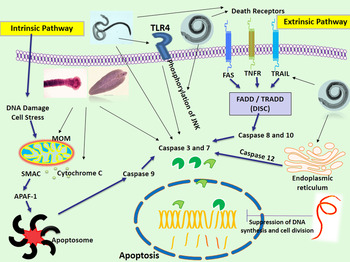
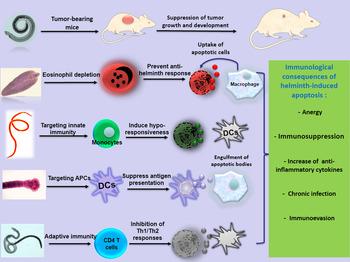
To prolong their longevity within their hosts, these worms need to manipulate the lifespan of host immune cells. The main pathways of apoptosis in mammalian cells along with the potential helminth-associated intervention are illustrated (Fig. 1). In addition, the process of apoptosis induces an anti-inflammatory environment along with induction of an anergic state in APCs (Fig. 2). In fact, uptake of apoptotic cells by the engagement of scavenger receptors on APCs has been found to inhibit antigen presentation, production of pro-inflammatory mediators and priming adaptive immunity via the release of anti-inflammatory cytokines including TGFβ and IL-10 from APCs (Voll et al. Reference Voll, Herrmann, Roth, Stach, Kalden and Girkontaite1997; Fadok et al. Reference Fadok, Bratton, Konowal, Freed, Westcott and Henson1998; Albert, Reference Albert2004).
An overview of the potential mechanisms of helminth-induced apoptosis. The major molecules involved in apoptosis have been illustrated and two main pathways indicated by bold arrows. The extrinsic pathway is triggered by stimulation of death receptor and mediated by the formation of DISC, which is responsible for caspases 8 and 10 activation, while the intrinsic pathway typically mediated by mitochondria upon membrane depolarization via DNA damage and cellular stress. In this pathway, mitochondria play a pivotal role in the orchestration of signalling cascade in the cytosol. Helminths can target various molecules and pathways involving in apoptosis. They are able to activate both extrinsic and intrinsic pathways directly or indirectly. For example, some of them stimulate mitochondria to release cytochrome c and SMAC leading to the formation of apoptosome and activation of caspase 3. On the other hand, some worms can elicit extrinsic pathway through stimulating death receptors and intracellular molecules resulting in DISC formation and caspase 3 activation. Interestingly, caspase 3 can also be activated through ER-mediated pathway during trichinellosis. In addition, DNA synthesis might be suppressed by Onchocerca volvulus as a potential mechanism to prevent and cell division. DISC, death-inducing signal complex; ER, endoplasmic reticulum; SMAC, second mitochondria-derived activator of caspases.

A schematic illustration of direct and indirect effects of helminths and their products on host immune cells. As shown here, apoptosis occurs in various immune cells during infection with helminths. Helminth-induced apoptosis plays an essential role in parasite survival not only through suppression of anti-parasite immunity, but also via inhibition of immune-mediated tissue injury. Phagocytosis of apoptotic cells provides an immunoregulatory environment due to the release of anti-inflammatory mediators such as TGFβ and IL-10 from APCs. On top of that, induction of apoptosis in certain immune cells such as CD4+ T cells and APCs results in hyporesponsiveness and anergy. Importantly, depletion of host immune cells paves the way to set up a chronic infection thereby guarantee transmission between various hosts. On the other hand, apoptotic functions of some helminths and their products have received a great of interest to exploit them for fighting against cancers. Although promising results have been provided in most in vitro studies, more in vivo models should be conducted to address the anti-tumour activity of helminth-derived compounds. APCs, antigen presenting cells.

POTENTIAL THERAPEUTIC APPLICATIONS
One of the new emerging oncotherapeutic investigations is exploiting helminths and their products as an effective agent in priming apoptosis in cancer cells. Several in vitro and in vivo studies have conducted to display anti-cancer activity of helminth-derived biomolecules via triggering apoptosis pathway, which has been indicated in the following.
Inhibitory effects of S. mansoni-derived molecules on the cell proliferation show that this worm is masterful in the manipulation of cell cycle checkpoints to facilitate apoptosis process (Yang et al. Reference Yang, Sun, Shen, Yu, Liang, Zheng and Wu2013). Exposure of murine myeloid leukaemia WEHI-3B JCS cells to a recombinant protein of the worm (rSj16) provided interesting findings on the mechanisms by which rSj16 suppresses proliferation of these cells (Yang et al. Reference Yang, Sun, Shen, Yu, Liang, Zheng and Wu2013). This in vitro study showed that rSj16 not only inhibits the growth of the cells via suppressing G0/G1 phase, but also promotes apoptosis through targeting mitochondrial membrane potential and an increase of caspase 3, 6, and 9 activity. Interestingly, it was revealed that rSj16 is able to up-regulate pro-apoptotic Bax expression and down-regulate anti-apoptotic Bcl-2 expression (Yang et al. Reference Yang, Sun, Shen, Yu, Liang, Zheng and Wu2013).
Recently, it has been reported that T. spiralis and excretory-secretory (ES L1) molecules derived from muscle larvae have inhibitory effects on the melanoma progression and the size of the tumour in mice (Vasilev et al. Reference Vasilev, Ilic, Gruden-Movsesijan, Vasilijic, Bosic and Sofronic-Milosavljevic2015). Further in vitro assessments showed that ES L1 antigens reduce cell proliferation and longevity of B16 melanoma cells through the increase of apoptosis. The main mechanism by which ESL1 suppresses cell proliferation is activation of the outer caspase-dependent apoptotic pathway. In support of this, treatment of melanoma cells with caspase-3 and -8 inhibitors prevented the apoptotic effects of ES L1, indicating death receptor is involved in ES L1-mediated apoptosis (Vasilev et al. Reference Vasilev, Ilic, Gruden-Movsesijan, Vasilijic, Bosic and Sofronic-Milosavljevic2015).
Furthermore, T. spiralis can forestall the development and metastasis of melanoma tumour through modulation of cytokine profile in infected mice (Kang et al. Reference Kang, Jo, Cho, Yu, Leem, Song, Ock and Cha2013). Results derived from cytokine array showed that infection with T. spiralis in tumour-bearing mice results in up-regulation of CXCL9, CXCL10 and CXCL13 in comparison with un-infected mice (Kang et al. Reference Kang, Jo, Cho, Yu, Leem, Song, Ock and Cha2013). However, no explanation has been provided concerning the possible chemokine-related mechanisms through which T. spiralis suppress tumour progress. Prospectively, the apoptosis-associated factors and their relevance with a decrease of tumour growth and metastasis need to be evaluated (Kang et al. Reference Kang, Jo, Cho, Yu, Leem, Song, Ock and Cha2013).
The apoptotic effects of T. spiralis have widely been investigated in cancerous cell lines and tumour-bearing mouse models. In this regard, Wang et al. have provided interesting findings on the apoptotic functions of this worm both in vitro and in vivo (Wang et al. Reference Wang, Fu, Yang, Wu, Cui, Liu, Zhao, Yu, Liu, Deng, Chen and Liu2009, Reference Wang, Liu, Sun, Liu, Yu, Wang, Chu, Rosenthal, Shi, Boireau, Wang, Zhao and Wu2013). Anti-tumour activity of crude T. spiralis extract on five different cell lines including murine forestomach carcinoma (cell line MFC), ascetic hepatoma (cell line H22) and sarcoma (cell line S180), human chronic myeloid leukaemia (cell line K562) and hepatoma (cell line H7402) has been documented. In addition, further experiments were shown that infection of mice with viable T. spiralis larvae can reduce the development of murine tumours such as murine forestomach carcinoma, ascetic hepatoma and sarcoma (Wang et al. Reference Wang, Fu, Yang, Wu, Cui, Liu, Zhao, Yu, Liu, Deng, Chen and Liu2009). The apoptotic activity of T. spiralis antigens was also demonstrated by the construction of a recombinant protein (A200711) from the cDNA library of the worm in T7 phage display. Exposure of human hepatoma cell line (H7402) to A200711 resulted in apoptosis and inhibition of cell proliferation (Wang et al. Reference Wang, Liu, Sun, Liu, Yu, Wang, Chu, Rosenthal, Shi, Boireau, Wang, Zhao and Wu2013).
However, there are some helminth species such as Opisthorchis viverrini, Clonorchis sinensis and Schistosoma haematobium, which are able to induce cholangiocarcinoma and urinary bladder carcinoma, in affected tissues including bile ducts and urinary bladder, respectively. Various factors can participate in the carcinogenesis of these helminths. Induction of chronic inflammation due to the release of eggs and other helminth-associated secretory products results in production of free radicals such as ROS and reactive nitrogen species, which eventually cause DNA damage (Brindley et al. Reference Brindley, da Costa and Sripa2015). Precisely, it has been revealed that the level of carcinogenic metabolites such as catechol estrogens and oxysterols, which are capable of affecting DNA is increased in patients suffering from opisthorchiasis and urogenital schistosomiasis (Jusakul et al. Reference Jusakul, Loilome, Namwat, Haigh, Kuver, Dechakhamphu, Sukontawarin, Pinlaor, Lee and Yongvanit2012; Gouveia et al. Reference Gouveia, Santos, Brindley, Rinaldi, Lopes, Santos, da Costa and Vale2015). Furthermore, other factors are at play, such as N-nitroso compound formation by parasites, which is able to accelerate neoplastic transformation and DNA mutagenesis (Ohshima et al. Reference Ohshima, Bandaletova, Brouet, Bartsch, Kirby, Ogunbiyi, Vatanasapt and Pipitgool1994). Thus, the genotoxicity of these helminths is likely due to the presence of such carcinigenic metabolites and production of ROS that are augmented around the inflammation resulting in DNA damage.
One of the hallmarks of allergic asthma is severe eosinophilia in the airway lumen, which is responsible for many clinical manifestations of this disease. It has been documented that recruited eosinophils possess an unusual lifespan and reside around the bronchial wall for a long time even in the absence of allergen exposure (Felton et al. Reference Felton, Lucas, Rossi and Dransfield2014). Thus, apoptosis appears to be an essential event affecting the resolution of eosinophil-associated airway inflammation.
It has been indicated that newly excysted metacercariae of Paragonimus westermani (PwNEM), a lung fluke worm, is able to release excretory-secreted products (ESP) that induce apoptosis in human eosinophils (Min et al. Reference Min, Lee, Ryu, Ahn, Chung, Sim and Shin2004). In fact, in vitro co-culture of human eosinophils with ESP caused phosphatidylserine (PS) externalization on the outer surface of eosinophils along with caspase3 activation, leading to parasite evasion and suppression of eosinophil-mediated local inflammation (Min et al. Reference Min, Lee, Ryu, Ahn, Chung, Sim and Shin2004).
However, it is well known that some helminth-derived products have significant apoptotic effects on eosinophils (Min et al. Reference Min, Lee, Ryu, Ahn, Chung, Sim and Shin2004; O'Connell and Nutman, Reference O'Connell and Nutman2015; Huang and Appleton, Reference Huang and Appleton2016), but no proof still exists concerning the helminth-mediated suppression of allergic asthma via eosinophil apoptosis. Thus, in the future studies, it would be of interest to seek whether exploiting such natural biomolecules may represent a significant step forward against asthma, as well as other eosinophil-mediated disorders.
Concluding remarks and future directions
Apart from apoptosis, several other mechanisms have been recognized thereby helminths arrest immunity and prolong their infections including an increase of immunoregulatory cells (Maizels and McSorley, Reference Maizels and McSorley2016), inhibition of Th1 or Th2 responses (Obieglo et al. Reference Obieglo, Feng, Bollampalli, Dellacasa-Lindberg, Classon, Osterblad, Helmby, Hewitson, Maizels, Gigliotti Rothfuchs and Nylen2016; Valanparambil et al. Reference Valanparambil, Tam, Jardim, Geary and Stevenson2017) and targeting pattern recognition receptors, especially TLRs (Zakeri et al. Reference Zakeri, Borji and Haghparast2016).
So far, helminth-induced activation of apoptotic pathways has only been partially studied and the molecular entities orchestrating these pathways during an acute and chronic infection remain to be elucidated. Thus, our understanding of the precise mechanisms involved in helminth-induced apoptosis and their significance clearly lags. Recognition of main worm-derived compound involved in host cell death not only can be useful for future researches making a profound understanding of worm–host interaction and anti-parasite response, but also offers novel potential therapeutics against life-threatening diseases such as cancer. However, it requires more in vivo and preclinical studies to examine its feasibility and applicability in a real situation. The main question that principally needs to be addressed is whether the immune system is suppressed during anti-tumour activity of helminths or not.
With exploiting omics-based technologies such as proteomics and genomics considerable progress being made to identify the main helminth-derived compounds and characterize the profile of released exosomes responsible for anergy induction and hyporesponsiveness in host immune cells via targeting apoptosis pathway.
An interesting issue that needs to be addressed is whether neutralizing the main pathways and death receptors by which helminths exert immune cell death will be helpful to elevate the potency of early immune responses and combat helminth infections. Here just the molecular process of helminth-induced apoptosis as a less-known modality of their pathogenicity has been discussed. It is also quite unknown whether other forms of cell death, except apoptosis, including necrosis, autophagy and pyroptosis can be exerted by helminths to create an immune privilege area around them. Of note, it should be taken into account that it is not always possible to distinguish activation-induced cell death driven by strong immune activation, from apoptosis actively being driven by the parasite in an attempt to directly dampen immune reactivity. Thus, in many of the papers published over the years the authors have used the word ‘apoptosis’ when they have really not distinguished between apoptosis, necrosis or indeed pyroptosis.
Generally, induction of apoptosis is not restricted to helminths, it contributes to the pathogenesis of many parasitic infections as an effective tool to dampen host immunity and ensure survival. For example, several protozoan-mediated infections including toxoplasmosis, leishmaniasis and malaria exploit apoptosis to conceal their infection through the sophisticated mechanisms. Collectively, these findings provide evidence for such an orphan aspect of host–parasite interplay, which is subject to bypass host immunity by the parasitic worms. It appears to be attractive in terms of parasite longevity, immunosuppression and evasion with implications beyond parasitology.
ACKNOWLEDGEMENTS
The author is heartedly grateful to Professor Rick Maizels (Wellcome Centre for Molecular Parasitology, Institute of Infection, Immunity and Inflammation, University of Glasgow, UK) for critical and insightful comments, careful review and editing the manuscript.
FINANCIAL SUPPORT
This research received no specific grant from any funding agency, commercial or not-for-profit sectors.