Introduction
The family Pleurotomariidae Swainson, Reference Swainson1840 is a moderately large clade of marine gastropods (24 genera) that ranges from the Middle Triassic onwards (Begg and Grant-Mackie, Reference Begg and Grant-Mackie2003; Harasewych and Kiel, Reference Harasewych and Kiel2007; Pieroni and Nützel, Reference Pieroni and Nuetzel2014; Monari et al., Reference Monari, Gatto and Valentini2018; Szabo et al., Reference Szabo, Conti, Monari and Wendt2019). This is the only family within the superfamily Pleurotomarioidea Swainson, Reference Swainson1840 that survived the end-Cretaceous mass extinction (Harasewych, Reference Harasewych2002). The family is characterized by a conispirally coiled shell having a trochiform shape with a remarkable emargination or slit along its outer lip that produces a selenizone. The body plan of the pleurotomariids is constrained by the occurrence of homeomorphism with regard to several morphological attributes (e.g., gross shell form, surface ornamentation, presence/absence of umbilicus, and nature and position of selenizone). The recurrence of these attributes with time may reflect strong selective pressure as well as evolutionary limitations in shell geometry (Das, Reference Das2002). As a result, this particular group of gastropods has generated considerable scientific interests for decades (e.g., Goldfuss, Reference Goldfuss1841–1844; Eudes-Deslongchamps, Reference Eudes-Deslongchamps1849; d’Orbigny, Reference d'Orbigny1850; Huddlestone, Reference Huddlestone1887–1896; Hickman, Reference Hickman1976, Reference Hickman1984, Reference Hickman, Beesley, Ross and Wells1998; Szabo, Reference Szabo1980; Fischer and Weber, Reference Fischer, Weber and Fischer1997; Harasewych et al., Reference Harasewych, Adamkewicz, Blake, Saudek, Spriggs and Bult1997; Jaitley et al., Reference Jaitly, Szabo and Fürsich2000; Das, Reference Das2002; Harasewych and Kiel, Reference Harasewych and Kiel2007).
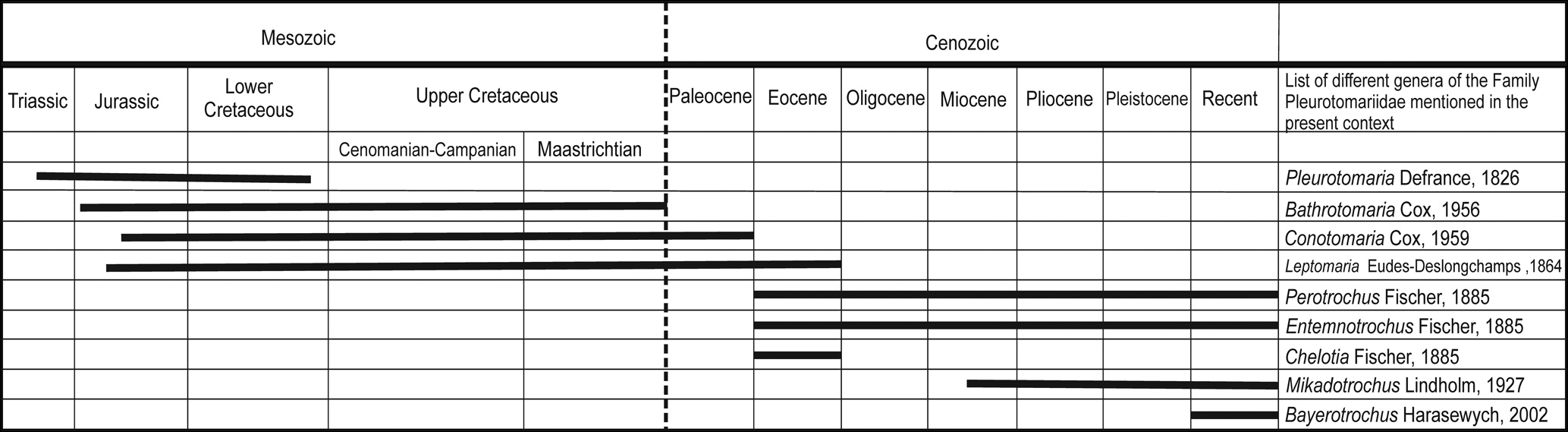
Pleurotomariids, after their origin in the Middle Triassic, became biogeographically widespread, proliferated quite rapidly in diversity, and reached their acme during the Middle Jurassic (~11 genera reported; Harasewych and Kiel, Reference Harasewych and Kiel2007, p. 78, fig. 3; Szabo et al., Reference Szabo, Conti, Monari and Wendt2019). However, during the Cretaceous, diversity gradually decreased and only three genera remained in the Maastrichtian—Bathrotomaria Cox, Reference Cox1956; Leptomaria Eudes-Deslongchamps, Reference Eudes-Deslongchamps1864; and Conotomaria Cox, Reference Cox1959 (Harasewych and Kiel, Reference Harasewych and Kiel2007). However, while Leptomaria and Conotomaria survived the K-Pg mass extinction, Bathrotomaria succumbed (Harasewych and Kiel, Reference Harasewych and Kiel2007) (Fig. 1). This diversity decline in the Cretaceous happened at all taxonomic levels, hence Cenozoic fossil pleurotomariids are rare. In addition to that, the habitat shift to deeper water and rocky substrate in submarine volcanic settings certainly contributes to their scarce in Cenozoic fossil record (Hickman, Reference Hickman1976).
Temporal ranges (time units not up to scale) of pleurotomariid genera mentioned in the present context (adopted from Harasewych and Kiel, Reference Harasewych and Kiel2007). The dotted line represents the K-Pg boundary. The figure portrays the temporal range of the genus Pleurotomaria as ranging up to the Lower Cretaceous whereas only two genera have crossed the K-Pg boundary, i.e., Leptomaria and Conotomaria.

Mesozoic pleurotomariids were part of shallow marine faunas, whereas extant pleurotomariids are found in deeper waters (i.e., in the bathayal zone), with depths ranging from 100–1000 m (Yonge, Reference Yonge1973; Harasewych, Reference Harasewych2002). The bathymetric distribution of pleurotomariids during the Cenozoic still remains uncertain, and several workers have given varied opinions of their distribution. Hickman (Reference Hickman1976) and Das (Reference Das2002) emphasized that the bathymetric distribution shift occurred at the transition from the Mesozoic to the Cenozoic. However, several Oligocene and Miocene pleurotomariids were reported from shallow marine deposits (Kase and Katayama, Reference Kase and Katayama1981; Tomida and Sako, Reference Tomida and Sako2016). Kanno (Reference Kanno1961) suggested that juveniles preferred shallow waters and migrated to a deep-sea habitat after maturing to adults.
Pioneering studies on Cenozoic pleurotomariids were performed by Fischer (Reference Fischer1885), who proposed three genera—Perotrochus, Entemnotrochus, and Chelotia. Later, Lindholm (Reference Lindholm1927) described another new genus, Mikadotrochus. Kuroda (Reference Kuroda1955) was the first to express the need to discriminate the Cenozoic pleurotomariids from those that occurred during the Mesozoic. He concluded that Perotrochus, Entemnotrochus, and Mikadotrochus are the only extant genera strictly occurring in the Cenozoic (Lin, Reference Lin1975). Later, a new extant genus, Bayerotrochus, was introduced by Harasewych (Reference Harasewych2002), which was earlier informally classified as Perotrochus Group B by Bayer (Reference Bayer1965). Among the three extinct genera, Chelotia is restricted to the Cenozoic, whereas Leptomaria and Conotomaria crossed the K-Pg boundary. These are the seven genera that have been so far reported from the Cenozoic rocks (Fig. 1).
There are numerous reports of pleurotomariid gastropods from India, with ~40 species recorded from the Mesozoic of western India, especially from the Jurassic and the Cretaceous of Kutch (Jaitley et al., Reference Jaitly, Szabo and Fürsich2000; Das, Reference Das2002; Das et al., Reference Das, Bardhan and Kase2005). However, reports of Cenozoic pleurotomariid gastropods from the Indian sub-continent are very rare. Entemnotrochus bianconii (d’Archiac and Haime, Reference d'Archiac and Haime1854) from the Eocene of Kutch, Sindh, and Baluchistan (western India) was reported by d'Archiac and Haime (Reference d'Archiac and Haime1854). Pleurotomaria sp. from the Miocene of Meghalaya (North-East India) was mentioned, but a systematic description was not provided by Lyngdoh et al. (Reference Lyngdoh, Tiwari and Kachhara1999). Apart from that, only one extant species, Bayerotrochus indicus (Anseeuw, Reference Anseeuw1999), was reported from the vicinity of the Bay of Bengal and Andaman Sea.
Although there is a plethora of work on fossil and extant pleurotomariids from different regions of the world (e.g., Kellum, Reference Kellum1926; Hickman, Reference Hickman1976; Szabo, Reference Szabo1980; Harasewych and Kiel, Reference Harasewych and Kiel2007), the taxonomic classification of this group, especially of the fossil pleurotomariids, remained ambiguous during the past two centuries. The existing classification schemes (Knight et al., Reference Knight, Cox, Keen, Batten, Yochelson, Robertson and Moore1960; Szabo, Reference Szabo1980) have numerous limitations and remain inadequate for classifying fossil pleurotomariids, and thus requires further detailing. The taxonomy and phylogenetic relationships of the extant genera, on the other hand, are very well known, based on molecular data and soft part morphology (which includes a highly specialized radula) (Hickman, Reference Hickman1976; Harasewych et al., Reference Harasewych, Adamkewicz, Blake, Saudek, Spriggs and Bult1997; Das, Reference Das2002; Harasewych, Reference Harasewych2002). The major cause of conflicting classification schemes of fossil pleurotomariids lies in the fact that these classifications are mostly based on a few simple morphological characters (e.g., shell shape; position and width of the selenizone; the presence or absence of an umbilicus). Several authors included both Mesozoic and Cenozoic species in the genus Pleurotomaria Defrance, Reference Defrance1826, and thus regarded this genus as a ‘living fossil’ (see Hickman, Reference Hickman1976). However, significant morphological differences exist between Mesozoic and Cenozoic taxa initially placed in Pleurotomaria, and as a result, these taxa were assigned to several genera and subgenera (Fischer, Reference Fischer1885; Szabo, Reference Szabo1980; see Das, Reference Das2002). Pleurotomaria sensu stricto has noded ornamentation as a diagnostic character, which is altogether lacking in the Cenozoic taxa (see Hickman, Reference Hickman1976). Also, Pleurotomaria sensu stricto is regarded as a Mesozoic genus with a stratigraphic range from the Lower Jurassic to the Lower Cretaceous by Knight et al. (Reference Knight, Cox, Keen, Batten, Yochelson, Robertson and Moore1960) (Fig. 1). Thus, Hickman (Reference Hickman1976, Reference Hickman1984) assigned all the Cenozoic ‘Pleurotomaria’ under Pleurotomaria sensu lato in a provisional sense and considered Pleurotomaria as a living fossil. Later, Das (Reference Das2002) re-evaluated Pleurotomaria as a Mesozoic genus and disqualified its status as a ‘living fossil’ as well as its existence as a Cenozoic genus. It is, therefore, essential to revise the taxonomic status of those taxa assigned to Cenozoic ‘Pleurotomaria’ s. l. and re-assign them to the seven strictly Cenozoic genera.
Herein, we report four species, of pleurotomariid gastropods from western India—three from the Oligocene of the Kutch Basin, and one from the Miocene of the Dwarka Basin. Two of these described species are new. We also provide a literature review of all the previously described Cenozoic pleurotomariids and propose a new classification scheme for this taxonomic group. We have used all conventional characters, mostly adopted from Knight et al. (Reference Knight, Cox, Keen, Batten, Yochelson, Robertson and Moore1960), Szabo (Reference Szabo1980), and Harasewych and Kiel (Reference Harasewych and Kiel2007), as well as several new characters (supported by multivariate analyses). Applying this scheme, Mesozoic pleurotomariids can readily be distinguish from the Cenozoic forms.
Geological setting
Stratigraphic information
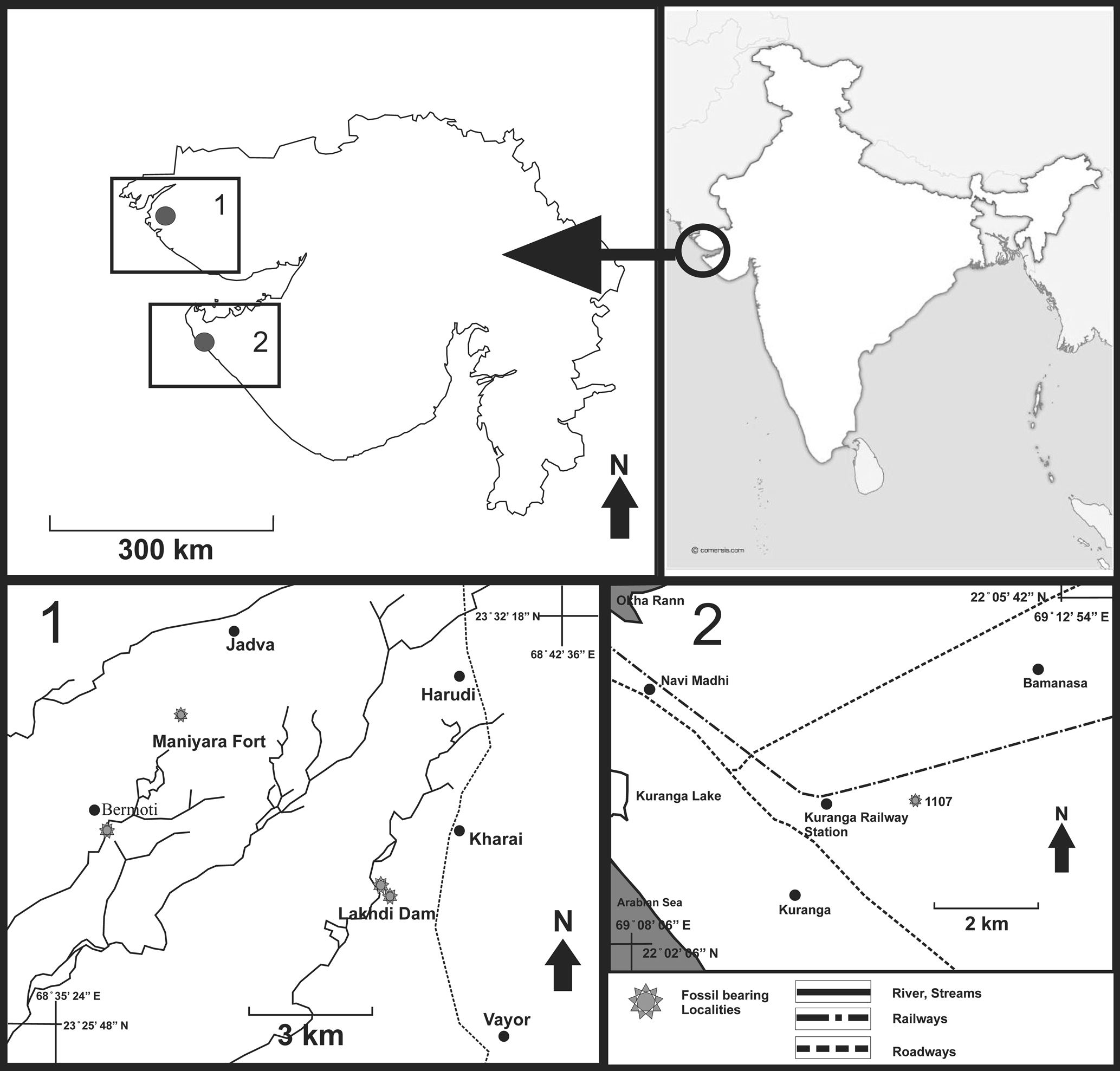
The Cenozoic beds of western India are known for their rich and diverse heritage of marine faunas (Biswas, Reference Biswas1992; Harzhauser et al., Reference Harzhauser, Reuter, Piller, Berning, Kroh and Mandic2009; Kulkarni et al., Reference Kulkarni, Kapoor and Borkar2010; Jain, Reference Jain2014). The specimens upon which this study is based were collected from different localities in the Kutch and Devbhumi Dwarka districts of Gujarat, western India (Fig. 2).
(1, 2) Geographic location of (1) Kutch, and (2) Devbhumi Dwarka districts of Gujarat, India, as shown in the upper panels; inset figure (1) shows fossil-bearing localities in the Kutch Basin; inset figure (2) shows fossil-bearing localities in the Dwarka Basin.

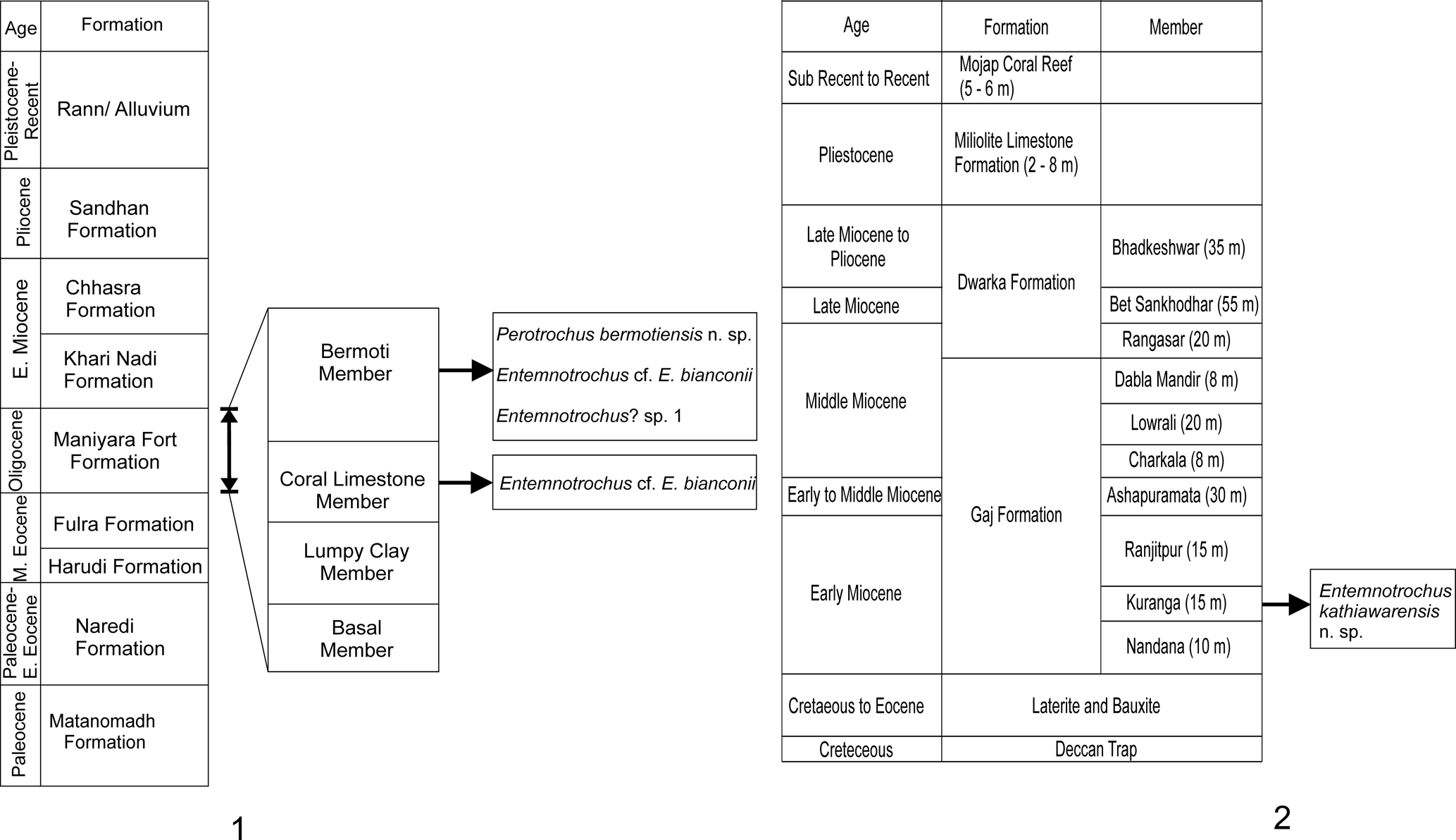
The Cenozoic strata of the Kutch Basin are divided into the Matanomadh, Naredi, Harudi, Fulra, Maniyara Fort, Khari Nadi, Chhasra, and Sandhan formations, in stratigraphic order (Biswas, Reference Biswas1992) (Fig. 3.1). The Oligocene stage is represented by the Maniyara Fort Formation, which consists of well-bedded, yellow to ochre foraminiferal limestone, with a basal grayish green glauconitic siltstone overlying the middle Eocene Fulra Formation (Biswas, Reference Biswas1992; Catuneanu and Dave, Reference Catuneanu and Dave2017). The type section of this formation is well exposed along the Bermoti Stream and the Maniyara Fort (Biswas, Reference Biswas1992). The formation is subdivided into four members, the Basal Member, the Lumpy Clay Member, the Coral Limestone Member, and the Bermoti Member, in stratigraphic order. The lower three members were deposited during the early Oligocene (Rupelian), while the Bermoti Member is late Oligocene (Chattian) in age (Biswas, Reference Biswas1992; Catuneanu and Dave, Reference Catuneanu and Dave2017). Fossils for the present study were collected from the Coral Limestone Member and the Bermoti Member. The Coral Limestone Member comprises beds of white nodular limestone alternating with calcareous claystone in its lower part, while the upper part consists of white massive limestones with abundant corals. The upper Bermoti Member is composed of thinly bedded yellow foraminiferal limestone with interbeds of silty marlite. An overall marginal marine to shallow inner shelf environment has been suggested for the Maniyara Fort Formation. The sediments were deposited during a transgressive interval in the Oligocene, with a gradual shift from a restricted lagoonal to a high energy, open shelf environment, which facilitated the formation of coral bioherms (Catuneanu and Dave, Reference Catuneanu and Dave2017).
(1, 2) Lithostratigraphic tables of the Cenozoic succession of the Kutch Basin (1) (after Biswas, Reference Biswas1992) and the Dwarka Basin (2) (after Jain, Reference Jain2014) showing the pleurotomariid-bearing horizons.

The Dwarka Basin, situated at the western fringe of the Kathiawar Peninsula, is a peri-cratonic shelf basin, and filled with an extensive succession of marine sediments. The succession is subdivided into three formations—the Gaj, Dwarka, and Miliolite Limestone formations, in stratigraphic order—ranging from the early Miocene to Holocene and overlying unconformably on the Deccan Traps and laterite (Jain, Reference Jain2014). A single pleurotomariid specimen from the Kuranga Member of the Gaj Formation is reported in the present study. The Gaj Formation is early–middle Miocene in age and is subdivided into seven members (Fig. 3.2). The Kuranga Member is early Miocene (Burdigalian) in age. It is 15 m thick and comprises alternations of marly limestone, white calcareous clays, and ash gray clays. The main fossiliferous unit of the Kuranga Member that hosted the pleurotomariid specimen is a coralline limestone that was deposited in a shallow marine, inner shelf environment. The Kuranga Member is well exposed in and around the Kuranga village and Kuranga railway station (22°03′35.7″N, 69°11′17″E) (Jain, Reference Jain2014).
Materials and methods
Revision of Cenozoic Pleurotomaria sensu lato
Several workers have attempted to compile lists of all the pleurotomariid species reported from the Cenozoic (e.g., Pritchard, Reference Pritchard1903; Malaroda, Reference Malaroda1950; Palmer and Brann, Reference Palmer and Brann1966; Hickman, Reference Hickman1976; Pacaud, Reference Pacaud2004). For the present study, we have compiled and tabulated data encompassing all the previously reported Cenozoic pleurotomariid species (see Appendix 1). The new species reported in the present paper have been added to the data.
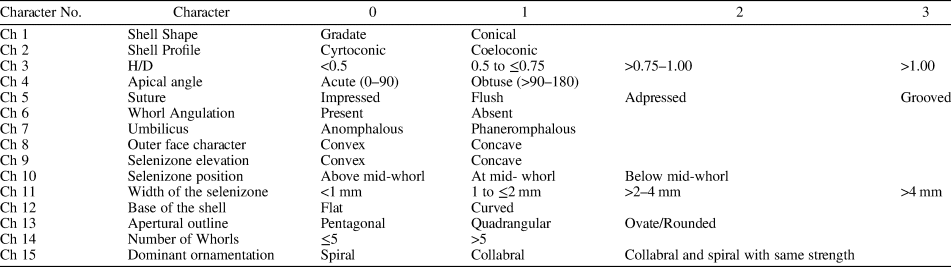
All Cenozoic pleurotomariid genera have broad similarities, for example in overall shell shape (Character [Ch.] 1), which is conical, but they differ in several characters and each genus has its distinctive character combination. To show this, we have compiled a character data matrix for generic discrimination. Additional characters included in the character matrix and thereafter used for classification are (Table 1): shell profile (Ch. 2); Height/Diameter (H/D) ratio (Ch. 3); apical angle (Ch. 4); type of suture (Ch. 5); whorl angulation (Ch. 6); the presence of an umbilicus (Ch. 7); outer whorl face shape (Ch. 8); selenizone elevation (Ch. 9); selenizone position (Ch. 10); width of the selenizone (Ch. 11); shape of the base of the shell (Ch. 12); apertural outline (Ch. 13); number of whorls (Ch. 14); and dominant ornamentation (Ch. 15). The character matrix was constructed based on 81 different Cenozoic pleurotomariid species for which detailed descriptions were readily available from the literature (Supplementary Table 1). These characters have been tested individually to see whether they can used to distinguish genera from each other. However, considering the large overlap in characters among different genera, the character data matrix (Supplementary Table 1) has been subjected to multivariate analysis using non-metric multi-dimensional scaling (nMDS) plotting using Euclidian distance (k = 2) to achieve optimal clustering of different genera. Even though the nMDS plot provides a better clustering of the data, it does not provide the loading of the characters essential for generic discrimination. Thus, Principal Component Analysis (PCA) is used to establish the loadings of different characters essential for the generic discrimination.
Different morphological characters with character states used for constructing character matrix data set. Character state numbers are 0, 1, 2, and 3.

Based on the multivariate (nMDS and PCA) analyses, we propose a classification scheme for Cenozoic pleurotomariids that is based on those morphological characters that incorporate the maximum variation among the genera. The genera that show significant overlapping in the plots are distinguished based on several significant conventional morphological characters used by previous workers (mostly adopted from Knight et al., Reference Knight, Cox, Keen, Batten, Yochelson, Robertson and Moore1960 and Szabo, Reference Szabo1980). Based on the newly proposed classification scheme, Cenozoic species previously assigned to Pleurotomaria are revised and transferred to the following seven genera, which comprise all Cenozoic pleurotomariids: Leptomaria, Conotomaria, Perotrochus, Entemnotrochus, Chelotia, Mikadotrochus, and Bayerotrochus. The remaining ‘Pleurotomaria’ species, whose generic status established by the proposed classification scheme because of the lack of data on character states, are classified as Genus uncertain.
Collection of the new pleurotomariid specimens
The pleurotomariid specimens from the Kutch and Dwarka basins were collected by following the random sampling protocol (Kowalewski, Reference Kowalewski2002; Mallick et al., Reference Mallick, Bardhan, Paul, Mukherjee and Das2013). The specimens from the Maniyara Fort Formation are from two stratigraphic levels, the Coral Limestone Member and the Bermoti Member, from four different localities. The locality near Bermoti Village (23°27′45.1″N, 68°36′06.4″E) yielded eight specimens; a locality near Lakhdi Dam, 4.8 km NW of Vayor (23°27′02.2″N, 68°40′03″E) yielded two specimens; a locality in the Kharoi Village near Lakhdi Dam, 4.5 km NW of Vayor (23°26′55.5″N, 68°40′09.4″E) yielded one specimen; and a locality in the Maniyara Fort near Bermoti Village (23°29′15″N, 68°37′10″E) yielded only one specimen (Fig. 2.1). Only one specimen was collected from 200 m east from Kuranga Railway Station (22°03′35.7″N, 69°11′17″E), which belongs to the Kuranga Member of the Gaj Formation (Fig. 2.2). The specimens were coated with MgO before photography.
Repository and institutional abbreviations
All specimens are archived in the museum of Geological Studies Unit, Indian Statistical Institute, Kolkata, India. Specimens are numbered following the institutional abbreviation: ISI/dwk/Pleu/19 and Mani/17/Pleu. ISI = Indian Statistical Institute; dwk = Dwarka; Pleu = Pleurotomariidae; Mani = Maniyara Fort Formation.
Results
The Cenozoic pleurotomariid database
The database comprises a total of 149 species of Cenozoic Pleurotomariidae assigned to the following eight genera in the literature: Leptomaria: 14 species; Conotomaria: 5 species; Perotrochus: 34 species; Entemnotrochus: 17 species; Chelotia: 4 species; Mikadotrochus: 9 species; Bayerotrochus: 14 species; and lastly Pleurotomaria: 52 species.
Revision of Cenozoic ‘Pleurotomaria’
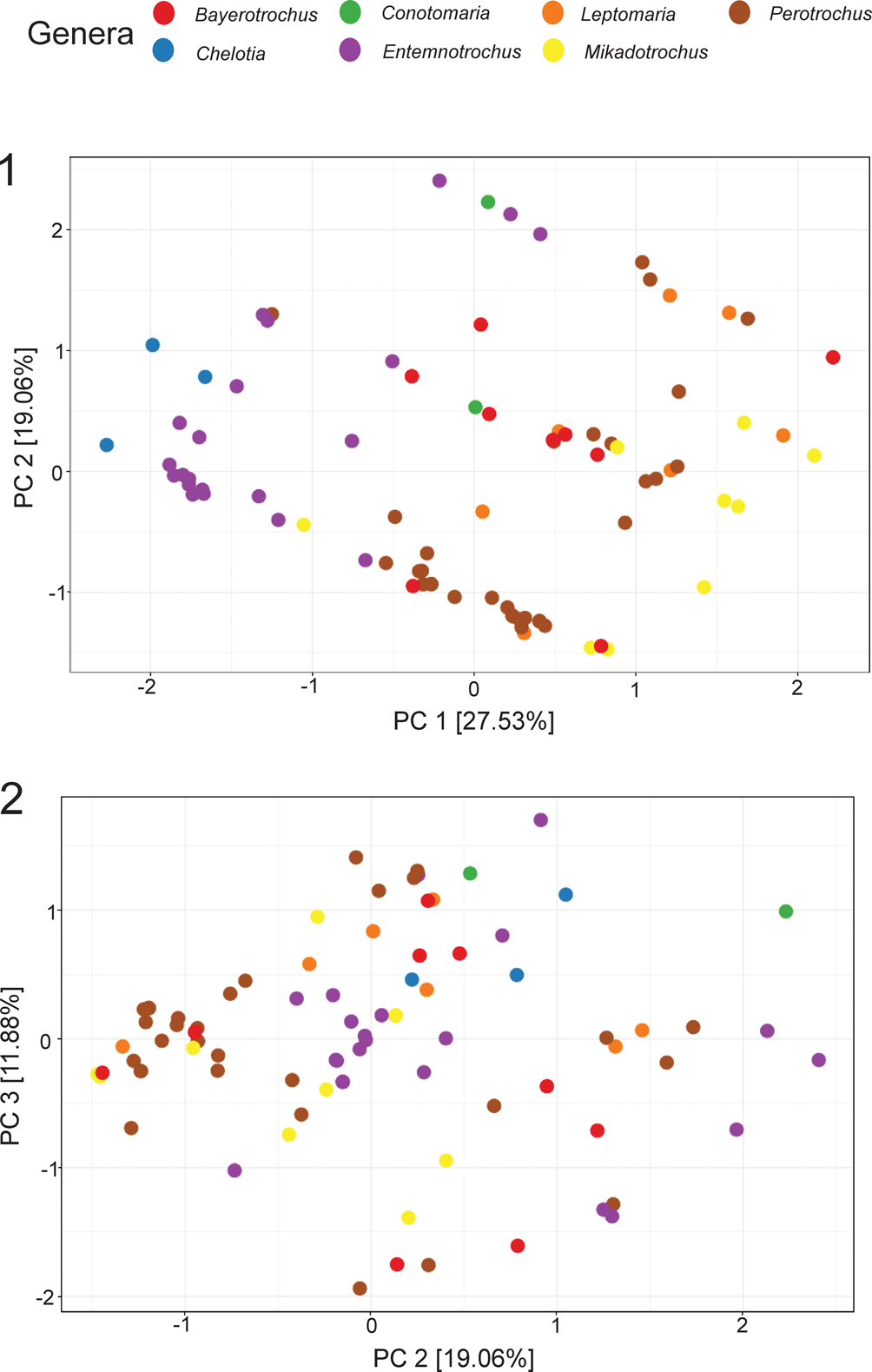
The nMDS 3D plot using Euclidean distance has a stress value of 0.26, which is very poor for getting separate clusters for different genera (Supplementary Fig. 1). Consequently, most of the ranges of the genera are overlapping, although the plot demarcates three poorly defined clusters, referring to Entemnotrochus, Perotrochus, and Mikadotrochus. Of the remaining genera, Bayerotrochus and Leptomaria show significant overlaps with Perotrochus and Mikadotrochus, whereas, Chelotia and Conotomaria occupy isolated areas in the plot. It should be noted that the latter two genera are represented by very few data points. Therefore, their positions in the morphospace are less reliable and may be subject to sampling bias.
The PCA plots show a similar picture. The first three PC axes account for 58.4% of the total variation. PC 1 (explaining ~27.5% of the variation) mostly represents selenizone position (Ch. 10) (loading: 59%), width of the selenizone (Ch. 11) (loading: 51%), type of suture (Ch. 5) (loading: 42%), and the presence/absence of an umbilicus (Ch. 7) (loading: 31%). PC 2 (explaining ~19% of the variation) represents dominant ornamentation (Ch. 15) (loading: 65%) and Ch. 5 (loading: 58%), whereas PC 3 (explaining ~11.49% of the variation) represents Ch. 15 (loading: 63%), Ch. 5 (loading: 61%), Ch. 11 (loading: 28%), and Ch. 3 (H/D ratio) (loading: 26%). In the PC1/PC2 morphospace (Fig. 4.1), the genus Entemnotrochus forms a cluster in the left half of the plot, with relatively low PC 1 values, whereas the genus Mikadotrochus is clustered at the right side of the plot and has high PC1 values. This indicates that these two genera can be distinguished based on Ch. 10 and Ch. 11, followed by Ch. 7 and Ch. 5. The genus Bayerotrochus has a near-separate cluster in the upper half of the plot, while Perotrochus plots in the center, occupying a wide range, but generally below Bayerotrochus, implying that these two genera can be distinguished by Ch. 15 and Ch. 5. The genus Leptomaria has significant overlap with Perotrochus and Mikadotrochus in the PC morphospace. Chelotia is constrained to the extreme left of the PC morphospace, whereas Conotomaria overlaps with the area covered by Entemnotrochus. However, these two genera can be differentiated along the PC 1 axis. The PC2/PC3 plot (Fig. 4.2) does not show any significant clusters and thus is not useful for the generic discrimination.
(1, 2) Discrimination of pleurotomariid genera applying Principal Component Analysis (PCA) to the character matrix dataset. The plots show a similar picture to the nMDS plot, with the genera showing poor clusters. (1) PC1-PC2 morphospace; (2) PC2-PC3 morphospace.

Based on these plots, the genera Chelotia, Entemnotrochus, Perotrochus, Mikadotrochus, and Bayerotrochus can readily be distinguished by the characters Ch. 10, Ch. 11, Ch. 7, Ch. 5, and Ch. 15. However, the remaining two genera, Leptomaria and Conotomaria, show consistent overlap and thus need to be distinguished based on conventional morphological characters.
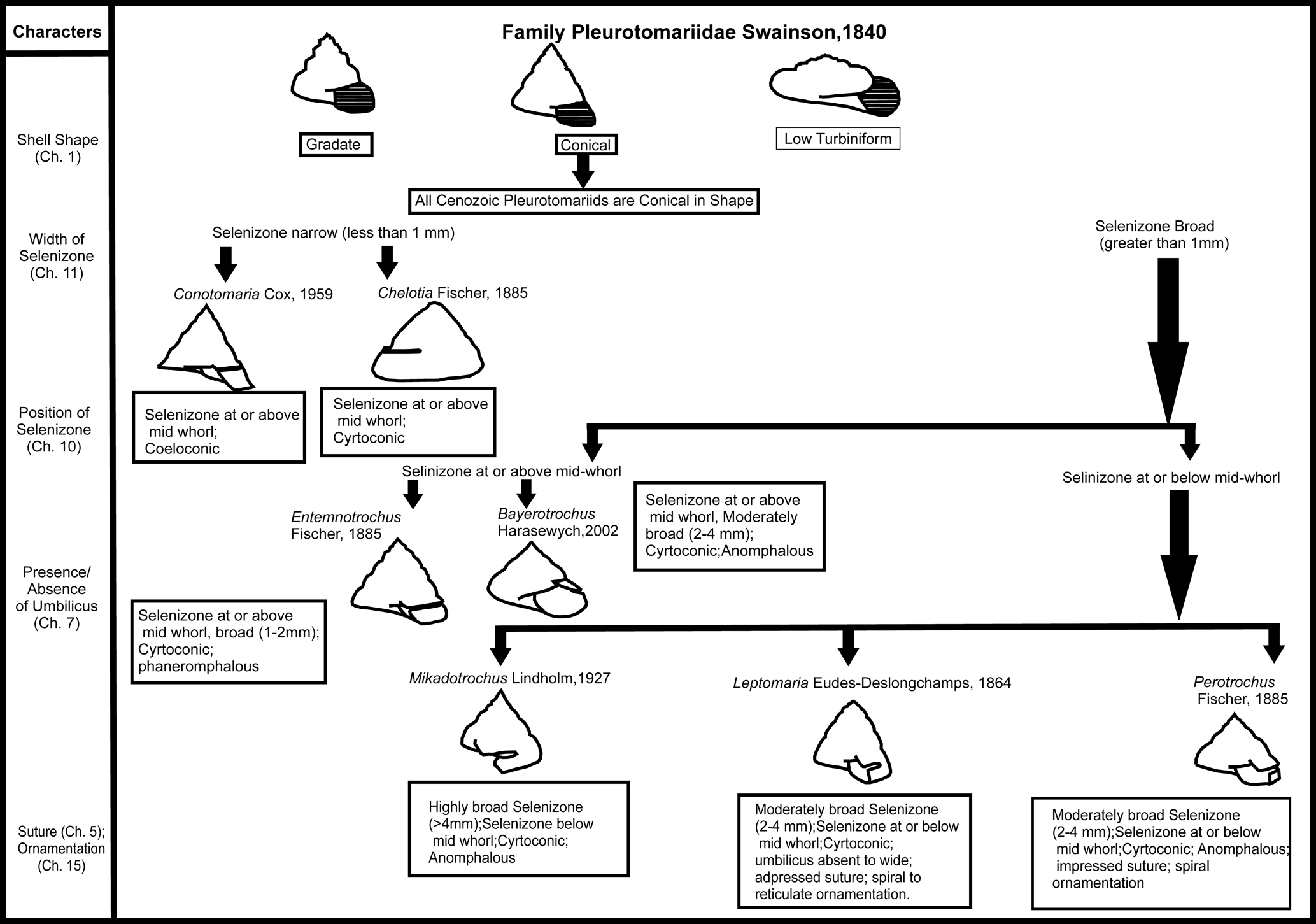
For the Cenozoic pleurotomariids, the first division in the classification scheme (Fig. 5; Supplementary Table 2) is based on the width of the selenizone (Ch. 11). Two genera, Conotomaria and Chelotia, fall in the narrow selenizone group (<1 mm). Entemnotrochus has a broad selenizone (1–2 mm), Leptomaria, Perotrochus, and Bayerotrochus have a moderately broad selenizone (2–4 mm), and Mikadotrochus has a very broad selenizone (>4 mm).
The newly proposed classification scheme for the Cenozoic pleurotomariid genera based on conventional characters (mostly adopted from Knight et al., [Reference Knight, Cox, Keen, Batten, Yochelson, Robertson and Moore1960], Szabo [Reference Szabo1980] and Harasewych and Kiel [Reference Harasewych and Kiel2007]) and several new characters supported by the multivariate analyses. For details see text.

Conotomaria and Chelotia both have a narrow selenizone, but can be readily distinguished on the basis of their shell profile (Ch. 2), which is coeloconic in the former, and cyrtoconic in the latter.
With regard to the position of the selenizone (either above or below the mid-whorl) (Ch. 10), Conotomaria, Chelotia, Entemnotrochus, and Bayerotrochus have the selenizone at or above mid-whorl, whereas the remaining genera have their selenizone at or below mid-whorl.
Entemnotrochus can be distinguished from Bayerotrochus based on the presence/absence of the umbilicus (Ch. 7), as well as the width of the selenizone. As stated earlier, Entemnotrochus is strictly phaneromphalous, whereas Bayerotrochus is anomphalous.
Leptomaria is variable with regard to the umbilicus, ranging from anomphalous to broadly phaneromphalous. However, Leptomaria is mostly characterized by an adpressed suture (Ch. 5) along with the spiral and reticulate shell ornamentation (Ch. 15). Perotrochus is strictly anomphalous along with an impressed suture and predominantly spiral ornamentation.
In addition, the length of the slit also can be considered as a distinguishing morphological character for extant genera (described in Knight et al., Reference Knight, Cox, Keen, Batten, Yochelson, Robertson and Moore1960 and Harasewych, Reference Harasewych2002). Perotrochus has a shallow slit (length of ~30° of the last whorl), followed by Mikadotrochus (<40°) and Bayerotrochus (<60°). Entemnotrochus has the longest slit, extending for ~160–180°.
Based on the proposed classification scheme, 20 species out of the 54 species previously classified as Pleurotomaria are here reassigned. Two of them are transferred to Leptomaria, one to Conotomaria, two to Chelotia, seven to Perotrochus, and eight to Entemnotrochus.
Following revision, the 149 Cenozoic pleurotomariid species belong seven genera in the Family Pleurotomariidae, and are assigned as follows: Leptomaria: 14 species; Conotomaria: six species; Chelotia: six species; Perotrochus: 41 species; Entemnotrochus: 25 species; Mikadotrochus: nine species; Bayerotrochus: 16 species. Finally, 32 species are classified as Genus uncertain, which is due to the lack of data enabling their reassignment (Appendix 1). Examination of their type material or of additional specimens may resolve their generic allocation in the future.
Discussion
The Cenozoic pleurotomariids are less diverse compared to the Mesozoic ones and are represented by only seven genera. The overall diversity declined until the late Miocene, but a sudden increase followed toward the modern fauna. The bathymetric distribution of extant species is limited to deeper water on the outermost shelf and upper continental slope. Most of the Cenozoic fossil pleurotomariids are also reported from strata representing deep marine environments (Hickman, Reference Hickman1976; Lin, Reference Lin1976; Harasewych, Reference Harasewych2002; Harasewych and Kiel, Reference Harasewych and Kiel2007). On the other hand, several fossil Cenozoic pleurotomariids (as described in Kase and Katayama, Reference Kase and Katayama1981 and Tomida and Sako, Reference Tomida and Sako2016), including our finds from the Oligocene and early Miocene of western India, have been found in shallow water (i.e., marginal marine to inner shelf settings). These observations indicate that Cenozoic pleurotomariids occurred over a greater range of water depth and contradicts the generalization that they only occur in deep water.
While successfully addressing the problems of taxonomic classifications of Cenozoic pleurotomariids, our character matrix and the multivariate analyses (nMDS and PCA plots) indicate that multiple characters are required for accurate classification. Conventional classification is preferable for a general morphology-based grouping of taxa, but not always adequate for generic distinction. In addition, there is very little morphological diversification within Cenozoic members of the family. As a consequence, previous authors assigned several Cenozoic pleurotomariid species to the genus Pleurotomaria. The classification scheme proposed in the present study reduces the chances of misidentification of Cenozoic pleurotomariids because it considers conventional morphological characters along with newly recognized morphological characters supported by multivariate statistics.
The K-Pg mass extinction was a fatal blow for both the representatives of gradate and conical genera of the Family Pleurotomariidae. The gradate forms became extinct at the boundary, whereas two genera with conical form (Leptomaria and Conotomaria) were the sole survivors (Harasewych and Kiel, Reference Harasewych and Kiel2007). Even though the pleurotomariids survived the K-Pg mass extinction, recovery of the group throughout the entire Cenozoic was very slow (Hickman, Reference Hickman1976; Das, Reference Das2002; Harasewych and Kiel, Reference Harasewych and Kiel2007). It is important to know the migration patterns of the different pleurotomariid genera throughout the Cenozoic, so that the recovery, as well as the evolutionary change of this family, can be traced. To do so, the primary requirement is to determine the global paleobiogeographic distribution of species and genera during the Cenozoic. In addition, knowledge of the global distribution of pleurotomariids during the Late Cretaceous is important, so that the impact of the K-Pg mass extinction can be determined. The lack of a Cenozoic fossil record of pleurotomariids from the Indian sub-continent has limited past researchers to find a link between the distribution areas of Atlantic and Pacific pleurotomariids. The new finds from the Oligocene and early Miocene of western India shed light on the migration pathways of two pleurotomariid genera between the Atlantic and Pacific oceans. The revision of Cenozoic Pleurotomaria results in the definition of several strictly Cenozoic genera, and the generic status of numerous pleurotomariid species is updated so that these issues can be addressed in future publications.
Systematic paleontology
Class Gastropoda Cuvier, Reference Cuvier1797
Subclass Vetigastropoda Salvini-Plawen, Reference Salvini-Plawen1980
Order Pleurotomariida Cox and Knight, Reference Cox and Knight1960
Superfamily Pleurotomarioidea Swainson, Reference Swainson1840
Family Pleurotomariidae Swainson, Reference Swainson1840
Genus Entemnotrochus Fischer, Reference Fischer1885
Type species
Entemnotrochus adansoniana (Crosse and Fischer, Reference Crosse and Fischer1861); (by original designation); Recent; Gulf of Mexico, Caribbean.
Entemnotrochus kathiawarensis new species
Figure 6
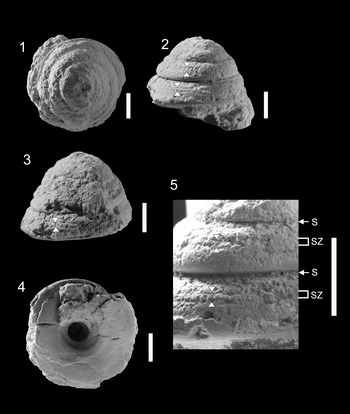
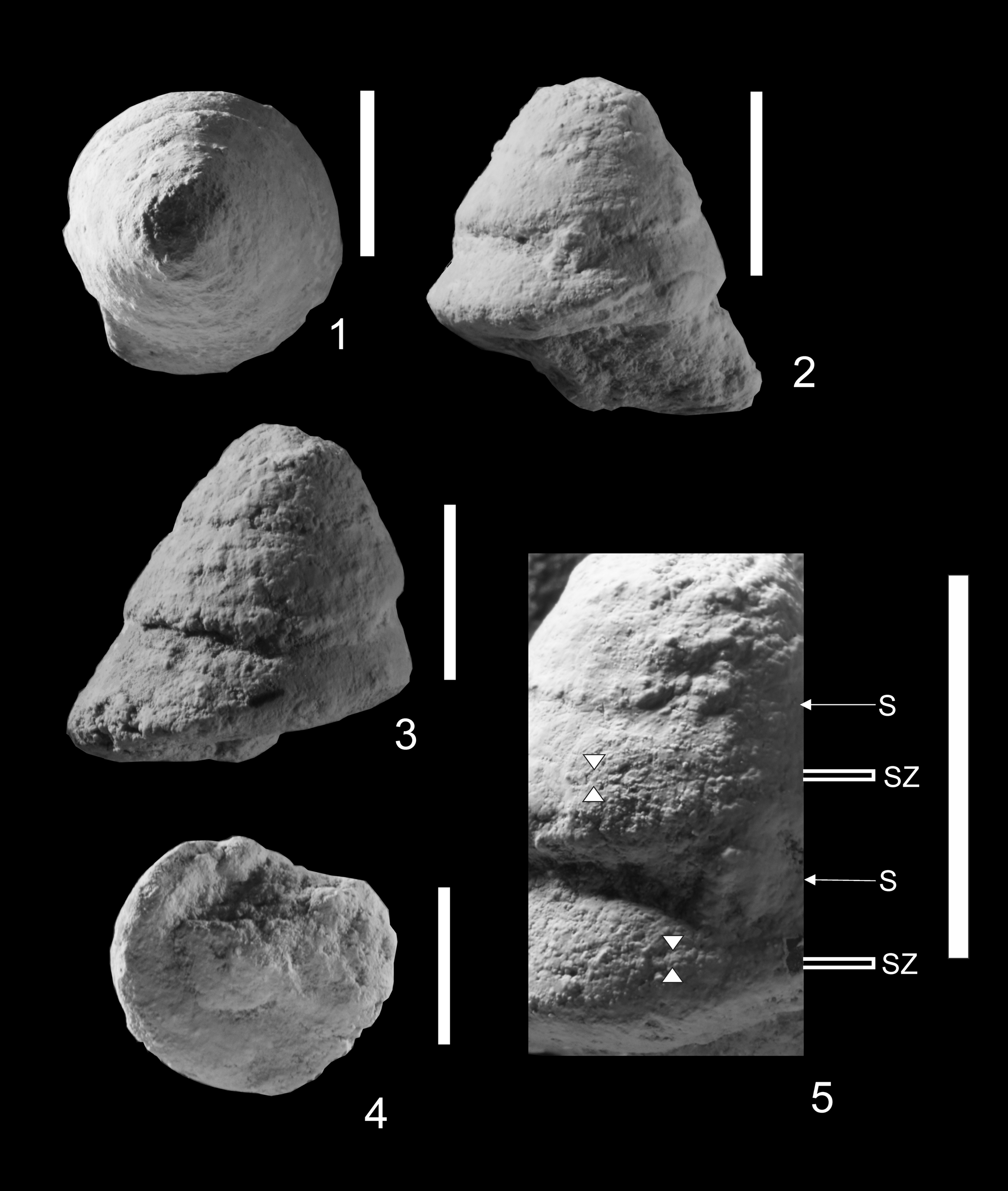
(1–5) Entemnotrochus kathiawarensis n. sp., specimen no. ISI/dwk/Pleu/19/110701/01 (holotype): (1) apical view; (2) apertural view; (3) abapertural view; (4) basal view; (5) close up view of selenizone and sculpture between suture and last two dorsal whorls; scale bars = 10.0 mm. The white arrows mark the selenizone. Abbreviations: SZ = selenizone; S = suture.

Holotype
Holotype: specimen no. ISI/dwk/Pleu/19/110701/01. Kuranga Member, Gaj Formation, Dwarka Basin; early Miocene (Burdigalian).
Diagnosis
Flat to slightly convex whorl profile, no shoulder present, smooth selenizone, weakly convex and smooth base, broad umbilicus.
Occurrence
Early Miocene (Burdigalian); Kuranga Member, Gaj Formation, Dwarka, Gujarat, India.
Description
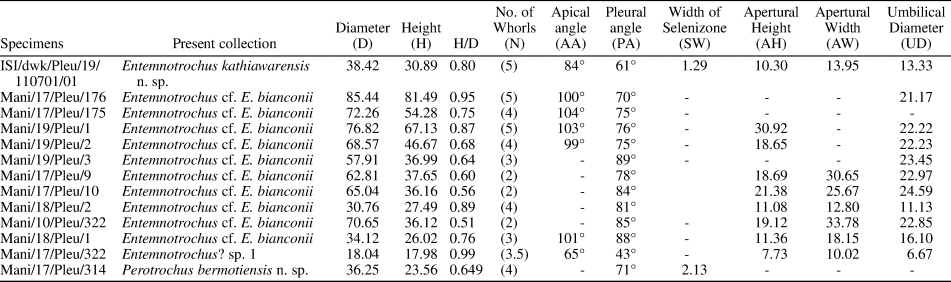
Shell medium sized, with diameter slightly greater than height (H = 30.89 mm, D = 38.42 mm), trochiform, with flat to slightly convex whorl profile. Five whorls preserved; earlier whorls missing. H/D ratio is 0.80. Apical angle 84°, pleural angle 61°. Suture impressed. Base weakly convex, smooth, with broad and deep umbilicus (UD = 13.33 mm). Shell surface ornamentation is not clearly discernible; feebly developed spiral threads present below selenizone.
Width of selenizone (SW) is 1.29 mm; selenizone positioned between upper third of whorl height and mid-whorl. Selenizone feebly convex and smooth. Aperture slightly broken with sub-rectangular in shape (AH = 10.30 mm, AW = 13.95 mm); base of aperture more or less flat.
Etymology
Named after Kathiawar Peninsula of Gujarat, India from where the present specimen was collected.
Material
One moderately preserved specimen (specimen no. ISI/dwk/Pleu/19/110701/01), an internal mold with parts of the shell preserved. The specimen was collected 200 m east of Kuranga Railway Station, Devbhumi Dwarka District, Gujarat, India (22°03′35.7″N, 69°11′17″E). For measurements of the specimen, see Table 2 and Supplementary Figure 2 (1).
Measurement table for the newly described pleurotomariid specimens from the Oligocene and the early Miocene of Kutch and Dwarka basins of western India. Other abbreviations used in descriptions: D = Diameter; H = Height; H/D = Height by Diameter ratio; N = Number of Whorls; AA = Apical Angle; PA = Pleural Angle; SW = width of the Selenizone; AH = Apertural Height; AW = Apertural Width; UD = Umbilical Diameter; dwk = Dwarka; Pleu = Pleurotomariidae; Mani = Maniyara Fort Formation; ‘-’ represents data could not be measured.

Remarks
The species is represented by only one moderately preserved specimen, but the overall shape of the shell, position of the selenizone, surface ornamentation, smooth and weakly convex base, and broad umbilicus justify assignment of the present species to the genus Entemnotrochus Fischer, Reference Fischer1885. The specimen closely resembles the Recent species Entemnotrochus rumphii (Schepman, Reference Schepman1879) with regards to its overall shape, the flat to convex whorl profile, and the smooth selenizone. However, the entire shell of Entemnotrochus rumphii is ornamented with a cancellate ‘beaded’ sculpture, while E. kathiawarensis n. sp. only has feeble spirals threads below the selenizone.
The species can be distinguished from other Miocene species of Entemnotrochus based on overall shell shape, size, and surface ornamentation. In Entemnotrochus panchangwui Lin, Reference Lin1975 and Entemnotrochus siuyingae Lin, Reference Lin1975 from the Miocene of Taiwan, the H/D ratio is greater than one, while it is less than one in E. kathiawarensis n. sp. In addition, the umbilical diameter (UD) to shell diameter (D) ratio in E. panchangwui is 1:4, whereas E. kathiawarensis n. sp. has a UD/D ratio of 1:2.88. Entemnotrochus kathiawarensis n. sp. has a smooth selenizone while E. siuyingae has a beaded selenizone.
Entemnotrochus cf. E. bianconii (d’Archiac and Haime, Reference d'Archiac and Haime1854)
Figure 7
cf. 1854 Pleurotomaria? bianconii d'Archiac and Haime, p. 291, 369, pl. 26, fig. 19.
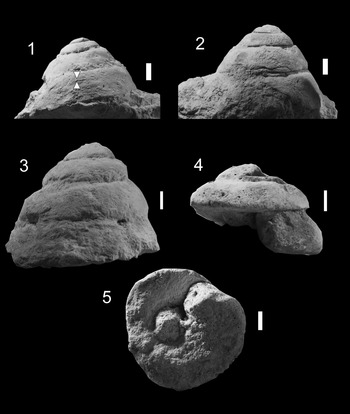
(1–5) Entemnotrochus cf. E. bianconii (d’Archiac and Haime, Reference d'Archiac and Haime1854), specimen no. Mani/17/Pleu/175: (1) abapertural view; (2) apertural view; Mani/17/Pleu/176: (3) abapertural view; Mani/17/Pleu/10: (4) apertural view; (5) basal view; scale bars = 10.0 mm. The white arrows mark the selenizone.

Occurrence
Late Oligocene (Chattian), Bermoti Member, Maniyara Fort Formation, Kutch, India.
Description
Shell medium to large sized, with diameter slightly greater than height (H = 81.49 mm, D = 85.44 mm), trochiform. Slightly convex whorl profile with a very narrow shoulder, gradually curving towards broad outer face of whorl. No more than five whorls preserved; earlier whorls missing in most specimens. Apical angle ~100°. Pleural angle ranging from 70–89°. Suture weakly impressed. Base nearly flat to slightly convex. Umbilicus wide (UD = 24.59 mm). Ornamentation indiscernible, but a narrow, faint impression of the selenizone can be observed above mid-whorl on several whorls. Aperture nearly tetragonal with apertural width much greater than apertural height (AW = 33.78, AH = 19.12); base of aperture feebly convex.
Material
Ten poorly preserved specimens, all internal molds. Specimens no. Mani/17/Pleu/10, 175, 176, Mani/19/Pleu/1, 2, 3 were collected from Bermoti Vilage (23°27′45.1″N, 68°36′06.4″E); specimens no. Mani/18/Pleu/1, 2 were collected from Lakhdi Dam, 4.8 km NW of Vayor (23°27′02.2″N, 68°40′03″E); specimen no. Mani/18/Pleu/3 was collected from Kharoi Village near Lakhdi Dam, 4.5 km NW of Vayor (23°26′55.5″N, 68°40′09.4″E); specimen no. Mani/10/Pleu/322 was collected from Maniyara Fort near Bermoti Village (23°29′15″N, 68°37′10″E). For measurements of the specimens see Table 2 and Supplementary Figure 2 (2). Specimens no. Mani/17/Pleu/175, Mani/19/Pleu/1, 3, Mani/17/Pleu/175, 176, 10 are the figured specimens.
Remarks
The specimens are poorly preserved, all of them being internal molds. The trochiform, slightly broader than high with a convex whorl profile, wide umbilicus, and a narrow selenizone positioned above mid whorl justify assignment to Entemnotrochus. Entemnotrochus bianconii (d’Archiac and Haime, Reference d'Archiac and Haime1854), reported from the Eocene of Kutch, western India, shows striking similarity with regard to overall shell outline and size when compared to our specimens. The species E. bianconii was not described in detail, but only illustrated by d’Archiac and Haime (Reference d'Archiac and Haime1854) due to the very poor preservation of the specimens. Although the specimens described here are closely similar to E. bianconii, better-preserved specimens are needed for confident assignment.
Entemnotrochus? sp. 1
Figure 8
(1–5) Entemnotrochus? sp. 1, Specimen no. Mani/17/Pleu/322: (1) apical view; (2) apertural view; (3) abapertural view; (4) basal view; (5) close up view of selenizone and sculpture between suture and last two dorsal whorls; scale bars = 10.0 mm. The white arrows mark the selenizone. Abbreviations: SZ = selenizone; S = suture.

Occurrence
Late Oligocene (Chattian), Bermoti Member, Maniyara Fort Formation, Kutch, India.
Description
The specimen is a poorly preserved, small (D = 18.04 mm, H = 17.98 mm) internal mold. Shell trochiform, whorls nearly flat to slightly convex, suture impressed. Apical angle 65°, pleural angle 43°. Base convex; umbilicus indiscernible. Ornamentation cannot be discerned. Faint impression of very narrow selenizone visible above the mid-whorl (Fig. 8.5). Aperture rectangular with apertural width greater than height (AW = 10.02, AH = 7.73). Base of aperture convex.
Material
One poorly preserved specimen, an internal mold, Mani/17/Pleu/322, collected from Bermoti Village (23°27′45.1″N, 68°36′06.4″E). For measurements of the specimen see Table 2 and Supplementary Figure 2 (3).
Remarks
The specimen is poorly preserved and the umbilicus is indiscernible. The shell is characterized by an overall trochiform shape, and a nearly flat to slightly convex whorl profile, with a very faint impression of the narrow selenizone present above mid whorl, indicating its affinity with the genus Entemnotrochus. Thus, the specimen is placed tentatively in Entemnotrochus. For an exact determination of the generic position, better-preserved specimens are needed. Also, because the specimen is an internal mold and lacks external shell features, it cannot be assigned to any species. The small size and elongated shell profile (H/D = 0.99) of the present species clearly differentiated it from the coeval species, Entemnotrochus cf. E. bianconii (d’Archiac and Haime, Reference d'Archiac and Haime1854), which has large size and has slightly depressed shell profile (H/D = 0.95). Moreover, overall shape with flat whorl profile and absence of shoulder clearly distinguishes it from Entemnotrochus cf. E. bianconii (d’Archiac and Haime, Reference d'Archiac and Haime1854).
Genus Perotrochus Fischer, Reference Fischer1885
Type species
Pleurotomaria quoyanus quoyanus Fischer and Benardi, Reference Fischer and Bernardi1856 (by original designation); Recent; from the Caribbean.
Perotrochus bermotiensis new species
Figure 9
Holotype
Specimen no. Mani/17/Pleu/314, the figured specimen. Oligocene (Rupelian), Coral Limestone Member, Maniyara Fort Formation, Kutch, India.
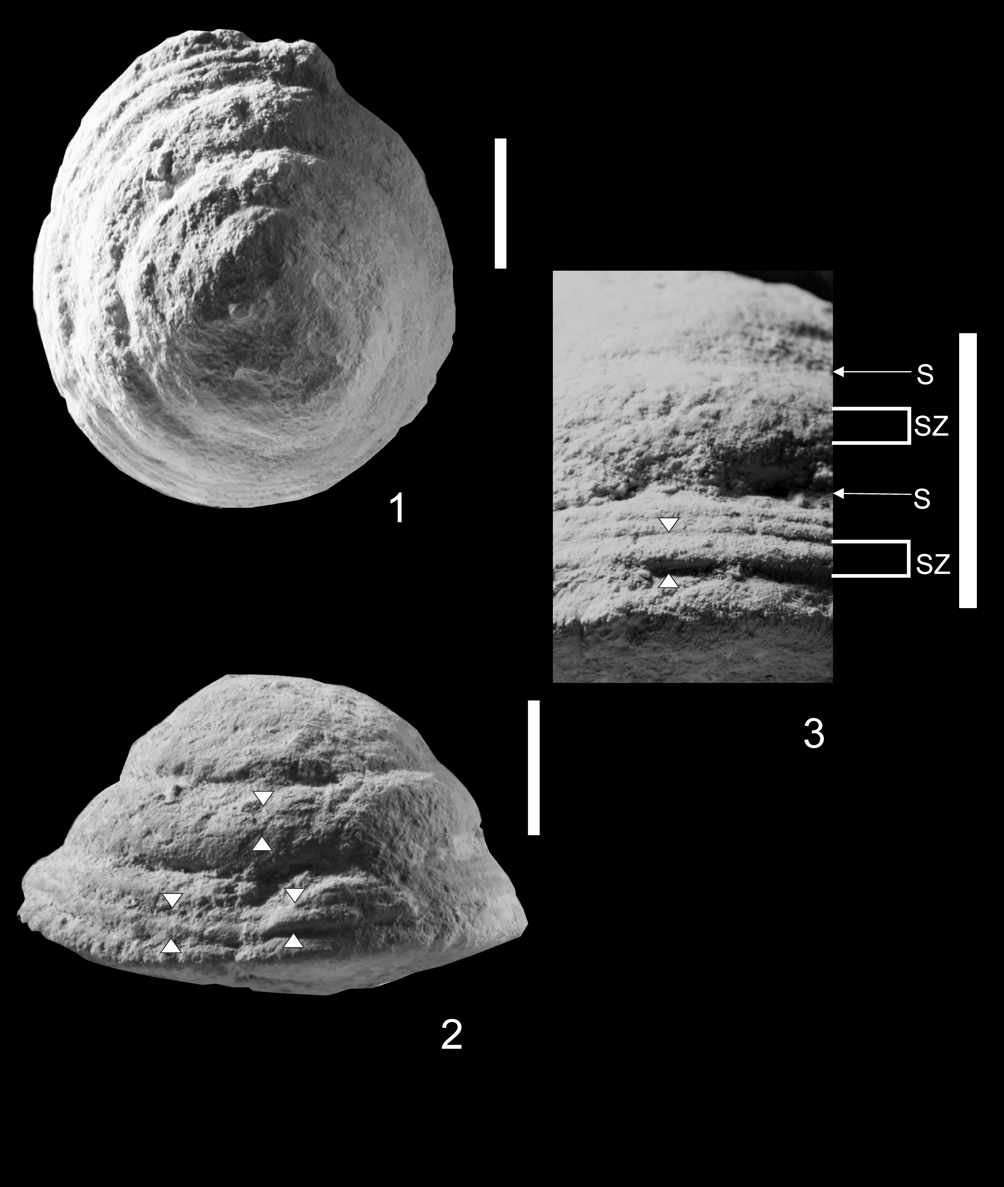
(1–3) Perotrochus bermotiensis n. sp., Mani/17/Pleu/314 (holotype): (1) apical view; (2) abapertural view; (3) close up view of selenizone and sculpture between suture and last two dorsal whorls; scale bars = 10.0 mm. The white arrows mark the selenizone. Abbreviations: SZ = selenizone; S = suture.

Diagnosis
Shell trochiform, with flat whorl profile; no shoulder present; convex selenizone sculptured with two feebly visible narrow spiral threads.
Occurrence
Oligocene (Rupelian), Coral Limestone Member, Maniyara Fort Formation, Kutch, India.
Description
Shell medium-sized, trochiform, vaguely anomphalous; diameter greater than height (H = 23.56 mm, D = 36.25 mm), apex not preserved. Pleural angle is 71°, four whorls preserved. Whorls feebly convex; suture impressed. Shell ornamented with two spiral ribs between the suture and the selenizone. Faint spiral ornamentation also present near the base of the shell. Selenizone situated at the lower third of the body whorl. Width of selenizone 2.13 mm. The selenizone is feebly convex, with two narrow inconspicuous spiral threads on the selenizone. Base of the shell obscured by adhering sediment. Aperture poorly preserved.
Etymology
Named after Bermoti village, Kutch, Gujarat, India from where the present specimen collected.
Material
One moderately preserved specimen, an internal mold with parts of the shell preserved. Specimen no. Mani/17/Pleu/314 collected at Bermoti River, near Bermoti village (23°27′45.1″N, 68°36′06.4″E). For measurements of the specimen see Table 2 and Supplementary Fig. 2 (4).
Remarks
Perotrochus bermotiensis n. sp. is represented by a single moderately preserved specimen, but the overall shape of the shell, position of the selenizone (below mid-whorl), width of the selenizone in the range of 2–4 mm, surface ornamentation, and the weakly convex anomphalous base place this in the genus Perotrochus. The specimen closely resembles Perotrochus hsiehkwanghoi Lin, Reference Lin1976 in overall shell outline and position and width of the selenizone. However, the shell of P. hsiehkwanghoi Lin, Reference Lin1976 is much larger (max D = 130 mm), its whorls are much higher, and it has a narrow shoulder on the last whorl.
Acknowledgments
KB and SSD acknowledge the Indian Statistical Institute, Kolkata for providing funding and infrastructural facilities. SM acknowledges the University of Calcutta, Kolkata for providing infrastructural facilities. This work was supported by the Indian Statistical Institute (5427D for the Year 2019–2020) and Science and Engineering Research Board, Department of Science and Technology, Government of India (EMR/2017/000328). The authors acknowledge S. Bardhan for critically reviewing the manuscript and providing valuable input. We are also grateful to S. Saha and B. Biswas for their help during data collection and photography. Native English speaker, S. Kumar Biswas, provided corrections to the English language. The authors acknowledge S. Schneider, Associate Editor, Journal of Paleontology for valuable suggestions. The authors also acknowledge B. Karapunar, A. Nützel, and an anonymous reviewer for critically reviewing our paper and providing valuable suggestions and recommendations.
Data Availability Statement
Data available in Dyrad Digital Repository: https://doi.org/10.5061/dryad.m905qfv0d.