Pulmonary arterial hypertension is caused by an increase in pulmonary arterial pressure in the pulmonary vascular bed and is defined as a mean pulmonary arterial pressure of greater than or equal to 25 millimetres of mercury shown at right heart catheterisation.Reference Galie, Hoeper and Humbert 1 In the past, the diagnosis of pulmonary arterial hypertension was associated with a poor prognosis, especially in children, with a median survival of 0.8 months upon diagnosis.Reference Tissot and Beghetti 2 However, the introduction of specific vasodilator therapy and increased awareness of the disease has improved survival and quality of life of the patients with pulmonary arterial hypertension.Reference Yung, Widlitz, Rosenzweig, Kerstein, Maislin and Barst 3
The targeted approach to pathogenic mechanisms causing pulmonary arterial hypertension has resulted in the emergence of three general classes of specific vasodilator agents. These include: prostacyclin analogues – epoprostenol, treprostinil, beraprost, and iloprost; endothelin receptor antagonists – ambrisentan, bosentan, sitaxentan; and phosphodiesterase inhibitors – sildenafil and tadalafil.Reference Barst, Rubin and Long 4 – Reference Galie, Brundage and Ghofrani 12 There are limited number of studies involving children, and therefore most of the data are derived from the adult studies and adapted to children. To evaluate the tolerability, safety, and efficacy of inhaled iloprost therapy, we retrospectively evaluated the acute and chronic effects of inhaled iloprost in children with pulmonary arterial hypertension.
Methods
A total of 20 patients with either idiopathic or associated pulmonary arterial hypertension were treated with iloprost between April, 2003 and January, 2010. A detailed history, physical examination, electrocardiogram, echocardiographic evaluation, cardiac catheterisation, vasoreactivity test, and 6-minute walking test were performed before initiation of therapy, and these tests – except cardiac catheterisation – were repeated every 3 months during follow-up.
Inhaled iloprost therapy was initiated for newly diagnosed pulmonary arterial hypertension in 14 patients, and as an add-on therapy in six patients with inadequate response to prior therapy. Of the 14 patients, three had two different classes of specific vasodilator drugs as the initial treatment. Initiation of the specific vasodilator therapy was approved in a local committee formed in our unit that consisted of experienced paediatric cardiologists and paediatric cardiothoracic surgeons. After committee approval, iloprost (Ventavis, Bayer AG, Bayer Healthcare, Berlin, Germany) was administered by Microair U22 nebulizor system (Omron Healthcare, Hoofddorp, Netherlands). Iloprost therapy was initiated during hospital admission or in the outpatient clinic setting depending upon patient stability. Information on the dosing of iloprost for children is lacking. The most comprehensive study in children was conducted by Ivy et al,Reference Ivy, Doran and Smith 7 where they used a median dosage of 30 micrograms per day for their patients. Our patients, compared with those of Ivy et al, were much smaller, and therefore we made modifications of the dosing stated by Ivy et al according to weight. The dosing of inhaled iloprost was 7.5 micrograms per day for patients less than or equal to 10 kilograms, 12.5 micrograms per day for patients weighing 10–20 kilograms, 17.5 micrograms per day for patients weighing 20–30 kilograms, 22.5 micrograms per day for patients weighing 30–40 kilograms, and 30 micrograms per day for patients weighing more than or equal to 40 kilograms. This is the effective dosing that reaches to the pulmonary alveolae. Dosing delivered to the medication chamber is approximately four times the dosing mentioned above. In order to deliver 5 micrograms to pulmonary alveolae, 20 micrograms must be put into the medication chamber. The frequency of dosing was initiated at six times a day, but could be increased up to nine times a day according to a patient's needs. The dosing was titrated individually if needed according to the severity of pulmonary arterial hypertension, side effects, and a patient's response to therapy.
Cardiac catheterisation and vasoreactivity test with inhaled iloprost was performed on all patients before treatment. The 6-minute walking test was performed in children 6 years of age and older. The test was performed in a covered corridor where the patients were instructed to walk at their own pace, receiving no encouragement. The test was instructed by the same physician at all times, and at the completion of 6 minutes the distance walked was measured and recorded.
After initiation of inhaled iloprost therapy, follow-up visits were scheduled every 3 months or sooner if clinical deterioration was present. Evaluations at the follow-up visits included physical examination, echocardiographic evaluation, assessment of World Health Organization functional class, 6-minute walking test in patients older than 6 years of age, complete blood count, liver function tests, brain natriuretic peptide level, and measurement of oxygen saturation.
Statistical analysis
All values are expressed as mean plus or minus standard deviation and median (minimum–maximum). Software package Statistical Package for the Social Sciences for Windows (version 17, Chicago, Illinois, United States of America) was used. Comparisons between 6-minute walking distance and brain natriuretic peptide levels at the initiation and at the end of the study period were performed based on Wilcoxon Signed-Ranks Test.
Results
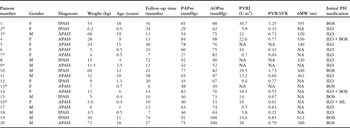
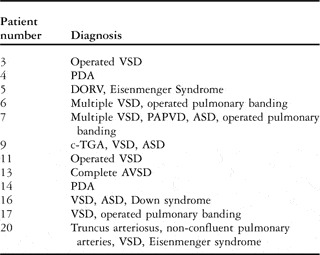
Between April, 2003 and January, 2010, 20 patients (10 female and 10 male) received inhaled iloprost for pulmonary arterial hypertension. The median age and weight of the patients were 3.8 years – ranging from 4 months to 19 years – and 12.3 kilograms – ranging from 4 to 73 kilograms – respectively (Table 1). Pulmonary arterial hypertension was idiopathic or hereditary in 8 (40%) and associated with congenital cardiac disease in 12 (60%) patients. There were six patients who had previous surgeries, which included the following: pulmonary banding in four patients and ventricular septal defect closure in two patients. The baseline characteristics and associated congenital cardiac defects are given in Tables 1 and 2.
Baseline characteristics.

AOPm = mean aortic pressure; APAH = associated pulmonary arterial hypertension; BOS = bosentan; ILO = iloprost; IPAH = idiopathic pulmonary arterial hypertension; 6MW = 6-minute walking distance; NA = non-applicable; PAPm = mean pulmonary arterial pressure; PH = pulmonary hypertension; PVR = pulmonary vascular resistance; SIL = sildenafil; SVR = systemic vascular resistance
*Patients who died during follow-up
Associated congenital cardiac defects.

ASD = atrial septal defect; AVSD = atrioventricular septal defect; c-TGA = corrected transposition of the great arteries; DORV = double-outlet right ventricle; PDA = patent ductus arterious; PAPVD = partially anomalous pulmonary venous drainage; VSD = ventricular septal defect
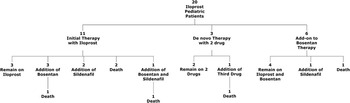
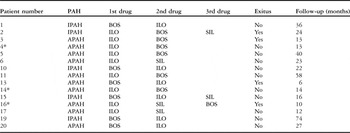
Inhaled iloprost alone was the initial specific therapy in 11 patients, whereas two patients had both bosentan and iloprost and one patient had sildenafil and iloprost as the starting therapy. Iloprost was added to bosentan therapy in six patients for clinical deterioration (Fig 1). There was one patient on bosentan therapy who developed an increase in liver function tests, and thus bosentan was changed to iloprost. There were seven patients who needed concomitant-specific vasodilator therapies added for clinical deterioration at a median time of 6 (1–48) months after initiation of inhaled iloprost. A total of 15 patients had combined therapy, that is, 12 with two different classes of drugs and three with three different classes of drugs (Table 3). In all, six patients died during follow-up.
Classification tree for long-term follow-up of children receiving inhaled iloprost.

Combination therapy.

APAH = associated pulmonary arterial hypertension; BOS = bosentan; ILO = iloprost; IPAH = idiopathic pulmonary arterial hypertension; PAH = pulmonary arterial hypertension; SIL = sildenafil
*Two drugs combined from beginning
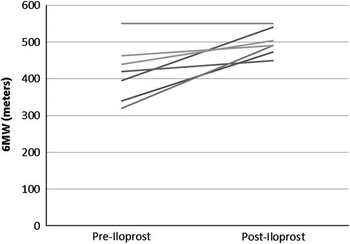
Cardiac catheterisation and baseline haemodynamic measurements and calculations using the Fick method were performed in all the patients before initiation of inhaled iloprost. Haemodynamic measurements are given in Table 1. The median follow-up time was 18 months, ranging from 6 to 74 months. The 6-minute walking test was performed in 7 out of 20 patients at baseline and on follow-up. The median 6-minute walking test was 420 metres (320–550) before initiation of therapy, and it increased to a median of 490 metres, 6 months (450–550) after iloprost therapy (p = 0.028, Z = −2.201; Wilcoxon Signed-Ranks Test; Fig 2).
Six-minute walking distance at baseline and after 6 months of therapy with iloprost. 6MWD = 6-minute walking distance.

There were two patients – Patient numbers 7 and 9 – who required mechanical ventilation therapy and could only be weaned from the ventilator after the initiation of inhaled iloprost therapy; seven of the patients could attend school and all the patients stated that they felt better after initiation of inhaled iloprost therapy. The World Health Organization functional class was evaluated in 18 patients at baseline and at 6 months. The median World Health Organization functional class was class III at baseline. The World Health Organization functional class improved in seven patients, remained unchanged in 10 patients, and worsened in one patient. A second cardiac catheterisation after initiation of inhaled iloprost therapy was performed in six patients. The median mean pulmonary arterial pressure, aortic pressure, pulmonary vascular resistance, systemic vascular resistance, and the ratio of pulmonary to systemic vascular resistances before and after initiation of inhaled iloprost therapy are provided in Table 4. We observed a decrease in median pulmonary artery pressure and pulmonary vascular resistance. However, these findings did not reach a statistically significant value (p > 0.05, Wilcoxon Signed-Ranks Test).
Baseline and second catheterisation values.

Median (range), p > 0.05 (Wilcoxon Signed-Ranks Test) for all
Brain natriuretic peptide measurement was recorded in all patients before and after initiation of inhaled iloprost therapy. The median brain natriuretic peptide level was 125 picograms per millilitre and 80 picograms per mililitre before and after treatment, respectively (p = 0.349, Z = −0.936; Wilcoxon Signed-Ranks Test). Patient number 19 reported headache with iloprost therapy and Patient number 15 who was also using continuous oxygen therapy concomitantly had a red rash around his mouth. None of the other patients included in this study reported any side effects. However, two patients not included in this study, in whom vasoreactivity test with inhaled iloprost was performed during catheterisation, had acute bronchospasm with inhaled iloprost and the test could not be completed. Another patient in whom inhaled iloprost was added to bosentan therapy complained of shortness of breath, cough, and signs of lower airway obstruction with iloprost therapy. All of these three patients received inhaled iloprost after the study period and were not included in this study.
Of the 20 patients, six (30%) died during the study period. Of these, one of these patients (Patient number 2) was diagnosed with idiopathic pulmonary arterial hypertension, whereas the remaining five were associated with various cardiac defects. Only one of the patients who died (Patient number 9) had iloprost as monotherapy, whereas the others had combination therapy. One of the patients died in the early post-operative period and one in the late post-operative period after cardiac surgery. All the patients showed progressive clinical deterioration despite specific therapy.
Discussion
Pulmonary hypertension is characterised by a progressive increase in pulmonary vascular resistance leading to right ventricular failure, causing significant morbidity and mortality. With the introduction of pulmonary-specific vasodilators to medical practice, a significant increase has been achieved in these patients’ quality of life and life expectancy; however, debate still exists about the best management strategy of pulmonary arterial hypertension. There is limited experience regarding the use of inhaled iloprost therapy especially in children. This study is a retrospective analysis of clinical data that involved 20 children with pulmonary arterial hypertension – idiopathic or associated – in a tertiary paediatric clinic providing a single centre experience of long-term safety and efficacy of inhaled iloprost treatment of paediatric pulmonary arterial hypertension. To our knowledge, this is the largest group of patients from a single centre with the longest follow-up time.
Inhaled iloprost is a prostacyclin analogue that is stable and selective for pulmonary vasculature with an elimination half-life of 20–30 minutes that is used as a specific vasodilator. Inhaled iloprost induces a decrease in pulmonary vascular pressure with no or minor effects on the systemic circulation, which is an advantage in acute pulmonary hypertensive crises. Owing to the fact that iloprost is delivered by inhalation, it can only be delivered to ventilated lung segments, which avoid the potential increase of intrapulmonary shunts, improving the ventilation–perfusion mismatch. Improvement of ventilation–perfusion mismatch might result in an increase of oxygen saturation in patients with hypoxia.Reference Tissot and Beghetti 2 , Reference Olschewski, Rohde and Behr 13
Use of inhaled iloprost in children has been reported in the management of acute and chronic pulmonary hypertension and in vasoreactivity testing. Several reports have been published in the previous years regarding the use of inhaled iloprost in acute pulmonary hypertensive crisis in the critical care unit in children with pulmonary arterial hypertension related to congenital cardiac disease.Reference Limsuwan, Wanitkul, Khosithset, Attanavanich and Samankatiwat 14 , Reference Hallioglu, Dilber and Celiker 15 Limsuwan et alReference Limsuwan, Wanitkul, Khosithset, Attanavanich and Samankatiwat 14 conducted a study that involved 12 children with post-operative pulmonary hypertensive crisis causing cardiopulmonary compromise, and they showed that inhaled iloprost was an effective drug for post-operative pulmonary hypertensive crisis in children undergoing congenital cardiac surgery. Similarly, Rimensberger et alReference Rimensberger, Spahr-Schopfer and Berner 16 showed the efficacy of inhaled iloprost in acute post-operative pulmonary hypertensive crisis, and all these studies concluded that inhaled iloprost could be used as an effective alternative to inhaled nitric oxide in acute post-operative pulmonary hypertensive crisis. Similarly, Patient number 7 had pulmonary hypertensive crisis after the pulmonary banding operation and could only be weaned from the ventilator after the initiation of inhaled iloprost therapy.
There is a lack of controlled randomised trials regarding the use of inhaled iloprost therapy in children. There is only one study showing the effect of chronic inhaled iloprost use in children. Ivy et alReference Ivy, Doran and Smith 7 studied the effects of inhaled iloprost in 23 children with idiopathic or associated pulmonary arterial hypertension and showed that inhaled iloprost can be beneficial in some patients; however, further studies regarding the dosing and long-term effects of inhaled iloprost therapy need to be conducted. Owing to the fact that there is no consensus among paediatric cardiologists regarding the dosing of inhaled iloprost in children, we have formulated our own dosing strategy as stated in the “Methods” section. The dosing described in the “Methods” section describes the dosing that reaches the pulmonary alveolae. It is thought that only one-fourth of the dosing applied to the medication chamber is delivered to the lungs.Reference Hsu and Rubin 17 We grouped the patients according to their weight, and started with an effective dosing of 7.5 micrograms per day for patients – the dosing of the medication chamber was 30 micrograms per day – weighing less than 10 kilograms, and increased the effective daily dose by 5 micrograms per day for every 10 kilograms. After the initiation of inhaled iloprost therapy, we individualised the dosing according to the patients’ needs and observed side effects, and we think that this system is appropriate for children.
In general, the use of inhaled iloprost as de novo or monotherapy is not widely practiced. However, some authors argue that iloprost could be used as a first-line monotherapy in chronic pulmonary hypertension, even if scientific data supporting this argument are lacking.Reference Tissot and Beghetti 2 The time at which inhaled iloprost was used as the initial specific therapy in most of our patients dates back to when bosentan and sildenafil were not approved for paediatric use in our country. We have used inhaled iloprost as the initial specific therapy in 14 patients. Of these, nine patients needed the addition of concomitant-specific vasodilator therapies because of clinical deterioration evidenced by progressive right ventricular dilatation by echocardiography or a decrease in the 6-minute walking distance. Therefore, we think that patients with pulmonary arterial hypertension should be followed up closely as some patients may deteriorate clinically and may require combination therapy.
During the median follow-up time of 6 months (1–48), all our patients were evaluated with detailed history, physical examination, echocardiographic evaluation, and 6-minute walking test in patients older than 6 years of age. It is worth emphasising that one of our patients (Patient number 8) with idiopathic pulmonary arterial hypertension received iloprost therapy for 72 months with no side effects and is still in a stable clinical condition. All our patients stated that they felt better after the initiation of iloprost therapy. However, two of our (Patient numbers 15 and 18) patients required hospitalisation during the study. Patients old enough could attend school. Patient number 6 was admitted with pneumonia and needed mechanical ventilation and could not be weaned from ventilator therapy. Similarly, Patient number 7 required mechanical ventilation after her pulmonary banding operation. However, after the initiation of iloprost therapy, both could be weaned from the ventilator and discharged from the hospital. The median 6-minute walking test increased from 420 to 490 metres in the patients who could perform the test. Overall, a 16.7% increase in median 6-minute walking distance was noted, an objective indicator of improved exercise tolerance. We think that our findings of increase in the 6-minute walking test distance, capability of weaning from the ventilator, and attendance of school in seven patients can be attributed to the efficacy of inhaled iloprost therapy. Of the six patients in whom catheterisation was performed, a statistically significant difference in the pulmonary artery pressures could not be observed; however, the lack of this difference might be related to the heterogeneity and small number of patients.
In all, six of our patients died during follow-up. All of these patients had severe pulmonary hypertension; one was diagnosed with idiopathic and the remaining five with associated pulmonary arterial hypertension. Despite combination therapy, three patients died due to progressive clinical deterioration during the study period. Our study shows that pulmonary arterial hypertension is still a lethal disease despite specific vasodilator therapy. Surgical procedures are important risk factors for mortality in these patients. Patient number 9 could not be closely monitored, and thus his clinical deterioration could not be detected and combination therapy could not be initiated. Patient numbers 16 and 7 were lost in the post-operative period. However, we believe that specific vasodilator therapy prolonged and improved these patients’ quality of life.
Concern regarding the use of inhalation therapy 6–9 times a day and consequent patient compliance in the paediatric population exists among the treating physicians. However, close monitoring, thorough education, and establishing a good communication with our patients’ families have resulted in satisfactory patient compliance in our study group. The reported side effects of inhaled iloprost use are flushing, jaw pain, headache, cough, dizziness, and reversible airway obstruction.Reference Ivy, Doran and Smith 7 , Reference Olschewski 18 Patients enrolled in this study were evaluated every 3 months. Patient number 19 reported headache with the use of inhaled iloprost, and thus the dosing was decreased. None of the other patients reported any of these side effects. Only one patient (Patient number 15) with idiopathic pulmonary arterial hypertension using concomitant inhaled iloprost, sildenafil, bosentan, and continuous oxygen therapy developed oral rash around the oxygen mask. He received concomitant continuous oxygen therapy, and the rash persisted in between iloprost inhalations, and it was thought that the oral rash was more due to chronic irritation caused by the mask than iloprost inhalations. Interestingly, though, three patients had lower airway obstruction symptoms that were not included in this study. Ivy et alReference Ivy, Doran and Smith 7 reported a decrease of more than 15% in forced expiratory flow (25–75) in 38% of their patients assessed by pulmonary function tests. We did not perform pulmonary function tests, and therefore we cannot provide objective data assessing pulmonary function of our patients. However, none of the patients described any symptoms compatible with airway obstruction.
A retrospective study of a relatively rare, heterogeneous group of patients at a tertiary referral centre has multiple inherent limitations. Referral bias and survival bias are likely, leading to the inclusion of potentially more severe or refractory cases and of patients seen late in the course of their disease. The potential for survival bias may be high, with death of 30% of the patient population; however, it is worth emphasising that only one of the patients who died was old enough to perform the 6-minute walking test.
Conclusions
Pulmonary hypertension is associated with significant morbidity and mortality. Close monitoring of these patients, expertise, and multi-disciplinary approach are essential for optimal care. Careful assessment of each patient and timely combination of specific vasodilator therapy is needed to improve clinical outcomes. This study suggests that inhaled iloprost, with or without concomitant endotelin receptor antagonist and/or phosphodiesterase inhibitor, is safe and efficacious for the treatment of pulmonary arterial hypertension in children.