Cardiac catheterisation still remains the most accurate tool to assess pressure haemodynamics in patients with complex congenital cardiac disease, although non-invasive imaging can provide very detailed structural information. However, the limitations of cardiac catheterisation in evaluating the physiological significance of coronary or pulmonary vasculature stenosis have been widely recognised for decades.Reference Topol and Nissen1, Reference Kern, De Bruyne and Pijls2 One of the currently available and reliable physiological techniques is coronary pressure measurement, which has evolved over the past decade as a crucial diagnostic as well as prognostic tool in interventional cardiology.Reference Pijls, Van Son, Kirkeeide, De Bruyne and Gould3–Reference Pijls, De Bruyne and Peels5
Currently, pressure wire assessment is mainly restricted to assessing the stenosis of coronary arteries. However, there are some isolated case reports of its application in non-coronary artery disease.Reference Edwards, Al-Bustami and Ilsley6–Reference Bertog, Smith and Panetta8 We report a novel use of the pressure wire in patients with complex congenital cardiac disease in whom it was used in assessing pressures in the distal pulmonary artery, aorto-pulmonary collaterals, and across prosthetic St Jude® (St. Jude Medical, Inc., USA) valves in the tricuspid position, where conventional catheters are unable to reach to record accurate pressures.
Methods
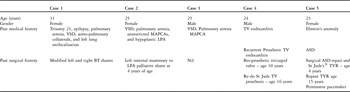
We had five patients who underwent pressure wire assessment where distal pressures could not be assessed using conventional catheters. The details are given in Table 1.
Patients demographics.

ASD = atrial septal defect; BT = Blalock–Taussig; LPA = left pulmonary artery; MAPCA = major aorto-pulmonary collateral artery; TV = tricuspid valve; TVR = tricuspid valve replacement; VSD = ventricular septal defect
There were four cases that were performed under local anaesthesia, while one had general anaesthesia. None had any procedural complications.
Case 1
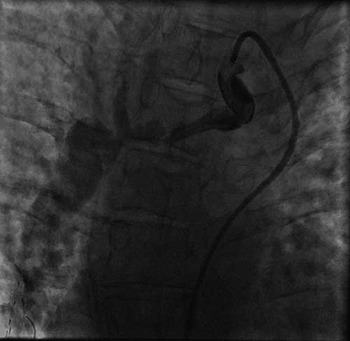
This patient was referred with increasing breathlessness and cyanosis on exertion for consideration of advanced pulmonary hypertensive therapy. A transthoracic echocardiogram showed normal valves, as well as a large ventricular septal defect with equal right left ventricular pressures and good biventricular function. After a detailed clinical assessment, the patient underwent cardiac catheterisation to assess her pulmonary pressures for consideration of advanced pulmonary hypertensive therapy. Left ventricular systolic function was good with no gradient on pullback from the left ventricle to the aorta. The previous Blalock–Taussig shunts were occluded. The unifocalised graft was occluded proximally on the left side. A branch from the arch of aorta (Fig 1) supplied the right pulmonary artery. The proximal left pulmonary artery could not be identified and the distal left pulmonary artery appeared to be supplied by pleural-based collaterals and a very large internal mammary.
A large aortic collateral with significant stenosis (mid) supplying RPA. Pressure wire seen in the distal RPA to assess PA Pressure. RPA = right pulmonary artery; PA = pulmonary artery.

The aortic collateral to the right pulmonary artery was entered using a JL4® diagnostic catheter (Cordis, USA). It was a tortuous vessel with a very tight stenosis before supplying the right pulmonary artery. The catheter could not be advanced beyond the stenosis. A pressure wire was used to cross this lesion into the distal pulmonary artery, which gave a mean distal pulmonary artery pressure of about 3 millimetres of mercury with aortic pressures (108/65 millimetres of mercury) at the proximal end. She was not considered for advanced pulmonary hypertensive therapy, as her distal pulmonary artery pressure was low. The patient was offered dilatation and stenting of the stenosis to improve her saturations but she decided against having any intervention.
Case 2
This patient was referred with increasing dyspnoea and significant reduction in the exercise capacity for consideration of advanced pulmonary hypertensive therapy. She was not suitable for any definitive repair. She was also declined for heart–lung transplant. A transthoracic echocardiogram revealed an overriding of the aorta with pulmonary atresia and a large ventricular septal defect with no pressure differential between the right and left ventricles. Left ventricular size and systolic function were good.
Cardiac magnetic resonance scan revealed a right-sided aortic arch with a large ventricular septal defect, marked aortic override, and complete pulmonary atresia. Multiple aorto-pulmonary collaterals were noted from the descending aorta.
Cardiac catheterisation revealed mean right atrial pressure of 14 millimetres of mercury. Left ventricular systolic pressure was 129 millimetres of mercury and aortic pressure was 111/71 millimetres of mercury. Ventriculography revealed pulmonary atresia and a rudimentary small right ventricle. The descending thoracic aortogram revealed one large aorto-pulmonary collateral supplying the right lung. There was no evidence of any supply to the left lung. The aorto-pulmonary collateral was entered using a JR4® catheter. However, it was not possible to pass a Terumo wire® (Terumo Medical Corporation, Japan) distally enough to measure pressures. In view of this, the pressure wire was passed distally into the left pulmonary artery via the collateral and simultaneous aortic and pulmonary artery pressures were measured as 106/77 and 101/65 millimetres of mercury, respectively. This confirmed significant pulmonary hypertension, and therefore the patient was commenced on advanced pulmonary hypertensive therapy (Bosentan) based on the raised pulmonary artery pressures with good symptomatic benefit.
Case 3
This patient with Velo–Cardio–Facial Syndrome was referred with increasing breathlessness and cyanosis, for consideration of advanced pulmonary hypertensive therapy. A transthoracic echocardiogram revealed a large ventricular septal defect with pulmonary atresia. There was mild-to-moderate tricuspid regurgitation with no significant mitral regurgitation. The aortic valve was normal. The right ventricle appeared to be dilated and hypertrophied, with good biventricular function. A computerized tomography pulmonary angiogram did not show any significant stenosis in the aorto-pulmonary collaterals but the right pulmonary artery could not be identified.
Catheterisation revealed right atrial pressure of 8 millimetres of mercury and right ventricular pressure of 124 millimetres of mercury. Systolic left ventricular and aortic pressures were 134/10 millimetres of mercury and 122/86 millimetres of mercury, respectively. Aortography revealed significantly dilated aorta with an aorto-pulmonary collateral supplying the left pulmonary artery. There was no evidence either of the right pulmonary artery or of a patent duct.
There was no stenosis in the collateral arising from the aorta into the left pulmonary artery. Despite multiple attempts, we were unable to advance a catheter distally into the collateral to the left pulmonary artery. A Radi pressure® (St. Jude Medical, Inc., USA) wire was easily advanced into the distal left pulmonary artery and a systolic pressure of 124/90 millimetres of mercury was recorded, indicating systemic levels of pressure (aortic pressure of 133/90).
As he had significantly high pulmonary artery pressure in the aorto-pulmonary collateral, he was commenced on advanced pulmonary hypertensive therapy (Bosentan) with good improvement in his functional capacity.
Case 4
This patient was referred for an assessment of dyspnoea and pre-syncope. He had previous tricuspid valve endocarditis for which he underwent surgical replacement. He was non-compliant with anticoagulation therapy (warfarin). A transthoracic echocardiogram revealed well-seated tricuspid valve prosthesis with evidence of stenosis and an inflow velocity of 2.3 milliseconds. The patient underwent cardiac catheterisation and fluoroscopic screening of his St Jude® tricuspid valve. Fluoroscopic screening revealed excursion of only one leaflet of the prosthetic tricuspid valve in the oblique views. The mean right atrial pressure was 25 millimetres of mercury. A multipurpose end-hole catheter was positioned in the right atrium and a Radi pressure wire® was advanced into the right ventricle across the prosthetic tricuspid valve. Right ventricular pressures revealed systolic pressure of 50 millimetres of mercury with a significant end-diastolic gradient. The patient underwent a redo tricuspid valve replacement with a tissue valve in view of his history of non-compliance with Warfarin.
Case 5
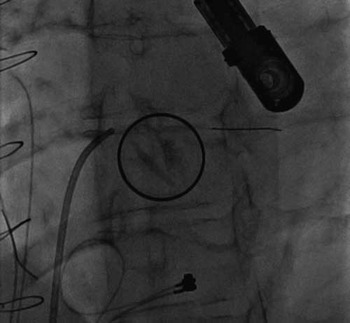
This patient was referred with worsening exercise tolerance. A transthoracic echocardiogram revealed a satisfactory tricuspid prosthesis with flow velocity of 1.9 milliseconds across the valve. There was a tiny residual atrial septal defect (2 millimetres by colour flow measurement) with a dilated right atrium. Right ventricular systolic function was mildly reduced. Left ventricular size and systolic function were normal. The above findings were confirmed by transoesophageal echocardiography with a left-to-right shunt across the tiny atrial septal defect. The patient underwent right and left cardiac catheterisation to assess right cardiac pressures in further detail in view of her dyspnoea. In view of the St Jude prosthesis® being in the tricuspid position, we were unable to get into the pulmonary artery to obtain pressures. The right ventricular pressure was obtained using a Radi pressure wire® across the tricuspid valve prosthesis, which was normal with no end-diastolic gradient (Fig 2), and hence we decided that no further intervention was required.
Pressure wire across the prosthetic St Jude® tricuspid valve.

Discussion
Complex congenital cardiac disease accounts for 2.5 to 3/1000 live births.Reference Hoffman and Kaplan9 Recent advances in diagnosis, as well as surgical and interventional management, have significantly changed the quality of life in patients with congenital cardiac disease. The various tools currently used include echocardiography, cardiac computer tomography, cardiac magnetic resonance imaging, and cardiac catheterisations. There is one reported case of using the pressure wire in assessing the gradient across a prosthetic aortic valve.Reference Edwards, Al-Bustami and Ilsley6
To the best of our knowledge, this is the first reported series to use the pressure wire as a diagnostic tool in patients with complex congenital cardiac disease. This assessment led to appropriate pulmonary hypertension therapy with BosentanReference Rubin, Badesch and Barst10 in two patients with significant benefit. In one of the patients, unnecessary and very expensive therapy was avoided although the patient unfortunately declined other intervention, which could have potentially improved her condition in the short term. Surgery in patients with aorto-pulmonary collaterals is known to be associated with increased risk of morbidity and mortality,Reference Cho, Puga and Danielson11 and this is likely to be even higher in adult patients with this condition. In patients with tricuspid valve prosthesis, one patient received appropriate surgery, whereas another was spared from having any further procedures.
The pressure wire can be used for haemodynamic assessment in patients with complex congenital cardiac anatomy in whom currently available catheters cannot be manipulated into the distal vessel or chamber adequately. The future may widen the horizon for this relatively new technique and see wider applications in the fields of valve stenosis and complex congenital cardiac disease.
Conclusion
Pressure wire assessment is a novel use of an existing diagnostic tool in the assessment of adults with congenital cardiac disease where conventional catheters are unable to reach. It enables these patients to receive appropriate therapy and avoid unnecessary intervention. It may have benefits of cost-effectiveness for these patients.
Disclosures
We have no conflicts of interests to disclose.