U.K. investment trusts were the first investing institutions to fully adopt the strategy of international portfolio diversification.Footnote 1 In the wake of the introduction of limited liability laws for companies in the 1850s and 1860s, the U.K. investment trust sector was established to offer asset management services to individual investors. Originally structured as trusts from their initial appearance in the late 1860s, the great majority of U.K. investment trusts had acquired limited liability company status by the 1880s, thus converting themselves into incorporated closed-end funds (CEFs). These investment trust companies issued shares and fixed-interest securities which were then traded on the London Stock Exchange (LSE) and other provincial stock exchanges, using the funds raised by such issuance to create an investment portfolio of marketable securities. Investment trusts are thus CEF in the sense that their capitalization is fixed (unless there are new issues of securities) and the supply of shares is inelastic (Corner and Burton Reference Corner and Burton1968; Rutterford 2009; Dimson and Minio-Kozerski 1999). Shareholders can exit a CEF at any time by selling their shares in a secondary market. The fund has no obligation to redeem investors’ holdings, as opposed to open-end funds.Footnote 2
The valuation of CEFs has been a core theme in mainstream finance because it is linked to one of the most puzzling anomalies of the efficient market paradigm. In the post-1960s financial markets, on which most existing studies have focused due to data availability, the market values of CEFs deviated substantially from the net asset values (NAVs) of the underlying portfolios, the NAV being the difference between the total market value of all investments within the fund less any liabilities that the fund may have. A CEF trades at a discount (premium) when its market capitalization is lower (higher) than the underlying portfolio’s NAV. In the 1960s, the average discount to NAV in U.K. investment trusts fluctuated around 10 percent, increasing to as much as 50 percent by the mid-1970s. This discount gradually narrowed until the 1990s, when it started to increase again. The behavior of U.S. CEFs has generally resembled that of those on the U.K. market over the same period (Dimson and Minio-Kozerski Reference Dimson and Minio-Kozerski1999, p. 6; Cherkes Reference Cherkes2012).
The persistent and varying mismatch between a closed-end trust’s NAV per share and its ordinary share price has attracted a significant volume of research. If a CEF trades at a discount or premium to NAV, the ordinary share price deviates from its “fundamental value.” Any discrepancy between the share price of the trust and the NAV of its underlying investments violates one of the most basic principles of neoclassical finance, the law of one price (no-arbitrage principle). This pricing mismatch has been coined as the CEF discount puzzle (e.g., Ross Reference Ross2002; De Long and Shleifer 1991; Cherkes Reference Cherkes2012), with the CEF treated as a “laboratory” to empirically test market efficiency and investor behavior. CEFs have thus become the ideal vehicles for studying mispricing in financial markets as well as investor behavior (Pontiff Reference Pontiff1996, p. 1135; Brealey, Myers, and Allen Reference Brealey, Myers and Allen2011, p. 906; Ross Reference Ross2002).
While there is extensive literature on the performance of modern CEF sand the related pricing puzzle, there has been no research using historical data for the same question before the 1960s. There are two notable exceptions: De Long and Shleifer (1991) discussed the discount to NAV for a small sample of U.S. CEFs around the crash of 1929, and Chambers and Esteves (Reference Chambers and Esteves2014) estimated the discount to NAV of the Foreign and Colonial Investment Trust Company between 1880 and 1913. Our study extends the scope of previous analysis both in terms of the number of investment trusts and the period under investigation. It is the first to investigate the CEF pricing puzzle of the U.K. investment trust sector for the 50-year period between 1880 and 1929. In our analysis, we estimate the size of discount/premia to NAV for U.K. investment trusts and explore possible explanations.
Looking at the pricing puzzle of the investment trust sector from a historical perspective is interesting for two reasons. First, it reveals the long-term trend of one of the most discussed puzzles in financial theory, focusing on the world’s financial center in the late nineteenth century and the beginning of the twentieth century. Up to the 1930s, U.K. financial markets were a global financial hub, with the LSE being the largest, most sophisticated, and organized market in the world (Powell Reference Powell1915; Lavington 1921; Michie Reference Michie1987; Hannah Reference Hannah2007). Our dataset comprises hand-collected data from the annual reports archives held in the Guildhall Library in London as well as market price data from the Stock Exchange Yearbook (SEYB). We were able to calculate discounts/premia to NAV for a sample of 91 different investment trusts and 670 firm-years over a period of 50 years, from the origin of investment trust companies in the 1880s up to 1929. Our results show significant cross-sectional and time variation between share prices and underlying NAV. We find a tendency for trusts to trade at a discount to NAV, but this tendency was reversed in the 1920s. The median discount was 5.5 percent for the whole period, but it became a 2.4 percent premium in the 1920s. These results are accompanied by large levels of variance across investment trusts and are consistent with the large variation in discounts in the U.S. financial markets in 1929 as well as the post-1960s CEF pricing variation both in the United Kingdom and the United States. The CEF valuation puzzle is a long-run historical phenomenon, and our findings cast some doubt on the efficiency of the Victorian and Edwardian financial markets.
The second contribution of this study is related to U.K. investor behavior. Victorian and Edwardian investors have generally been assumed to be rational, even when there has been evidence of market imperfections. For instance, several studies have argued that British investors relied on informal trust networks and local knowledge to deal with informational asymmetries (Thomas Reference Thomas1973; Campbell and Turner Reference Campbell and Turner2011; Rutterford, Sotiropoulos, and van Lieshout Reference Rutterford, Sotiropoulos and van Lieshout2017; Acheson et al. Reference Acheson, Campbell, Gallagher and Turner2021). Irrational/naive investors did not seem to have a substantial influence on asset prices during the British Railways Mania in 1845–6; market movements on the nineteenth-century LSE were shown to be rational responses to changes in fundamentals as well as financial news (Campbell and Turner Reference Campbell and Turner2012; Campbell et al. Reference Campbell, Quinn, Turner and Ye2018). Even studies that have debated U.K. capital exports and their influence on domestic investment—one of the most discussed topics in economic history—have very rarely challenged British investors’ rationality.Footnote 3
The U.K. investment trust sector allows us to access investor behavior in a way no other study has done. The novelty of our research is that it discusses U.K. investor behavior and asset pricing in relation to the underlying “fundamental” value of their investment, which cannot typically be observed. Our analysis offers evidence of mean-reverting behavior in the discounts to NAV. This implies that investors were aware of the relation between share prices and underlying NAVs and corrected high pricing deviations/mismatches. U.K. investors were also keen on rewarding performance, as captured by realized returns or nominal dividend yields. Higher realized income and capital gains by investors were associated with lower discounts or higher premia to NAV for investment trusts. We also find some evidence for investor sentiment driving decisions. Our analysis implies a mix of U.K. investor behavior: investors were ready to relate performance to fundamentals but may also have been driven by waves of pessimistic or optimistic sentiments.
THE U.K. INVESTMENT TRUST SECTOR: SOURCES AND DATA
The standard investment textbook calculates the NAV of an investment trust as the total market value of all portfolio investments within the trust, minus any liabilities that the trust may have, adjusted for short-term assets and liabilities and long-term liabilities. This is summarized by Equation (1):
 $$\eqalign{& NAV = Portfolio\,Market\,Value\, + \,Net\,Short - Term\,Assets \cr & \,\,\,\,\,\,\,\,\,\,\,\,\,\,\,\,\, - No\min al\,Value\,of\,Long - Term\,Liabilities \cr} $$
Equation (1) shows the shareholders’ funds from the point of view of the balance sheet. The Portfolio Market Value on the right-hand side includes all portfolio investments at market prices. For U.K. investment trusts before the 1930s, the great majority of portfolio holdings were listed investments in ordinary or preferred shares and bonds.Footnote 4 Investment trusts also hold current assets, usually bank accounts and cash, and current liabilities, such as deposits and bank loans. The difference between current assets and liabilities appears in Equation (1) under the term Net Short Term Assets and was usually a very small part of investment trust operations (the working capital was also close to zero). The final term of Equation (1) is the Nominal Value of Long-Term Liabilities, which includes issued and paid-up preferred stock (preference shares), loan stock, and debentures (as long-term debt) in nominal terms. We treat the preferred shares of investment trusts as a long-term liability because they are closer to bonds in an economic, not legal, sense.Footnote 5 They typically specified a fixed nominal dividend yield, which was usually very close to the interest yield on the investment trusts’ long-term debt.Footnote 6 According to standard practice, both preferred shares and bonds, as long-term liabilities, should appear at their nominal value in Equation (1), indicating what it would cost someone to redeem them.Footnote 7
We were able to obtain information on investment trust short-term assets and liabilities from the investment trust annual reports held in the London Guildhall Library. U.K. investment trusts adopted similar accounting norms, which means that information extracted from their annual balance sheets is consistent across trusts. The annual balance sheet also shows the aggregate portfolio book value, which is the sum of the historic costs of portfolio holdingsFootnote 8 after write-downs.Footnote 9 The book value of the portfolio, however, is very different from the portfolio market value required in Equation (1).
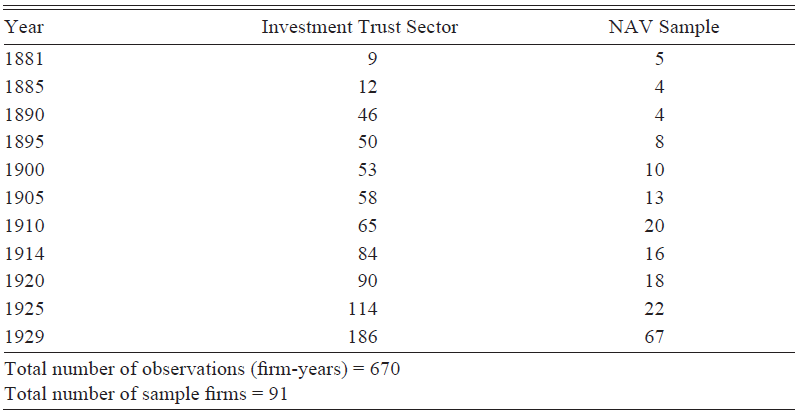
After a careful inspection of the annual reports of all U.K. investment trusts, along with the accompanying Chairman’s statements, we were able to identify the exact figure for the portfolio market value of a sample of trusts for several years between 1880 and 1929. The aggregate portfolio market value was provided as additional information and was not integrated into the balance sheet. The market value of the portfolio was at the date when the accounts were made up and verified by the auditors (Glasgow Reference Glasgow1930; Campbell Reference Campbell1924; Wright Reference Wright1924). For these investment trusts, we were able to calculate an exact figure for the NAV by applying Equation (1). Table 1 compares this sample with the total of incorporated investment trusts in the United Kingdom for selected years between 1880 to 1929. A detailed list of the firms in our sample along with the number of NAV observations corresponding to each firm are described in Appendix Table 1. Our sample has the structure of an unbalanced panel dataset. As we see in Table 1, there are 670 NAV observations (firm-years), which correspond to 91 different investment trusts.Footnote 10
OUR SAMPLE IN RELATION TO THE INVESTMENT TRUST SECTOR FOR SELECTED YEARS BETWEEN 1880 AND 1929

Notes: We have excluded three outliers from the sample. For more information about our sample, see Appendix Table 1. A detailed list of English and Scottish investment trusts is provided by the three studies conducted by George Glasgow (Reference Glasgow1930, Reference Glasgow1932, Reference Glasgow1935): one in 1930 on English investment trusts; one in 1932 on Scottish investment trusts; and one updated and revised study in 1935 of both English and Scottish investment trusts. Glasgow’s studies offer important insights into the workings of the investment trust industry from its origins up to the 1930s, carefully distinguishing investment trusts from financial trusts that pursued a different investment strategy (for more discussion see Sotiropoulos, Rutterford, and Keber Reference Sotiropoulos, Rutterford and Keber2020).
Sources: Our dataset and Glasgow (Reference Glasgow1930, Reference Glasgow1935).
For the investment trusts in the sample, we obtain the discount to NAV per share, DISC it, from Equation (2):
 $$DIS{C_{it}} = {{NA{V_{it}} - N \cdot S{P_{it}}} \over {NA{V_{it}}}},$$
where SP it is the ordinary share price and NAV it is the NAV of investment trust i in year t. We multiply the ordinary share price SP it by the number of issued shares N to get the market value of the ordinary share capital. Ordinary share prices are not included in the company’s annual reports. In our calculations, we have used the SEYB to obtain share prices.
For every firm, the annual issues of the SEYB offer information on the accounting month, that is, the month in which each firm publishes its annual accounts and related financial statements. The SEYB also reports the market prices of the trusts’ issued shares and bonds. It is not clear whether these prices refer to the month of the companies’ accounting year-end or are collected toward the end of the calendar year when the SEYB was published. Our assumption is that the SEYB market prices are prices for the company’s financial year end. To check this hypothesis, we compared as many monthly prices—taken from the Investor’s Monthly Manual (IMM) at the end of the reporting month for each trust—as were available for the trusts in our sample against the corresponding SEYB market prices. The correlation we got was almost perfect (correlation coefficient equal to one, p-value = 0, and R-squared = 0.999). This suggests that the SEYB market prices correspond to the same month as the other NAV components we collected from the SEYB. The big advantage of the SEYB is that it offers easy and reliable access to a wide range of market prices for all trusts, including Scottish investment trusts, which were not reported in the IMM nor the Stock Exchange Daily Official List. Using the SEYB data increases our NAV observations from 208 to 670.
Additionally, for each firm-year in our dataset, we were able to collect information from the SEYB about several company-level variables, for use in our analysis, such as paid-up capital of the trust, which allowed us to calculate the leverage of each trust every year.
SHARE PRICES AND NAVS BEFORE THE 1930S
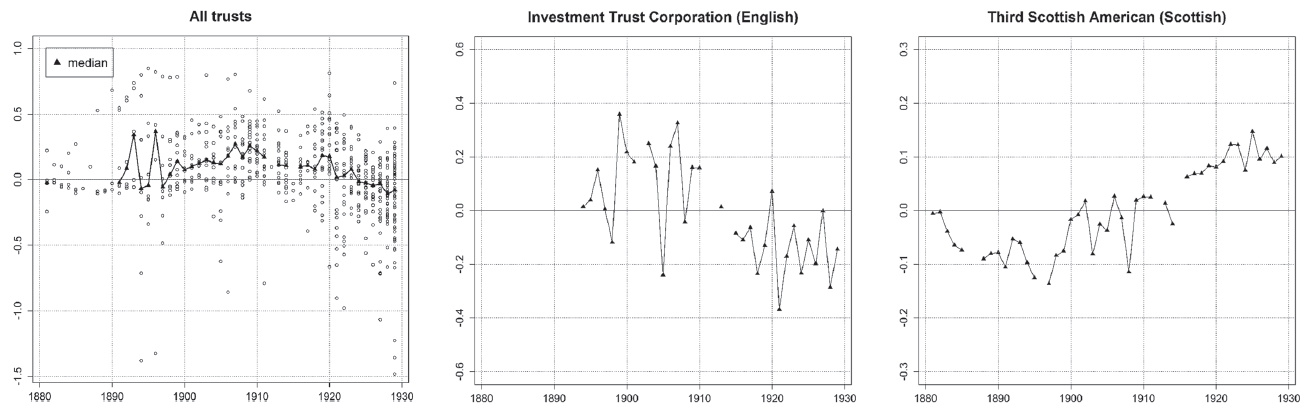
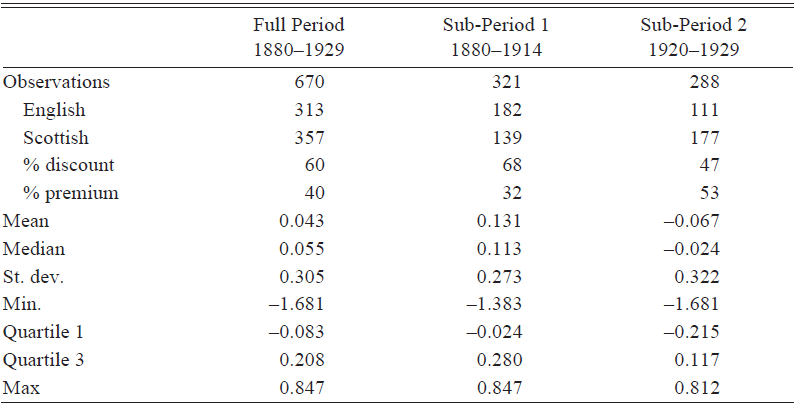
If markets efficiently disseminate information and investors are “rational,” the discounts to NAV, as defined by Equation (2), should not be far from zero. Share prices should closely match the NAVs per share for every firm i and year t. We know from the existing literature that, in post-1960 financial markets, for example, closed-end trust shares traded at substantial discounts or premia. Figure 1 shows that this was also the case in U.K. financial markets before the 1930s. The figure presents the calculations of discounts (or premia if negative) for the U.K. investment trusts in our sample. It also shows the historical trend of discounts for two selected investment trusts (both trusts with many observations over time). Table 2 additionally reports some descriptive statistics for our sample. Following de Long and Shleifer (1991), we have omitted outliers with a very high premium to NAV or with a negative NAV (this leads to an extreme discount).Footnote 11
DISCOUNT TO NAV ON CEF IN PERCENTAGE POINTS
Notes: The calculations are based on Equation (2). The NAV corresponds to the reporting month of the year, which was not the same for each investment trust. The share price comes from the SEYB as explained in the text.
Sources: Our dataset and SEYB. See Sotiropoulos, Rutterford, and Tori (2022).

DESCRIPTIVE STATISTICS OF DISCOUNTS TO NAV FOR OUR SAMPLE

Notes: We have excluded 3 outliers from the sample.
Source: Our dataset. See Sotiropoulos, Rutterford, and Tori (2022).
As we see from the first chart of Figure 1, there is considerable cross-sectional variation in the discounts to NAV for our sample. The ordinary shares of only a few trusts traded at market prices comparable to NAVs. The median discount captures the central tendency (the mean would be sensitive to the extreme variation in the distribution of discounts). Before the 1920s, trust shares typically traded at a discount, but this was reversed in the 1920s when there was a general trend toward trading at a premium to NAV. This is also clear from Table 2. Before WWI, the median discount was 11.3 percent, but this switched to a 2.4 percent premium by the 1920s. The number of investment trust shares that traded at a premium, as a percentage of the sample, increased from 32 percent before WWI to 53 percent in the 1920s. The examples of the two investment trusts in Figure 1 offer some evidence that the discounts/premia to NAV of individual investment trusts fluctuated substantially over time. It is worth noting at this point that our sample is an unbalanced panel with more observations in the 1920s than in each of the four previous decades. To our knowledge, in addition to the study of Chambers and Esteves, De Long and Shleifer (1991) is the only other study to explicitly investigate the discount puzzle from a historical perspective. The authors calculated the discount to NAV for a small sample of U.S. closed-end trusts around the crash of 1929 and used this calculation to estimate overall investor sentiment on the eve of the crash. Their results show that the median CEF sold at a premium of 37 percent in the first quarter of 1929. This median premium further rose to 47 percent in the third quarter of 1929, before retreating to a median discount of 8 percent in December 1929. There was also a huge variation in the difference between share prices and NAVs across investment trusts, ranging from a premium of 160 percent to NAV to a discount of 50 percent (De Long and Shleifer 1991, p. 864). We find that our results also reveal large differences between investment trust share prices and NAVs per share—these differences are as variable as the range shown by De Long and Shleifer (1991). Chambers and Esteves (Reference Chambers and Esteves2014, p. 14), in a case study of the Foreign and Colonial Investment Trust Company, investigated the difference between the share price and the NAV for this investment trust. They estimated that between 1880 and 1913, the discount to NAV averaged 8 percent, 11 percent, and 17 percent, depending on whether one priced the unquoted/private securities in the trust’s portfolio at 25 percent, 50 percent, and 75 percent of their par value. The shortcoming of this calculation is that it relies on hypothetical valuation scenarios that treat all unquoted/private securities in the same manner. In contrast, our calculations, as well as De Long’s and Shleifer’s analysis, are based on the NAV figure provided to investors by the directors.
EXPLANATIONS OF CLOSED-END TRUST PUZZLE FROM A HISTORICAL PERSPECTIVE
How can one explain the mismatch between an investment trust’s share price and its NAV per share, the so-called “fundamental value?” In other words, why did investors choose to buy/hold investment trust shares trading at very different discounts or premia to underlying values?
One possible answer is that investors were naïve, paying no attention to either investment trust portfolio strategies or the underlying NAVs. There are reasons to doubt that this is a convincing explanation. De Long and Shleifer (1991, pp. 686–7) offer some qualitative evidence that the comparison between the ordinary share price and the NAV of a closed-end trust was discussed in the United States in the press and among financial analysts just before the crisis of 1929. There is evidence that the same was happening in the United Kingdom long before the end of the 1920s. For instance, in an article about the Railway Share Trust and Agency on 28 February 1920, The Times discusses the discount to NAV in relation to the ordinary share price as something that would be attractive to investors:
The directors were happy in being able to pay 5 per cent on the deferred stock. That was the highest dividend for five years past, and they trusted to be able to continue to pay it. The board could congratulate the shareholders on the position to which the company has attained. The yield on the deferred stock at the market price was no less than 8 per cent, and the break-up value on the balance sheet presented was about £122, whereas it stood in the market at £61 (The Times, 28 February 1920, p. 23).
In this case, the directors themselves provided the information that the discount to NAV was about 50 percent, presenting it as an opportunity for investors. In other cases, observers used whatever information was provided by the annual accounts and the directors to make their own estimates about discount/premia to NAV.Footnote 12 It seems that experienced U.K. investors, advisers, and analysts were able to follow and understand the connection between the NAV and the price of ordinary shares. Other factors must be sought for the explanation of the price mismatch.
Studies of the closed-end pricing puzzle in more recent decades have tested a number of possible explanations. The first systematic attempt to investigate this puzzle came from Malkiel (Reference Malkiel1977), although the issue was already discussed in the 1960s by academics and practitioners (Pratt Reference Pratt1966; Doane and Hills 1962). Since then, the topic has attracted a great volume of research and debate. There are two broad approaches to this pricing puzzle: “(a) the investor sentiment theory, which invokes the irrational behavior of small investors,” and (b) several models that “utilize the trade-off between CEF managerial costs and CEF investment services to offer a rational explanation for the puzzles” (Cherkes Reference Cherkes2012, p. 433; see also Lee, Shleifer, and Thaler Reference Lee, Shleifer and Thaler1991). The first approach draws upon behavioral finance and challenges the main principles of neoclassical finance (Ross Reference Ross2002, p. 133). Prices reflect investor psychology, which is unrelated to market fundamentals. The second approach reverses the argument. It argues that investors are rational and market prices are always correct; the puzzle is therefore due to the fact that NAVs do not account for all fundamental factors reflected in market prices.
The rest of this paper is focused on three possible explanations of the pricing puzzle, that are relevant to the period we investigate. It examines to what extent investment trust pricing before the 1930s can be explained by: (i) faulty estimates of NAV based on the unlisted portfolio holdings; (ii) leverage opportunities offered by investment trusts and related trust performance; and (iii) the investor sentiment hypothesis.
NAV ESTIMATES AND UNLISTED SECURITIES
Valuation procedures have been suggested as a possible explanation for the CEF pricing puzzle. According to this argument, private/ unlisted securities held by a CEF may be overvalued by the directors when estimating NAV. Investors may not be prepared to pay in full for the “inflated” NAV, thus correcting potential opportunistic valuations by the directors (see Lee, Shleifer, and Thaler Reference Lee, Shleifer and Thaler1991, pp. 78–9; Malkiel Reference Malkiel1977; Cherkes, Sagi, and Stanton Reference Cherkes, Sagi and Stanton2009; Dimson and Minio-Kozerksi 1999, pp. 10–11). One would thus expect a positive relationship between the port-folio weight of unlisted or private securities valued by the directors and the discount to NAV. However, this link is far from unambiguous. During the period under consideration, U.K. investment trusts had a strong reputation for the quality of their reporting and conservative bookkeeping.Footnote 13 Investors might well have been ready to pay a premium to NAV if they believed the valuation of unlisted securities to be conservative.
U.K. investment trusts generally avoided “unquoted securities” (Campbell Reference Campbell1924, p. 298; see also Glasgow Reference Glasgow1935; Robinson Reference Robinson1923; Rutterford 2009). As explained by Campbell (Reference Campbell1924, p. 298), unlisted securities “are not easily realizable, and most companies avoid this class of investment, except in special cases, as the investment of their funds in marketable securities has been found an excellent safeguard.” In their analysis of the Foreign and Colonial Investment Trust before 1913, Chambers and Esteves (Reference Chambers and Esteves2014, p. 14) used an expanded definition of unlisted securities (which comprised securities privately held, infrequently traded, or quoted on a smaller regional stock exchange) and estimated that these “unlisted” securities represented between 10 percent and 15 percent of total portfolio value between 1880 and 1914. This implies that the actual proportion of the unlisted securities was lower than 10 percent of the portfolio value.
Could there be any link between unlisted/private securities and discounts for the U.K. investment trusts in our sample?Footnote 14 Considering the reporting standards followed by investment trusts before the 1930s, we believe that the answer is in the negative. The vast majority of investment trusts disclosed either the list of the underlying portfolio investments in nominal values or the total market value of their portfolios (based on directors’ estimates of the market value of the unlisted securities). When NAVs were provided by directors, investors did not have access to the underlying portfolios to enable them to estimate the potential value of the unlisted securities and challenge directors’ valuations. When lists of portfolio holdings were provided, investors did not have any directors’ estimates for comparison. The portfolio weighting of unlisted securities cannot explain the variation in the results shown in Figure 1.
A possible challenge to the above argument could be that investors might have had a good idea (or inside information) about the underlying portfolio holdings of the trusts that did not disclose the lists of their investments. While it is not unreasonable to assume the investors had some “broad” idea of the underlying investment approach applied by directors—company general meetings could be places for this type of discussion—there is plenty of textual evidence that investors did not have access to the detailed list of portfolio holdings for the trusts in our sample.
An investment trust choosing to keep the details of its portfolio investments secret did so for a reason: to avoid “laying open to the public and to rivals the benefit of all its skill and experience” (Campbell Reference Campbell1924, p. 301)—or, as Robinson (Reference Robinson1923, p. 7) put it, these investment trusts felt that “they would be handicapped in realizing on their holdings if knowledge of the extent of these holdings were public property” (see also Glasgow Reference Glasgow1935; Morgan and Thomas Reference Morgan and Thomas1962). There was no reason for these trusts to give away what they thought was their competitive edge. According to Parkinson (Reference Parkinson1932, p. 184), in these cases, investors gave directors “the nearest equivalent, under British Company Law, of a blank cheque”— ruling out any channel for inside information as to the portfolio investments. Having trust in the directors (the “personal side,” as put by Ripley (Reference Ripley1934, p. 127)) was thus the most important—and perhaps the only— substitute to offset this lack of portfolio information. Investors would offer a “blank cheque” only to managers they trusted: “if the stockholders are satisfied with their directors, it is probably both unnecessary and unwise to ask them to disclose their selection of investments” (Campbell Reference Campbell1924, p. 301). In the same fashion, Sturgis (Reference Sturgis1924, p. 171) argued that the success of an investment trust was “entirely and absolutely dependent upon the character of its management” and, therefore, “almost the only question which the prospective investor in such a trust need ask is, who are the men who will handle the fund?” (see also Parkinson Reference Parkinson1932, p. 184–5). In addition, MoodyFootnote 15 argued that, in the case of trusts that did not disclose the lists of their portfolio investments, it is only the “financial reputation of the Board and Management” that can indicate “how an investment trust company earns its dividends.” It is thus safe to conclude that, when investment trusts decided to keep their investment lists secret, there was no way for investors to get this information.
Trust in directors’ asset management skills was equally important for investment trusts that provided the lists of their investments. The reason is that the shareholder could not, in practice, estimate the trust portfolio’s market value from the very long list of portfolio holdings. The average number of portfolio holdings per trust was close to 300, with some investing in more than 700 securities (Sotiropoulos, Rutterford, and Keber Reference Sotiropoulos, Rutterford and Keber2020). It would have been impossible for the individual investor to keep close track of the market values and returns of the numerous portfolio holdings and calculate the market value of the portfolio: “Not only would it involve days, if not weeks, of arithmetic for a single individual to do the job, but even the arithmetic would be impossible unless one had relations with several Stock Exchanges and received the list prices of the securities quoted thereon” (Glasgow Reference Glasgow1935, p. xxvi). It is exactly for that reason that, according to Glasgow, offering the portfolio market value “is a more valuable piece of information to proprietors in general than a published list of investments” (Glasgow Reference Glasgow1935, p. xxvi). In addition, Ripley (Reference Ripley1934, p. 127) warned against mistakes by investors in the calculations of portfolio values.
Unlike modern financial markets, matching NAVs to market share prices was extremely difficult in U.K. markets before the 1930s, even when investors had full details of the portfolio investments—and in most cases, they did not. It appears, therefore, unlikely that the prevalence of unlisted securities in trust portfolios can offer a reliable explanation for the variation in NAV discounts/premia.
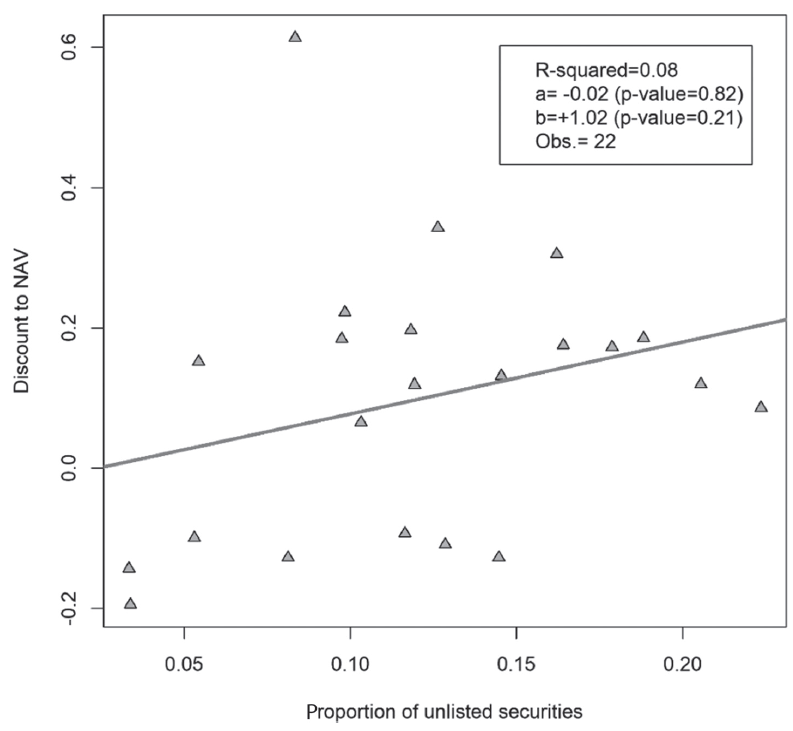
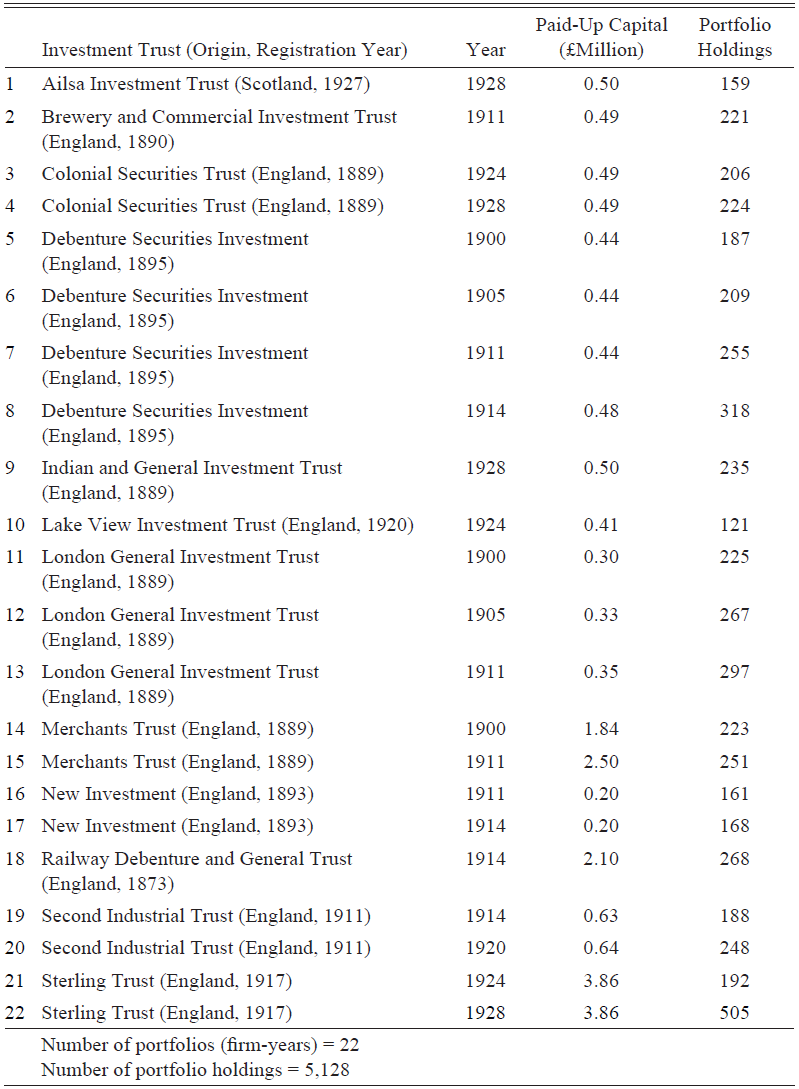
There are, however, very few exceptions to the binary reporting rule between providing investment lists and portfolio market values. We managed to identify a small subsample in our data for which both portfolio holdings and directors’ estimates of portfolio market value are available. This subsample comprises 22 observations of NAVs and associated lists of portfolio holdings, equivalent to 5,128 securities. The subsample is described in Appendix Table 2 and is very small in relation to our main sample, which contains 670 observations of NAVs that may correspond to as many as 201,000 securities (assuming an average portfolio of about 300 securities; Sotiropoulos, Rutterford, and Keber Reference Sotiropoulos, Rutterford and Keber2020). However, these 22 observations allow some preliminary descriptive analysis. From the investment lists, we were able to identify the characteristics of each security from its description. We also used information from the IMM and the SEYB to see whether each security in this subsample could be categorized as listed (this applies to securities listed both on the LSE and on the provincial stock exchanges) or unlisted. According to our findings, unlisted securities represented on average 12 percent of the portfolio par value, which is close to the calculations by Chambers and Esteves (Reference Chambers and Esteves2014) for the Foreign and Colonial Investment Trust. This average is the same both before and after WWI. Figure 2 shows that there is no relation between the proportion of unlisted securities in the portfolio and the discount to NAV.
RELATIONSHIP BETWEEN THE NOMINAL SHARE PROPORTION OF UNLISTED SECURITIES IN THE PORTFOLIO AND THE DISCOUNT TO NAV
Notes: All overseas securities, which are not listed on domestic financial markets, are categorized as “listed.” The legend on the table reports cross-sectional regression results for the equation: y it = a + b·x i + u it, where y it is the discount to NAV, as defined by Equation (2), and x it is the percentage of unlisted securities in the portfolio (in nominal values).
Sources: Our dataset, SEYB, and IMM. See Sotiropoulos, Rutterford, and Tori (2022).

LEVERAGE AND MANAGERIAL SKILLS
This section continues with explanations that are consistent with the assumption that investors’ valuations are rational. It discusses two possible factors that were relevant to the period we investigated: leverage and managerial skills.
Leverage
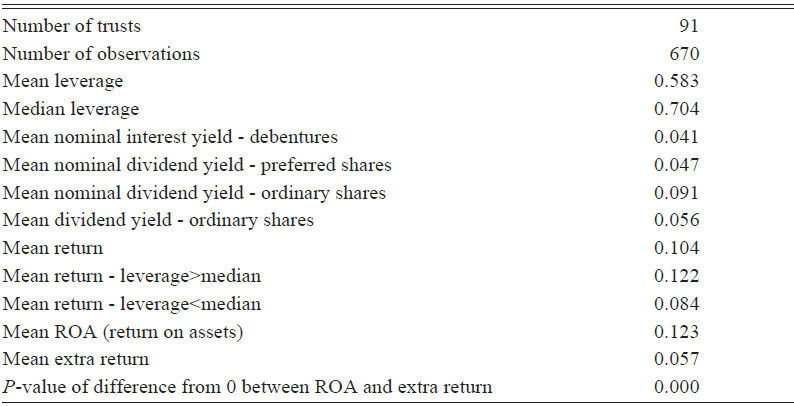
Leverage has been offered as an explanation for discounts to NAV (see Elton et al. Reference Elton, Martin Gruber, Blake and Shachar2013). The argument is that CEFs, as opposed to open-end funds (the latter the so-called “fixed” trusts in the United Kingdom before the 1930s, Parkinson Reference Parkinson1932, p. 190), offer investors the opportunity to leverage their portfolio investments at low borrowing rates, lower than the borrowing costs that individual investors would face, while enjoying the benefits of limited liability and diversification. Individual investors, with restricted access to borrowing, can thus use investment trust shares to move to a different part of the risk-return spectrum, something that they could not do on their own on such good terms. They might well be ready to pay a premium for this. As we can see in Table 3, this argument is certainly relevant to the United Kingdom before the 1930s, when investment trusts were successful in securing low financing costs on debentures and preferred shares.Footnote 16 Investment trusts in our sample could raise money on average at a fixed rate of about 4 percent for debentures or 4.75 percent for preferred shares in relation to par values. This is considerably lower than the 9.1 percent nominal dividend yield for their ordinary shares. It is evident that U.K. investment trusts systematically used their low borrowing costs to increase investors’ returns.
EFFECT OF LEVERAGE ON ORDINARY SHARE RETURNS

Notes: See the text for the definition of the extra return. Leverage is equal to the fixed income paid-up capital of the trust, which includes both preferred shares and bonds, divided by all issued and paid-up capital of the trust, all in nominal values. We have excluded outliers (2.5 percent from each tail) in the calculations of the mean return and the mean ROA.
Source: Our dataset and the SEYB. See Sotiropoulos, Rutterford, and Tori (2022).
In our calculations, leverage is equal to the fixed-income element of the paid-up capital of the trust, which includes both preferred shares and bonds,Footnote 17 divided by all issued and paid-up capital of the trust in nominal values. We obtained the data from the SEYB. U.K. investment trusts operated with high leverage to exploit low fixed costs. Table 3 shows the median amount of leverage of our sample is about 70 percent. Our results also show that more highly leveraged trusts generated higher total share returns.
Table 3 also shows that investment trusts earned on average additional income for ordinary shareholders, using the additional investment funds available from leverage. This incremental return is defined as the return on total assets (ROA) less borrowing costs.Footnote 18 On average, the return earned on the assets financed using leverage is about 6 percent higher than the total borrowing costs, which is statistically significant at the 1 percent level (when compared with the average ROA). Reassurance about the dividend yield in relation to borrowing costs was a key aspect in directors’ communications to investors (see, for instance, Financial Times, 4 May 1929, p. 11; Gilbert Reference Gilbert1939).
Managerial Skills
Another important explanation in the literature is linked to managerial skills in keeping costs down and in generating better than average performance (Malkiel Reference Malkiel1977, p. 851; Thompson Reference Thompson1978; Dimson and Minio-Kozerski Reference Dimson and Minio-Kozerski1999, p. 12). Such skills might induce investors to pay a premium for investment trust shares.
This argument is plausible for the period we are investigating. As already mentioned, there is a large amount of evidence indicating that directors’ asset management skills were the most important factor in investors’ decisions and perhaps the only reliable information, especially for trusts that did not disclose the lists of their investments (like the trusts in our sample). Parkinson (Reference Parkinson1932, pp. 185–6) argues that ordinary share-holders’ returns in investment trusts “depend entirely on the managers’ ability to re-invest their funds.” This is why, according to the same author, when investors subscribe for new investment trust shares, “the really important names, frequently, are those of the managers of the trust”; more specifically, “the investor has a right to know what other trusts are managed by these interests, and what their results have been as regards earnings and dividends during, say, each of the previous five years” (Parkinson Reference Parkinson1932, pp. 185–6). Almost all analyses or reports about U.K. investment trusts before the 1930s have similar comments concerning the importance of directors’ skills and experience (Sturgis Reference Sturgis1924, p. 171; Glasgow Reference Glasgow1935; Ripley Reference Ripley1934, p. 127–8; Robinson Reference Robinson1930; Wright Reference Wright1924).
It is likely that investors were prepared to reward superior investment performance skills more than cost-cutting skills because the costs were mainly directors’ fees, and these were fixed and generally relatively small for the period up to 1929 in relation to company capitalization or annual profitability.Footnote 19 The number of directors on the board remained generally stable over time as well.Footnote 20 It would thus appear that the level of directors’ fees is not an explanatory factor for the discount to NAV. This point has also been made in contemporary studies of the closed-end puzzle since, in the modern investment trust industry, directors’ fees are typically a fixed percentage of NAV and do not fluctuate as much as discounts.Footnote 21
Regression Analysis
In light of the earlier discussion about leverage and managerial skills, we perform a set of panel data regressions to better understand the relationship between these potential explanatory factors and discounts to NAV. Our baseline model is given by the following equation:
 $$\Delta (DIS{C_{it}}) = {c_i} + {\lambda _t} + {\beta _1} \cdot \Delta (Performanc{e_{it}}) + {\beta _2} \cdot \Delta (Leverag{e_{it}}) + {\varepsilon _{it}},$$
where Δ(DISC it) is the change in the investment trust discount (premium if negative) to NAV for firm i in year t in relation to the previous year t – 1.Footnote 22 As already defined, the leverage variable is equal to the fixed income paid-up capital of the trust (including both preferred capital and bonds) divided by all issued and paid-up capital of the trust in nominal values. The performance variable is a proxy for managerial skills, which is basically an unobserved variable. In our regression analysis, we have used three alternative proxies for performance: the rate of return on ordinary shares, the return on total assets, and the nominal dividend yield. The rate of return on ordinary shares is the actual performance obtained by the investor from the percentage change in the investment trust share‘s market value plus the dividend income yield from the share. The rate of return on total assets (ROA) includes both dividends and capital gains from all the investment trust’s portfolio holdings. This is the realized performance of the portfolio. The nominal dividend yield (i.e., the ratio between the nominal dividend and the nominal value of the investment trust share) assesses the effect of dividend rates on the discount to NAV (consistent with a standard model of forward-looking stock prices, see Demsetz and Villalonga (Reference Demsetz and Villalonga2001)). The inclusion of this variable is also consistent with the historical evidence about managers’ priority to reassure investors about performance.
In addition to financial returns, experience in asset management or management, in general, might also indicate directors’ skills. However, boards of directors for the U.K. investment trusts as well as interlocking directorships of these boards with other trusts or economic sectors did not change over time.Footnote 23 As mentioned previously, the same applies to directors’ fees. These variables do not appear in Equation (3) because their changes are practically zero. The specification also includes individual effects c i and year effects λ t. The year effects capture all potential macroeconomic variables that may affect discounts and are the same for all trusts. For instance, a possible change in investors’ sentiment would have the same influence on the discounts of all trusts in year t, and λ t will account for that effect. The same applies to all other possible macro-economic variables that may reflect economic “fundamentals” such as growth or inflation.Footnote 24 In addition to these considerations, the inclusion of individual and time effects provides standard errors that are not biased by serial and cross-sectional correlation effects, which, according to the results from the Lagrange Multiplier (Breusch-Pagan) test, are indeed present in our panel.
Specification (3) is the starting point for our analysis of the relationship between performance and discounts to NAV. We also include a dynamic component in the relationship between performance and discounts, employing the lagged value of the change in the discount Δ(DISC it–1) as an additional explanatory variable. The rationale for including this term is twofold. First, if the behavioral explanation of variations in discount is correct, that is, investment trusts’ discounts to NAV represent “irrational” deviations from fundamental values, one should expect either a positive or insignificant (small in magnitude) sign for the lagged discount. If, on the contrary, investors were rational, the process should be described by a negative sign indicating a “learning process” from the investors’ point of view (mean-reverting). Therefore, the expected sign of the lagged value of the change in the discount is ambiguous. Second, the lagged dependent variable acts as a proxy for any other factor associated with variations in the dependent variable at time t otherwise difficult to account for, and that would be included in the error term. Therefore, including this additional explanatory variable yields more accurate estimated parameters, while at the same time testing for the robustness of the effects of the other explanatory variables.
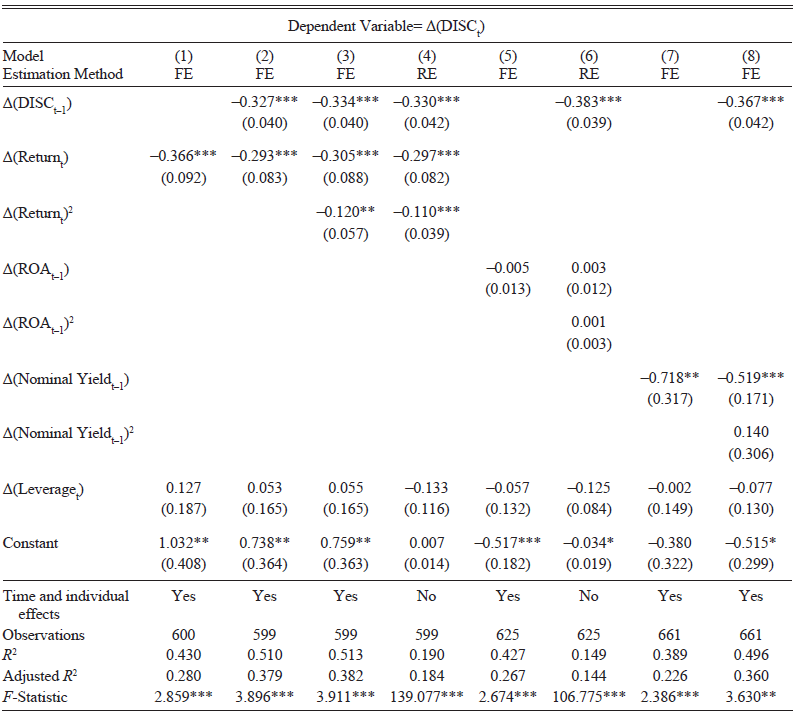
Table 4 shows our regression results. We estimate all our models with a standard OLS estimator. In the regressions in Columns (3), (6), and (8) we additionally investigate whether discounts are oversensitive to performance, introducing the squared change in returns as an additional explanatory variable. More generally, a quadratic form is relatively less restrictive than the simple linear specification.
REGRESSION RESULTS FOR THE DISCOUNT TO NAV

*= Significant at the 10% level.
** = Significant at the 5% level.
*** = Significant at the 1% level.
Notes: FE= fixed effects estimation; RE= random effects estimation. The table reports robust standard errors in parentheses to account for serial correlation and cross-sectional dependence. In our estimations, we have followed the double clustering approach suggested by Petersen (Reference Petersen2009), Cameron, Gelbach, and Miller (Reference Cameron, Gelbach and Miller2011), and Thompson (Reference Thompson2011). For more details on this robust standard error estimator for panel models in R see Millo (Reference Millo2014).
Sources: Our dataset and the SEYB. See Sotiropoulos, Rutterford, and Tori (2022).
The primary insight from the results of Table 4 is the highly significant and negative relationship between changes in returns on trusts’ ordinary shares and changes in discounts to NAV. In addition, our results suggest a concave non-linear relationship. A positive change in realized returns reduces discounts (or increases premiums), with the magnitude of this effect becoming stronger as returns get bigger. The same is not true for the overall performance of the portfolio. The ROA has an overall statistically insignificant effect on the discount. This may imply that investors were more interested in monitoring what they gained (dividends plus capital gains) rather than the trust results (part of which was booked as reserves). This finding is in line with the textual evidence we presented earlier, according to which realized returns of ordinary shares were the most important factor for ordinary shareholders. In addition, the relationship between the lagged difference in nominal dividend yield (investors acted based on past dividends and they may not know the dividend at time t in the NAV reporting month) is negative and significant. We do not find evidence of a non-linear effect as we do in the case of the return on ordinary shares.
The estimated coefficient for the lagged value of the change in discount is statistically significant at the level of 1 percent and negative in all the specifications in which it is included. This suggests a positive change in the discount to NAV at time t – 1 would lead to a negative one in the following period t, indicating a tendency toward stability over time. This finding agrees with the calculations of Chambers and Esteves (Reference Chambers and Esteves2014, p. 14) for the Foreign and Colonial Investment Trust before WWI, in which discounts never stayed at low levels for long, tending to revert to their long-run mean. The mean-reverting tendency is extra evidence that U.K. investors had some understanding of the underlying “fundamentals” and that, despite the mismatch between prices and NAVs, they took action to correct this mismatch.
Our regression results for leverage are not statistically significant and their sign is not consistent across different specifications. The argument that investment trusts represent an opportunity for constrained investors to leverage their portfolios at low borrowing rates does not hold for our sample. Columns (4) and (6) of Table 4 present the estimates for random effects models since the results from the standard Hausmann specification test returned a borderline rejection. The random effects model accounts for issues related to small sample properties as well as the cross-sectional dimension of the variation in the dependent variable (this model is a weighted average of the pooled, fixed, and between effects estimations).
The significance, signs, and magnitudes of the estimates are consistent between models.Footnote 25
INVESTOR SENTIMENT THEORY
A Test Based on a Two-Factor Pricing Model
Investor sentiment theory has been used as a possible explanation for the mispricing puzzle by de Long and Shleifer (1991) in their investigation of U.S. CEFs in 1929. The authors’ argument was based on a model developed by de Long et al. (Reference De Long, Andrei Shleifer, Summers and Waldmann1990) and Lee, Shleifer, and Thaler (Reference Lee, Shleifer and Thaler1991). This line of research has triggered a large volume of follow-up studies and debates, most of which use CEF discounts to NAV as a measure of investor sentiment—a nowadays standard assumption.Footnote 26
The key idea behind the investor sentiment hypothesis is that market mispricing related to the shares of CEF is a reflection and measure of the sentiment of individual investors.Footnote 27 These investors—sometimes referred to as noise traders—are the predominant holders and traders of smaller stocks (i.e., shares of firms with low market capitalization), as well as the shares of CEFs, and are driven by irrational sentiment factors, led by waves of optimism or pessimism. In contrast, shares of large firms have high institutional ownership. Institutional or sophisticated investors would thus determine the share prices of firms with large market capitalizations. On the contrary, investor sentiment in low-capitalization shares would create higher share price volatility. In the absence of perfect arbitrage opportunities, rational investors will require an additional return to compensate for this higher investor sentiment risk.
An argument based on the distinction between ordinary and institutional/sophisticated shareholders cannot explain the U.K. financial markets before the 1930s. It is well-known that U.K. financial markets before WWII predominantly comprised individual investors while institutional ownership was very low in comparison with modern standards (see also Morgan and Thomas Reference Morgan and Thomas1962; Cheffins Reference Cheffins2008; Rutterford and Hannah Reference Rutterford, Hannah, Chambers and Dimson2017; Rutterford and Sotiropoulos Reference Rutterford and Sotiropoulos2017). In the absence of a strong presence of institutional investors, the argument by Lee, Shleifer, and Thaler (Reference Lee, Shleifer and Thaler1991) regarding investor sentiment cannot offer a convincing explanation (or a related new source of risk).
Can we still associate discounts with investor sentiment? Investor sentiment is an unobserved variable, which is very difficult to be measured or proxied by another variable. This presents a big challenge to any empirical analysis. In our regression results described previously, the change in investor sentiment was assumed to be absorbed by time effects and was not estimated separately. To investigate the investor sentiment hypothesis, we employ a test similar to the one applied by Lee, Shleifer, and Thaler (Reference Lee, Shleifer and Thaler1991), which has become a benchmark in relevant research (e.g., Chen, Kan, and Miller Reference Chen, Kan and Miller1993; Elton, Gruber, and Busse 1998). However, we adjust the test to the conditions of the U.K. financial markets in the period we examine. Following Lee, Shleifer, and Thaler (Reference Lee, Shleifer and Thaler1991), we use the change in the median discount Δ(MD) as a proxy for investor sentiment.Footnote 28 Our hypothesis is as follows. To the extent that the investor sentiment hypothesis is correct, the change in the median discount will be a factor in the explanation of returns of all shares that have a similar investor profile to that of investment trusts. U.K. trusts issued ordinary stock or shares of par value £100, so we would expect the sentiment factor to appear in the valuation of all U.K.-listed ordinary shares with high denomination values.
A closer look at the U.K. financial markets during the period of our investigation justifies our hypothesis. Different levels of denomination appealed to different types of investors. Shares with a high denomination were chosen by companies that would like to target more wealthy and sophisticated investors (see Jefferys Reference Jefferys1977, p. 156). Very gradually, as we move into the 1920s and 1930s, share par values fell.Footnote 29 This allowed lower-income investors to join the stock market and motivated portfolio diversification (Jefferys Reference Jefferys1977, pp. 200–1). The great majority of investment trusts issued ordinary shares, with a par value of £100.Footnote 30 Our assumption is that the investor sentiment towards the shares of investment trusts would equally affect the valuation of all U.K.-listed ordinary shares with high denominations that presumably had a similar investor profile.
According to this argument, we assume that the expected returns for high-denomination shares would be described by the following two-factor asset pricing model:Footnote 31
 $${R_{it}} = {a_i} + \beta \cdot R{M_t} + \gamma \cdot \Delta (M{D_t}) + {u_{it}}$$
In this equation, R it is the return of portfolio i in year t; RM t is the market return in year t; MD t is the median discount to NAV in year t; a i is the non-systematic mean return of i; u it is the residual of i in year t. Ideally, it would be preferable to regress Equation (4) on monthly data, but our dataset includes annual discounts to NAV, so we can only have annual changes in the median discount Δ(MD t). In our calculations, we use annual data obtained from the IMM database. Returns of each ordinary share, whether in portfolio i or the market portfolio RM, are weighted by the market capitalization of the share. Table 5 reports the results of time series regression between annual returns of value-weighted portfolios comprising different bands of share nominal denomination (dependent variable), changes in the annual median discount to NAV, and the annual return on a value-weighted market portfolio of ordinary shares. Details for our calculations can be found in the notes to Table 5.
TIME SERIES RELATIONSHIP BETWEEN RETURNS OF SHARES WITH DIFFERENT DENOMINATIONS, THE MARKET RETURN, AND CHANGES IN THE INVESTMENT TRUST DISCOUNT (INVESTOR SENTIMENT)

Notes: The time-series relationship is estimated based on annual data. The annual returns of ordinary shares or stocks are calculated every year at the end of January and include both dividends and capital gains. Our calculation of annual returns thus follows the approach of Grossman (Reference Grossman2015); see also Hannah (Reference Hannah2018) for a discussion of the IMM data. Our results do not change if we use another reference month. Membership in each portfolio is determined at the beginning of each year and returns R it are weighted by the market capitalization also at the beginning of each year. For the market portfolio, we follow the approach of Acheson et al. (Reference Acheson, Campbell, Gallagher and Turner2021): RM t is the annual return of the market index of all ordinary stocks and shares, weighted by their market capitalization (we exclude 5 percent tail observations). Observations in our regression analysis begin in 1900; the estimation of the median discount is not reliable before 1900 due to a lack of NAV observations in our dataset.
Sources: Our dataset and the IMM. See Sotiropoulos, Rutterford, and Tori (2022).
The beta estimates in Table 5 are almost identical when these regressions are run without the Δ(MD t) variable (these regressions are not reported). The systematic risk is not affected by the presence of an additional covariate. For portfolios including high denomination ordinary shares and stocks, which presumably had the same type of investors as investment trusts, there is a negative relation between the change in the median discount and the expected returns. The negative sign confirms the prediction of the investor sentiment effect: shares are doing well when discounts shrink and investors become more optimistic (higher sentiment risk). This is consistent with the results of Lee, Shleifer, and Thaler (Reference Lee, Shleifer and Thaler1991), who also found that discounts were negatively correlated with returns on small-capitalization shares, despite CEFs not investing in them. However, the coefficient γ is not statistically significant.Footnote 33 The sign is reversed in low-denomination shares, which presumably appealed to a different type of investor, which is also consistent with our hypothesis.
Alternative Evidence for the Investor Sentiment Hypothesis
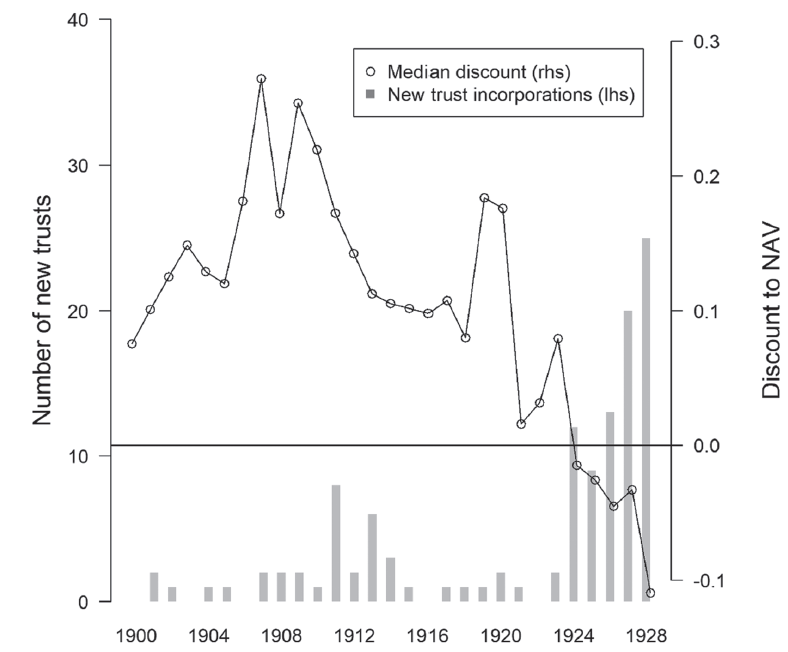
In a more descriptive manner, the investor sentiment explanation would predict that it is more likely for new investment trusts to get started when old/existing trusts are sold at premiums (Lee, Shleifer, and Thaler Reference Lee, Shleifer and Thaler1991, pp. 91–2). The argument is that when investors are optimistic, new funds are expected to be launched, taking advantage of the price premiums—although new trusts may not be perceived as perfect substitutes for existing trusts. Figure 3 shows the number of new trust incorporations in each year against the median discount to NAV after 1900. While there was at least one investment trust incorporated in most years after 1900, there was a significant cluster of new trusts in the 1920s, coinciding with a median premium to NAV. Another more moderate cluster before WWI was accompanied by a decline in the discounts, which also captures an optimistic change in investor sentiment. The evidence in Figure 3 supports the argument of investor sentiment.
THE NUMBER OF NEW INVESTMENT TRUST INCORPORATIONS IN RELATION TO MEDIAN DISCOUNTS/PREMIUMS
Notes: The number of new investment trust incorporations is for the whole investment trust sector, as described by Glasgow (Reference Glasgow1930, Reference Glasgow1932, Reference Glasgow1935); see also notes to Table 1. The line graph represents the median discount in each year and is measured on the vertical axis on the right-hand side. The bar graph represents the number of new investment trust incorporations started during the year and is measured on the vertical axis on the left-hand side. Our observations of this figure begin in 1900; the estimation of median discount is not reliable before 1900 due to a lack of NAV observations in our dataset.
Sources: Our dataset, and Glasgow (Reference Glasgow1930, Reference Glasgow1932, Reference Glasgow1935). See Sotiropoulos, Rutterford, and Tori (2022).

According to our results in Table 2, the average discount in the 1920s was reduced to –6.7 percent from 12.7 percent in the period before 1920 (the second figure is not reported). This is equal to a difference of about 20 percentage points. The average annual rate of return also improved, from 8 percent before 1920 to 15 percent after 1920, which is a 7 percentage points increase. However, as we see in Table 4, this increase in ordinary share performance would explain ceteris paribus about 10 percent to 35 percent of the change in the discount to NAV (using, for instance, the coefficients in models 1 and 3 of Table 4). This leaves a significant part of the average shift to premium in the 1920s unexplained. It may well be that investor sentiment was an important factor in explaining the move to premia in the 1920s, along with average improvement in performance.
CONCLUSIONS
While there is extensive literature on the performance of modern CEFs and the related CEF pricing puzzle, there is very little research using historical data for the same question before the 1960s. This is the first systematic attempt to study the CEF pricing puzzle in the context of the economic history of U.K. financial markets before the 1930s and to address related questions about investors’ behavior.
Our results show significant cross-sectional and time variation between share prices and underlying NAV, the so-called “fundamentals.”
Our analysis is based on a sample of 91 different investment trusts and 670 firm-years over a 50-year period between 1880 and 1929. We find a tendency for trusts to trade at a discount to NAV, but this tendency was reversed in the 1920s. The median discount was 5.5 percent for the whole period (the mean was 4.3 percent), but it became a 2.4 percent premium in the 1920s (the mean was 6.7 percent). However, these figures are accompanied by large levels of variation across investment trusts, ranging from 85 percent premium to 168 percent discount (after removing outliers). These results are consistent with the large variation in discounts in the U.S. financial markets in 1929 as well as the post-1960s closed-end pricing variations both in the United Kingdom and the United States. The CEF valuation puzzle is, as we show, a long-run historical phenomenon. We further investigated three main explanations for this puzzle that have been suggested in the literature and are relevant to financial market conditions in the United Kingdom before the 1930s.
Our sample includes investment trusts that did not disclose the lists of their investments. Since investors could not inspect the underlying portfolios, variations in the discounts to NAV cannot possibly be explained by investors’ reaction to valuation procedures applied by the directors— in particular, how directors valued unlisted securities. We provide textual evidence to support this argument.
Managerial skills seem to be a key factor in explaining variations in investment trust discounts/premia. To the extent that these managerial skills were captured by investment trust performance, our results show a robust relationship between discounts and realized returns: higher realized income and capital gains by investors were associated with lower discounts to NAV for investment trusts. This evidence implies that investors behaved quite rationally, rewarding managerial skills—which, according to textual evidence, appears to be the most important factor in investors’ decisions. Our analysis also offers evidence for mean-reverting behavior, with discounts showing a tendency toward some stability over time. This finding perhaps suggests that investors were concerned with - and corrected - high deviations in the valuation of ordinary shares.
Assessing whether investment sentiment drives investment trust valuation is a challenging task from an empirical point of view. In our analysis, we applied the benchmark empirical test, originally put forward by Lee, Shleifer, and Thaler (Reference Lee, Shleifer and Thaler1991), adjusted to the financial conditions of the U.K. markets before the 1930s. Using a conventional two-factor pricing model, we tested the hypothesis that investor sentiment would affect the valuation of all ordinary shares with a similar investor profile as the investment trusts. Our results confirm the predictions of investor sentiment theory. A more descriptive analysis of the new investment trust incorporations also shows that the investor sentiment hypothesis may hold. If this is the case, our analysis implies a mix of U.K. investor behavior: investors were ready to reward realized performance but may also have been driven by waves of pessimistic or optimistic sentiments.
One of the novelties of this study is that it examines this longstanding puzzle in a period that has not been researched before. Our analysis shows that the CEF puzzle was alive and kicking between 1880 and 1930 and that financial markets were not efficient from a “neoclassical” viewpoint. The puzzle seems to have a longer history than mainstream finance had thought.
OBSERVATIONS OF INVESTMENT TRUST DISCOUNTS/PREMIA

Notes: Investment trusts are sorted according to the number of available observations.
Source: Our dataset.
SUBSAMPLE FOR WHICH BOTH PORTFOLIO HOLDINGS AND OBSERVATIONS OF INVESTMENT TRUST DISCOUNTS/PREMIA ARE AVAILABLE

Notes: Investment trusts are sorted alphabetically.
Source: Our dataset.