


I. Introduction
Omnibus legislation – packaging numerous unrelated measures in one long bill, often enacted in a hastened process – has become a common practice in many countries.Footnote 1 Recently, it also became “an increasingly common feature of EU law-making,”Footnote 2 with the European Commission embracing it “as the principal mechanism for systematic deregulatory reform.”Footnote 3 While omnibus legislation has become popular among some governments and lawmakers, it is also a highly controversial lawmaking mechanism, and is a matter of intense debate and criticism. Its advocates praise its effectiveness, whereas critics see it as anathema to good lawmaking and a threat to democratic and rule-of-law principles.Footnote 4
This led legal scholars in various countries to ask whether courts should play a role in regulating the use of omnibus legislation and help curb excessive or at least egregious uses of this legislative practice.Footnote 5 A common assumption is that in the absence of a constitutional prohibition on omnibus legislation via a “single-subject rule,” not much can be done.Footnote 6 The Israeli Supreme Court, however, developed a new procedural model of judicial review, which enables judicial review of this legislative mechanism, in the absence of formal rules limiting the legislature’s power to use omnibus legislation. This article provides an extensive, first of its kind, empirical study on whether and how the introduction of judicial review of omnibus legislation impacted its use in parliament. This study could be interesting for any jurisdiction dealing with omnibus legislation and contribute to this special issue about omnibus legislation and to the growing international debate on this subject.
It could also contribute to another field that is raising burgeoning global interest: the debates about judicial review of the legislative process. There seems to be agreement that we are indeed witnessing “the emergence of a global ‘procedural trend’… in the case law of several national and international courts.”Footnote 7 These developments have spurred academic interest in procedural models of judicial review, in which courts subject parliament’s legislative process to their review. However, a crucial question in this budding and vibrant debate has not been explored yet: how does judicial review of the legislative process impact legislative behaviour? This question is important because improving the legislative process seems to be a major justification underlying the turn towards judicial review of the legislative process.Footnote 8 As Judge Lenaerts, President of the Court of Justice of the European Union, observed, for example, “recent case-law reveals that the ECJ has also striven to develop guiding principles which aim to improve the way in which the political institutions of the EU adopt their decisions.”Footnote 9 Judge Spano, former President of the European Court of Human Rights, has similarly depicted the ECtHR’s turn to process-based review as a “democracy-enhancing” approach and explicitly highlighted its purpose to incentive national parliaments.Footnote 10 Similarly, in its recent “Guidelines on Democratic Lawmaking for Better Laws,” OSCE has explicitly called for adopting judicial review of the legislative process as a means to “enhance the quality of the lawmaking process,”Footnote 11 based on the assumption that judicial review that focuses on the enactment process may “have a substantial indirect influence on the lawmaking process, as the government and the legislature may then take greater care to follow the correct procedure to avoid legislation being overturned on such grounds.”Footnote 12 Academic advocates of process review have made similar claims.Footnote 13 Indeed, as one commentator observed, “Advocates of the varied family of process review doctrines often claim that courts thereby contribute to better lawmaking.”Footnote 14 He added, however, that “this is an empirical question on which no conclusive data are available.”Footnote 15 Due to the lack of empirical studies, “[t]he impact of [procedural] judicial review on legislative … behavior … remain[s] to be examined.”Footnote 16 This article fills this important gap in the scholarship while also contributing to the broader field of judicial impact studies.
Section II provides the theoretical background on omnibus legislation and its version in Israel called arrangement laws; on judicial review of omnibus legislation, including the seminal novel case that established such judicial review in Israel; and on the scholarship about judicial impact and the interbranch dialogue between courts and legislatures. Section III describes the study’s extensive multi-method methodology, including, inter alia, examining all arrangements laws over a period of twenty years and analysing their legislative debates from nearly 12,000-pages worth of committee debates. Section IV presents the findings on changes in legislative behaviour in the extent of use of arrangements laws and their legislative process. Section V presents findings from the content analysis of legislative debates, revealing legislators’ knowledge of the judicial decision and their anticipation of future judicial review, and exhibiting two types of judicial impact: persuasive and deterrent. Finally, Section VI presents findings from process-tracing that link the changes in the enactment of arrangements laws to the introduction of judicial review. Section VII concludes. The results offer a strong case for the potential of judicial review for regulating omnibus legislation and improving lawmaking.
II. Theoretical background
1. Omnibus legislation and arrangements laws
Omnibus legislation is the general legislative practice of enacting a long bill that packages together many unrelated measures. This bill is also often enacted in an expedited legislative process that deviates from regular order.Footnote 17 This legislative practice exists, under various names and versions, in many countries,Footnote 18 and recently, increasingly in the EU as well.Footnote 19
In Israel, omnibus legislation has been employed since 1985 in a specific type of law called the Arrangements Law. It is a large governmental bill, initiated by the Ministry of Finance, that combines, within a single bill, amendments of multiple laws in various unrelated subjects. It is enacted in an expedited timetable in parallel with the budget law.Footnote 20 Its original and stated purpose is to enact a package of legislative arrangements required to enable the implementation of the budget and the government’s economic program.Footnote 21 In practice, however, over the years, arrangements laws grew in size and scope and included a growing number of issues not directly connected to the budget.Footnote 22 They became one of the most powerful policy tools employed by the government for enacting its policy agenda, including major regulatory reforms. It facilitates the passage of legislation and helps the government overcome opposition and parliamentary scrutiny.Footnote 23
Given this last feature, omnibus legislation has become popular among governments in many countries. Its advocates see it as an efficient and effective lawmaking mechanism, enabling legislation that may otherwise be difficult to pass.Footnote 24 They perceive it as an overall justified institutional adaptation to challenging circumstances, particularly for gridlocked legislatures.Footnote 25 Yet, omnibus legislation is also a highly controversial lawmaking mechanism. Its critics see it as thwarting debate, deliberation, accountability, participation and parliamentary scrutiny. It is criticised as undemocratic and contrary to good lawmaking and rule-of-law principles and as undermining the quality of legislation.Footnote 26 In parliamentary systems, it is also often criticised as a tool used by the executive to force its will over parliament, thereby infringing the separation of powers.Footnote 27 Critics also point to abuses of omnibus legislation to pass stealth legislation and special interest provisions.Footnote 28 Recently, there is also greater awareness of the risks of omnibus legislation used as part of the “autocratic toolkit” to pass illiberal and autocratic reforms that lead to democratic backsliding.Footnote 29
Hence, there is great importance, and growing interest, in examining how the use, or at least abuse, of omnibus legislation can be limited or regulated. The comparative research suggests that once omnibus legislation is adopted in a certain legal system, it is nearly impossible to turn back the clock, and that relying only on political will for regulating the use of omnibus legislation is likely to be insufficient. Opposition parties often decry omnibus legislation and vow to “bring an end to this undemocratic practice,” yet, once they become the governing coalition, the temptation to continue using it is often too great.Footnote 30
This led legal scholars in various legal systems to ask whether judicial review can be employed to help regulate the use (and abuse) of omnibus legislation.Footnote 31
2. Judicial review of omnibus legislation
The traditional model of judicial regulation of the use of omnibus legislation has been through judicial enforcement of single-subject rules. These rules stipulate that each act of the legislature must be limited to a single subject.Footnote 32 A common assumption in many jurisdictions is that single-subject rules are required to enable judicial regulation of the use of omnibus legislation (or at least that absent such rules, there is little courts can do).Footnote 33 As Oliver-Lalana observes, “[t]he problem intensifies in formalistic legal cultures …: as single subject phrases are nowhere to be read in the [Constitution] or the parliamentary standing orders, our constitutional judges do not feel entitled to intervene.”Footnote 34
This presents two main challenges to employing judicial review to regulate the use of omnibus legislation. First, enacting a single-subject rule to curb legislative abuses might be politically unfeasible in many jurisdictions. Legislatures often lack the political will to pass meaningful institutional or procedural reforms that would curb their power,Footnote 35 and as noted in the previous section, this has also been the experience regarding curbing omnibus legislation. It is no wonder that single-subject rules are most prevalent in state constitutions in the United States, where their enactment was facilitated by the popular initiative power.Footnote 36 In many jurisdictions, the people lack such initiative power, and at any rate, enacting constitutional amendments require very strong political will and mobilisation. Second, the experience in states that do have single-subject rules suggests that they often fail to provide an effective and applicable tool for judicial regulation of omnibus legislation, largely due to difficulties in defining the concept of “subject” and in determining whether different parts of a bill are sufficiently related to be considered as dealing with a single subject.Footnote 37
Against this backdrop, the Israeli Supreme Court provides a particularly interesting and innovative alternative. There is no single-subject rule nor any other constitutional, statutory or even internal parliamentary rule prohibiting or limiting the use of omnibus legislation in Israel. Consequently, when the arrangements laws practice was challenged in court as an invalid legislative process, the Attorney General’s position was that even if this legislative mechanism may be problematic, as long as the legislative process was carried out in accordance with the powers given to parliament in its rules of procedure, “the mere fact that “excessive” or “improper” use was made of arrangement laws” cannot lead to judicial intervention or invalidation of the law.Footnote 38
In the seminal 2004 Poultry Farmers case, the Court acknowledged that existing rules of parliamentary procedure do not prohibit the use of arrangements laws legislation. It also acknowledged that all previous case-law stressed the need for great judicial restraint and deference when reviewing parliamentary procedures, and particularly the legislative process; including a previous precedent holding that expedited legislative processes are no ground to invalidate a law.Footnote 39 Nevertheless, the Court rejected the formalistic position that absent a single-subject rule there could be no judicial regulation on use of omnibus legislation: “the fact that the Knesset is authorized to follow a legislative process of the Arrangements Law type is not sufficient to lead to the conclusion that there is never any basis for judicial intervention in the legislative process.”Footnote 40 Hence, it developed a new doctrinal approach that would enable judicial review of the legislative process of omnibus legislation.
The Court held that the legislative process is governed not only by formal rules of procedure but also by fundamental democratic principles. Consequently, the Court rejected the respondents’ argument that judicial review of the legislative processes is limited to defects of ultra vires or only formal defects in the legislative process. Instead of focusing on whether a formal rule of parliamentary procedure was violated, the Court held that the test for judicial review of the legislative process should be whether a “defect that goes to the heart of the process” occurred in the legislative process, that is, a defect involving “a severe and substantial violation of the basic principles of the legislative process.”Footnote 41
Among these principles, the Court developed the principle of participation, according to which each parliament member has a right to participate in the legislative process. In developing this principle, the Court held that this principle requires a legislative process in which MPs are given not only the opportunity to be physically present in the legislative process, but also “a practical possibility of formulating their position on the draft law.”Footnote 42 In applying this principle to arrangements laws, the Court held that given the characteristics of this legislative mechanism, it may indeed impair the ability of MPs to form a considered opinion on each of the issues that appear in the bill. Hence, through the principle of participation, the Court created the doctrinal basis and theoretical possibility for judicial review of omnibus legislation.
Nevertheless, the Court emphasised that it would exercise this new model of judicial review with great restraint, and will intervene only in “extreme cases” “in which the scope of the issues in the draft law will be so great, and the legislative process will be so rushed, that there will be a basis for holding that the Knesset members have been denied any practical possibility of knowing about what they are voting” or “formulating their position with regard to the draft law.”Footnote 43 The Court refrained from invalidating the specific law in that case, and its rhetoric included indications that the Court hopes it will never have to. Instead, a large part of the decision was dedicated not to legal analysis, but to normative arguments against omnibus legislation that appear as an effort to persuade its audience, and particularly the legislature. Indeed, the Justices explicitly and directly addressed the Knesset and its Speaker, calling upon them to change their behaviour.Footnote 44
Notwithstanding this restraint, media reports of this seminal decision perceived it as a clear signal that if the Knesset does not limit and adjust its use of omnibus legislation, the Court will intervene. As one newspaper reporter put it:
The High Court of Justice came today and said: Enough is enough. Only for reasons of judicial restraint did [the] Justices … refrain from repealing the… Arrangements Law …. But it is almost certain that next time the High Court will not hesitate. The Treasury received a yellow card today, and only by luck did it not receive a red card. If … the same type of law is submitted to the Knesset again, it can be assumed that a petition to the High Court against … it will be answered in the affirmative – despite the court’s traditional refrain from interfering in legislative proceedings.Footnote 45
Leading academic commentators also argued that despite the rhetoric about judicial restraint, the decision not only lays the groundwork for, but in fact, “presage[s] the imminent judicial intervention in the legislative process.”Footnote 46
Thus, the Israeli case is interesting for two main reasons. First, it offers an innovative option for judicial regulation of omnibus legislation in the absence of single-subject rules. Second, it is a perfect case for exploring the potential impact of the introduction of judicial review on legislatures’ use of this legislative practice.
3. The impact of judicial review on legislative behaviour and dialogue theories
As noted in the introduction, one important justification in the growing debates about procedural judicial review is the assumption that judicial review can positively impact the behaviour of legislators and thereby improve lawmaking.Footnote 47
These arguments could be situated within broader debates in the fields of constitutional theory, judicial review and statutory interpretation. In all these debates, assumptions about the impact of judicial incentives on legislative behaviour have been both ubiquitous and influential.Footnote 48 Scholars are deeply divided on the impact of judicial review on legislators’ behaviour. Some believe that the fear of judicial invalidation motivates legislators to act more responsibly;Footnote 49 some suggest that judicial review has little or no effect;Footnote 50 whereas others argue that judicial review actually motivates legislators to shirk responsibility and “pass the buck” to the court.Footnote 51 Others note that there are still arguments in these debates that “sorely need[] testing.”Footnote 52
A related body of scholarship focuses on dialogue and interactions between courts and legislatures. The idea that legislatures and courts are engaged in a dialogue has swept the world.Footnote 53 It is arguably one of the most influential constitutional theories in the world.Footnote 54 Yet, this idea has also been harshly criticised as an empty and unhelpful metaphor, with some arguing that it should be discarded altogether.Footnote 55 Here as well, in addition to normative and theoretical questions, the empirical questions of exploring whether and how dialogue operates and how legislatures respond to judicial review in practice has central importance.Footnote 56
The existing empirical studies within both bodies of scholarship – about judicial impact and about dialogue – have generally focused on substantive judicial review: mostly rights-based, and occasionally federalism-based, review.Footnote 57 This study shifts focus to empirically investigating the impact of procedural models of judicial review. This may offer novel insights, particularly because there have been suggestions, which have not been tested yet, that judicial review that focuses on reviewing the legislature’s decision-making process rather than the content of its decision may have a different impact on legislative behaviour.Footnote 58
III. Methodology and hypotheses
This article is a culmination of an extensive multi-year research project, which covered massive amounts of data and employed a combination of various methods and methodological approaches. The methodology’s main elements are presented here in brief. A detailed explanation appears in Appendix 1.
The main research questions were whether and how parliament changed its behaviour following the introduction of procedural judicial review of omnibus legislation; whether there are indications that these changes were influenced by Poultry Farmers; and if so, how and in what ways the judicial influence operated.
Taking a multi-method approach, the study employed a triangulation of three different approaches to study judicial impact.Footnote 59 First, based on the positivist approach to judicial impact studies, it conducted a “natural experiment” for comparing legislative behaviour in enacting arrangements laws ten years before and ten years after the jurisprudential change signalled by the Poultry Farmers decision.Footnote 60 Second, based on the interpretive approach to judicial impact studies, which focuses on the point of view of those involved in the legislative process,Footnote 61 it conducted extensive, yet in-depth qualitative content analysis of legislative debates, covering nearly 12,000 pages of committee debates.Footnote 62 The purpose was to look for indications of judicial impact in two senses: legislative discussions of Poultry Farmers (which, at minimum, indicate legislators’ awareness of the decision and may reveal additional influences); and legislative statements anticipating future judicial review (which can indicate the anticipatory or deterrent impact of judicial review).Footnote 63 Third, it conducted detailed process-tracing of the legislative processes of arrangements laws, focusing on the pivotal years in which the Knesset changed its behaviour in enacting arrangement laws.Footnote 64 The purpose was to explore whether changes in legislative behaviour can be linked to the impact of judicial review and to explore how statements about the judicial decision and anticipation of judicial review operated in practice in the dynamics of the legislative process and in changing legislative behaviour.
Using these methods, it tested four hypotheses:
Hypothesis 1: there was an observable change in legislative behaviour in enacting arrangements laws after Poultry Farmers compared to the period before the decision.
Hypothesis 2: legislative debates reveal indications of legislators’ awareness of the judicial decision.
Hypothesis 3: legislative debates reveal indications of legislators’ anticipation of judicial review.
Hypothesis 4: process-tracing links these statements in legislative debates to actual changes in enactment of arrangements laws.
IV. Changes in legislative behaviour
1. The extent of use of arrangements laws
The study covered the twenty years’ timeframe of 1995–2014: ten years before the 2004 Poultry Farmers ruling and ten years after. The study measured the number of arrangements laws enacted; the size of each arrangements law (according to the two established measures in previous studies on arrangements laws: number of articles and the number of pagesFootnote 65 ); and the extent each arrangements law was used to amend existing legislation (the number of laws the arrangements law amended).
Twelve arrangements laws were enacted in the decade before Poultry Farmers, and seven in the following decade (see Appendix 2 for the list of laws). This drop from an annual average of 1.2 to 0.7 arrangements laws following the decision may be explained by an external intervening factor: the shift to a biennial budget in 2009, and consequently biennial arrangements laws. To control for this factor, we can focus only on the annual average of arrangements laws before the shift to biennial budgets, which shows a more moderate decline from an annual average of 1.2 to an annual average of 1 arrangements law.
As Graph 1 illustrates, a comparison of arrangements laws before and after Poultry Farmers reveals a clear, yet short term, change in their size and extent. The four arrangements laws enacted during the first four years following the decision, demonstrate an evident overall trend of reduction in both size and extent of arrangements laws. Yet, after that, the picture becomes more complex. In 2009, the dual-year arrangements law for the 2009–2010 fiscal years showed a dramatic peak in its size and an increase in extent. The size and extent then declined again in 2010 in the dual-year arrangements law for fiscal years 2011–2012; with the dual-year arrangements law enacted in 2013 for fiscal years 2013–2014 showing a moderate increase in size and small decrease in extent.
Size & extent of arrangements laws 1995–2014.

Graph 1. Long description
Panel A: A bar graph comparing the number of articles, number of pages, and number of laws amended from 1995 to 2004. The horizontal axis represents the years from 1995 to 2004, and the vertical axis represents the count. The graph uses three colors: blue for the number of articles, orange for the number of pages, and green for the number of laws amended. Notable trends include a peak in the number of articles and pages in 2003. Panel B: A bar graph comparing the same metrics from 2005 to 2014. The horizontal axis represents the years from 2005 to 2014, and the vertical axis represents the count. The graph uses the same color scheme. A significant spike in the number of articles is observed in 2009. The graph is divided into two sections: before and after the Poultry Farmers Ruling.
Graph 2 compares the combined data from all arrangements laws in each decade, before and after the ruling. It shows an overall reduction in the extent of arrangements laws’ usage to amend legislation, albeit only a moderate reduction in size (with a reduction in the number of articles, but same number of pages). This relatively moderate change is mostly due to the arrangements law for the 2009–2010 fiscal years.
Overall use of arrangements laws – ten years comparison.

Thus, a cautious conclusion is that Poultry Farmers was followed by an evident and substantial short-term change in the use of arrangements laws in the first four years following the judicial decision, but only a moderate long-term change, if at all.
2. Changes in the legislative process of arrangements laws
While Poultry Farmers called upon the Knesset to limit its use of arrangements laws, its legal test placed more emphasis on ensuring a legislative process that would provide legislators an opportunity to form an opinion on the bill. Hence, the study examined changes in the legislative process of arrangements laws. The study found several important changes in the process of enactment of arrangements laws in the years following the ruling.
First, in the years after Poultry Farmers, the Knesset started a practice of removing subjects from arrangements laws’ draft bill before their tabling. Even before the bill reaches the Knesset, the Speaker of the Knesset and the Knesset Legal Advisor engage in preliminary discussions with the Ministry of Finance. The Knesset’s representatives present their position regarding the scope of the draft bill and the issues that are not suitable for inclusion in arrangements laws and merit a separate legislative process through regular order. These informal negotiations lead to agreements to split certain laws or certain chapters from the Arrangements bill even before it is placed on the Knesset table.
Second, after first reading, the bill is transferred to the Knesset committee, and this committee began a practice of determining that some subjects are not appropriate for enactment via the arrangements law vehicle. It therefore removes them altogether from the arrangements bill and diverts them to the normal legislative process as separate laws. This practice is called substantive splitting.
For each arrangements law, the study examined whether and how many subjects were removed from the bill by the Knesset committee. It found that this practice started a couple of years after Poultry Farmers (in 2006). In some years, a substantial number of subjects were removed. In the arrangements bill for fiscal year 2008, eight subjects were removed, and in the arrangements bill for fiscal years 2009–2010 (which as mentioned was particularly large), twenty-two subjects were removed by the Knesset committee. It should be noted, moreover, that the committees that prepare the bill to second and third reading can also split subjects from the bill.
Third, for subjects that remain in the arrangements bill, the Knesset committee increasingly directed parts of the bill to be debated in the subject-matter committees rather than the past practice of the entire bill being debated in the finance committee. This allows more time for committee scrutiny and deliberation and ensures that the scrutiny and deliberation is conducted by the committees with relevant expertise and experience on the subject. This is particularly important, because committees are the main arena of legislative work, for realising the principle of participation and for parliament to assert its role vis-a-vis the executive.Footnote 66
For each of the nineteen arrangements laws covered by the study (see Appendix 2 for the list of laws), the study examined the number of subjects and the portion of the bill (measured by number of articles) that were directed for consideration by committees other than the finance committee. Surprisingly, the study found that this practice began two years before the ruling. Yet, as Graph 3 demonstrates, after the ruling, the number of subjects and, even more so, the portion of the bill, sent to subject-matter committees generally increased.
Procedural splits to committees other than finance arrangements laws 1995–2014.

Fourth, there was an increase in the number of committee meetings and in the extent of committee debate in the legislative processes of arrangements laws following Poultry Farmers. The study measured for each arrangements law, the number of committee meetings and the extent of committee debate (measured in number of pages in the committee transcripts) in the two most relevant committees: the finance committee and the Knesset committee.Footnote 67 In both committees, there was an increase in both the number of meetings and the extent of debate in the decade following the ruling (Graphs 4a and b). The growth was particularly dramatic in the finance committee.
a) Average number of committee meetings per decade (b) Average extent of committee debate per decade.

In sum, there were substantial changes in legislative behaviour in the decade after the ruling. These included evident short-term change in the extent of arrangements laws usage, and more significant and longer-lasting changes in the legislative process of arrangements laws. Hence, hypothesis 1 about observable change in legislative behaviour is confirmed.
The next parts will show whether this change can be linked to the introduction of judicial review of arrangements laws.
V. Indications of judicial impact in legislative debates
Content analysis of committee debates yielded a wealth of speech acts about the judicial decision and about the anticipation of judicial review. It also revealed the ways judicial review can impact legislative behaviour. It provided strong indications that Poultry Farmers indeed played a role in triggering the changes in the enactment of arrangements laws.
1. Legislators’ knowledge of the judicial decision and its persuasive impact
The study yielded 137 speech acts discussing the judicial decision, confirming hypothesis 2 that legislative debates reveal indications of legislators’ awareness of the decision. Interestingly, moreover, it revealed various ways that the decision was mentioned and discussed.
The legal advisors informed legislators about the judicial decision and explained what the decision requires from the Knesset. For example, already in the first legislative process of an arrangements bill that occurred a few months after the Poultry Farmers decision, Adv. Sagit Afik, Legal Advisor to the Finance Committee, explained to the MKs how legislative debates should change following the judicial decision:
The High Court of Justice (HCJ) Poultry Farmers decision, which was given this year, harshly criticized the government and the Knesset… I think that following this HCJ decision, we must be careful in these discussions to hold a proper procedure, to allow the participation of all the bodies, to hold long and substantive discussions, because in that HCJ decision there was criticism both on the government for introducing a law that includes so many amendments at once, and on the Knesset that was forced to conduct a hasty procedure more than in the regular proceedings it conducts.Footnote 68
Interestingly, however, in various statements, politicians themselves professed knowledge of the decision, sometimes providing various reasons for this knowledge. For example, MK Reuven Rivlin, who served as Speaker of the Knesset when the decision was published (and would later return to that role and play a pivotal role in changing the Knesset’s behaviour in enacting arrangements laws), mentioned that he “read carefully” the closing passage of the judgment “because it was aimed at me.”Footnote 69 Minister of Justice Yaacov Neeman stated that he was well-aware of the Court’s judgement because, as a lawyer, he represented the petitioners in that case.Footnote 70 MK Israel Katz said “the decision of Justice Beinisch – I am also familiar with it, because it dealt with agriculture.”Footnote 71
MK Ruhama Avraham, who as Chair of the Knesset Committee played a pivotal role in changing the Knesset behaviour regarding arrangements laws, similarly stated: “We are also aware of the criticism made by the Supreme Court.” Yet, in addition to stating her cognisance, she wanted to inform and instruct fellow legislators about the decision, adding:
I will not repeat all the criticism… but I chose to quote a few sentences from retired Justice Mishael Cheshin, who said about the Arrangements Law: “I think that this process in itself is a fatal blow to democracy. I would say that the government is contemptuous of the Knesset. But, if the Knesset allows it to be treated like this, then it is no wonder that afterward they say what they say about it. The Knesset is relinquishing its dignity. And a Knesset that is relinquishing its dignity, its dignity may not be relinquished. Because the dignity is not the dignity of the Knesset, the Knesset is the representative of the people. It cannot relinquish the dignity of the people.”…Footnote 72
A few years later, in a new Knesset, in which MK Avraham became an opposition member, she stated:
It’s a shame that the new Knesset members did not hear the High Court’s criticism of the Arrangements Law. It did not criticize the Knesset for the size of the Arrangements Law, but for the time for deliberation that the Knesset allowed the coalition’s pressure to pass any bill it wanted.Footnote 73
MK Avraham’s discussion of the decision illustrates that some legislators were not only interested in the decision’s legal ruling and what it legally required. Instead, they employed arguments from the decision as persuasive support for a normative (or moral) argument for the Knesset to change its behaviour. A good example is this statement by MK Esterina Tartman, who employed the decision in this fashion in appealing to MKs:
I would like to quote Justice Cheshin’s remarks: “We call upon the Knesset to be a Knesset, to make its voice heard, to review and scrutinize as expected of it, and in the honour of the Knesset we will all be honoured. Will the Knesset come to its senses and fix its ways?”
As a new Knesset member, I came with naïve hope… that I am really moving towards a Knesset that will reform its ways. I do not want to repeat the words that were said… I appeal here to members from the coalition, from the opposition; Let’s leave it all aside, we are first of all, people, Members of Knesset, representing Israel and are obliged to respect this House and to build a respectable House later on, so let’s consider carefully before raising our hand [to vote].Footnote 74
Perhaps most interesting was the following way MK David Tal, Chair of the Knesset Committee, employed the judicial decision. Under his leadership, the Knesset Committee was vigilant in resisting the government and reducing the arrangements law. This led the economics columnist of Haaretz, who supported the Ministry of Finance and its use of arrangements laws, to harshly criticise the Knesset. In response, MK Tal published a response in the newspaper stating:
Strassler … thinks that the Knesset actually only obstructs the government in advancing its goals. I will reply to this with the words of the President of the Supreme Court, Dorit Beinisch, on the arrangements law, that it is a “legislative mechanism, which is used by the government as a device for ‘overcoming parliamentary obstacles’ (in other words, preventing effective parliamentary scrutiny of the government’s legislative initiatives), may harm the proper balance, according to the principle of the separation of powers, between the executive and the legislature in the legislative process. A real parliamentary democracy requires legislation to be enacted, in theory and in practice, in the legislature and by the legislature.”Footnote 75
These examples reveal legislators’ knowledge of the decision, sometimes to the extent of quoting passages from it. They also reveal a use of the decision beyond just its bottom-line legal ruling; they reveal an employment of the decision’s normative argumentation. Hence, they illustrate an interesting, and less-studied form of judicial impact: the persuasive impact. Here, the Court influences legislative behaviour not through its authority to invalidate legislation (and the deterring impact it creates), but through the persuasive power of the normative arguments in the judgement. We shall see more examples of how this impact operates in practice in the legislative process through process-tracing in Section VI.
2. Legislators’ anticipation of judicial review and its deterrent impact
The study yielded 127 speech acts anticipating judicial review, confirming hypothesis 3 that legislative debates reveal indications of legislators’ anticipation of judicial review. The findings also revealed the deterrent impact of judicial review, in which legislators change their behaviour to avoid judicial invalidation.
A good example is this statement by MK Gideon Saar:
[…W]e have to consider […] the Supreme Court’s decision which tells the Knesset: Be warned – we can ignore it, as if it doesn’t exist, but I am telling you what would be the result … when a legal advisor writes that if we do not accept the recommendations that she includes in her opinion, this could have an operative legal result beyond the criticism that the court gave to the Knesset in the past … she actually tells us: You can also consider other considerations, but this is a law that will be invalidated by the HCJFootnote 76
This statement nicely illustrates the anticipatory impact of judicial review on legislators’ considerations: legislators consider a host of considerations and are free to ignore judicial opinions, but if they anticipate the possibility of future judicial invalidation (and want to avoid that result), they need to take the Court’s opinion into account.
In contrast to the persuasive impact discussed in the previous section, in the anticipatory/deterrent impact, legislators are not necessarily concerned with the normative arguments in the judicial decision and their persuasiveness. Instead, their interest could be purely instrumental: they are interested in the bottom-line legal ruling and what it requires them to do to avoid future judicial intervention. A particularly explicit example is the statement by MK Yaacov Litzman, Chair of the Finance Committee:
As a temporary committee chair I have to know exactly what the Supreme Court said, that’s why I am asking that it would be clarified according to the Court’s ruling, what is allowed and what is not. I am asking the [Knesset] Legal Advisor to tell me, what I am required to do by this Court decision, and what I am not allowed to do .…
Following this debate, we are entering a debate in [our committee], and a certain MK will say: according to the Court, you may not [do that]. He will submit a petition to the Court, and I don’t want that. Is allocating [the chapter on] the water authority to the finance committee – legal or not? Will I be subject to judicial review or not?
And some committee chairs have also been explicit that they orient their behaviour to avoid judicial intervention, particularly when the anticipation of judicial review is imminent. For example, MK Stas Mesejnikov, Chair of the Finance Committee, emphasised that the debate will not be concluded on the same day and will receive more time. In explaining the reason for allowing sufficient time for debate, he added: “I also remind us, yesterday the legal advisors reminded me that there is a [petition to the] HCJ against debating this issue within the Arrangements law, so we have to be very careful.”Footnote 77 Indeed, as we shall see in Section VI, even with no specific pending petition to the Court, statements indicating the idea that “the HCJ will examine us and therefore I want to conduct the debate seriously”Footnote 78 were a recurring theme.
The anticipation of judicial review and its deterring impact led not only to changes in legislative behaviour in allowing more time to debate but also to removing subjects from arrangements laws. The following exchange from the Knesset Committee is illustrative of how this impact operated in practice:
Eyal Yinon, Knesset Legal Advisor:
Here I would like to persuade the committee to split the amendment on the subject of the Entry into Israel Law, a substantive split, and transfer it to a regular legislative process, and I will explain why …
This amendment, if accepted, would not be easy to defend before the HCJ, even without the hump of the Arrangements Law … Following the Arrangements Law path, with arrangements that are so problematic from a constitutional point of view …
In my opinion, to insert [this amendment] into the Arrangements Law, precisely for those who support this reform … [would be self-defeating] and will make it simply impossible for the legal advisors … to protect such legislation in court. Because how will we explain to the judges that such a thing was brought to a single vote together with a variety of issues that have nothing to do with each other, and that Knesset Members were forced to vote on a matter that the Supreme Court has already opined upon several times in such a clear and direct manner?
MK Uri Orbach:
And a separate law it would be possible to defend?
Eyal Yinon:
… A regular legislative procedure will not be easy to defend [in Court], but once you burden it with the Arrangements Law, which is a very problematic thing, you greatly risk the capability to defend such a thing …
…
MK Haim Oron:
I must add only one thing to the remarks of the Knesset Legal Advisor … I remember only a few times that the Knesset Legal Advisor told the Knesset: Dear friends, you are going beyond the extent that I can defend before the HCJ. That’s what he told us here.Footnote 79
Perhaps not surprisingly, several of the MKs from the opposition relied on the Knesset’s Legal Advisor and argued that this reform should be removed from the arrangements law.Footnote 80
More interesting was the responses from the Ministry of Finance and from the pivotal players from the coalition. Yoel Baris, Legal Advisor of the Ministry of Finance, said that he disagrees with the Knesset Legal Advisor and said that they have learned the Court’s rulings very well and believe that the reform could be enacted within the Arrangements law.Footnote 81 The Deputy Minister of Finance, Yizhak Cohen, was also resistant to Yinon’s idea. Yinon said to him: “Deputy Minister Cohen … [if you] keep it in the Arrangements Law […] the chances it will pass the HCJ are low. I will give you a good advice – get it out from the Arrangements Law, because it will not be possible to defend it.” Cohen resisted the argument, repeating his position several times that “the Arrangements Law is also a Law.” Yinon said: “The court will tell you: How did you take a subject that we wrote about it that it is clearly unconstitutional, and put it in a mix of other issues and did not allow Knesset members to vote? Even before it [the Court] begins to discuss the substance of the law, it will send you back home.” Deputy Finance Minister Yitzhak Cohen countered: “Members of the Knesset discuss and vote. The Arrangements Law is also a law, do not say that it is not a law.”Footnote 82
The Knesset Committee Chair, MK Yariv Levin, opined that this law is “essential.” He added: “I also think that it is impossible to run the Knesset on the basis of fear of what the HCJ will say or what the HCJ will do, and so on.” Yet, he then said: “At the same time, I say with the same breath … as long as we live in a certain reality, as described by the Knesset’s Legal Advisor, I think his words, at least on the tactical level, are things that need to be taken into account, and I suggest, Mr. Deputy Minister and Mr. Chairperson of the Coalition, that we take these comments seriously, because this law is absolutely essential and must be in the statute book.”Footnote 83
Deputy Finance Minister Cohen remained resistant, while the Chair Levin repeated this advice a couple more times in the debate, until the Deputy Minister said that he will consider it. MK Zeev Elkin, Chairperson of the Coalition, also said, “I listened attentively to the words of the Knesset Legal Advisor … and I think that the issue should really be considered seriously, and it will be weighed seriously.”Footnote 84
Eventually, ten days later, the Chair of the Knesset Committee proposed to split this reform from the arrangements law, noting that “there were many comments [about this reform] from the Knesset Legal Advisor and from opposition representatives.” The Knesset Committee accepted this proposal by a unanimous 10–0 vote. According to the Chair’s opening statement in the hearing, his proposal on this specific subject was part of “a proposal formulated in agreement and in coordination with the chairperson of the coalition, MK Elkin, and taking into account the comments of the Knesset legal advisor and remarks made here by members of the Knesset.” He also argued that “there has been comprehensive work here that has reduced the law in such a way that it is much more limited than we were used to in the past, with a direct touch and interface to issues related to the budget …”Footnote 85
This case nicely demonstrates how the fear of judicial invalidation was not only an empty argument raised by legal advisors or by legislators from the opposition who were against the law on the merits. Instead, it was a consideration that influenced the pivotal members of the coalition, even those who supported the law’s policy and even those who were in principle in favour of using arrangements laws or ideologically opposed to judicial interventions in parliament’s work. MK Yariv Levin’s statements here are particularly interesting, because his major political ticket and policy agenda since entering politics was his opposition to the court and judicial activism.Footnote 86 Yet, as committee chair, even he argued that as long as the Court has the power to invalidate legislation, the Court’s position and the position of the Knesset legal advisor must be taken into account to avoid judicial intervention. And as we saw, he was instrumental in convincing the resistant Ministry of Finance and chair of the coalition to heed the legal advisor’s advice and remove the subject from the arrangements law.
In sum, these examples illustrate the anticipatory impact and how it can lead to changes in legislative behaviour, such as conducting more serious debate or removing subjects from the arrangements bill. The ways in which the anticipatory impact translated to changes in the enactment of arrangements laws will be further elaborated through process-tracing in Section VI. Another recurring theme illustrated in these examples is the crucial role of legal advisors. We shall discuss this theme separately later.
3. Legislators attributing the change to the judicial decision
Another interesting theme that emerged from the legislative debates is that some of the legislators themselves observed that the Knesset is changing its legislative behaviour in enacting arrangements laws and explicitly attributed this change to the judicial decision.
Participating in a discussion organised by the Knesset Committee about arrangements laws in general, and before offering a plan to reform the use of arrangements laws, Minister of Justice (and former Minister of Finance) Yaacov Neeman, began by stating that the Court’s ruling is what led to this discussion: “Following the final remarks of Justice Cheshin, who called upon the Knesset to come to its senses and change its ways, this debate is taking place. This was the last sentence in the [Poultry Farmers] ruling.”Footnote 87
When the Knesset Committee began the practice of removing subjects from arrangements laws, Committee Chair Ruhama Avraham linked that change to the Court:
This is the first time that in the Knesset Committee, a very intense discussion was held about splitting up [the Arrangements Law] …. The Knesset Committee, for the first time, expressed its opinion in a very serious manner, with a clear position on the entire legal system, taking into account all the positions of the High Court of Justice. Guys, [the HCJ] warned us very clearly that the Knesset should not continue with the legislative processes as it used to be in the past.Footnote 88
MK Gideon Saar also stated on several occasions: “What has changed since our previous debate of the arrangements law to this debate? The Supreme Court’s decision.”Footnote 89
MK Shaul Yahalom similarly stated: “we are very blessed that this year’s arrangements law is not like the previous arrangements law, because the Supreme Court has already intervened and the Attorney General has intervened, and so the law was reduced and many things were taken out of it.”Footnote 90
And MK David Azulay stated that what prompted the change was the legal advisor’s opinion following the HCJ ruling: “Madam Chair, Members of the Knesset, the truth must be said, the first to fire the opening shot on the subject of the Arrangements Law was the opinion of the legal advisor after the HCJ ruling.”Footnote 91
In sum, content analysis of legislative debates revealed that legislators were aware of the judicial decision, as well as the possibility of future judicial review. It revealed the two main types of influence of judicial review: the persuasive impact and the deterrent or anticipatory impact. It further revealed that several legislators observed a change in the Knesset’s behaviour in enacting arrangements laws and explicitly attributed this change to the judicial decision. These findings provide strong indications that the change can indeed be linked to the introduction of judicial regulation of arrangements laws. This link will be substantiated in the next section.
VI. Process tracing
The study revealed that the most crucial period in which the Knesset established the changes in its behaviour in enacting arrangement laws was 2006–2007, in which the Knesset enacted the arrangements law for fiscal year 2006 and the arrangements law for fiscal year 2007. These laws exhibited significant change in legislative behaviour in the findings in Section IV, and the most substantial number of relevant statements in legislative debates from the content analysis discussed in Section V. More importantly, these two legislative processes reveal the watershed moments in how the Knesset changed its behaviour regarding arrangements laws and established the long-lasting changes in their enactment process.
Hence, this section employs process-tracing of their legislative processes to examine whether the changes in the enactment of arrangements laws could be attributed to the introduction of judicial review. It also puts the findings from the previous section in context, revealing how statements about the judicial decision and anticipation of judicial review operated in practice in the dynamics of the legislative process and in changing legislative behaviour.
1. Legislative process of the 2006 arrangements Law
In the debates over the 2006 Arrangements Law, there was a plethora of statements indicating the impact of the decision: seventy-two turns discussing the judicial decision and seventy-five turns discussing the anticipation of future judicial review. More importantly, qualitatively, these statements clearly revealed that the MKs were anxious to know what the Supreme Court has said and what the ruling means for the way they should conduct the legislative process. These statements also revealed much evidence that the introduction of judicial review created a significant deterrent effect, and that much of the discussion was influenced by a desire to avoid future judicial invalidation. Moreover, these statements were not limited to legal advisors, nor to legislators from the opposition. They clearly influenced the pivotal players from the coalition, which actually drove changes in legislative behaviour.
The debate during the Knesset Committee hearing on 17 May 2006 provides several illustrative examples. For example, MK Yaacov Litzman, Chair of the Finance Committee (a pivotal player in the enactment of arrangements laws) said:
What’s missing for me here, and I think it’s missing for many others here – I don’t exactly know what the HCJ has said, and I’m not kidding. As a temporary committee chair I have to know exactly what the Supreme Court said, that’s why I am asking that it would be clarified according to the Court’s ruling, what is allowed and what is not. I am asking the [Knesset] Legal Advisor to tell me, what am I required to do by this Court decision, and what am I not allowed to do.
…
Following this debate, we are entering a debate in [our committee], and a certain MK will say: according to the Court, you may not [do that]. He will submit a petition to the Court, and I don’t want that. Is allocating [the chapter on] the water authority to the finance committee - legal or not? Will I be subject to judicial review or not?Footnote 92
The same committee debate also reveals two ways in which MKs from the opposition employed the decision. First, the veteran MK (and former Speaker) Reuven Rivlin employed the decision as support of a normative argument about the role of the Knesset in reducing arrangements laws:
[T]he Supreme Court has made its remark, even though it did not intervene, and said very clearly that it is incumbent on the Knesset and the Speaker of the Knesset to ensure that the Arrangements Law will be reduced as much as possible and will only be used in a manner that directly assists the government in carrying out the state [budget].Footnote 93
Other MKs employed the decision in a similar fashion, such as the example of MK Tartman, quoted in Section V.Footnote 94
MK Saar (from the opposition, who in the previous Knesset served as chairperson of the coalition), on the other hand, employed the deterrent effect of the decision and highlighted the risk of future intervention by the Court:
What has changed since our previous debate of the arrangements law to this debate? The Supreme Court’s decision. Last time that we sat here we didn’t have Beinisch’s decision, which was given about ten months ago. […W]e have to consider […] the Supreme Court’s decision which tells the Knesset: Be warned [dir balak] – we can ignore it, as if it doesn’t exist, but I am telling you what would be the result…Footnote 95
Saar’s statement also provides a good illustration of the role of the legal advisors in communicating the decision and its deterrent potential to the legislators (as well as the ways that legal advisors can bolster the deterrent effect of judicial review, while the anticipation of judicial review bolsters the deterrent impact of the legal advisor’s recommendations). In the same statement Saar said:
I have read legal opinions, and when a legal advisor writes that if we do not accept the recommendations that she includes in her opinion, this could have an operative legal result beyond the criticism that the court gave to the Knesset in the past … she actually tells us: You can also consider other considerations, but this is a law that will be invalidated by the HCJ ….
I would like to conclude with one question to the legal advisor: On the assumption that the proposal of the chairperson of the coalition [regarding the legislative process of the proposed arrangements bill and its allocation to the committees will be adopted], is there a risk that this law or parts of it would be invalidated in the HCJ’s review?Footnote 96
To this question, the Adv. Nurit Alstein, the Knesset Legal Advisor, replied: “the Answer is yes.”Footnote 97
MK Moshe Gafni called upon the Chairperson of the Coalition:
MK Yitzhaki, I tell you this in the greatest friendship….
You must sit down and make all the considerations. Because there will be petitions to the HCJ here, I can already smell it. I’m not going to submit a petition to the HCJ, but there will be petitions to the HCJ. It is not a good thing, but it’s going to happen. I’m against it, because it takes the Knesset’s work to Court. There are many MKs who oppose taking the Knesset’s work to Court, but sometimes they have no choice and they do so…. Sit down with a group of coalition leaders and a group of opposition leaders, and invite me as the middle, sit down and start taking laws out of this bill…Footnote 98
Perhaps not surprisingly, the appeal to the deterrent effect of future judicial invalidation appears to have been more effective than employing the judicial decision as persuasive or moral call to the Knesset. And indeed, these statements had apparent effect on MKs from the coalition. Many of them expressed the fear of impending judicial review, asking the Knesset Legal Advisor to clarify whether there is risk of judicial invalidation,Footnote 99 and calling upon the coalition chairperson to consider this judicial risk and reconsider his position accordingly.Footnote 100
In response to these calls by members of the coalition, MK Yitzhaki, Chairperson of the Coalition (a major pivotal player in the legislative process), stated: “I have a responsibility [for the legislative process and ensuring that things will be done properly]. I declare here … : No law will come to the HCJ, because any law that has any doubt that it may reach the HCJ … I tell you: it will not be here.”Footnote 101
The impact of the judicial decision over the legislative process of the 2006 arrangements law did not end at the Knesset Committee. It was also very evident in the debates of the Finance Committee. There was extensive debate among the MKs and between them and the Knesset Legal Advisor on the correctness and the legality of the legislative process, with extensive discussion of the judicial decision and the requirements it created to enable participation, and on the prospect of impending judicial review.Footnote 102 Not to be labour the point, suffice it to provide just a brief description, with a small number of representative examples.
Alstein, the Knesset Legal Advisor, extensively explained the legal requirements on the legislative debate that were created by the Court’s decision and the principle of participation.Footnote 103 MK Haim Oron said: “the HCJ will examine us and therefore I want to conduct the debate seriously.”Footnote 104 Committee Chair Litzman stressed that he will conduct a serious debate, because the legal advisor says we must do so. The Chair also reaffirmed several times that he accepts that the Legal Advisor’s position and that he accepts (albeit, apparently grudgingly) that the Legal Advisor will monitor the debate and ensure that the committee is conducting a proper debate.Footnote 105
Some MKs also employed the judicial decision in arguing that certain subjects should be removed from the arrangements law. For example, MK Israel Katz said:
I do not think the legal advisor’s comment can be taken lightly. We are in the period after the HCJ and the decision of Justice Beinisch - I am also familiar with it, because it dealt with agriculture – which made many remarks about the continuation [of the arrangements laws practice] and therefore the Knesset is bound by it. If the Knesset’s legal advisor says sharply that this law should not be brought here for discussion, but rather that it should be passed on a regular track, it is improper to continue discussing this law …Footnote 106
MK Shelly Yehimovich pressed the Legal Advisor on whether she would be able to defend in court leaving a certain subject in the bill, in case there would be petitions to the HCJ against this issue. MK Rivlin called upon the Chair to listen to the Legal Advisor not simply because of fear from judicial review. MK Israel Katz added:
As far as I know the reality, I think it’s important to hear what the legal advisor said, because it has nothing to do with coalition and opposition. We cannot prevent anyone from going to the HCJ, which we are all subordinate to, even though we are not the ones that have to initiate it. Of all the things we have heard here, including from the legal advisor, this law should be split from the Arrangements Law.Footnote 107
Eventually, the Committee Chair decided to ask the Legal Advisor to write a written opinion on whether the subject should be split from the arrangements law.Footnote 108
2. The legislative process of 2007 arrangements Law
Five months later, after the next arrangements bill was tabled at the Knesset, the Knesset Committee did an extraordinary thing. Before holding the hearings about that specific arrangements bill that was tabled, it held a seminar on the general subject of arrangements laws on 31 October 2006. MK Ruhama Avraham, Chair of the Knesset Committee, stated in her opening statement: “Members of Knesset, the seminar we are conducting today in the Knesset Committee is precedent-setting and groundbreaking.”Footnote 109 Among the guest speakers who were invited to talk to the Knesset Members were two retired Supreme Court Justices, including Justice Cheshin, who wrote the concurrence in the Poultry Farmers case. In introducing him, the Chair of the Knesset Committee stated: “Members of Knesset, distinguished guests. [We are] honoured by the presence of Dr. Mishael Cheshin, a retired Supreme Court Justice, who wrote the judgement on the [Poultry Farmers]. He will give his view to the claim that the Supreme Court is abrogating the Knesset’s conduct of the enactment of the Arrangements Law.” Justice Cheshin gave a lengthy speech (roughly six and a half pages in the Minutes).Footnote 110
The speaker after Justice Cheshin was Minister of Justice (and former Minister of Finance) Yaacov Neeman. As noted in Section V, he stated that the debate is a result of Justice Cheshin concurrence. Several other invited speakers, as well as MKs, discussed the judicial decision.Footnote 111
A particularly interesting exchange about the changes that ensued following the judicial decision, occurred between the two retired Supreme Court Justices and veteran MK Reuven Rivlin, who was member of the opposition at that time, but was Speaker of the Knesset when the Poultry Farmers case was decided, and has returned to the Speaker’s role in later Knessets. In countering the Ministry of Finance’s claim that arrangements laws are necessary and inevitable, Justice Izhak Zamir said:
Another fact is that in recent years, when the harsh criticism of the Arrangements Law began, in various contexts, including from the Supreme Court, there has been a change, and many sections that were already in the Arrangements Law, because there was no choice, suddenly came out of the Arrangements Law and all kinds of changes. Suddenly it turned out that there was a choice, not a necessity. Not all of them were taken out, but many were removed – there is a choice.Footnote 112
MK Rivlin responded: “It is true that over the years the Court has created obligations and narrowed [the arrangements law] and caused only one thing, that the wise men from the Treasury managed to understand that the Arrangements Law could not pass without removing something from it. So they put in things just so that they could take something out. And so we live and revolve around ourselves.”Footnote 113 He also stated that the government learned from the Court, and from the Court’s lack of willingness to intervene, that it could continue to use the arrangements law, which the government has come to consider as an effective and legitimate tool.
Rivlin then turned to Justice Cheshin and said: “Honorable Justice Cheshin, I ask for your response about the closing passage of the judgment, which I read carefully, because it was aimed at me. By chance, I filled the role [of Knesset Speaker] at the time and received the regards [drishat shalom] from you.”Footnote 114 He added:
My question is whether the demand given to the Knesset, through this ruling, is a sign and a signal to the Knesset that if it does not use [reclaim] its exclusive powers, the High Court of Justice will intervene?
Because if there is no understanding by the government that in the separation of powers test, the judiciary steps up and says you have gone too far, we may find ourselves in a situation where when the opposition and the coalition are replaced, it will continue to be. Every time we are in the opposition we will be against and every time we are in the coalition we will be in favour. And those who are always in the opposition will always be against. I see it as a great danger.Footnote 115
Rivlin then turned to the Knesset Committee Chair and asked whether it was appropriate that the Knesset would even receive orders from another branch and is it not more appropriate that “we” will step up and say to the government in the clearest way “enough.” He added, “Because if we do not understand this matter, we will be in a situation where we will be subordinate to the executive branch and the judiciary.”Footnote 116
This exchange was joined by MK Moshe Gafni (who in several Knessets played pivotal role in enacting arrangements laws, as Chair of the Finance Committee):
Gafni:
I would like to ask, Justice Cheshin, about the dignity of the Knesset…. The subject of the Arrangements Law is both laziness and a very bad invention that gives us a bad reputation both in the eyes of the Supreme Court and in the eyes of the public … Today I agree with all the things you said. Without a vow, I do not promise for the future, but that’s true for now …
Cheshin:
MK Gafni, wait until you enter the coalition.
Gafni:
I did this in the coalition. I am also a naughty boy in the coalition. I join the question of MK Rivlin. In your opinion, as someone who has been in the legal system for many years, do you think that there will ever be a time, in the foreseeable future or in the longer term, the Supreme Court will intervene in the Knesset enactment in the Arrangements Law? Could there be a situation in which the Supreme Court, because of the reality in which the Knesset approves the laws of arrangements of this kind that are before us … will the Supreme Court, in your opinion, intervene?
Rivlin:
Was the statement a signal?
Gafni:
The crux of the question is whether the decision of the court is a decision on which they rely over the years, that they do not interfere with the legislative work, they say the harsh things they say, or whether this is the beginning of a process that this time we said “A”, “B” “C,” and next time or two more times, we say that this legislation is invalid?Footnote 117
Thus, this rare seminar in the Knesset Committee provided a unique opportunity for direct dialogue between legislators and Justices and offered an illustrative glimpse into the way legislators perceived the judicial decision. As we can see, the MKs (who will be pivotal players during significant portions over the following years) were anxious to know one thing: is this another case in which the court says harsh criticism, but will not actually intervene, or is it a signal that the court will eventually intervene and invalidate an arrangements law. They pressed Justice Cheshin for an answer, but he emphasised that he is no longer on the Court and refused to give a definite answer about what the future holds.Footnote 118
This exchange is particularly interesting, because the veteran MKs essentially explained to Justice Cheshin that the persuasive impact of judicial review is not enough, and that in order to change the government’s and legislature’s behaviours there must be a credible threat of judicial invalidation. Otherwise, mere judicial talk without real willingness to intervene sends the message to the government that it can go on with its practices. Astoundingly, Rivlin and Gafni, who were usually harsh critics of judicial activism and judicial intervention in the legislature’s work, are here essentially saying to the Justice: “when you have to shoot, shoot, don’t talk.”Footnote 119
On a follow-up Knesset Committee meeting on 5 December 2006, the Committee Chair provided information on the results of the seminar. She mentioned that following the seminar, “Knesset Members, all of us, signed a letter to the Knesset Speaker and the Finance Minister and made clear that the 17th Knesset [… believes] that the arrangements law should not be conducted as it was in previous years.”Footnote 120 The Chair also informed the Committee members that she has reached agreements with the chairperson of the coalition, and they agreed that two major reforms and one more issue would be removed from the arrangements bill.Footnote 121
During this debate, several legislators opined that this is a historic turning point and that the road to burying the arrangements law is beginning today.Footnote 122 Several MKs mentioned that they see significant changes in the extent and enactment of arrangements laws compared to past years, and several discussed the Court decision. Alstein, the Knesset Legal Advisor, said, inter alia: “Every Knesset Member will also have to take into account the flaws that have been attributed to the Arrangements Law, as they appeared also in the Supreme Court’s ruling.”Footnote 123 MK David Azulay explicitly stated that what prompted the change was the Legal Advisor’s opinion following the HCJ ruling (as quoted in Section V).Footnote 124
MK Gideon Saar once again argued that the difference compared to previous years is the judicial decision. When he was asked by MK Yizhaki, the chairperson of the coalition, what has changed from the times that Saar was chairperson of the coalition, he replied:
I will willingly explain to you the previous times. What had changed this night of all other nights? First, there is a ruling of the Supreme Court. A ruling by Hon. Justice Beinisch, who today is the President of the Supreme Court, who in the language of the guys said ‘Dir Balak’ [be warned]. I suggest taking into account this statement.Footnote 125
And once again, Saar employed the deterrent effect, relying also on the opinion of the Knesset Legal Advisor. He stated: “This will not meet the test of HCJ. Then, this government insists on being the first government to pass an arrangements law that will not withstand the review of the HCJ?” This was a recurring theme throughout his statements.Footnote 126
On the next day, when the Knesset Committee moved from the general abstract discussion of arrangements laws, to discussing the committee allocation for the specific arrangements bill before the Knesset, the judicial ruling remained prominent in the debates. In her opening statement, the Committee Chair stated:
This meeting is not like all other meetings, since the decisions we will make today, my fellow Knesset members, will affect not only one law or another, but also the status and dignity of the Knesset as a legislative authority. The criticism of the legislative process of the Arrangements Law, as we have known in previous years, is already the domain of many …. We are also aware of the criticism made by the Supreme Court. I will not repeat all the criticism… but I chose to quote a few sentences from retired Justice Mishael Cheshin… [quoted above in Section V]Footnote 127
While the Chair turned to the judicial ruling to stress the moral and public duty of the Knesset to resist the abuse of the arrangements laws, other MKs stressed the deterrent aspect of judicial review. The following exchange between MK Shelly Yehimovich, the Knesset Legal Advisor, and MK Saar is particularly illustrative:
Yehimovich:
Madam, is there at present a greater chance for a petition at the HCJ [to succeed] than on ordinary days?
…
Alstein:
Of course, the more the flaws in the Arrangements Law are exacerbated, and in our case at present, in the timetable we are in – for me, this is an insurmountable flaw, a flaw that undermines the foundations of such a law – of course the invitation for the Court to intervene in the legislative act is also growing. This is understandable and clear.
…
Saar:
Never before has this committee heard such sharp things from the legal advisor. Each Knesset member from each party is faced with a very sharp choice: One option is to go down as one of those [who would be responsible for] the first time in the history of the state and the Knesset in which the Court intervened and invalidated the Arrangements Law; a second alternative is to maintain the Knesset as the legislative branch, which is sovereign over its legislation. And from here onward everyone will do his own consideration, because things today are clear and evident.Footnote 128
Coalition chair Yizhaki asked to respond to the statements by the Legal Advisor and MK Saar. He criticised the Knesset Legal Advisor for “openly inviting MKs to go the Court,” but seemed to heed the warning. He proclaimed that if the time given for debate will turn out not be enough, he would be willing to remove issues from the arrangements bill and also to delay the dates for votes on the arrangements bill.Footnote 129
After the Knesset Committee concluded its debates and votes on the arrangements bill, the Committee Chair stated in her concluding remarks that “This is the first time that in the Knesset Committee, a very intense discussion was held about splitting up [the Arrangements Law]” and explicitly attributed the change to the Court (as quoted in Section V).Footnote 130
These changes in the Knesset Committee’s practice were buttressed by another important development that occurred toward the end of 2006. On 7 November 2006, the Knesset Legal Advisor published guidelines on the proper enactment process of arrangements laws, including guidance for the Knesset Committee on substantive and procedural splits from arrangements laws.Footnote 131
The guidelines’ section explaining the background for the guidelines included explicit and extensive reliance on Poultry Farmers, in addition to other criticisms against arrangements laws. Citing Poultry Farmers, the section mentioned, inter alia, that “[t]he Supreme Court has repeatedly expressed … its displeasure with the use of the legislative mechanism of the Arrangements Laws” and added: “The Supreme Court called on the Knesset ‘to make its voice heard, to supervise and inspect as expected of it’ and even advised the government to act to reduce the use of the Arrangements Laws.” The guidelines’ section about the criticism of the arrangements laws ended with noting that “[t]he President of the Supreme Court, Justice Dorit Beinisch, also sharply criticised the Arrangements Law in the context of the Poultry Farmers case,” and provided extensive quotes from Justices Beinisch and Cheshin.Footnote 132
Although these guidelines are “softer law” than formal amendments to the Knesset’s Rules of Procedure (and there are questions if they have binding force), in practice, with the support of the Speaker of the Knesset and committee chairs, they led to the establishment of “working procedures” in the Knesset’s enactment of arrangements laws. As the Legal Advisor explained in letter to the MKs in 2021:
Over the years, and particularly after the ruling in the case of Poultry Farmers, the Knesset, with the support of the Knesset Speakers and Knesset Committee Chairs, inter alia, through the guidance of the Knesset Legal Advisor from 2007, established a working procedure designed to deal with the scope of the Arrangements Bill. This is with the aim of enabling the Knesset and its committees to hold regular discussions in which it would be possible to clarify the various issues of the Arrangements Bills, to allow each Knesset member the right to participate in the legislative process properly and to formulate his substantive position in a practical manner with respect to the Bill.Footnote 133
In sum, at the end of 2006, the Knesset Members rightly observed a turning point in the Knesset conduct in enacting arrangements laws. Their statements reveal that the judicial ruling played a major role in this significant change. These statements show that part of the Court decision’s impact stemmed from its persuasive powers, particularly in Justice’s Cheshin’s direct appeal to the Knesset and its speaker to reclaim the Knesset’s legislative authority and resurrect its dignity. Yet, it seems that its greater source of impact was its deterrent effect, and legislators’ fear that the ruling is a signal indicating impending judicial intervention. It appears that the impact of the Court’s ruling, and its deterring power, reached its height during these years (particularly in the enactments of the 2006 and 2007 arrangements laws).
3. The aftermath of the changes established in 2006–2007
The debates on the arrangements laws at the end of 2006 were marked by legislators’ observation of a historical turning point and led to optimism that the Knesset (with the prompting of the Court) will finally manage to curtail and perhaps even abolish the use of arrangements laws.
This optimism continued in the enactment of the arrangements law for fiscal year 2008, in which the Knesset managed to reduce the enacted law by over 80% compared to the bill submitted by the government, with the final product containing only twenty-three articles across nineteen pages. When the bill reached the plenum for the final votes in the second and third reading, MK Stas Mesejnikov, Chair of the Finance Committee, congratulated the Speaker and the Chair of the Knesset Committee for their success in extensively reducing the bill. MK Yizhak Ziv stated that “the arrangements law is a miserable law … [which] the HCJ described as a law that is unfitting a democratic process. I believe that next year [our] party will work, together with other parties in this House, to further reduce the arrangements laws, and will strive to completely eliminate it.”Footnote 134
This optimism, however, was cut short in mid-2009 by the enactment of the massive 2009–2010 arrangements law. The Minister of Finance explained (or at least purported to justify) the extraordinary size of that arrangements law as an exceptional response to a unique combination of circumstances: the global economic crisis, which the law itself declared it was designed to address through a large package of economic measuresFootnote 135 ; the separate large economic package-deal between the government, the Histadrut (the General Federation of Labour in Israel) and the employers representatives, which he claimed was the first such package deal in 26 years and incidentally happened in the same year and was inserted into the arrangements law; and the transition to a biennial budget for the first time ever, after no budget law or arrangements law were enacted for fiscal year 2009. He claimed that this unique combination of circumstances required the packaging of broad economic policy programmes for two budget years within a single arrangements law, therefore requiring such a large bill.Footnote 136
In 2010, the Knesset, led by Speaker Rivlin and Eyal Yinon, pushed back, and managed to significantly cut the extent of the arrangements law for fiscal years 2011–2012, and later also the arrangements law enacted in 2013 for fiscal years 2013–2014.
Hence, during the period covered by this study (the decades before and after the 2004 court decision), the 2009–2010 arrangements law seemed like an outlier. It should be noted, however, that in later years, there were arrangements laws that were even larger than the 2009–2010 law, and that despite fluctuations, generally, arrangements laws grew in size after 2015.
In a written submission to the Court in 2024 on behalf of the Knesset, the Knesset Legal Advisor stated: “It can be assumed that the judgments regarding Poultry Farmers and Quintinsky led to a certain decline in the scope of the arrangements bills, but this decline has eroded in recent years and we are witnessing a growing trend of the proliferation of issues included in the arrangements law.”Footnote 137
The submission also stated, however, that the working procedures that were established in 2006–2007 regarding the legislative process of arrangements laws remained. It also explicitly stated that these working procedures were established (inter alia) following the HCJ decision in Poultry Farmers, and were later updated and improved following later developments in the case-law (namely the Quintinsky decision from 2017).Footnote 138 Consequently, the Knesset Legal Advisor called upon the Court to intervene once again and to establish binding guidelines regarding issues that should not be included in arrangements bills, which will complement the existing case-law that focused only on the legislative process of these bills and on ensuring the right of participation.Footnote 139
The Court did not heed the call to intervene once more and establish additional judicial limits on arrangements laws. However, the relevant point for this study is that the Knesset Legal Advisor’s submission corroborates the findings of this study that Poultry Farmers was followed by short-term changes in arrangements laws’ scope and long-lasting changes in their legislative process. Furthermore, it corroborates the findings that these changes were indeed triggered by, and influenced by, the Court decision.
In fact, in an 2018 interview after the Quintinsky decisionFootnote 140 (which was the first to apply the power created in Poultry Farmers and invalidate parts of an arrangements law, and also elaborated the principle of participation established in Poultry Farmers)Footnote 141 Adv. Sagit Afik, Legal Advisor to the Finance Committee, was very explicit about the impact of judicial review:
The High Court of Justice helped us, in the sense that it prevented a deterioration of the legislative procedures in the Knesset and sharpened the principles according to which a proper legislative procedure should be built. This may prevent future disdain by representatives in committee deliberations and the need to provide data and information …Footnote 142
She added:
Today, government representatives know that it is not enough to just read the text of the law and walk away. They cannot disregard the questions of committee members. They also need to provide data. The ruling allows us to tell government representatives and Knesset members today what cannot be proper procedure. It also caused the boundaries of the jurisdiction between the government and the Knesset to be regulated, the enactment of the Arrangements Law was greatly sharpened. This was necessary …
Things were greatly sharpened. The High Court helped the Knesset fulfil its role correctly.Footnote 143
Knesset Legal Advisor Eyal Yinon expressed a similar perspective in a separate 2018 interview, adding that the impact of judicial review goes beyond the enactment of arrangements laws, to all legislative processes in the Knesset, including constitutional ones. He stated that Quintinsky ruling’s “impact on legislative debates in the Knesset cannot be overstated.”Footnote 144 He added:
the ruling prevented a serious deterioration in legislative proceedings in the Knesset. One example that can be noted is Basic Law: Nation State, which is the most important constitutional act that the current Knesset has discussed. There was an attempt to approve the bill for first reading, skipping the committee stage of debates. The ruling … served me to stop this attempt.Footnote 145
Interestingly, however, in Afik’s interview she also suggested that Quintinsky was needed to restore the deterrent effect created by Poultry Farmers which declined over the years. She stated that the ruling in Quintinsky “increased the deterrence against improper legislative procedures. Until then, this deterrence had weakened.”Footnote 146 As we saw, a similar theme appeared in the 2024 submission to Court, suggesting that Quintinsky’s deterrent impact is also declining.
Hence, the legal advisors’ perspective suggests that judicial review has an important role in contributing to improving the legislative process, but that the judicial impact depends on its deterrent effect. It declines over time, and its maintenance requires the Court’s willingness to actually employ the authority established in Poultry Farmers and intervene every few years.
While this study focused on the perspectives of legislators, as they expressed them in the official parliamentary debates, the perspectives of senior parliamentary professionals who had front-row view of the operation of the Knesset, and often also a central role in influencing this operation, during the relevant years, offers an important complement. Yinon and Afik are probably the most relevant for this purpose, as Yinon served as Secretary General of the Knesset and then as Knesset Legal Advisor, and Afik served as Legal Advisor to the Finance Committee for many years (before, during and after the Poultry Farmers and Quintinsky decisions) and as the Legal Advisor to the Knesset after Yinon.
VII. Conclusions
The Israeli Supreme Court developed a model of procedural judicial review that enables judicial regulation of omnibus legislation in the absence of limitations on such legislation in formal parliamentary rules of procedure. Through multiple methodological approaches, this study showed that the establishment of judicial regulation indeed impacted legislative behaviour in enacting omnibus legislation. The impact on the size and extent of arrangements laws was manifest but short, whereas the impact on the quality of the legislative process of these bills was both substantial and long-lasting. Thus, the hypothesis that the judicial decision was followed by changes in legislative behaviour was corroborated. The three hypotheses that link these changes to judicial impact were likewise corroborated.
The study also revealed clear evidence of interbranch dialogue, starting with the Court directly and explicitly addressing the legislature and its Speaker; continuing with a unique seminar in parliament following the decision, which included direct dialogue between legislators and judges; and ending with legislative responses that clearly responded to the judicial decision. While some dialogue theories define dialogue as anytime the judicial intervention leaves room for and receives a legislative response,Footnote 147 other stress the role of judicial review as a catalyst for debate and dialogue within the legislature.Footnote 148 In our case, the Court’s ruling not only left room for legislative response and received a response, it played a crucial role in sparking significant deliberation within the legislature about arrangements laws.
Furthermore, while many studies on judicial impact and dialogue theories focus on court cases that invalidated legislation, this study shows that even a decision that stops short of invalidating can have an impact.Footnote 149 It shows that indirect influences, such as persuasion and deterrence, could also have an impact. The study’s findings are particularly unique in revealing the persuasive judicial influences. At the same time, however, they clearly show that, at the end, the deterrent impact of judicial review is most influential.
Hence, on one hand, legislators clearly responded to the persuasive elements in the judicial decision and even routinely quoted them. On the other hand, both the legal advisors and legislators themselves (including the former Speaker and committee chair) made it very clear that for the judicial regulation to have any long-term impact, the Court must be willing to not only talk but also intervene and invalidate legislation. As former Speaker Rivlin essentially told Justice Cheshin, if the government realised that “the court always chickens out,” it will conclude that it can carry on with its behaviour. He explicitly explained that without credible threat of judicial invalidation, legislators will continue to criticise omnibus legislation when they are in the opposition and then use it when they are in the coalition.
The Poultry Farmers decision was effective in influencing the Knesset’s enactment of omnibus legislation for several reasons. Some of the reasons are elements in the decision itself. The decision made an evident and explicit attempt to influence future legislative behaviour, directly addressing the legislators and the Speaker. While it stopped short of invalidating the law, the decision employed all its sources of indirect influence: developing the basis for future invalidation and therefore triggering the anticipatory and deterring impact; dedicating a large portion of Justice Beinisch’s decision and all of Justice Cheshin’s concurrence to persuasive normative arguments against omnibus legislation (and here, it appears that Cheshin’s passionate and unique prose also contributed); bolstering possible allies outside the court, particularly the Knesset’s Legal Advisor; and raising the issue to public and political attention. It is therefore an especially apt case for studying the indirect impacts of judicial review on legislative behaviour. It could also be a lesson for courts that want to write decisions in ways that would increase their potential impact on legislative behaviour.
Additionally, it is possible that the decision’s focus on procedural judicial review on the legislative process rather than the substantive content of legislation contributed to its impact. As we saw, some legislators explicitly stated that they want to conduct a proper and careful debate because they know their decision-making process will be reviewed by the Court. This may provide tentative support to theoretical claims, based on psychological studies about accountability, that accountability mechanisms (such as judicial review) are more effective when the decisionmakers know that the evaluation of their decision will be based on the process they used to reach the decision rather than on the outcome of the decision.Footnote 150 Moreover, it is possible that the focus on process rather than content made at least some legislators more receptive (or less resistant) to judicial review. Indeed, some legislators, particularly from the right and far-right, who are known as harsh critics of judicial activism, explicitly responded to the judicial invalidation in the Quintinsky case by saying that while they reject the Court’s legitimacy in intervening in their policy, they accept judicial review of the legislative process that merely ensures the procedural rules of the game.Footnote 151 This lends some support to Hans Linde’s claim that “It is far more cause for resentment to invalidate the substance of a policy that the politically accountable branches and their constituents support than to invalidate a lawmaking procedure that can be repeated correctly …”Footnote 152
Relatedly, it is possible that because omnibus legislation is perceived in Israel (as in many parliamentary systems) as a tool for the executive branch to encroach on the legislature, legislators were more receptive to the judicial intervention, which was viewed less as the Court disrespecting separation-of-powers by intervening in the workings of parliament and more as the Court protecting the separation-of-powers by defending the legislature against the encroachment of the government.Footnote 153 Indeed, the Court did a good job emphasising this perspective in its decision, and some legislators seemed to echo this sentiment.
Other reasons for the judicial impact are external to the Court and the elements of the decision. For example, the decision received significant media coverage, which contributed to legislative and public attention, and as we saw in the article quoted in Section II, amplified the anticipatory impact by stressing (and perhaps exaggerating) the potential for imminent judicial invalidation.
Finally, and most importantly, the decision led to change because pivotal players in the legislature, who can actually drive legislative behaviour in enacting arrangements laws, seized the opportunity created by the judicial decision and stood up to the government. Most important here were Speakers of the Knesset (particularly Dalia Izik and later Reuven Rivlin) and Chairs of the Knesset committee (particularly Ruhama Avraham and later David Tal). Yet, additional crucial actors were legal advisers in the Knesset.
Although this was not the focus of the current study, the role of legal advisors surfaced as a recurring theme in the findings, and therefore merits special attention in the conclusions. The legal advisors serve as an important link between the Court and its decisions and the legislators. They raise the legislators’ awareness to the judicial decision, translate it to the legislators in plain non-legalese language and explain what the decision requires from the Knesset. We saw that already in the first legislative process of an arrangements bill after the Poultry Farmers decision.Footnote 154 Moreover, as we saw in many examples in the findings, legal advisors also play a crucial role in accompanying the legislative process, guiding the committee chairs and the legislators, monitoring the process and warning from violations of parliamentary procedure, including the principles established in the case-law. They also highlight the anticipatory and deterrent aspect of judicial review. Furthermore, legal advisors can have an important role in implementing the judicial ruling, as well as producing guidelines and helping establish “working procedures” for the enactment process of arrangements laws. Although the legal advisors are certainly not the main driving force in changing legislative behaviour (political pivotal players such as the Speaker and committee chairs will always be more influential), they serve as important facilitators through which judicial decisions can eventually lead to changes in legislative behaviour. Hence, legal advisors are crucial to judicial impact on legislative behaviour.
Note, moreover, the mutual-reinforcing cyclical dynamic between the Court and the legal advisors: the Court decision empowers the legal advisors: it develops and provides binding legal rules for the legal advisors to implement, and the possibility of future judicial invalidation is a main reason for legislators’ to heed the legal advice of the legal advisors. The legal advisors, in turn, play a crucial role in promoting the implementation of the Court ruling in the legislatures, by informing legislators of the ruling and explaining it to them, by establishing working procedures to implement the ruling, and by warning legislators of the risks of ignoring the ruling, thereby contributing to its deterrent impact.
It would be wrong, however, to assume that there is some uniform “united front” of jurists vis-à-vis politicians. Rather, legal advisors very much adopt an institutional identity in addition to their jurist identity. Governmental lawyers, and particularly the legal advisors to the Ministry of Finance, often take an opposing position to the Knesset’s legal advisors. They advocate for the government’s use of arrangements laws and challenge the Knesset’s legal advisors’ efforts to limit its use. For example, when the legal advisor to the Knesset tried to persuade the Knesset to split some subject from the arrangements bill and argued that enacting this subject within arrangements legislation would be nearly impossible to defend in Court, the Legal Advisor of the Ministry of Finance challenged that position. He argued that their legal department also learned the ruling very well, and they believe that subject could be enacted within the Arrangements law. In later years we also saw similar cases of the Knesset lawyers pitted against governmental lawyers on arrangements laws, both during committee debates and later during legal challenges before the Court.Footnote 155
The findings in this study provided, I believe, very strong evidence of judicial impact. Yet, like any study, this study has limitations and leaves much room for further study. First, it focused on a twenty-years period. It would be interesting to conduct a follow-up study focusing on later years, and particularly the impact of the 2017 Quintinsky decision. This will enable to test an assumption that seems to flow from remarks of the legal advisers: that judicial impact has a life cycle, with ebbs and flows, depending on how many years passed from the decision, and whether it was followed by additional judicial interventions and invalidation in later years. Second, further studies could compare legislative responses to judicial review of the legislative process to legislative responses to substantive constitutional review. This would enable checking the tentative conclusion that procedural judicial review operates differently on legislative behaviour and causes less legislative antagonism. Third, this study focused on a single-country study. Further studies can compare its findings to the experiences in other countries. Finally, and most importantly, this study cannot, and does not purport to, claim that judicial review was the only reason for the changes in legislative behaviour. Obviously, the court will always be only one factor among several (and we have highlighted other important factors such as Speakers, committee chairs and legal advisers). The study has shown that judicial review was an important (rather than sole) factor.
At the very least, I believe this study exhibited the promising potential of procedural judicial regulation of the legislative process to deal with omnibus legislation and to improve lawmaking more generally. Hence, it could be of interest to any legal system dealing with similar challenges.
Supplementary material
The supplementary material for this article can be found at https://doi.org/10.1017/err.2026.10129.
Acknowledgments
This article is a culmination of an extensive multi-year study and was therefore conducted mostly when I was at Bar-Ilan University, but also during my stays as visiting professor at the University of Zurich, Charles University in Prague and University of Graz. I thank my colleagues in these institutions. Many additional colleagues from the Knesset, the Ministry of Justice and academia were extremely generous in helping with advice, information, materials, suggestions and comments on previous drafts. I am particularly grateful to Sagit Afik, Arbel Asterkhan, Gali Ben Or, Zemer Blondheim, Yossi Dolev, Chen Friedberg, Dudi Gabay, Yair Gardin, Reuven Hazan, Nir Kosty, David Levi-Faur, Gabi Liberman, Dan Marzuk, Gilad Natan, Inda Novominsky, Gideon Rahat, Ilana Shpeizman, and Eyal Yinon.
I was also fortunate to have an excellent team of dedicated research assistants. I am very grateful to Ziv Alkobi, Gal Ben-Haim, Daria Chill, Hagai Cohen, Itay Cohen, Uriel Dahan, Avi Dell, Nitzan Hazan, Yonatan Ivgi, Merav Knafo, Chani Kot, Dorin Mordechay, Tair Samimi-Golan, Yuval Shaki, Dov Slomowitz, Shaiel Tchercansky, Avichay Twig and Shani Wiersch.
For helpful feedback I also thank the participants in conferences and workshops at: the International Conference on “Rearranging the Arrangements Law: Comparative, Multidisciplinary, Empirical and Normative Perspectives on Omnibus Legislation” at Bar-Ilan University; Day of Parliamentary Research, the Parliament of Austria; Centre for Parliamentary Studies, LUISS Guido Carli University, Rome; Centre for Legislative Studies, University of Zurich; annual conference of the International Society of Public Law (ICON·S), Santiago, Chile; annual conference of the Israeli branch of the International Society of Public Law (ICON·S-IL), Ono Academic college; International Expert Seminar on Procedural Review, Utrecht University; and Research Seminar of the Law and Government Research Group, Antwerp University.
Financial support
I thank the Israel Science Foundation (grant #1436/15) and the BIU Data Science & AI Institute for their support.
Competing interests
The author has no commercial or institutional conflicts of interest or other competing interests. For full disclosure, the author discloses that he clerked for Justice Beinisch when she wrote the Poultry Farmers decision, but declares this has not impacted on this research.
AI use
Generative AI tools were not used in the research or writing process for this manuscript.
Pre-GenAI supervised machine learning was used for one purpose only: creating a classifier to detect possible statements of interest in the legislative debates for the human annotators to read. Crucially, we did not replace human annotation with computer-based annotation. Instead, the classifier was only used to direct human annotators to possibly relevant segments in the text, which the human annotators then read and analysed. All annotation and content analysis were done entirely by humans. For further elaboration see Appendix A detailing the study’s methodology.
Other than that, Google Translate and Chat GPT were used only for assistance in translations of Hebrew texts into English. All the text (including translations) was written by the author.
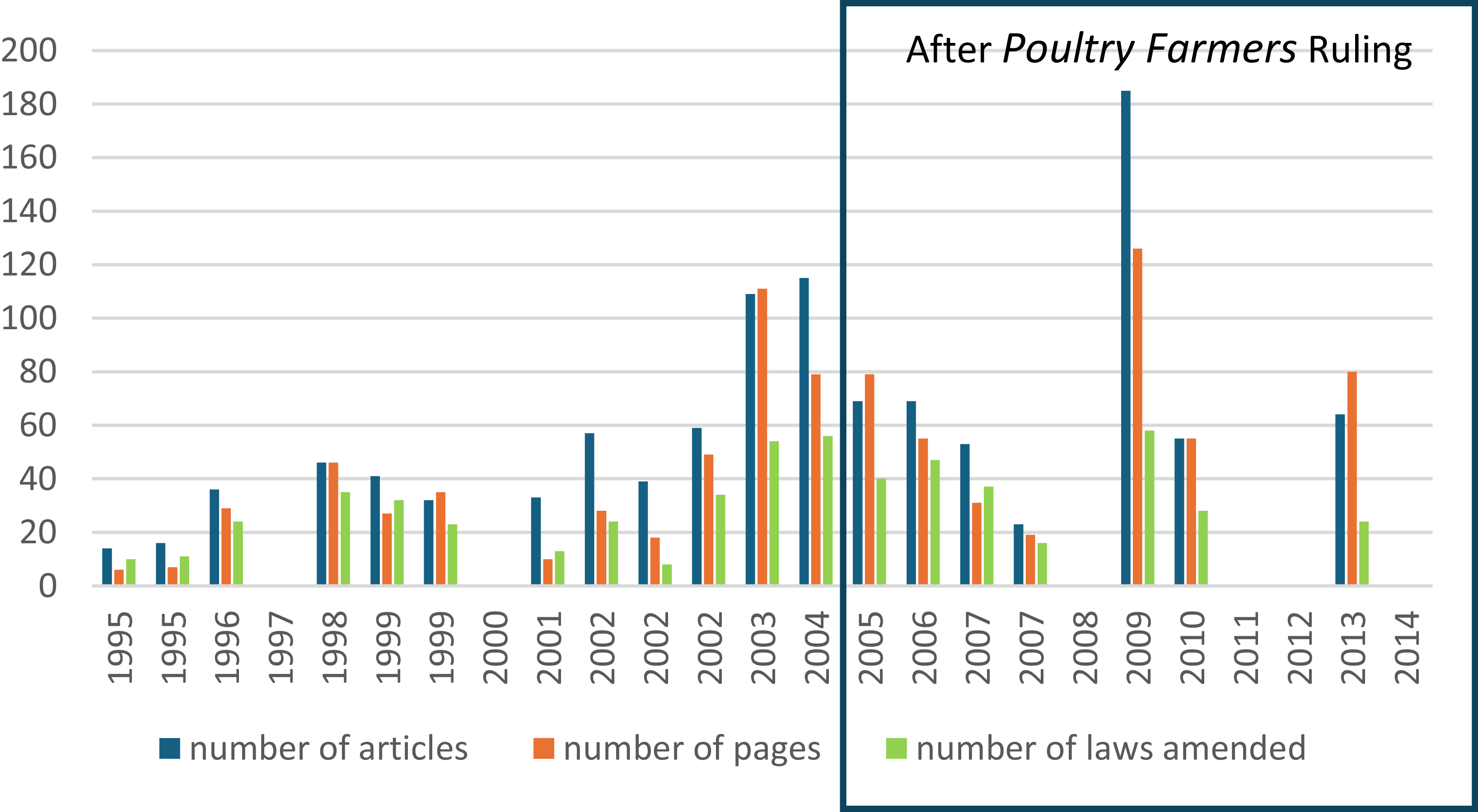
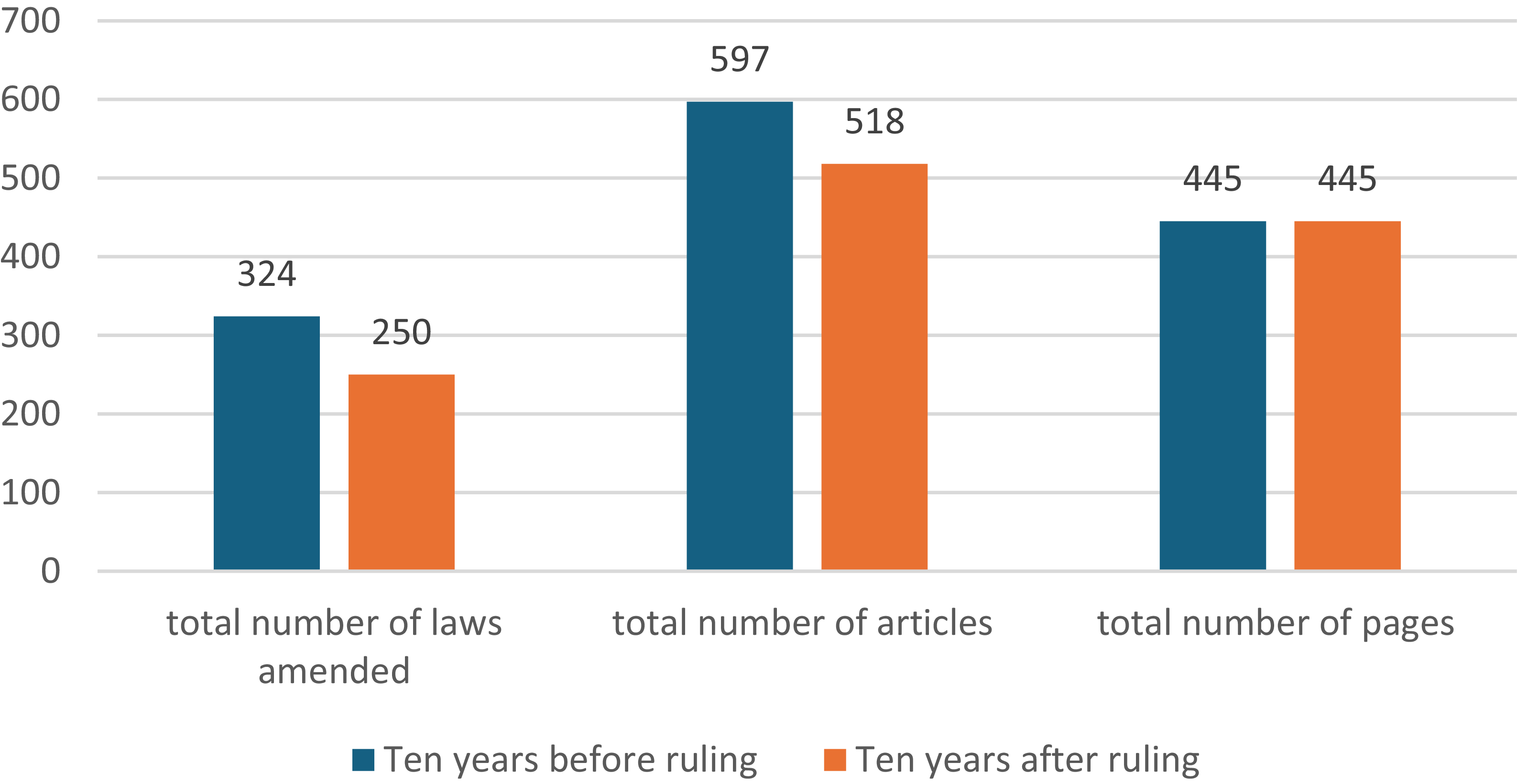
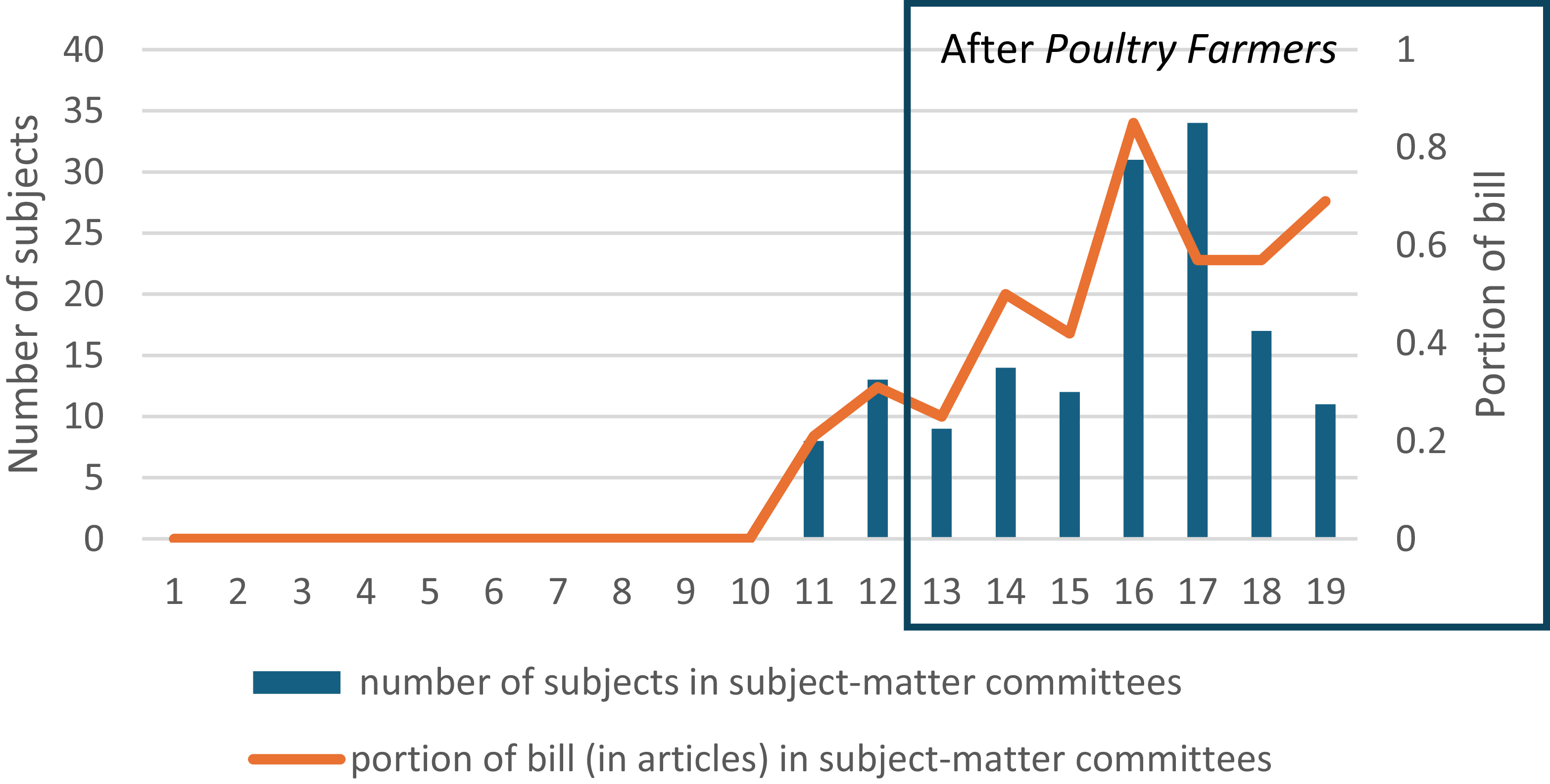
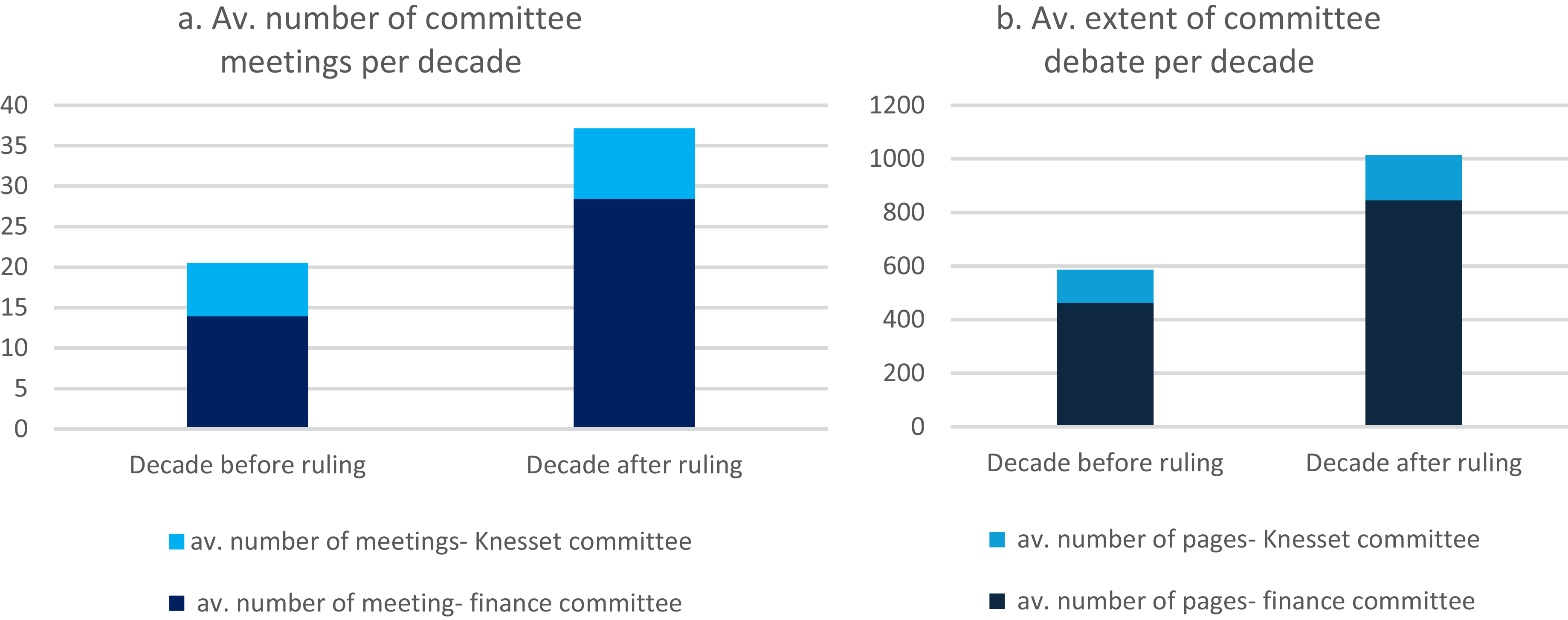


 Open access

