Introduction
Hospital-at-home (HaH) allows for the provision of traditional inpatient services in a patient’s own residence via inpatient transfer or direct admission from the Emergency Department. HaH patients receive laboratory monitoring, intravenous medications, and both in-person and telemedicine visits from providers and nurses. According to the Centers for Medicare & Medicaid Services, there are over 398 hospitals across 142 health systems in 39 states implementing HaH in the US (https://qualitynet.cms.gov/acute-hospital-care-at-home/resources). Compared to traditional inpatient brick-and-mortar (BaM) hospitalization, benefits of HaH include reduced healthcare costs, reduced hospital readmissions, improved quality of life, and improved patient safety, including reduced nosocomial infections. Reference Arsenault-Lapierre, Henein, Gaid, Le Berre, Gore and Vedel1–Reference Levine, Ouchi and Blanchfield4
Infections are a common HaH admitting diagnosis. Reference Levine, Ouchi and Blanchfield4 Like traditional BaM care, HaH patients receive intravenous antibiotics and frequent clinical monitoring. HaH antimicrobial management is a distinct subset of outpatient parenteral antimicrobial therapy (OPAT) as HaH patients receive more frequent monitoring due to their high-acuity and inpatient care status. Reference Norris, Shrestha and Allison5 However, HaH antimicrobial use is not well characterized, with prior investigations limited to patients receiving parenteral therapy or cohorts outside of the US. Reference Miron-Rubio, Gonzalez-Ramallo and Estrada-Cuxart6
Mayo Clinic has a robust HaH program, known as Advanced Care at Home (ACH), which provides inpatient home care for patients in Arizona, Florida, and Northwest Wisconsin from a single command center. Reference Paulson, Shulman and Dunn7 We sought to characterize HaH antimicrobial use across our multi-regional health system.
Methods
This descriptive, retrospective study was approved by the Mayo Clinic Institutional Review Board (protocol numbers 20-010753 and 21-004666). We included all patients aged 18 years or older who were admitted to Mayo Clinic’s ACH program in Arizona, Florida, and Wisconsin with either a medical diagnosis or post-surgical condition managed in the home, regardless of whether antibiotics were prescribed. ACH uses a virtual hybrid model of hospital-level care, which has been described in detail previously. Reference Paulson, Shulman and Dunn7 Initiated by referrals by the emergency department or inpatient care teams, patients are screened using clinical, demographic, and safety criteria using standardized clinical decision support tools. These ensure that all ACH patients meet criteria for hospital admission and are not appropriate for lower-intensity outpatient options such as oral antibiotics or OPAT. Admission to ACH is voluntary and patients provide both oral and written informed consent to participate.
All patients enrolled in ACH between January 1, 2023, and December 31, 2024, were included. ACH patients were cared for at one of our 3 locations, Mayo Clinic Florida, a 307-bed community academic hospital in Jacksonville, FL, Mayo Clinic Health Systems Eau Claire, a 304-bed community hospital in Eau Claire, WI, or Mayo Clinic Arizona, a 368-bed community academic hospital in Phoenix, Arizona. Systemic (intravenous and enteral) antibiotic, antifungal, and antiviral administrations were quantified. Antimicrobial indication was required upon order entry in the electronic health record. Antimicrobials with indications for medical or surgical prophylaxis, chronic bacterial suppression, HIV treatment and prevention, and viral hepatitis were excluded. Antimicrobial use was quantified as days of therapy (DOT) per 1,000 days-present and as the proportion of all patients who were administered an antimicrobial. Antimicrobial use was stratified by indication, agent, and route. A nonlinear mixed effects model was used to evaluate temporal changes in frequency of antimicrobial use over the study period. Analysis was conducted in R version 4.1.3.
Results
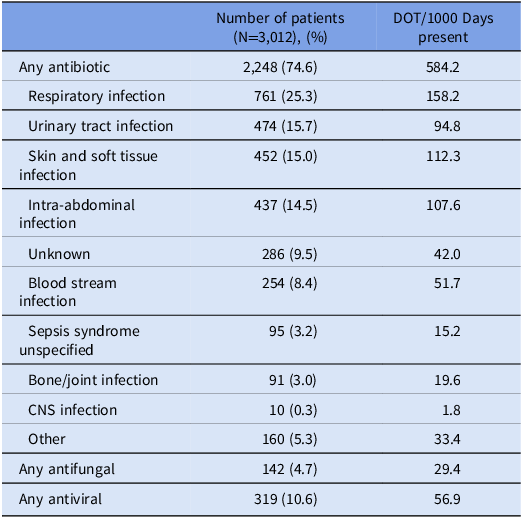
During the two-year study period, 3,012 patients contributed 17,031 days-present across the three regions. In total, 2,398 (79.6%) patients received a systemic antimicrobial. Antibiotics contributed the greatest use with 585.6 DOT per 1,000 days-present. Antivirals and antifungals contributed 56.9 DOT and 29.4 DOT per 1,000 days-present, respectively. Most patients (n = 2,247, 74.6%) received at least one antibiotic, while 319 (10.6%) received an antiviral, and 142 (4.7%) received an antifungal (Table 1). The monthly proportion of patients receiving an antibiotic increased (0.18% per month, 95% CI, 0.10% to 0.26%) whereas antifungal use decreased over the study period (–0.05% per month, 95% CI, –0.08% to –0.02%). There was no significant change in antiviral therapy usage.
Antimicrobial utilization and primary indication among all hospital-at-home patients

Respiratory infections were the most prevalent indication for antibiotic use (761 patients, 25.3% of all patients; 33.9% of patients receiving an antibiotic) followed by urinary tract infections (474 patients, 15.7% of all patients; 30.5% of patients receiving an antibiotic). Respiratory infections were the most common indication for antiviral use (256 patients, 8.5% of all patients; 81.0% of all patients receiving an antiviral), whereas unknown indications were most common among antifungal use (34 patients, 1.1% of all patients; 23.9% of patients receiving an antifungal).
Ceftriaxone was the most frequently administered antibiotic (986 patients, 32.7%), followed by cefepime (465 patients, 15.4%), and piperacillin-tazobactam (377 patients, 12.5%) (Figure 1). Among patients who received ceftriaxone, 379 (38.4%) had a respiratory infection indication. Anti-SARS-CoV-2 therapy (remdesivir and nirmatrelvir-ritonavir) were the most frequently administered antiviral agents, comprising 219 (7.3%) patients. Fluconazole was the most frequently administered antifungal (96 patients, 3.2%).
Prevalence of antibiotic agents among all hospital-at-home patients. Note: ACH, Advanced Care at Home.

Among patients who received an antibiotic, 2,018 (89.6%) patients were administered at least one dose of an intravenous antibiotic and 1,470 (65.2%) were administered an antibiotic enterally. Enteral administration comprised 38.2% (4,544/11,893) of antibiotic DOTs, 36.6% (361/985) of antiviral DOTs, and 74.2% (389/524) of antifungal DOTs.
Discussion
Our multi-regional HaH program demonstrated a high prevalence of systemic antimicrobial use, consistent with international HaH experiences. Reference Miron-Rubio, Gonzalez-Ramallo and Estrada-Cuxart6 A large proportion of HaH patients received antibiotics, especially ceftriaxone, which aligns with known OPAT practices favoring long-acting, broad-spectrum antibiotics for convenience and coverage. Reference Norris, Shrestha and Allison5 The most common indications in our cohort were respiratory tract infections, urinary tract infections, and skin and soft tissue infections, consistent with prior HaH reports. Reference Moreno Nunez, Garmendia Fernandez and Ruiz Munoz8,Reference Dickinson, Rashid, Weiland, Tjoa, Kim and Huang9 Notably, most patients received an intravenous antibiotic in our program, reflecting the acute-care nature of HaH and its role as a substitute for in-hospital intravenous therapy.
The unique care setting of HaH influences antimicrobial prescribing patterns. In a hospital ward, clinicians have immediate access to a full formulary of parenteral agents, on-demand pharmacy compounding, and services like immediate imaging or specialist consultation. In HaH, practical logistics encourage a more streamlined approach. HaH formularies emphasize a core set of antimicrobials suited to common infections, partly due to operational considerations (eg, home delivery and drug stability). However, many HaH programs partner with their hospital’s inpatient pharmacy to dispense medications, which can facilitate daily dispensing with the added benefit of pharmacist verification. We leverage this capability at some sites to ensure our HaH patients benefit from hospital-grade pharmacy oversight to receive timely first-line antimicrobials without gaps in therapy.
The HaH model offers unique opportunities for antimicrobial stewardship (AMS) that can complement traditional hospital stewardship efforts. HaH care involves a focused patient census and frequent touchpoints, creating an ideal environment for prospective audit-and-feedback on antibiotic use. The implementation of an AMS program in a Spanish HaH program resulted in 98% acceptance of stewardship recommendations and significantly reduced antibiotic-days. Reference Moreno Nunez, Garmendia Fernandez and Ruiz Munoz8 In our program, the care team (physician, nurse, and often a pharmacist or case manager) convene daily to facilitate safe antimicrobial monitoring and continuation of therapy from the traditional BaM setting, which can be fraught with antimicrobial errors. Reference Dickinson, Rashid, Weiland, Tjoa, Kim and Huang9
An important stewardship consideration in HaH is avoiding unnecessary intravenous therapy. Paradoxically, the convenience of HaH can lead to overuse of intravenous antimicrobials simply because the barrier of hospitalization is removed. Current analyses warn that HaH programs might inadvertently expand the use of advanced interventions to patients who could have been treated with oral drugs, thereby increasing utilization rather than purely substituting for inpatient care. Reference Taylor and Golding10 To guard against this, clinicians should follow established guidelines for when intravenous therapy is truly indicated.
Several limitations should be acknowledged. We did not perform chart review, so we were unable to assess the appropriateness of antimicrobial prescriptions or quantify the total duration of therapy (ie, inclusion of BaM-administered antibiotics or discharge prescriptions). The study was conducted within a single health system, which may limit the generalizability of the findings to other HaH programs with different structures or patient populations.
Our study describes antimicrobial prescribing patterns within a US-based HaH program, revealing high utilization of systemic and intravenous antimicrobials. As HaH programs continue to expand, integrating AMS will be essential to optimize patient outcomes, reduce the burden of antimicrobial resistance, and ensure the sustainability of this innovative care model.
Data availability statement
Data not publicly available.
Acknowledgements
DTD contributed to conceptualization and study design. DTD and DTI contributed to data abstraction and analysis. MJM contributed to study supervision. All authors contributed to manuscript preparation and editing.
Financial support
This publication was supported by Grant Number UL1 TR002377 from the National Center for Advancing Translational Sciences. Its contents are solely the responsibility of the authors and do not necessarily represent the official views of the National Institutes of Health.
Transparency declarations
All authors have no relevant disclosures.