Introduction
Plasmacytomas are malignant plasma cell tumours which grow within either soft tissue or the bony skeleton. Solitary bone plasmacytomas are rare haematological malignancies which usually disseminate to multiple myeloma over the course of five to 10 years, but which remain dormant in some individuals for 10 to 20 years. They are responsive to radiotherapy. In comparison, soft tissue plasmacytomas rarely disseminate, represent limited disease, and can usually be cured by local resection.Reference Cotran, Kumar and Robbins 1
To be diagnosed as such, bony plasmacytoma must be found as a solitary lesion with less than 5 to 10 per cent bone marrow plasma cell infiltration.Reference Afonso 2 It is often found in the spine without other evidence of multiple myeloma,Reference Afonso 2 often causing a lytic lesion within the body of a vertebra (usually thoracic), and can cause compression of the spinal cord. In the cervical spine, it has been described in the odontoid process, the second, third and sixth vertebrae, and the cervical dura.Reference Prasad, Raju and Sundaram 3 – Reference Lourbopoulos, Ioannidis, Balogiannis, Stavrinou, Koletsa and Karacostas 8
There has been one previous report of bony plasmacytoma occurring in the atlas, but the presentation was one of occipital headaches, difficulty with cranial movements and hyperactive deep tendon reflexes.
Here, we present the first case report of an atlas plasmacytoma presenting with unilateral vocal fold palsy.
Case report
A 71-year-old, Caucasian male, previously a professional singer, presented to our department with progressive vocal weakness which left him unable to continue singing in his choir, together with dysphagia over a six-month period.
On flexible nasendoscopy, a left vocal fold palsy was found. The rest of the head and neck examination was normal.
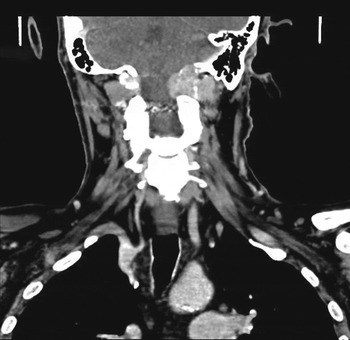
The patient underwent computed tomography (CT) of his neck and chest in an attempt to detect a lesion affecting the vagus nerve or its recurrent laryngeal branch. This revealed a destructive lesion affecting the first cervical vertebral body, with a large, expansile, soft tissue component (Figure 1). The lesion had extended to involve the left occipital bone, with involvement of the hypoglossal canal and infiltration of the carotid canal.
Coronal computed tomography scan of the neck showing a destructive lesion affecting the first cervical vertebral body.

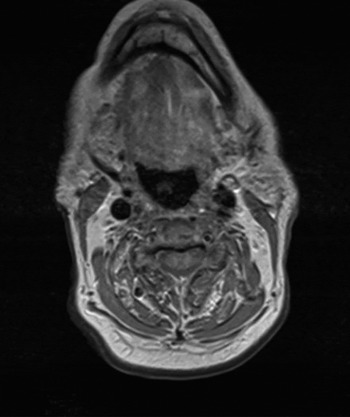
Magnetic resonance imaging (MRI) showed asymmetry of the oropharynx, along with deviation of the glossal septum and fatty replacement on the left side of the tongue (Figure 2). There was significant encroachment on the spinal canal.
Axial magnetic resonance imaging showing deviation of the glossal septum and fatty infiltration of the left side of the tongue.

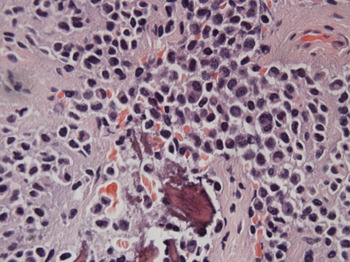
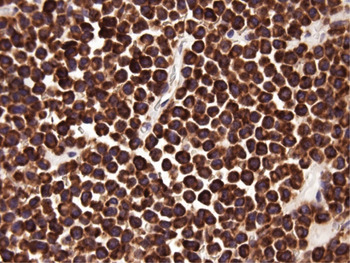
The patient underwent a trans-oral biopsy under general anaesthetic, which demonstrated abnormal-looking plasma cells consistent with plasmacytoma (Figure 3). Immunohistochemical staining with VS38C (Figure 4) and BCL2 confirmed the diagnosis.
Photomicrograph of trans-oral biopsy specimen, showing plasmacytoma cells invading into the bone. (H&E; × 400)

Photomicrograph showing immunohistochemical staining for plasma cell marker VS38C, with cytoplasmic positivity. (×400)

Following discussion at the multidisciplinary team meeting, the patient was referred to the haematologists for definitive treatment with radiotherapy, which was successful.
Subsequently, he underwent medialisation of the paralysed vocal fold with biphasic polymer injection, and achieved both subjective and objective improvement of his voice. Swallowing function improved with speech and language therapy input.
At the most recent visit, he remained in remission.
Discussion
The vagus nerve exits the skull through the middle compartment of the jugular foramen. Just below the skull base, its trunk dilates into the inferior ganglion, which contains the cell bodies of the afferent fibres of the vagus nerve. It also receives its complement of nucleus ambiguus fibres from the cranial part of the accessory nerve (which carries it through the jugular foramen). These fibres supply all of the striated muscle of the pharynx, soft palate, oesophagus and larynx.Reference McMinn 9 In the presented case, it was thought that involvement of the vagus nerve at this level resulted in the patient's vocal fold palsy, dysphagia and oropharyngeal asymmetry.
The hypoglossal nerve emerges from the medulla oblongata and exits the skull through the hypoglossal canal which runs through the occipital bone. It descends in a spiral fashion, between the internal carotid artery and internal jugular vein, behind the vagus nerve. It passes deep to the posterior belly of the digastric muscle to enter the tongue and supply motor fibres to the tongue muscles, except for the palatoglossus.Reference McMinn 9 In the presented case, deviation of the glossal septum and fatty replacement on the left side of the tongue occurred as a result of infiltration of the hypoglossal canal and its contained nerve.
There are many well-documented causes of unilateral vocal fold palsy. Approximately one-third are idiopathic, a similar amount are iatrogenic (mainly due to thyroid or cardiothoracic surgery), and the remainder are due to neoplasia of proximal organs (e.g. the thyroid, cervical neck nodes, upper aerodigestive tract or bronchus).
Unilateral vocal fold palsy as a result of a high vagal insult is more uncommon, and may be categorised as sudden onset palsies or gradual onset palsies. The former are usually the result of skull base trauma, cerebrovascular accident or complications arising as a result of skull base surgery, while the latter are usually due to a skull base tumour or mass compression.Reference Fang, Tam, Courey, Li and Chiang 10 Our case is an example of the latter. Fang et al. Reference Fang, Tam, Courey, Li and Chiang 10 have reported a higher incidence of feeding tube dependency in patients with sudden onset palsy. For the treatment of high vagal palsies, these authors recommend appropriate injection or medialisation thyroplasty, as was the case in our patient. They also suggest immediate laryngoplasty for those suffering palsies following trauma or surgery.
-
• Unilateral vocal fold palsy due to high vagal insult is uncommon
-
• In unilateral vocal fold palsy cases, both high vagal lesions and local neck pathology should be considered
-
• First cervical vertebra plasmacytoma is a rare cause of unilateral vocal fold palsy
-
• Definitive treatment is medical, but surgical palsy treatment has good outcomes if done early
The trans-oral approach for access to the high cervical spine is well documented as offering excellent access to, and good wound healing of, lesions of the bodies of the atlas, axis and upper third of the third cervical vertebra.Reference O'Laoire and Thomas 11 The advantages of this approach are: (1) bony pathology is accessible only via the ventral route; (2) the head is placed in the extended position, thus decreasing angulation of the brainstem during surgery; and (3) surgery is performed through the avascular median pharyngeal raphe and clivus.Reference Landeiro, Boechat, Christoph D de, Gonçalves, Castro and Lapenta 12 Reported complications include delayed oropharyngeal bleeding, cerebrospinal fluid leakage and meningitis. Ideally, neurosurgical support should be available; however, in our case biopsy was deemed safe without such support due to the size of the tumour and its ready accessibility for punch biopsy.
Conclusion
Plasmacytoma of the atlas is a rare cause of unilateral vocal fold palsy, which occurs as a result of high vagus nerve involvement at the level of the inferior ganglion. Whilst the definitive treatment of plasmacytoma is medical, surgical options are available for the management of the vocal fold palsy. Early recognition and intervention result in good outcomes.