The Centers for Disease Control and Prevention (CDC) established recommendations for inpatient antimicrobial stewardship programs (ASPs) in the form of Core Elements of Antimicrobial Stewardship Programs. 1 These elements include (1) leadership, (2) accountability, (3) drug expertise, (4) tracking, (5) actions (6) reporting, (7) education. Individual core elements can be met in a variety of ways. For example, for meeting the leadership commitment element, hospital leadership can support training and education. Implementing the action element can take on the form of antibiotic time outs or prior authorization, among others. The Joint Commission accreditation process includes survey questions related to an institution’s ASP using the core elements structure. 2
Common metrics for an ASP’s effectiveness include antimicrobial utilization.Reference Moehring, Anderson and Cochran 3 We hypothesized that ASPs that met all core elements would perform better in this metric. Thus, the goal of this study was to ascertain whether ASPs that met all elements used fewer antibacterial agents than ASPs that did not.
Methods
Data for this hospital-level cross-sectional analysis were obtained from Vizient (https://www.vizientinc.com), a performance improvement company. A total of 50% of acute care health systems and 95% of academic medical centers are Vizient members. The first data source was a survey (available upon request) sent in April 2016 (with a follow-up request in May 2016) to persons who were ASP members through the Vizient Antimicrobial Stewardship Network (ASN) electronic mailing list. The electronic mailing list includes >400 ASP members, largely from academic medical centers. The survey was also sent to hospitals via the Vizient Pharmacy Network electronic mailing list. The survey had 24 questions regarding aspects of ASPs and was pilot tested by ASN members. All questions pertained to adult ASPs, with the exception of 1 questions that inquired about ASP activity on pediatric units. Seven questions pertained to the core elementsReference O’Leary, van Santen, Webb, Pollock, Edwards and Srinivasan 4 and whether a particular element was met (yes/no).
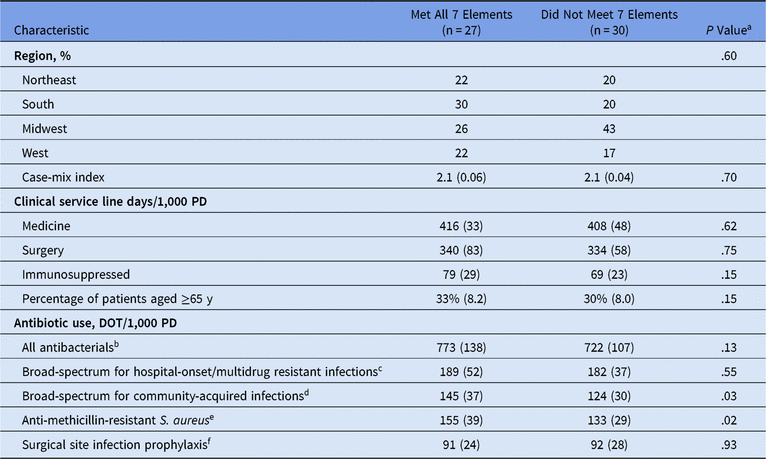
Responses were linked to antibacterial utilization data using a second data source: the Vizient clinical database resource manager (CDB/RM). The CDB/RM includes data for charge-based inpatient medication, procedure, and diagnosis. Use in adult inpatients (≥18 years old) in year 2015 was measured in days of therapy per 1,000 patient days (DOT/1,000 PD) and was grouped according to the CDC’s National Healthcare Safety Network’s (NHSN’s) Antimicrobial Use Option (first version) (Table 1).Reference van Santen, Edwards and Webb 5
Characteristics of Study Hospitals According to Meeting of Core Elements

Note. Data are mean (standard deviation) unless otherwise noted.
a χ2or independent t tests for categorical and continuous data, respectfully.
b Antibacterials listed below plus amoxicillin, amoxicillin/clavulanate, ampicillin, ampicillin/sulbactam, azithromycin, cefaclor, clarithromycin, clindamycin, dicloxacillin, doxycycline, erythromycin, metronidazole, nafcillin, oxacillin, penicillin G, penicillin V, sulfamethoxazole/trimethoprim, tetracycline.
c Amikacin, aztreonam, cefepime, ceftazidime, doripenem, gentamicin, imipenem/cilastatin, meropenem, piperacillin/tazobactam, ticarcillin/clavulanate, tigecycline, tobramycin, (ceftazidime/avibactam, ceftolozane/tazobactam, colistimethate, piperacillin, polymyxin B are not included).
d Cefotaxime, ceftriaxone, ciprofloxacin, ertapenem, gemifloxacin, levofloxacin, moxifloxacin
e Ceftaroline, daptomycin, linezolid, quinupristin/dalfopristin, telavancin, vancomycin (dalbavancin, oritivancin, tedizolid are not included).
f Cefazolin, cefotetan, cefoxitin, cefuroxime, cephalexin.
For descriptive analyses, χ2 and independent t tests were used for categorical versus continuous variables, respectively. Differences in antibiotic grouping DOT/1,000 PD were compared between hospitals that met all elements versus those that did not using independent t tests. Conducting 5 different negative binomial regression models, we evaluated the association between meeting all elements (independent variable) and DOT/1,000 PD (dependent variable). Regression models were adjusted for the following factors: Centers for Medicare and Medicaid Services case-mix indices (CMI); percentage of inpatients aged ≥65 years; the number of patient days (PD) in 3 different clinical service lines (CSLs) per 1,000 PD (ie, surgical, immunosuppressed, or medicine); geographic region according to 4 US census regions: North, Midwest, South, and West. These factors have been associated with antibiotic use in previous studies of Vizient hospitals.Reference Patterson, Edmond, Hohmann and Pakyz 6, Reference Pakyz, Moczygemba, Wang, Stevens and Edmond 7 Explanatory variables were entered into the model if univariable analysis with that variable resulted in a P value < .20. Statistical tests were 2-sided; a P < .05 was considered statistically significant unless otherwise stated. The study was approved by the Virginia Commonwealth University Institutional Review Board.
Results
Overall, 211 of 446 hospitals surveyed responded: 34% of responders self-identified as academic medical centers, 19% as large community hospitals (>300 beds), 23% as medium-sized community hospitals (100–299 beds), 13% as small community hospitals (<100 beds), and 10% as critical access hospitals. The antibiotic utilization analysis was carried out on a subgroup of academic medical centers that subscribed to the CDB/RM and for which representatives completed the survey in calendar year 2015 (n = 57).
Of 57 hospitals, 27 (47%) met all 7 core elements, and 30 hospitals (53%) met 3–6 elements. Of these 30 hospitals, 18 (60%) met 6 elements, 8 (27%) met 5 elements, 2 (6.6%) met 4 elements, and 2 (6.6%) met 3 elements. Of these same 30 hospitals, a total of 61% met the leadership element, 95% met the accountability element, 96% met the drug expertise element, 93% met the tracking element, 100% met the actions element, 77% met the reporting element, and 93% met the education element. Table 1 displays characteristics of hospitals according to whether or not all core elements were met.
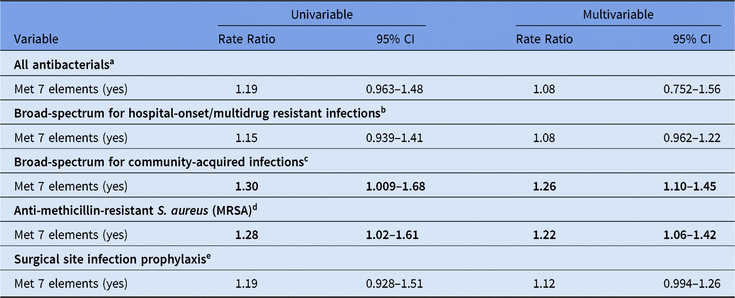
We detected statistically significant differences in use between hospitals that met all 7 core elements versus those that did not, for broad-spectrum community-acquired infection and anti-methicillin-resistant S. aureus (MRSA) agent DOT/1,000 PD (Table 1), but not for other antibiotic groupings (Table 1). Adjusted regression analyses results are presented in Table 2; a statistically significant positive association was detected between meeting all 7 elements with broad-spectrum community-acquired infection and anti-MRSA agent DOT/1,000 PD.
Results of Adjusted Negative Binomial Regressions for each National Healthcare Safety Network Antimicrobial Use Option Antibiotic Grouping for 57 Hospitals

Note. CI, confidence interval; CSL, clinical service line; PD, patient days; CMI, case-mix index. Bold represents statistical significance at P < .05.
a Adjusted for no. of surgery, immunosuppressed and medicine CSL days per 1,000 PD and region.
b Adjusted for no. of surgery, immunosuppressed and medicine CSL days per 1,000 days PD, region, CMI, and % inpatients ≥ 65 y.
c Adjusted for no. of surgery, immunosuppressed and medicine CSL days per 1,000 days PD, region, and % of inpatients ≥ 65 y.
d Adjusted for no. of surgery, immunosuppressed and medicine CSL days per 1,000 days PD, region, CMI, and % of inpatients ≥ 65 y.
e Adjusted for no. of surgery and immunosuppressed CSL days per 1,000 days PDs, region, CMI, and % of inpatients ≥ 65 y.
Discussion
Among 57 academic medical centers, according to our adjusted analyses, meeting all elements was associated with greater use of anti-MRSA and broad-spectrum community-acquired infection agents compared to meeting 6 or fewer elements. These findings were unexpected because we hypothesized that fewer antibacterial agents would be used in hospitals that employed all elements. It is possible that hospitals that adopted all elements had a greater need for a more robust ASP due to a higher baseline rate of antibacterial use. The cross-sectional design could not account for this, nor could we account for the extent of implementation of individual core elements.
A total of 47% of hospitals met all elements. From the CDC’s NHSN’s Annual Hospital Survey data, which included >4,000 hospitals, 40.9% had met all 7 elements in 2014 and 48.1% had met all 7 elements in 2015.Reference O’Leary, van Santen, Webb, Pollock, Edwards and Srinivasan 4 Interestingly, according to the NHSN data, in 2014 and 2015, in general, the adoption of individual elements was lower than our sample (which had >90% adoption for 5 of 7 elements). The exception was for the core elements of leadership and reporting, which were the lowest met in the current study, 61% and 77% versus 67.7% and 86% for the NHSN data in 2015.
This study has several limitations. Survey completion was voluntary and by means of self-report. Selection bias may have been present because the study sample represents academic medical centers that subscribe to the Vizient CDB/RM and responded to the ASP survey via the list-serve. Results may have differed if antibacterial data were available for all facilities that completed the survey and/or for US hospitals at large. Also, results may have differed if a larger sample size enabled evaluation of different cutoffs for meeting the elements. Finally, the cross-sectional nature of the analysis prevented the inference of causality.
These data were collected before the Joint Commission implemented required standards regarding antimicrobial stewardship (2017), and thus afforded an opportunity to evaluate relationships between core elements and ASP outcomes prior to hospitals adopting core elements to a greater extent. These exploratory analyses outline that more research is needed regarding the impact of meeting individual core elements on different ASP outcomes and the extent to which the elements have been adopted. For example, for the reporting element, what types of data need to be reported, in what manner, and how often, to impact on desired program benefits? Ultimately, identification of element components that lead to decreased antibiotic resistance is an important goal in this line of inquiry.
Author ORCIDs
Amy L. Pakyz, http://orcid.org/0000-0002-6763-461X
Acknowledgments
We thank all of the survey respondents for their support of this work.
Financial support
No financial support was provided relevant to this article.
Conflicts of interest
All authors report no conflicts of interest relevant to this article.