




No CrossRef data available.
Article contents
- Abstract
- HISTORICAL BACKGROUND: CALIFORNIA FARMING, JAPANESE IMMIGRATION, AND THE ALIEN LAND LAWS
- THE DECLINE OF JAPANESE IMMIGRANT FARMING IN CALIFORNIA IN THE 1920S: THE ALIEN LAND LAW AND THE AGRICULTURAL CRISIS
- DID EVASION BY JAPANESE IMMIGRANT FARMERS RENDER THE LAW IMPOTENT?
- CONCLUSION
- References
Important or Impotent? Taking Another Look at the 1920 California Alien Land Law
Published online by Cambridge University Press: 29 March 2004
Article contents
- Abstract
- HISTORICAL BACKGROUND: CALIFORNIA FARMING, JAPANESE IMMIGRATION, AND THE ALIEN LAND LAWS
- THE DECLINE OF JAPANESE IMMIGRANT FARMING IN CALIFORNIA IN THE 1920S: THE ALIEN LAND LAW AND THE AGRICULTURAL CRISIS
- DID EVASION BY JAPANESE IMMIGRANT FARMERS RENDER THE LAW IMPOTENT?
- CONCLUSION
- References
Abstract
Opposition to Japanese immigration led to Alien Land Laws that barred Japanese immigrants from buying or leasing farmland. Although there is general agreement that the 1913 California Alien Land Law had little impact, historians and social scientists have differed over the effectiveness of the 1920 initiative, which closed loopholes in the earlier law. Census data show a decline in Japanese American agriculture over the short and long run, which cannot be fully explained by the agricultural downturn of the 1920s. This evidence indicates that the 1920 California Alien Land Law had negative consequences for Japanese immigrant farmers.
Information
- Type
- ARTICLES
- Information
- Copyright
- © 2004 The Economic History Association
In the early part of the twentieth century opposition to Japanese immigration led a number of states, beginning with California in 1913, to pass so-called Alien Land Laws, which barred Japanese immigrant farmers from buying or leasing farmland. Despite these attempts, the number of Japanese immigrant farmers continued to increase. In 1920 California voters passed a ballot initiative that closed many loopholes in the earlier law. Following the passage of the 1920 initiative, Japanese immigrant agriculture went into a sharp decline.
Although there is general agreement that the 1913 Alien Land Law had little impact, historians and social scientists have long been divided as to the effectiveness of the 1920 law. Whereas some have argued that the 1920 law had negative consequences for Japanese immigrant farmers, others have argued that the decline in Japanese immigrant farming was due to the agricultural crisis of the 1920s and that the 1920 law was impotent in the long run due to evasion and lack of enforcement.1
Ichihashi, Japanese, pp. 261–82; Iwata, “Japanese Immigrants,” pp. 25–37; and Ichioka, “Japanese Immigrant Response,” pp. 157–78, all stressed the negative impact on Japanese immigrant agriculture of the 1920 California Alien Land Law. Other scholars who argue that the laws had little impact include Strong, Second Generation, p. 23; Roger Daniels, Politics, pp. 79–91; Modell, Economics, pp. 100–04; and Higgs, “Landless,” pp. 205–25.
Some of the strongest arguments that the 1920 Land Law had a significant and negative impact on Japanese American agriculture have been based on Japanese immigrant sources. However none of the major studies on the Alien Land Laws have made explicit comparison to overall trends in agriculture in California and the rest of the United States. Further, much of the previous research only covers the pre–World War II period, even though the California Supreme Court did not overturn the Alien Land Laws until 1952. This article examines trends in California farm tenure, crop prices, land prices, and markets for farm products, and concludes that the agricultural depression of the 1920s cannot explain the decline in Japanese American farming relative to other California farmers. Contrary to the views of some scholars who argue that the Alien Land Law of 1920 had little long-term impact on Japanese immigrant farming due to evasion of the law, this article also concludes that not only was the 1920 Alien Land Law a setback for Japanese American farming in the short run, it also caused long-term damage.2
Japanese immigrant sources are used by Ichioka, “Japanese Immigrant Response,” pp. 157–78; Iwata, Planted in Good Soil, pp. 261–327; and Azuma, “Japanese Immigrant Farmers,” pp. 14–29. Japanese immigrant records included land farmed under labor contract, whereas U.S. government reports did not. With this adjustment, the census reported 36 percent less land farmed by Japanese in California than immigrant sources reported in 1910, 7 percent less in 1920, and 15 percent less in 1930 (immigrant figures from Ichioka, Issei, pp. 150, 155, and 234; and Iwata, Planted in Good Soil, pp. 318–19).
Although the trends are the same with either set of data, mixing the two can lead to errors. For example, Higgs erroneously argues that the difference between the increase in land owned by Japanese after 1932 and the continuing decline in acres rented “suggests that something other than the land laws was at work.” (“Landless,” p. 222). Higgs's data for 1905 to 1932 were based on Japanese immigrant sources that combined rented land and land worked under labor contracts, but his 1942 figures only include rented acres based on a U.S. government report, so that what appears to be a continued drop in acres rented after 1932 is actually due to the exclusion of acres working under labor contract. This pattern of both acres owned and rented suffering a sharp drop after 1920 and then rebounding partially in the 1930s can be explained by the impact of the Alien Land Laws and then the increase in native-born Japanese American farmers, who were not subject to the law.
For more on the Alien Land Laws during and after World War II, see Chuman, Bamboo People, pp. 198–223.
HISTORICAL BACKGROUND: CALIFORNIA FARMING, JAPANESE IMMIGRATION, AND THE ALIEN LAND LAWS
At the turn of the twentieth century California agriculture was undergoing a qualitative change. Towards the end of the nineteenth century California was the nation's number two wheat-producing state, with highly mechanized, extensive farms. By the early twentieth century, crops such as cotton, sugar beets, fruits, and vegetables, grown on smaller farms with more intensive use of farm labor, came to dominate California agriculture. One consequence of this transformation was the increased use of farm labor: by 1910, about half of the agricultural work force in California was made up of wage laborers, compared to less than 20 percent in other states.3
See Rhode, “Learning.” pp. 773–800; and Taylor and Vassey, “Historical Background,” pp. 281–95, on the development of California agriculture. This trend toward more intensive use of farm labor put California's agriculture on a different path from farming in the Northeast and Midwest, where the main tendency was towards labor-saving mechanization of farming and where the basis for agriculture was the family farm (Wright, “American Agriculture,” pp. 182–209).
A growing number of Japanese immigrants filled the increasing demand for agricultural labor by California farms in the early twentieth century, whose supply of Chinese labor was cut off by the Chinese Exclusion Act of 1882. In addition to the more than 66,000 Japanese who came to the continental United States from Japan between 1900 and 1908, another 35,000 came by way of Hawaii. By 1905 Japanese immigrants dominated the supply of seasonal farm labor in California. Like the Chinese immigrants who had provided much of California's farm labor in the nineteenth century, Japanese immigrants were organized under co-ethnic labor contractors. Japanese immigrant laborers also inherited the legacy of anti-Chinese sentiments, and were treated as “coolies” or illegal contract laborers.4
Chinese immigrants made up a significant part of the seasonal farm labor force in California in the late 1800s. See Fuller, “Supply,” pp. 198–222; and Chan, Bittersweet Soil, p. 319. The number of Japanese coming to the continental United States from Hawaii is from Strong, Second Generation, p. 281. See Fuller, “Supply,” pp. 19827–49 for more on Japanese workers in California's agricultural labor market. Although many of the Japanese who came to California worked for labor contractors, they were not bound to a contract (Ichioka, Issei, pp. 57–69).
These sentiments, and the view that Japanese immigrants were the agents of a rising foreign power, soon led to efforts to end immigration from Japan. The first restriction on Japanese immigration came in 1908 when the government of Japan agreed to end the emigration of Japanese laborers to the United States and the U.S. government banned Japanese laborers from entering the continental United States via Hawaii, Canada, or Mexico. This “Gentlemen's Agreement” did restrict the immigration of Japanese laborers. However, the total number of Japanese entering the United States only fell slightly, due to a large increase in the number of family members (women without occupations and children) who followed their relative and to the growing number of immigrants re-entering the United States after going back to Japan.5
For a history of the Japanese exclusion movement see Daniels, Politics, especially pp. 16–24 on the connection of anti-Japanese and anti-Chinese movements. Chinese Americans were the first to be targeted by restrictive covenants that prevented them from purchasing property, a practice that foreshadowed the passage of the Alien Land Laws decades later (Jones-Correa, “Origins,” pp. 548–50). Daniels, Asian America, pp. 3–4, discusses the defensive frontier attitude where the Pacific Coast was seen as a bulwark against a sea of Asian immigrants that threatened the way of life of white Californians. For an example of this view, see Hunt, “Swat,” pp. 1–2 and also the cover page of that issue. Takaki, Strangers, pp. 46–51, discusses the differences in women's immigration between Japanese and Chinese.
In response to the curtailment of Japanese immigrant labor, California farm employers tried to diversify their sources of labor. However, their efforts were not successful so they turned to labor contracts and tenancy to insure a supply of Japanese immigrant farm labor. Tenant farming was also much more attractive to Japanese immigrants than agricultural labor, because under tenancy they could utilize family labor to increase total income and save money to purchase land.6
See Fuller, “Supply,” pp. 19835–43; Hallagan, “Labor Contracting” pp. 757–76; and Azuma, “Japanese Immigrant Farmers,” p. 19. On the use of family labor, see Ichioka, Issei, p. 152; Lukes and Okihiro, Japanese Legacy, p. 55; and Wright, Old South, p. 94. However, Japanese tenant farmers often paid higher rents than white tenants (Lebergott, Wealth, pp. 118–26).
Between 1900 and 1920 there was a rapid expansion of farms operated by Japanese in California as well as of acres farmed (see Table 1 and Figure 1). The growth of Japanese agriculture could also be seen in the increasing proportion of Japanese male immigrants who were farmers, which went from less than 1 percent in 1900 to more than 20 percent of working adults in 1920. In contrast, the total number of farms in California also grew between 1900 and 1920, but only by 34 percent. The percentage of non-Latino white male immigrants in California who were farmers actually declined from 16 percent in 1900 to 13 percent in 1920.7
The percentage of working adults who were farmers is calculated from Ruggles, Sobek, et al., IPUMS.


The growing number of Japanese farmers provided a new target for the anti-Japanese movement, which opposed the settlement and family formation of Japanese immigrant farmers. Opposition to Japanese immigration became a campaign issue; in 1913 the California legislature passed an Alien Land Law, banning the purchase and long-term leasing of land by “aliens ineligible for citizenship.” Although never mentioned explicitly, Japanese immigrants were the main targets of the law.8
See Daniels, Politics, pp. 46–64 for political developments leading to the 1913 Alien Land Laws. Immigrants from Japan, China, and other east and south Asian countries could not become citizens because they were not mentioned in the 1870 naturalization law. This view was upheld by the Supreme Court in its 1922 ruling in upholding the denial of citizenship to Japanese immigrant Takao Ozawa. See Ichioka, Issei, pp. 210–26, for more on efforts of Japanese immigrants to win citizenship rights.
The 1913 Alien Land Law was written with a number of loopholes, which were known to some of the legislation's promoters. These loopholes allowed Japanese immigrants to circumvent the law in a number of ways. Land could be purchased under the name of an American-born (citizen) child. A land corporation could be set up. American-born offspring of Japanese could be recruited to buy land for Japanese immigrants. Further, the 1913 law only prohibited the purchase and long-term leasing of farmland; rental agreements of three years or less were allowed. These loopholes, combined with the agricultural boom during World War I, allowed Japanese immigrants to continue expanding their farming after the 1913 Alien Land Laws were passed (see Table 1 and Figure 1).9
Daniels, Politics, p. 63; Higgs, “Landless,” pp. 216–18; and McGovney, “Anti-Japanese Land Laws,” p. 28.
International considerations also served to keep a lid on anti-Japanese legislation during World War I when Japan was an ally of the United States, but soon after the war ended it reemerged. With the slogan “Keep California White,” James Phelan reignited the anti-Japanese movement in his 1920 campaign for reelection to the United States Senate. The core of this movement consisted of members of the nativist Sons (and Daughters) of the Golden West, the American Legion, the California Federation of Labor, and farm groups such as the California Grange, all of whom were angered by the growing settlement of Japanese in California, despite the “Gentlemen's Agreement” and the 1913 Alien Land Law.10
Their platform included demands to cancel the “Gentlemen's Agreement,” exclude all Japanese immigrants, and bar all Asians from U.S. citizenship, including the native-born children of immigrants. See Daniels, Politics, pp. 79–84.
These groups spearheaded an initiative in 1920 that was passed by a three to one margin, closing many of the loopholes in the 1913 law. All rental of land was banned, and aliens ineligible for citizenship were barred from holding stock in corporations owning or leasing farmland. Despite efforts by Japanese immigrants to challenge these laws in court, the U.S. Supreme Court in 1923 upheld key sections of the law.11
Porterfield vs. Webb, 263 U.S. 225, 1923; Webb vs. O'Brien, 263 U.S. 313, 1923; and Frick vs. Webb, 263 U.S. 326, 1923. See Chuman, Bamboo, pp. 83–87.
One section of the law, which barred aliens ineligible for citizenship from acting as guardians of minor citizen children owning land, was overturned. See Ichioka, Issei, pp. 226–34, on the court struggle by Japanese immigrants; and Chuman, Bamboo People, p. 87, on efforts to amend the law.
Following the lead of California, similar legislation was soon passed in nine other states: Arizona (1917); Washington, Texas, and Louisiana (1921); New Mexico (1922); Idaho, Montana, and Oregon (1923); and Kansas (1925). These states, together with California, were home to about 90 percent of the Japanese American population in the continental United States in 1920. During World War II, Arkansas, Minnesota, Nebraska, Utah, and Wyoming also passed Alien Land Laws.13
Missouri also passed an anti-alien land law in 1939. See Chan, Asian Americans, p. 47. The only state in the continental United States with a sizeable Japanese immigrant population which did not pass an Alien Land Law was New York, where most Japanese lived in New York City. Three of the states passing Alien Land Laws during World War II (Arkansas, Utah, and Wyoming) were sites for concentration camps for Japanese Americans.
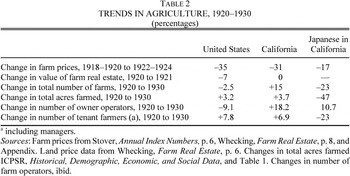
Japanese American farming declined after 1920, in contrast to its continued expansion following the passage of the 1913 Alien Land Law. Between 1910 and 1920 the number of farms operated by Japanese in California almost tripled from 1,816 to 5,152, while the number of acres farmed increased more than three times from 99,254 to 361,276. In contrast, the decade after the passage of the 1920 Alien Land Law saw the number of Japanese-operated farms in California fall from 5,152 to 3,956, or about 25 percent, and the number of acres farmed fell from 361,276 to 191,429, or almost 50 percent (See Table 1 and Figure 1). The law had its biggest impact on tenant farmers as would be expected (because the law only banned leases and purchases of land, but did not affect ownership), so that the number of farms operated by Japanese American tenants fell 26.9 percent between 1920 and 1930, while the number of owner-operated farms actually rose 10.7 percent (see Table 2). The average size of Japanese American farms in California also fell from 70.1 acres in 1920 to 48.4 acres in 1930.14
The absolute increase in Japanese owner-operated farms was only 54, as the number increased from 506 in 1920 to 560 in 1930. This could reflect the use of native-born Japanese Americans to buy land on behalf of immigrant farmers (Ichioka, Issei, p. 237–38). Although the number of Japanese-owner operated farms rose between 1920 and 1930, Japanese immigrant records show a decline of almost 50 percent in the number of acres farmed (Strong, Japanese, p. 138). Size of farms from Tolan Committee, “Japanese,” p. 122.

Some scholars have questioned whether the loss of land really represented losses to Japanese immigrant farmers. John Modell has argued that the decline in the number of acres and size of Japanese-operated farms simply represented a move toward more intensive agriculture, noting that the value of Japanese farm land and buildings actually rose four-fold in Los Angeles in the 1920s. However other local studies of Japanese American farming in California differ: Eiichiro Azuma's study of the impact of the 1920 Alien Land Law on the farming community of Walnut Grove reports a 50 percent decline in the number of Japanese farmers following the passage of the law. Further, Japanese American farmers in Los Angeles do not seem to be representative of the state as a whole, where value of farms, lands, and buildings owned by Japanese fell from 4.5 percent of the total in 1920 to 2.5 percent in 1930 (see Table 3).15
Modell, Politics, pp. 103–04, is cited by Daniels, Asian America, pp. 146–47, to argue that the 1920 law had little impact. Daniels, in turn, is cited by Matsumoto, Farming the Home Place, p. 2, in her work on a Japanese American farm community. Azuma's sources included an unpublished report on Japanese American agriculture in 1923 compiled by the Japanese Consulate in San Francisco (Azuma, “Japanese Immigrant Farmers,” p. 27).

In contrast to the decline of Japanese American farming in California after 1920, Japanese American agriculture in Hawaii grew in the 1920s. Hawaii, with its large Japanese American population and no alien land law, saw the number of farms operated by Japanese Americans increase from 3,098 in 1920 to 4,191 in 1930, an increase of one-third.16
In Hawaii, the main obstacle for Japanese trying to acquire land was the concentration of farmland (Fuchs, Hawaii, pp. 258–59). Although two-thirds of all farms in Hawaii in 1930 were operated by Japanese Americans, 633 white farmers (1 percent of the total) controlled more than 90 percent of the land. See pages 107–08 of U.S. Bureau of the Census, “Outlying Territories,” Fifteenth Census (1930).
THE DECLINE OF JAPANESE IMMIGRANT FARMING IN CALIFORNIA IN THE 1920S: THE ALIEN LAND LAW AND THE AGRICULTURAL CRISIS
A major issue in the debate over the effectiveness of the 1920 Alien Land Law in California was the impact of the 1920/21 depression and the sharp fall in farm prices. One explanation of the decline in Japanese immigrant farming during the 1920s was that Japanese immigrant farmers overextended themselves during the agricultural boom during and after World War I and suffered a setback from the agricultural depression of 1920/21. Both scholars who argue that the 1920 Alien Land Law was impotent and those who argue that it had significant negative consequences agree that the downturn in agriculture was a factor contributing to the decline in Japanese immigrant farming.17
See Higgs, “Landless,” p. 221; Ichihashi, Japanese, p. 280; Iwata “Japanese Immigrants,” p. 31; Ichioka, “Japanese Immigrant Response,” pp. 163–64; and Pajus, Real Japanese California, p. 148.
The financial distress of farmers can easily be seen on the national level during the 1920s. Farm real estate prices declined by almost one-third between 1920 and 1930.18
The price index declined from 170 in 1920 to 115 in 1930 per Regan and Johnson, “Farm Real Estate,” p. 4.
Regan and Johnson, “Farm Real Estate,” pp. 4, 25, and 37.
But to fully understand the impact of the agricultural depression in the 1920s, two differing explanations of the crisis have to be considered: one which focuses on the decline in the prices of farm products, especially during the 1920/21 recession, and an alternative explanation which focuses on over-optimism among farmers and lenders during the post–World War I period which produced a boom and bust in farm real estate prices.20
Johnson, “Postwar Optimism,” pp. 173–92. Alston, “Farm Foreclosures,” pp. 885–903, found empirical evidence for multiple causes, including both the decline in farm incomes and the World War II boom.
On a national level, the impact of the fall in farm prices during the 1920/21 downtown was severe: an index of farm prices fell 43 percent from 1920 to 1921, and even after accounting for the general deflation, the purchasing power of farmers (relative price of farm output) fell almost 19 percent. However, one would expect Japanese immigrant farmers in California to have been less affected by the agricultural downtown because they were heavily concentrated in truck crops whose prices held up better during bad times than those of other crops.21
During the Great Depression of the 1930s, truck crop (vegetable) prices fell only about half as much as the prices of all farm products (Regan and Johnson, “Farm Real Estate,” p. 11).
To examine how Japanese immigrant farmers were affected by the 1920/21 agricultural crisis, I constructed an index of farm prices for crops grown by Japanese farmers in California for the years 1918–1920 and 1922–1924 using price indices developed by H. J. Stover weighted by the value of output reported by Japanese farmers (see the Appendix for details of this calculation). This index included crops that made up 89 percent of the value of the output of Japanese immigrant-operated farms in California in 1920. I found that the prices of crops most grown by Japanese immigrant farmers in 1920 did indeed hold up better: their prices fell about 17 percent over this period, compared to a 31 percent fall in California farm prices and a 35 percent fall for U.S. farm prices, as shown in Table 2.22
California prices are from Stover, “Annual Index Numbers,” p. 6. U.S. prices are from Whecking, “Farm Real Estate,” p. 8.
Despite the fact that California farm prices fell almost as much as agricultural prices on a national level, the impact of the 1920s downturn was not as severe on California agriculture in general as it was on the agriculture of the country as a whole. The total number of farms in California grew by 15 percent over the decade (with all of the increase taking place between 1920 and 1925). California farmers continued to move up the farm tenure ladder with an 18.2 percent increase in the number of owner-operators outpacing the 6.9 percent increase in tenant farmers and managers.23
Sullivan, “Statistical Information,” p. 2.
If agricultural prices and the decline of farm income were the main reason for agriculture's economic crisis, then one would expect Japanese immigrant farmers to be less affected than California farmers in general. However this was not the case. U.S. census data show a large loss of farmland by Japanese farmers and a drop in the overall number of Japanese farms between 1920 and 1930. This decline, when the opposite trends were occurring among all California farms, can best be explained by the 1920 California Alien Land Law, not the decline in farm prices during the 1920/21 recession.
There is an alternative explanation of the agricultural crisis of the 1920s which is not based on the decline of farm prices. H. Thomas Johnson argues that the financial distress of the 1920s was not due to the decline in farm prices and incomes, but to excessive optimism during the postwar boom in farm real estate prices.24
Johnson, “Postwar Optimism.”
The real culprit according to Johnson was the expectation by farmers and rural lenders that it would take a long time for European farm production to recover from the war. This led to a speculative boom in farm real estate prices between 1918 and 1920. This boom was supported by excessive lending, which rose 18 percent in 1919 and 21 percent in 1920 alone. In addition, more risky second mortgages, which were largely funded by individuals and not banks, grew rapidly during and after World War I, and accounted for many of the loan failures in the 1920s.25
Ibid., pp. 184–85.
At first glance, California did seem to participate in the World War I farm real estate boom, although perhaps not quite as much as did the country as a whole. From 1916, when farmland price increases began to accelerate, to their peak in 1920, California farm real estate values rose 44 percent as compared to a 60 percent increase for national farmland prices. California also had a higher percentage of farms that were mortgaged in 1920 than the national average: 50.4 percent versus 37.2 percent nationally, and the percentage of all farms that were mortgaged grew at a faster rate in California than for the country as a whole during the 1910s.26
Regan and Johnson, “Farm Real Estate,” pp. 4–5; and U.S. Bureau of the Census, Sixteenth Census (1940) Agriculture, p. 257.
However, the driving forces behind the national boom and California's increase were different. Nationally, the rise in farm real estate prices was driven by a rise in farm exports: between 1914, when World War I began, and the peak of farm exports in 1919, agricultural exports as a percentage of farm gross product almost doubled, from 16.3 percent to 32.1 percent. All of this increase was reversed during the 1920s, so that by 1930 only 15.5 percent of farm output was exported. Of the six major classes of exported farm commodities, the sharpest boom and bust in exports was in pork, followed by wheat. California has historically raised very few hogs, and by 1920 California's wheat production had fallen dramatically from earlier levels. There was one major class of exported farm products that not only did not have a boom and bust during and after World War I, but also increased during the 1920s: fruit. California was number one among the states in fruit production, growing most or all of the apricots, plums and prunes, almonds, walnuts, figs, grapes, olives, oranges, and lemons in the United States.27
The percentage of farm production exported continued to fall by half again during the Great Depression, bottoming out in 1940/41 at less than 8 percent (Lipsey, Price, pp. 436–37). Export crops from Export-Import Section, Report, p. 5. California crops from Olmstead and Rhode, “Overview,” pp. 2–3 and 12–13; and Rhode, “Learning,” p. 778.
California's agricultural boom in the twentieth century was also sustained by a boom in domestic demand. California had a fast-growing population, which increased 60 percent between 1900 and 1910, 44 percent during the following decade, and 66 percent during the 1920s. California's population growth rate was three to four times the national average, and California was more urbanized than the country as a whole, further increasing the market for farm goods. California farmers were also able to increase their sales to other parts of the nation through the development of refrigerated transport and the growth of farm marketing cooperatives. Demand for many of the fruits and nuts grown in California grew rapidly because it was more income-elastic than the demand for staples such as wheat. California farmers were also able to displace imported fruits and nuts from Europe.28
See Kidner, California Business Cycles, pp. 11 and 13; and Jelinek, Harvest Empire, pp. 57–60 for the demographics of California. Critz, Olmstead, and Rhode discuss the growth of California fruit and nut production in “Horn of Plenty,” pp. 316–29.
The different basis for the increase in farm real estate prices led to very different outcomes during the 1920s: between 1920 and 1929, national farm real estate values fell 32 percent, while California farmland suffered only a 4 percent drop! In addition to California agriculture's better performance in terms of growth in the number of farms and farm acreage, and movement up the agricultural tenant ladder, California's agricultural employment grew 6.5 percent in the 1920s while it fell 4.5 percent in the rest of the nation. California also had a lower rate of farm foreclosures than the rest of the country during the late 1920s.29
See Regan and Johnson, “Farm Real Estate,” pp. 4–5; Kidner, California Business Cycles, pp. 18–19; and Alston, “Farm Foreclosures,” p. 888.
The crops grown by Japanese immigrant farmers were largely fruit and vegetables, and thus should have been less vulnerable to the boom and bust of farm exports during and after World War I. Seven of the ten top crops (by value) grown on Japanese-run farms were fruits (grapes, miscellaneous fruits and nuts, berries, and cantaloupes) or vegetables (miscellaneous vegetables, potatoes, and onions). If the agricultural crisis of the 1920s was a result of the collapse of excessively high land prices based on excess optimism from the World War I boom in farm exports, then one would expect Japanese immigrant farmers to feel less effect than the average American farmer, as was the case with farmers in California. Again, the loss of land and farms by Japanese farmers during the 1920s can best be explained by the 1920 California Alien Land Law, not the decline in farm exports and the resulting agricultural depression of the 1920s.30
Japanese crops are from Bunje, Real Japanese Story, p. 26. Ichioka, Issei, p. 235, also states that the Alien Land Law of 1920 made banks less willing to lend to Japanese American farmers. This loss of credit, combined with the failure of local Japanese American banks and the policy of Japanese banks not to lend to Japanese immigrants, also contributed to the decline in Japanese American farming.
DID EVASION BY JAPANESE IMMIGRANT FARMERS RENDER THE LAW IMPOTENT?
A final argument, made by Robert Higgs, is that evasion of the law rendered the 1920 California Alien Land Law impotent.31
Higgs, “Landless.”
Ichioka, Issei, pp. 237–40, discusses ways of evading the law.
But not all Japanese immigrant farmers were willing and able to evade the laws. An interviewer for a study of Japanese in the 1930s reported, “…many object to these subterfuges and refuse to attempt to transgress the law.” Another interviewer reported that “Many who had made verbal contracts to continue leasing were cheated or the verbal contracts were broken.” Those farmers who did evade the law were by no means immune from prosecution. Frank Chuman states that between 1920 and 1940 there were 16 appeals of escheat actions taken against Japanese immigrant farmers for violation of the Alien Land Laws. This number only includes cases that were appealed to the state appellate courts or to the U.S. Supreme Court, so the total number of cases was undoubtedly greater.33
Quotes from Strong, Japanese, pp. 103–04. Chuman, Bamboo People, pp. 117–25.
Higgs argued that, “…the apparently precipitous drop [in the number of Japanese-operated farms] from 1920 to 1930 was largely spurious. Much of this decline was offset by the greatly increased number describing themselves as managers, a common ruse to evade the alien land laws.” But even including managers, the decline in Japanese farming was severe. The number of Japanese-operated farms in California shows the smallest decline of a number of measures, falling from 5,152 to 3,956 (or 23 percent) in the ten years following the passage of the law. However acres farmed by Japanese fell 47 percent, and the value of their farms, lands, and buildings fell from 4.5 percent to 2.5 percent of the total, or by 44 percent (see Tables 2 and 3).34
Higgs, “Landless,” p. 221.
Higgs also concluded “the alien land laws appear to have failed utterly.” because the “total number of Japanese farm operators in 1940 was virtually the same as it had been 20 years earlier.” Although it is true that there were 5,152 Japanese-operated farms in California in 1920 and 5,135 in 1940, Higgs overlooks the lack of any progress in acquiring farmland during these years. The War Relocation Authority records of Japanese taken to World War II concentration camps show that Japanese immigrants and their citizen children owned about 69,000 acres of farm land in California, slightly less that the 74,000 acres reported by Japanese immigrants in 1920. In 1940 only 28.4 percent of all Japanese American farmers in California (including American-born Japanese exempt from the Alien Land Laws) were full-owners and 6.3 percent were part owners, as compared to 67.8 percent and 10.5 percent, respectively, of all California farmers. Twenty years after the passage of the California Alien Land Law, Japanese American farmers were more than three times as likely as the average farmer to be a tenant.35
Ibid, p. 221. World War II data are from Poli and Engstrand, “Japanese Agriculture,” p. 355. California data are from Sullivan, “Statistical Information,” p. 2.
Further, American-born offspring of Japanese, who as citizens were able to rent and buy farmland, owned much of this land. In 1920 American-born offspring of Japanese only numbered 20,814 in California, as compared to 51,138 Japanese immigrants. Further, the second generation was still quite young, with almost all of them under 20 years of age. However, by 1940 the second generation outnumbered their immigrant parents by almost two to one in California, 60,148 to 33,569. Even though most of the second generation were under 20, there were two-thirds as many adult American-born offspring of Japanese as immigrants. The number of second generation Japanese American farmers rose rapidly, so that by 1940 there were 1,663 in California as compared to 4,134 Japanese immigrant farmers.36
The age of the second generation in 1920 can be discerned from the fact that there were only 269 native-born Japanese Americans in the entire continental United States in 1900 (Thomas, Salvage, pp. 576–77). 38,133 of the American born Japanese in California in 1940 were under age 20, leaving 22,015 adults as compared to 33,192 adult immigrants (U.S. Bureau of the Census, Sixteenth Census (1940), Characteristics, p. 98). The number of farmers is from ibid, p. 107.
Higgs does argue that looking at only immigrant Japanese farmers one can still find progress up the agricultural tenant ladder. Higgs states that because the population of Japanese immigrant adult males in California declined by about one-third between 1920 and 1940, from 32,000 to 21,000, while the population of Japanese immigrant farmers declined only 22 percent, from 5,039 to 3,911, so that: “the conclusion applies a fortiori: the Japanese immigrants substantially improved their tenure status in California agriculture during the two decades after the passage of the harsh Initiative act of 1920.”37
Higgs, “Landless,” pp. 222–23.
But what Higgs does not make clear is that the data exclude the number of Japanese immigrants who were farm managers in 1920, while the 1940 number includes farm managers. He also used data on the number of Japanese owner-operated and tenant farms in California in 1920 from the Agricultural Census, while the 1940 data based on the Census of Population counts the number of male Japanese immigrant farmers, which was greater than the number of farms. After correcting for these factors, the number of Japanese immigrant–owned farms in California fell by 32 percent between 1920 and 1940, or about the same proportion as the fall in population.38
In 1940 there were a total of 5,807 Japanese American farmers in California (including men and women, native-born and immigrants), but only 5,135 Japanese operated farms. If one assumes that the ratio of farmers to farms is the same for the native-born and immigrants, and for men and women, then for the 3,911 Japanese male immigrant farmers in California there would be approximately 3,458 immigrant-operated farms, a drop of 32 percent from 1920. These data are from Higgs, “Landless,” pp. 222–23; and Tolan Committee, “National Defense Migration,” p. 105.
One could argue that the fact that the proportion of Japanese who were farmers did not fall shows that the Alien Land Law of 1920 was not that effective. But this just means that farming did not lose its attractiveness when compared to alternative occupations, not that the laws had no impact. By 1940 over half of Japanese immigrants in the labor force in California were in agriculture, as compared to only 10.7 percent of all Californians. Japanese immigrants were largely excluded from moving up to semi-skilled jobs in manufacturing, which employed many (European) immigrants in the Midwest and Northeast. The proportion of Japanese employed in manufacturing was not only low, but actually fell from 12 percent in 1920 to only 4.1 percent in 1940, despite the rapid growth in manufacturing in California after 1900.39
There is also the possibility that selective return migration of Japanese immigrants who were not farmers was a factor (Suzuki, “Success Story?” pp. 889–901). Data for Japanese Americans are from Tolan Committee, “National Defense Migration,” pp. 104–05, and for California are from Gordon, Employment, p. 29. Note that the 1920 figure is for all Japanese in the (continental) United States, whereas the 1940 figure is for Japanese in California, Oregon, and Washington, where 88.5 percent of Japanese lived (Thomas, Salvage, p. 575).
Last but not least, the combination of the Alien Land Laws and the incarceration of Japanese Americans into concentration camps during World War II dealt a severe blow to Japanese American agriculture in California and to Japanese American tenant farmers in particular. The War Relocation Authority reported that after World War II, “…few whose prewar farm operations depended on leased land were able to resume farming. Owners, however, had no great difficulty in getting back their land.” This observation is confirmed by census figures: between 1940 and 1950, the total number of Japanese American farmers fell by 40 percent, from 6,978 to 4,123; and the number of acres farmed dropped by 25 percent, from 348,568 to 262,405. Although the number of Japanese American farmers who owned land increased slightly, their farm acreage fell, and the number of Japanese tenant farmers and farm managers fell by almost 75 percent, as did their number of acres farmed (See Table 1 and Figure 1).40
War Relocation Authority, People, p. 65. This quote refers to the Santa Clara Valley, but other local histories have the same view. See for example Matsumoto, Farming the Home Place, p. 157.
CONCLUSION
The growing demand for labor by California's booming fruit, vegetable, and cotton farms drew Japanese immigrants into agriculture during the first two decades of the twentieth century. Japanese, like other immigrants and racial minorities, turned to entrepreneurship in their attempts to escape the unskilled labor market and to better their lives. Yet the growing opposition to Japanese immigration in general and to their progress in farming in particular led to the passage of the Alien Land Laws in a number of states, beginning with California in 1913. When Japanese immigrant farming continued to make progress in California despite the 1913 law, a stiffer law was passed in 1920. During the 1920s there was a decline in both the acres farmed by Japanese immigrants and in the number of farmers. The maturation of U.S.-born Japanese Americans who were citizens and thus exempt from the law allowed some progress during the 1930s, but the incarceration of the Japanese American community during World War II dealt their farms a major blow. By 1950 Japanese Americans in California were farming almost the same number of acres as in 1910!
After a close examination of the effects of the 1920 agricultural depression and general trends in California agriculture, this article finds that the general agricultural downturn cannot explain the severe losses of Japanese American farmers relative to other farmers, and that the 1920 Alien Land Law must have been an important factor. Further, suggestions that the decline in acreage actually masked gains for Japanese immigrant farmers are refuted. Finally, this article shows that the view that Japanese immigrant farmers actually did continue to move up the farm tenure ladder in the longer run is based on erroneous calculations. The decline of Japanese American farming in California after 1920 is best explained by the effects of the 1920 Alien Land Law.
This conclusion is at odds with the conclusions of other social scientists such as Higgs and Robert Jiobu who see Japanese American farming as a success story before World War II. Rather than being a model minority, there are many parallels between Japanese-immigrant and African American farmers before World War II. In both cases, about three-quarters of farmers were still landless tenants in 1940, whereas almost three-quarters of white farmers owned land. Both groups were hurt by public policy, Japanese immigrants by the Alien Land Laws and African Americans by the implementation of the Agricultural Adjustment Act during the 1930s. Japanese immigrants were excluded from more skilled jobs and went into farming as did many African Americans in the South, who in the words of economic historian Gavin Wright, “put quite a bit of effort into escaping from the labor market, but they did not always succeed.”41
Jiobu, “Ethnic Hegemony,” pp. 353–67; and Higgs, “Landless,” p. 223. The quote is from Gavin Wright, “Postbellum Southern Labor Markets,” p. 116. However, Japanese immigrants, unlike African Americans, had a relatively large nonfarm business sector, in part because they had legal protections under U.S.-Japan treaties (Consulate General of Japan, Law Cases, pp. 396–97).
Appendix
The price index for crops grown by Japanese farmers in California was calculated as follows: records of the Japanese Agricultural Association as reported by Emil Bunje (Japanese Farming, p. 26) show the acreage planted to, and value of output of, 19 major crops grown by Japanese farmers in California in 1920: asparagus, beans, potatoes, celery, tomatoes, onions, sugar beets, cantaloupes, (other) vegetables, berries, grapes, (other) fruits, hops, corn, rice, hay and (other) grain, cotton, seeds, and miscellaneous.
Index prices for corn, rice, cotton, potatoes, beans, sugar beets, and grapes were based on Stover (Annual Index Numbers, pp. 14–17). Hay and grain were also based on Stover (ibid, pp. 6 and 15) with a weighting of 60 percent hay and 40 percent grain based on the distribution of acreage grown by Japanese farmers in California in 1924, because 1920 data was not available. Other fruit prices were based on Stover's (ibid, p. 6) index of nine fruits (oranges, lemons, apples, grapes, peaches, pears, apricots, raisins, and prunes). Index prices for asparagus, cantaloupes, celery, onions, and tomatoes were calculated from monthly prices reported by H. J. Stover and A. W. Stuart (Monthly Prices, pp. 9, 23, 35, 43, and 53) using harvest season prices, or if crop was grown year around, an average of low-price months for the years covered. An index of other vegetables was calculated as a simple average of prices for artichokes, string beans, cabbage, carrots, cauliflower, lettuce, peas, and spinach from Stover and Stuart (ibid, pp. 4, 16, 20, 27, 31, 39, 45, and 50). All prices were taken from the Los Angeles market except for artichokes, where San Francisco prices were used. Prices for berries, hops, seeds, and miscellaneous crops were not available, but they accounted for only 11 percent of the total value of output of Japanese American farmers in 1920 according to Bunje (Japanese Farming, p. 26).
The periods from July 1918 to June 1920 and from July 1922 to June 1924 were chosen as leading up to the peak agricultural prices in 1919 and 1920, and following the downturn in 1920 and 1921. The index prices of crops grown by Japanese American farmers were weighted by the value of output in 1920 of each crop, to give an overall index which showed a 17.41 percent decline between these two periods.
The author would like to acknowledge the comments and suggestions of Susan Carter, Gordon Chang, Joan Hannon, Cynthia Lee, Robert McMillan, Mae Ngai, Brian Niiya, Peggy O'Brien-Strain, Michael Teitz, Gavin Wright, and anonymous referees, and feedback from the 1997 Economic History Association conference, the 1998 Association for Asian American Studies conference, and a 1999 Public Policy Institute of California seminar where earlier versions of this article were presented. In addition the author would also like to acknowledge the support of the Public Policy Institute of California where he was a visiting fellow from 1999 to 2000, and the assistance of Dan Lawrence and the staff of the Institute for Governmental Studies at U.C. Berkeley. The author is responsible for all errors and any opinions are his alone.
References
Alston Lee.
1983
“Farm Foreclosures in the United States During the Interwar Period.”
This Journal 43,
no. 9
885–
903.Google Scholar
Azuma Eichiro.
1994
“Japanese Immigrant Farmers and California Alien Land Laws: A Study of the Walnut Grove Japanese Community.”
California History
73,
no. 1
14
29.Google Scholar
Bunje Emil.
1957
The Story of Japanese Farming in California.
San Francisco:
R and E Research Associates
Chan Sucheng.
1991
Asian Americans: An Interpretive History.
Boston:
G. K. Hall
Chan Sucheng.
1986
This Bittersweet Soil: The Chinese in California Agriculture, 1860–1910.
Berkeley and Los Angeles:
University of California Press
Chuman Frank.
1976
Bamboo People.
Del Mar, CA:
Publisher's Inc.
Consulate General of Japan.
1925
Law Cases Affecting Japanese in the United States, 1916–1924,
Vol. 1.
San Francisco, CA
Critz Jose,
Olmstead Alan, and
Rhode Paul.
(June 1999)
“Horn of Plenty: The Globalization of Mediterranean Horticulture and the Economic Development of Southern Europe, 1880–1930.”
This JOURNAL
59,
no. 2:
316–52.Google Scholar
Daniels Roger.
1977
The Politics of Prejudice.
2nd ed.
Berkeley and Los Angeles:
University of California Press
Daniels Roger.
1988
Asian America.
Seattle:
University of Washington Press
Export-Import Section, Agricultural Adjustment Administration,
1935
Report on Planning. Part 2, Agricultural Exports in Relation to Land Policy.
Washington, DC:
GPO
Fuchs Lawrence.
1961
Hawaii Pono: A Social History.
San Diego and New York:
Harcourt Trade Publishers
Fuller Varden.
“The Supply of Agricultural Labor as a Factor in the Evolution of Farm Organization in California.”
In U.S. Congress Senate Committee on Education and Labor. Hearings Pursuant to Senate Resolution 266, Exhibit 8762-A. 76th Congress, 3rd Session [1940],
pp. 19827–49.
Gordon Margaret.
1954
Employment, Expansion and Population Growth: The California Experience 1900–1950.
Berkeley and Los Angeles:
University of California Press
Hallagan William.
1980
“Labor Contracting in Turn of the Century California Agriculture.”
This JOURNAL
40,
no. 4
757–76.Google Scholar
Higgs Robert.
1978
“Landless by Law: The Japanese Immigrants in California Agriculture to 1941.”
This JOURNAL
38,
no. 1
205
225.Google Scholar
Hunt Clarence M.
1920
“Swat the Japs and Save the State! Vote “Yes” on Proposition One— The Alien Land Law.”
The Grizzly Bear
28,
no. 1
1
2.Google Scholar
Ichihashi Yamato.
1932
Japanese in the United States.
Stanford, CA:
Stanford University Press
Ichioka Yuji.
1984
“The Japanese Immigrant Response to the 1920 California Alien Land Law.”
Agricultural History
43,
no. 2
157–78.Google Scholar
Ichioka Yuji.
1988
The Issei.
New York:
The Free Press
Inter-University Consortium for Political and Social Research–ICPSR,
1992
Historical, Demographic, Economic, and Social Data: The United States, 1790–1970.
URL: http://fisher.lib.virginia.edu/census/,
Ann Arbor, MI:
Iwata Masakazu.
1962
“The Japanese Immigrants in California Agriculture.”
Agricultural History
36,
no. 2
25
37.Google Scholar
Iwata Masakazu.
1992
Planted in Good Soil.
New York and San Francisco:
Peter Lang
Jelinek Lawrence.
1982
Harvest Empire: A History of California Agriculture.
2nd ed.
San Francisco:
Boyd and Fraser
Jiobu Robert.
1988
“Ethnic Hegemony and the Japanese of California.”
American Sociological Review
53,
no. 3
353–67.Google Scholar
Johnson H. Thomas.
1973/74
“Postwar Optimism and the Rural Financial Crisis.”
Explorations in Economic History
11,
no. 2
173–92.Google Scholar
Jones-Correa Michael.
2000–2001
“The Origins and Diffusion of Racial Restrictive Covenants.”
Political Science Quarterly
115,
no. 4
541–68.Google Scholar
Kidner Frank.
1946
California Business Cycles.
Berkeley and Los Angeles:
University of California Press
Lebergott Stanley.
1975
Wealth and Want.
Princeton, NJ:
Princeton University Press
Lipsey Robert.
1963
Price and Quantity Trends in the Foreign Trade of the United States.
Princeton, NJ:
Princeton University Press
Lukes Timothy, and
Okihiro Gary.
1985
Japanese Legacy.
Cupertino, CA:
California History Center
Matsumoto Valerie.
1993
Farming the Home Place.
Ithaca, NY:
Cornell University Press
McGovney Dudley
1947
“The Anti-Japanese Land Laws of California and Ten Other States.”
California Law Review
35
7
54.Google Scholar
Modell John.
1977
The Economics and Politics of Racial Accommodation: The Japanese of Los Angeles, 1900–1942.
Urbana:
University of Illinois Press
Olmstead Alan, and
Rhode Paul.
1997
“An Overview of the History of California Agriculture.” In California Agriculture: Issues and Challenges,
edited by J. Siebert,
1–
27.
Berkeley:
University of California, Giannini Foundation, Division of Agriculture and Natural Resources
Pajus Jean.
1937
The Real Japanese California.
Berkeley, CA:
James J. Gillick, Inc.
Poli Adon, and
Engstrand Warren.
1945
“Japanese Agriculture on the Pacific Coast.”
Journal of Land and Public Utility Economics
21,
no. 4
352–64.Google Scholar
Regan M. M. and
Johnson A. R.
1942
“The Farm Real Estate Situation, 1939–40, 1940–41, and 1941–42.”
Circular #662,
Washington, DC:
U.S. Department of Agriculture
Rhode Paul.
1995
“Learning, Capital Accumulation, and the Transformation of California Agriculture.”
This JOURNAL
55,
no. 4
773–
800.Google Scholar
Ruggles Steve,
Matthew Sobek, et al.,
1997
Integrated Public Use Microdata Series: Version 2.0,
Minneapolis,
URL: http://www.ipums.umn.edu.
Stover H. J.
1936
“Annual Index Numbers of Farm Prices, Farm Crop Production, Farm Wages, Estimated Value per Acre of Farm Real Estate and Farm Real Estate Taxes, California, 1910–1935.”
Mimeographed Report #50,
Berkeley, CA:
Giannini Foundation on Agricultural Economics
Stover H. J., and
A. W. Stuart.
1934
Monthly Prices of Selected California Truck Crops on the San Francisco, Oakland, Los Angeles, and New York City Markets, 1910–1934.
Berkeley, CA:
Giannini Foundation on Agricultural Economics
Strong Edward.
1933
Japanese in California.
Stanford, CA:
Stanford University Press
Strong Edward.
1934
The Second Generation Japanese Problem.
Stanford, CA:
Stanford University Press
Sullivan W.
1947
“Statistical Information on Farm Tenure in California.”
Berkeley:
University of California College of Agriculture and U.S. Department of Agriculture
Suzuki Masao.
1995
“Success Story? Japanese Immigrant Economic Achievement and Return Migration, 1920–1930.”
This JOURNAL
55,
no. 4
889–
901.Google Scholar
Takaki Ronald.
1989
Strangers from a Different Shore.
Boston:
Little, Brown, and Company
Taylor Paul, and
Tom Vassey.
1936
“Historical Background of California Farm Labor.”
Rural Sociology
1,
no. 3
281–95.Google Scholar
Thomas Dorothy.
1952
The Salvage.
Berkeley and Los Angeles:
University of California Press
Tolan Committee.
1942
“The Japanese.”
Part 1 of National Defense Migration, Supplement to House Report 2124, 77th Congress, 2nd Session
U.S. Bureau of the Census.
1914
Thirteenth Census of the United States (1910), Chinese and Japanese in the United States.
Washington, DC:
GPO
U.S. Bureau of the Census.
1923
Fourteenth Census of the United States (1920), Agriculture.
Washington, DC:
GPO
U.S. Bureau of the Census.
1932
Fifteenth Census of the United States (1930), Agriculture.
Washington, DC:
GPO
U.S. Bureau of the Census.
1932
Fifteenth Census of the United States (1930), Outlying Territories and Possessions.
Washington, DC:
GPO
U.S. Bureau of the Census.
1943
Sixteenth Census of the United States (1940), Agriculture,
Vol. 3.
Washington, DC:
GPO
U.S. Bureau of the Census.
1943
Sixteenth Census of the United States (1940), Characteristics of Non-White Population by Race.
Washington, DC:
GPO
U.S. Bureau of the Census.
1953
Seventeenth Census of the United States (1950), Agriculture.
Washington, DC:
GPO
War Relocation Authority.
1947
People in Motion.
Washington, DC:
GPO
Whecking E. H.
1927
“The Farm Real Estate Situation, 1926–27.”
Circular #15,
Washington, DC:
U.S. Department of Agriculture
Wright Gavin.
1986
Old South, New South,
New York:
Basic Books
Wright Gavin.
1987
“Postbellum Southern Labor Markets.”
In Quantity and Quiddity,
edited by Peter Kilby
98–
134.
Middletown, CT:
Wesleyan University Press
Wright Gavin.
1988
“American Agriculture and the Labor Market: What Happened to Proletarianization?”
Agricultural History
42,
no. 3
182–
209.Google Scholar

JAPANESE FARMING IN CALIFORNIA, 1900–1950

TRENDS IN AGRICULTURE, 1920–1930 (percentages)

JAPANESE-OPERATED FARMS IN CALIFORNIA, 1920–1940
 You have
Access
- 7
- Cited by