Introduction
Most studies of communities of practice (CofP) look at situations where people come together willingly (friendships, networks at school, workplace teams). This article explores language use in a CofP that has come together in circumstances that the majority of members consider unfavourable. I show that in this context members of the CofP have converged on a nonstandard form of negation in Japanese as a way of marking not only intergroup boundaries, but specifically boundaries that carry negative affect.
The group of people under discussion in this article are Japanese women living on the outskirts of Amsterdam because their husbands have been transferred from Japan to the area temporarily on short-term job contracts. The women belong to a nonprofit organization run entirely by them, and they frequently meet to arrange a variety of events and participate in activities. Over the course of a year-long period of fieldwork, I came to see both already constituted and emerging patterns in their actions and their use of available resources—both linguistic and cultural—and therefore the question of whether or not they could be considered as a CofP began to emerge.
A CofP cannot be defined merely on the basis of some abstract characteristics attributed by a researcher in a top-down manner, nor can it be identified by selecting a group of individuals who simply co-exist, for example by way of being co-workers or members of the same organization (Eckert Reference Eckert and Brown2006). As King (Reference King2014) aptly points out, an ethnographic approach to research might bring a much-needed understanding of the extent to which the inner workings of a given community have indeed been negotiated by the community itself—a crucial component of the CofP framework. Looking at a group of people engaging together in some common activity, we cannot assume a priori the existence of a CofP. What we can do, however, is unpack their engagement with one another and understand the way in which they organize themselves as a group (if they do), thus gaining a more nuanced understanding of the internal workings of the group.
In this article, I use participant observation of a small group of expat Japanese women living in The Netherlands to explore how their use of standard Japanese negation and nonstandard Osaka-style negation transcends the typical use of dialect features as a marker of the speaker's origin, and becomes a sociolinguistic resource for expressing affect and for orienting to supralocal, even international, boundaries of intergroup distinctiveness.
Ethnographic background
Japan on Amstel
Data for this analysis was collected in Amstelveen (south of Amsterdam) in 2012–2013. Amstelveen is known as a place with a high density of expatriates and specifically a large Japanese expatriate community and long-standing links with Japan. It was estimated that in 2008, out of 8,600 foreign residents of |Amstelveen, 1,719 were Japanese, making it the largest expatriate group.Footnote 1 There is a Japanese kindergarten, Japanese day care, a cram school (juku), travel agent, dentist, and a number of restaurants; and help in Japanese is available in one of the largest hospitals. Three times a year a health check is organized for Japanese residents. Doctors who normally reside in Tokyo come to The Netherlands at these times to cater for this particular community. In spring, Japanese hanami ‘cherry blossom viewing’ parties are organized at the river Amstel, and are attended by both local and expatriate communities. The place has come to be referred to at times, albeit often jokingly, as ‘Japan on Amstel’.
It is clear then that there is a strong presence of both Japanese residents and Japanese culture in the area of Amstelveen. This seems particularly important in view of the fact that the majority of the Japanese residents are living there for a relatively short term—participants in this research have all been there between three and ten years, and they all refer to themselves as chuuzaiin ‘expatriates’. The women interviewed for this project are wives of men who were offered a temporary post in a branch of their Japanese company in Amsterdam or Amstelveen, and are employed on temporary contracts. Upon completion of the contracts, the families return to Japan, where the men return to work in their company of origin. At the time of fieldwork, none of the women knew exactly how much longer they would be staying in Amstelveen—they said it could be anything from a year to ten years. This creates an ongoing sense of insecurity, palpable among the women I talked to, and the temporality of this experience seems to make it challenging to engage with any local community—be it Dutch or expatriate. One of the women interviewed for this project put it like this: “When you know you will leave at some point it is difficult to make friends. It is difficult to … meet people and talk to them, because you know you will leave. Maybe you will leave soon. Meeting Japanese people is easier, because it is the same for all of us” (translation from Japanese).
‘The Club’
The community investigated for this research is a group of Japanese women who are all members of what I call here ‘The Club’. The Club was set up in 1989 as a volunteer-run, nonprofit organization. Initially it was organized for Japanese volunteers wishing to get involved in work that would give something back to the community they had moved into. The early activities included organizing events and activities for underprivileged children and creating and maintaining links between several Japanese and Dutch nonprofit organizations. The Club is still run by volunteers, but has since developed into an organization that mainly supports the Japanese living in The Netherlands. Their flyer, printed in both Japanese and English, reads:
This may be a great opportunity for you to make the best use of your time in the Netherlands, and to mentally reduce the long distance from Japan. We believe that if we share and join forces, deepen friendships and integrate in the local community, we will develop a better understanding of the Dutch society.
Anyone can become a member of The Club, according to the website. At the time of the fieldwork, however, all of the eighteen members were unemployed Japanese women. The activities The Club organizes range from open lectures and cherry blossom festivals, to free Japanese conversation classes for the local community. The members meet regularly in the local community centre, at least twice a month, to organize events or simply to chat. When there are some special events, the meetings are more frequent. Also, several of the members meet every other Friday to run Japanese lessons for the local community; people attending these classes range from the Dutch who are simply interested in learning a little bit of Japanese, through students who have been to Japan, or are planning to go, to foreigners who have some links with Japan. The regular club meetings have no strictly scheduled agenda, so everything that happens depends on the activity that is currently being planned, or an issue that is being discussed (change in the committee, setting up a new event, etc.). While not all of the members participate in the bi-weekly language class, a majority of the members attend the meetings. During the events they organize, members are responsible for distributing or checking the tickets, organizing food, setting up and preparing the room, and so on.
All of the current club members are willingly involved in a number of activities, and are quite engaged in the work done at the club. Participation in activities is not actively policed, but it is encouraged, and one of the key issues for future members seems to be how much involvement and participation will be expected of them. Several of the members have mentioned that the numbers seem to have been decreasing over the past years because women are not willing to put in the time and effort needed for things to run smoothly. While the members meet frequently around matters concerning its activities, they hardly (if ever) meet outside the club setting, or for purposes other than those related to the workings of The Club itself. It became apparent that only two of the members have social ties outside The Club, and others either belong to other networks (e.g. a sports club), or are not involved in any other social activities at all. For twelve out of the eighteen club members this is the only social activity outside of their homes.
Methodology
The analysis in this article is part of a larger project looking at the linguistic and cultural practices of Japanese expatriates in The Netherlands. While the focus of the study was on linguistic practices in a situation of language and dialect contact and the outcomes thereof, during fieldwork it became clear that the practices of this particular group needed to be considered in their own right, paying closer attention to the ongoing creation of group identity. In the linguistic analysis, and the approach to data, I adopt an interactional sociolinguistic approach (Gumperz Reference Gumperz1982).
Bearing ethnographic ideals in mind, it would have been of immense value to the research to be able to engage in ongoing in-depth participant observation, which would involve following all of the members of The Club both within the club setting and outside of it. In reality, however, it proved difficult to do this, for several reasons: the nature of this community is such that it is a very closed group, being a group of immigrants, as well as being Japanese. The participants themselves, towards the end of my research, shared with me that initially they were not willing to allow me to attend the meetings, and only did so as an exception. Bearing these difficulties in mind, I approached the research in a way that would allow me to see the inner workings and self-organization of the group, while at the same time making sure that I was not in any way breaching their feelings of comfort and safety in my presence. Off the record I participated in a number of meetings of The Club, and was invited to several of the events; during these meetings and events I was allowed to take notes. For the linguistic analysis, data was collected in two forms: (i) a set of seven recorded, semi-structured conversations between the researcher and two to three Japanese women, each lasting between sixty and ninety minutes, and (ii) two recordings of meetings of club members, where they discussed current affairs and planned an upcoming event.
At the beginning of my fieldwork I attended a meeting organized by The Club and introduced myself. One of the members volunteered to talk to me after the meeting, and answer my questions. I was then invited to participate in two Japanese language sessions run for the local community, where I was introduced to the other members. Only after one or two informal meetings with any given person did I record any interactions; these are the basis of the linguistic analysis and the discussion. The audio-recorded conversations were transcribed in ELAN for a time-aligned transcription, and relevant utterances, that is, those containing any form of negation were extracted and analysed. All of the conversations were held in Japanese, either at the local community centre, or in a café of the participants’ choice. This was to ensure as much as possible the informality of the situation and the comfort of the participants. The groups of club members were self-selected, which meant that all of the members were informed about the ongoing research and then they decided among themselves who was going to show up for a given recording.
Out of eighteen members of The Club at the time, eight agreed to participate actively in the research, in that they agreed to meet and talk with me. The regional origins of the group members at the time of fieldwork were as follows: four women from Osaka, two from Kyoto, six from Tokyo, three from Nagoya, three from Kyushu. The make-up of the community is of importance when we consider the linguistic choices with regard to negation.
I now turn to discuss CofP as an analytical framework and give examples of certain routines and practices that I observed at The Club.
The Club as a community of practice
Community of practice
In its most straightforward definition, a community of practice is a ‘collection of people who come together around a mutual engagement in an endeavour’ (Lave & Wenger Reference Lave and Wenger1992:464). The defining features of a CofP, as outlined by Wenger, are joint enterprise, mutual engagement, and a shared repertoire of resources (Wenger Reference Wenger1998:73). All of these defining characteristics must be satisfied to speak of a CofP. Enterprise within this framework is both understood by the members and negotiated by them, and so understanding of this enterprise (and its negotiation) necessarily contributes to the sense of identity.
Wenger (Reference Wenger1998:125) provides a list of specific indicators that show that a community of practice has indeed formed:
-
1. Sustained mutual relationship—harmonious or conflictual
-
2. Shared ways of engaging in doing things together
-
3. The rapid flow of information and propagation of innovation
-
4. Absence of introductory preambles, as if conversation and interaction were merely the continuation of an ongoing process
-
5. Very quick setup of a problem to be discussed
-
6. Substantial overlap in participants’ description of who belongs
-
7. Knowing what others know, what they can do, and how they can contribute to an enterprise
-
8. Mutually defining identities
-
9. The ability to assess the appropriateness of actions and products
-
10. Specific tools, representations and other artifacts
-
11. Local lore, shared stories, inside jokes, knowing laughter
-
12. Jargon and shortcuts to communication as well as the ease of producing new ones
It is not my intention to relate my analysis to all of these indicators (for the sake of efficacy and space); however, they are referred to in the course of discussion and analysis. While the joint enterprise connects the members as they construct their membership in the CofP through their mutual engagement with one another, a shared repertoire of resources (both linguistic and nonlinguistic) and the mutually understood use of this repertoire emerge in the course of this engagement. The members of a CofP develop various ways of doing things—a shared practice (Eckert & McConnell-Ginet Reference Eckert and McConnell-Ginet1992; Eckert Reference Eckert and Brown2006). This development of practice within the community, and through constant negotiation, comprises a crucial difference between this and other constructs that deal with aggregates of people, such as the speech community or social networks, as well as frameworks from intergroup theory (cf. Holmes & Meyerhoff Reference Holmes and Meyerhoff1999; Meyerhoff & Strycharz Reference Meyerhoff, Strycharz, Chambers and Schilling2011).
Learning to be
The main objective of The Club is the organization of events for the Japanese community, and each of the members is endowed with a certain amount of responsibility and a specific set of tasks. Discussing these tasks constitutes an important part of the meetings. But there is also another, less explicit and not officially stated, function of this community—providing support for each other in their current situation. In that sense as well, as has become apparent through conversations and in off-the-record comments, the women who have been in The Netherlands for a longer period of time have become self-elected mentors for the ones who have been there for a shorter period of time, showing the newer members where and how to get things done, and providing informal support. In that sense, the component of passing on knowledge comes through as one of the important traits of this CofP (cf. Wenger Reference Wenger1998), not only with regard to the tasks involved in work done within The Club, but also with regard to life in The Netherlands in a very general sense. The Club is therefore construed by its members as a platform of learning actually how to be, that is, how to enact membership—how to exist in these circumstances, how to engage with the reality, and how to use the resources at hand. There seem to be three distinct levels of learning happening for new members joining The Club: (i) they are explicitly guided as to what their roles and responsibilities will be within the organization, (ii) on the side-lines, in off-record comments, they are taught about life in The Netherlands, life in Amstelveen, and (iii) they learn to understand and follow (or not) certain practices and routines.
Any explicit teaching that I observed was done by five women, who, as I was told, had been in The Netherlands for the longest time (between five and seven years), and so had also been involved in The Club for longer. The role of these mentors, or core members, is visible also in their policing of the use of linguistic resources, as I discuss later, and so the identities and roles within the Club are being actively co-constructed by its members in relation to one another (cf. also Wenger Reference Wenger1998:130–31).
Mutually constructed practices and identities
As mentioned earlier, I observed the activities within The Club for a period of twelve months. On a number of occasions it became clear that as an outsider I had no access to certain routines—such as who gets through the door first, who sits where during the meetings—and no understanding of the use of certain resources such as jokes that were clearly understandable to the members but not to me, or stories involving past members of The Club that clearly constituted common knowledge (cf. Wenger Reference Wenger1998:125). When I started my fieldwork, Noriko,Footnote 2 a woman from northern Japan, had just joined The Club, and during the first meeting I attended she was instructed where to sit at the table; she kept that place in all other meetings I was allowed to attend. I, however, was never told where to sit. My identity as an outsider, who is not (and most likely never will be) construed as a member, was clear from the beginning, and so there was an understanding of who is, and potentially who can be, construed as a member (cf. Wegner Reference Wenger1998; Holmes & Meyerhoff Reference Holmes and Meyerhoff1999); as such I remained a nonparticipant, in Wenger's (Reference Wenger1998) terminology, throughout the duration of my fieldwork.
One of the key aspects often discussed in the informal part of the meetings were the differences between the Japanese and Dutch ways of doing things. Sometimes they were mere mentions of simple things (like the fact that Dutch dishwashers are too loud, or the meat is sliced too thick at the butcher's), but at times these turned into full-blown conversations revolving around these topics. Foregrounding them allowed the members to construct themselves as first and foremost Japanese abroad, relocated to a new and what they perceived as a mostly unfriendly reality, putting aside all of the differences that may possibly emerge from discrepancies in their age, life experience, or place of origin. In this way, the members foreground their shared experience and identity—being Japanese wives of the men who were relocated, and needing to stick together—but these were also examples of a ‘shared discourse, which reflects a certain perspective on the world’ (Wenger Reference Wenger1998:131, cited in Holmes & Meyerhoff Reference Holmes and Meyerhoff1999). Regardless of the extent to which these differences (between Dutch and Japanese) are real or imagined, they allow the members to affirm the divide between themselves as a group, and the society they have found themselves in, thus serving as interactional devices for strengthening the sense of community among the members. They have been detached from their homeland in the physical sense, and so their way of creating belonging now lies solely outside the realm of autochtony perceived as physically being in the land of origin (cf. e.g. Geschiere Reference Geschiere2009)—they reassert their belonging to a distant autochtonous land through locally developed networks, one of them being The Club they belong to. One of the ways in which this is visible is through their discourse foregrounding the commonalities between them vis-à-vis the Dutch ‘other’, thus strengthening the ‘us-them’ dichotomy over any other local differences within the group. Yet another is the choice of standard Japanese as the common (unmarked) code for most communication among the members from different parts of Japan (see analysis and discussion below).
The exact processes involved in co-construction of membership within The Club are a topic of future analysis; however, it is important to note here that over time it became clear that this community satisfies the three fundamental criteria of a CofP, that is, mutual engagement, jointly negotiated enterprise, and a shared repertoire of resources. To summarize, the members arrange regular meetings during which most, if not all, of the members are present (mutual engagement); the way The Club functions, its main purpose, the activities that are organized, and the way the activities are run are all continuously negotiated and decided by the members (jointly negotiated enterprise); members share the discourse regarding their identity vis-à-vis the outside world, and there are a number of stories about past members and events circulating among members (and often repeated or referred to during meetings), as well as inside jokes (shared repertoire of resources). Active engagement in the joint enterprise of the group drives group membership, and thus causes local practices to emerge.
I now turn to an analysis of negation strategies used in The Club. Specifically, I argue that in line with social identity theory (Tajfel & Turner Reference Tajfel, Turner, Austin and Worchel1979), a specific linguistic feature marking negation is used not only to underscore a significant intergroup contrast (here mainly between the Dutch and the Japanese), but also to map negative evaluations when the differences are noticed.
Data
From all of the recorded conversations, 481 interactions with utterances containing negation were extracted. Negation was coded for: category (verb, noun, adjective, and nominal adjective); presence/absence of the polite ending desu/masu; tense (past, nonpast); region (standard Japanese or regional/nonstandard dialect); context (free chat or meeting); and the origin of the speaker. Nonstandard negation was found only in the negation of verbs. With all other grammatical categories (i.e. nouns, nominal adjectives, and adjectives), only standard Japanese variants were used.
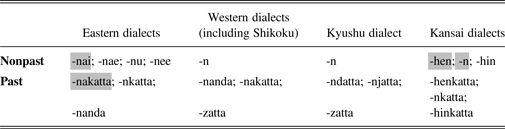
Negation in Japanese is expressed by means of bound morphemes suffixed to the element that is being negated and classified according to tense and formality (see e.g. Tsujimura Reference Tsujimura1996; Matsumoto & Britain Reference Matsumoto and Britain2003). In addition to a number of possible standard Japanese negation patterns, there is a high degree of regional variation between Eastern, Western, and Kyushu dialects (Shibatani Reference Shibatani1990). Table 1 combines regional variants of verbal negation—morphemes suffixed to the verb. Shaded variants are the ones that can be found in the dataset.
Verbal negation patterns across regions (combined from Shibatani Reference Shibatani1990; Tsujimura Reference Tsujimura1996; Matsumoto & Britain Reference Matsumoto and Britain2003; Strycharz Reference Strycharz2012).

The dataset contains verbal negation associated with standard Japanese, that is, V + -nai, as well as features with the form V + -hen and V + -n. In the analysis I have combined these two features and refer to them jointly as Osaka-style negation. Osaka city is in the Kansai region, and so the dialect spoken in Osaka belongs to the supralocal Kansai variety. V + -hen negation can also be found in other Kansai varieties (such as Kyoto or Kobe); however, I refer to it as Osaka-style negation for the purpose of this article, because (i) it is a salient feature of Osaka Japanese, and (ii) while there are speakers from other parts of the Kansai area in this community, V + -hen was not observed in their speech. V + -n is a feature of several nonstandard varieties (see Table 1), not only Osaka Japanese; however, (i) in this study only Osaka Japanese speakers used V + -n and (ii) the interactional meaning of this variant matches that of the V + -hen variant, as we see below.
Verbal negation constituted 301 tokens (63% of all negative tokens). Nineteen out of 301 tokens are Osaka-style negation; all of the other verbal negation is standard Japanese. Eleven Osaka-style tokens were found in the speech of people from Osaka, but the remaining eight were found in the speech of women from Tokyo—Nagoya and Kyushu—where the feature V + -hen does not occur. This might suggest that Osaka-style negation has gained social meaning in this CofP, beyond simply that of a marker of the speaker's origin, and I explore this in the analysis below.
Meaning-making in a CofP: Reanalysis of Osaka-style negation
Standard and nonstandard features as resources
Among members of The Club, the common and implicitly agreed-upon policy, especially during meetings, seemed to be communicating using standard Japanese morphosyntactic and lexical features.
Standard Japanese negation is found across all tenses, and both with and without overt honorific marking. Osaka-style negation—the only regional negative form found in the dataset—is found only in utterances with no desu/masu honorific marking in nonpast tense. This is perhaps not surprising, as we expect to find dialect used in more informal speech (Jones & Ono Reference Jones and Ono2008). The overall use of Osaka-style negation in this corpus, however, even among Osaka Japanese speakers, is much lower than we could expect based on other research (cf. Heffernan Reference Heffernan2012). This suggests that, in general, even speakers originally from Osaka are consciously targeting standard Japanese. For this reason, any use of nonstandard negation is potentially highly meaningful.
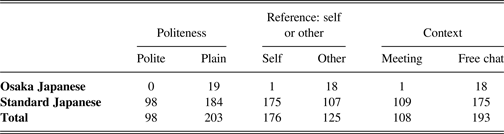
Table 2 shows the distribution of all tokens of verbal negation (in raw numbers), according to politeness (presence or absence of polite marking on the utterance), reference (to self or other), and the context (meeting or free chat).
Distribution of all verbal negation according to politeness of the utterance, reference to self or other, and interactional context.
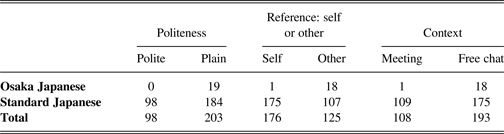
The distributional data alone shows that the use of Osaka-style negation in this CofP is almost exclusively limited to the informal context of free chat. There is one exception to this, and in this particular interaction the use of Osaka-style negation is noticed and commented on overtly, as we observe in extract (4).
I now focus on three exchanges where the switch to a local Osaka variant went unnoticed. This allows us to explore the kind of meaning that is indexed by these variants in this CofP; I then discuss an example where the use of Osaka-style negation was overtly commented on.
‘Us’ and ‘them’
Using linguistic resources to draw boundaries between ‘us’ and ‘them’ is one of the more common practices to include and exclude, to assert our place within one community but not another, as well as to compare ourselves to others. In the group under discussion, the discourse used when (re)creating the us-them boundaries (most notably explicated in the discussions of the Dutch versus the Japanese) points to the fact that making this distinction is an important component of asserting and foregrounding group identity (cf. Tajfel & Turner Reference Tajfel, Turner, Austin and Worchel1979; Meinhoff & Galasiński Reference Meinhoff and Galasiński2008). We see that the use of Osaka-style negation also serves this purpose in interactions.
I discuss three extracts from the dataset. The first one is the most typical of this community—the use of Osaka-style negation delimits the boundary between ‘us’ Japanese and ‘them’ Dutch and is found in the speech of a person from Osaka; the second example also shows a case where Osaka-style negation is used to mark the boundary between ‘us’ Japanese and ‘them’ Dutch, but this time is found in the speech of a woman originally from Tokyo; and the third extract shows a more dynamic boundary-making practice, where Osaka-style negation is used to delimit boundaries between ‘us’ and ‘them’, but ones that are not as clearly drawn with respect to different nationalities. All uses of Osaka-style negation, in addition to reasserting the in/out-group boundaries, are also connected with a strong negative evaluation of the person or event referred to.
Extract (1) is taken from a conversation between Tomoko (from Tokyo), Mai (also from Tokyo), and Yui (from Osaka). The discussion takes place after one of the Japanese classes in a community centre. I participated in the class, and was allowed to stay on and record a conversation between these three club members. Throughout the conversation Osaka-style negation occurs four times (V + -n occurs once, and V + -hen three times), two of which are discussed here: one in extract (1) and one in extract (2). The first occurrence is found in the speech of Yui who, as mentioned, is originally from Osaka (extract (1)); the second one appears in the speech of Mai from Tokyo (extract (2)). As mentioned earlier, this is not unusual in this CofP—Osaka-style negation can be occasionally found in the speech of the majority of the members, regardless of their place of origin.
-
(1) Y: Yui, A: author, T: Tomoko, M: MaiFootnote 3


Fourteen out of nineteen tokens of Osaka-style negation occur in this kind of context—in conversations where the Japanese and the Dutch, or the Japanese and Dutch ways, are being compared and contrasted, with negative evaluation of the Dutch ways presented in a more or less explicit way. The first occurrence of Osaka-style negation can be seen in line 14 (V + -n in kuren), where Yui comments on the difficulty of buying fish for sashimi, as nobody here (i.e. in The Netherlands) tells you if the fish is suitable for sashimi. Throughout the chat all of the women compare the Japanese and the Dutch ways of preparing, selling, and afterwards also eating fish and meat, with an underlying message that it is different and better ‘back home’. Osaka-style negation marked on the verb occurs two more times in a similar context, this time used by speakers of the Tokyo variety of Japanese. Notice also the immediate use of Standard Japanese negation by Yui in line 15, when she refers to herself. It is especially interesting since Yui herself is from Osaka. This reinforces the fact that the general norm in The Club is for participants—regardless of their home dialect—to use standard Japanese. Hence, any use of nonstandard (in this case, Osaka-style) features is sociolinguistically marked. Because the majority of tokens of Osaka-style negation occur when speakers are drawing an explicit contrast between the Japanese and the Dutch, it seems that use of Osaka-style negation carries strong connotations of othering, especially negative evaluative othering.
Extract (2) is taken from the same interaction, and it occurs later on in the discussion. Osaka-style negation is found in the speech of Mai, a speaker of the Tokyo variety of Japanese.
-
(2) M: Mai, T: Tomoko

Still talking about the good and bad sides of living in The Netherlands, Mai says that The Netherlands is a good country for dogs (line 1)—she herself has a dog, and enjoys going for walks with it. Laughter at the end of that comment might suggest that she finds it difficult to come up with any good sides of living here, and this is the only thing she can think of that she would consider a positive. This is also apparent throughout the conversation in her numerous comments, as well as in her partial rebuttal of Tomoko's comments in lines 2 through 9, where Tomoko says how fond she is of the Dutch, and how they appear much friendlier and kinder than people in Japan. In lines 10–12 Mai comments that that while people who come here (i.e. to the community centre to learn Japanese with the women) are nice, she has also met people who don't even say hello. This is where her use of Osaka-style negation (V + -hen in iwahen ‘(they) don't say’) appears. Again, Osaka-style negation is used to refer to others, and, as with extract (1), to convey a negative evaluation.
Extract (3) comes from a casual conversation between three club members. One of the more heavily explored topics was again that of the differences between the Japanese and the Dutch, but this time on a number of occasions the Dutch were actually compared to the people from Osaka. This is significant, as one of the participants, Nao, comes from Osaka and strongly identifies with the city. Akiko and Kana are both from Tokyo.
-
(3) N: Nao, A: Akiko, K: Kana

In line 1 of this extract Nao suggests that people in Osaka are as friendly as people in The Netherlands—she responds to Akiko's previous comments earlier on in the interaction about people in Japan and people in The Netherlands being very different in terms of how friendly and approachable they are. Yet again, in expressing her opinion about her hometown (Osaka) Nao, perhaps unexpectedly, uses standard Japanese. She hesitated noticeably before she answered, which probably prompted Akiko to also suggest that Osaka might be a different case (line 2). Both Akiko and Kana agree, here and throughout the conversation, that the biggest difference between people in Japan and in The Netherlands is that people in The Netherlands smile more, start conversations with strangers (see lines 5–7), and are generally much more open than the Japanese. They also judge these qualities as positive, and ones that make living in The Netherlands easier than it would have been otherwise. Nao strongly identifies with Osaka, and this has been apparent a number of times throughout the conversation, with her comments that imply Osaka is different than the rest of Japan, and that's why she enjoyed living there. In her reference to Osaka we do not see a topic-induced shift into dialect (as one might have expected), but dialect negation appears for the first time in line 12, where Nao describes English people and their ways in contrast to Osakans and the Dutch. Similarly to Yui, in extract (1), Nao uses Standard Japanese negation in line 1 to refer to herself (V +-nai in omowanai ‘(I) don't think’), but Osaka-style negation to refer to an out-group member's behaviour in line 12 (V + hen in kawarahen ‘don't change’). Nao clearly aligns herself with the kinds of people who do smile, say ‘hello’, and are generally friendly, which in her experience the Osakans and the Dutch are, but the English are not.
Negotiating the rules
I now turn to the only example where OJ negation was overtly commented on by another member to show how the rules are actively negotiated by the speakers. The interaction in extract (4) takes place between three members of The Club—Miho (from Tokyo), Naoko (from Nagoya), and Emi (from Osaka). There were eight women present altogether during this meeting, and the members were discussing the agenda for the upcoming months, specifically focusing on organizing a piano recital. Miho is the one responsible for checking and organizing guest numbers, and a discussion on how many people can be expected ensues. In this extract, verbs marked with honorification are shaded, as they are also relevant for the discussion of this interaction.
-
(4) M: Miho, N: Naoko, E: Emi

In the process of mutual engagement, one aspect of the co-construction of mutual membership in a CofP is members’ ability or willingness to learn certain rules (Wenger Reference Wenger1998). Observing ways in which members, implicitly or explicitly, (re)negotiate the rules of conduct and the use of resources provides us with insights as to the inner hierarchy of the group, as well as the co-construction of identities and types of membership in this particular CofP. In extract (4), the comment in line 4, which occurs after one of the members uses Osaka-style negation in her speech, suggests that the use of dialectal negation is warranted in some contexts, but not others. Miho, who leads this conversation on the number of guests, is older than the other two members, and also has been a member of The Club longer. Her comment on Emi's use of Osaka-style negation can thus be seen as an active use of her leading role of being the one who can ‘teach’ the correct use of resources. It is possible that Miho's objection is not only to the use of Osaka-style negation where no intergroup difference is being underscored, but also to the implication of a negative evaluation of Naoko's comment. The reaction to Miho's comment is the laughter of all members present, followed by a swift return to the conversation that was interrupted. No offer of explanation, or indeed explicit repair, is offered by Emi, and no further comment (following the laughter) is made by any other member, which might suggest the comment was warranted, no further discussion was necessary, and it was unproblematic within the context of this CofP. Clearly, this off-topic comment is seen by all members (including Emi and Miho) as a change of frame (Goffman Reference Goffman1974), where a temporary break occurs in the main line of interaction.
While throughout this interaction Emi is comfortable in addressing Miho in plain (nonhonorific) form, once some kind of in-group code is breached, there seems to be the need to employ politeness as one measure of repair, if only temporary. Although there was no explicit repair, an implicit repair can be seen in Emi's response in line 6. She agrees to Naoko's suggestion of twenty guests coming to the recital, even though she initially suggested the number will not be as high (in line 3 immediately preceding the off-topic exchange). She also switches from using plain verb form, which had been her default throughout this particular interaction up to this point, to a verb marked with addressee honorification (shimashoo ‘let's make’). This can indeed be seen as a form of repair, though not explicitly orienting to a specific problem needing repair.
At the time of this exchange Emi was a relatively new member of The Club and had been given an active role in an event for the first time. In comments made to me outside the interview, however, she underscored that The Club was one of the most important parts of her social life in The Netherlands, and that she had been receiving a lot of support from other members. This exchange points to the mutual co-construction of identities within The Club, where some members are positioned and (re)position themselves as mentors, or possibly core members, while others—those still learning the norms and ideologies, like Emi—are perhaps more peripheral, but crucially for extract (4) open to explicit correction about CofP norms, as shown by her use of addressee honorification following Miho's intervention.
Discussion
As has been discussed in other research (e.g. Ball Reference Ball2004; Strycharz Reference Strycharz2012), regional variants of Japanese, rather than indexing a straightforward identification with a certain locale, can be used to dynamically mark in/out-group boundaries. Two factors play a key role in this (re)making of boundaries in the CofP discussed here: (i) self-identification with specific groups of people and their behaviour, and (ii) evaluation of these groups of people. Neutral remarks about the Dutch alone do not seem to warrant the use of Osaka-style negation; instead, both factors, that is, out-group marking and negative evaluation, need to be present.
The significance of in/out-groupness, or uchi and soto, has been discussed in much research on Japanese culture and language (e.g. Bachnik Reference Bachnik, Bachnik and Quinn1994). What is crucial about the understanding of how the uchi-soto boundaries are being (re)asserted is that they are not in any way static.
The Japanese are known to differentiate their behaviour by whether the situation is defined as uchi or soto… Where the demarcation line is drawn varies widely: it may be inside vs. outside an individual person, a family, a group of playmates, a school, a company, a village or a nation. It is suggestive that the term uchi is used colloquially to refer to one's house, family or family member, and the shop or company where one works. The essential point, however, is that the uchi-soto distinction is drawn not by social structure, but by constantly varying situations. (Lebra Reference Lebra1976:112)
The negotiation of uchi and soto marking needs to therefore be seen as ongoing and subject to (re)evaluation and change. Not only are these boundaries different for different people, but it is also clear that they can be fluid for any given speaker.
The crucial difference between the uses of Osaka-style negation in this dataset, and discussions of local variants in other research, is the appropriation of dialect variants to mark soto out-groupness, rather than uchi in-groupness. This is indeed unexpected, as the local variants are intuitively more likely to occur in contexts where belonging is being foregrounded, and where intimacy or closeness is underlined (see e.g. Ball Reference Ball2004). Here, however, the meaning of a regional variant is being reevaluated, as the CofP consists of women from different places throughout Japan. We can see the actual process of meaning-making with the linguistic resources at hand, in ways specific to this CofP. Regardless of their place of origin, the women seem to have agreed upon the use of Standard Japanese as the common means of communicating, and Osaka-style negation is used to mark the soto, out-group; the ‘other’, who not only differs from ‘us’, but whose behaviour we evaluate negatively. This is visible in the prototypical uses of Osaka-style negation, where the Dutch are being compared to and contrasted with the Japanese (as in extracts (1) and (2)), but also in a more dynamic way, where the boundaries are being reasserted along the lines of self-identification with those who not only are like us, but whose behaviour is likeable and agreeable to us (as in extract (3)), regardless of nationality. Extract (3) presents a unique example in the corpus, where the intra-Japanese differences are being foregrounded, and dialect is used to mark these foregrounded distinctions. However, even though Nao in extract (3) backgrounds the identity associated with their CofP (Japanese women in The Netherlands), and foregrounds her local identity (Osakan), she nonetheless plays by the rules of this CofP using Osaka-style negation only to refer to the ‘other’, soto members and not when referring to herself (line 1).
Note that both Nao and Yui (extracts (3) and (1)), who are originally from Osaka, use Standard Japanese negation to refer to themselves, which again shows that Osaka-style negation is reserved for a different kind of indexical meaning. Extract (4), where the ‘inappropriate’ use of Osaka-style negation is overtly commented on, provides yet another source of support for this interpretation.
I am not suggesting that Osaka Japanese used by speakers of other varieties is a phenomenon unique to this CofP; Osaka Japanese has been gaining popularity and recognition throughout Japan, and it is not uncommon to hear it used in other regions, as a way of sounding cool or funny (Strycharz Reference Strycharz2012). What is interesting, however, in the example of this group of speakers, is the use of Osaka Japanese negation for the process of distinction (Bucholtz & Hall Reference Bucholtz, Hall and Duranti2004), to mark the out-group boundary and negatively evaluate the ‘other’.
The status and popular images associated with Osaka-style Japanese within Japan (also represented in the wider discourses in the media) might shed some light on the choice of this particular regional variety to mark a negatively evaluated ‘other’. Osaka Japanese overall is widely represented in Japanese media in comedy shows, where one recognizable (and oft-represented) character is that of an Osaka-no obachan (Osaka auntie; see e.g. SturtzSreetharan Reference SturtzSreetharan, Brown and Iorio2008; Strycharz Reference Strycharz2012), who is a loud-mouthed, complaining lady, very much unlike the stereotypical Japanese ‘womanly woman’. It is therefore possible that the speakers of this CofP are tapping into this particular image, employing a linguistic stereotype (Osaka-style negation) to, essentially, complain about their life in The Netherlands, or about any other social distinctions, in a sense also perhaps breaking from the stereotypical image of polite and nice Japanese women. OJ negation in this particular CofP seems then to be indexing key personality traits associated with an Osaka auntie persona, so that to a certain extent it allows the women in The Club to escape the ‘polite Japanese woman’ image. The obachan persona is recognizable across Japan, so the women coming to The Netherlands had probably already acquired this cultural association before leaving Japan, but in this CofP features of an Osaka auntie's manners are deployed to a localized effect to convey disapproval of some out-group behaviour, and performed according to localized rules developed in this CofP.
Conclusion
I have discussed how this community shapes its practices and ideologies, and, effectively, how the members learn to negotiate the commonly understood meanings. As an example of negotiated and developed linguistic practices, I showed an unexpected use of local (Osaka-style) negation as an interactional device to mark boundaries between the in-group and the out-group. Unlike in a number of previous studies, the members of this particular CofP have chosen a local variant to index not in-groupness, but out-groupness.
This research, specifically the use of resources within the CofP, once again underscores the value of the CofP framework for the analysis of language in use, as it shows how involvement in a CofP can bring about rapid and at times unexpected changes in the use and meaning of a linguistic item. Further research is now needed to explore the potential long-term consequences with respect to the linguistic innovation or change that such communities can motivate.
Appendix: Transcription conventions
- =
-
latched utterances
- [ ]
-
overlapping speech
- { }
-
paralinguistic features and comments
- -
-
interrupted utterances
- (inc.)
-
incomprehensible words and utterances
- ,
-
short pause
- :
-
lengthened sounds
- underline
-
nonstandard variants
- bold
-
Standard Japanese variants