INTRODUCTION
Most palliative care efforts focus on assessing and improving quality of life and quality of care for patients. Palliative care views the family as the unit of care; therefore, excellent comprehensive palliative care should address family and caregiver needs as well. While recent literature has offered detailed descriptions of the needs involved in home caregiving in palliative care (Funk et al., Reference Funk, Stajduhar and Toye2010; Stajduhar et al., Reference Stajduhar, Funk and Toye2010), it is crucial to describe family members' needs in the inpatient setting, where they serve as the key intermediaries and decision makers.
Literature reviews describing the experience of home-based caregiver needs have shown the importance of several key areas, including information on practical aspects of care, disease course, consistency of information, and the desire to have communication with providers clarified (Funk et al., Reference Funk, Stajduhar and Toye2010; Stajduhar et al., Reference Stajduhar, Funk and Toye2010). Lack of preparedness in these areas is associated with increased caregiver anxiety and stress (Funk et al., Reference Funk, Stajduhar and Toye2010; Stajduhar et al., Reference Stajduhar, Funk and Toye2010). Because caregivers are often required to be at home for extended periods of time, foregoing their usual activities, social support is crucial in combating increased isolation. Many studies within the home setting, including and not including hospice, also describe the need for access to adequate, competent, and continuous support services. In accordance with the above-described needs, most interventions focus on home care caregiver training to increase efficacy in medical management and to enhance emotional coping skills (Funk et al., Reference Funk, Stajduhar and Toye2010; Stajduhar et al., Reference Stajduhar, Funk and Toye2010).
Despite the extensive reviews of home care research, little is known about what improves caregiver experience in the inpatient setting. This knowledge has its own implications for both intervention and palliative care outcomes assessment. With regard to the former, in the absence of daily, practical bedside demands, which caregiver needs come to the fore and can be best met by hospital staff? Regarding outcomes assessment implications, to date, family members' interview responses often serve as proxies for patient indicators of quality. However, as families constitute the unit of care in palliative care, we must understand what contributes to quality of family experience and therefore what to measure to assess the quality of that experience.
In a previous study, we interviewed seriously ill patients, bereaved family members, physicians, nurses, social workers, chaplains, and hospice volunteers, asking them to reflect on dying persons they had cared for and to identify the important attributes of that experience (Steinhauser et al., Reference Steinhauser, Bosworth and Clipp2002; Reference Steinhauser, Clipp and Bosworth2004). Participants were sampled from the Durham Veterans Administration Medical Center (VAMC), the Duke University Medical Center, and a community hospice, with groups stratified by role. The study included data describing what was important to providers, families, and patients. Interviewing such a wide range of participants offered the advantage of multiple role perspectives as well as the cumulative experience from thousands of end-of-life scenarios.
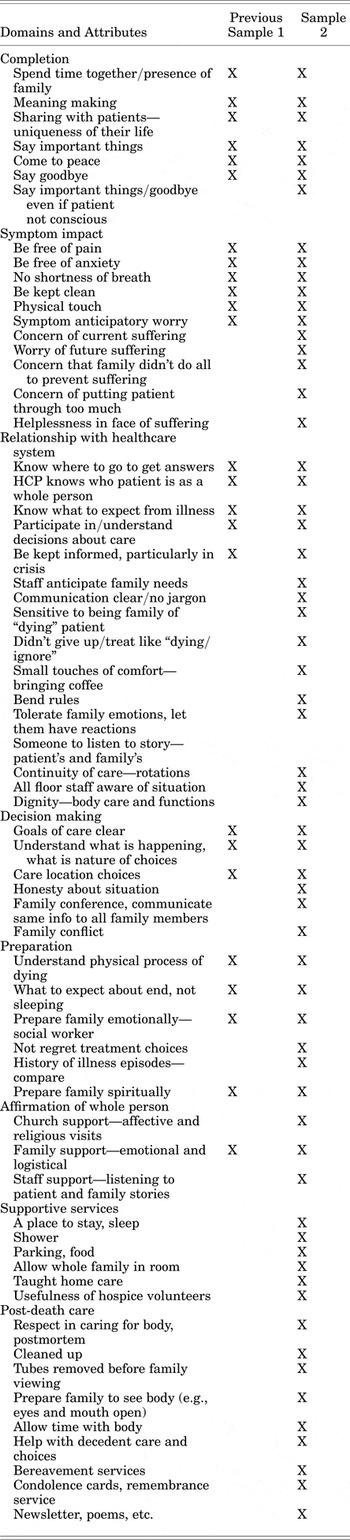
The study produced six domains important at the end of life: completion, symptom impact, relationship with healthcare provider, preparation, decision making, and affirmation of the whole person. These data later became the foundation for an instrument to assess quality of life at the end of life for patients (the QUAL–E questionnaire) (Steinhauser et al., Reference Steinhauser, Bosworth and Clipp2002; Reference Steinhauser, Clipp and Bosworth2004). In our efforts to develop a companion instrument for family experience, we wanted to conduct additional family-only focus groups that would allow: (1) confirmation or disconfirmation of previous domains and attributes, (2) additional details and new attributes and domains, and (3) probes specific to what is important for families whose loved ones have died in hospital. To assess and measure these needs in an inpatient setting, we sought to define the relevant aspects of quality for families of hospitalized patients. The purpose of the present paper was to describe what families of hospitalized patients consider central to the quality of their experience at the end of life.
METHODS
Design
We convened two focus groups to identify the domains important for the quality of experience for family members of dying patients. Discussion in each group was guided by a semistructured interview protocol. Additional probes were employed to gain elaboration of responses to a priori questions as well as themes generated spontaneously by participants (Corbin & Strauss, Reference Corbin and Strauss1993; Krueger, Reference Krueger1994; Stern, Reference Stern and Leininger1985).
Setting and Participants
Participants were recruited from decedent care records from the Durham VAMC and the Duke University Medical Center, stratified by recruitment site, and consisting of family members of patients who died of chronic disease 6 to 12 months prior. Family members were identified in hospital databases as next of kin and those who had been present in the hospital, and whose loved ones had died of a chronic illness, as opposed to accident or traumatic injury. In addition, they were English speaking, had a telephone (for initial contact), were cognitively able (a Short Portable Mental Status Questionnaire [SPMSQ] score of 7 or higher) (Corbin & Strauss, Reference Corbin and Strauss1993; Stern, Reference Stern and Leininger1985), and lived within 35 miles of Durham, to facilitate ease of travel. We screened medical records to look for instances of family members who demonstrated a lack of ability to communicate. When calling family members for participation, we confirmed their involvement with medical decision making. Because VA and non-VA institutional settings are distinct in patient and family composition and milieu, separate groups were conducted at each site. All focus groups, led by a trained facilitator, were audiotaped and transcribed. Group members were compensated $20 for their time.
Content/Measures
Participants were asked to reflect on the end-of-life experiences and care received by the patient (their loved one) and to comment on what was important, what was most needed, and what constituted quality of experience. When subtopics were not generated spontaneously, we probed specific issues related to their relationship and communication with the healthcare team, the role of location and institutional issues, as well as family and other support. The majority of these topics were generated spontaneously, so that the facilitator probed for more details only when vague language was encountered.
As noted, after analyzing transcripts from each group, we conducted in-depth interviews with two members of each focus group to provide a more fine-grained description of the attributes generated in the larger group discussion.
Analyses
We conducted a content analysis using open and axial coding techniques (Corbin & Strauss, Reference Corbin and Strauss1993; Krueger, Reference Krueger1994; Stern, Reference Stern and Leininger1985). During open coding, investigators independently read an example of a transcript and analyzed it for common and recurrent themes pertaining to the qualities of a family end-of-life experience. These summaries were then compared for theme agreement and disagreement. One coder (KES) then applied the coding scheme to the remaining transcripts. Throughout the coding process, theme exemplars from all transcripts were reviewed as a check on coding validity. During axial coding, the investigators developed further conceptual domains by describing comparisons between themes and within and between transcripts (Corbin & Strauss, Reference Corbin and Strauss1993).
In developing our interview protocol for this study, we reexamined the findings from our previous study and its sample, and subsequently developed additional in-depth probes for the present study of only family members. This allowed us to have a general understanding of what was important to family members, based on responses from the first study, and to know where to elicit additional details. We compared attributes and domains listed in both qualitative data collections. Because of theme repetition in the two data samples, we explored the context of conversations to determine if the second sample attributes provided an extension of a previously identified domain or constituted a new one. This mainly took the form of confirming previous attributes and identifying additional needs of family within an existing domain of experience. In two instances, two new family-centered domains were in fact created.
RESULTS
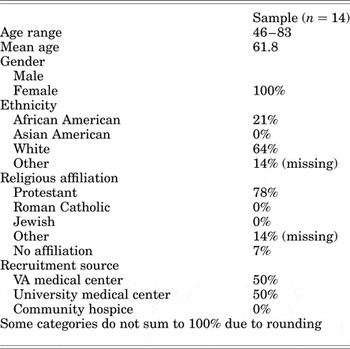
The participants in the two focus groups (a total of 14) ranged in age from 46 to 83, with a mean of 62. All were female, 64% were Caucasian and 21% African American, and 14% did not report ethnicity (Table 1). We conducted four in-depth follow-up interviews.
Focus group participant characteristics

Data from family members' discussions and interviews confirmed the six end-of-life domains identified previously: completion, symptom impact, relationship with healthcare provider, preparation, decision making, and affirmation of the whole person (Steinhauser et al., Reference Steinhauser, Clipp and McNeilly2000). Family members generated new attributes for these six domains specific to the hospital setting. They also generated two new domains specific to the quality of family experience: “supportive services” and “post-death care” (Table 2). We offer below the domains and attributes confirmed in our study and provide additional details, illustrative quotations, and discussion about the data novel to the experience of family members of hospitalized patients at the end of life.
Attributes and domains

Completion
Within the domain of completion , families talked about the importance of spending time together, meaning making, sharing stories, saying important things, coming to peace, and saying goodbye. Family members described these attributes even in the context of patient nonresponsiveness (either poor communication or even full unconsciousness). Despite the lack of reciprocal communication, families emphasized the relevance of saying goodbye or other important statements toward an overall act of relational completion:
We talked to him constantly. We didn't act like he wasn't listening to us. We let him know who was there and who was coming and going.
Other family members described saying goodbye, even nonverbally:
I didn't walk up and say goodbye, but you know, within my heart (. . .).
Symptom Impact
Within the symptom impact domain, family members confirmed previously identified concerns of attending to symptoms to relieve pain, shortness of breath, anxiety, or other presenting symptoms as well as preventing future symptom expression and issues of dignity related to being kept clean and physical touch. In the present study, these specific symptom concerns were augmented by discussions of more general unease about current and future suffering. This sometimes took the form of worry that the family did not do all they could to prevent suffering or other times concern about whether the treatment was worth it. They often expressed a sense of helpless in the face of suffering:
It was important for him to have immediate care because he was very sick, and it hurt to have to wait and see him suffer. And there wasn't anything I could do to relieve that.
Alternatively, families described a sense of peacefulness, as long as their loved one “wasn't suffering.”
Relationship with Healthcare Provider
Family members spoke most frequently and generated the most attributes within the domain of relationship with healthcare provider . Both the previous and current study samples produced attributes of knowing where to get answers, knowing what to expect about the illness, having a provider who knows the patient as a whole person, and participating in decisions about care. In the current study, families described a desire to be kept informed in a crisis, that healthcare providers bend the rules to accommodate family time with the patient and tolerate families' emotions, and problems with unclear communication, which was often peppered with medical jargon:
The doctor did come in and tried to explain to us what it was, but I really wasn't understanding it. It was kind of over my head because we're not doctors.
Additionally, they provided fine-grained detail regarding the need to be sensitive to the family of a “dying” patient, resulting in the need for additional continuity in care and communication, the need to have someone listen to the family's stories, anticipate needs, offer small touches of comfort, and make the whole floor staff aware of the imminence of death for the family.
Decision Making
Relatedly, in the domain of decision making, family members expressed a need to have clear goals of care, understand the nature of what was happening and the nature of choices, and discuss care location choices. Additionally, families described the importance of honesty about the situation and a desire for meetings to offer all family members the same information:
She [sister] felt like I didn't give him a chance to get better. If they [the medical team] had called a family meeting, then everybody would have gotten the same information at the same time.
Preparation
Preparation included a need to prepare the family emotionally and spiritually (Steinhauser et al., Reference Steinhauser, Alexander and Byock2008). There was extensive conversation about the need to better understand the physical process of dying:
The whole thing about the experience with me was I didn't know he was dying, so it was very hard.
I had been in the room at one point, and the nurse was in there, and I would say, “What's going to happen, how is this going to take place, is his fever going to go so up so high that it's going to kill him, after they take him off the antibiotics?” She just listened to me, and she didn't answer.
Affirmation of the Whole Person
Our previous study revealed that the domain of affirmation of the whole person entailed feeling as though the patient was known beyond the confines of a disease status and treated with respect and dignity. For the families in the present study, this domain was most often manifested as families described very personal support from staff, family, and church members who acknowledged the individuality of their loved one, and knew the details of a life lived fully:
The chaplain came in and listened to me go on and on about my wonderful husband. Although I know he got tired of listening to me, I told him about his Navy days and his father. He grew up here and his father died in the VA hospital also. So, I went through all that. The nurses, you know, were wonderful.
For families, the affirmation was expressed in the ability to tell stories, participate in life review, and relay the fullness of life of the family member who in the inpatient setting may have been in a limited or unresponsive state.
Two additional domains were generated by these bereaved family member groups: supportive services and post-death care .
Supportive Services
We heard discussions about the importance of needing a place to stay or shower (during extended hospital visits), comments about parking and food, allowing the whole family in the room, and the need for home care training upon discharge and the usefulness of hospice volunteers when under home care:
[The volunteer] would come once a week or whenever we wanted him to. It was great. In fact, he would say, “Leave me some dishes or something to do.” He'd tell me all the little things he could do. He would just sit there with [the patient].
Post-Death Care
Finally, we learned the seminal importance of care for the patient and family after the moment of death. Families expressed the need for caring for the body postmortem (such as being cleaned for family to view), preparing the family to see the body, allowing time with the body, helping with decedent care and choices, condolence cares, services of remembrance, and newsletters on other bereavement communications:
They came in and stretched him out and put one pillow under his head and wiped his face. They had already come in a little bit earlier and changed him because he was very particular about his hygiene. (. . .) They had shaved him, bathed him, put him in clean pajamas before he died. After he died, the kind of propped him, and told me I could stay with him as long as I wanted to.
Alternatively, one respondent shared a tormenting memory after no one prepared her to see her husband's body in the morgue. The attendant opened the body bag to reveal the body with mouth and eyes wide open. She said it looked like “he was screaming” when he died.
DISCUSSION
In palliative care, both patient and family comprise the unit of care. Therefore, to provide comprehensive care, we must have the ability to assess and intervene with regard to the quality of experience for both patients and families. This need is particularly pertinent when a patient's ability to communicate is diminished due to loss of consciousness, fatigue, or some other symptom burden, and family members serve as intermediaries with healthcare providers. The present study confirmed previous findings regarding the general attributes of quality at the end of life and offered new insights regarding how to improve end-of-life family experience in the inpatient setting, which often includes periods of patient nonresponsiveness. Family members caring for loved ones in the hospital expressed needs distinct from home care settings and required corresponding methods to accomplish life completion, understand symptom expression and burden, communicate with providers, and make treatment choices. Supportive services and post-death care also had a strong influence on overall family experience with end-of-life care and the moment of the death of their loved one.
While we know from extensive prior literature that life completion is important for patients (Funk et al., Reference Funk, Stajduhar and Toye2010; Stajduhar et al., Reference Stajduhar, Funk and Toye2010), our data show ways that completion is important to family members even in instances where loved ones possess limited or no capacity for verbal or nonverbal interaction. Describing times of patient unconsciousness, family members gave examples of gaining completion by saying important things regarding the meaning of their relationship, loving affirmations, or saying goodbye. This highlights an opportunity for staff to encourage, as some do, family members to engage in tasks of completion and closure, regardless of the patient's cognitive status or ability to interact verbally.
Tasks of completion may arise spontaneously or as prompted by a more formally designed life review narrative intervention, which has shown consistent positive outcomes for geriatric patients as well as for those with chronic illness (Fratorolli, Reference Fratorolli2006). Dignity therapy offers one modality focused on legacy documents (Chochinov et al., Reference Chochinov, Hack and Hassard2005). Our team recently developed specific end-of-life interventions that pair life review with discussing forgiveness and heritage and legacy for patients and caregivers (Steinhauser et al., Reference Steinhauser, Alexander and Byock2008). The data from the present study emphasize family members benefiting from sharing the loved one's life story or the story of their relationship. In previous work, we called this “concern for the whole person” and affirmed that beneficial support can be delivered in the context of acknowledging the unique stories of patients and families.
Our results also affirm family members' distress about symptom burden and extend the discussion to a more pervasive concern for overall suffering (see Steinhauser et al., Reference Steinhauser, Christakis and Clipp2001). Most assessment tools measure symptom prevalence, frequency, and severity, all key components to improving quality of care. The current results suggest that, when evaluating a family member's quality of experience, clinicians and researchers must evaluate the extent of perceived suffering and decide which individual factors contribute to a sense of suffering for that particular patient. In addition, the current results point to the role of family education related to end-of-life symptoms that may appear bothersome but are likely not sources of suffering. For example, a patient's open eyes and mouth after death are a common natural physiological response. Or, agonal breathing patterns may alarm family members but are unlikely to reflect the actual sensation of dyspnea.
As expected, the relationship between family members and the healthcare team is an essential element of their perception of the quality of the inpatient stay. In the present study, it was the most often-expressed concern and the one presented in the most detail. In the hospital environment, so laden with uncertainty and crisis, receiving timely information, being updated during crises, and hearing communication in easy-to-understand terminology were described as assisting in ameliorating overall feelings of confusion and helplessness. Even more specifically, family members noted the importance of a healthcare provider's capacity to tolerate families' emotions (Azoulay et al., Reference Azoulay, Pochard and Chevret2003; Curtis et al., Reference Curtis, Engelberg and Wenrich2002). Recent interventions, particularly within oncology training, are aimed at assisting physicians with skill building to recognize and facilitate patient emotions during serious illness (Back et al., Reference Back, Arnold and Baile2007; Koropchak et al., Reference Koropchak, Pollak and Arnold2006; Skinner et al., Reference Skinner, Pollak and Farrell2009). These data suggest the relevance of training for use with family members and nonphysician providers experiencing high levels of patient and family crisis contact.
Beyond emotional responsiveness, these data draw attention more broadly to what family members need from providers to prepare themselves as they move into the active phases of the death of their loved one. First, families requested more practical information regarding the dying process. While hospices and some palliative care programs provide family members with pamphlets about some of the general physical changes that are likely to occur, the family members in our study had not received such material and therefore expressed the need for more real-time information related to the physical idiosyncrasies of their loved one's illness and its likely course of progression. They wanted to know what was normal and what was not, and which physical changes to expect. This was usually related to previously described feelings of uncertainty and helplessness. While the end of life is rife with uncertainty, providers may guide patients through this process closely, assuring family members that they are doing all that is possible.
Study participants strongly valued the family meeting, when possible, as the preferred modality of information delivery. This strategy reduced relaying of miscommunication and the conflict that arises when information is parceled out to individual family members as it becomes available. This reduction in conflict assisted family members with moving on and grieving rather than being caught up in second guessing choices or blaming other family members for decisions. Family meetings often focused on delivering consistent and practical information to assist with treatment choices; study participants described meetings as an additional opportunity for general emotional caring for the family during illness and preparing them for bereavement. While family meetings are central to most palliative care services, the field is just beginning to include resources from the fields of social work and marriage/family therapy, which base their approach on family systems theory and offer evaluation and therapeutic strategies to assist with challenging family dynamics.
Finally, we saw the emergence of two domains generated only in the family-member groups: post-death care and supportive services . The majority of training in palliative care is focused up to the point of death, yet the illustrative quotes remind one of the immense importance of the post-death phase of care for the overall experience of family members and their end-of-life memories as they moved through grief and bereavement. With regard to supportive service concerns, many family members traveled significant distances to the hospital and needed assistance in terms of an affordable place to stay, shower, and eat. While these attributes do not fit into our usual quality-of-life model or even the biopsychosocial spiritual model, as noted by Casarett and colleagues (Reference Casarett, Fishman and O'Dwyer2008), logistical support services are crucial for the overall quality of family experience. Again, this highlights the importance of an interdisciplinary team in addressing the biopyschosocial spiritual needs of patients and family members, some of which are highly logistical. This awareness has been forged in pediatric end-of-life care settings, but is only belatedly being applied to adult caregivers.
LIMITATIONS
Similar to other studies of caregiving in seriously ill patients, the vast majority of our participants were women. However, by triangulating with previously collected data, which included the responses of males, we were able to mitigate this limitation. While the number of groups in our study was limited to two, the responses were triangulated and confirmed previous focus group data in which participants responded from the perspective of a professional role in the personal end-of-life experiences and as a member of the family of a beloved patient who had died.
CONCLUSIONS
A large body of work demonstrates the centrality of the family and caregiving role for those living with chronic disease, mostly among the family members of patients with dementia. More recently, work specific to family members and caregiving in palliative care has emerged in the literature, with a large proportion concentrating on the home caregiving needs of patients and families at the end of life. Our present work contributes to the body of work on family needs at the end of life by addressing their active role in decision making and by emphasizing some unique and unmet needs that arise in the inpatient setting during health crises and in the face of imminent death.
ACKNOWLEDGMENTS
This article was based on work supported by the Office of Research and Development, Health Services Research and Development Service, Department of Veterans Affairs (IIR #96-006 and IIR 02-285). The views expressed in this article are those of the authors and do not necessarily represent the views of the Department of Veterans Affairs.