Introduction
To what extent do parties’ candidate lists change between elections – and why do they change? It is often assumed that parties are strategic actors, whose goal is to maximize votes, offices and policies (Strøm, Reference Strøm1990). During candidate selection processes and campaigning, this implies using surveys, focus groups, external experts or other means of modern marketing to refine their campaigns and lists of nominated candidates (Lees-Marshment, Reference Lees-Marshment2012). However, as classic candidate recruitment studies demonstrated, supply matters too (Norris and Lovenduski, Reference Norris and Lovenduski1993, Reference Norris and Lovenduski1995). Especially in list PR systems with dozens of candidates in several districts, the supply of quality candidates may be low, increasing parties’ dependence on potential candidates’ decisions to run. Party elites’ strategic capacity may also be affected by party organizations’ ‘genetic’ legacies (e.g., Gallagher, Reference Gallagher, Gallagher and Marsh1988; Passarelli, Reference Passarelli2015). Overall, the reality of compiling candidate lists may deviate significantly from the ideal.
A decade ago, candidate selection was still ‘one of the less discussed mysteries’ in political science (Hazan and Rahat, Reference Hazan and Rahat2010: 7). Recently, the effects of selection methods on the representation of specific groups have attracted attention, but party preferences have remained understudied (Rehmert, Reference Rehmert2020). Even the incumbency effect, a well-established determinant of nomination in single-member district (SMD) systems, has only recently garnered attention in studies of list PR systems (Put and Maddens, Reference Put and Maddens2013; Golden and Picci, Reference Golden and Picci2015; Moral et al., Reference Moral, Ozen and Tokdemir2015; Dahlgaard, Reference Dahlgaard2016; Dettmann et al., Reference Dettman, Pepinsky and Pierskalla2017). Considering the democratic relevance of the flexibility of candidate lists [i.e., parties’ capacity to react to voters’ changing preferences], it is surprising how little research has been undertaken into their intertemporal volatility. To our knowledge, the only longitudinal effort, which is limited to demand-side factors, is Ecevit and Kocapınar’s (Reference Ecevit and Kocapınar2018) recent study of Turkish parties, which suggests that even in party-driven closed-list systems, electoral defeats incentivize party leaders to seek strategic list changes. The few other recent, cross-sectional studies have also analyzed closed-list systems (Galasso and Nannicini, Reference Galasso and Nannicini2015; Rehmert, Reference Rehmert2020) where candidates’ personal reputations generally bear less weight (Carey and Shugart, Reference Carey and Shugart1995) than in preferential voting systems.
Indeed, if ‘the closed-list electoral system minimizes selectors’ concerns for any single candidate’s presumed electability’ (Rehmert, Reference Rehmert2020), open-list PR system should maximize it. When votes are cast for individual candidates, parties need to present voters with an appealing list of candidates to succeed (Arter, Reference Arter2013). Consequently, factors relating to intra-party unity should matter less than the candidates’ individual capacity to attract votes (Galasso and Nannicini, Reference Galasso and Nannicini2015).
For these reasons, we study intertemporal volatility of candidate lists in Finland that employs a pure open-list PR system – one of the few in the world. Through its strong candidate-centredness, it can be considered a critical case for observing electorally ‘hyper-strategic’ party behaviour, that is, a context where we can expect parties to put a premium on adapting candidate lists to fit with the current tastes of voters. However, as already mentioned, parties’ strategic capacity can be hindered by various factors ranging from candidate supply to intra-organizational limitations, resources and skills. Therefore, besides demand [i.e., the question of ‘what parties want’, which Ecevit and Kocapınar (Reference Ecevit and Kocapınar2018) exclusively focused on], it is important to take into account factors that might limit parties’ capacity to operate according to the incentives that the party system bestows on them. By also accounting for these factors – theoretically, empirically and intertemporally – we aim to make a novel contribution to the emerging field of list volatility.
This study presents a two-stage mixed methods analysis that employs elite interviews and time series data to study party list formation and volatility in Finland. We posit two broad research questions: (1) In general, which factors affect candidate list volatility in open-list PR? and (2) How has the volatility of Finnish candidate lists developed over time and which factors explain changes in volatility? In addition to situational factors that condition list formation at every election, we consider broader long-term societal and party organizational developments. Partisan dealignment (e.g., Dalton and Wattenberg, Reference Dalton and Wattenberg2000), increasing voter volatility (Drummond, Reference Drummond2006), personalization of elections (Renwick and Pilet, Reference Renwick and Pilet2016), and the presidentialization (Poguntke and Webb, Reference Poguntke and Webb2005; Passarelli, Reference Passarelli2015) and professionalization of party organizations (Katz and Mair, Reference Katz and Mair2018) may have strengthened parties’ strategic ambitions and capabilities and led to higher turnover in candidate lists. On the other hand, declining party memberships (van Biezen et al., Reference van Biezen, Mair and Poguntke2012) that decrease the supply of potential candidates and the democratization of party organizations (e.g., Scarrow, Reference Scarrow2015) may have limited the leadership’s strategic capacity.
To address the first question and improve our understanding of the general logics of candidate list formation and volatility, we first present a qualitative content analysis of 22 in-depth interviews with the central architects of Finnish candidate lists. To address the second question, we compile a set of measurable factors from the interviews and relevant literature that are expected to affect list volatility over time and test them in our regression analyses covering four decades of elections [1983–2019]. Our results show how demand and supply factors interact in a highly contingent fashion in list formation. Overall, list volatility in Finland has increased over time, which is related to long-term factors, such as declining party membership and to more contingent factors like parties’ electoral success. Especially parties with a member-driven mass-party heritage, with more inclusive and decentralized selection practices, have changed candidates in their list less frequently than other parties.
Candidate list formation and party change
The general dynamics of list formation
While the value of individual candidates and their capacity to attract personal votes has been thoroughly explored in electoral systems with SMDs, it has received far less attention in systems with multimember districts (MMDs) (Bergman et al., Reference Bergman, Shugart and Watt2013). However, as recent studies suggest, candidate qualities are also likely to be a key issue in these contexts (e.g., Put and Maddens, Reference Put and Maddens2013), in particular, when lists are open or flexible, that is, when voters express a preference for a specific candidate. In such contexts, list composition – the mixture of candidates offered to voters – can be a highly relevant strategic tool for parties in their quest for votes. A rational party should try to adapt the menu on offer, depending on the current tastes of the voters.
Several factors can hinder or enhance parties’ strategic capacity. These can be bundled under three broad categories: demand [what parties want], supply [what parties can get] and selection methods [how parties decide on the candidates].
Parties’ demands on candidate qualities have been examined in several studies. Gallagher (Reference Gallagher, Gallagher and Marsh1988: 6–8) defined three general sets of factors that impact candidates’ desirability from a party’s viewpoint: (1) formal requirements, (2) candidates’ objective and (3) subjective characteristics. As Hazan and Rahat (Reference Hazan and Rahat2010) have emphasized, the question of ‘who can be selected’, that is, the formal requirements of eligibility, can severely impact candidate demand [and supply, too]. Typically, eligibility criteria relate to party membership and age, but can also concern financial capacity and incumbency. Objective criteria refer to candidates’ socio-demographic features and subjective criteria to candidates’ personal characteristics and achievements.
Regarding objective criteria, parties in open-list PR systems typically employ a ‘balanced ticket’ strategy, that is, offer voters a heterogeneous menu of candidates, designed to resemble the composition of the electorate in the district (Arter, Reference Arter2013). The ‘balanced ticket’ strategy can be seen as a defensive nomination strategy designed to avoid voters deflecting to other parties, due to lack of a suitable candidate to cast their vote for. Because in candidate-centred PR-system parties cannot rely merely on their collective reputation, they try to select candidates with personal attributes that are cherished by voters. Candidates with strong personal reputations are considered valuable due to their ability to mobilize support and attract new voters to the party. Attractive characteristics typically refer to subjective criteria, like valence (Rehmert, Reference Rehmert2020), political experience (Dahlgaard, Reference Dahlgaard2016), name recognition from outside of politics (Arter, Reference Arter2014) or to more objective criteria such as strong local attachments (Shugart et al., Reference Shugart, Valdini and Suominen2005). Loyalty, commitment and ideological stands are also valued traits in nomination processes, but they are likely to be given more weight in closed-list systems where party leaders favour loyalists for control and unity (Rehmert, Reference Rehmert2020). In open-list systems, where parties’ vote shares depend more on candidate qualities, signifiers of personal capacity like valence should weight more.
Incumbent Members of Parliament (MPs) form a special candidate category, as incumbency can significantly raise chances of re-election. The incumbency advantage relates to two perks of the public office: (1) capacity to use public resources to cultivate a personal base and (2) publicity and name recognition that cues heuristic-seeking voters. Traditionally, the incumbency advantage was considered mainly to impact SMD systems, which through clear linkages of responsibility and credit claiming incentivize the use of public office resources. In MMD systems, dispersed credit claims, party-centred voting and party elites’ desire for unity should decrease incumbent-favouring dynamics. However, recent studies suggest that there is a strong tendency for incumbent MPs to get renominated and to be placed in advantageous list positions even in closed-list systems where candidates’ personal characteristics and preference votes should matter less. Despite potential harm to party unity, even in MMD-system parties seem to benefit from strong candidates [through networks, continuity, publicity, etc.], and thus party elites are likely to favour the renomination of incumbents. (Put and Maddens, Reference Put and Maddens2013; Moral et al., Reference Moral, Ozen and Tokdemir2015; Golden and Picci, Reference Golden and Picci2015; Dahlgaard, Reference Dahlgaard2016; Dettmann et al., Reference Dettman, Pepinsky and Pierskalla2017). In open-list systems, where the powerful vote-earning capacity of incumbency constitutes a significant advantage for the individual candidate, as well as for the party as a collective (von Schoultz and Papageorgiou, Reference von Schoultz and Papageorgiou2019; Isotalo et al., Reference Isotalo, Mattila and von Schoultz2020), this tendency is likely to be particularly strong.
An important addition to the framework of Gallagher (Reference Gallagher, Gallagher and Marsh1988) was the supply and demand model by Norris and Lovenduski (Reference Norris and Lovenduski1993, Reference Norris and Lovenduski1995) that raised the issue of supply to the forefront. In the model, the selectors [i.e., party functionaries who run candidate selection processes] produce demand through their own, often biased, judgements and opinions, but supply-side factors [i.e., the availability and type of potential candidates interested in standing in elections] also impact the outcome. The interaction of demand and supply factors in a multistage selection process ultimately determines the final candidate lists. Party leaders’ optimal strategy is thus always limited by the amount and quality of candidates that happen to come forward (Rehmert, Reference Rehmert2020).
Parties’ capacity to adapt their candidate lists could also depend on the party’s internal distribution of power, that is, the level of intra-party democracy (IPD) (Gallagher, Reference Gallagher, Gallagher and Marsh1988; Hazan and Rahat, Reference Hazan and Rahat2010; Rahat, Reference Rahat2013). In locating relevant centres of power in candidate selection, Gallagher (Reference Gallagher, Gallagher and Marsh1988: 4–6) distinguished organizational layers [local, regional and national] and the extent to which party members participate inside them. Later, Hazan and Rahat (Reference Hazan and Rahat2010) added two variables besides decentralization [of the relevant level of decision-making, i.e., local, regional and national party units] and the selectorate [inclusiveness of the decision-making group]: candidacy [who is eligible to run] and decision-making procedure [appointment or voting-based]. They stressed that territorial decentralization does not necessarily lead to more inclusive selection, as regional and local party branches may operate in a more exclusive fashion than the central party.
While parties’ formal statutes and the country’s legal provisions may highlight the democratic character of the selection method, party elites have good reasons to control the selection process, like ticket balancing, maximizing vote share and minimizing risks for the party’s unity (Rahat et al., Reference Rahat, Hazan and Katz2008). Likely, informal networks operate beyond formal processes (Gallagher, Reference Gallagher, Gallagher and Marsh1988: 4–6) and even under legal constraints party elites tend to impact the process, for example, by drafting nomination lists and hiding informal influence behind the sequential process (Rahat, Reference Rahat2013: 146). Party rules can be specifically designed to enable elite manoeuvring while appearing democratic (Bille, Reference Bille2001: 369).
Finally, parties may encase relatively persistent organizational cultures, which affect how demand, supply and decision-making in candidate selection are interpreted within parties. Following Duverger (Reference Duverger1967), party organizations have been traditionally classified into two ideal types: (1) elite-driven and vote-seeking parties that favour generally electable candidates [the cadre party] and (2) activist-driven and policy-seeking parties that favour ideologically pure and strongly committed loyal candidates (the mass party) (Gallagher, Reference Gallagher, Gallagher and Marsh1988: 11–12)]. Although this distinction has likely diluted over time, ‘genetic’ party differences have been observed to condition party elite behaviour even recently (Passarelli, Reference Passarelli2015).
Party change and its effects on list formation
During the past half-century, parties in advanced democracies have experienced transformations which may have influenced candidate demand, supply and selection – and thus the intertemporal volatility of candidate lists. Underlying these changes is partisan dealignment, the gradual thawing of party-voter linkages originally based on the social class distinctions of industrial society (Dalton and Wattenberg, Reference Dalton and Wattenberg2000). Parties’ competitive space has also been severely affected by the mediatization of politics that increasingly emphasizes image over content (Katz and Mair, Reference Katz and Mair2002). Relatedly, a general trend towards a more personalized political arena has taken place. The ‘personalization of politics’ (McAllister, Reference McAllister2007; Karvonen, Reference Karvonen2010; Renwick and Pilet, Reference Renwick and Pilet2016) generally implies a shift in focus – away from the party as a collective organization, towards individual politicians – with the underlying assumption that individual politicians [not only party leaders] have become more important in citizens’ voting choices. These changes have likely increased the strategic value of list composition, in particular, in open-list systems.
The most notable organizational changes in parties have been the general decrease in party membership (van Biezen et al., Reference van Biezen, Mair and Poguntke2012) and the withering of parties’ subnational organizations (van Biezen and Poguntke, Reference Biezen and Poguntke2014; Katz and Mair, Reference Katz and Mair2018). Along with decreasing numbers of active members, the supply of secure candidates [i.e., party ‘soldiers’ who fight for the party’s overall support] has probably decreased over time, which may have increased list volatility [but not necessarily, see below]. What seems clear is that the weakening of subnational parties and the coincidental strengthening of parties’ elected officials (Katz and Mair, Reference Katz and Mair2002) and leaders (Poguntke and Webb, Reference Poguntke and Webb2005) has likely increased the elites’ capacity to control nomination processes, as the leaders of national and regional party organizations no longer need to pay as much attention to the opinions of local cadres.
A related development that is also likely to increase candidate list volatility is the ‘electoral professionalization’ of party organizations, that is, a turn away from cultivation of class-based mass-membership networks, towards courting of the more volatile general electorate via mass-media management (Panebianco, Reference Panebianco1988). According to a recent study, parties have reacted to growing electoral volatility by adjusting their policy positions towards the median voter (Dassonneville, Reference Dassonneville2018). Growing shares of volatile voters are also likely to make party elites more inclined to engage in strategic planning of party lists, leading to lists that are more contingent on periodic public demands. Parties’ growing dependence on public resources (Katz and Mair, Reference Katz and Mair1995) could also boost parties’ electoral concerns, as public subsidies are often allocated according to legislative seats. This, too, should push parties towards more strategic behaviour and growing volatility in candidate lists. The trends towards centralization, leader-centrism and electoral professionalization have been strongly present in Finnish parties (Koskimaa, Reference Koskimaa2016, Reference Koskimaa2020).
These trends have pushed for increasing candidate list volatility, at least through candidate demand and selection. Parties should now be more inclined to constantly search for better candidates, and party elites should possess better means to execute their strategic plans. A few countertrends, however, are also worth mentioning. First, as membership decline, combined with professionalization, has likely reduced candidate supply, parties may have become more dependent on their existing candidates. This would, ceteris paribus, increase list stability.
Another notable trend that could decrease list volatility is the democratization of party organizations, which in recent decades has been devised to arrest membership decline and elitization of parties (Scarrow, Reference Scarrow2015). One aspect of party democratization concerns candidate selection, that is, the increasing of inclusiveness through more permissive candidacy requirements and wider selectorates. According to studies that largely rely on formal party statutes, candidate selection methods have slowly been democratizing since the 1960s (Bille, Reference Bille2001; Hazan and Rahat, Reference Hazan and Rahat2010; Sandri and Seddone, Reference Sandri, Seddone, Sandri, Seddone and Venturino2015; Cross et al., Reference Cross, Kenig, Pruysers and Rahat2016). Proponents of party democratization have highlighted virtues like empowerment of members and growing openness and transparency (see Sandri and Seddone, Reference Sandri, Seddone, Sandri, Seddone and Venturino2015: 4–7 and Cross et al., Reference Cross, Kenig, Pruysers and Rahat2016: 7–12). If ordinary members gained more control over nominations, candidate lists could stabilize, as active members would likely work for specific candidates and, at least, subnational party elites would have less leverage over the process. On the other hand, democratization, too, can be used strategically to empower specific elites, like the national leadership over the mid-level elites (Rahat, Reference Rahat2013). Theoretically, however, democratization of candidate selection could stabilize candidate lists.
The competitive context of Finnish parties
For several reasons, Finland constitutes an interesting context for the study of candidate list volatility. The first reason as to why the Finnish context is particularly interesting from a selection perspective is the strong candidate-centredness of the system. Finland uses an open-list proportional electoral system with mandatory preferential voting, often listed as a quasi-list preferential voting system in a more detailed classification (Shugart, Reference Shugart2005; Passarelli, Reference Passarelli2020), as voters are obliged to cast a vote for a specific candidate and are not able to vote for a party list. The number of votes won by each candidate determines the order in which seats are distributed within each party. Most parties present their candidates in alphabetical order on the lists. All votes cast for individual candidates are, however, pooled at list level, and the total number of preference votes cast for a party determines how many seats the party wins (von Schoultz, Reference von Schoultz, Herron, Pekkanen and Shugart2018). Compared with closed-list PR systems where parties present pre-ranked party ballots, open-list PR creates a context in which candidates are incentivized to run personalized campaigns, aiming to attract as many personal votes as possible (Carey and Shugart, Reference Carey and Shugart1995). This also implies that voters pay considerably more attention to the individual candidates and their attributes when deciding how to vote (Karvonen, Reference Karvonen2010). From a party selectorate perspective, it is hence vital to nominate candidates with strong personal vote-earning potential, along with a balanced list in terms of central objective criteria such as age, gender and regional distribution. It is further imperative for parties to nominate as many candidates as possible, since all votes add to the party vote-total, and there are no risks involved with maximizing the number of candidates (Shugart and Taagepera, Reference Shugart and Taagepera2017).
The second reason as to why Finland is particularly interesting from the candidate nomination perspective is the formal candidate selection method, which is legally defined and counts amongst the most democratic in the world (Hazan and Rahat, Reference Hazan and Rahat2010). Following the 1975 addition to the original Law of Parliamentary Elections from 1969, the current Law of Elections (1998) states that for parliamentary elections, all local party branches in electoral districts may nominate candidates, and a district-level membership ballot is mandatory if more nominees emerge than the party can nominate in the district. However, the law also allows district executives to change a quarter of the nominees after the ballot – a right the district executives used extensively already over 20 years ago. Moreover, historically, only the Social Democratic Party (SDP) has applied membership ballots systematically. Some parties have used them occasionally, some almost never (Helander, Reference Helander and Norris1997: 69–72). Despite comprehensive legal regulation, Finnish parties clearly differed in terms of IPD, in line with traditional left-right features, at the turn of the 2000s (Sundberg, Reference Sundberg1997), and visible differences between the main cadre- and mass-based parties continue to exist today (Koskimaa, Reference Koskimaa2020). Over time, the occurrence of membership ballots in selecting candidates has declined significantly. However, while our interviews also suggest that ballots are nowadays usually avoided with agreements amongst district elites in all parties, the law still provides party activists leverage to affect the nomination process, and it thus can limit the powers of district leaders. Parties are allowed to nominate a maximum of 14 candidates within each district, or as many candidates as there are seats to be distributed. In the 2019 parliamentary election, there were 13 districts, and district magnitude varied between 14 and 36, except for the Åland Island SMD [not included in our analysis].
Finally, the high-level fragmentation of the Finnish party system supports small-margin wins and emphasizes the relevance of volatile voters. The system developed at the turn of the 20th century, and by the early 1920s, a fragmented system representing all significant cleavages had already formed. This included the SDP, the Communist Party [the predecessor of today’s Left Alliance (LA)], the Agrarian Union [now the Centre Party], the conservative National Coalition Party (NCP), a language minority party [the Swedish People’s Party (SPP)] and a liberal party [National Progressive Party]. These parties had strongly identified memberships and stable electoral support until the turn of the 1970s (Paloheimo and Raunio, Reference Paloheimo and Raunio2008).
Eventually, old cleavages began to melt and were partially replaced by new ones. While the party system remained fairly intact, some noteworthy changes took place. Liberals ceased to exist in 1991, while the Christian Democrat Party (CD) won its first seat in 1970 and has since been represented in the parliament as a minor party. The Green Party gained its first seats in 1983, and today, the party has consolidated into a mid-sized party. Also, as with many other democracies, Finland has witnessed the emergence of a large populist party. The Finnish Rural Party (FRP), founded in 1959, garnered a significant following in the 1970s and the 1980s, but experienced a rapid decrease of support in the 1980s. It disbanded in 1995 but immediately reformed as the True Finns (TF). In the 2010s, the Finns challenged the historical dominance of the three main parties [the SDP, Centre and NCP].
The Finnish party system has been defined, using Sartori’s (Reference Sartori1976) scheme, as polarized pluralism, that is, the most extreme form of fragmentation (Evans, Reference Evans2002). In the 2019 parliamentary election, all three frontrunners [SDP, TF and NCP] finished within a 0.7% margin, highlighting the highly competitive context of Finnish parties and the significance of strategic list formation.
Data description
We used both qualitative and quantitative data to study candidate list volatility in Finland. Our approach is mainly exploratory. We used interviews to search for mechanisms that can affect candidate list formation and then performed a quantitative analysis to evaluate the relative importance of these mechanisms for the actual observed indicators of list volatility.
The qualitative material stems from 22 broad, in-depth interviews with district party chairs and general managers (16), and national party general secretaries and heads of organizational activities (6) in 2019 and 2020. The interviewees represented six out of eight parties that have more than one MP in parliament [SDP, NCP, TF, Centre, Greens and CD], and four electoral districts [out of a total of 13] that differ in terms of magnitude, geographical location, internal centralization and economic structure and performance. The interviewed district-level leaders represent around 15% of all Finnish district party chairs and the interviewed national-level leaders represent around 75% of all party general secretaries. Almost 40% of the Finnish voters reside in these districts [see Appendix for details of case selection].
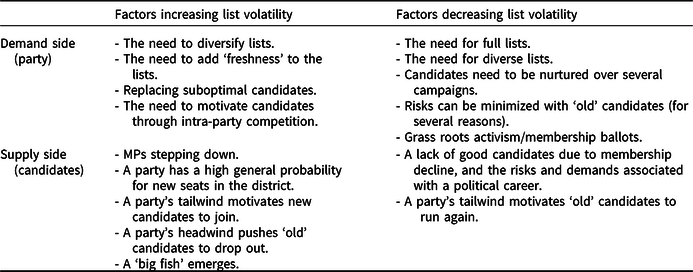
The semi-structured interviews covered the whole process of list formation, from how parties determine their objectives for the next election to how parties recruit candidates and make decisions about them. For the purposes of this study, the interviews were interpreted and coded through two questions: (1) Which factors can be regarded as drivers of change? and (2) Which factors can be regarded as enhancers of list stability? Both classes of factors were subdivided into demand-side factors [the party perspective] and supply-side factors [the candidate perspective]. Overall, we found 32 factors that can enhance volatility or stability of party lists between elections. Half of them reflect major independent causal factors and the other half reflect sub-factors that relate to some of the independent factors, expanding on their internal logic. The former are summarized in Table 1 after the analysis, the latter only appear in the text, as supporting mechanisms. Although the number of statements supporting each factor varied [i.e., some factors were mentioned more often], we decided to report all the factors because all the interviewees belong to the absolute intra-party elite and possess valuable insight. Determining the weight of the factors through the generality of their appearance is also not wise, because sometimes even highly significant factors can appear so trivial for party elites that they simply fail to notice them. Instead of presenting a simple, generalized picture, we describe the complex forces affecting list formation, focusing on the tension between demand and supply.
Factors increasing and decreasing candidate list volatility

For the quantitative part, we used candidate data from Finnish parliamentary elections spanning the period from 1983 to 2019. We defined list volatility for a party in a district as the percentage share of candidates at election t who had not run at the previous election [t − 1]. Thus, zero volatility would mean that the list was exactly the same as in the previous election, and a volatility score of 100 indicates that none of the later candidates were on the previous list.
Unfortunately, we were not able to calculate volatility for the alliance lists where two or more parties decided to run with a common list. Alliances are typically formed by small parties, and they are decided for each election individually. An alliance generally only lasts for one election, and in the next election, the same parties campaign with their own lists or in alliance with new parties. Out of a total of 985 lists between 1983 and 2019, 257 [26%] were alliance lists. Furthermore, of the 728 non-alliance lists, volatility could not be calculated for lists appearing for the first time or lists for non-consecutive elections. Hence, the final number of lists in the analysis was 564.
Demand and supply factors affecting list formation according to party officials
Democratic political competition incentivizes parties to continually be on the lookout for new votes. Therefore, parties constantly seek to enhance the quality of their candidates (Cain et al., Reference Cain, Ferejohn and Fiorina1987). According to our interviews, Finnish parties have thoroughly internalized this logic. Four distinct motivations of parties to change candidate lists emerged from the interviews. First, as the Finnish electoral system mandates a preferential vote, parties are determined to present socio-demographically balanced lists to suit all tastes (see also Arter, Reference Arter2013). Like Gallagher (Reference Gallagher, Gallagher and Marsh1988) noted, diversification allows parties to attract votes outside of their core constituencies, but diversification also prevents situations where overly similar candidates ‘eat’ into each other’s votes. Second, parties need to add freshness to their lists. As ‘old names’ eventually drop off, a constant recruitment of ‘new names’ is crucial for parties’ continuity. Becoming an MP is a ‘marathon sport’. It usually takes several elections at municipal and national levels before one gets elected, and parties need to start nurturing new candidates at a very early stage. Third, the parties want to eject unwanted candidates, including those holding radical opinions, or who performed poorly in previous elections. Finally, the district leadership may want to change names on the list to increase intra-party competition, which motivates the candidates to work harder and thus increase the party’s vote share.
Hence, parties constantly analyze their ‘market’, scout for new contenders and evaluate their current candidates. As Rehmert (Reference Rehmert2020) also noted, lower-level elections – for example, municipal elections – work typically as ‘qualifiers’ for candidates. In addition to measuring votes, parties analyze candidates’ motivation and general capacity to mobilize voters. New names are actively probed from relevant networks [workplaces, associations, etc.] and media [traditional and social]. ‘Headhunting’ is motivated by a strong belief that ‘good’ new candidates, that is, ones that possess several valence-related attributes (Rehmert, Reference Rehmert2020), can be game changers in close-margin elections. Especially the emergence of a ‘big fish’, that is, a person with exceptional vote-earning potential, based on personal publicity and an established network [for example, a celebrity with a credible public record] for whom the parties deliberately save list space until the last moment, will almost certainly alter the list.
However, the extent to which parties can engage in these activities depends, first, on resources. Larger parties have a permanent workforce for the scouting process; smaller parties operate on a more voluntary basis. The strategic capacity of parties also depends on the level of IPD, that is, the extent to which members of subnational party branches participate in the list formation process (Gallagher, Reference Gallagher, Gallagher and Marsh1988; Hazan and Rahat, Reference Hazan and Rahat2010). In the SDP and Centre, which historically conform to the member-driven mass party model (Mickelsson, Reference Mickelsson2007; Koskimaa, Reference Koskimaa2016), the process seems more decentralized as local branches’ right to suggest candidates for district leaders is more pronounced than in other parties. While this could only mean that local elites control the nominations [i.e., the process is decentralized but not democratized], the SDP and Centre are also the only parties where open district-level membership ballots are still frequently used to select candidates when more hopefuls emerge than what the party can nominate in the district. Thus, while the general professionalization and centralization of parties [including centralization at the district level that the tendency to organizational stratarchy suggests] (Katz and Mair, Reference Katz and Mair2018) may have pushed towards enhancing the strategic capacity of district party elites, intra-party factors could produce variation within this tendency.
Several supply-side factors can also induce volatility in candidate lists. This is an important addition to party strategy models, which despite Norris and Lovenduski’s (Reference Norris and Lovenduski1993, Reference Norris and Lovenduski1995) seminal work still tend to emphasize party elites’ demands. Sometimes former candidates simply step down, for example, after passing the peak of their ‘development curve’ or due to a new career. A less trivial supply-side driver is the availability of new candidates. Besides the number of active members (see also van Biezen and Poguntke, Reference Biezen and Poguntke2014), parties’ candidate supply depends on their probability to gain seats, which relates to parties’ historical district-level support and on district magnitude. More periodical factors also affect supply: how parties perform in polls; how they fared in previous elections; and whether there have been significant media crises prior to elections. Periodical factors contribute to the party’s ‘tailwind’, which tends to increase candidate supply and party elites’ strategic capacity, but also to incentivize former candidates to run again. Conversely, ‘headwind’ may encourage old candidates to drop out from the list.
If increasing supply strengthens party elites’ strategic capacity, then decreasing supply should weaken it. The interviews stressed that while it is still relatively easy to find ‘list fillers’, good candidates with a decent personal reputation, resources and motivation, that is, persons with positive valence (Rehmert, Reference Rehmert2020), are hard to recruit nowadays. Prospective quality candidates typically contrast the looming ‘marathon’ to other career possibilities. Exchanging financial security and personal privacy for the perils of contemporary electoral politics requires strong conviction and a good chance of being elected within a reasonable time. As with increasing supply, the effects of decreasing supply on list stability are somewhat uncertain. On the one hand, a declining supply will limit party elites’ strategic capacity and increase their dependence on ‘old names’, which should increase stability. On the other hand, as loyal party activists have traditionally formed the bulk of candidates, their declining numbers can increase volatility because parties constantly need to find new candidates to fill the lists. This seemed to be the predominant conception amongst party interviewees. Determining the effect of membership development is a central objective of the intertemporal regression analysis that follows.
Finally, while the strategic flexibility of parties gets often more attention, several demand-side [party] factors enhance list stability. They relate to parties’ two basic needs: (1) the need to run full lists, as every candidate contributes with some votes and (2) maximization of diversity amongst candidates so that as many potential voters as possible can vote for the party. Theoretically, new candidates could satisfy both needs. But because finding better new candidates is uncertain, the parties need a reservoir of dedicated and experienced candidates with profiles that combine essential objective characteristics [place of residence, sex, age, occupation, etc. (see also Gallagher, Reference Gallagher, Gallagher and Marsh1988)]. Every new candidate list builds on the list in the previous election. Reflecting the recent observations on the incumbency effects in list PR systems, the interviewees stressed that if a party holds seats in the district, incumbent MPs are the first ones whose candidacy the district leadership aims to secure. Losing an incumbent is always a risk, as the party needs to replace him/her with a candidate whose popularity amongst voters is uncertain. The incumbent has also likely fostered deep political ties with local stakeholders. More generally, experienced ‘old names’ reduce risks of agency loss as they have proven their ideological purity and capacity to run campaigns (Rehmert, Reference Rehmert2020). Three additional factors strengthen this dynamic. First, due to the ‘marathon’ nature of the competition, most MPs will have had to compete several times in order to increase their publicity. Second, despite the wealth of information available, predicting who voters will eventually vote for is still very difficult, producing another advantage for candidates who have a proven track record. And third, experienced candidates usually possess strong local support, which can be difficult for the party leadership to bypass – especially in parties that adhere to democratic selection methods.
To summarize, party actors think very strategically about list formation, but the available supply of candidates and organizational resources limit their strategic capacity. If the district party enjoys a good supply of newcomers and a powerful and unified leadership, it can ‘revamp’ its list very strategically. Usually, however, the uncertainty of supply drives parties simultaneously in both directions: towards ‘nurturing’ old candidates while actively seeking new ones. We thus concur with Norris and Lovenduski (Reference Norris and Lovenduski1993, Reference Norris and Lovenduski1995) that list formation is best conceived as an ongoing negotiation between strategic demands and the supply of candidates. We have summarized the main demand and supply factors and their potential effects on list volatility from the interviews in Table 1. Due to the general nature of the interviews and because contingency plays a major role in the intra-party negotiations, we have not drawn general conclusions regarding the relative weights of these factors. That can, however, be evaluated with our quantitative analysis.
Demand and supply factors affecting list volatility: formulating expectations
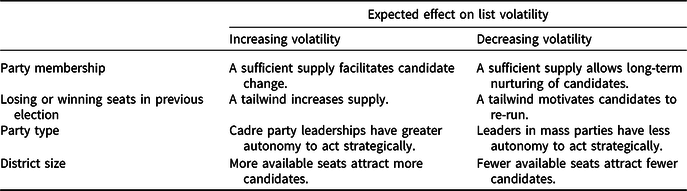
Next, we will outline how we used the observations from the interviews, coupled with the general party trends outlined earlier, as the basis for our quantitative analysis. The qualitative data helped us locate the several factors or mechanisms that decrease or increase list volatility, but these factors may be of different importance for different parties, or their effects may vary over time. Hence, we followed up the qualitative analysis with a quantitative analysis to examine these differences between factors and parties, as well as how volatility in candidate lists has developed over time (Table 2).
Variables in the regression analysis and their expected effect on volatility

First, the interviews indicated that parties need to keep their candidate lists diverse and ensure the ‘freshness’ of the list at each election. In line with what was emphasized by the interviewed selectors, it seems reasonable to assume that these needs are easier to meet for parties with access to a large supply of potential candidates. In the quantitative analysis, we used party membership size as a proxy indicator of the quality and quantity of supply in terms of potential candidates. As has happened elsewhere, Finland has experienced a general and marked decline in party membership (van Biezen et al., Reference van Biezen, Mair and Poguntke2012), particularly for older parties. When party membership declines and the cadres get older, it becomes more difficult to find suitable candidates, which may lead to increased list turnover. However, the effect of the availability of potential candidates can work in the opposite direction as well. Parties with an adequate pool of candidates are better able to concentrate on longer term goals when it comes to nurturing candidates over several consecutive campaigns, which is likely to increase list stability.
Second, the interviews showed that a party’s development in terms of popularity affects list formation, although its effect on list volatility can be mixed. A good ‘tailwind’ mobilizes new aspirants to run, but it also motivates previous candidates to participate again. Thus, we did not have a clear expectation in terms of the direction of the effect of a good ‘tailwind’. In the analysis, we used the district party’s results, operationalized as winning or losing seats in the previous election, as a proxy for a party’s ‘tailwind’ or ‘headwind’.
Third, as the interviewees also noted, the extent to which district leaders are challenged from below may affect list formation. Some scholars have argued that parties have become more centralized and professional, also at the district level (Katz and Mair, Reference Katz and Mair2018), increasing leaders’ strategic capacity. Others have highlighted a possibility for the democratization of parties (e.g., Scarrow, Reference Scarrow2015). In line with international (Passarelli, Reference Passarelli2015) and Finnish literature (Mickelsson, Reference Mickelsson2007; Koskimaa, Reference Koskimaa2016, Reference Koskimaa2020), the interviews also suggested that Finnish parties continue to vary in terms of decentralization and IPD. In some parties, namely, those that hail from the mass party tradition, local branches participate more actively in list formation and the district parties also use membership ballots more often. Because of the lack of comprehensive longitudinal measures of IPD, we simply classified parties into groups according to their historical ‘genetic’ organizational features, which relate to the level of membership involvement in intra-party affairs (Duverger, Reference Duverger1967), to assess the impact of party type-dependent level of decentralization and IPD on list volatility. Drawing insight from relevant literature (e.g., Duverger, Reference Duverger1967; Gallagher, Reference Gallagher, Gallagher and Marsh1988), we expected that district leaderships in parties of mass-party origin would have less autonomy than district leaderships in parties of cadre party origin, as local branches and their members have typically played a stronger role in mass parties. We also identified newer activist-driven parties that differ from mass parties by adhering to more direct forms of IPD (e.g., Scarrow, Reference Scarrow2015). Due to the less-organized nature of their grassroots activity, the theoretical impact of this party type on list stability is not certain. For example, the Green Party of Finland, an archetypical specimen of this type, has traditionally also emphasized the autonomy of its MPs [alongside strong grassroots] (Koskimaa, Reference Koskimaa2016). We duly recognize the rudimentary nature of this nominal measure, but considering its potential impact, we decided to see if it can produce the relevant insight to guide further research. Finally, we added district size as an independent variable in the models as it is possible that larger districts with more available seats attract more candidates.
Demand and supply factors affecting list formation: testing expectations
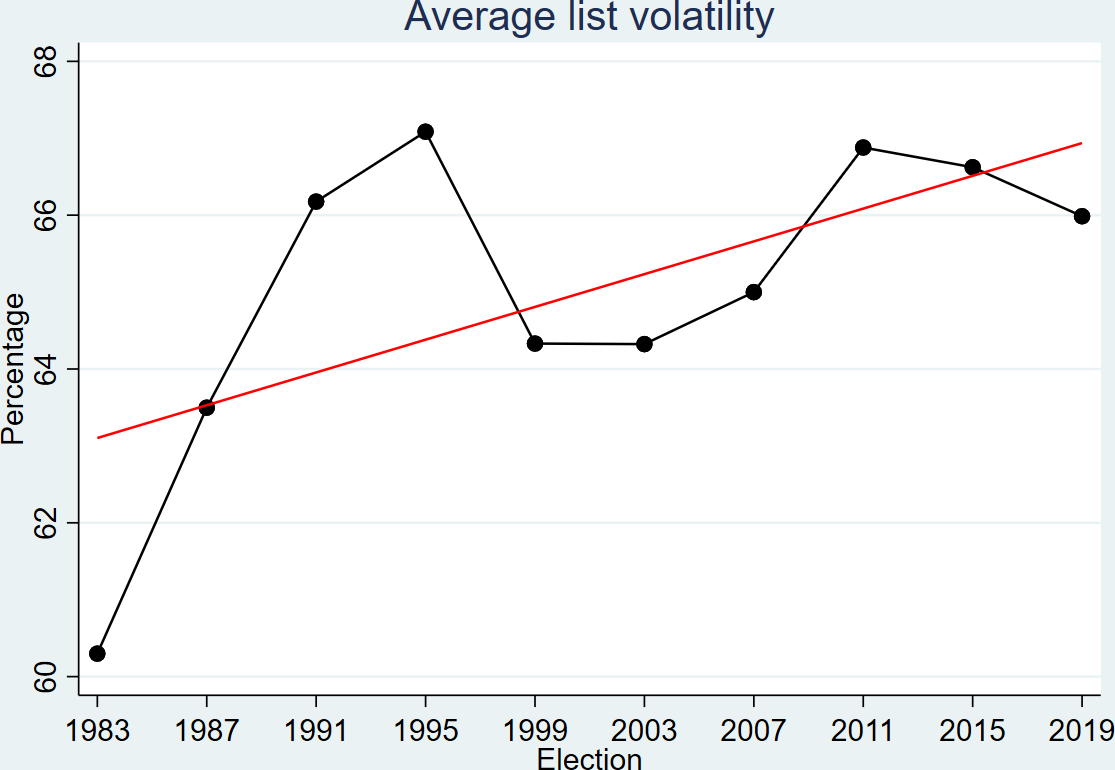
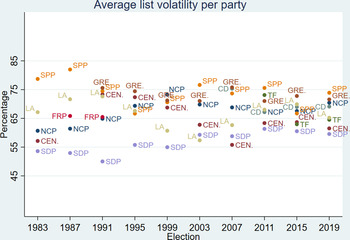
We will now move on to how we tested our loosely formulated expectations, using data on list volatility in 10 consecutive Finnish general elections spanning almost 40 years. The overall average list volatility during the period 1983–2019 was as high as 65.3% [N = 564; std. dev. = 12.4], indicating that only about one in three candidates ran again in the next elections.Footnote 1 This shows that parties, intentionally or not, ‘revamp’ their lists to a large extent. This finding might seem surprising, mainly because as in many other open-list proportional (OLPR) systems, also in Finland incumbent MPs appear in media to a larger extent.Footnote 2 As shown in Figure 1, the average list volatility increased over the period. List volatility edged upwards from 1983 to 1995, but after 1995, the trend has, after a small dip, stabilized. It is not easy to explain this stabilization. The reason for this development mabe related to the gradual decline of inter-party differences in list volatility that has taken place in the 2000’s, as can be seen in Figure 2.
Overall average candidate list volatility in Finnish elections between 1983 and 2019.

Average list volatility per party. Notes: National Coalition(NCP); Centre Party (CEN.); The Finns Party (TF); Swedish People’s Party (SPP); Christian Democrats (CD); Finnish Rural Party (FRP); Social Democratic Party(SDP); Left Alliance (LA); Green League (GRE.). When a candidate run in the past for the Finnish People’s Democratic League (FDPL) and then for Left Alliance(LA), we considered her as running for the same party.

Figure 2 plots the average list volatility of political parties over time. A clear pattern cannot be seen in terms of the average list volatility per party, aside from a few exceptions: The SDP had the lowest average list volatility in all elections but two [2003 and 2007], where it had the second lowest volatility. At the other end, the SPP presented lists with the largest [or amongst the largest] candidate volatility for most of the elections. This reflects our expectations on party ‘genetics’ as the SDP is an exemplar case of a party with a mass-party origin, whereas the SPP is a clear descendant of the cadre party tradition. Over the 10 elections, the smallest variation in list volatility can be observed for the SPP, and the FRP and SDP have the largest. In general, Figure 2 shows decreasing heteroscedasticity in the volatility, meaning that differences in list turnover between parties were smaller in the 2010s than in the preceding decades.
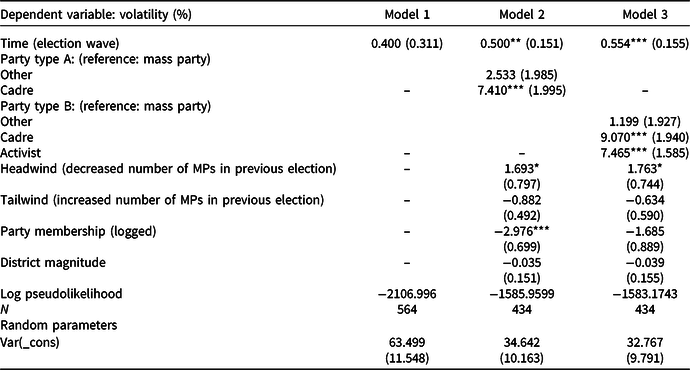
To test which factors affect list volatility, we ran three linear mixed models with a random intercept for a variable that combined district and political parties, while, simultaneously, modelling heteroscedasticity and first-order autoregressive errors.Footnote 3 Although Model 1 (Table 3) showed that time does not have a statistically significant effect on volatility, Model 2 and Model 3 indicated that when more predictors are added in the analysis the increasing trend in volatility over time is statistically significant, although the effect is rather small [on average, around 0.5%–0.6% points per electoral period]. Model 2 showed the effects of party type, losing and winning MPs between subsequent elections, district magnitude and the [log of] party membership.Footnote 4
Multilevel mixed-effect linear regressions of candidate list volatility

Notes: Models account for heteroscedasticity and first-order autoregressive errors; Standard errors clustered in the level of parties in parentheses; ***P < 0.001, **P < 0.01, *P < 0.05.
Categorizing Finnish parties into ‘genetic’ organizational types is not straightforward as they all have individual histories and idiosyncrasies. To be sure of the robustness of the results, we decided to use two slightly different categorizations. The SDP and Centre Party belong to the member-driven mass-party category, whereas the National Coalition and SPP have an elite-driven cadre-party origin. However, while the LA’s predecessor [the Finnish People’s Democratic League] was a large mass party, the LA – with its stronger commitment to individual members’ grassroots democracy – can also be classified as an activist party, as can the Greens. Due to their small size, the Christian Democrats have resembled the cadre party model, but not as clearly as the National Coalition or SPP. The FRP and its successor, the TF, was organized according to the leader-centric model that has been typical for right-wing populist parties (Mickelsson, Reference Mickelsson2007). For these reasons, we explored slightly different categorizations in Models 2 and 3. In Model 2, the Centre, the SDP and the LA were categorized as mass parties, whereas the National Coalition and the SPP were classified as cadre parties [other parties were classified as ‘Other’]. In Model 3, we used an additional category of activist parties. Here, the Centre and the SDP were classified as mass parties; the NCP, SPP and Christian Democrats were classified as cadre parties; and the LA and Green League were classified as activist parties [other parties were classified as ‘Other’].
In Models 2 and 3, as we expected, results in the previous elections matter. A loss of MPs in previous elections discourages old candidates from running again, providing space for new candidacies to emerge. On the other hand, an increase in the number of MPs in previous elections is not associated with a decrease in list volatility. However, instead of automatically signifying strategic elite action, our interviews suggest that decreasing list stability after electoral defeat may also signify the exit of previous candidates who consider their future possibilities to win a seat to be low. Hence, instead of reflecting party elite’s strategic capacity, this result is more likely to highlight the – perhaps even involuntary – necessity to revamp the list as previous candidates are no longer willing to participate.
In Model 2, the size of the party membership is negatively associated with list volatility. Parties with a large membership base seem to be better at attracting candidates who run in consecutive elections. However, the estimate of party membership narrowly loses its statistically significant effect [P = 0.058] when a different party categorization is adopted in Model 3. Finally, district magnitude does not seem to affect list stability. The reason for this may be that all the mainland districts are rather large in Finland. In terms of different party types, Model 2 showed that mass parties have lower list volatility in comparison to cadre parties, as expected. The alternative party classification in Model 3 showed that mass parties have less volatile lists than both cadre and activist parties. Albeit a crude measure, this result clearly indicates that parties’ organizational ‘genetics’ and practices really matter. While this level of analysis cannot determine the causal mechanisms behind the effect, combined with the observations from our interviews, the results suggests that typical mass party features [local branch strength, grassroots activism and candidate referendums] can lead to lower turnover in candidate lists. The observed difference is sizable, with the volatility of candidate lists 7%–9% points lower in mass parties than in cadre parties.
Overall, and in line with our expectations, many variables included in the regression analysis were found to have a statistically significant effect on list volatility. In terms of the effect size, the largest impact was found for party type. It is especially those parties with mass-party heritage that display the most stability in their party lists. The other two important variables, party membership and success in the polls, have a smaller and in the case of party membership also a partial impact, although the long-term effect of the decline in party membership may also be significant if the general shrinking of parties’ membership bases continues.Footnote 5
As our results are based on Finnish data only, their external validity should also be considered. The lack of systematic data on list volatility available from other countries makes it difficult to assess if volatility in Finland is high. The only comparable data come from Turkey and the levels of list volatility there seem to be approximately on a similar level to Finland (Ecevit and Kocapınar, Reference Ecevit and Kocapınar2018: 708). Considering the different incentive structure provided by the electoral systems in Turkey [closed-list PR] and Finland [open-list PR], this is surprising. It does, however, indicate that the candidate-centredness of the electoral system plays only a minor role in determining list-volatility, and that our findings regarding the development over time and across parties might travel well to other [PR] electoral contexts. Due to the differences in the time span studied, and the process of autocratization in Turkey (V-Dem, 2018), we do, however, refrain from drawing strong conclusions based on this comparison.
What comes to the factors behind list volatility, is that parties win and lose in all democracies and, hence, one could assume that the effects of previous electoral success can be similar in other types of electoral systems as well (as also indicated by Ecevit and Kocapınar, Reference Ecevit and Kocapınar2018). Also, party membership decline is occurring in most Western democracies, but as the rate of decrease varies between countries and parties, more studies are needed to confirm the effect of this decline on candidate lists. PR systems typically rely on significantly larger numbers of candidates than, for example, SMD. Hence, the decline in party membership may have larger effects in PR systems. Finally, party type clearly matters but as all parties have somewhat unique organizational histories and internal practices (Passarelli, Reference Passarelli2015), the definite classification of parties into comparable party types was difficult even in the Finnish context, let alone in international comparisons. In addition, the crude comparison of historical organizational ‘genetics’ does not say much about the exact mechanisms that enhance party list stability in these parties. Hence, our study only sets a baseline for further inquiries in different contexts where the findings should be elaborated.
Main findings and conclusions
In this study, we have presented an explorative analysis of party list volatility in the Finnish open-list PR system. In contrast to party-dominated closed-list systems, the higher candidate-centeredness of open-list systems should incentivize party elites to engage in more strategic list formation. Thus, we considered Finland to be a critical case for ‘hyper strategic’ party behaviour. Surprisingly, a comparison of our results with the only existing study on list volatility, Ecevit and Kocapınar’s (Reference Ecevit and Kocapınar2018) study on the Turkish closed-list proportional electoral system, indicates that the incentive structure provided by the electoral system plays a relatively minor role for parties’ tendency to ‘revamp their menu’ in PR systems.
Besides the electoral system, we envisaged that list volatility could be affected by broad societal tendencies and more proximate factors at the intra-party level. We expected that the general transformation of Western party politics – voter dealignment, membership decline, organizational centralization and professionalization, and a more personalized electoral arena – would increase party elites’ incentives and capacity to strategically shape candidate lists to accommodate changing needs, leading to increased volatility in candidate lists, and we indeed found such a development. Over time [especially during the 1980s and early 1990s], the volatility in candidate lists in Finland increased. However, although increasing volatility coincides with the increasing overall capacity of party elites (Koskimaa, Reference Koskimaa2016), we cannot be completely sure that the former was caused by the latter, as we found several other reasons affecting list volatility as well.
Our party elite interviews revealed several factors that can induce stability and volatility on party lists in a complex and contingent fashion, heavily reflecting the forces of broader political ‘market’, especially the supply of ‘quality’ candidates. After extracting some general factors and submitting them into a regression analysis, we were able to identify a few factors that affect list volatility in a particular direction. Like Ecevit and Kocapınar (Reference Ecevit and Kocapınar2018), we found that previous election results matter. A defeat often leads to candidate list changes. With an open-list system, this dynamic is not very surprising. A more interesting observation is that party type does indeed matter. Parties with membership-oriented organizational legacies and more decentralized and inclusive selection methods exhibit greater list stability than parties of cadre party origin – regardless of the general trends of party professionalization and centralization (Katz and Mair, Reference Katz and Mair2018). Finally, our analysis shows that list volatility is influenced to some degree by party membership size. Declining membership, a general trend across Europe (van Biezen et al., Reference van Biezen, Mair and Poguntke2012), potentially leads to greater turnover in candidate lists.
While both supply and demand obviously matter, it is difficult to say whether our results emphasize more the former or the latter. The effect of declining party membership is a supply-side explanation, leaving fewer aspirants at parties’ disposal. On the other hand, the party type effect is mostly a demand-side explanation as it refers to the capacity of district leadership to make decisions about candidates. Finally, the effect of an election loss can be interpreted as both a supply- and a demand-side factor. Electoral losses prompt party leaderships to search for new candidates, but losses also discourage previous candidates from standing again. Party lists are shaped in the continuous interaction between candidate supply and the demands and capacities of party selectors, just as Norris and Lovenduski (Reference Norris and Lovenduski1995) maintained. Combined, our findings suggest the following general dynamic for candidate list formation: (1) all party leaders react to electoral pressures to the extent that (2) the supply of candidates and (3) the level of leadership capacity allow.
In terms of broader implications, these results suggest ambiguous consequences for electoral representation and democracy. If the increased turnover in candidate lists predominantly results from parties trying to match their candidates to voter preferences, the outcome may result in higher congruence between voters and elected representatives and improved responsiveness of the political system. While parties still vary in terms of IPD, the ‘electoral professionalization’ and centralization of Finnish parties during the past four decades (Koskimaa, Reference Koskimaa2016) have generally enhanced parties’ capacity for such behaviour. However, if the increased candidate volatility is more a result of declining party membership and fewer incentives for party members to run in elections, the overall outcome may be negative for democracy as larger shares of candidates now consist of poorly motivated and less committed candidates who are not prepared to run the ‘marathon’ that it takes to become an elected representative. Combined with the increasing economic and publicity-related costs of political careers, such development may, in time, lead to electoral opportunism, where resourceful individuals with no genuine political ideology [and perhaps with a strong personal interest] come to dominate the scene.
Supplementary material
To view supplementary material for this article, please visit https://doi.org/10.1017/S1755773921000175.
Acknowledgement
The article is a part of the research project ‘Intraparty competition: the neglected dimension of political competition’ funded by the Academy of Finland [project number 316239].