Introduction
During an intensive survey of Graphidaceae Dumort. in Paraná State, southern Brazil, four new Graphis Adans. species with completely carbonized excipula were encountered. The species were found in a typical Brazilian coastal vegetation forest, known as restinga, which is included in the Atlantic forest domain and grows on poor sandy soil along the coast of Brazil (Joly et al. Reference Joly, Aidar, Klink, Mcgrath, Moreira, Moutinho, Nepstad, Oliveira, Pott, Rodal and Sampaio1999). The new species are described below.
Materials and Methods
The specimens were examined using standard stereoscopic and light microscopic techniques. Sections of thalli and ascomata were mounted in water, 10% KOH and Lugol's Solution. All measurements were made in water. Chemical constituents were identified by thin layer chromatography (Culberson & Ammann Reference Culberson and Ammann1979, Elix & Ernst-Russell Reference Elix and Ernst-Russell1993) and by comparison with authentic samples.
The Species
Graphis archeri Dal-Forno & Eliasaro sp. nov
Sicut Graphis componens sed ascosporis minoribus et lirellis immersis differt.
Typus: Brazil, Paraná, Pontal do Paraná, Pontal do Sul, 25°34′11″S, 48°21′32″W, on lianas in forest restinga, 28 February 2008, M. Dal-Forno 502a (UPCB—holotypus).
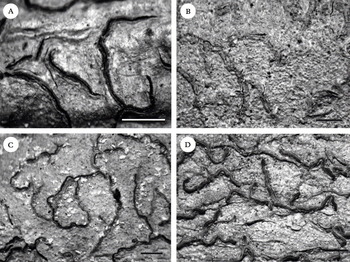
Graphis species. A, G. archeri (holotype); B, G. invisibilis (holotype); C, G. lueckingii (holotype); D, G. paranaensis (holotype). Scales: A–D = 1 mm.

(Fig. 1A)
Thallus epiperidermal, corticate, continuous to slightly rimose, 120–135 μm tall, with many crystals of 8–25 × 8–18 μm, scattered in the thallus, but mainly in clusters of 27–62 × 30–50 μm near the excipulum; soredia absent; surface white-grey, dull, uneven.
Ascomata lirelliform, isolated, sinuous, simple to partly branched, immersed, 1–3 mm long and 0·1–0·16 mm wide, black; disc concealed; thalline margin lateral, reaching the apices in some lirellae; labia striate, convergent; excipulum completely carbonized, 150–160 μm tall. Hymenium clear, 70–90 μm tall, 70–100 μm wide, I−; paraphyses unbranched, filiform, 1·0–1·5 μm thick, hyaline, sometimes pale brown at the tips; ascospores hyaline, muriform with 7–8 × 1–2 septa, ellipsoid, I+ blue-violet, 24–31 × 10–13 μm, 4–6 per ascus, 2–3 times as long as wide.
Chemistry. Thallus K+ yellow → orange, norstictic acid present.
Etymology. The new species is named in honour of Dr Alan W. Archer, from the National Herbarium of New South Wales, Sydney, Australia.
Remarks. Graphis archeri is characterized by immersed, delicate and long lirellae, striate labia, completely carbonized excipula, clear hymenia, small muriform ascospores (24–31 μm long), and by the presence of norstictic acid.
Graphis componens Nyl., closely resembles G. archeri but is distinguished from G. archeri by its larger ascospores (60–85 × 20–25 μm) and erumpent lirellae (Staiger Reference Staiger2002).
Graphis schiffneri Zahlbr. and G. paralleloides Cáceres & Lücking share some characteristics with G. archeri, such as striate labia, completely carbonized excipula, clear hymenia, small ascospores (20–40 μm long) and the presence of norstictic acid in the thallus. However, these two species have trans-septate ascospores and short lirellae (Archer Reference Archer2004, Reference Archer2006; Cáceres Reference Cáceres2007; Lücking et al. Reference Lücking, Chaves, Sipman, Umaña and Aptroot2008). Graphis renschiana (Müll. Arg.) Stizenb. and G. albotecta (Redinger) Staiger are also similar to G. archeri, but the first differs in its erumpent lirellae with basal thalline margins, entire labia and laterally carbonized excipula (Lücking et al. Reference Lücking, Chaves, Sipman, Umaña and Aptroot2008) while the second is distinguished by its entire labia and the absence of lichen compounds (Staiger Reference Staiger2002).
Graphis invisibilis Dal-Forno & Eliasaro sp. nov
Sicut Graphis subimmersa sed ascosporis majoribus et margine thallino completo differt.
Typus: Brazil, Paraná, Pontal do Paraná, Pontal do Sul, 25°34′11″S, 48°21′32″W, 28 February 2008, on bark in forest restinga, M. Dal-Forno 388 (UPCB—holotypus).
(Fig. 1B)
Thallus epiperidermal, corticate, rimose, 150 μm tall, with many crystals of 8–20 × 8–15 μm, scattered in the thallus, but mainly in clusters of 50–55 × 30–62 μm near the excipulum; soredia absent; surface pale greenish grey, dull, verrucose.
Ascomata lirelliform, isolated, sinuous, partly branched, immersed, but sometimes slightly erumpent, 0·8–2 mm long and 0·12–0·14 mm wide, black; disc concealed; thalline margin complete, thick; labia entire, convergent; excipulum completely carbonized, 250 μm tall. Hymenium clear, 100 μm tall, 80 μm wide, I−; paraphyses unbranched, filiform, 1·0–1·5 μm thick, hyaline; ascospores hyaline, transversely 14–17-septate, ellipsoid, I+ violet, 85–90 × 11–14 μm, 2–4 per ascus, 6 times as long as wide.
Chemistry. No lichen substances detected.
Etymology. The epithet is from the Latin invisibilis (invisible), a reference to the characteristic immersed lirellae with thick complete thalline margins, which makes the lirellae difficult to see.
Remarks. Graphis invisibilis is characterized by the verrucose thallus, immersed lirellae with thick, complete thalline margins, entire labia, completely carbonized excipula, clear hymenia, large ascospores (80–85 μm long), and the absence of lichen substances.
Graphis subimmersa (Fée) A. Massal. is very similar to G. invisibilis, but differs in having smaller ascospores (45–75 μm long) and a lateral thalline margin (Redinger Reference Redinger1935). Graphis rhizocola (Fée) Lücking & Chaves is also similar but can be differentiated by its prominent lirellae and a thin, complete thalline margin (Lücking et al. Reference Lücking, Chaves, Sipman, Umaña and Aptroot2008).
Graphis asterizans Nyl. resembles G. invisibilis, but it has striate labia, smaller ascospores, not exceding 70 μm long and stellately branched lirellae (Lücking et al. Reference Lücking, Archer and Aptroot2009).
Graphis lueckingii Dal-Forno & Eliasaro sp. nov
Sicut Graphis intricata sed thallo soredioso differt.
Typus: Brazil, Paraná, Pontal do Paraná, Pontal do Sul, 25°34′02″S, 48°22′01″W, 28 February 2008, on bark in forest restinga, M. Dal-Forno 560 (UPCB—holotypus).
(Fig. 1C)
Thallus epiperidermal, corticate, rimose, 55–90 μm tall, with a few crystals of 8–20 ×8–19 μm, scattered in the thallus, mainly in clusters of 50–55 × 60–65 μm near the surface; soredia granular, accumulated in distinct soralia, laminal, 0·1–0·2 mm; surface pale greenish grey, uneven.
Ascomata lirelliform, sinuous, branched, prominent, 1·0–5·2 mm long and 0·14–0·16 mm wide, black; disc concealed; thalline margin complete, thin; labia entire to slightly crenulate, convergent; excipulum completely carbonized, 200–250 μm tall, 45–59 μm wide. Hymenium clear, 125 μm tall, 55 μm wide, I−; paraphyses unbranched, filiform, 1 μm thick, hyaline; ascospores hyaline, transversely 3–5-septate, ellipsoid, I+ blue-violet, 20–23 × 5–6 μm, 8 per ascus, 4 times as long as wide.
Chemistry. Thallus K+ yellow → orange; norstictic acid present.
Etymology. The new species is named in honour of Dr. Robert Lücking, from the Field Museum, Chicago, USA.
Remarks. Graphis lueckingii is characterized by the sorediate thallus, prominent lirellae with thin, complete thalline margins, a clear hymenium, a completely carbonized excipulum, small, trans-septate ascospores (20–23 μm long) and by the presence of norstictic acid.
Structures of asexual reproduction, such as soredia and isidia, are very rare within Graphidaceae. Soredia have so far been reported in two Graphis species: G. sorediosa Nagarkar & Patw. and G. sorediella (Müll. Arg.) Stizenb. Graphis sorediosa is characterized by the erumpent lirellae, lacking a thalline margin, a laterally carbonized excipulum, a clear hymenium, and the presence of stictic and constictic acids (Adawadkar & Makhija Reference Adawadkar and Makhija2007). Graphis sorediella has poorly developed, short lirellae (0·5–0·7 mm long), with an inconspicuous thalline margin, and small, muriform ascospores (25–35 μm long) (Müller Reference Müller Argoviensis1880). These two species share few features with G. lueckingii.
Graphis lueckingii shares some characteristics with G. intricata Fée and G. caesiocarpa Redinger, such as small transversely septate ascospores, a non-inspersed hymenium, a completely carbonized excipulum and the presence of norstictic acid in the thallus, but both these species lack soredia (Redinger Reference Redinger1935; Staiger, Reference Staiger2002; Lücking et al. Reference Lücking, Chaves, Sipman, Umaña and Aptroot2008).
Graphis paranaensis Dal-Forno & Eliasaro sp. nov
Sicut Graphis intricata sed ascosporis majoribus et thallo substantias lichenicas destituto differt.
Typus: Brazil, Paraná, Pontal do Paraná, Pontal do Sul, 25°34′11″S, 48°21′32″ W, 28 February 2008, on bark in forest restinga, M. Dal-Forno 352 (UPCB-holotypus).
(Fig. 1D)
Thallus epiperidermal, corticate, continuous to rimose, 50 μm tall, with many crystals of 8–25 × 8–20 μm, scattered in the thallus but mainly in clusters of 75–125 × 45–112 μm near the excipulum; soredia absent; surface pale grey, dull, uneven.
Ascomata lirelliform, isolated, sinuous, richly branched, prominent to sessile, 0·9–3·2 mm long and 0·2–0·26 mm wide, black; disc concealed; thalline margin complete, apically thin and basal and laterally thick, lacking in the young lirellae; labia entire, convergent; excipulum completely carbonized, c. 312 μm tall. Hymenium clear, 160 μm tall, 150 μm wide, I−; paraphyses unbranched, filiform, 1·0–1·5 μm thick, hyaline; ascospores hyaline, transversely 8–11-septate, ellipsoid, I+ violet, 35–52 × 10–12 μm, 8 per ascus, 3–5 times as long as wide.
Chemistry. No lichen substances detected.
Etymology. The specific epithet is derived from the type locality, Paraná, a state in southern Brazil.
Remarks. Graphis paranaensis is characterized by the prominent and conspicuous lirellae, with a thin complete thalline margin, entire labia, a completely carbonized excipulum, a clear hymenium, trans-septate ascospores (32–52 × 10–12 μm) and by the absence of lichen compounds.
This new species is morphologically similar to Graphis intricata, but this species has smaller ascospores (15–30 μm long) and norstictic acid in the thallus (Staiger Reference Staiger2002, Archer Reference Archer2006). Graphis caesiocarpa is also morphologically similar to G. paranaensis but differs in its pruinose labia, smaller ascospores (15–20 μm long), and the presence of norstictic acid (Redinger Reference Redinger1935).
Graphis pernambucoradians Cáceres & Lücking is anatomically similar to G. paranaensis, but has very long, radiately branched lirellae and slightly smaller ascospores (25–35 μm long) (Cáceres Reference Cáceres2007).
We are grateful to Dr. Robert Lücking and Dr. Alan W. Archer for many discussions about the taxa and for providing a valuable bibliography on Graphis. The authors also wish to thank Professor Nasser K. Hammad for the Latin diagnoses, two unknown reviewers for critical revision of the original manuscript and CAPES (Coordenadoria de Aperfeiçoamento do Pessoal do Ensino Superior) for granting a Mastership to Dal-Forno.