Implications
Compared with diets exclusively composed of grasses, diets that include tropical legume consumption may help improve animal performance and reduce the emission of greenhouse gases. However, the spatial distribution of a tussock-forming grass, such as dwarf elephant grass (DEG, Pennisetum purpureum), can restrict legume access by grazing animals because the long leaves of the tall tufted grass may overlap some herbaceous legume plants. Allowing steers grazing DEG access to an exclusive area of peanut (Arachis pintoi) improves their herbage intake and average daily gain without increasing methane production per kg of dry matter intake.
Introduction
The inclusion of forage legumes in grass-pasture-based diets for ruminants has environmental and nutritional benefits. These benefits include reduced N input costs, reduced risk of N leaching at the farm level and beneficial ingestive and digestive interactions. In addition, compared with diets exclusively composed of grasses, tropical legume consumption may help reduce the emission of greenhouse gases (GHG) (Archimède et al., Reference Archimède, Eugène, Marie Magdeleine, Boval, Martin, Morgavi, Lecomte and Doreau2011).
However, the nutritional advantages of including forage legumes in ruminant diets are difficult to achieve under grazing conditions when either the proportion of legumes in the herbage mass or the spatial distribution of grasses in the sward limits legume access by grazing animals, such as when the leaves of a tufted tall grass, such as dwarf elephant grass (DEG) (Pennisetum purpureum cv. BRS Kurumi), overlap with the legumes (Crestani et al., Reference Crestani, Ribeiro Filho, Miguel, de Almeida and Santos2013). Therefore, further studies of management strategies for increasing legumes in the diet of grazing animals and the consequences for enteric methane emissions from ruminants eating tropical forages are needed.
Thus, the main question to answer of this study was whether access to an exclusive area of tropical legumes by steers grazing a tropical grass pasture, with no limitations to intake due to forage allowance, would improve herbage intake and animal performance and reduce enteric methane emissions. The aim was to evaluate the herbage intake, animal performance and enteric methane emissions of cattle grazing DEG pastures with or without access to an exclusive area of peanut (A. pintoi cv. Amarillo).
Material and methods
Treatments, subject animals and experimental design
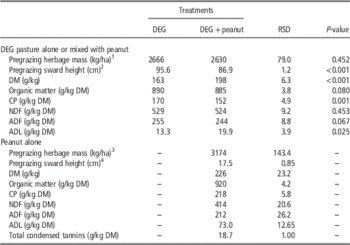
Two experimental treatments were compared. One treatment was DEG pasture receiving nitrogen fertilization (150 kg N/ha as ammonium nitrate), and the second was DEG pasture intercropped with peanut, with an adjacent area of peanut (DEG+P) that was accessible to grazing animals for 5 h/day (from 0700 to 1200 h). The chemical compositions of the pastures are presented in Table 1.
Pregrazing herbage mass, sward height and chemical composition of steer-grazed pastures of dwarf elephant grass (DEG) (Pennisetum purpureum cv. BRS Kurumi) cultivated alone, DEG intercropped with peanut (Arachis pintoi cv. Amarillo) and peanut alone

DEG+peanut=DEG pasture mixed with peanut.
1 Dry matter (DM) of green leaves of DEG.
2 Measured with a sward stick.
3 Petiole+foliole of the peanut pasture.
4 Measured with a rising plate meter.
In total, 12 Charolais steers aged 10 to 12 months were assigned into four homogeneous groups, two groups per treatment, according to BW (213±8.9 kg) measured 1 day before the start of the experiment. The treatments were applied using a completely randomized design replicated during three grazing cycles from January to April 2012. Each grazing cycle was 21 days on average. The animals did not change treatment groups during the experiment.
Paddock management
Two uniform areas were used. These areas included a 1-ha area planted with a monoculture of DEG in October 2004 and a 1.5-ha area planted with a 1-ha mixture of DEG and peanut in November 2004, and a 0.5-ha monoculture of peanut in October 2005. Each pasture was subdivided into 16 paddocks, forming two replicates with eight paddocks of ~600 m2 of DEG in monoculture, two replicates with eight paddocks of ~600 m2 of DEG intercropped with peanut and eight paddocks of ~300 m2 of peanut in monoculture.
The characteristics of the experimental area and the fertilization are described in greater detail in Supplementary Material S1.
Pasture management
The animals were managed under intermittent stocking, using a pregrazing management target of 90 to 100 cm for the DEG-pasture-based paddocks (DEG or DEG+P). The postgrazing management target was 45 to 50 cm or greater. The management of the forage, pure-peanut paddocks was synchronized with the management of the DEG-pasture-based paddocks. The pre- and postgrazing heights varied between the two paddock types; this variation was considered to be a consequence of the current grazing interval. The number of days of occupancy varied among the paddocks, with the grazing cycles averaging 35±2 days. The grazing period – defined as the length of time that grazing livestock occupy a specific area (Allen et al., 2011) – was 2.5±0.5 days/paddock, with a rest period of 32.75±2.25 days. A sufficient number of paddocks were not available for the animals to be stocked on the experimental pastures throughout each grazing cycle. Therefore, during the intervals between grazing cycles (15±2 days), the animals were all gathered in a Panicum maximum pasture.
All pasture measurements and chemical analyses are described in Supplementary Material S1.
Animal measurements
The individual herbage intake and the dry matter (DM) digestibility of the consumed herbage were measured using the n-alkane technique (see Supplementary Material S1). In the final 11 days of each grazing cycle, the steers were dosed twice daily (at 0800 and 1600 h) with a cellulose stopper (Carl Roth, GmbH, Karlsruhe, Germany) containing 248 mg of C32. During the final 5 days of each grazing cycle, fecal grab samples were collected from each steer twice daily (at 0800 and 1600 h). The feces were oven-dried at 60°C for at least 72 h, subsampled by period and by steer, and then ground by passing the samples through a 1-mm screen for subsequent chemical analysis. Hand-plucked forage samples were collected on days 7 to 11.
Daily CH4 emission was measured in the final two grazing cycles using the SF6 tracer technique. The periods of gas collection were selected to match the evaluation period for herbage DM intake as closely as possible. These measurements are described in greater detail in Supplementary Material S1.
To measure average daily gain (ADG), the animals were weighed before and after each grazing cycle after fasting from solids and liquids for 12 h. The daily patterns of grazing and ruminating times were measured by visual observation every 5 min from 0700 to 1900 h and every 10 min from 1900 to 0700 h on days 10 and 12.
Statistical analyses
All of the animal and pasture data were analyzed using the PROC MIXED procedure (SAS Institute Inc., Cary, NC, USA) with grazing cycle considered as a repeated measures using the following model:
 $$Y_{{ijkl}} \,{\equals}\,\mu {\plus}\alpha _{i} {\plus}\beta _{j} {\plus}\gamma _{k} {\plus}ɛ_{{ijkl}} $$
where μ is the overall mean; α i and β j the random effects of animals and grazing cycles, respectively; γ k the fixed effects of legume access; and ɛ ijkl the residual error.
The forage data for DEG alone and DEG+P, averaged per treatment and period, were also analyzed using repeated measurements and the following model:
 $$Y_{{ijkl}} \,{\equals}\,\mu {\plus}\alpha _{i} {\plus}\beta _{j} {\plus}\gamma _{k} {\plus}ɛ_{{ijkl}} $$
where μ is the overall mean; α i and β j the random effects of paddock; γ k the fixed effects of pasture type (grass alone or grass mixed with peanut); and ɛ ijkl the residual error. The peanut-only pasture data were not subjected to statistical analyses because this pasture was not available to animals in the DEG treatment.
Results
Pasture characteristics
The pregrazing herbage mass and NDF concentration were similar between treatments, whereas the pregrazing sward height and CP concentration were higher (P<0.001) in the DEG paddocks compared with the DEG±P paddocks (Table 1). The peanut paddocks had an average pregrazing herbage mass of >3000 kg/ha, a CP value >200 g/kg DM and an NDF value of ~400 g/kg DM. The forage allowance, postgrazing herbage mass, postgrazing sward height and alkane concentrations are provided in Supplementary Table S1.
Animal data
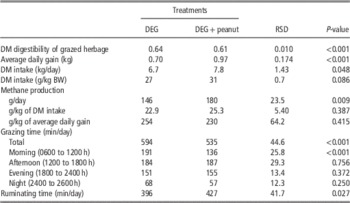
The DM digestibility of consumed herbage was lower for the animals with access to legume pasture (P<0.05), whereas the DM herbage intake, energy intake and ADG were higher (P<0.05) for the animals with access to legume pasture (Table 2). The daily methane emissions were higher (P<0.05) for the animals with access to legume pasture, whereas the methane emissions per kg of DM intake were not affected by treatment. The time spent grazing was lower (P<0.001) for the animals in the pure-peanut paddocks (from 0600 to 1200 h) compared with those in the DEG paddocks. The total grazing time of the animals in the DEG±P treatment group was lower (P<0.001) than that of the animals in the DEG treatment group.
Average daily gain, herbage intake, enteric methane production and ingestive behavior of steers grazing dwarf elephant grass (DEG) (Pennisetum purpureum cv. BRS Kurumi) with or without access to peanut (Arachis pintoi cv. Amarillo)

DEG+peanut=DEG pasture mixed with peanut and with access to peanut pasture; DM=dry matter.
Discussion
Herbage intake and animal performance
Despite the greater DM digestibility of the DEG treatment, the animals in the DEG+P treatment group had greater herbage intake and ADG than the animals in the DEG treatment group. It is well known that intake is more closely related to the rate of digestion than to digestibility per se. In addition, the primary chemical component of foods that determines their rate of digestion is NDF, which is less abundant in peanut compared with elephant grass. The lower digestibility of peanut compared with elephant grass diets was recently demonstrated by Schinaider et al. (Reference Schnaider, Ribeiro-Filho, Kozloski, Reiter, Orsoletta and Dallabrida2014).
The differences in forage intake between the treatments were not associated with grazing management or differences in the structural characteristics of the pastures. The pregrazing mass of DM of green leaves (DMGL) per hectare, the forage allowance of DMGL and the proportion of defoliation were not limiting pasture intake. This conclusion is based on previous research (Crestani et al., Reference Crestani, Ribeiro Filho, Miguel, de Almeida and Santos2013) in which steers grazing DEG alone or mixed with A. pintoi pastures achieved an ADG of greater than 1 kg/day when the amount of DMGL exceeded 2000 kg/ha. Steers grazing mixed DEG±P pasture have an ADG similar to that of steers grazing DEG (Crestani et al., Reference Crestani, Ribeiro Filho, Miguel, de Almeida and Santos2013) and, in the present study, the animals with access to an exclusive area of peanut exhibited an increase in ADG of ~0.3 kg/day.
The reduced grazing time of the animals with access to legume pastures can be attributed to the superior prehensibility of the legume, which enables a higher daily herbage intake compared with that of animals that are allowed to graze DEG. A higher herbage intake rate in legume pastures may be related to smaller changes in the morphological composition of the defoliated strata compared with those found for grass swards. Similar to white clover pastures (Frame and Newbould, Reference Frame and Newbould1986), the stolons of peanut are located at ground level, in the layer inaccessible to grazing animals. In contrast, the leaves (petioles±leaflets) are less resistant to breakage compared with the stems and sheaths of grasses and are distributed in the upper layer of the pasture.
Finally, when the actual DM intake was compared with the predicted DM intake considering the standard reference weight, the actual weight and the quality of diet (CSIRO, 2007) values were very close. However, the actual DM intake exceeded the estimated DM intake based on the calculation of energy requirements by ~40%. This result is consistent with the proposal of Hodgson (Reference Hodgson2004) that predictions based on the calculated energy requirements of grazing animals are most likely to be best suited to compare farm-scale production or the performance of relatively large groups of experimental animals.
Methane emissions
The similarity of methane production per kg of DM intake between the treatments demonstrates that the introduction of peanut into a tropical livestock production system is not sufficient to mitigate the enteric emission of GHG. This result was unexpected because the meta-analysis of Archimède et al. (Reference Archimède, Eugène, Marie Magdeleine, Boval, Martin, Morgavi, Lecomte and Doreau2011) showed that tropical legumes resulted in 23% less methane/kg of DM intake than tropical grasses. This lower methane production occurs because some tropical legumes, such as peanut, contain secondary metabolites such as condensed tannins and saponins that alter rumen methanogenesis (Jouany and Morgavi, Reference Jouany and Morgavi2007). In the present study, the condensed tannins of A. pintoi averaged 19 g/kg DM, close to the 20 to 40 g/kg of DM range that has been shown to offer nutritional advantages for ruminants ingesting temperate legumes (Min et al., Reference Min, Barry, Attwood and McNabb2003). The differences between tropical legumes may be partially due to differences in the biological activity of condensed tannins, which vary among plant species. Thus, even if tannins are recognized as compounds with a high capacity to reduce ruminal methane production (Jouany and Morgavi, Reference Jouany and Morgavi2007), the effect of condensed tannin-rich forages on methane production is not generalizable because of their variable bioactivity.
The lack of effect of legume inclusion on methane production per kg of DM intake could also be associated with pasture traits, such as chemical composition and digestibility. Kennedy and Charmley (Reference Kennedy and Charmley2012) evaluated several combinations of tropical grass and legume species and found that methane production per kg of DM intake varied across diets but was related to their digestibility and fiber and protein content. Methane emissions arise mainly from carbohydrate digestion, and increasing the dietary fiber content decreases the molar ratio of propionate and increases the release of H2 for methanogenic archaea (Janssen, Reference Janssen2010). In the current study, the DEG paddocks had an NDF content near 530 g/kg DM, much lower than that of most tropical grasses found in the literature and of those reported by Kennedy and Charmley (Reference Kennedy and Charmley2012), which ranged between 623 and 743 g/kg DM. The peanut paddocks had an NDF of ~400 g/kg DM, slightly more than that of Leucaena pasture (336 g/kg DM); the methane yield was reduced by 11% when the Leucaena content in a mixture with Rhodes grass was doubled from 22% to 44%.
Conclusion
Steers grazing DEG with access to peanut pastures can improve their performance with lower grazing time without increasing methane production by kilograms of DM intake.
Acknowledgments
The authors are grateful to the Conselho Nacional de Desenvolvimento Científico e Tecnológico (CNPq/Brazil) for financial support.
Supplementary material
To view supplementary material for this article, please visit http://dx.doi.org/10.1017/S1751731116000628