Introduction
The recently merged Graphidaceae and Thelotremataceae (Ascomycota: Lecanoromycetes: Ostropales) is the largest family of crustose lichens, with about 1200 species world-wide. While emending the revised generic classifications presented by Staiger (Reference Staiger2002) and Frisch et al. (Reference Frisch, Kalb and Grube2006), we compiled a large dataset with characters of most of the species described in the two families, focusing on the genus Graphis and the thelotremoid Graphidaceae. Based on this dataset, we prepared a world key to species of Graphis (Lücking et al. Reference Lücking, Archer and Aptroot2009) and present here a world-key to the species of most genera of thelotremoid Graphidaceae, excluding the bulk of the Ocellularia-Myriotrema-Stegobolus clade (Mangold et al. Reference Mangold, Martìn, Lücking and Lumbsch2008) for which no final generic concept is yet available and which will be treated in a forthcoming paper.
The majority of the thelotremoid Graphidaceae were traditionally classified into four ascospore genera (Ocellularia, Phaeotrema, Thelotrema, Leptotrema) by Müller Argoviensis (Reference Müller Argoviensis1887) and later into three excipular genera (Ocellularia, Myriotrema, Thelotrema) by Salisbury (Reference Salisbury1971, Reference Salisbury1978) and Hale (Reference Hale1980, Reference Hale1981). Frisch et al. (Reference Frisch, Kalb and Grube2006) used a combination of thallus, apothecial, ascospore, and chemical features to distinguish 21 genera. This system was subsequently emended by various authors (Mangold et al. Reference Mangold, Elix and Lumbsch2009; Rivas Plata et al. Reference Rivas Plata, Kalb and Frisch2010, this volume).
Molecular studies have improved our understanding of phylogenetic relationships and generic delimitation within the thelotremoid Graphidaceae, although the position and delimitation of several genera are unknown. The two main emerging clades are the Ocellularia-Myriotrema-Stegobolus clade and the Chapsa-Leucodecton-Thelotrema clade (Mangold et al. Reference Mangold, Martìn, Lücking and Lumbsch2008; Papong et al. Reference Papong, Corush, Mangold, Lücking and Lumbsch2009). The position of other genera and clades within the Graphidaceae is not yet resolved. The following genera have been shown to be monophyletic and more or less well-supported in molecular phylogenetic studies: Chroodiscus, Leucodecton, Melanotopelia, Schizotrema, Thelotrema, Topeliopsis and Wirthiotrema. Two further genera have only had one species analysed, but do represent separate lineages not nested within other genera, i.e. Acanthotrema and Leptotrema. Other genera, such as Chapsa, are not yet well-understood and generic limits in the Ocellularia-Myriotrema-Stegobolus clade are not clear.
To illustrate the progress in our studies of the thelotremoid Graphidaceae, we present a world-key to the genera and species with chroodiscoid or lepadinoid apothecia and all their relatives and similar taxa, which includes all genera of the Chapsa-Leucodecton-Thelotrema clade, as well as the genera Diploschistes, Fibrillithecis, Gyrotrema, Melanotopelia, the ‘Ocellularia’ cruentata group, Reimnitzia, Schizotrema, Topeliopsis and Wirthiotrema. In the course of this study, we revised nearly one thousand type specimens and assigned the epithets to the corresponding genera if not done previously. However, a small fraction of the taxa in the family have yet to be studied, including some described from India, and their taxonomic status remains uncertain at this point. Therefore, it is likely that further type studies will reveal previously unrecognized species in the genera treated here. Also, additional fine-tuning in the generic concepts is to be expected as result of our ongoing molecular studies.
Delimitation of the subject
The following keys to species include all thelotremoid genera of Graphidaceae with chroodiscoid (erect to recurved lobulate margins) or lepadinoid (double margin) apothecia or feature periphysoids, as well as similar and related genera. Essentially this covers all thelotremoid Graphidaceae except the bulk of the Ocellularia-Myriotrema-Stegobolus clade (Mangold et al. Reference Mangold, Martìn, Lücking and Lumbsch2008), which will be treated in a forthcoming paper. Except for the Acanthotrema-Chapsa-Chroodiscus-Leucodecton-Thelotrema clade (Papong et al. Reference Papong, Corush, Mangold, Lücking and Lumbsch2009), the genera treated here do not form a monophyletic group. For chroodiscoid species of Melanotrema, the Ocellularia clandestina group, and Stegobolus, the reader is referred to the keys presented by Frisch et al. (Reference Frisch, Kalb and Grube2006).
Following the key to genera, keys are presented to the species of each genus, in alphabetical order. Nomenclature of the species follows Frisch et al. (Reference Frisch, Kalb and Grube2006), Mangold et al. (Reference Mangold, Martìn, Lücking and Lumbsch2008, Reference Mangold, Elix and Lumbsch2009), Lumbsch et al. (Reference Mangold, Elix and Lumbsch2009; this volume), Messuti et al. (Reference Messuti, Codesal, Mangold, Lücking and Lumbsch2009; this volume), Papong et al. (Reference Papong, Boonpragob, Mangold, Divakar and Lumbsch2010; this volume) and Rivas Plata et al. (Reference Rivas Plata, Kalb and Frisch2010; this volume). New species and new combinations are indicated by an asterisk and are treated at the end of this paper. Taxonomic synonyms, if applicable, are listed under the corresponding species entries in the keys (basionyms only).
In a few instances, the generic placement of species or species delimitations are preliminary and may deviate from those provided in the recently completed monograph on Australian thelotremoid Graphidaceae (Mangold et al. Reference Mangold, Elix and Lumbsch2009). Some species provide transitional forms between different genera and molecular data are needed to confirm their systematic placement. Delimitation between Chapsa and Thelotrema on one hand and Topeliopsis on the other is particularly difficult: all three agree in core features but Topeliopsis falls consistently outside the Chapsa-Thelotrema clade (Mangold et al. Reference Mangold, Martìn, Lücking and Lumbsch2008; Papong et al. Reference Papong, Corush, Mangold, Lücking and Lumbsch2009). We have used the combination of free excipulum plus lepadinoid or urceolarioid apothecia to characterize Thelotrema (all species confirmed to belong to this genus by molecular data have this character combination), but there are at least two species included in the genus that have a fused excipulum. Chapsa platycarpa and C. neei have Thelotrema-like apothecia, but the first has been confirmed as belonging in Chapsa by molecular data (Frisch et al. Reference Frisch, Kalb and Grube2006). The apothecia are not strictly lepadinoid in these two species as they feature a widely exposed disc.
Although molecular studies indicate that Chapsa and Topeliopsis are not closely related, they include some difficult species that make a clearcut separation of both genera difficult. In Chapsa, the apothecia are usually erumpent with erect to recurved marginal lobules and more or less widely exposed discs. In Topeliopsis, the apothecia are typically sessile with incurved marginal, exfoliating teeth (more numerous and more regular than the lobules in Chapsa) and the disc is hidden or barely visible. Chapsa is more frequently tropical and occurs on bark, whereas Topeliopsis is typically tropical-montane to temperate and occurs on bryophytes. Intermediate forms which cause difficulties include Chapsa meridensis, a species that clusters with Chapsa in molecular studies, but on account of its ecology and its (at least young) topeliopsidoid apothecia would key out under Topeliopsis. Chapsa asteliae, C. lamellifera and C. minor are all southern hemisphere temperate species that resemble Topeliopsis, and a similar species, Topeliopsis novae-zelandiae, is currently retained in Topeliopsis although it closely resembles Chapsa astelia and C. lamellifera. Then there is the Chapsa scabiomarginata group, with tropical species producing a waxy thallus and immersed-erumpent apothecia with layered margins; the species of this group are provisionally placed in Chapsa but their systematic affinity is unclear. All doubtful species are keyed out under both Chapsa and Topeliopsis.
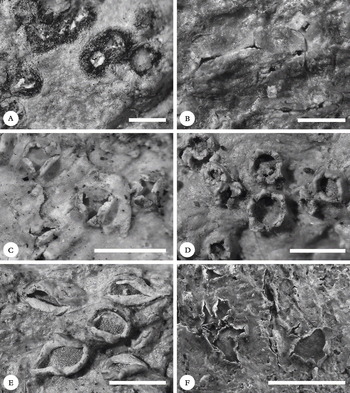
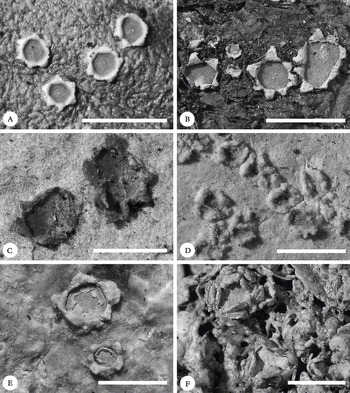
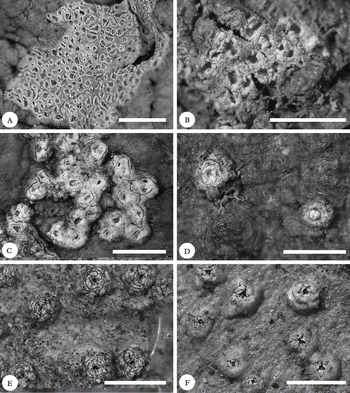
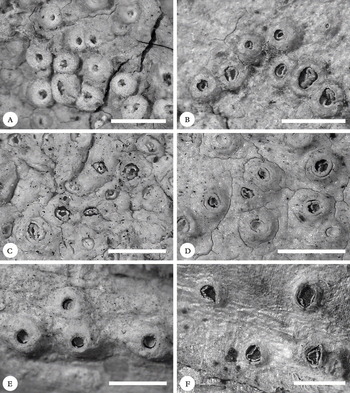
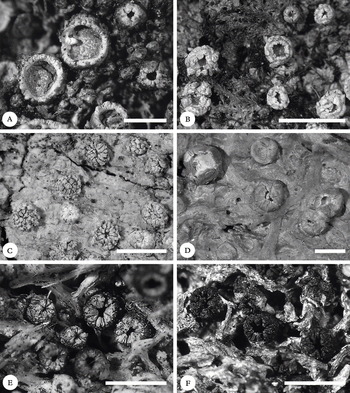
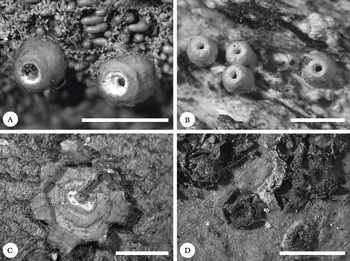
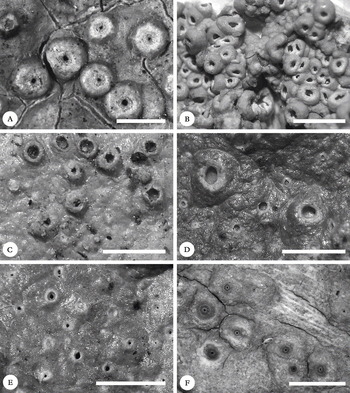
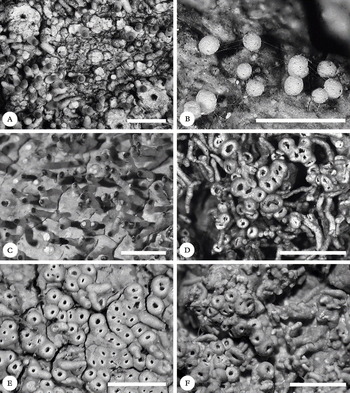
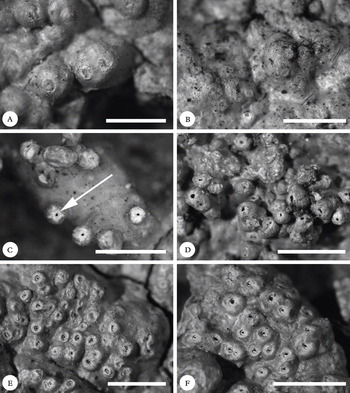
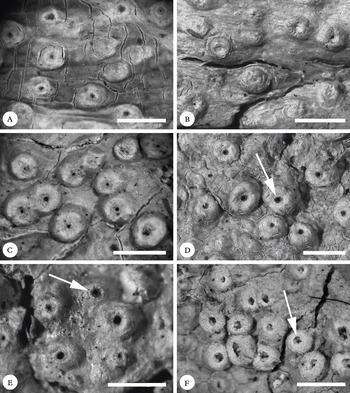
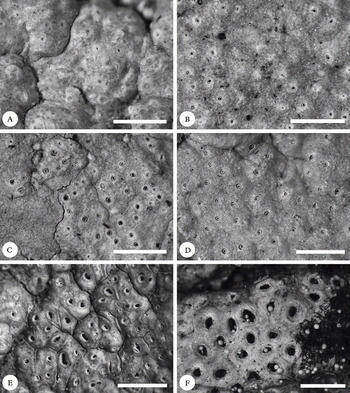
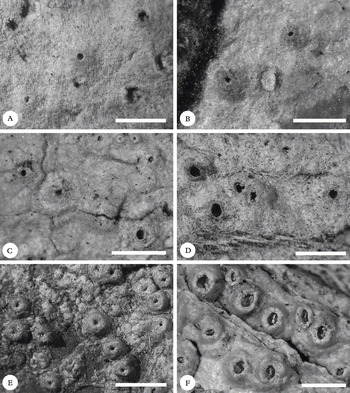
In order to facilitate the identification to genus and species levels apothecial morphology as an important character complex, we have defined several different apothecial morphotypes (Figs 1–7 ). This list is by no means exhaustive but provides a good starting point to characterize and classify the vast diversity of apothecial types in the thelotremoid Graphidaceae:
Aulaxinoid (Fig. 1A): apothecia are immersed-erumpent with black, carbonized thalline margin that opens by irregular cracks; only known example: “Thelotrema” dislaceratum (systematic affinity unknown).
Fig. 1.Thelotremoid Graphidaceae, apothecial types. A, aulaxinoid (‘Thelotrema’ dislaceratum); B, fissurinoid (Chapsa perdissuta); C–F, fissurinoid-chroodiscoid; C, Chapsa dissuta; D, C. calathiformis; E, C. zahlbruckneri; F, Acanthotrema brasilianum. Scales A – F = 1 mm.
 Fig. 2.
Thelotremoid Graphidaceae, apothecial types. A & B, chroodiscoid; A, Chroodiscus defectus; B, Chapsa astroidea; C, chroodiscoid-leprocarpoid pigmented (Chapsa waasii); D, leprocarpoid (C. velata); E. platycarpoid (C. platycarpa); F, lamelloid (C. lamellifera). Scales: A – F = 1 mm.
Fig. 3.Thelotremoid Graphidaceae, apothecial types. A, glaucescentoid (Leucodecton glaucescens); B & C, scabioid; B, Chapsa aggregate; C, C. albomaculata; D – F, schizotremoid; D, Schizotrema scabiomarginatum; E, S. schizolomum; F, S. decoloratum. Scales: A – F = 1 mm.
Fig. 4.Thelotremoid Graphidaceae, apothecial types. A–F, lepadinoid; A, Fibrillithecis halei; B, Thelotrema hians; C, T. defossum; D, Leucodecton occultum; E, Thelotrema rockii; F, Chapsa neei. Scales: A – F = 1 mm.
Fig. 5.Thelotremoid Graphidaceae, apothecial types. A–D, topeliopsidoid; A, Chapsa meridensis; B, Topeliopsis macrocarpa; C, T. lomatiae; D, T. novae-zelandiae; E & F, melanotopelioid; E, Melanotopelia blepharostoma; F, M. rugosa). Scales: A – F = 1 mm.
Fig. 6.Thelotremoid Graphidaceae, apothecial types. A & B, urceolarioid; A, Thelotrema isidiophorum; B, T. weberi; C, gyrotremoid (Gyrotrema wirthii); D, cruentodiscoid (‘Ocellularia’ cruentana). Scales: A – D = 1 mm.
Fig. 7.Thelotremoid Graphidaceae, apothecial types. A, ocellularioid (Fibrillithecis vernicosa). B – D, glaucophaenoid; B, Fibrillithecis insignis; C, Wirthiotrema santessonii; D, W. glaucopallens p.p.; E, myriotremoid (W. glaucopallens p.p.); F, porinoid (Leucodecton compunctellum). Scales: A – F = 1 mm.
Chroodiscoid (Fig. 2A–C): apothecia are immersed-erumpent and open by regularly triangular marginal lobules that become recurved to form geaster-like mature apothecia; examples: Chroodiscus, Chapsa astroidea, C. stellata.
Fissurinoid (Fig. 1B–F): similar to chroodiscoid but apothecia open by irregular cracks in thallus (“exfoliating” thallus) eventually resembling chroodiscoid apothecia; they often have an irregularly elongate shape when mature; examples: Acanthotrema brasilianum, Chapsa calathiformis, C. dissuta, C. perdissuta, C. lassae, C. sublilacina, C. zahlbruckneri, Reimnitzia santensis.
Leprocarpoid (Fig. 2D): apothecia are immersed-erumpent and open by irregular marginal lobes that remain more or less erect but often crumble or break apart; examples: Chapsa indica, C. leprocarpa, C. phlyctidioides, C. velata.
Platycarpoid (Fig. 2E): similar to chroodiscoid or leprocarpoid but with a free excipulum and forming a distinct double margin; example: Chapsa platycarpa, C. neei.
Lamelloid (Fig. 2F): apothecia are erumpent to prominent and form several distinct, concentric rows of lobulate excipula; example: Chapsa lamellifera.
Glaucescentoid (Fig. 3A & B): similar to leprocarpoid but tend to have a free excipulum and irregular split between excipulum and thalline margin; example: Leucodecton glaucescens.
Scabioid (Fig. 3B–D): similar to leprocarpoid but with regenerating hymenia that produce concentrically layered excipula which eventually cover the disc; examples: Chapsa aggregata, C. albomaculata.
Schizotremoid (Fig. 3E & F): similar to scabioid but the apothecia have a narrow pore from the beginning and the excipula are more or less carbonized; the new hymenia are formed from below the previous hymenium; examples: Schizotrema.
Lepadinoid (Fig. 4A–F): apothecia are immersed-erumpent to more typically prominent and feature a free excipulum and a distinct double margin, with the thalline margin bulging and entire and the excipulum prominent and undulate-lobulate; examples: Fibrillithecis halei, Leucodecton occultum, Myriotrema costaricense, Thelotrema.
Topeliopsidoid (Fig. 5A–D): apothecia are prominent to sessile (but often hidden between substratum) and open with numerous, more or less regular teeth that remain more or less incurved over the barely visible disc; the margins often exfoliate, i.e.the covering thallus cortex breaks away from the underlying marginal thallus tissue but no distinct, clean split between thallus margin and excipulum is formed; examples: Chapsa meridensis, Topeliopsis.
Melanotopelioid (Fig. 5E & F): similar to topeliopsidoid but the thallus margin is reduced and the teeth are (at least externally) black and carbonized.
Pseudoramonioid (not shown): similar to topeliopsidoid or melanotopelioid but with distinct stipe.
Urceolarioid (Fig. 6A & B): apothecia are prominent to sessile and have a narrow pore with entire margin through which the disc and excipulum are not visible; examples: Thelotrema isidiophorum, T. subweberi, T. weberi.
Gyrotremoid (Fig. 6C): similar to chroodiscoid but with regeneration of new hymenia in centrifugal direction, leaving concentrical, shallow rings of old excipula; the excipula are partially carbonized (not to be confused with complex columellae!) and the disc is pigmented; example: Gyrotrema.
Cruentodiscoid (Fig. 6D): apothecia are erumpent but are covered by thalline tissue for a long time before eventually rupturing the upper cortex and exposing the inner, often pigmented medulla; apothecia appear chroodiscoid but the disc is actually hidden under the inner thalline layers and then the carbonized excipulum and is not visible; example: “Ocellularia” cruentata (systematic affinity unknown).
Ocellularioid (Fig. 7A): apothecia are erumpent to prominent with a thick thalline margin and narrow, entire pore; example: Fibrillithecis argentea, Thelotrema monosporum.
Glaucophaenoid (Fig. 7B–D): similar to ocellularioid but the thalline margin is thinner and ascending and the disc is more exposed, giving the apothecia a crater-like appearance; examples: Fibrillithecis insignis, Myriotrema glaucophaenum, Wirthiotrema santessonii.
Myriotremoid (Fig. 7E): apothecia are immersed and open with a narrow, entire pore; examples: Leptotrema, Leucodecton (several species), Myriotrema (most species), Wirthiotrema glaucopallens.
Porinoid (Fig. 7F): similar to ocellularioid but with very narrow pore resembling an ostiolum of a genuine perithecium;contrary to genuine perithecia, the hymenium remains organized in a distinct, compact layer with paraphyses and asci of similar height; examples: Leucodecton bisporum, L. compunctellum, T. patwardhanii.


Key to the Genera
While it is recommended to perform TLC to determine the secondary chemistry of species of Graphidaceae, in most cases spot tests will give a preliminary assessment and, if giving an unequivocal reaction, will be conclusive. Spot tests help to identify the most common substances, including norstictic, salazinic and stictic acids, as well as psoromic and protocetraric acids and related derivatives. Other substances will not give a positive spot reaction and need TLC. We recommend performing spot tests as follows: P and C should be tested on the thallus surface, preferably on a pale portion or with the medulla exposed or with a small piece of thallus on tissue paper. K should be used on microscopic sections under themicroscope to test for a pale to deep yellow outflux; if it remains yellow it indicates stictic acid; if it forms large red, needle-shaped crystals it indicates norstictic acid. Small red crystals are characteristic of salazinic acid. In the keys we usually mention one substance for a particular taxon but this implies that accessory substances, such as connorstictic or constictic acid, are often also present.
1 Photobiont trebouxioid; growing on soil or rock (siliceous or calcareous rock in ± exposed or dry situations); thallus frequently containing depsides (lecanoric, gyrophoric and diploschistesic acids) and C+ red; excipulum carbonized; ascospores dark ... Diploschistes Norman [p. 158]
Photobiont trentepohlioid; growing on bark, wood, bryophytes or leaves, very rarely on rock (siliceous rock in ± shaded, humid situations); thallus frequently containing depsidones (stictic, norstictic, salazinic, protocetraric, and psoromic acid chemosyndromes), C− (except for one species, Topeliopsis lomatiae), but often K+ yellow or yellow turning red or P+ yellow or red; excipulum and ascospores variable ... 2
2(1) Apothecia stipitate ... Pseudoramonia Kantvilas & Vězda [p. 170]
Apothecia immersed to sessile ... 3
3(2) Excipulum with periphysoids (lateral of hymenium) or apical fibrils (above level of hymenium) ... 4
Excipulum lacking periphysoids and apical fibrils ... 11
4(3) Paraphyses and periphysoids apically spinulose; ascospores with thin septa, non-amyloid; apothecia fissurinoid-chroodiscoid ... ... Acanthotrema A. Frisch [p. 152]
Paraphyses and periphysoids glabrous; ascospores variable but usually not with completely thin septa; apothecia variable ... 5
5(4) Excipulum laterally dark brown to carbonized ... 6
Excipulum hyaline to (pale) brown, rarely slightly carbonized apically (then with free excipulum and double margin) ... 7
6(5) Apothecia prominent to sessile (if appearing half-immersed then base hidden among loose substratum), non-regenerating, melanotopelioid with denticulate black margins lacking a distinct thalline layer; over bryophytes or more rarely on bark ... ... Melanotopelia Lumbsch & Mangold [p. 168]
Apothecia erumpent to prominent, schizotremoid, regenerating with concentrically layered excipula and laterally covered by thalline layer; on bark ... ... Schizotrema Mangold & Lumbsch [p. 170]
7(5) Excipulum above level of hymenium with apical fibrils consisting of radiating, partially free hyphae converging against the pore; periphysoids absent; apothecia ocellularioid (but lacking a columella) to glaucophaenoid, rarely lepadinoid; usually with psoromic acid (thallus P+ yellow) ... ... Fibrillithecis A. Frisch [p. 160]
Excipulum lacking apical fibrils but with horizontally to obliquely arranged periphysoids separating the lateral hymenium and excipulum (and continuing above the hymenial layer); apothecia fissurinoid, chroodiscoid, leprocarpoid, platycarpoid, lamelloid, lepadinoid, scabioid, topeliopsidoid, or urceolarioid; chemistry variable but psoromic acid rare ... 8
8(7) Apothecia lepadinoid or rarely urceolarioid or ocellularioid (to rarely porinoid), with more or less free excipulum and distinct split between excipulum and thalline margin (double margin; in specimens with narrow pore, dissection of the apothecium is necessary to detect the double margin); thalline margin usually entire (sometimes ± eroded) but free excipulum often undulate to fissured; ascospores often with thick outer wall ... Thelotrema Ach. [p. 171]
Apothecia fissurinoid, chroodiscoid, leprocarpoid, platycarpoid, lamelloid, scabioid, or topeliopsidoid, with more or less fused excipulum and lacking distinct split between excipulum and thalline margin (except Chapsa platycarpa group) but sometimes thallus cortex or outer thallus layers exfoliating; combined thalline-excipular margin lobulate to recurved or denticulate; ascospores usually with thin outer wall ... 9
9(8) Apothecia topeliopsidoid (to rarely leprocarpoid), with the disc more or less concealed by the incurved, denticulate margins; the thallus margin usually exfoliating; paraphyses apically not distinctly thickened; tropical montane to temperate, often on bryophytes or dead plant material ... ... Topeliopsis Kantvilas & Vězda [p. 179]
Apothecia fissurinoid, chroodiscoid, leprocarpoid, platycarpoid, lamelloid, or scabioid, with the disc more or less exposed (except in species with regenerating hymenia and excipula); paraphyses often apically thickened and moniliform; tropical lowland to lower montane, on bark, very rarely tropical montane to temperate and then also on bryophytes or dead plant material ... 10
10(9) Thallus with large clusters of columnar crystals which give the surface a warty appearance; young ascospores conspicuously thick-walled, mature ascospores dark brown and minutely ornamented ... Reimnitzia santensis (Tuck.) Kalb
Thallus with crystals irregularly dispersed or lacking crystals; young ascospores thin-walled or with gelatinous halo, mature ascospores usually hyaline, when brown lacking ornamentation ... Chapsa A. Massal. [p. 152]
11(3) Growing on living leaves in the understorey of lowland to lower montane rainforests; apothecia chroodiscoid; ascospores with thin septa, hyaline and non-amyloid ... ... Chroodiscus (Müll. Arg.) Müll. Arg. [p. 157]
Growing on bark or other substrata; apothecia variable, not distinctly chroodiscoid but sometimes fissurinoid-chroodiscoid; ascospores distoseptate, hyaline to brown and I− to I+ violet-blue ... 12
12(11) Apothecia gyrotremoid, regenerating with new hymenia and excipula formed centrifugally in concentric circles, leaving the disc fully exposed (newest hymenia at the periphery of the disc); disc bright orange to cinnabar-red or pink (K+ purple); ascospores distinctly amyloid ... Gyrotrema A. Frisch [p. 163]
Apothecia variable but not gyrotremoid and not regenerating; ascospores variable ... ... 13
13(12) Apothecia with broad-stump-shaped to complex columella ... ... Melanotrema, Ocellularia s. lat., Redingeria, Stegobolus [not treated, see keys in Frisch et al. Reference Frisch, Kalb and Grube2006]
Apothecia lacking columella ... 14
14(13) Apothecia erumpent, with strongly carbonized black, inclined, marginal lobules and pale disc (aulaxinoid) ... ‘Thelotrema’ dislaceratum Nyl.
Apothecia variable, if excipulum carbonized then only with age and hidden below a thalline layer ... 15
15(14) Apothecia cruentodiscoid, with the covering lobules rupturing radially and horizontally to form a split between the outer thallus layer and the usually pigmented medulla; excipulum becoming carbonized with age ... ... ‘Ocellularia’ cruentata group [p. 169]
Apothecia glaucescentoid, lepadinoid, glaucophaenoid, myriotremoid, or porinoid; excipulum hyaline to rarely brown ... 16
16(15) Excipulum composed of parallel, apically radiating hyphae (appearing prosoplectenchymatous in thin sections), apically often with hyphae terminating in a short hyphal felt; thallus often with prosoplectenchymatous cortex with internal splitting; chemistry variable but psoromic acid common ... ... Myriotrema Fée [not treated]
Excipulum composed of irregularly interwoven hyphae (appearing ±paraplectenchymatous in thin sections), apically glabrous; thallus cortex variable but often reduced or absent; chemistry variable but psoromic acid absent and stictic acid common ... 17
17(16) Ascospores hyaline, non-amyloid; thallus with prosoplectenchymatous cortex with internal splitting ... ... Wirthiotrema Rivas Plata, Kalb, Frisch & Lumbsch (Rivas Plata et al. Reference Rivas Plata, Kalb and Frisch2010, this volume, p. 201)
Ascospores brown and often ornamented, rarely hyaline, non-amyloid or weakly amyloid (when young); thallus with ± irregular, weakly developed cortex or cortex absent ... 18
18(17) Young ascospores conspicuously thick-walled; thallus loosely attached to substratum, often with gall-like appearance, with large clusters of columnar crystals which give the surface a warty appearance; clusters of red crystals usually present in medulla; apothecia myriotremoid ... Leptotrema Mont. & Bosch [p. 163]
Young ascospores thin-walled; thallus firmly attached to substratum, not appearing gall-like, with irregularly dispersed clusters of crystals, rarely crystals columnar and then apothecia porinoid with very narrow pore; red crystals in medulla absent; apothecia glaucescentoid, lepadinoid, or porinoid, rarely myriotremoid ... ... Leucodecton A. Massal. [p. 163]
Keys to the Species
Species names annotated with an asterisk* in the keys to species indicate new taxa or new combinations introduced at the end of this paper.
Acanthotrema A. Frisch
1 Ascospores submuriform, broadly oval with blunt ends; tropical Africa ... ... Acanthotrema frischii Lücking*
Ascospores predominantly transversely septate but with occasional longitudinal septa, fusiform with acute ends; tropical America ... ... Acanthotrema brasilianum (Hale) A. Frisch
Chapsa A. Massal
1 Ascospores transversely septate ... 2
Ascospores (sub)muriform ... 3
2(1) Ascospores hyaline ... Group 1
Ascospores brown ... Group 2
3(1) Ascospores hyaline ... Group 3
Ascospores brown ... Group 4
Group 1 (ascospores transversely septate, hyaline)
1 Apothecial disc with orange or pink-purple pigment ... 2
Apothecial disc without pigments ... 4
2(1) Apothecial disc with orange pigment; ascospores 70–100 μm long, 15–27-septate ... ... Chapsa magnifica (Berk. & Broome) Rivas Plata & Mangold*
Apothecial disc with pink-purple or red-brown pigment; ascospores 15–25 μm long, 3–7-septate ... 3
3(2) Apothecial disc with pink-purple pigment; no other substances; ascospores 15–18 μm long ... Chapsa waasii (Hale) Sipman & Lücking*
Apothecial disc with red-brown pigment; also with stictic acid (K+ yellow); ascospores 17–25 μm long ... Chapsa rubropruinosa Messuti & Codesal
4(1) Hymenium inspersed ... 5
Hymenium not inspersed ... 6
5(4) Ascospores 35–50 × 7–10 μm, 13–19-septate ... ... Chapsa elabens (Müll. Arg.) Rivas Plata & Mangold*
Ascospores 20–25 × 6–8 μm, 5–7-septate ... ... Chapsa pseudoschizostoma (Hale) Sipman
6(4) Ascospores (40–)50–200 μm long, 13–37-septate ... 7
Ascospores 9–45 μm long, 1–13-septate ... 12
7(6) Thallus ecorticate, white-grey to pale green-grey; apothecial disc pruinose; ascospores non-amyloid ... 8
Thallus with prosoplectenchymatous cortex, olive-green; apothecial disc non-pruinose; ascospores amyloid ... 9
8(7) Ascospores (40–)70–120 μm long, 25–37-septate ... Chapsa indica A. Massal.
Synonyms: Thelotrema albescens Vain.; Thelotrema pycnophragmium Nyl.
Ascospores 40–70 μm long, 13–19-septate ... ... Chapsa pulchra (Müll. Arg.) Mangold
9(7) Apothecia scabioid, with layered excipulum covering most of the disc, up to 0·8 mm diam. ... 10
Apothecia chroodiscoid, with simple or indistinctly layered excipulum and disc widely exposed, up to 5 mm diam. ... 11
10(9) Ascospores 35–70 × 6–12 μm ... ... Chapsa imperfecta (Hale) Rivas Plata & Lücking*
Ascospores 100–200 × 10–20 μm ... ... Chapsa pseudoexanthismocarpa (Patw. & C. R. Kulk.) Rivas Plata & Lücking*
11(9) Thallus with discrete soralia; lichen substances absent ... ... Chapsa sorediata Lücking
Thallus lacking soralia; stictic acid present (K+ yellow) ... ... Chapsa sublilacina (Ellis & Everhart) Sipman & Lücking
12(6) Stictic acid present (K+ yellow) ... 13
Lichen substances absent (K−) ... 18
13(12) Thallus ecorticate, white-grey to pale grey-green ... 14
Thallus with irregular to prosoplectenchymatous cortex, grey-green to olive-green ... 15
14(13) Apothecia up to 2 mm diam., often irregularly elongate to almost lirellate; disc with thick white pruina; excipulum pale brown ... ... Chapsa dilatata (Müll. Arg.) Kalb
Apothecia up to 0.8 mm diam., angular-rounded; disc with thin white pruina; excipulum colourless ... Chapsa phlyctidioides (Müll. Arg.) Mangold
Synonym: Ocellularia conglomerata Hale.
15(13) Apothecia 0·7–2 mm diam. ... 16
Apothecia 0·2–0·6 mm diam. ... 17
16(15) Thallus with prosoplectenchymatous cortex, olive-green; apothecia up to 2 mm diam., with recurved marginal lobules; ascospores 10–18 × 3–5 μm, non-amyloid ... Chapsa megaphlyctioides Mangold
Thallus with irregular, indistinct cortex, pale grey-green; apothecia up to 1.2 mm diam., with erect marginal lobules; ascospores 15–23 × 5–7 μm, amyloid ... ... Chapsa esslingeri (Hale) Sipman
17(15) Apothecia aggregate; excipulum simple; ascospores 10–20 μm long, amyloid ... ... ... Chapsa albomaculata (Sipman) Sipman & Lücking*
Apothecia solitary; excipulum layered; ascospores 20–28 μm long, non-amyloid ... ... Chapsa minor (Kantvilas & Vězda) Mangold & Lumbsch
18(12) Ascospores 1-septate, less than 8 μm long ... ... Chapsa bicellularis Sipman & Lücking
Ascospores 3–13-septate, more than 8 μm long ... 19
19(18) Excipulum brown; periphysoids indistinct; apothecia 0·2–0·3 mm diam. ... ... Chapsa chionostoma (Nyl.) Rivas Plata & Mangold*
Synonym: Ocellularia phlyctellacea Müll. Arg.
Excipulum colourless; periphysoids usually distinct; apothecia 0·3–1(–5) mm diam. ... 20
20(19) Apothecia 2–5 mm diam.; ascospores up to 45 × 10 μm, amyloid; thallus with prosoplectenchymatous cortex ... Chapsa tibellii Mangold
Apothecia 0·3–1 − 5(–2·5) mm diam.; ascospores up to 30(–35) × 8 μm, usually non-amyloid, rarely amyloid; thallus ecorticate or cortex variable ... 21
21(20) Thallus with prosoplectenchymatous cortex ... 22
Thallus ecorticate or rarely with irregular, loose cortex ... 24
22(21) Apothecial margin inclined to erect (fissurinoid); thallus pale olive; excipulum free; ascospores distoseptate, weakly amyloid ... Chapsa dissuta (Hale) Mangold
Apothecial margin recurved; thallus rather dark olive; excipulum fused; ascospores with thin septa, non-amyloid ... 23
23(22) Thallus olive-green, epiperidermal, lacking crystals ... Chapsa lassae Mangold
Thallus olive-brown, endoperidermal, with sparse to abundant crystals ... ... Chapsa astroidea (Berk. & Broome) Cáceres & Lücking
Synonyms: Ocellularia alba var. caesiascens Räsänen; Thelotrema platycarpellum Vain.
24(21) Ascospores 10–15 μm long, 3–5-septate ... Chapsa halei Mangold
Ascospores 15–30(–35) μm long, 5–13-septate ... 25
25(24) Ascospores distoseptate, amyloid ... 26
Ascospores with ± thin septa, non-amyloid ... 27
26(25) Thallus endoperidermal, ecorticate ... Chapsa subpatens (Hale) Mangold
Thallus epiperidermal, with irregular cortex ... ... Chapsa crispata (Müll. Arg.) Rivas Plata & Mangold*
27(25) Thallus thickly farinose ... Chapsa farinosa Lücking & Sipman
Thallus ± smooth to uneven or verrucose ... 28
28(27) Thallus verrucose, with irregular cortex ... ... Chapsa albida (Nyl.) Lücking & Sipman*
Thallus smooth to uneven, ecorticate ... 29
29(28) Apothecia frequently elongate-lirellate; ascospores halonate ... ... Chapsa cinchonarum (Fée) A. Frisch
Synonym: Ocellularia feeana Müll. Arg.
Ascomata angular-rounded; ascospores not halonate ... 30
30(29) Excipulum layered; ascospores 20–35 μm long ... ... Chapsa diploschistoides (Zahlbr.) A. Frisch
Excipulum simple; ascospores 17–25 μm long ... 31
31(30) Thallus grey-green; ascospores 17–22 μm long, 5–9-septate ... ... Chapsa alborosella (Nyl.) A. Frisch
Thallus white-grey; ascospores 20–25 μm long, 9–13-septate ... ... Chapsa boninensis (Tat. Matsumoto) Rivas Plata & Mangold*
Group 2 (ascospores transversely septate, brown)
1 Thallus isidiate; chinchonarum unknown present ... ... Chapsa isidiifera A. Frisch & Kalb
Thallus lacking isidia but sometimes with soredia-like granules; stictic acid present (K+ yellow) or lichen substances absent ... 2
2(1) Thallus with yellow, soredia-like granules; stictic acid present (K+ yellow) ... ... Chapsa granulifera A. Frisch & Kalb
Thallus lacking vegetative propagules; chemistry variable ... 3
3(2) Stictic acid present (K+ yellow); apothecia with free excipulum and distinct double margin (± lepadinoid) but ± fully exposed disc ... 4
Lichen substances absent; apothecia with fused excipulum, if double margin then disc ± hidden ... 5
4(3) Apothecial disc dark-red to purple-brown; thallus white-grey, endoperidermal, ecorticate ... Chapsa neei (Hale) Mangold & Lücking*
Apothecial disc grey-brown; thallus olive-green, epiperidermal, with prosoplectenchymatous cortex ... Chapsa platycarpa (Tuck.) A. Frisch
Synonyms: Asteristion erumpens Leight.; Phaeotrema apertum C. W. Dodge; Platycarpa bivela Berk. & Broome; Platygrapha alborufa Berk. & Broome; Thelotrema platycarpoides Tuck.
5(3) Apothecia 0·5–0·7 mm diam., aggregate; excipulum free; disc ± hidden; margin not felty ... Chapsa aggregata (Hale) Sipman & Lücking*
Apothecia 1–2 mm diam., solitary to rarely aggregate; excipulum fused; disc exposed; margin distinctly felty ... Chapsa leprieurii (Mont.) A. Frisch
Synonyms: Graphis phlyctidea Vain.; Graphis subnivescens Nyl.; Leptotrema bahianum var. asiaticum Zahlbr.; Ocellularia confluentula Zahlbr. [nom. nov. pro Thelotrema confluens Vain., non Kremp.]; Thelotrema leucastrum Tuck.; Thelotrema leucastrum var. difforme Tuck.
Group 3 (ascospores muriform, hyaline)
1 Hymenium inspersed ... 2
Hymenium clear ... 3
2(1) Over and between bryophytes on soil; apothecia sessile; thallus with prosoplectenchymatous cortex ... ... Chapsa meridensis (Kalb & Frisch) Lücking, Lumbsch & Rivas Plata*
On bark; apothecia erumpent; thallus ecorticate ... Chapsa niveocarpa Mangold
3(1) Ascospores 12–60 μm long, (2–)4–8 per ascus ... 4
Ascospores 60–180 μm long, 1–2(–4) per ascus ... 16
4(3) Ascospores 12–20 μm long; thallus ecorticate; lichen substances absent ... 5
Ascospores 20–60 μm long; thallus and chemistry variable ... 6
5(4) Ascospores 15–20 μm long, with thickened septa and lens-shaped to rounded lumina ... Chapsa kalbii A. Frisch
Ascospores 12–15 μm long, with thin septa and rectangular lumina ... ... Chapsa hiata (Hale) Sipman
6(4) Excipulum layered; protocetraric, fumarprotocetraric, and succinprotocetraric acids present (P+ red) ... 7
Excipulum simple; stictic acid present (K+ yellow) or lichen substances absent ... 8
7(6) On dead leaves; apothecia prominent; disc non-pruinose; thallus with prosoplectenchymatous cortex; ascospores weakly amyloid ... ... Chapsa asteliae (Kantvilas & Vězda) Mangold
On bark; apothecia erumpent; disc white-pruinose; thallus with irregular, loose cortex; ascospores non-amyloid ... ... Chapsa lamellifera (Kantvilas & Vězda) Mangold
8(6) Stictic acid present (K+ yellow) ... 9
Lichen substances absent ... 12
9(8) Thallus ecorticate; apothecial margin inclined to erect, disc ± covered ... ... Chapsa laemensis (Homchantara & Coppins) Lumbsch & Papong
Thallus with irregular or prosoplectenchymatous cortex; apothecial margin erect to recurved; disc exposed ... 10
10(9) Ascospores 2–4 per ascus, 30–60 × 15–20 μm; thallus cortex prosoplectenchymatous ... Chapsa recurva (G. Salis.) A. Frisch
Ascospores 8 per ascus, 20–50 × 8–12 μm; thallus cortex loose, irregular ... 11
11(10) Apothecia aggregate, 0·2–0·3 mm diam.; ascospores 20–25 μm long ... ... Chapsa paralbida (Riddle) Rivas Plata & Lücking*
Apothecia solitary, 1–3 mm diam.; ascospores 25–50 μm long ... ... Chapsa megalophthalma (Müll. Arg.) Mangold
Synonym: Thelotrema leucophthalmum var. laceratum Räsänen.
12(8) Thallus with irregular or prosoplectenchymatous cortex; apothecia 0·8–1·2 mm diam.; ascospores 6–8 per ascus, 20–30(–35) × 7–10(–12) μm ... 13
Thallus ecorticate; apothecia 0·25–0·6 mm diam.; ascospores 2–4(–8) per ascus, 30–60 × 10–20 μm ... 14
13(12) Thallus with prosoplectenchymatous cortex, ± with internal splitting; apothecia up to 1·2 mm diam. ... Chapsa sipmanii A. Frisch & Kalb
Thallus with irregular, loose cortex; apothecia up to 2 mm diam. ... ... Chapsa alstrupii A. Frisch
14(12) Excipulum free; apothecia often aggregate; ascospores 30–40 × 10–12 μm ... ... Chapsa leprocarpoides (Hale) Cáceres & Lücking
Excipulum fused; apothecia solitary; ascospores 30–60 × 12–20 μm ... 15
15(14) Thallus white-grey; apothecial disc dark grey, thinly pruinose with bluish tinge ... ... Chapsa velata (Nyl.) Lücking & Sipman
Synonym: Thelotrema deightonii C. W. Dodge.
Thallus pale olive; apothecial disc pale brown, distinctly white-pruinose ... ... Chapsa pseudophlyctis (Nyl.) A. Frisch
Synonyms: Graphina pseudophlyctis var. monospora Redinger; Lecanactis confluens var. calcea Mont.
16(3) Stictic acid present (K+ yellow) ... 17
Lichen substances absent or protocetraric acid present (P+ red) ... 19
17(16) Thallus ecorticate; apothecial disc thickly white-pruinose; apothecia often irregularly elongate-lirellate ... Chapsa aff. dilatata (Müll. Arg.) Kalb
Notes. This material from Brazil (see Cáceres Reference Cáceres2007) closely resembles Chapsa dilatata except that the ascospores are muriform. The specimen is too scanty to provide a formal description.
Thallus with irregular or prosoplectenchymatous cortex; apothecial disc thinly pruinose; apothecia angular-rounded to irregular ... 18
18(17) Ascospores amyloid; thallus cortex irregular, loose ... ... Chapsa lordhowensis Mangold
Ascospores non-amyloid; thallus cortex prosoplectenchymatous ... ... Chapsa zahlbruckneri (Redinger) A. Frisch
Synonym: Thelotrema ahtii Sipman.
19(16) Thallus with prosoplectenchymatous cortex ... 20
Thallus ecorticate ... 22
20(19) Apothecia fissurinoid, with inclined to erect marginal lobules, solitary; excipulum not layered ... Chapsa perdissuta Sipman & Lücking
Apothecia scabioid, with erect to recurved marginal lobules, often aggregate; excipulum layered ... 21
21(20) Ascospores amyloid; apothecia to 1·5 mm diam. ... ... Chapsa scabiomarginata (Hale) Rivas Plata & Lücking*
Ascospores non-amyloid; apothecia to 0·8 mm diam. ... ... Chapsa laceratula (Müll. Arg.) Rivas Plata & Lücking*
22(19) Ascospores usually 2 per ascus, 60–80 × 12–20 μm ... ... Chapsa grossomarginata (Tat. Matsumoto) Mangold
Ascospores 1 per ascus, (60–)80–160 × 20–40 μm ... 23
23(22) Protocetraric acid present (P+ red) ... Chapsa eitenii (Hale) A. Frisch
Lichen substances absent ... 24
24(23) Ascospores 90–160 μm long; apothecial margin usually recurved ... ... Chapsa patens (Nyl.) A. Frisch
Ascospores 60–110 μm long; apothecial margin usually erect ... ... Chapsa leprocarpa (Nyl.) A. Frisch
Synonyms: Thelotrema colobicum Nyl.; Thelotrema poeltii Patw. & C. R. Kulk. Notes. The types of the latter two species are extremely similar in morphology and differ mainly in ascospore size. Other material available suggests that the forms with larger ascospores usually have recurved marginal lobes whereas those with smaller ascospores have erect marginal lobes, but this difference needs to be evaluated further.
Group 4 (ascospores muriform, brown)
1 Excipulum free; pseudocolumella absent; ascospores 9–12 × 4–6 μm ... ... Chapsa pulvereodisca (Hale) Rivas Plata & Mangold*
Excipulum fused; irregular pseudocolumella sometimes present; ascospores 20–120 × 7–30 μm ... 2
2(1) Ascospores 100–120 × 20–30 μm ... Chapsa stellata (Hale) Sipman
Ascospores 20–50 × 7–15 μm ... 3
3(2) Lichen substances absent; thallus ecorticate ... ... Chapsa meghalayensis (Patw. & Nagarkar) Lumbsch & Divakar*
Stictic acid present (K+ yellow); thallus with prosoplectenchymatous cortex ... 4
4(3) Hymenium inspersed; excipulum carbonized; ascospores 40–50 × 11–15 μm; apothecial disc with thick white pruina ... ... Chapsa mirabilis (Zahlbr.) Lücking*
Hymenium clear; excipulum colourless to pale brown; ascospores 20–30 × 8–12 μm; apothecial disc thinly pruinose ... ... Chapsa calathiformis (Vain.) Lumbsch & Papong
Synonyms: Leptotrema phaeosporum var. vainioana Räsänen.; Thelotrema phliuense Homchantara & Coppins.
Chroodiscus (Müll. Arg.) Müll. Arg
1 Apothecia scarlet-red, K+ purple (unknown anthraquinone present) ... 2
Apothecia brown-grey, K+ yellow (stictic acid present) ... 6
2(1) Ascospores 1-septate; thallus smooth-uneven; photobiont Trentrepohlia; stictic acid present (K+ yellow) ... Chroodiscus australiensis Vězda & Lumbsch
Ascospores 3–5-septate or submuriform; thallus verrucose or lacking crystals; photobiont Phycopeltis; stictic acid absent ... 3
3(2) Ascospores submuriform ... Chroodiscus submuralis Lücking
Ascospores 3–5-septate ... 4
4(3) Ascospores (3–)5-septate; thallus lacking crystals, lichenicolous on Porina rubentior ... Chroodiscus rubentiicola Lücking, Grube & Kalb
Ascospores 3-septate; thallus with large crystal clusters; facultatively lichenicolous on the Porina epiphylla group ... 5
5(4) Apothecia round ... Chroodiscus coccineus (Leight.) Müll. Arg.
Synonyms: Chroodiscus igneus Müll. Arg.; Platygrapha rutila Stirt.
Apothecia lobate-lirellate ... Chroodiscus graphideus Lücking & Kalb
6(1) Thallus verrucose, with large crystal clusters; photobiont Phycopeltis ... 7
Thallus smooth-uneven, with continuous crystal layer; photobiont Trentepohlia ... 9
7(6) Ascospores 1-septate ... Chroodiscus neotropicus Kalb & Vězda
Ascospores 3–5-septate ... 8
8(7) Ascospores 3-septate ... Chroodiscus verrucosus R. Sant., Lücking & Vězda
Ascospores (3–)5-septate ... Chroodiscus khaosokensis Papong & Lücking
9(6) Disc-shaped isidia present; apothecia usually rare and ascospores often depauperate ... 10
Isidia absent; apothecia abundant and ascospores well-developed ... 11
10(9) Ascospores 3-septate ... Chroodiscus homchantarae Papong & Lücking
Ascospores submuriform ... Chroodiscus mirificus (Kremp.) R. Sant.
Synonyms: Lecania beccarii Jatta; Lecania disserpens Zahlbr.; Phyllobrassia mirifica var. integra Vain.; Phyllobrassia mirifica var. radians Vain.
11(9) Ascospores consistently 1-septate ... Chroodiscus africanus R. Sant. & Lücking
Ascospores (1–)3-septate or submuriform ... 12
12(11) Ascospores submuriform ... Chroodiscus defectus Papong & Lücking
Ascospores 3-septate ... 13
13(12) Ascospores 18–24 μm long ... Chroodiscus khaolungensis Papong & Lücking
Ascospores 8–10 μm long ... ... Chroodiscus argillaceus (Müll. Arg.) Lücking & Papong
Synonyms: Chroodiscus parvisporus Kalb & Lücking; Ocellularia argillacea var. radians Müll. Arg.
Diploschistes Norman
1 Ascomata perithecioid ... 2
Ascomata urceolate to lecanoroid ... 18
2(1) Thallus whitish pruinose; on calciferous rocks or soil ... 3
Thallus epruinose; on siliceous rocks or soil ... 5
3(2) Species growing on calciferous rocks; diploschistesic acid absent; cosmopolitan ... ... Diploschistes candidissimus (Kremp.) Zahlbr.
Species growing on soil; diploschistesic acid present or absent ... 4
4(3) Thallus containing diploschistesic acid, ascospores 14–22 × 5–9 μm; Southern Hemisphere ... Diploschistes hensseniae Lumbsch & Elix
Thallus lacking diploschistesic acid, ascospores 20–30 × 12–19 μm; Madagascar ... ... Diploschistes thelenelloides Lumbsch & Aptroot
5(2) Thallus on soil; Australia ... Diploschistes elixii Lumbsch & Mangold
Thallus on siliceous rocks ... 6
6(5) Thallus lacking depsides (C−), ascospores broadly ellipsoid ... 7
Thallus containing depsides (C+ red), ascospores of different shape ... 8
7(6) Thallus thick, whitish, apothecia not ridged; Northern Hemisphere ... ... Diploschistes arabiensis Lumbsch
Thallus very thin, mostly restricted to margin of apothecia, whitish grey, apothecia ridged; Cosmopolitan ... Diploschistes euganeus (A. Massal.) J. Steiner
8(6) Thallus containing gyrophoric acid as major constituent ... 9
Thallus containing lecanoric and/or diploschistesic acid as major constituent ... 11
9(8) Thallus surface rough, containing 2′-O-methylgyrophoric acid, ascospores broadly ellipsoid; cosmopolitan ... Diploschistes gyrophoricus Lumbsch & Elix
Thallus surface smooth, lacking 2′-O-methylgyrophoric acid, ascospores ellipsoid or broadly ellipsoid ... 10
10(9) Thallus up to 2.4 mm thick, reddish brown to brown; North and Central America ... Diploschistes badius Lumbsch & Elix
Thallus up to 1.4 mm thick, dark bluish grey to bluish brown; Southern Hemisphere ... Diploschistes sticticus (Körb.) Müll. Arg.
11(8) Thallus yellowish or yellowish brown to dark brown ... 12
Thallus grey to whitish or bluish grey ... 14
12(11) Ascospores 30–40 μm long; thallus yellowish brown; southern Africa ... ... Diploschistes austroafricanus Guderley & Lumbsch
Ascospores 16–26 μm long ... 13
13(12) Thallus dark brown, ascomata epruinose; cosmopolitan ... ... Diploschistes aeneus (Müll. Arg.) Lumbsch
Thallus yellowish, ascomata whitish pruinose; Northern Hemisphere ... ... Diploschistes prominens (Vain.) Lumbsch
14(11) Thallus thin (up to 0·7 mm thick), ascospores 10–18 × 8–13 μm; Australia ... ... Diploschistes microsporus Lumbsch & Elix
Thallus thick (up to 2 mm thick), ascospores larger (16–65 × 10–20 μm) ... 15
15(14) Thallus pale grey to whitish grey, ascospores 16–32 × 10–20 μm; cosmopolitan ... ... Diploschistes actinostomus (Pers. ex Ach.) Zahlbr
Thallus bluish grey, ascospores 28–65 × 12–26 μm ... 16
16(15) Ascospores amyloid, halonate ... 17
Ascospores non-amyloid (only young ascospores sometimes faintly amyloid), non-halonate; Northern Hemisphere ... ... Diploschistes caesioplumbeus (Nyl.) Vain.
17(16) Ascospores 30–52 μm long, with 4–7- transverse septa; Southern Hemisphere ... ... Diploschistes diploschistoides (Vain.) G. Salisb.
Ascospores 45–65 μm long, with 6–12 transverse septa; India ... ... Diploschistes megalosporus Lumbsch & H. Mayrhofer
18(1) Thallus K+ yellow turning red, containing norstictic acid, disc lecanoroid; cosmopolitan ... Diploschistes ocellatus (Vill.) Norman
Thallus K− or K+ yellow, containing depsides or lacking lichen substances, disc urceolate ... 19
19(18) Thallus on siliceous or calciferous rocks ... 20
Thallus on soil, mosses or lichens ... 22
20(19) Thallus on calciferous rocks, whitish pruinose, asci 4-spored; cosmopolitan ... ... Diploschistes gypsaceus (Ach.) Zahlbr.
Thallus on siliceous rocks, asci 6–8-spored ... 21
21(20) Thallus greenish grey to grey, ascospores broadly ellipsoid, 10–20 μm broad; cosmopolitan ... Diploschistes scruposus (Schreb.) Norman
Thallus yellowish grey to orange-yellow, ascospores ellipsoid, 7–12 μm broad; pantropical ... Diploschistes rampoddensis (Nyl.) Zahlbr.
22(19) Juvenile parasite on Cladonia spp. ... 23
Not lichenicolous ... 24
23(22) Asci 8-spored; Southern Hemisphere ... ... Diploschistes muscorum ssp. bartlettii Lumbsch
Asci 4-spored; mostly northern hemisphere ... ... Diploschistes muscorum ssp. muscorum (Scop.) R. Sant.
24(22) Thallus containing gyrophoric acid as major compound ... 25
Thallus containing lecanoric and/or diploschistesic acid as major compounds ... 26
25(24) Thallus whitish grey, pruinose, hymenium 80–100 μm high; semi-arid regions of Southern Hemisphere ... Diploschistes conceptionis Vain.
Thallus yellowish brown to yellowish green, epruinose, hymenium 120–150 μm high; pantropical ... Diploschistes hypoleucus Zahlbr.
26(24) Thallus whitish grey and heavily pruinose ... 27
Thallus yellowish brown to brownish grey, epruinose ... 28
27(26) Thallus verruculose to bullate or plane; asci 4–8-spored, ascospores up to 38 μm long; cosmopolitan ... Diploschistes diacapsis (Ach.) Lumbsch
Thallus plane; asci 8-spored, ascospores up to 28 μm long; Southern Hemisphere ... ... Diploschistes thunbergianus (Ach.) Lumbsch & Vězda
28(26) Thallus very thin, brownish grey, apothecia small, up to 1 mm in diam.; southern Africa ... Diploschistes isabellinus Zahlbr.
Thallus thick, yellowish brown, apothecia large, up to 3.6 mm in diam.; pantropical ... Diploschistes cinereocaesius (Sw.) Vain.
Fibrillithecis A. Frisch
With new information available, the key presented here deviates from recent concepts of Fibrillithecis and its species presented by Frisch et al. (Reference Frisch, Kalb and Grube2006) and Mangold et al. (Reference Mangold, Elix and Lumbsch2009), particularly with regard to nomenclature and species concepts. The extraordinary similarity between what has been called Fibrillithecis insignis and Myriotrema hartii in the literature led us to determine that both names have been misapplied. The two taxa involved have several important characters in common, including the formation of isidia, submuriform, amyloid ascospores, and the presence of psoromic acid. Sterile specimens with isidia were usually identified as Myriotrema hartii, whereas material with apothecia was assigned to Fibrillithecis insignis, for example, by Frisch et al. (Reference Frisch, Kalb and Grube2006). Re-examination of the type material and other collections available revealed that two taxa with both apothecia and isidia can be distinguished: one has apothecia with a narrow, dark-rimmed pore with distinct fibrils (Fibrillithecis type) and produces erect isidia which become brown-tipped with age, whereas the other has apothecia with a broad, pale-rimmed pore lacking fibrils (Myriotrema type), and forms decumbent isidia lacking a brown tip (Fig. 8). The type material of both Thelotrema hartii and Thelotrema insignis conform to the latter (Fig. 8) and hartii is the older name, making Thelotrema insigne a synonym of Myriotrema hartii (and Thelotrema sect. Tremotylium a synonym of Myriotrema). Frisch et al. (Reference Frisch, Kalb and Grube2006) already noted that the type of Thelotrema insigne does not agree with the other material named Fibrillithecis ‘insignis’, so we introduce here a new name for this taxon, F. confusa, which is the isidiate counterpart of F. argentea (see below). Most sterile material that we revised has erect isidia with brown tips and hence must be assigned to F. confusa, not to Myriotrema hartii. The situation is complicated by the fact that a third species, Fibrillithecis halei, produces irregular isidioid structures; its apothecia are at first glance more similar to those of Myriotrema hartii but produce fibrils and usually have a free excipulum and double margin.
Fibrillithecis confusa and similar taxa. A & B, Fibrillithecis confusa (holotype); A, thallus with apothecia (note the narrow pore with dark, fibrillate rim); B, isidia (note the dark tips in old isidia and the young isidia which are globose and white); C, F. confusa, sterile specimen previously confused with Myriotrema hartii (note the dark tips of the isidia); D–F, Myriotrema hartii; D, type of Thelotrema insigne; E type of Thelotrema hartii; F, typical specimen from Costa Rica; note the decumbent isidia lacking dark tips. Scales: A – F = 1 mm.

The taxonomy of psoromic-acid containing species with fibrillate apothecia lacking isidia and submuriform ascospores is not well understood. This complex includes a wide array of morphologically disparate forms (Figs 9 & 10) which have usually been identified as Thelotrema pachystomum, T. piluliferum, or more recently as Fibrillithecis vernicosa (Frisch et al. Reference Frisch, Kalb and Grube2006) or F. halei (Mangold et al. Reference Mangold, Elix and Lumbsch2009), often accommodating all forms in a single species. However, experience and molecular phylogenetic studies (Staiger Reference Staiger2002; Kalb et al. 2004; Lumbsch et al. Reference Lumbsch, Mangold, Martìn and Elix2008) have shown that taxa can exhibit a certain morphological uniformity but the species are often delimited by subtle differences (e.g. in Thelotrema, Lumbsch et al. Reference Lumbsch, Mangold, Martìn and Elix2008). It is therefore unlikely that a single species would include such a variety of forms, especially if certain characters that have no functional association are intercorrelated, such as apothecial versus pore size and morphology (F. argentea s. str. has large apothecia with almost closed pores with dark, fibrillate rims whereas F. diminita has small apothecia with open pores with pale, entire rims), thallus colour (silvery grey in F. argentea versus olive in F. diminita), and geography (the large lepadinoid form with wide pores, F. halei, is known only from the Neotropics whereas the large ocellularioid form with narrow, dark-rimmed and fibrillate pores, F. argentea, is paleotropical). The fact that all have the same ascospore type and chemistry is by no means an indicator that they belong to the same species; many other cases are known where species variation is primarily morphological, whereas the ascospores are virtually identical (e.g., Lecanora), although such cases are rare in the Graphidaceae. Also, the isidiate counterpart, F. confusa, shows a very uniform apothecial morphology corresponding to that of F. argentea, but does not include any of the other forms separated here as F. diminitum and F. gibbosum.
1 Ascospores transversely septate ... 2
Ascospores submuriform ... 5
2(1) Isidia present; ascospores 1-septate, 8–12 μm long, brown-ornamented ... ... Fibrillithecis eximia (R. C. Harris) Rivas Plata & Lücking*
Isidia absent; ascospores 3–7-septate, 8–30 μm long, hyaline ... 3
3(2) Ascospores 3-septate, 8–12 μm long ... ... Fibrillithecis pachystoma (Nyl.) Sipman
Ascospores 5–7-septate, 15–30 μm long ... 4
4(3) Apothecia erumpent, with narrow pores; excipulum dark brown; ascospores 7-septate, 18–30 × 5–8 μm; psoromic acid (P+ yellow) present ... ... Fibrillithecis fissurata (Nagarkar & Hale) Rivas Plata & Lücking*
Apothecia prominent, with narrow pores but conspicuously flesh-coloured; excipulum colourless; ascospores 5–7-septate, 15–20 × 4–6 μm; lichen substances absent ... Fibrillithecis carneodisca (Hale) Rivas Plata & Lücking*
5(1) Isidia present ... 6
Isidia absent (Fibrillithecis argentea complex) ... 7
6(5) Isidia sparse, remaining short and globose or becoming slightly elongate and irregular, pale; apothecia ± lepadinoid, with wide pores and pale rims ... ... Fibrillithecis halei (Tuck. & Mont.) Mangold
Isidia abundant and well-developed, ± more or less erect and becoming brown-tipped with age [if isidia decumbent and lacking brown tips, cf. Myriotrema hartii (Müll. Arg.) Hale]; apothecia ± ocellularioid, with narrow pores and dark, fibrillate rims ... Fibrillithecis confusa Lücking, Kalb & Rivas Plata*
7(5) Apothecia 0·2–0·4 mm diam. ... 8
Apothecia 0·5–1·5 mm diam. ... 10
8(7) Apothecia usually aggregate and immersed in irregular thallus verrucae, with a completely closed pores; thallus silvery grey to almost white ... ... Fibrillithecis gibbosa (H. Magn.) Rivas Plata & Lücking*
Apothecia solitary but numerous and dense, erumpent to substipitate, with a distinct, open pores; thallus olive-green to olive grey ... 9
9(8) Apothecia (prominent to) sessile to substipitate, usually with pale ridges radiating from the pore (resembling Topeliopsis) ... ... Fibrillithecis diminita (Hale) Rivas Plata & Lücking*
Apothecia erumpent to prominent, excipulum becoming apically free and forming double margin (resembling Thelotrema) ... ... Fibrillithecis aff. diminita (Hale) Rivas Plata & Lücking
10(7) Apothecia ± lepadinoid, with double margin and wide pore, prominent to sessile; Neotropical ... Fibrillithecis halei (Tuck. & Mont.) Mangold
Apothecia ocellularioid, with narrow pores and dark, fibrillate rims, erumpent to prominent (rarely become sessile); Palaeotropical ... ... Fibrillithecis argentea (Müll. Arg.) Rivas Plata & Lücking*
Synonyms: Thelotrema pachystomum subsp. piluliferum Tuck.; Thelotrema vernicosum Zahlbr.; Thelotrema platysporum Zahlbr.
Species in the Fibrillithecis halei complex. A & B, F. gibbosa; A, type; B, a specimen from Australia; C & D, F. diminita; A, type, note the pale radiate ridges; B, a specimen from Australia (Lich. Exs. 453); E & F, Fibrillithecis aff. dimunita, two specimens from Australia. Scales: A – F = 1 mm.

Species in the Fibrillithecis halei complex. A–E, F. argentea; A, type of Thelotrema argenteum; B, type of T. vernicosum; C, type of T. pachysporum subsp. piluliferum; D & E two specimens from Australia, note the narrow pore with dark, fibrillate rim; F, F. halei type, note the lepadinoid apothecia with wide pore and double margin. Scales: A–F = 1 mm.

Gyrotrema A. Frisch
1 Apothecial disc pink; hypoprotocetraric acid present; ascospores 28–50 μm long ... ... Gyrotrema sinuosum (Sipman) A. Frisch
Apothecial disc orange or cinnabar-red; hypoprotocetraric acid absent ... 2
2(1) Apothecial disc cinnabar-red; ascospores 20–28 μm long ... ... Gyrotrema wirthii Rivas Plata, Lücking & Lumbsch
Apothecial disc orange; ascospores unknown ... ... Gyrotrema aff. wirthii Rivas Plata, Lücking & Lumbsch
Notes. This taxon is included here as it produces an orange pigment different from the other two recognized species; further collections with mature ascospores are required to describe the species formally.
Leptotrema Mont. & Bosch
1 Thallus with clusters of red crystals in medulla; otherwise lichen substances absent ... Leptotrema wightii (Tayl.) Müll. Arg.
Synonyms: Endocarpon baileyi Stirt.; Thelotrema ravenelii Tuck.; Thelotrema subconcretum Leight.
Thallus lacking red crystals; hypoprotocetraric acid present ... ... Leptotrema zollingeri Mont. & Bosch
Leucodecton A. Massal
This genus is characterized by the excipulum formed by irregular hyphae (± paraplectenchymatous) versus parallel hyphae (± prosoplectenchymatous) in Myriotrema. Most species appear to contain stictic (or norstictic) acid and have brown ascospores, and the thallus cortex is usually weakly developed and large columnar clusters of crystals are often present. It therefore appears that, apart from the different excipulum structure, Leucodecton is characterized by thallus morphology and chemistry. Almost all genuine Myriotrema species have a prosoplectenchymatous cortex often with internal splitting and about half of these produce psoromic acid and most of the remaining protocetraric, fumarprotocetraric, or hypoprotocetraric acids. Species with Myriotrema morphology containing stictic acid are likely to belong to Wirthiotrema, especially if the ascospores are non-amyloid. Coincidentally, many of the species containing stictic or norstictic acid which were previously included in Myriotrema have already been transferred to Leucodecton, Thelotrema, or Wirthiotrema or have been shown to be synonyms of species in those genera, including the recently described Myriotrema subanamaliense, a synonym of Wirthiotrema glaucopallens, and M. grandisporum, a synonym of Thelotrema patwardhanii (see this key; Rivas Plata et al. Reference Rivas Plata, Kalb and Frisch2010; Papong et al. Reference Papong, Corush, Mangold, Lücking and Lumbsch2010; this volume).
Species still remaining in Myriotrema with stictic or norstictic acid include M. anamaliense, M. coppinsii, M. dactyliferum, M. desquamans, M. eminens, M. expallescens, M. frustillatum, M. norsticticum, M. peninsulae and M. phaeosporum. Myriotrema eminens is an odd species which overgrows bryophytes, with narrow, sessile apothecia resembling those of Topeliopsis; it does not belong in Myriotrema s. str. and its generic affinities are unknown. The only other species in this list with a split cortex is Myriotrema desquamans, which basically represents the non-inspersed counterpart of Wirthiotrema trypaneoides and most probably belongs in that genus instead of Myriotrema. This is supported by its non-amyloid ascospores. Myriotrema norsticticum is most probably a genuine Myriotrema as it has a dense cortex and amyloid ascospores. Myriotrema anamaliense is identical to Leucodecton compunctellum except for the hyaline ascospores; since these often become brown only at maturity in the latter species, the former might even be a synonym of the latter.
The remaining six taxa have a loose, irregular or strongly reduced cortex. Myriotrema phaeosporum further has ± columnar crystals and brown ascospores and is very similar to Leucodecton compunctum in ascospore dimensions and to L. compunctellum in thallus morphology; it appears to represent a true Leucodecton species. Myriotrema expallescens and M. peninsulae agree in most features except for a different degree of emergence of the apothecia; both have hyaline ascospores and resemble Thelotrema except for the lack of periphysoids, a feature typical of most Leucodecton species. We have not studied the types of the remaining two species, M. coppinsii and M. dactyliferum, but thallus structure and chemistry suggest that these species may belong in Leucodecton.
As apparently no typical species of Myriotrema produces stictic acid and/or develops a Leucodecton-type thallus, we included all these taxa in the key below but have refrained from making formal combinations in cases where the type has yet to be studied or the general appearance is different from typical Leucodecton species.
The taxonomic concept of the Leucodecton compunctellum aggregate (Fig. 11) presented here is provisional. Based on our observation on abundant material from the Neotropics, Thailand and the Philippines, the re-examination of the type specimens together with the statements by Hale (1974, 1978, Reference Hale1981) and Frisch et al. (Reference Frisch, Kalb and Grube2006), we tentatively recognize four species based on thallus and apothecial morphology.
1 Ascospores transversely septate; stictic acid present (K+ yellow) ... 2
Ascospores (sub)muriform; stictic or norstictic acid present or lichen substances absent ... 4
2(1) Ascospores hyaline, amyloid; thallus with isidia; apothecia myriotremoid with fused excipulum ... [Myriotrema dactyliferum (Hale) Hale]
Ascospores brown, non-amyloid or weakly amyloid (when young); isidia absent; apothecia myriotremoid-lepadinoid with (apically) free excipulum ... 3
3(2) Ascospores less than 20 μm long ... Leucodecton samaranum (Nyl.) Mangold
Ascospores more than 20 μm long ... Leucodecton albidulum (Nyl.) Mangold
4(1) Ascospores 10–50 μm long, (2–)4–8 per ascus ... 5
Ascospores 50–200 μm long, 1–4 per ascus ... 17
5(4) Ascospores remaining hyaline; stictic acid present (K+ yellow) ... 6
Ascospores becoming brown; stictic or norstictic acid present or lichen substances absent ... 9
6(5) Apothecia porinoid; thallus with compact and shiny cortex; ascospores 25–32 × 14–18 μm ... Leucodecton compunctum (Ach.) A. Massal.
Synonym: ?Thelotrema leucocarpoides Nyl.; Thelotrema pauperculum Vain.
Apothecia myriotremoid or lepadinoid; thallus with loose, irregular cortex; ascospores 10–25 × 5–10 μm ... 7
7(6) Apothecia erumpent to prominent, up to 1 mm diam., distinctly lepadinoid;ascospores 18–25 μm long ... ... Leucodecton peninsulae (Hale) Rivas Plata & Lücking*
Apothecia immersed to erumpent, up to 0·3 mm diam., myriotremoid to indistinctly lepadinoid; ascospores 10–20 μm long ... 8
8(7) Apothecia myriotremoid with fused excipulum ... ... [Myriotrema coppinsii Homchantara]
Apothecia indistinctly lepadinoid with (apically) free excipulum ... ... Leucodecton expallescens (Nyl.) Rivas Plata & Lücking*
9(5) Thallus sorediate; apothecia erumpent to prominent, often elongate, glaucophaenoid; ascospores 35–50 × 13–19 μm, 2–4 per ascus; stictic acid present (K+ yellow) ... Leucodecton sorediiferum A. Frisch
Thallus lacking soralia; apothecia immersed to erumpent, rounded to angular, porinoid, myriotremoid, lepadinoid, or glaucescentoid; ascospores 12–45 × 5–17 μm, 4–8 per ascus; stictic or norstictic acid present or lichen substances absent ... 10
10(9) Hymenium inspersed; apothecia myriotremoid-lepadinoid, with excipulum free; ascospores 30–45 μm long; stictic acid present (K+ yellow) ... ... Leucodecton oxysporum (Redinger) Rivas Plata & Lücking*
Hymenium clear; apothecia and excipulum variable; ascospores variable but usually shorter; stictic or norstictic acid present or lichen substances absent ... 11
11(10) Norstictic acid present (K+ yellow forming red crystals); apothecia myriotremoid-lepadinoid, with excipulum free ... ... Leucodecton occultum (Eschw.) A. Frisch
Synonyms: Leptotrema compactum Müll. Arg.; Leptotrema compunctum var. purpuratum Müll. Arg.; Leptotrema norstictideum Patw. & Nagarkar; Lichen compunctum Sm. ex Ach.; Thelotrema bahianum var. antillarum Vain.; Thelotrema compunctum f. portoricense Vain.; Thelotrema com punctum var. antillarum Vain.; Thelotrema compunctum var. praiense Vain.; Thelotrema loandense Vain.
Stictic acid present (K+ yellow) or lichen substances absent; apothecia and excipulum variable ... 12
12(11) Lichen substances absent ... ... Leucodecton desquamescens (Vain.) Rivas Plata & Lücking*
Synonym: Leptotrema desquamescens var. cervinum Zahlbr.
Stictic acid present (K+ yellow) ... 13
13(12) Apothecia usually aggregate in whitish pseudostromata, chroodiscoid-lepadinoid; ascospores less than 20 × 10 μm; thallus ecorticate ... ... Leucodecton glaucescens (Nyl.) A. Frisch
Apothecia solitary (although sometimes numerous), myriotremoid-lepadinoid or porinoid; ascospores usually larger than 20 × 10 μm and up to 40 × 18 μm; thallus with loose, irregular (sometimes indistinct) to prosoplectenchymatous cortex ... ... 14
14(13) Apothecia porinoid; thallus with dense, shiny cortex ... ... Leucodecton compunctum (Ach.) A. Massal.
Synonym: ?Thelotrema leucocarpoides Nyl.; Thelotrema pauperculum Vain.
Apothecia myriotremoid to almost lepadinoid; thallus with loose, irregular cortex ... ... 15
15(14) Ascospores 15–25 μm long; thallus with columnar clusters of crystals and finely verruculose surface ... ... Leucodecton phaeosporum (Nyl.) Rivas Plata & Lücking*
Synonym: Leptotrema polyporum Riddle.
Ascospores 20–40 μm long; thallus with irregular clusters of crystals and smooth to uneven surface ... 16
16(15) Apothecia lepadinoid, with free excipulum ... ... Leucodecton subcompunctum (Nyl.) A. Frisch
Synonyms: Leptotrema diffractum Müll. Arg.; Leptotrema inclusum Zahlbr.; Leptotrema polycarpum Müll. Arg.; Myriotrema decorticatum Hale.
Apothecia myriotremoid, with ± fused excipulum ... ... Leucodecton fissurinum (Hale) A. Fisch
17(4) Ascospores remaining hyaline ... 18
Ascospores brown when mature ... 19
18(17) Thallus with irregular isidia developing from a pit-like base; ascospores 80–200 × 20–40 μm, 1–2 per ascus; norstictic acid present (K+ yellow forming red crystals) ... [Myriotrema frustillatum Mangold]
Thallus lacking isidia; ascospores 50–80 × 15–20 μm, 2–4/ascus; stictic acid present (K+ yellow) ... ... Leucodecton anamaliense (Patw. & C. R. Kulk.) Rivas Plata & Lücking*
Notes. This taxon might represent a form of Leucodecton nuwarense (see below) in which the ascospores become brown often very late in their development.
19(17) Hymenium inspersed; ascospores up to 180 × 40 μm ... ... Leucodecton bisporum (Nyl.) Sipman & Lücking
Hymenium clear; ascospores usually less than 100 μm long, rarely up to 140 μm in single-spored asci (Leucodecton compunctellum aggregate) ... 20
20(19) Apothecia myriotremoid to ocellularioid with 0·1–0·3 mm wide pore; thallus with irregular clusters of crystals, smooth to uneven ... 21
Apothecia porinoid to myriotremoid with 0·05–0·1 mm wide pore; thallus in Leucodecton compunctellum s. str. with large, often columnar clusters of crystals and a rugulose-verruculose surface ... 22
21(20) Apothecia prominent, 0·3–0·6 mm diam. with 0·15–0·25 mm wide pore ... ... Leucodecton tarmuguliense (Sethy, Nagarkar & Patw.) A. Frisch
Apothecia immersed, 0·3–0·4 mm with 0·2–0·3 mm wide pore ... ... Leucodecton biokense A. Frisch
22(20) Thallus with large, often columnar clusters of crystals and finely rugulose-verruculose surface; apothecia porinoid (to indistinctly myriotremoid or lepadinoid with apically free excipulum), immersed-erumpent, with a very narrow pore (less than 0·05 mm) surrounded by dark ring ... ... Leucodecton compunctellum (Nyl.) A. Frisch (s. str.)
Synonyms: Anthracothecium oligosporum Müll. Arg.; Leptotrema deceptum Hale; Thelotrema elachistoteron Leight.; Thelotrema microglaenoides Vain.; Thelotrema monosporum var. subgemium Nyl.; Thelotrema reclusum Kremp.
Thallus with small, ± irregularly dispersed clusters of crystals and smooth to uneven surface; apothecia myriotremoid, immersed, with narrow pores (c. 1 mm) surrounded by white rings ... Leucodecton nuwarense (Hale) A. Frisch
Species in the Leucodecton compunctellum complex. A–D, L. compunctellum s. str., four different specimens from Australia, note the finely verrucose-rugulose thallus surface caused by large, partly columnar clusters of crystals; E, L. nuwarense (type); F, L. biokense (type). Scales: A – F = 1 mm.

Melanotopelia Lumbsch & Mangold
1 Ascospores 70–120 × 20–30 μm; protocetraric acid present (P+ red) ... ... Melanotopelia toensbergii (Vězda & Kantvilas) Lumbsch & Mangold
Ascospores 110–180 × 30–45 μm; stictic or salazinic acid present (K+ yellow) ... 2
2(2) Salazinic acid present (K+ yellow forming red crystals) ... ... Melanotopelia blepharostoma Lumbsch & Divakar
Stictic acid present (K+ persistently yellow) ... 3
3(2) Apothecia 0·5–1 mm diam., with wide pore ... ... Melanotopelia rugosa (Kantvilas & Vězda) Lumbsch & Mangold
Apothecia 0·3–0·5 mm diam., with narrow pore ... ... Melanotopelia africana Sérus. et al.
‘Ocellularia’ cruentata group
1 Thallus layer covering the disc with a red, K+ green pigment ... ... ‘Ocellularia’ cruentata (Mont.) Hafellner & Magnes
Thallus layer covering the disc dark grey-brown, lacking red pigment ... ... Ocellularia kurandensis Mangold
Pseudoramonia Kantvilas & Vězda
1 Ascospores 3-septate, 10–14 μm long; stictic acid present (K+ yellow) ... ... Pseudoramonia stipitata (Vězda & Hertel) Kantvilas & Vězda
Ascospores 7-septate, 15–30 μm long; succinprotocetraric acid present ... ... Pseudoramonia richeae Kantvilas & Vězda
Schizotrema Mangold & Lumbsch
The circumscription of this genus is provisional. There are similarities with certain species of Chapsa, which is a phylogenetically distinct genus. We have used the formation of a narrow pore, (partially) carbonized excipulum and non-amyloid ascospores, to place species in Schizotrema, but several species (decolorata, fissiporum, parvizebrinum, petractoides, refertum) require molecular data to confirm their systematic affinities with Schizotrema.
1 Ascospores transversely septate ... 2
Ascospores (sub)muriform ... 6
2(1) Ascospores 30–80 × 6–12 μm, 9–21-septate ... 3
Ascospores 12–25 × 4–8 μm, 3–7-septate ... 4
3(2) Ascospores 30–80 μm, 11–21-septate, non-amyloid; thallus pale to dark olive brown; stictic (K+ yellow) or fumarprotocetraric acids present (P+ red) ... ... Schizotrema zebrinum Mangold
Notes. The two different chemotypes possibly represent different species but we must await the results of molecular studies to test this hypothesis.
Ascospores 30–35 μm, 9–11-septate, amyloid; thallus whitish, ecorticate; no lichen substances present ... [Thelotrema petractoides P. M. Jørg. & Brodo]
4(2) No lichen substances present; ascospores 12–20 μm long, amyloid; thallus ecorticate; apothecia 0·15–0·25 mm diam. ... [Thelotrema parvizebrinum Mangold]
Hypoprotocetraric acid and satellites or chinchonarum unknowns present; ascospores 18–25 μm long, amyloid; thallus with irregular or prosoplectenchymatous cortex; apothecia 0·4–0·7 mm diam. ... 5
5(4) Hypoprotocetraric acid and satellites present; thallus with prosoplectenchymatous cortex ... [Thelotrema refertum (Hale) Hale]
Chinchonarum unknowns present; thallus with irregular cortex ... ... [Ocellularia decolorata Hale]
6(1) Ascospores submuriform, 20–35 × 7–10 μm; no lichen substances present ... 7
Ascospores muriform, 35–180 × 15–40 μm; chemistry variable ... 8
7(6) Hymenium inspersed; ascospores amyloid ... [Thelotrema fissiporum Hale]
Hymenium clear; ascospores non-amyloid ... ... Schizotrema subzebrinum Mangold
8(6) Ascospores 60–180 × 20–40 μm; salazinic acid or no lichen substances present ... ... Schizotrema schizolomum (Müll.Arg.) Mangold & Lumbsch
Notes. The two different chemotypes possibly represent different species but we must await the results of molecular studies to test this hypothesis.
Ascospores 35–80 × 15–30 μm; psoromic or stictic acid or cinchonarum unknowns present ... 9
9(8) Stictic acid (K+ yellow) or chinchonarum unknowns present ... ... Schizotrema guadeloupense (Hale) Mangold & Lumbsch
Notes. The two different chemotypes possibly represent different species but we must await the results of molecular studies to test this hypothesis.
Psoromic acid present (P+ yellow) ... ... Schizotrema cryptotrema (Nyl.) Rivas Plata & Mangold*
Synonym: Thelotrema annulatum
Thelotrema Ach
Lumbsch et al. (Reference Lumbsch, Mangold, Martìn and Elix2008) provided a phylogenetic study of the lineages in Thelotrema species, concluding that species delimitation needs to be more subtle and that more species have to be recognized than previously assumed. Besides focusing on the T. subtile complex, the phylogenetic analysis also suggested a solution for the difficult T. monosporum complex. Re-study of the sequenced material and the available type specimens showed that the T. monosporum complex includes four different species, one of which is quite distinct from the remaining three. All specimens in the T. monosporum clade sequenced, including T. pachysporum, have the same thallus and apothecial morphology: an ecorticate, endoperidermal, ± farinose, white to pale yellowish grey thallus and erumpent to prominent, crateriform apothecia with an initially narrow pore that eventually widens or erodes to (partially) expose the disc and inner free excipulum, which is ± entire to undulate. This morphology, which is very characteristic and makes the specimens at first glance appear dead and barely recognizable as lichens, differs from that found in T. lepadinum, which has a corticate thallus and prominent apothecia with a thick thalline rim and distinct double margin and the inner free excipulum divided into irregular lobules (Fig. 12). Most of the type specimens of the synonyms previously assigned to T. monosporum s. lat. (Frisch et al. Reference Frisch, Kalb and Grube2006) conform to the monosporum morphology, whereas the types of T. saxatile and T. macrosporum have a corticate, verrucose thallus and more lepadinum-like apothecia with a very thick thalline rim and persistently narrow pore. As a consequence, the clade named ‘saxatile’ in Lumbsch et al. (Reference Lumbsch, Mangold, Martìn and Elix2008), characterized by very large ascospores but monosporum morphology, should correctly be named T. monosporoides, with three synonyms (attenuatum, manosporum, monospermum). Thelotrema saxatile, on the other hand, is a morphologically distinct species (Fig. 12) which has not been sequenced but probably does not belong to this clade.
Species in the Thelotrema monosporum complex. A, T. pachysporum (sequenced as pachysporum 2 by Lumbsch et al. Reference Lumbsch, Mangold, Martìn and Elix2008); B, T. lepadodes (sequenced by Lumbsch et al. Reference Lumbsch, Mangold, Martìn and Elix2008); C, T. monosporum s. str. (sequenced as monosporum 3 by Lumbsch et al. Reference Lumbsch, Mangold, Martìn and Elix2008); D, T. monosporoides (sequenced as “saxatile” 3 by Lumbsch et al. Reference Lumbsch, Mangold, Martìn and Elix2008); E, T. saxatile s. str. (type). F, T. lepadinum for comparison. Scales: A – F = 1 mm.

The distinction between Thelotrema lepadodes and T. monosporum s. str., based on ascospore morphology (Lumbsch et al. Reference Lumbsch, Mangold, Martìn and Elix2008; Mangold et al. Reference Mangold, Elix and Lumbsch2009), is tentative, as so far only one specimen of lepadodes has been sequenced and the application of the many available names is not exactly clear. More material from different parts of the world must be sequenced to resolve this problem satisfactorily, but it appears that the ascospore differences depicted in the key below separate the two species rather well.
1 Ascospores transversely septate ... 2
Ascospores (sub)muriform ... 3
2(1) Ascospores hyaline ... Group 1
Ascospores brown ... Group 2
3(1) Ascospores hyaline ... Group 3
Ascospores brown ... Group 4
Group 1 (ascospores transversely septate, hyaline)
1 Ascospores (60–)80–240 × 10–25 μm, generally exceeding 100 × 12 μm, 15–37-septate ... 2
Ascospores 10–60(–70) × 5–12(–13) μm, 3–15(–17)-septate ... 7
2(1) Norstictic or stictic acid present (K+ yellow) ... 3
Fumarprotocetraric and protocetraric acid present (P+ red) or lichen substances absent ... 4
3(2) Norstictic acid present (K+ yellow forming red crystals); ascospores 1–2 per ascus; apothecia with minute pores and discs concealed; thallus verrucose ... ... Thelotrema patwardhanii (Hale) Rivas Plata & Mangold*
Stictic acid present (K+ persistently yellow); ascospores 8 per ascus; apothecia with wider pore and disc partially visible; thallus smooth to uneven ... ... Thelotrema porinoides Mont. & Bosch
Synonyms: Ocellularia agasthiensis Nagarkar, Sethy & Patw.; Ocellularia floridensis Fink; Ocellularia multilocularis Zahlbr.; Ocellularia platychlamys Müll. Arg.; Thelotrema albidiforme Leight.; Thelotrema exanthismocarpum Leight.; Thelotrema homothecium Vain.; Thelotrema isertii Vain.; Thelotrema obovatum Stirt.
4(2) Fumarprotocetraric and protocetraric acid present (P+ red) ... ... Thelotrema nostalgicum Salisb.
Lichen substances absent ... 5
5(4) Ascospores 2–4 per ascus, subdistoseptate and thin-walled ... ... Thelotrema kamatii (Patw. & C. Kulk.) Hale
Ascospores (2–)4–8 per ascus, distoseptate and thick-walled ... 6
6(5) Apothecia up to 1·2 mm diam.; ascospores up to 220 × 20 μm ... ... Thelotrema nureliyum Hale
Apothecia up to 0·7 mm diam.; ascospores up to 110 × 12 μm ... ... Thelotrema diplotrema Nyl.
Synonym: Ocellularia turgidula Müll. Arg. [non Thelotrema turgidulum Vain.].
7(1) Stictic, norstictic, or salazinic acid present (K+ yellow) ... 8
Norsubnotatic or hypostictic acid present or lichen substances absent ... 14
8(7) Norstictic or salazinic acid present (K+ yellow forming red crystals) ... 9
Stictic acid present (K+ persistently yellow) ... 11
9(8) Excipulum apically dark brown; ascospores 5–9-septate; salazinic and stictic acid present ... Thelotrema hians Stirt.
Excipulum colourless to pale brown; ascospores 7–15-septate; salazinic or norstictic acid present, stictic acid absent ... 10
10(9) Ascospores with rather thin septa and angular lumina, thin-walled; salazinic acid present ... Thelotrema circumscriptum C. Knight
Ascospores with rather thick septa and lens-shaped lumina, thick-walled; norstictic acid present ... Thelotrema bicavatum Nyl.
11(8) Ascospores 3-septate, 15–20 μm long; thallus ecorticate ... ... Thelotrema triseptatum Mangold
Ascospores 5–13-septate, (15–)20–50 μm long; thallus variable ... 12
12(11) Apothecia immersed; thallus with prosoplectenchymatous cortex; ascospores 15–30 μm long ... Thelotrema bicinctulum Nyl.
Apothecia prominent; thallus ecorticate or with loose, irregular cortex and then verruculose; ascospores 25–50 μm long ... 13
13(12) Thallus ecorticate, smooth to uneven; ascospores 25–35 μm long; apothecia 0·2–0·4 mm diam. ... Thelotrema infundibularis Tat. Matsumoto
Thallus with loose, irregular cortex, verruculose; ascospores 25–50 μm long; apothecia 0·3–0·7 mm diam. ... Thelotrema capetribulense Mangold
14(7) Ascospores 3-septate, 10–15 μm long; thallus cortex prosoplectenchymatous; norsubnotatic acid present ... Thelotrema configuratum (Hale) Mangold
Ascospores 5–17-septate, 15–70 μm long; thallus cortex irregular and loose or absent; hypostictic acid present or lichen substances absent ... 15
15(14) Hymenium inspersed; apothecia immersed-erumpent, myriotremoid; ascospores 30–40 μm long ... Thelotrema parvulum Kremp.
Hymenium clear; apothecia immersed to prominent, ± lepadinoid with double margins; ascospores variable ... 16
16(15) Hypostictic acid present; ascospores with rather thin septa and angular lumina, I− ... Thelotrema mogkolsukii Homchantara & Coppins
Notes. This species finds a similar morphotype in Chapsa neei and C. platycarpa and molecular data are needed to confirm its position in Thelotrema.
Lichen substances absent; ascospores with thin to thick septa and angular to lens-shaped lumina, usually at least weakly amyloid ... 17
17(16) Ascospores mostly over 60 μm long, with thick outer wall ... ... Thelotrema diplotrema Nyl.
Synonym: Ocellularia turgidula Müll. Arg. [non Thelotrema turgidulum Vain.].
Ascospores up to 60 μm long, with thin to thick outer wall ... 18
18(17) Apothecia immersed, 0·2–0·3 mm diam.; ascospores with rather thin septa and angular lumina and thin outer wall, 15–35 μm long, weakly amyloid ... ... Thelotrema defossum (Müll. Arg.) Mangold
Synonyms: Ocellularia demersa Müll. Arg. [nom. nov. pro Pyrenula clandestina Fée]
Apothecia erumpent to prominent, 0·3–0·8 mm diam.; ascospores with rather thick septa and lens-shaped lumina and ± thick outer wall, (20–)25–60 μm long, amyloidity variable ... 19
19(18) Ascospores (30–)40–60 μm long, usually exceeding 45 μm; excipulum yellowish to pale brown; (sub)tropical ... Thelotrema pseudosubtile Mangold
Ascospores 20–40(–45) μm long; excipulum colourless; (subtropical to) temperate ... 20
20(19) Ascospores with thick outer walls from when young, remaining hyaline, weakly amyloid ... Thelotrema suecicum (H. Magn.) P. James
Synonym: Ocellularia bonplandiae var. obliterata Müll. Arg.
Ascospores with thin walls in early stages, becoming partially grey-brown in old stages, ± strongly amyloid ... Thelotrema subtile Tuck.
Group 2 (ascospores transversely septate, brown)
1 Ascospores 150–280 × 25–35 μm, 25–35-septate, single ... ... Thelotrema crespoae Mangold, Elix & Lumbsch
Ascospores 25–150 × 6–20 μm, 7–27-septate, (1–)2–8 per ascus ... 2
2(1) Ascospores (10–)12–20 μm broad ... 3
Ascospores 6–12 μm broad ... 4
3(2) Stictic acid present (K+ yellow); ascospores 50–80 μm long, 6–8 per ascus ... ... Thelotrema rockii (Zahlbr.) Hale
Lichen substances absent; ascospores 80–100 μm long, 1–2 per ascus ... ... Thelotrema pidurutalagalum Hale
4(2) Ascospores 17–27-septate, 60–150 μm long ... Thelotrema lacteum Kremp.
Synonyms: Ocellularia annulosa Müll. Arg.; Ocellularia cricota F. Wilson; Ocellularia japonica Zahlbr.; Ocellularia zeorina Müll. Arg.; Phaeotrema consimile Müll. Arg.; Thelotrema sitianum Vain.
Ascospores 7–15-septate, 25–75 μm long ... 5
5(4) Ascospores 25–45 × 6–10 μm; thallus corticate; excipulum colourless ... ... Thelotrema subtile Tuck.
Ascospores 35–75 × 9–13 μm; thallus ecorticate; excipulum pale brown ... ... Thelotrema pachysporum Nyl.
Synonyms: Thelotrema cavatum var. dolichosporum Nyl.; Thelotrema exalbidum Stirt.; Thelotrema galactinum Vain.; Thelotrema limae Vain.; Thelotrema palmense Vain.
Group 3 (ascospores muriform, hyaline)
1 Ascospores 60–300 μm long ... 2
Ascospores 10–60 μm long ... 22
2(1) Isidia present; thallus verrucose; apothecia sessile; ascospores 180–300 × 15–25 μm, more than 10 times as long as broad; stictic acid present (K+ yellow) ... ... Thelotrema isidiophorum (Kremp.) Zahlbr.
Isidia absent; thallus, apothecia, ascospores and chemistry variable but ascospores less than 10 times long as broad ... 3
3(2) Hymenium inspersed ... 4
Hymenium clear ... 5
4(3) Norstictic acid present (K+ yellow forming red crystals); excipulum pale; thallus ecorticate ... Thelotrema aff. porinaceum Müll. Arg.
Notes. This material differs from typical Thelotrema porinaceum in the inspersed hymenium. In other cases this is considered a specific feature, but we await the results of molecular studies to test this hypothesis.
Psoromic acid present (P+ yellow); excipulum dark brown to brown-black in upper half; thallus with irregular, loose cortex ... Thelotrema saxicola (Vain.) Salis.
Notes. The chemistry of this species is unusual for the Chapsa-Thelotrema clade; however, the type material has distinct periphysoids. Molecular data are required to clarify the systematic affinities of this taxon.
5(3) Norstictic or stictic acid present (K+ yellow) ... 6
Psoromic acid (P+ yellow), hypoprotocetraric or 4-O-methylhypoprotocetraric acids present or lichen substances absent (P−) ... 12
6(5) Norstictic acid present (K+ yellow forming red crystals) ... 7
Stictic acid present (K+ persistently yellow) ... 10
7(6) Ascospores with rather thick septa and lens-shaped lumina, I+ violet-blue; apothecia sessile ... 8
Ascospores with rather thin septa and angular lumina, I−; apothecia erumpent to prominent ... 9
8(7) Ascospores 80–100 × 15–25 μm; apothecia 1–1·5 mm diam. ... ... Thelotrema weberi Hale
Ascospores 170–250 × 30–40 μm; apothecia 0·5–0·8 mm diam. ... ... Thelotrema subweberi Sipman
9(7) Thallus ecorticate; ascospores 1–2 per ascus ... ... Thelotrema porinaceum Müll. Arg.
Thallus with irregular, loose cortex; ascospores 2–4 per ascus ... ... Thelotrema eungellaense Mangold, Elix & Lumbsch
10(6) Ascospores I+ violet-blue, 2 per ascus, 100–150 μm long ... ... Thelotrema conferendum Hale
Ascospores I−, (2–)4–8 per ascus, 60–100(–130 μm) long ... 11
11(10) Thallus verrucose, with a paraplectenchymatous cortex; apothecia 1–2 mm diam., with pore-like opening ... Thelotrema thesaurum Mangold
Thallus uneven, ecorticate; apothecia 0·7–1·1 mm diam., with wider opening ... ... Thelotrema hawaiense (Hale) Hale
12(5) Ascospores 4–8 per ascus, 40–80 × 12–20(–25) μm; apothecial disc flesh-coloured ... Thelotrema adjectum Nyl.
Ascospores 1–4 per ascus, (60–)80–250 × (15–)20–50 μm; apothecial disc white pruinose ... 13
13(12) Thallus ecorticate; psoromic acid present (P+ yellow) or lichen substances absent ... ... 14
Thallus with a prosoplectenchymatous or irregular and loose cortex; hypoprotocetraric or 4-O-methylhypoprotocetraric acid present or lichen substances absent ... ... 15
14(13) Psoromic acid present (P+ yellow); ascospores I−; apothecia 0·5–1·2 mm diam. ... ... Thelotrema foveolare Müll. Arg.
Notes. The chemistry of this species is unusual for the Chapsa-Thelotrema clade; however, the type material features distinct periphysoids. Molecular data are required to clarify the systematic affinities of this taxon.
Lichen substances absent; ascospores I+ violet-blue; apothecia 0·3–0·6 mm diam. ... Thelotrema conveniens Nyl.
15(13) Hypoprotocetraric or 4-O-methylhypoprotocetraric acid present; thallus verrucose, with a prosoplectenchymatous cortex; ascospores 1 per ascus ... 16
Lichen substances absent; thallus smooth to uneven or rarely verrucose, with an irregular, loose cortex; ascospores 1–4 per ascus ... 17
16(15) Apothecia 0·2–0·3 mm diam.; 4-O-methylhypoprotocetraric acid present ... ... Thelotrema occlusum Nyl.
Apothecia 0·6–1 mm diam.; hypoprotocetraric acid present ... ... Thelotrema cinereovirens Kremp.
17(15) Ascospores single; excipulum pale to dark brown ... 18
Ascospores 1–4 per ascus; excipulum colourless ... 19
18(17) Ascospores I+ violet-blue; excipulum dark brown ... Thelotrema similans Nyl.
Ascospores I−; excipulum pale brown ... Thelotrema capense Zahlbr.
19(17) Ascospores 1–2 per ascus, up to 220 × 45 μm, with rather thin septa and angular lumina ... 20
Ascospores 1–4 per ascus, up to 120 × 25 μm, with rather thick septa and rounded lumina ... 21
20(19) Thallus verrucose; apothecia erumpent ... Thelotrema rugulatum Nyl.
Thallus smooth to uneven; apothecia immersed ... ... Thelotrema armellense Patw., Sethy & Nagarkar
21(19) Ascospores thick-walled, remaining hyaline; apothecia prominent, up to 1·8 mm diam. ... Thelotrema lepadinum (Ach.) Ach.
Synonyms: Thelotrema aemulans Kremp.; Thelotrema flavescens Darb.; Thelotrema inclusum Funk; Thelotrema obconicum Räsänen; Thelotrema osornense C. W. Dodge; Thelotrema periphysatum Darb.; Volvaria truncigena D.C.
Ascospores thin-walled, sometimes becoming grey-brown when old; apothecia immersed, up to 0·7 mm diam. ... ... Thelotrema lepademersum Nagarkar, Sethy & Patw.
Synonym: Thelotrema subarmellense A. Frisch [nom. inval.].
22(1) Norstictic or stictic acid present (K+ yellow) ... 23
Lichen substances absent ... 33
23(22) Norstictic acid present (K+ yellow forming red crystals); ascospores submuriform, 18–22 × 6–9 μm ... Thelotrema canarense Patw. & C. Kulk.
Stictic acid present (K+ persistently yellow) ... 24
24(23) Ascospores (30–)40–60 × (10–)12–15 μm, usually exceeding 40 × 12 μm; (1–)2–6(–8) per ascus; apothecia prominent ... 25
Ascospores 15–40 × 5–10(–12) μm, 8 per ascus; apothecia usually erumpent ... 26
25(24) Thallus ecorticate; apothecia 0·5–1 mm diam.; ascospores 1–2 per ascus ... ... [Topeliopsis novae-zelandiae (Szatala) Lumbsch & Mangold]
Thallus with loose, irregular cortex; apothecia 1–2 mm diam.; ascospores 6–8 per ascus ... Thelotrema leucophthalmum Nyl.
Synonym: Leptotrema albocoronata C. Knight.
26(24) Thallus conspicuously folded; apothecia with pore-like opening ... ... Thelotrema zimbabwense A. Frisch
Thallus not folded; apothecia with wider opening ... 27
27(26) Thallus ecorticate; apothecia 0·2–0·3 mm diam. ... ... Thelotrema cyphelloides Müll. Arg.
Thallus with prosoplectenchymatous cortex; apothecia usually larger ... 28
28(27) Apothecia 0·25–0·35 mm diam., myriotremoid; ascospores up to 40 μm long ... ... Thelotrema myriocarpum Fée
Apothecia (0·3–)0·4–1(–1·8 mm), variable but not myriotremoid; ascospores not exceeding 30 μm ... 29
29(28) Apothecia 0·8–1·8 mm diam., with recurved, lobulate thalline margin, more or less aggregate ... Thelotrema cupulare Müll. Arg.
Synonym: Thelotrema dissultum Hale.
Apothecia 0·3–1 mm diam., with erect to inclined, entire to slightly fissured margin, solitary ... 30
30(29) Ascospores I+ violet-blue ... 31
Ascospores I− ... 32
31(30) Ascospores 10–15 μm long, with 3 transverse and 0–1 longitudinal septa per segment ... Thelotrema alboannuliforme Nagarkar, Sethy & Patw.
Ascospores 15–24 μm long, with 3–7 transverse and 0–1 longitudinal septa per segment ... Thelotrema alboolivaceum Vain.
32(30) Ascospores 12–20 × 8–12 μm, less than 2 times as long as broad; apothecia prominent ... Thelotrema crassisporum Mangold
Ascospores 18–30 × 6–10 μm, about 3 times as long as broad; apothecia erumpent ... Thelotrema subexpallescens Nagarkar, Sethy & Patw.
33(22) Ascospores 40–80 μm long, usually exceeding 50 μm ... ... Thelotrema adjectum Nyl.
Ascospores 12–40(–45) μm long ... 34
34(33) Ascospores 12–20 μm broad ... Thelotrema defectum Hale ex R. C. Harris
Ascospores 4–10 μm broad ... 35
35(34) Ascospores 25–35 × 8–10 μm, weakly I+ violet-blue; apothecia with pore-like openings ... Thelotrema subadjectum Mangold
Ascospores 12–25 × 4–9 μm, I−; apothecia with wider openings ... 36
36(35) Thallus corticate; ascospores 4 per ascus, 12–16 × 4–6 μm, with 3–5 × 0–1 septa ... ... Thelotrema confertum Nagarkar, Sethy & Patw.
Thallus ecorticate; ascospores 8 per ascus ... 37
37(36) Ascospores 10–15 × 4–6 μm, with 3–5 × 0–2 septa ... ... Thelotrema kalarense Nagarkar, Sethy & Patw.
Ascospores 17–25 × 6–9 μm, with 5–9 × 0–2 septa ... ... Thelotrema polythecium Nagarkar, Sethy & Patw.
Group 4 (ascospores muriform, brown)
1 Hymenium inspersed ... 2
Hymenium clear ... 4
2(1) Psoromic acid present (P+ yellow); excipulum dark brown to brown-black in upper half ... Thelotrema saxicola (Vain.) Salis.
Lichen substances absent; excipulum colourless ... 3
3(2) Ascospores single, up to 250 × 50 μm ... Thelotrema oleosum Mangold
Ascospores 8 per ascus, up to 35 × 17 μm ... Thelotrema leiospodium Nyl.
4(1) Norstictic acid present (K+ yellow forming red crystals); periphysoids absent; ascospores up to 400 μm long ... ... Thelotrema gallowayanum Mangold, Elix & Lumbsch
Hypoprotocetraric acid or canescens unknown present or lichen substances absent (K−); periphysoids present and distinct; ascospores up to 250 μm long ... 5
5(4) Ascospores 50–70 μm broad, single; thallus cortex prosoplectenchymatous; apothecia sessile, with pore-like opening ... Thelotrema africanum (Hale) Hale
Ascospores 15–45 μm broad, 1–4(–8) per ascus; thallus ecorticate or with irregular, loose cortex; apothecia immersed to prominent, if prominent with wider opening ... 6
6(5) Apothecia immersed, 0·2–0·3 mm diam.; disc with dark red to purplish tinge; ascospores 4–8 per ascus, 60–80 × 12–17 μm ... ... Thelotrema rhodothecium Vain.
Ascospores erumpent to prominent, 0·3–1·5 mm diam.; disc grey-brown and usually white-pruinose, lacking red or purple tinge; ascospores variable ... 7
7(6) Hypoprotocetraric acid present; thallus with paraplectenchymatous cortex; ascospores single, up to 250 μm long, amyloid ... ... Thelotrema hypoprotocetraricum (Hale) Hale
Canescens unknown present or lichen substances absent; thallus ecorticate or with irregular, loose cortex; ascospores 1–2(–8) per ascus, up to 200 μm long, non-amyloid or rarely amyloid ... 8
8(7) Canescens unknown present ... Thelotrema canescens Tat. Matsumoto
Lichen substances absent (Thelotrema monosporum complex) ... 9
9(8) Ascospores 120–200 μm long, 1–2 per ascus ... 10
Ascospores 60–120 μm long, (1–)2–8 per ascus ... 11
10(9) Apothecia prominent to almost sessile, with thick thalline rims and persistently narrow pores; non-amyloid; thallus with loose, irregular cortex, verrucose, grey-green to greenish yellow ... Thelotrema saxatile C. Knight
Synonym: Thelotrema macrosporum P. M. Jørg. & P. James.
Apothecia erumpent to prominent, crateriform with thin thalline rim and with initially narrow pore that eventually widens or erodes to expose the disc and inner, free excipulum; thallus ecorticate, endoperidermal and usually farinose, white to pale yellow ... Thelotrema monosporoides Nyl.
Synonyms: Ascidium attenuatum Müll. Arg.; Thelotrema monosporum [sic] C. Knight; Thelotrema monosporum Kremp. [nom. illeg., non Nyl.]; Thelotrema monospermum R. C. Harris.
11(9) Thallus with loose, irregular cortex, yellow-olive to olive-grey; apothecia immersed-erumpent, distinctly lepadinoid with double margin; ascospores usually hyaline but becoming pale brown when old ... ... Thelotrema lepademersum Nagarkar, Sethy & Patw.
Synonym: Thelotrema subarmellense A. Frisch [nom. inval.].
Thallus ecorticate, endoperidermal and usually farinose, white to pale yellow; apothecia erumpent to prominent, indistinctly lepadinoid with initially narrow pores that eventually widen or erode to expose the discs and inner, free excipula; ascospores becoming (dark) brown ... 12
12(11) Ascospores remaining hyaline for a long time and ± amyloid, becoming brown in later stages, with rather thick walls and septa and rounded lumina, usually with (1–)2–3(–4) locules per segment in side view near the middle, fusiform with ± subacute ends, proximal end often tapering, 2–8 per ascus ... ... Thelotrema lepadodes Tuck.
Synonyms: Leptotrema bisporum Szatala; Leptotrema pinarocarpum Zahlbr.; Thelotrema aemulum Müll. Arg.; Thelotrema aquilinum Vain.; Thelotrema disciforme Leight.; Thelotrema monosporum f. album Nyl.; Thelotrema monosporum var. patulum Nyl.; Thelotrema raratongae Räsänen; Thelotrema tantali Zahlbr.
Ascospores soon becoming brown, non-amyloid, with rather thin walls and septa and ± angular lumina, usually with 4–6 locules per segment in side view near the middle, oblong-ellipsoid with ± rounded ends, 1–4 per ascus ... ... Thelotrema monosporum
Topeliopsis Kantvilas & Vězda
1 Ascospores transversely septate ... 2
Ascospores muriform ... 8
2(1) Stictic acid (K+ yellow) or lecanoric acid (C+ red) present; ascospores 3–15-septate, 12–60 × 4–10 μm, with relatively thin septa, hyaline or brown, I− or weakly I+ violet-blue ... 3
Lichen substances absent; ascospores 15–31-septate, (50–)60–200 × 10–20 μm, distoseptate, I+ violet-blue ... 6
3(2) Lecanoric acid present (C+ red); apothecia with numerous marginal teeth ... ... Topeliopsis lomatiae (Messuti, Lumbsch & Vězda) Messuti & Mangold
Stictic acid present (K+ yellow); apothecia with few marginal teeth ... 4
4(3) Ascospores brown, 3–7-septate, 12–25 × 4–6 μm ... ... Topeliopsis kantvilasii Mangold & Lumbsch
Ascospores hyaline, 3–15-septate, 15–60 × 5–10 μm ... 5
5(4) Ascospores 3–7-septate, 15–30 × 5–7 μm ... ... [Chapsa minor (Kantvilas &Vězda) Mangold & Lumbsch]
Ascospores 9–15-septate, 35–60 × 6–10 μm ... ... Topeliopsis darlingtonii A. Frisch & Kalb
6(2) Apothecia immersed, with distinctly layered margin forming concentric rings of excipula; ascospores up to 200 × 20 μm; thallus thick, waxy ... ... [Chapsa pseudoexanthismocarpa (Patw. & C. R. Kulk.) Rivas Plata & Lücking*]
Apothecia prominent to sessile, with denticulate margin not forming concentric rings; ascospores usually up to 150 × 15 μm; thallus thin ... 7
7(6) Ascospores 19–35-septate, 90–130 × 8–12 μm, ends acute to subacute ... ... Topeliopsis acutispora Kalb
Ascospores 15–25-septate, 55–100 × 10–16 μm, ends rounded ... ... Topeliopsis subdenticulata (Zahlbr.) A. Frisch & Kalb
8(1) Ascospores 30–80 × 10–20(–25) μm, 4–8 per ascus ... 9
Ascospores (60–)80–180 × (15–)20–50 μm, 1–2(–8) per ascus ... 13
9(8) Stictic acid present (K+ yellow) ... 10
Succinprotocetraric, fumarprotocetraric, and protocetraric acids present (P+ red) or lichen substances absent ... 11
10(9) Thallus ecorticate, smooth; apothecia sessile, 0·5–1·2 mm diam., with up to 0·5 mm wide opening and lobulate margin; ascospores less than 20 μm wide ... ... Topeliopsis tasmanica (Kantvilas & Vězda) Mangold
Thallus with loose, irregular cortex, verrucose; apothecia prominent, 0·4–0·7 mm diam., with up to 0·15 mm wide pore and fissured margin; ascospores over 20 μm wide ... Topeliopsis guaiquinimae (Sipman) Rivas Plata & Mangold*
Synonym: Thelotrema meridense Hale [non Topeliopsis meridensis Kalb & A. Frisch].
11(9) Lichen substances absent; apothecia up to 1 mm wide; ascospores I+ violet-blue ... ... Topeliopsis decorticans (Müll. Arg.) A. Frisch & Kalb
Synonym: Topeliopsis corticola Kalb.
Succinprotocetraric, fumarprotocetraric, and protocetraric acids present (P+ red); apothecia up to 3 mm wide, usually lamellate when mature; ascospores I− or I+ violet-blue ... 12
12(11) Ascospores I+ violet-blue, up to 15 μm broad; apothecia up to 1·5 mm wide ... ... [Chapsa asteliae (Kantvilas & Vězda) Mangold]
Ascospores I−, up to 20 μm broad; apothecia up to 3 mm wide ... ... [Chapsa lamellifera (Kantvilas & Vězda) Mangold]
13(8) Hymenium inspersed ... ... [Chapsa meridensis (Kalb & Frisch) Lücking, Lumbsch & Rivas Plata]
Hymenium clear ... 14
14(13) Stictic and/or hypostictic acid present ... 15
Lichen substances absent ... 21
15(14) Ascospores up to 100 μm long, (1–)2–4 per ascus, I− ... 16
Ascospores up to 200 μm long, 1–2(–8) per ascus, I+ violet-blue ... 17
16(15) Thallus much reduced, visible only around apothecia; ascospores ellipsoid with rounded ends ... Topeliopsis athallina Lumbsch & Mangold
Thallus well-developed; ascospores fusiform with acute ends ... ... Topeliopsis tasmanica (Kantvilas & Vězda) Mangold
17(15) Ascospores 8 per ascus ... Topeliopsis patagonica Mangold & Lumbsch
Ascospores 1–2 per ascus ... 18
18(17) Hypoconstictic acid major substance present, stictic acid absent; apothecial margin fissured; thallus cortex prosoplectenchymatous ... ... Topeliopsis elixii A. Frisch & Kalb
Stictic acid major substance present; apothecial margin lobulate; thallus cortex absent or loose and irregular ... 19
19(18) Apothecia up to 2 mm diam., with rather large, flabellate marginal lobules ... ... Topeliopsis novae-zelandiae (Szatala) Lumbsch & Mangold
Apothecia up to 1·5 mm diam., with smaller, denticulate marginal lobules ... 20
20(19) Apothecia up to 0·8 mm diam.; thallus with loose, irregular cortex ... ... Topeliopsis azorica (P. James & Purvis) Coppins & Aptroot
Notes. This stictic-chemotype of Topeliopsis azorica possibly represents a different species but we await the results of molecular studies to test this hypothesis.
Apothecia up to 1·5 mm diam.; thallus ecorticate ... ... Topeliopsis macrocarpa (C. W. Dodge) Mangold & Lumbsch
Synonym: Chroodiscus australis Kantvilas & Vězda.
21(14) Apothecia immersed, with distinctly layered margin forming concentric rings of excipula; thallus thick, waxy ... 22
Apothecia prominent to sessile, with denticulate margin not forming concentric rings; thallus thin, often inconspicuous ... 23
22(21) Ascospores amyloid; apothecia to 1·5 mm diam. ... ... [Chapsa scabiomarginata (Hale) Rivas Plata & Lücking*]
Ascospores non-amyloid; apothecia to 0·8 mm diam. ... ... [Chapsa laceratula (Müll. Arg.) Rivas Plata & Lücking*]
23(21) Thallus verrucose; apothecia with entire margins ... ... Topeliopsis tuberculifera (Vain.) Rivas Plata & Mangold*
Thallus smooth; apothecia with fissured to denticulate-lobulate margins ... 24
24(23) Base of apothecia pale ... ... Topeliopsis azorica (P. James & Purvis) Coppins & Aptroot
Base of apothecia conspicuously reddish brown and corticate ... 25
25(24) Ascospores with thickened septa, often brownish when old and producing ascoconidia; apothecia up to 1·2 mm diam. with up to 0·5 mm wide pores ... ... Topeliopsis muscigena (Stiz.) Kalb
Synonym: Thelotrema indicum Hale.
Ascospores with thin septa, remaining hyaline, not forming ascoconidia; apothecia up to 0·4 mm diam. with up to 0·2 mm wide pores ... ... Topeliopsis monospora (Aptroot) Rivas Plata & Lücking*
New species and new combinations
Acanthotrema frischii Lücking sp. nov
Sicut Acanthotrema brasiliano sed ascosporis submuriformibus differt.
Typus: Cameroon, East Province, Yokaduma, April 1999, Frisch & Tamnjong Idi 99/Ka40 (hb. Frisch!—holotypus).
(Fig. 13)
Acanthotrema, ascospores. A, A. brasilianum, form with small 3-septate ascospores (left), form with larger 5-septate ascospores (right); B & C, A. frischii. Scales: A – C = 10 μm.

Thallus with prosoplectenchymatous cortex, smooth, olive green.
Apothecia immersed-erumpent, at first fissurinoid but becoming round to irregular in outline when mature, 1–2 mm diam., with irregular, erect to partially recurved, marginal lobules. Excipulum pale, prosoplectenchymatous, 20–30 μm thick, with apically spinulose periphysoids up to 15 μm long. Hymenium clear. Paraphyses apically spinulose. Ascospores 8 per ascus, broadly oval with blunt ends, submuriform with 3–4 transverse and 0–1 longitudinal septa per segment, with completely thin septa and walls, 8–12 × 5–6 μm, hyaline, with up to 4 μm thick halo.
Secondary chemistry. No lichen substances detected.
Etymology. This new species is named after Andreas Frisch for his significant contributions to the systematics of Graphidaceae (Thelotremataceae).
Notes. This new species was considered to represent the neotropical Acanthotrema brasilianum (Frisch et al. Reference Frisch, Kalb and Grube2006). However, as Frisch et al. (Reference Frisch, Kalb and Grube2006) noted, the ascospores of the African material are invariably submuriform, whereas those of neotropical specimens are predominantly 3-septate, but with some submuriform ascospores intermixed in the material from south-eastern Brazil. The main character separating the African A. frischii from the neotropical A. brasilianum is the form of the ascospores: broadly oval with blunt ends and thick halo in A. frischii and fusiform with acute ends and thin or indistinct halo in A. brasilianum.
Chapsa aggregata (Hale) Sipman & Lücking comb. nov
Phaeotrema aggregatum Hale, Smiths. Contr. Bot. 16: 29 (1974).— Thelotrema aggregatum (Hale) Hale, Mycotaxon 11: 131 (1980).
Chapsa albida (Nyl.) Lücking & Sipman comb. nov
Thelotrema albidum Nyl., Acta Soc. Sci. Fenn. 7: 451 (1863).— Ocellularia albida (Nyl.) Zahlbr., Catal. Lich. Univ. 2: 582 (1923).
Chapsa albomaculata (Sipman) Sipman & Lücking comb. nov
Thelotrema albomaculatum Sipman in Sipman & Aptroot, Trop. Bryol. 5: 89 (1992).
Chapsa boninensis (Tat. Matsumoto) Rivas Plata & Mangold comb. nov
Thelotrema boninense Tat. Matsumoto, J. Hattori Bot. Lab. 88: 17 (2000).
Chapsa chionostoma (Nyl.) Rivas Plata & Mangold comb. nov
Thelotrema chionostomum Nyl., Ann. Sci. Nat. Bot., Ser. 4, 19: 329 (1863).—Ocellularia chionostoma (Nyl.) Riddle, Bull. Torrey Bot. Club 44: 325 (1917).
Chapsa crispata (Müll. Arg.) Rivas Plata & Mangold comb. nov
Ocellularia crispata Müll. Arg., J. Linn. Soc. London 30: 452 (1895).
Chapsa elabens (Müll. Arg.) Rivas Plata & Mangold comb. nov
Ocellularia elabens Müll. Arg., J. Linn. Soc. London 30: 452 (1895).
Chapsa imperfecta (Hale) Rivas Plata & Lücking comb. nov
Thelotrema imperfectum Hale, Bull. Brit. Mus. Nat. Hist., Bot. Ser. 8: 255 (1981).
Chapsa laceratula (Müll. Arg.) Rivas Plata & Lücking comb. nov
Thelotrema laceratulum Müll. Arg., Flora 70: 399 (1887).
Chapsa magnifica (Berk. & Broome) Rivas Plata & Mangold comb. nov
Platygrapha magnifica Berk. & Broome, J. Linn. Soc. (Bot.) 14: 110 (1875).—Ocellularia magnifica (Berk. & Broome) Sherwood, Mycotaxon 3: 234 (1976).
Chapsa meghalayensis (Patw. & Nagarkar) Lumbsch & Divakar comb. nov
Leptotrema meghalayense Patw. & Nagarkar, Biovigyanam 6: 3 (1980).—Myriotrema meghalayense (Patw. & Nagarkar) D. D. Awasthi, Biblioth. Lichenol. 40: 180 (1991).
Chapsa meridensis (Kalb & A. Frisch) Lücking, Lumbsch & Rivas Plata comb. nov
Topeliopsis meridensis Kalb & A. Frisch, in Frisch & Kalb, Lichenologist 38: 42 (2006).
Chapsa mirabilis (Zahlbr.) Lücking comb. nova;
Phaeographina mirabilis Zahlbr. in Handel-Mazetti, Symb. Sin. 3: 60 (1930).—Leptotrema mirabile (Zahlbr.) Hale, Smiths. Contr. Bot. 38: 54 (1978); Thelotrema mirabile (Zahlbr.) Hale, Mycotaxon 11: 132 (1980).
Chapsa neei (Hale) Mangold & Lücking comb. nov
Ocellularia neei Hale, Smiths. Contr. Bot. 38: 25 (1978).—Thelotrema neei (Hale) Hale, Mycotaxon 11: 132 (1980).
Chapsa paralbida (Riddle) Rivas Plata & Lücking comb. nov
Thelotrema paralbidum Riddle, in Britton & Millspaugh, The Bahama Flora (New York): 544 (1920).
Chapsa pseudoexanthismocarpa (Patw. & C. R. Kulk.) Rivas Plata & Lücking comb. nov
Ocellularia pseudoexanthismocarpa Patw. & C. R. Kulk., Norw. J. Bot. 24: 130 (1977).—Thelotrema pseudoexanthismocarpum (Patw. & C. R. Kulk.) Hale, Mycotaxon 11: 132 (1980).
Chapsa pulvereodisca (Hale) Rivas Plata & Mangold comb. nov
Thelotrema pulvereodiscum Hale, Bull. Brit. Mus. Nat. Hist., Bot. Ser. 8: 268 (1981).
Chapsa scabiomarginata (Hale) Rivas Plata & Lücking comb. nov
Thelotrema scabiomarginatum Hale, Bull. Brit. Mus. Nat. Hist., Bot. Ser. 8: 269 (1981).
Chapsa waasii (Hale) Sipman & Lücking comb. nov
Thelotrema waasii Hale, Bull. Brit. Mus. Nat. Hist., Bot. Ser. 8: 270 (1981).
Fibrillithecis argentea (Müll. Arg.) Rivas Plata & Lücking comb. nov
Thelotrema argenteum Müll.Arg., Hedwigia 30: 50 (1891).
Fibrillithecis carneodisca (Hale) Rivas Plata & Lücking comb. Nov
Ocellularia carneodisca Hale, Mycotaxon 3: 173 (1975).
Fibrillithecis confusa Lücking, Kalb & Rivas Plata sp. nov
Sicut Fibrillithecis brasiliano sed ascosporis submuriformibus differt.
Typus: Brazil. São Paulo, Praia de Peruibe near Itanhaém, in a dense mangrove forest on Laguncularia racemosa, February 1979, Kalb s.n. (hb. Kalb 37602!—holotypus).
(Fig. 8)
Thallus with loose, irregular cortex, smooth, pale to dark olive-grey to almost white; isidia usually abundant, cylindrical, erect, up to 2 mm high and 0·25 mm thick, with rounded white top when young but becoming brown-tipped with age.
Apothecia erumpent to prominent (or sometimes sessile), 0·7–1·3 mm diam., with steep sides and flattened top and usually depressed pore region with narrow pore surrounded by dark, fibrillate rim. Excipulum hyaline, prosoplectenchymatous, 50–150 μm thick, terminating in long fibrils overarching the hymenium. Hymenium clear. Ascospores 8 per ascus, broadly ellipsoid, submuriform with 3–4 transverse and 0–2 longitudinal septa per segment, with thick septa and walls and rounded lumina, 14–24 ×8–12 μm, hyaline, amyloid.
Secondary chemistry. Psoromic, subpsoromic, and 2′-O-demethylpsoromic acids.
Notes. As discussed in the introduction to the key to Fibrillithecis species, the concept of F. insignis by Frisch et al. (Reference Frisch, Kalb and Grube2006) included a type that is conspecific with a very similar taxon but with Myriotrema type excipulum (lacking fibrils), M. hartii. As a consequence, the fibrillate taxon with isidia required a separate formal description. We choose the epithet confusa as it reflects the confusion regarding the correct identification of these isidiate species with psoromic acid.
Fibrillithecis diminita (Hale) Rivas Plata & Lücking comb. nov
Thelotrema diminitum Hale, Phytologia 27: 494 (1974).
Fibrillithecis eximia (R. C. Harris) Rivas Plata & Lücking comb. nov
Thelotrema eximium R. C. Harris, Some Florida Lichens: 97 (1990).
Fibrillithecis fissurata (Nagarkar & Hale) Rivas Plata & Lücking comb. nov
Thelotrema fissuratum Nagarkar & Hale, Mycotaxon 35: 445 (1989).
Fibrillithecis gibbosa (H. Magn.) Rivas Plata & Lücking comb. nov
Thelotrema gibbosum H. Magn. in Magnusson & Zahlbruckner, Ark. Bot. 31A(1): 53 (1943).
Leucodecton desquamescens (Vain.) Lücking comb. nov
Thelotrema desquamescens Vain., Bot. Magaz. Tokyo 35: 71 (1921).—Leptotrema desquamescens (Vain). Zahlbr., Catal. Lich. Univ. 2: 633 (1923).
Leucodecton anamalaiense (Patw. & C. R. Kulk.) Rivas Plata & Lücking comb. nov
Thelotrema anamalaiense Patw. & C. R. Kulk., Norw. J. Bot. 24: 127 (1977).—Myriotrema anamalaiense (Patw. & C. R. Kulk.) Hale, Mycotaxon 11: 132 (1980).
Leucodecton expallescens (Nyl.) Rivas Plata & Lücking comb. nov
Thelotrema expallescens Nyl., Flora 59: 560 (1876).
Leucodecton oxysporum (Redinger) Lücking comb. nov
Leptotrema oxysporum Redinger, Hedwigia 73: 63 (1933).
Leucodecton peninsulae (Hale) Rivas Plata & Lücking comb. nov
Myriotrema peninsulae R.C. Harris, Some Florida Lichens (New York): 90 (1990).
Leucodecton phaeosporum (Nyl.) Rivas Plata & Lücking comb. nov
Thelotrema phaeosporum Nyl., Ann. Sci. Nat. Bot., Sér. 4: 242 (1859).—Leptotrema phaeosporum (Nyl.) Müll. Arg., Flora 65: 499 (1882); Myriotrema phaeosporum (Nyl.) Hale, Mycotaxon 11: 134 (1980).
Schizotrema cryptotrema (Nyl.) Rivas Plata & Mangold comb. nov
Thelotrema cryptotrema Nyl., Ann. Sci. Nat. Bot., Sér. 5, 7: 318 (1867).—Ocellularia cryptotrema (Nyl.) Kalb, Lichenes Neotropici, Fasc VII: no. 283 (1983).
Thelotrema patwardhanii (Hale) Rivas Plata & Mangold comb. nov
Ocellularia patwardhanii Hale, Mycotaxon 7: 379 (1978).
Topeliopsis guaiquinimae (Sipman) Rivas Plata & Mangold comb. nov
Thelotrema guaiquinimae Sipman, Trop. Bryol. 6: 12 (1992).
Topeliopsis monospora (Aptroot) Rivas Plata & Lücking comb. nov
Ramonia monospora Aptroot, in Aptroot et al., Biblioth. Lichenol. 64: 170 (1997).
Topeliopsis tuberculifera (Vain.) Rivas Plata & Mangold comb. nov
Thelotrema tuberculiferum Vain., Ann. Acad. Sci. Fenn., Ser. A, 6(7): 136 (1915).
This study was made possible by three grants provided by the United States National Science Foundation (NSF): “Phylogeny and Taxonomy of Ostropalean Fungi” (DEB 0516116; PI Lumbsch, Co-PI Lücking); “TICOLICHEN” (DEB 0206125; PI Lücking); and “Neotropical Epiphytic Microlichens” (DEB 0715660; PI Lücking). Curators of the herbaria in B, BM, CANB, FH, G, H, M, NY, S, TUR, UPS, US, and W provided access to valuable type material and other significant collections.