INTRODUCTION
Since 2002, there has been an upsurge in efforts to control schistosomiasis in Africa. One of the first African countries to launch a national-scale schistosomiasis and intestinal helminth control programme was Uganda in 2003, which received five years of financial support from the Schistosomiasis Control Initiative (SCI) (Kabatereine et al. Reference Kabatereine, Tukahebwa, Kazibwe, Namwangye, Zaramba, Brooker, Stothard, Kamenka, Whawell, Webster and Fenwick2006a). This was run as a vertical programme, implemented by districts using school teachers and volunteers known as community drug distributors (CDDs). The aim of the programme was morbidity control and the delivery strategy was through mass annual anthelmintic treatment targeted at school-aged children and other high-risk groups in the endemic areas using praziquantel (PZQ) to treat schistosomiasis and albendazole (ALB) to treat soil-transmitted helminth (STH) infections. Preventive measures focused on raising awareness about schistosomiasis and STH infections and health education primarily in schools but also in wider communities.
The design and implementation of the programme was based on an in-depth empirical basis of the epidemiology and geographical distribution of infection (Kabatereine et al. Reference Kabatereine, Brooker, Tukahebwa, Kazibwe and Onapa2004, Reference Kabatereine, Tukahebwa, Kazibwe, Twa-Twa, Barenzi, Zaramba, Stothard, Fenwick and Brooker2005). In total, approximately 0·4 million, 1·2 million, 3·0 million, 1·5 million and 1·8 million people were treated in 2003, 2004, 2005, 2006 and 2007, respectively. It was intended that the initial support from SCI would reduce the disease burden associated with helminth infection and provide districts with experience in controlling disease, thereby creating a demand for treatment and sustainable government financial and political support. Key to achieving this goal has been the scientific documentation of the impact and cost-effectiveness of control (Kabatereine et al. Reference Kabatereine, Brooker, Koukounari, Kazibwe, Tukahebwa, Fleming, Zhang, Webster, Stothard and Fenwick2007; Brooker et al. Reference Brooker, Kabatereine, Fleming and Devlin2008). Another factor essential for achieving long-term sustainability is the community acceptability of the intervention approaches (Brooker et al. Reference Brooker, Marriot, Hall, Adjei, Allan, Maier, Bundy, Drake, Coombes, Azene, Lansdown, Wen, Dzodemenyo, Cobbinah, Obro, Kihamia, Issae, Mwanri, Mweta, Mwaikemwa, Salimu, Ntimbwa, Kiwelu, Turuka, Nkungu and Magingo2001). An increasing number of studies have investigated this issue (Nwaorgu et al. Reference Nwaorgu, Okeibunor, Madu, Amazigo, Onyegegbu and Evans1998; Brooker et al. Reference Brooker, Marriot, Hall, Adjei, Allan, Maier, Bundy, Drake, Coombes, Azene, Lansdown, Wen, Dzodemenyo, Cobbinah, Obro, Kihamia, Issae, Mwanri, Mweta, Mwaikemwa, Salimu, Ntimbwa, Kiwelu, Turuka, Nkungu and Magingo2001; Mwanga et al. Reference Mwanga, Magnussen, Mugashe, Gabone and Aagaard-Hansen2004; Lwambo, Siza and Mwenda Reference Lwambo, Siza and Mwenda2005; Anguzu et al. Reference Anguzu, Oryema-Lalobo, Oundo and Nuwaha2007; Massa et al. Reference Massa, Magnussen, Sheshe, Ntakamulenga, Ndawi and Olsen2009) however these have been done for pilot, and not long-running, national programmes.
The processes, advocacy and health education, implementation management, together with mass drug administration procedures, each of which have contributed to the Uganda national schistosomiasis and STH control programme achieving its aims, have been described elsewhere (Kabatereine et al. Reference Kabatereine, Tukahebwa, Kazibwe, Namwangye, Zaramba, Brooker, Stothard, Kamenka, Whawell, Webster and Fenwick2006a, Reference Kabatereine, Fleming, Nyandindi, Mwanza and Blairb). Thus the aim of this article is to evaluate the perceptions, attitudes, constraints and experiences of those implementing the strategy and those receiving the treatment.
METHODOLOGY
Study design and sites
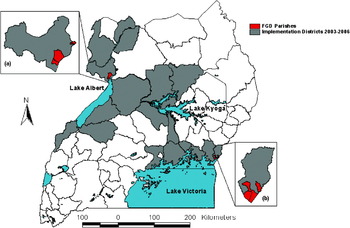
To evaluate the control programme in terms of programme performance (provision, utilization and coverage) an annual cross-sectional process evaluation was conducted retrospectively following the 2003–2005 mass drug administration campaigns in the 18 programme districts. In 2006, the evaluation using qualitative research methods was limited to two districts Nebbi and Busia. Nebbi district was selected as a poorer performing district with reported implementation problems (Parker, Allen and Hastings, Reference Parker, Allen and Hastings2008) and Busia as a well performing district under the schistosomiasis and STH control programme. The reported treatment coverage of target populations was, on average, 76·6% and 80·4%, respectively. In each district, the evaluation was carried out in four parishes per district: Manjanji and Hashure in Lumino sub-county and Busime and Nalwire in Lunyo sub-county in Busia district, which lie on the shores of Lake Victoria. Pubungu and Amor in Pakwach Trading Centre (sub-county) and Boro and Ganda in Panyimur sub-county in Nebbi district lie along the River Nile. Fig. 1 illustrates the 18 districts and eight parishes included in the process evaluations. At programme inception in 2003 the 18 districts selected were chosen based on knowledge of over 50% prevalence of Schistosoma mansoni in schools in each district (Kabatereine et al. Reference Kabatereine, Brooker, Tukahebwa, Kazibwe and Onapa2004, Reference Kabatereine, Tukahebwa, Kazibwe, Namwangye, Zaramba, Brooker, Stothard, Kamenka, Whawell, Webster and Fenwick2006a).
Map of Uganda showing the districts where the national schistosomiasis and intestinal worm control programme was implemented and process evaluation was carried out in 2003–2005. Insets: (a) and (b) highlight Nebbi and Busia districts, respectively. Parishes where the FGDs were carried out are shown in red.

Selection of participants
In the years 2003 to 2005, structured key informant interviews using questionnaires were used to assess financial and political support at the district and sub-county levels. The interview participants comprised chief administrative officers, district directors of health services, district health inspectors, district health education officers, district inspectors of schools, resident district commissioners, district local councillors (LC5), senior financial officers, secretaries for health, district vector control officers and at the sub-district level, sub-county LC3s, sub-county chiefs, parish LC2s, parish chiefs, village LC1s and religious leaders. Key informant interviews were also held with health workers (clinical officers, nurses, nursing assistants and health assistants) at the health sub-district and health units. In 2003–2005, drug distributors (CDDs and primary school teachers trained to distribute anthelminthics) were interviewed about selection, training and drug administration. In the same years the beneficiaries (adults and children receiving treatment) in the communities and schools were interviewed about awareness, knowledge and perceptions of the control programme. Within each district, sub-counties, parishes and villages were selected using convenience sampling. The results of the 2003 process evaluation are reported elsewhere (Kabatereine et al. Reference Kabatereine, Tukahebwa, Kazibwe, Namwangye, Zaramba, Brooker, Stothard, Kamenka, Whawell, Webster and Fenwick2006a).
The 2006 evaluation was limited to two purposively selected districts to explore in more depth than in the previous years, the perceptions, attitudes, constraints and experiences with the treatment strategy and control programme. The qualitative methods performed were focus group discussions (FGDs) with the beneficiaries (male, female and schoolchildren) and drug distributors (community and teachers), and in-depth key informant interviews were held with political and technical stakeholders at the district and sub-district levels, previously described for the 2003–2005 evaluations. The sub-counties and parishes were selected through convenience sampling. Participants of the FGDs were identified from randomly selected villages within the parishes. Local leaders assisted in identifying 6 to 12 representatives for each group to participate in the discussions.
Data collection and management
The data collection in 2003 to 2005 was conducted by independent assessors from the Ministry of Health (MoH). The qualitative data collection in 2006 was carried out by an experienced social scientist from Makerere University, Kampala, and 10 research assistants. The research assistants were trained for two days in qualitative methodology and data collection tools. Following training they carried out a pre-test in Busabala, Wakiso district, which is also part of the national control programme. The qualitative data collection tools were then improved and translated into Luo and Luganda languages for the research assistants to use in the field. For each FGD a moderator led the discussions in Luo and Samia in Nebbi and Busia districts, respectively. A notetaker was present in each FGD to document all verbal and non-verbal responses and a tape-recorder was used to record all sessions. Following transcription of the notes and tapes into English the data was typed and analysed manually using the thematic approach.
Ethical clearance for the study was obtained from the MoH ethical committee, the Uganda National Council of Science and Technology and the Ethics Committee of Imperial College, London. Before all FGDs and interviews, participants were explained the purpose and procedures of the study. Participants were informed that their involvement was voluntary and they would be free to leave the study at any point. Informed oral consent was then obtained from each participant before proceeding. Oral rather than written consent was obtained as it was presumed that many of the study participants would be illiterate.
RESULTS
Participant characteristics
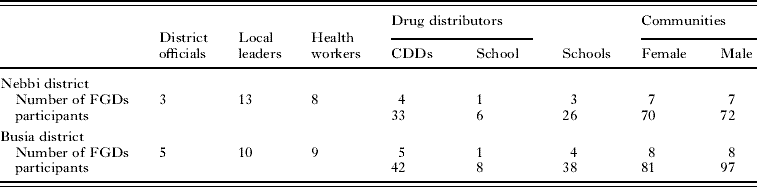
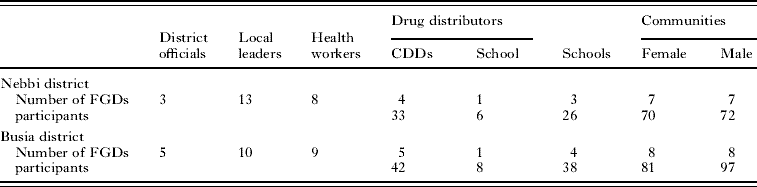
In the 18 districts, 269 key informant interviews were carried out in 2003; 2,316 interviews in 2004; and 751 interviews in 2005 (Table 1). In 2004, no health workers were interviewed. In 2006, key informant interviews were held with 24 individuals in Nebbi district and also 24 in Busia district (Table 2). Twenty-two FGDs were held in Nebbi, five with drug distributors, three with school-aged children between the ages of 10 and 16 years, and 14 with community members. In Busia, there were 26 FGDs conducted, six were with drug distributors, four with school-aged children between the ages of 9 and 16 years, and 16 with community members.
Number of interviewees by year 2003 to 2005

Number of key informant and FGD participants
Awareness and health education
Perceptions of schistosomiasis as a public health problem
In each district, the community members were asked what their leading health problems were, and malaria, HIV/AIDS, diarrhoea, stomach pains and measles were frequently mentioned. In most study sites in Busia district, schistosomiasis was not spontaneously listed among the leading causes of illness. The health units in Busia did not also list schistosomiasis among the leading causes of illness in their communities. Some felt that this was owing to the reduction of severe cases due to the control programme.
“Persistent stomach pains and swellings which used to disturb the people have reduced. The few cases which report here from Majanji and Lunyo are due to lack of safe water” (Clinical Officer, Lumino Health Centre Level 3).
In contrast, most groups in Nebbi district perceived schistosomiasis as one of the leading public health problems. It was regarded as a problem due to a high exposure to re-infection, the difficulties in prevention and the impact that is has on the individual and family.
“When one gets infected with bilharzia, he/she becomes weak unable to produce and feed the family. Children are affected and they cannot perform well in school. Also the infection affects the income of the family in that the little they get is spent on buying drugs” (FGD of LC1 leaders, Amor).
Awareness of schistosomiasis
Results from the annual process evaluations in 2004 and 2005 showed that knowledge of schistosomiasis, based on a yes/no answer is very high in communities and schools. It was 96·7% in 2004 of which knowledge of schistosomiasis was 95·8% in community members and 97·5% in schoolchildren, and 92·1% in 2005, 89·8% in communities and 94·8% in schools. Knowledge and awareness were explored further in 2006 during the FGDs which also revealed awareness of the disease and the signs and symptoms associated in both schoolchildren and community members. This is due to the disease being present in the areas for a long time, to the extent that schistosomiasis is frequently described by its signs and symptoms, for example, ‘esidada’ in Majanji, which means swollen stomach. In this area, the women FGD indicated that many fishermen in the past have died due to the ‘esidada’.
“We know that the swelling of the stomach is bilharzia because other diseases do not make the stomach to swell” (Female FGD, Hashiro).
Throughout the parishes interviewed in Busia district ‘esidada’ was also revealed to be an illness associated with witchcraft. The community members and the CDDs reported that they found it difficult to differentiate the ‘esidada’ due to schistosomiasis from the ‘esidada’ due to witchcraft and felt that this belief made it difficult to convince some people to go for schistosomiasis treatment. The signs and symptoms of bilharzia in children were reported to be slightly different from adults. Vomiting and diarrhoea were common and for the hair to turn brown like that of a child suffering kwashiorkor.
Perceptions on transmission of schistosomiasis
The community FGDs in both districts identified that in addition to the fishermen who are at risk of infection, women who collect water and wash clothes in the river or lake water and children who swim and bathe in the water are also at a greater risk of getting infection. The FGD held with the schoolchildren revealed that their knowledge of transmission and the life-cycle were also very good.
“The disease is got from water snail; it can't be seen, one cannot see it.” (FGD of pupils in Ayar primary school, Nebbi district).
However, there was a common misconception, with the schoolchildren and adults that drinking unsafe water is one source of schistosomiasis infection.
“When you enter stagnant water and when you drink contaminated water you get bilharzia.” (Male FGD, Pubungu).
Awareness of prevention practices
In most FGDs individuals knew that re-infection with the disease was possible if one continued to use lake water after treatment.
“If treated today and people use the same water they can still get the disease of bilharzia. That's why the treatment is there every year”(Female FGD, Boro).
The communities and schoolchildren received information from the local leaders, health-workers, CDDs and teachers on how to prevent transmission of schistosomiasis. Improving sanitation by constructing latrines and bathing shelters and discouraging swimming, bathing and washing in infected areas were the most common strategies advocated. In many cases these practices are seen to have constraints. Sandy soils, lack of available land and ‘stubbornness’, an unwilling attitude to construct and use, were cited for latrines and bathing shelters. To avoid washing and bathing in the infected water sources would require the use of boreholes which are limited and often have long queues of women and children waiting to use them. In addition to this are the costs involved in maintaining the boreholes which the majority of communities cannot afford, especially when there is ‘free’ lake or river water close by.
‘Instead it is people's desires to continue to use river water … they seem not bothered with the disease’. (In-Charge, Pakwach Health Centre 4).
In response to children bathing and playing in the water, the majority of focus groups highlighted that it is within a child's nature to play. Even when warned of the dangers of schistosomiasis, when sent to collect water the children would inevitably be tempted to play in the water with their friends.
“The children sneak to go and swim especially when they go to fetch water. So it is hard for the parents to stop children from playing in river water” (Male FGD, Patwe).
Perceptions of health education
In both 2004 and 2005, communities reported that they received health education through health workers, local leaders and the CDDs and the school-aged children through teachers and health workers. Teaching was facilitated by information, education and communication (IEC) materials, film vans and less frequently reported, the radio. The FGDs conducted in 2006 revealed that when given education it was often done on the treatment day and not before.
“Education about treatment was not given at all … only at distribution centres” (Female FGD Majanji).
In Pakwach, they complained of mixed messages about preventing schistosomiasis and stated they would like to receive more health education from the local health workers. In both districts there was minimal evidence indicating that schistosomiasis health education was integrated into routine health education plans for static and outreach services at the sub-county and village level. In each of the process evaluations carried out between 2003 and 2006, the need to intensify sensitisation and health education was a recurring theme from the beneficiaries, distributors and health workers and at district level.
Implementation management
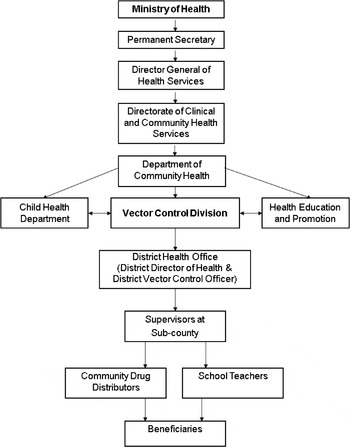
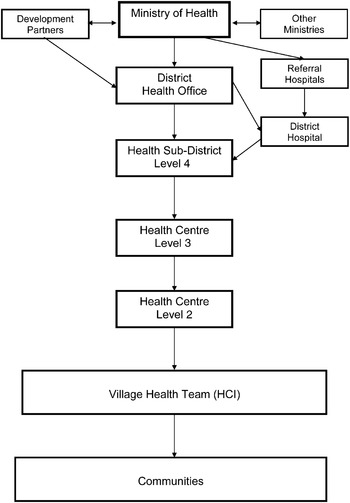
The Uganda Bilharzia and Worm Control Programme is managed centrally from the Vector Control Division of the MoH (Figure 2). The decentralised health system requires the District Health Office to be responsible for the programme delivery within their district. The District Vector Control Officer (DVCO) is the main programme focal point person in each district. The district cascades training and supervision duties to the sub-county supervisors which comprise of nurses, health assistants, community development officers, parish chiefs and others, and finally training to CDDs and the teachers. This management structure is illustrated in Fig. 2 and the Ugandan health system is shown in Fig. 3.
Uganda Bilharzia and Worm Control Programme management structure.

Uganda Ministry of Health System.

District management of the control programme
When interviewed about the district support to the control programme in 2004, 44·4% of the districts reported that they supplemented the programme budget and provided personnel and logistics. Those districts that never supplemented the budget claimed they lacked funds and others thought the control programme had sufficient funding at the national level. In 2005, the districts were asked if schistosomiasis control activities were included in their annual health workplan, with corresponding budget, and 70·8% responded positively. The most common control-related activities included in the districts health plans were health education (83·3%), supervision (75·0%) and training (54·2%). In both years, when asked about constraints in managing the programme, the majority of responses were that increased funds for programme activities were required, a lack of transport facility for supervisory activities and the demand for incentives from the CDDs.
The in-depth key informant interviews held with district political and technical stakeholders in 2006 revealed that there were very positive attitudes towards the programme due to consistent delivery of drugs for the treatment of schistosomiasis and STH. In both districts, advocacy for treatment had been carried out before programme inception as it was acknowledged that the infections were causing morbidity in several sub-counties and were thus a public health priority. Despite this awareness, in neither district were schistosomiasis and STH control activities directly allocated funds in the 2006/2007 health plans and budgets. The reasons given were the same as those in previous years; resource constraints, such as receiving only a sixth of what was budgeted for health education in 2005/2006, according to the Nebbi District Director of Health Services (DDHS), and the belief that the national programme would provide the requirements for implementation. In Busia, the Deputy Chief Administrative Officer indicated that although funds were not available specifically for schistosomiasis control, district plans to promote disease preventive behaviour at individual and community levels and promote community participation and advocacy for health existed and would thus support work carried out by the programme. During these interviews it was revealed that, due to the DVCO often being the sole representative of the district at the lower levels of implementation, there were limits to their capabilities. In addition, the DVCO were noted on their lack of involving functionaries at the lower levels, particularly from the health system. These factors combined led to an inability, on many occasions, to supervise the CDDs and teachers in their activities.
In both Busia and Nebbi the managers of the health sub-district (HSD) were interviewed and they reported a minimal involvement in the programme other than storing drugs and the routine management of schistosomiasis cases. They indicated that the drugs provided through the control programme were controlled by the DVCO. In Nebbi district, several local health unit staff were involved in drug distribution, but on an individual arrangement not on an institutional basis. Thus those who participated reported directly to the DVCO leaving no room for the participation of the health sub-district managers, who are responsible for planning and budgeting for health services at that level, in programme activities.
Sub-county management of the control programme
In 2004, only a third (36·7%) of the sub-county officials made extra budgetary provisions to the programme. The main reasons cited were that they were not aware of the need for programme budgetary support, that the programme commenced after the final sub-county budget had been compiled and that they thought it was the responsibility of the district to provide any additional financial support. The number of those making budgetary provisions for schistosomiasis control activities in 2005 had increased to 47·1%. Although there are participants in the programme at sub-county level, the process evaluation in 2006 highlighted that their involvement is by no means uniform. The health assistants who are responsible for health planning at the sub-county often have no specific role in the activities that take place within their sub-counties and can be bypassed when the CDDs report directly to the DVCO.
Community and school management of the control programme
The drug distributors in both schools and communities reported in 2004 that they were satisfied with their training (93·5%) and would continue to serve as distributors for the control programme in subsequent years (96·0%). In 2005, from the randomly selected drug distributors interviewed, 72·4% had participated in the previous years activities. The commonly reported constraints in both years were the lack of transport and incentives for carrying out their activities.
Both the districts visited in 2006 showed different management structures for the CDDs. In Nebbi district, the CDDs are part of the Village Health Teams (VHTs) which are involved in health promotion programmes. However, in 2005 the CDDs and VHTs played a more supporting role, rather than a lead role, to the local health workers. This was as a result of the CDDs receiving no incentives for the control programme activities in 2003 and 2004, which led to de-motivation and poor performance. The Nebbi district officials took the decision to increase the involvement of the local health workers instead of relying on CDDs entirely. In Busia, an existing structure of Parish Development Committees (PDCs) existed, having been set up by the government in partnership with UNICEF to carry out health activities. The CDDs for the control programme were attached to the PDCs and were seen as valuable within the communities because of their familiarity with people and their involvement in other health initiatives. In both districts, the CDDs are involved in other health-related activities and this confirms the reports from 2004 and 2005 process evaluations. Those programmes that the CDDs are concurrently involved in are home-based management of fever for malaria, sanitation and immunisation campaigns.
During FGDs with the school teachers they reported that those that had not been trained by the control programme had been trained by their colleagues and all were involved in treating their classes. The main constraint faced by the teachers was that, in announcing the treatment day in advance, some children would not turn up to receive treatment due to fears caused by previous side-effects such as, stomach ache, nausea and diarrhoea, and the negative attitudes from some parents.
Routine management of schistosomiasis
As previously mentioned, the HSD have not been fully involved in the control programme. The Nebbi HSD managers did, however, note that attitudes were changing and that in 2006 they were included in a schistosomiasis control conference at national level. The inclusion led to Pakwach Health Centre Level 4 purchasing its first two tins of PZQ as a result of increased awareness about the programme. There are concerns at the central level that the drug is too expensive to supply to all health units but evidence from the process evaluations indicates that it is present in the HSD facilities in 14 of the 18 districts and 33 out of 42 (78·6%) of health units visited in 2005. The drugs were received from the control programme (72% and 97%, respectively) and the remainder from National Medical Stores. Nonetheless, despite this presence of PZQ in the health facilities, when the community were asked during the FGDs about the availability of drugs to treat schistosomiasis at the health units they were either unaware that they were available, or believed there were no drugs.
“No health unit stocks bilharzia drugs in this community.” (Male FGD, Majanji).
Mass drug administration
Perceptions on the mass drug administration
When head teachers and village leaders were interviewed in 2004 they were aware of the control programme (97·1%, 93·1%) and they welcomed the treatment activities (98·1%, 98·9%). The majority of beneficiaries in each year responded that the programme was good because they were cured following the treatment (70·0% in 2004, 69·6% in 2005). In 2006, the community FGDs in Busia district indicated that they were happy with the procedures on treatment day. In Nebbi district, the focus groups raised their concern over the use of height according to the dose pole (Montresor et al. Reference Montresor, Engels, Chitsulo, Bundy, Brooker and Savioli2001), to determine their dose of drug. They felt that this measurement had no equity and that it resulted in people being overdosed. Even the CDDs were
“…..not sure why height was used in determining dosage instead of weight.” (FGD of CDDs, Boro).
The FGDs with schoolchildren identified size and smell of the drug and the fear of side-effects as reasons for missing treatment days. The same reasons had been given in the 2004 and 2005 process evaluations. Another reason for missing treatment was parents refusing them to take part. This was often due to the parents fears of side-effects; for example in Pakwach fears were the result of a woman who was reported to have taken PZQ, suffered severe diarrhoea and died. There are, however, no records of any reported severe adverse events from treatment with PZQ at the nearest health units or hospital nor was the case known by the CDD or local councillors. Nevertheless, in both districts, schoolchildren also reported that their parents encouraged them to attend the treatment days and take the drugs. For those who missed treatment in schools and communities it was clear that they were not aware they could receive treatment through the health units.
The communities and children perceived the control programme to be important because they wanted to be healthy and realised that they had the opportunity to receive annual treatment to contribute towards improved health. They also believed that it was very important for treatment to be of no cost so that it was accessible to all, no matter of socio-economic status.
Perceptions on the side-effects of mass drug administration
Dizziness, vomiting, stomach pain and diarrhoea were the commonly reported side-effects reported by the beneficiaries throughout each process evaluation. Most of the side-effects were generally mild and lasted for short periods of time. One case was reported to have been admitted to HC4 in Pakwach sub-county with symptoms of stomach ache which subsided after 12 hours. The main reasons given by respondents, over each year of process evaluation, for not welcoming or liking the programme by the beneficiaries and distributors were the fears of side-effects. However, having side-effects was commonly perceived as being unavoidable.
“They will always come and only stop after the medicine had finished clearing the worms. However, the effects may be reduced if somebody ate enough food.” (Male FGD, Pubungu).
Side-effects were interpreted in communities and schoolchildren as the medicine working against the disease as follows:
“Once you have recovered from the negative side-effects of the drug, you know that the drug has healed you.” (Male FGD, Pubungu).
Some individuals were actually concerned that if they experienced no side-effects that they had not been cured and some, especially schoolchildren, thought this indicated that they were no longer infected with schistosomiasis. In Busia and Nebbi districts, side-effects were reported to have decreased in intensity over the years of treatment. Despite the experience of side-effects people's perceptions were that they did not kill people but rather that the disease can kill.
Perceived benefits of mass drug administration
Mass drug administration through the control programme was perceived as beneficial by community members and schoolchildren because the drugs were effective in making them ‘feel better’. They also stated that the treatment has led to a reduction in schistosmiasis in the community:
“…..swollen stomachs no longer greet visitors entering Pakwach town.” (Town Clerk, Pakwach);
improvement in their health:
“….children's health has improved, they play well and are active.” (Female FGD, Hashure);
equitable availability of the drug:
“We were able to get free medicine which we would not have got.” (Female FGD at Majanji);
“People were not getting treatment before because the drug was very expensive. But when the national programme came in it was able to reach everybody and many poor people have benefited.” (Assistant Fisheries Officer, Panyimur);
and people reported a reduction in the number of deaths caused by the infection, especially in fishermen. Although a reduction in deaths cannot be substantiated through collected data, studies on the positive health impact of the treatment programme have been reported elsewhere (Kabatereine et al. Reference Kabatereine, Brooker, Koukounari, Kazibwe, Tukahebwa, Fleming, Zhang, Webster, Stothard and Fenwick2007).
Several of the teacher FGDs indicated that a need for the control programme had been established through the benefits seen. They expressed the opinion that communities would be disappointed in the government if the programme was to stop the free treatment. A case in point of the demand for treatment was seen in Nebbi district. Following the treatment of school-aged children only, several sub-counties grouped to solicit funds from the Northern Uganda Social Action Fund to buy the drugs for the treatment of the adults in the sub-counties.
Both school management and local council officials also greatly welcomed deworming activities into the communities and schools due to the proximity of the infected water-bodies. When questioned, the DDHS felt that the main benefits achieved by the programme were that children and communities were treated thereby reducing the number of cases of schistosomiasis and worms in the district and that there was an overall improved awareness in the community about schistosomiasis and STH.
DISCUSSION AND LESSONS LEARNED
Annual process evaluation has given the participants the opportunity to express their perceptions of, and attitudes towards, the Uganda Bilharzia and Worm Control Programme. The evaluations have highlighted the recurring issues that have contributed to the programme successfully achieving its aims in increased awareness and knowledge, establishment of a district-community partnership in managing the control efforts, and a demand for treatment created. The evaluations have also exposed factors which need to be further addressed for the programme to evolve and has provided lessons learned that might serve as a valuable contribution for the implementation of integrated neglected tropical disease (NTD) control activities in Uganda.
The fundamental role that both health education and improved sanitation play in communities affected by schistosomiasis and STH, in different epidemiological settings, has been reviewed in detail by Asaolu and Ofoezie (Reference Asaolu and Ofoezie2003). The review revealed that with chemotherapy, prevalence and intensity of infection decrease when health education and/or a sanitation interventions are concurrently implemented. In our evaluation, despite an overall awareness and knowledge of schistosomiasis in the communities and schools, several issues arose that emphasise the need for increased sensitisation and health education of the beneficiaries and distributors. If the common misconceptions seen, such as overlapping beliefs with witchcraft, drinking contaminated water as a source of infection and the rationale for using dose poles, are tackled by strengthened health education this will contribute not only to a potential decrease in infection prevalence and intensity but also to increased awareness, higher treatment coverage and potentially, in the long-term, positive behaviour change to improve sanitation and avoidance of unnecessary water contact (Ekeh and Adeniyi, Reference Ekeh and Adeniyi1988; Lansdown et al. Reference Lansdown, Ledward, Hall, Issae, Yona, Matulu, Mweta, Kihamia, Nyandindi and Bundy2002; Poggensee et al. Reference Poggensee, Krantz, Nordin, Mtweve, Ahlberg, Mosha and Freudenthal2005).
As is consistent with other studies, the side-effects experienced by the beneficiaries were mild and short-lived (Cioli and Pica-Mattoccia, Reference Cioli and Pica-Mattoccia2003; Kabatereine et al. Reference Kabatereine, Kemijumba, Ouma, Sturrock, Butterworth, Madsen, Ørnbjerg, Dunne and Vennervald2003; Raso et al. Reference Raso, N'Goran, Toty, Luginbühl, Adjoua, Tian-Bi, Bogoch, Vounatsou, Tanner and Utzinger2004). In Uganda similar side-effects of abdominal pain, dizziness and vomiting were seen in 80% of a treated population in an area highly endemic for S. mansoni (Kabatereine et al. Reference Kabatereine, Kemijumba, Ouma, Sturrock, Butterworth, Madsen, Ørnbjerg, Dunne and Vennervald2003). One case which would be considered a serious adverse event, which is defined as an adverse experience following the treatment of any drug that results in death, is life-threatening or requires hospitalisation, was reported. However, the symptoms subsided within 24 hours and information on this individual's health status before treatment was not given during the FGD. During sensitisation by the CDDs and teachers information is given about potential side-effects and notification that the drugs must not be taken on an empty stomach. This information appears to have been accepted, if not welcomed, by the beneficiaries perhaps as a result of witnessing a decrease in side-effect frequency and severity over several years of treatment.
While behaviour change gradually develops there is a requisite for regular treatment of individuals who continue to wash, fish and play in the infected water sources. The control programme offers annual treatment, but there are those who miss treatment and the process evaluations revealed that communities were not aware that they can seek treatment from the health system. In addition, the evaluations provided evidence that many, but not all, of the health centres stock PZQ for the treatment of schistosomiasis. A cause for concern is that the majority of the drugs in the health system units were provided by the control programme and not purchased using standard mechanisms. Thus there is a need to increase the awareness of treatment source outside of the control programme and the availability of PZQ through the existing health system.
The issue of strengthening the involvement of the existing health infrastructures in the control programme is necessary, not only for increased drug availability and routine management of schistosomiasis but also the management of side-effects and health education. If schistosomiasis control activities were to be included in the HSD and sub-county plans and budgets this would inevitably increase the sustainability of the programme (Ali et al. Reference Ali, Byskov, Mokgweetsinyana, Sibiya and Mott1989; Jarallah et al. Reference Jarallah, Al Shammari, Khoja and Al Sheikh1993; Webster et al. Reference Webster, Worrall, Hill, Hanson and Lines2004; Gryseels et al. Reference Gryseels, Polman, Clerinx and Kestens2006). The challenges of improved diagnosis in health units as well as the low rate of health-seeking behaviour of schistosome-infected individuals seen in West Africa must be taken into consideration (Landouré et al. Reference Landouré, van der Werf, Traoré and de Vlas2003; Danso-Appiah et al. Reference Danso-Appiah, de Vlas, Bosompem and Habbema2004; van der Werf et al. Reference van der Werf, de Vlas, Landouré, Bosompem and Habbema2004). The incorporation of particular vertical programme activities into the health infrastructure is an important lesson to bring forward during Uganda's move to an integrated strategy for NTDs that includes schistosomiasis and STH control.
During the process evaluation the concern over lack of incentives for the drug distributors was brought up repeatedly by the drug distributors themselves and by those managing them. Often in school and community programmes the incentives required by the drug distributors are not monetary but instead in-kind gifts such as T-shirts, certificates or gumboots. These incentives many not only encourage the drug distributor to carry out their work but can also provide feelings of ownership and play an important role in the success of the programme (Katabarwa, Mutabazi and Richards, Reference Katabarwa, Mutabazi and Richards1999, Reference Katabarwa, Mutabazi and Richards2000; Nuwaha, Okware and Ndyomugyenyi, Reference Nuwaha, Okware and Ndyomugyenyi2005). The increasing number of health initiatives using CDDs for the implementation of mass drug administrations has been a catalyst for the integrated NTD control strategy. This has the potential of intensifying the commitment of the CDDs to the health initiatives and reducing their capacity to carry out domestic duties (Katabarwa, Mutabazi and Richards, Reference Katabarwa, Mutabazi and Richards1999). Thus the provision of in-kind incentives could be considered alongside the required increase in collaboration with VHTs, which will provide a bigger pool of CDDs, during future control activities to improve the efficiency and sustainability of schistosomiasis and STH control.
The process evaluations provide valuable information on the important issues facing a national control programme for schistosomiasis and STH. For success and sustainability a programme of this scale requires continual sensitisation and education to accompany the mass drug administration to raise awareness, reduce fears of what effects the treatment may have and, most importantly, to create a demand among the beneficiaries. Fortunately, the process evaluations performed in Uganda demonstrate that a demand has been fostered within the beneficiaries and implementers of the national control programme. Thus the longevity of the programme is assured if the lessons learned-strengthening control activities in existing health systems, increased appreciation of drug distributor efforts, and strengthened health education-are taken into consideration. Utzinger and colleagues (Reference Utzinger, Bergquist, Xiao, Singer and Tanner2003) cite several of these lessons as characteristics of a successful schistosomiasis control programme and they note that sustainability would be further strengthened by incorporating water management initiatives. Knowledge gathered through water and sanitation interventions in combination with chemotherapy (Asaolu and Ofoezie, Reference Asaolu and Ofoezie2003) and the experiences gained from over 50 years of control in China (Zhou et al. Reference Zhou, Wang, Chen, Wu, Jiang, Chen, Zheng and Utzinger2005; Wang, Utzinger and Zhou, Reference Wang, Utzinger and Zhou2008) should be taken onboard for the continued and improved implementation of schistosomiasis and STH in Uganda and the progression towards an integrated approach to NTDs.
ACKNOWLEDGEMENTS
We wish to thank all persons who participated in the FGDs and key informant interviews in the 18 districts. We are highly indebted to the DVCO who coordinate the programme at the district level and the CDDs and teachers who are responsible for the drug distribution. This study as well as the Uganda Bilharzia and Worm Control Programme was supported financially by SCI through a grant from Bill and Melinda Gates Foundation.