1. Introduction
Mostly due to the development of cheaper and powerful software and hardware tools, the topic of spatialised sound in composition and music performance has been gathering momentum in recent decades (Otondo Reference Otondo2008: 78–81; Peters Reference Peters2010; Wilson and Harrison Reference Wilson and Harrison2010a: 183; Born Reference Born2013: 4–6). It is evident that the use of multi-channel sound systems for the presentation of films and videogames has increased awareness among audiences and composers about the creative possibilities of spatialised audio (Otondo Reference Otondo2007: 16–19; Stefani and Lauke Reference Stefani and Lauke2010: 251–6; Peters et al. Reference Peters, Marentakis and McAdams2011: 10). In recent years the use of spatial audio tools has also slowly expanded to the performing arts, whereby composers, performers and technology developers have started to incorporate wireless sound devices as organic components of music and dance projects (Wilkins and Ben-Tal Reference Wilkins and Ben-Tal2010: 19–20; Stahl and Clemens 2011: 427–8; Birringer and Danjoux Reference Birringer and Danjoux2014: 9–13). Nevertheless, there is still a lack of software and hardware tools that will allow composers and choreographers to relate creative and structural features of electroacoustic music and dance choreography in collaborative projects. In this article, the design, implementation and optimisation of an original body-worn sound system is discussed, taking as a point of departure a holistic approach that is aimed at incorporating the artistic, technical and practical requirements of dance and music.
2. Pilot Tests with Commercial Wireless Loudspeakers
Spatial sonic relationships generated by performers and musical instruments on and off stage have always played an important role in music performance (Trochimczyk Reference Trochimczyk2001; Zvonar Reference Zvonar2005; Salomon Reference Salomon2007; Bates Reference Bates2009). After the Second World War, composers such as Globokar, Musgrave, Stockhausen and Xenakis started to explore the creative possibilities of spatial design in their compositions by using original seating arrangements for audiences and instrumentalists, mobile performers and other theatrical effects involving the directivity of musical instruments (Stockhausen Reference Stockhausen1961; Musgrave Reference Musgrave1974; Globokar Reference Globokar1980; Harley Reference Harley1994). Probably the composer who created some of the most ambitious compositions using space as an organic feature of instrumental music was Henry Brant (Brant Reference Brant1967). Early on in his career, Brant created compositions exploring spatial features of sound by positioning performers around listeners, increasing distances between players on stage and using vertical arrays of instruments (Kollias Reference Kollias2004: 18–20). One of the most original features of Brant’s spatial music was the use of moving instrumentalists on and off stage to create various types of aural effects such as a physical feeling of ascent related to pitch, volume changes related to distance and timbral variations linked with the speed of performers’ movements (Harley Reference Harley1998: 149–50). Until very recently the use of travelling performers with sound devices attached to their bodies in a dance or music piece was restricted by the technical and practical limitations of wireless technology, speaker size, battery duration and the reliability of the sender–receiver transmission chain. In recent years mobile technology has become more reliable, cheaper and smaller, allowing users to incorporate portable wireless sound devices as creative tools for performance projects (Jones Reference Jones2013: 302; Samdanis et al. Reference Samdanis, Kim and Lee2013: 1–4). This section describes pilot tests carried out by the author with travelling performers using commercial hand-held wireless loudspeakers, which lead to the design and implementation of the body-worn sound system that will be described in the following sections of this article.
2.1. Tests with non-synchronised wireless loudspeakers
The first attempt to use wireless sound devices in a composition was carried out by the author for a music theatre piece commissioned by Base Theatre for the 2007 Edinburgh Fringe Festival. Two portable CD players were carried out by singers and actors as part of a hybrid multi-channel setup especially designed for the performance of the dance theatre piece To Have Done with the Judgment of Artaud (Otondo Reference Otondo2010a: 6–9). The music for the piece was composed as a four-channel composition soundtrack using two portable CD players manually synchronised with the stereo PA system of the theatre venue. Figure 1 shows an example of the use of the four-channel hybrid system during the performance of the piece where two performers carry the portable CD players reproducing independent channels (channels 1 and 2) while the venue’s stereo PA system plays a stereo mix (channels 3 and 4). The advantages of this hybrid system were the affordability of the technology used and its flexibility to adapt to different performance venues. The main limitation of the system was the need for manual synchronisation between fixed and mobile sound sources during the show, which restricted the performance significantly. Other disadvantages of this hybrid system were the cumbersome size and weight of the portable CD players, as well as the poor quality of their reproduced sound (Otondo Reference Otondo2011: 305).
Setup used for a four-channel mix played through two CD players and a stereo PA system for the music-theatre piece To Have Done with the Judgment of Artaud presented at the 2007 Edinburgh Fringe festival.

2.2. Tests with synchronised wireless loudspeakers
Due to the synchronisation problems with the system mentioned above, new tests were carried out. An 8-channel mix played through two pairs of commercial wireless loudspeakers carried by travelling performers and a quadraphonic sound system (Otondo Reference Otondo2011: 305–6). In this case the quad system surrounded the audience and the two pairs of wireless loudspeakers were carried as props by a dancer and an actress during the performance of a dance-theatre work. The system was synchronised using an 8-channel mix played employing a laptop and a soundcard that fed the quad system and the two pairs of speakers’ transmitters. Figure 2 shows an example of the setup used at a performance at the Jack Hylton concert hall at Lancaster University where an 8-channel mix was played through a fixed quad sound system surrounding the audience (channels 1–4) and two pairs of Rimex wireless loudspeakers carried by performers (channels 5–8). Figure 3 shows an actress carrying a pair of Rimex loudspeakers at Lancaster University during rehearsals of the piece. The use of synchronised wireless loudspeakers permitted in this case the possibility of creating a flexible and immersive sound environment where performers could play an active role in the design and implementation of the piece. The system also allowed the possibility of exploring interesting spatial relationships between performers’ movements and sound textures panned between the two pairs of external speakers. The main limitations of this hybrid system were the size of the portable loudspeakers, their limited acoustic power and the poor sound quality of the reproduced sound, as well as the unstable signal transmission of the commercial wireless loudspeaker system.
Setup used to reproduce an 8-channel mix played through a fixed quad system surrounding the audience and two pairs of commercial wireless loudspeakers carried by two performers during a performance at Lancaster University.
Performer carrying a pair of Rimax wireless loudspeakers during rehearsals at Lancaster University.
Further tests and measurements were carried out with three commercial wireless loudspeakers from different brands. The loudspeakers tested were JBL Flip, Dbest and Fiddler. Frequency response and sensitivity measurements were carried out with the three loudspeakers in an anechoic chamber. Figure 4 shows the measured frequency response and sensitivity for each loudspeaker. In the three cases, the measured frequency response shows large amplitude variations, with a drop of more than 6 dB in some parts of the spectrum. The sensitivity measured also showed large variations, with fluctuations from 79 to 89 dB (1m/1W). Practical tests with performers using the three loudspeakers during rehearsals were also carried out. These tests showed that the loudspeakers used were not versatile enough to be used as stage props by performers, mostly due to their large size and weight. Frequently the Bluetooth transmission chain between sender and receiver probed to be unstable, vulnerable to interference from commercial FM stations signals and affected by the distance form the transmitter to the source. The battery consumption of the integrated system was also an issue, it provided 30 minutes of continuous operating time during rehearsals.
Frequency response of three commercial wireless loudspeakers measured in an anechoic chamber.
3. Wireless Body-Worn Sound System
In recent decades, various artists and technology developers have carried out different kinds of projects involving the design and implementation of mobile sound systems (Di Scipio Reference Di Scipio2003: 271; Tanaka and Gemeinboeck Reference Tanaka and Gemeinboeck2006: 26; Schiemer and Havryliv Reference Schiemer and Havryliv2007; Weismann 2015). Hahn and Bahn designed an original interactive platform for dance that included a ‘sensor-speaker performer’ interface (Hahn and Bahn Reference Hahn and Bahn2002: 231–2). Hahn and Bahn designed an original interactive platform for dance that included a ‘sensor-speaker performer’ interface (Hahn and Bahn Reference Hahn and Bahn2002: 231–2). By using wireless sensors and loudspeakers the interface located and reproduced electronic sounds directly from the body of the performer using two independent audio channels to feed the system. Looking at the documentation available about performances with the system, it is apparent that the large size and shape of the interfaces considerably limited the movement of performers on stage (Weismann 2015). During the last decade Johannes Birringer and Michèle Danjoux at DAP-Lab at Bruynel University in England have also designed and implemented different types of wearable sound systems for various performance projects (Birringer Reference Birringer2010: 89–92). Aiming to enhance relationships between physical and virtual spaces, they designed and implemented original body-worn sound systems and portable sound props to be used by performers as part of different kinds of multi-media productions. Probably their most ambitious work involving wearable and portable sound devices was the piece UKIYO, premiered in November 2010 at the Sadler’s Wells’ Lilian Baylis studio in London (Birringer and Danjoux 2010: 92–100). The work was conceived as a site-specific multimedia installation where ‘dancers and musicians perform simultaneously with digital objects that mutate; garments are custom-built for sound in motion’ (UKYO 2010). During the performance of the piece, a singer and a dancer wore sound vests especially designed for the project while an actor carried two spherical loudspeakers on a yoke (Wilkins and Ben-Tal Reference Wilkins and Ben-Tal2010: 20–2). The body-worn sound systems used for the piece, while original and visually attractive, revealed, in the opinion of the author, technical and practical problems that constrained to some extent the performance of the piece. The first noticeable issue identified was the fact that the body-worn systems used by performers were large and not wireless, posing clear limitations for the movements of actors, singers and audience members surrounding the performers. Another apparent problem identified during the show was the insufficient acoustic power of the sound devices worn by performers. It was also apparent that the projected sound by these devices was regularly masked by the sounds of other sound sources on stage and the PA system in the room, making the sonic contribution of the mobile sources negligible during large portions of the presentation. Taking into account the acoustic and practical limitations of wireless commercial sound systems and the wearable devices mentioned above, it was decided to design a wireless body-worn prototype in collaboration with the British audio company Greenlight AV (Greenlight AV Reference Greenlight2010). The goal of the prototype design was to develop a robust and acoustically reliable system that could be adjusted to the requirements of dancers and musicians in different types of performance environments. The designed system had to be capable of projecting sound in small and medium performance locations and flexible enough to allow performers to carry out conventional dance movements in both standing positions and on the floor. The system included two loudspeakers located in the front and back of the performer’s torso, a 2-channel Maxim 25 Watt amplifier fed by 12 Volt batteries and a two channel 2.4 GHz Bluetooth transmitter with receiver set. The volume of each torso loudspeaker cabinet was 456 cm3 and included a 2 inch Audica full-range loudspeaker unit. One of the challenging aspects of the prototype design was the construction of small loudspeaker cabinets that would be confortable for performers and also provide enough sound power to project sound across a medium-sized performance enclosure. Each loudspeaker cabinet was built using rigid materials such as fibrous wood and plastic, and the rear of each housing was curved in order to offer a reasonable fit for performers within a range of sizes. The speakers were covered in light black fabric to minimise the visual impact of the housing and were supported by flexible straps over the shoulders and round the torso. Several tests were carried out with a dancer to establish the best solution for width, elasticity and adjustment of the straps. Figure 5 shows the loudspeaker prototype being tested by the dancer Victoria Harper at Lancaster University. After these trials it was decided to host the amplifier units on the power belt carried by the performer and the battery pack, power controller and radio receivers were mounted on the belt to be worn around the waist or hips of the performer. The belt contained a power control circuit, radio receivers, a removable battery pack and two digital amplifiers. Tests during rehearsals showed that the new battery provision provided the sound system with energy for 60 minutes of continuous operation.
Body-worn loudspeaker prototype tested by dancer Victoria Harper at Lancaster University.
4. System Optimisation
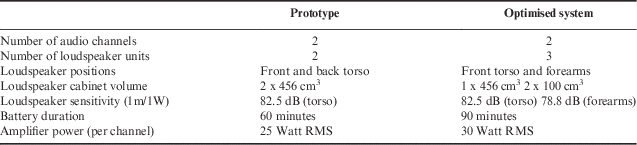
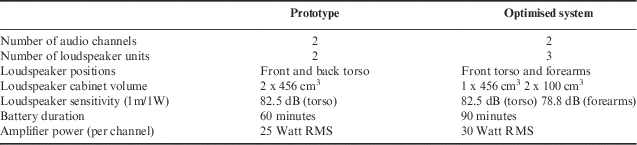
New tests to assess the flexibility and robustness of the body-worn system were carried out with a dancer in a studio. The performer was satisfied with the overall design of the optimised system, but had concerns regarding the position of the rear torso loudspeaker. The dancer noted that this loudspeaker restricted to some extent the range of body movements, especially for actions taking place on the floor. As a way of increasing control over radiated sounds by the performer, the dancer also suggested the inclusion of loudspeakers attached to the arms of the performers. Taking on board these suggestions, it was decided to modify the architecture of the original prototype by removing the rear speaker to include a pair of small speakers on both forearms of the performer. In order to find the most suitable pair of loudspeakers for the performer’s forearms, several 2-inch full-range loudspeakers units were tested and measured in an anechoic chamber. Frequency response and sensitivity measurements showed that the loudspeaker unit with the best overall acoustic performance was the Vifa NE65W (Typhany 2015). The next step in the optimisation process was to find suitable cabinets for the chosen loudspeaker unit, focusing on two main design criteria. The first criterion was to maximise the acoustic power and frequency response of the Vifa NE65W units to be used in small and medium-sized dance studios. The second criterion was to make the size of the cabinets as small as possible in order to allow the performer to carry out regular dance movements in standing positions and on the floor. Anechoic measurements of the Vifa NE65W loudspeaker mounted on cabinets of different sizes showed that for volumes below 250 cm3 the variations in the frequency response and sensitivity of the loudspeakers were minor. In order to optimise the size of the forearm loudspeakers, it was decided to build a smaller cabinet that would fit the Vifa NE65W speaker units. The volume of this cabinet was 100 cm3 and the measured sensitivity of the loudspeaker system with this cabinet unit was 79.9 dB (1m/1W). This sensitivity level is less than expected for large diaphragm sound reinforcement loudspeaker systems, but within the range of the sensitivity of small conventional home studio loudspeaker systems (Borwick Reference Borwick2001: 429) and within the original expectations for the system. Figure 6 shows the frequency response of the Vifa NE65W loudspeaker measured in an anechoic chamber without a cabinet, with a 100 cm3 volume cabinet and with a 200 cm3 volume cabinet. In order to improve the overall performance of the wearable application, other various aspects of the system were also optimised. Battery size and storage have been an issue for similar projects involving wireless devices for dance (Tooper and Swendsen Reference Tooper and Swendsen2005: 77; Aylward and Paradiso Reference Aylward and Paradiso2006: 134–5). In this case the regular commercial rechargeable battery units of the prototype were replaced with lithium-ion batteries, which extended the functioning duration of the system in 30 minutes and were considerably lighter than conventional commercial rechargeable batteries. Another aspect of the system optimised was the power of the built-in electric amplifier. A new more powerful amplifier with 30 Watt RMS per channel was added. This amplifier could easily drive two more extra loudspeakers, allowing the possibility of expanding the capacity of the current system in the future. Figure 7 shows the dancer Ignacio Díaz wearing the optimised body-worn system during tests at Universidad Austral and Figure 8 displays the frequency response of the torso speaker and one of the forearm speakers with the small cabinet mentioned above. Table 1 shows a comparison of the main features of the original body-worn prototype designed by Greenlight AV and the optimised sound system described above.
Frequency response of the Vifa NE65W loudspeaker measured without cabinet, with cabinet 1 (100 cm3) and with cabinet 2 (200 cm3).
Dancer Ignacio Díaz testing the optimised wireless body-worn system with one speaker on the torso and two speakers on the forearms.
Frequency response of torso and forearms loudspeakers of the optimised body-worn system.
Technical information of prototype and optimised body-worn system
A demonstration of the optimised body-worn sound system took place at the IX Ibero-American Congress on Acoustics in Valdivia, Chile. A short dance improvisation was performed by Ignacio Díaz wearing the system in a room the size of a small dance studio of approximately 200 m3. During the presentation, the dancer moved across the stage and the corridors of the room to exemplify numerous types of movements while the system played a two-channel mix created using different types of sounds materials. These sound materials varied from short intense noise samples to long subtle tonal textures reproduced in close proximity to the audience. After the demonstration, several members of the audience were questioned about their opinions concerning the acoustic performance of the wearable sound system. Feedback received showed that the expressive character of the application, as well as the striking effect of the embodiment of movement and sound on and off stage impressed most respondents. Quizzed about the acoustic power of the system, most participants considered that the wearable sound device was capable of covering the size of a small and medium-sized dance studio. Questioned about the quality of the application’s reproduced sound, most respondents were positive about the overall functioning of the system, but noted that, as observed in similar performance projects with worn sound devices, the quality of the reproduced sound is dependent on the type of sound material played (Stahl and Clemens Reference Stahl and Clemens2010: 429; Wilkins and Ben-Tal Reference Wilkins and Ben-Tal2010: 21–2). In most cases, this behaviour relates more to the acoustic phenomena of mobile loudspeaker reproduction than the intrinsic qualities of a particular wireless sound system used.
Another interesting aspect of the system mentioned by several respondents was that when in close proximity to the audience, the body-worn system is capable of creating a very impressive and intimate acoustic experience. These comments are in line with feedback received from previous shows done with wireless commercial sound systems mentioned above (Powell Reference Powell2007).
Following the demonstration, the dancer was also questioned about his experience using the body-worn sound system. He noted a considerable improvement in terms of flexibility and weight in comparison to the original prototype, which made for easier regular movements in standing and floor positions. The performer also noted that, when in close proximity to the public, communication with the audience seemed to be enhanced by the use of the body-worn system. Finally, the artist welcomed the possibility of being able to radiate sounds through his arms. As in similar dance projects where performers had control over sounds on and off stage, in this case the performer felt that he could play a more important role in the implementation of the piece by conceiving his role as blend between a dancer and a musician (Lanzalone Reference Lanzalone2000: 23–6; Wilkins and Ben-Tal Reference Wilkins and Ben-Tal2010: 20–2).
5. Discussion and Future Work
The goal behind this study was to develop and implement a robust and acoustically reliable wearable sound system that could be easily adjusted to the requirements of dancers and musicians in small and medium-sized performance environments. The main challenge in this case was to balance the artistic, technical and practical specifications of a wearable sound system for dance and music performance. Pilot tests with various commercial wireless sound systems showed that there is great potential for the development of innovative performance projects that explore the creative possibilities of spatial audio tools by carefully mapping simple choreographic and compositional aspects of a dance piece. Inspired by these early trials and the lack of reliable commercial wearable sound systems, it was decided to design and implement an original body-worn application that would allow an organic integration of sound and movement on stage. By equipping an existing prototype with full-range loudspeaker units hosted in small cabinets in the arms and torso, it was possible to optimise the frequency response and acoustic power of the system while still maintaining the necessary level of the performer’s comfort. Anechoic sensitivity and frequency response measurements showed that the optimised system demonstrates an optimal acoustic behaviour for dance performance projects carried out in small and medium-sized enclosures. Further improvements in sensitivity and frequency response performance of the system will consider the inclusion of tweeter high frequency loudspeakers as a way of further optimising the effectiveness and acoustic power performance of the system.
An important aspect of the project presented here was the impact that the wearable sound system had on audiences and performers during rehearsals and presentations. In line with reactions to previous performance projects developed using wireless sound systems, feedback from presentations with the body-worn system showed that sound wearable devices are very effective tools to establish a direct and close connection with audiences (Powell Reference Powell2007; Birringer and Danjoux Reference Birringer and Danjoux2013: 232–4). Further studies with wearable sound devices should consider ways of assessing this impact in different kinds of performance scenarios by employing a suitable evaluation method such as tests with trained panels (Bech and Zacharov Reference Bech and Zacharov2006: 112–17), context-methods surveys such as the ones proposed by Wilson and Harrison (Wilson and Harrison Reference Wilson and Harrison2010b: 250) or perceptual studies exploring spatial features of electroacoustic music performance in concert halls (Lynch and Sazdov Reference Lynch and Sazdov2011; Sazdov Reference Sazdov2011: 22–7). The impact that the body-worn interfaces have on the way performers conceive of their role in a dance or music piece is also an important aspect to be investigated in future studies. Feedback from performers who participated in similar projects shows that the use of wearable sound devices has a very positive impact in a piece’s creative process, allowing a more fluid relationship between the performers and the composer (Stahl and Clemens Reference Stahl and Clemens2010: 427–8; Wilkins and Ben-Tal: 21–3). As in a previous educational performance project with students, further studies will consider ways of effectively relating compositional and choreographic strategies by mapping specific body movements with sonic spatial attributes in a dance piece (Otondo Reference Otondo2013: 182). By allowing the possibility of effectively integrating corporeal and sonic movement, the body-worn sound system permits the composer, choreographer and dancer to explore new aesthetic relations that go beyond the traditional associations found in dance and music performance. A challenge for future performance projects incorporating the sound system implemented in this study will be to find a suitable framework wherein specific spatial and timbral elements of electroacoustic music can be successfully translated into a dance performance environment. The pilot tests and demonstrations mentioned above showed that, in most cases, this is not a straightforward task because sound materials reproduced by fixed speakers are perceived by listeners in a very different way when they are projected through a wireless loudspeaker attached to a moving body. In this case, the body of the performer significantly shapes the sonic input to the system, making the acoustic output a complex modulated sound which is directly related to the dance movements of the performer and the position of the loudspeaker units in the body of the performer. Previous projects involving the wireless sound systems mentioned above showed that, in order to make wireless sound systems work effectively in a performance context, it is essential to test sound materials in a realistic performance scenario rather than in an acoustically treated composition studio. It was also observed that, in most cases, raw sounds, with little or no timbral and spatial processing, tend to work better in mobile sound systems than carefully composed sound material, which is normally obscured by the spatial and timbral modulations derived from the performer’s movements.
The use of two or more performers wearing body-worn sound systems on stage as part of a multi-channel loudspeaker platform would be a natural development of this project. Trials with two pairs of commercial wireless loudspeakers synchronised with a quad loudspeaker system displayed in Figure 4 showed that the use of mobile sound sources can effectively enhance performance aspects of multi-channel electroacoustic music that are normally lacking in a concert situation (Otondo Reference Otondo2008: 80–1; Otondo Reference Otondo2010b: 447–8). Tests with the 8-channel hybrid system shown above revealed that by carefully blending and contrasting multiple real and virtual sound sources on stage a greater sense of intimacy could be achieved, as well as a spatial counterpoint between acoustic travelling sounds sources and projected sounds on stage. The artistic and practical implications of such a hybrid system will have to be considered carefully, aiming always to maintain the spatial coherence pursued by Henry Brant in his remarkable spatial compositions.
Acknowledgements
This work was partly funded by Lancaster University and the Chilean National Commission for Scientific and Technological Research under grant CONICYT PAI/ACADEMIA 79130014.