




For much of the last quarter of a century, Chinese government finances have depended heavily on the sale of urban land. The centrality of land sales to local government finance is widely attributed to tax-sharing reforms implemented in 1994: deprived of tax revenues, local governments are said to have turned to land sales as a substitute.Footnote 1 This is wrong. Land sales constituted just a small portion of local government revenue through the 1990s, and local governments continued selling land far below market prices even after 1994.Footnote 2 Local governments often failed even to collect the below-market prices they charged.
Local governments only began to sell land at market prices and collect payment when the central government forced them to do so in the early 2000s. Only then did land sales revenue become a major component of local government finance nationwide, with the ratio of land sales revenues to budget revenues (excluding land sales) jumping from under 10 per cent in 2000 to over 50 per cent in 2003 (see Figure 1).
Local Government Land Revenue Dependence

Given how lucrative land sales ultimately proved to be, why did local governments not turn to land finance of their own accord in the 1990s? Land finance required more disciplined, stronger and wealthier local governments than were common in the 1990s. For local governments to collect market prices for their land, land revenue needed to go into state coffers, not the pockets of state agents. For local governments to collect monopoly prices for their land, they needed to push aside competing landholders, many of whom were bureaucratically powerful.Footnote 3 For local governments to collect high prices for their land, they needed to prepare land by taking it from peasants and urban residents, a capital-intensive endeavour that risked social unrest.Footnote 4 Local governments could not simply start collecting land revenue: they first had to build substantial state capacity.Footnote 5
Because the literature argues that fiscal deprivation drove local governments to land finance, this article focuses narrowly on showing that most local governments did not even try to sell land at market prices, a relatively simple task, until the central government forced them to do so. While fierce competition to attract investors motivated local governments to keep land prices low,Footnote 6 this does not explain their refusal to sell land at market prices: market prices are, by definition, clearing prices.
While selling land at market prices was clearly in the fiscal interests of local governments, it was often not in the personal interests of local officials, who sold land below market price in return for bribes. This corruption was often the work of broad networks: sometimes, higher-level officials asked subordinates – who dared not refuse – to grant discounted land to particular developers; sometimes, officials across multiple agencies collaborated to trade land for bribes. With so many officials partaking of the rents from corrupt land sales, local officials seldom tried to impose market prices; when they did attempt to do so, they rarely succeeded. When the central government pushed local governments to sell land at market prices, the move encountered pockets of stubborn resistance; only after a multi-year anti-corruption campaign did market pricing of residential and commercial land become the national norm.
Because demonstrating that a policy choice is driven by corruption is challenging, I first introduce the paper’s evidentiary foundations. In the subsequent sections, I argue that the fiscal deprivation caused by the 1994 tax sharing reforms was neither necessary nor sufficient to drive local governments to land finance. Local governments initially declined numerous fiscal opportunities that made land finance institutionally advantageous. It was only when land finance became a political imperative that they ultimately changed course.
Sources of Evidence
This section introduces the sources of evidence for the paper’s four core arguments.
Argument 1. Land sales did not become a substantial source of government revenue until the early 2000s.
This argument is obvious from Figure 1.
Argument 2. Using backroom negotiations, local governments routinely sold land well below market prices until the central government intervened.
We know this because occasional auctions revealed market prices far above negotiated prices.
In the 1990s, local governments could allocate land in several ways. They could assign (huabo 划拨) land at or below cost to an end user, a protocol inherited from the planned economy. Such land could not be traded on the secondary market. Local governments could also sell tradable land use rights through negotiation (xieyi 协议). In this commonly used method, the price was agreed, generally in secret, between the government and the end user. While these two mechanisms obscure market prices, two others shed light on market prices: bid solicitation (zhaobiao 招标) and live auctions (paimai 拍卖), collectively referred to as “auctions” hereafter. Before an auction, the local government would publish planning restrictions for a land parcel. When soliciting bids, it would invite developers to submit sealed bids. Officials then evaluated each developer’s price, track record and project proposal. While bid solicitation allowed officials some leeway to choose underpriced proposals, live auctions did not: developers gathered in person to bid, and land went to the highest bidder.
Throughout the 1990s, local governments generally sold land through negotiation but occasionally used auctions. Drawing on local yearbooks and gazetteers, this paper shows that land that was sold at auction, especially live auction, brought in much higher revenue than land sold through negotiation. Thus, I use the share of land sold at auction as a measure of the extent to which local governments sold land at market prices.
Throughout the paper, I focus on residential and commercial markets, which are the most lucrative segments of the real estate market and the core of land finance as it ultimately developed. Unfortunately, much of the data on land sales in the 1990s are not broken down by land use, so some evidence necessarily draws on the broader land market.
Argument 3. Local officials resisted selling land at market prices because they were corrupt.
Closed-door negotiations yielded lower prices because state agents were corrupt, negotiating on their own behalf and undermining the institutions they represented. I draw on three case studies to show that local governments turned down repeated opportunities to sell land at market prices by 1) retreating from auctions to negotiated sales (Shenzhen 深圳); 2) selling land cheaply into a real estate bubble (Beihai 北海 and Hainan); and 3) ignoring fiscal incentives designed by the national government (Shenyang). In each case, contemporaries, including the disciplinary authorities and local officials themselves, identified corruption as a major cause. These cases draw on local gazetteers and yearbooks, journalism and officials’ published words, confirmed by fieldwork undertaken in Shenzhen, Hainan and elsewhere.
Argument 4. Land sales became a major source of local revenue because the central government required that residential and commercial land be sold at market prices.
As the central government forced local governments to sell residential and commercial land at auction,Footnote 7 land revenue soared, rising 977 per cent from 2000 to 2004.
To show that auctions were forced upon local governments, I draw on central documents and speeches, as well as journalistic accounts and land agency newsletters from two different locales. One, Guangxi, quickly adapted to central directives, while the other, Beijing, resisted until compelled.
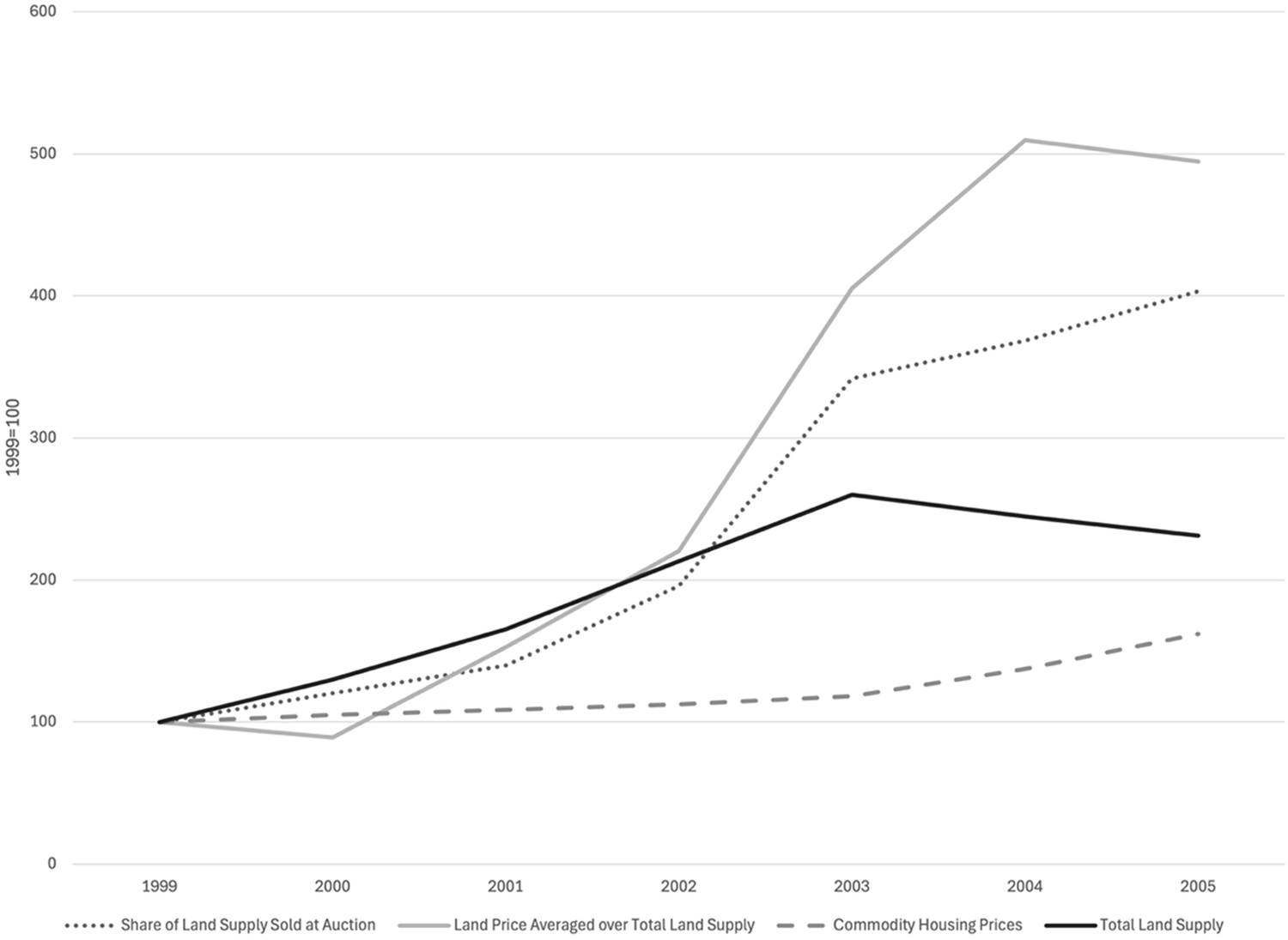
While it is not possible to conclusively prove that rising land revenues were due to auctions, the most obvious alternative explanations can be ruled out. If land revenues increased simply because local governments were selling more land, prices should have remained stable while supply increased rapidly; instead, land prices rose much faster than supply (see Figure 2). If rising housing demand drove land prices up, housing prices should have risen earlier and at least as rapidly as land prices; instead, housing prices rose later and more slowly than land prices (see Figure 2). A more detailed discussion of these alternative explanations and statistical measurement issues appears in the online Appendix.
Alternative Explanations

Fiscal Opportunities
Local governments had many opportunities to charge market prices for land. The initiation of land sales in 1987, and their institutionalization in 1990, provided the institutional structure and political legitimacy for local governments to sell land. Local governments did sell land, but they quickly turned away from seeking high prices. When a real estate bubble emerged in 1992, rising values created opportunities to extract more land revenue but also generated huge incentives for corruption, as many local officials chose to allocate land at steep discounts in return for bribes. In the late 1990s, the national government introduced reforms that increased the profitability of market-priced land sales. But, again, only a few local governments sought to extract revenue from land. Throughout, local officials proved adept at collecting bribes in exchange for discounted land sales.
Legalized land sales
Initially, local governments fought to sell land at market prices. As early as 1986, Guangzhou sought bids for land development rights, seeking to maximize in-kind payment.Footnote 8 A year later, Shenzhen sold term-limited land use rights for cash, culminating in a live auction that sought the highest price the market would bear.Footnote 9 Only then did the national government remove the ban on such transactions from the national constitution. With local governments willing to violate the constitution for higher land revenues, institutional self-interest in high-priced land sales was clearly potent in the 1980s, long before the 1994 tax sharing reforms. The 1994 tax sharing reform was not necessary for local governments to attempt land finance.
Local governments’ enthusiasm for price-maximizing land sales quickly evaporated. The share of land parcels sold at live auction fell from 1988 to 1989.Footnote 10 After May 1989, local governments stopped holding live auctions altogether, although they continued to solicit bids. A May 1989 central government circular required localities to remit 40 per cent of land revenue to the centre.Footnote 11 Local governments responded by hiding land revenue, collecting payments in-kind or concealing transaction prices.Footnote 12
Hiding land revenue was incompatible with the transparent auctions that had maximized land prices, and so local governments turned to backroom deals, with officials negotiating prices directly with developers. Although these backroom negotiations may initially have served local governments’ institutional interests by hiding land price information from the centre and “ensuring relatively high profits for the real estate sector so as to attract capital and accelerate housing construction,”Footnote 13 they also necessarily empowered state agents, who soon discovered they could negotiate for themselves, substituting personal for institutional interests. Local officials quickly became addicted to negotiated land transactions.
Even after the central government stopped demanding a share of land revenue, local governments did not restart auctions. The national government dramatically reduced its claims on local land revenue in 1990, relinquishing them entirely after December 1993.Footnote 14 With no pressing need to hide revenue, local governments continued selling land through backroom negotiations.
Shenzhen offers an illuminating example. Despite publicly violating the constitution by auctioning off land in 1987, Shenzhen sold no land at live auction between November 1988 and May 1993. Until 1992, it did sell substantial land through bid solicitation.Footnote 15 In 1992, Shenzhen sought to curtail backroom negotiations, requiring lucrative parcels to be sold at live auction or through bid solicitation.Footnote 16 However, these reforms were not implemented: in 1993, Shenzhen held only two live auctions and sold no land through bid solicitation. Those two live auctions alone generated 1.3 billion yuan, nearly twice the revenue from the remaining 294 parcels sold through negotiation that year. Per unit area, auction prices were 264 times higher than the average negotiated price.Footnote 17 Despite this, Shenzhen did not solicit bids again until 1996, nor did it hold another auction until 1997.Footnote 18
Indeed, Shenzhen could barely be bothered to collect payment of the below-market prices it charged. It collected only 25 per cent of contracted land revenue in 1995, with arrears exceeding 9 billion yuan, over one-and-a-half times the municipal government’s total in-budget revenue that year.Footnote 19 This was not the behaviour of a fiscally deprived local government desperately pursuing land revenue.
Shenzhen gradually made charging and collecting market prices for land a priority, but the process was arduous. As the then-mayor, Li Zibin 李子彬, recalled:
In 1997, the municipal government decided to … curb “land corruption” [by] implementing public auctions of land meant for profitable purposes. [At first], even the leaders of the managing agency did not state their position (biaotai 表态). To establish a public land auction market, the municipal government used nearly a year to … sort out all manner of power and interests (quanli yu liyi guanxi 权力与利益关系).Footnote 20
The deputy mayor for urban development was soon arrested, in part for arranging a 128 million-yuan discount on land for his son-in-law, a real estate developer.Footnote 21 Local officials were reluctant to part with the significant opportunities for corrupt rents – “power and interests” in polite parlance – offered by negotiated land deals.
The legalization of land sales in the late 1980s opened up a significant new revenue source for local governments. After enthusiastically selling land at price-maximizing auctions, local governments opted to hide their wealth from a central government that demanded a share, and so they turned to backroom negotiations, which created enormous scope for rent-seeking opportunities. Even after the centre stopped demanding a share of land revenue, and even when local governments sought to return to auctions, there was resistance from officials who preferred to bargain directly with developers.
The land bubble
Following Deng Xiaoping’s 邓小平 1992 Southern Tour, China experienced a land bubble.Footnote 22 Despite rapidly rising market prices, local governments continued to sell land cheaply and often failed to collect even half of land payments.Footnote 23 The windfall went instead to speculators and the officials who helped them to access land at below-market prices. The speculators then flipped the land for huge profits. While prices fell after 1993, the corrupt sale of discounted land, which had been normalized during this period, continued through the 1994 tax sharing reforms.
To some extent, this underpricing of land was intentional. Beihai, for instance, adopted a “low barrier to entry” (dimenkan 低门槛) policy, which allocated land cheaply to investors.Footnote 24 The result was a mad dash for land by those with good connections. Speculators frenetically traded the right to purchase land from the government without actually paying the government. When they did pay, prices were set through backroom negotiation. After the bubble burst, much of Beihai’s municipal leadership was implicated in a sprawling bribery scheme through which developers circumvented or received discounts on land payments: the leaders of the municipal disciplinary inspection commission, the organization department, the land bureau and the planning bureau were all removed from office.Footnote 25 Although officials presented cheap land as an incentive to attract investors, the same officials were taking bribes to keep land cheap.
In nearby Haikou, another epicentre of the 1992–1993 bubble, local leaders acknowledged that the government’s institutional interests lay in selling land at the highest possible prices. When Haikou sold land at auction, it revealed market prices nearly ten times higher than the city’s officially listed land prices.Footnote 26 Despite this, state agents almost always opted for backroom negotiations, and leaders interpreted such discounted land sales as an indication of rampant corruption. Local officials promoted auctions as crucial in the fight against corruption. Newly appointed as Party secretary and governor of Hainan, Ruan Chongwu 阮崇武 criticized backroom land deals in early June 1993:
Except for public welfare and infrastructure, etc. not a single piece of land should be sold through negotiation. I will not issue orders [to allocate land] (wo shenme tiaozi ye bu pi 我什么条子也不批), [you] cannot auction [land] today, and sell land by negotiation tomorrow … If [we] do things that way … the government will lose the trust of society, we will not have a scrap of reputation left (weixinsaodi 威信扫地). Therefore, we must persist in selling land through the solicitation of bids and live auctions.Footnote 27
Nonetheless, Haikou rarely sold land except through backroom negotiation. As the mayor of Haikou remarked, from 1988 to 1994, Haikou “only held two live auctions … with the remaining [land transactions] occurring through negotiation, costing the government an enormous amount of lost revenue that it could have earned by selling land through bids or auctions, while also making corporate competition [among developers] unfair.”Footnote 28
New institutional foundations
By the late 1990s, not only was the 1994 tax sharing reform firmly in place, but the central government had laid the foundations for land finance. New legislation made it easier for local governments to impose land takings on villages, increasing their potential profit margins from land sales. Financial reforms made it harder for local governments to borrow without collateral, but banks were happy to lend against land if municipalities would extract higher revenues from land sales. The central government also accelerated housing reforms, banning subsidized housing for state employees and promoting the private housing market, increasing demand for residential land. Together, these reforms offered local governments higher profit margins when selling land at market prices, bank financing for initial capital outlays and increased demand.Footnote 29
A handful of local governments seized these opportunities, establishing the capacity to charge not only market but high monopoly prices for land. Most notable was Zhejiang, where local governments borrowed against their land and began auctioning it.Footnote 30 Such practices remained rare, however, even as the real estate sector grew steadily.Footnote 31 Most local governments still refused to charge even market prices for land.
At the other extreme were the localities still engaged in flagrant corruption. Consider Shenyang. Throughout the 1990s, Shenyang sold no land at auction. In fact, it rarely sold land at all, opting instead for administrative allocations (huabo) that exempted users from payment. Although increased housing demand in the late 1990s triggered a construction boom, Shenyang almost always allocated housing land for free.Footnote 32 In a notorious case, the Shenyang government became involved with gangster-businessman Liu Yong 刘涌, the son of a senior local judge. Following Liu’s payment of several hundred thousand US dollars in bribes to the deputy mayor, Shenyang allocated prime downtown real estate to him free of charge in 1999. Under the protection of the mayor, deputy mayor, chief procurator and leading judges, Liu demolished houses with violent abandon. By 2000, the corruption was so blatant that Liu was arrested, along with his protectors.Footnote 33 Both the mayor and deputy mayor were sentenced to death.
Only after this public embarrassment did Shenyang turn to land finance. In 2000, Chen Zhenggao 陈政高, the new mayor, made a familiar promise: “Please rest assured, I will not issue orders [to allocate land].”Footnote 34 Shenyang turned to the China Development Bank for help, promising that “by establishing a land banking system … we can raise funds for urban construction and guarantee our ability to repay bank loans.”Footnote 35 In Chen’s first full year, Shenyang’s land revenue skyrocketed to 1.1 billion yuan, up from 70 million yuan the year before. When Shenyang auctioned its first piece of land in 2001, it sold for 129 million yuan, which was more than the city’s entire land revenue from the previous year.Footnote 36
Shenyang illustrates both the extraordinary potential of – and extraordinary resistance to – charging market prices for land. Clearly, municipal efforts to maximize land revenue could be lucrative, serving the municipality’s institutional interests. However, it is also clear that state agents gained enormous benefits from selling land for personal gain. Only after being publicly shamed in the national and international press did Shenyang begin to use the tools created by the central government to engage in land finance.
Political Imperatives
Ultimately, the national government lost patience. Although some localities had tried to charge market prices for land, the vast majority had not. In the early 2000s, the centre instructed local governments to engage in land finance. When many locales ignored these instructions, the centre responded with a sweeping multi-year, interagency rectification campaign called the “Governance and rectification of order in the land market” (zhili zhengdun tudi shichang zhixu 治理整顿土地市场秩序), which required local governments to sell the most profitable land parcels at auction. Local governments were forced by the central government to collect more land revenues, often over the objections of local officials.
The rectification campaign was ambitious: the centre sought to force local governments not only to sell land at market prices but also to monopolize the land market and engage directly in land takings. These reforms promised much higher land revenue for local governments; however, they also required a sharp increase in state capacity and changes in the relative power of local governments and “socialist land masters” such as state-owned enterprises.Footnote 37 While each of these reforms contributed to the advent of land finance, this paper’s focus remains on market pricing through auctions, a comparatively straightforward task that nonetheless evinced significant opposition from local governments.
This section examines the increasingly harsh measures taken by the centre to force local governments to adopt land auctions. It draws on case studies of Guangxi, which was relatively compliant, and Beijing, which baldly resisted central orders. In both cases, the centre not only mandated that land be sold through auctions but also forced localities to undo negotiated land sales. The centre publicly criticized individual local leaders; it threatened their access to land – a crucial input for economic development; and it restructured recalcitrant local land bureaucracies. Local governments began to collect payments for land. Land auctions became a political imperative. Land finance followed.
The centre demands land be sold at auction
At the turn of the millennium, the central government’s demands for land market reforms grew increasingly vocal. Citing Zhejiang’s impressive auction revenue,Footnote 38 the national government argued that other locales were forfeiting land revenue that was rightfully state revenue.Footnote 39 The central government sought to redesign the land market, calling in 2001 for local governments to monopolize land markets, establish land banks and auction land to commercial developers.Footnote 40 The Ministry of Land and Resources (MLR) finally clarified that land could not be granted through heavily discounted administrative allocation (huabo) for profitable purposes.Footnote 41
Although some local governments responded enthusiastically, the share of land parcels allocated by auction rose only slightly,Footnote 42 from 6.9 per cent in 2000 to 8.0 per cent in 2001. In Guangxi, the share rose from 5.3 per cent to only 6.8 per cent; Beijing effectively ignored the centre’s orders, with its auction share remaining below 1 per cent.Footnote 43
The national government responded forcefully, characterizing local foot-dragging as indicative of corruption and ordering local governments to auction land. From at least 2000, the Central Commission for Discipline Inspection (CCDI) secretary, Wei Jianxing 尉健行, had been touring the country, insisting that the sale of land designated for profitable purposes (jingyingxing tudi 经营性土地) was a major source of corruption and that, henceforth, such land sales must be conducted by auction.Footnote 44 This culminated in a CCDI communiqué in January 2002.Footnote 45 In February 2002, Premier Zhu Rongji 朱镕基 echoed his language, stating that land auctions were necessary to combat corruption.Footnote 46 The MLR stipulated that, from 1 July 2002, land meant for profitable purposes must be auctioned. It then joined with the Ministry of Supervision to issue a circular complaining that “for land that ought to be allocated by market mechanisms, some leaders continue to interfere.” They emphasized that the allocation of land outside the market was breeding corruption:
Using auctions to lease state-owned land use rights is an effective mechanism for preventing corruption in land supply … [Use rights on land meant for profitable purposes must be sold at auction.] … If leading cadres continue to personally approve [land transactions], regardless of whether there is an exchange of power and money involved, it constitutes a violation of discipline (weifan jilü 违反纪律).Footnote 47
In September, the two ministries instructed their provincial counterparts to launch an enforcement campaign and announced inspections of selected provinces.Footnote 48
These orders bifurcated the land market. Local governments retained broad leeway to lure factories with discounted industrial land. “Land meant for profitable purposes” such as residential and commercial development was, however, to be sold at auction. The national leadership was gradually making market pricing of residential and commercial land a political imperative.
Local government resistance
Despite orders and threats from the central government, many local governments refused to auction land. Beijing was among the most transparently intransigent.
To “implement” central requirements, Beijing issued a “Regulation regarding the cessation of negotiated land transactions for profitable projects” in June 2002. The regulation was obviously not intended to end negotiated land sales: it permitted negotiated sales for land in the city’s green belt, small town construction projects, urban renewal of dilapidated housing, “profitable projects associated with other major construction projects,” high-tech projects, industrial projects, and such other projects as the municipal government might designate.Footnote 49 Beijing argued that developers would not redevelop dense downtown areas without discounted land prices (although auctions would presumably have found the price at which they would). The broadest exceptions were necessary because “the land situation is relatively complicated, and all types of situations might exist” (shenme qingkuang dou keneng cunzai 什么情况都可能存在).Footnote 50
Beijing’s land market was, indeed, complex. Beijing had long sold uncleared land cheaply, pushing the financial risk of demolition delays onto developers. Moreover, Beijing allowed powerful socialist land masters, such as state-owned enterprises, to transact freely in land, collaborating with developers and seeking administrative permission for planning modifications. The existing system was defended by a powerful lobby, including developers who benefited from cheap land,Footnote 51 socialist land masters who could engage in the same land sales practices as local governments elsewhere, and the municipal and district governments that controlled planning and land paperwork.Footnote 52 Indeed, the director of Beijing’s municipal land and housing bureau observed that the land market was especially “prone to corruption,” prescribing “the use of institutions to block behind-the-scenes dealings in land price approvals, thereby preventing land corruption from occurring at its source.”Footnote 53
While recognizing that land pricing was a hotbed of corruption, Beijing chose to retain political control rather than let the market set prices. As an anti-corruption measure, the director of the municipal land and housing bureau had to personally approve the price of each land parcel. When the centre instructed that land be auctioned, Beijing joined many localities in ignoring the order.
The campaign: governance and rectification of order in the land market
In January 2003, the National Audit Office delivered a damning report on the state of the land market. It stated that local governments had failed to monopolize the land market and that their land transactions were riddled with corruption, leading to the loss of state assets. In the three cities examined – Anshan 鞍山, Ji’nan and Shenzhen – untradable land allocated at cost (huabo) for government use was widely traded on the market. The collection of 5.8 billion yuan in land fees had been delayed.Footnote 54 On 12 January 2003, the then-vice-premier, Wen Jiabao 温家宝, responded to the audit with a demand for action that would occupy the first several years of his term as premier, set to start just months later:
The land market in some locales is chaotic, with quite severe illegal land claims (zhandi 占地) and illegal land supply to the market. The use of land to make huge profits (baoli 暴利) has already become a rent-seeking strategy for some work units and individuals. Not a few land bureaus are lax in their management, some even breaking the law [under the guise of] enforcing the law, [or] opening the door to facilitate those who break the law.Footnote 55
The MLR responded by launching the “Governance and rectification of order in the land market” campaign. Broadly, this campaign aimed to eliminate competing sources of land supply and thereby establish local governments as monopolists while also protecting the interests of peasants. The centre forced local governments to adopt monopoly pricing by selling land designated for profitable purposes at auction, and it sought to force developers to actually pay for the land they bought, thereby turning land sales into a lucrative source of revenue for local governments.
The MLR initially devolved most campaign work to local authorities. Local officials and land bureaucrats were informed that the campaign would revolve around self-examination and self-correction (zicha zijiu 自查自纠) by municipal and county land bureaus, due by 10 July. While promising lenience for violations proactively addressed through self-correction, the ministry threatened strict punishment for violations uncovered by inspections or public complaints.Footnote 56
The “Governance and rectification of order in the land market” campaign was joined in April 2003 by another campaign, focused on enforcing the auctioning of land meant for profitable purposes. Led by the MLR and Ministry of Supervision, this campaign again hinged on self-examination by local bureaus, which were ordered to report details of each parcel sold.Footnote 57 However, now, local officials were told that any failures to auction land after the summer 2002 circular would be strictly punished.Footnote 58 Yet even at this late date, some Guangxi counties had not auctioned a single land parcel.Footnote 59
Inspection teams proliferated. The Guangxi Office of Inspection sent teams to each of Guangxi’s cities.Footnote 60 The provincial departments of supervision and land and resources followed, sending three teams to examine auction work in eight cities from 23 to 28 June.Footnote 61 On 30 June, the MLR sent department-level (siji 司级) cadres to inspect ten provinces.Footnote 62
The campaign asked local land bureaucrats to self-examine and self-correct, but they struggled to discipline the responsible municipal and county leaders. In an editorial, the monthly newsletter of the Guangxi Department of Land and Resources opined that local land agencies “are helpless. They [are paid] by the localities, and they are appointed by the localities. Is it possible for them not to follow the orders of local leaders?”Footnote 63 The provincial land department’s vice-director bluntly informed Guangxi’s executive vice-governor that, “these days, local leaders have developed the mindset that they needn’t implement ministerial regulations.”Footnote 64
In July, the campaign was restructured to exert more leverage over top local leaders. Leadership of the campaign moved from the MLR to the State Council, which extended the campaign and demanded a list of provinces passing joint ministerial inspections by March 2004. The vice-premier, Zeng Peiyan 曾培炎, told local leaders that top provincial leaders – not land bureaucrats – must lead the campaign, while campaign performance should be added to evaluation criteria for leading municipal and county cadres.Footnote 65 Those who “do not implement auctions should be strictly dealt with. We must not only clean up cases, but also punish people” (jiyao chuli shi, yeyao chuli ren 既要处理事, 也要处理人).Footnote 66
Central officials put localities under pressure. From 8 to 17 August 2003, the vice-minister of land and resources, Li Yuan 李元, led a five-agency inspection team to four Guangxi cities, accompanied throughout by a provincial vice-governor.Footnote 67 While broadly commending Guangxi’s work, he sharply criticized “some comrades” who had not properly understood the “importance and necessity” of auctioned land sales. “Some locales continue to use every means at their disposal to evade the [auctions] process. They don’t dare to issue written orders (xie tiaozi 写条子), but they do make phone calls. They don’t dare to sell land by negotiation … but instead they use fake auctions with a set buyer and a set price.”Footnote 68 Indeed, the inspection team uncovered just such a case in Beihai. A Beihai developer “claimed to be a good friend of a top provincial leader … openly declaring that if he wasn’t given land at a price and time of his choosing, then he would have the entire leadership team at the municipal bureau of land and resources dismissed.” The municipal bureau gave him what he wanted: an agreement with his (as yet unregistered) company to set the land price, followed by a fake silent auction.Footnote 69 Of the parcels that should have been sold at auction, only 85 per cent had been.Footnote 70
Local officials were starting to recognize that auctions were a political imperative. In October, Guangxi called all municipal and county heads of government to Nanning for instruction on land management.Footnote 71 The executive vice-governor told assembled leaders that the choice of how to sell land was not theirs to make: auctions were central policy, and violators would be held personally responsible. Perhaps referring to the recent Beihai scandal, he continued that if anyone demands land at a specific price, “I will back you up. You should say ‘This is really not OK! That vice-governor and vice-Party secretary Wang said I must sell land at auction or I will get into trouble’.”Footnote 72
Meanwhile, the MLR prepared a concluding round of inspections. Cities would inspect counties; provinces would inspect cities, including select counties; the centre would inspect provinces, including select cities and counties. To pass inspection, localities needed to have fully implemented auctions for profitable land, while addressing problems flagged in earlier inspections. If any city previously inspected by a central team failed, the entire province would fail. If localities did not meet expectations, then new construction land approvals and quotas would be cut off.Footnote 73
Beyond the potentially dire economic effects of losing construction land approvals, the centre wanted to signal that it would punish individual cadres. Threats of disciplinary action had been swirling for years, but as the vice-minister, Li Yuan, observed, “there was no breakthrough on the problem of disciplining people for a long time.”Footnote 74 Only after Premier Wen Jiabao issued orders on 8 November that “representative cases should be publicly exposed”Footnote 75 and the MLR “publicly [launched] investigations of five cases, … was the person primarily responsible for the [mismanagement of Ji’nan’s land, which prompted the campaign ten months earlier,] finally disciplined.”Footnote 76 The deputy mayor of Ji’nan was publicly censured by the Party (dangnei jinggao 党内警告), but not removed from his post.Footnote 77 Expressing frustration with “some prominent remaining problems” in the land market, the State Council threatened more punishments for cadres: “if after the period [of rectification, a locality is] still not up to standards, … the responsible person should be held responsible.”Footnote 78
Pressure grew. For the ministries, if a province “did not pass inspection, then the governor and Party secretary will be very embarrassed. If it passes inspection, and problems are identified later [by the media], our bureaucracy will be very embarrassed. To prevent this, … inspection results will be made public … If the public raises serious concerns, then [the locality] will have to fail.”Footnote 79 In Guangxi, the director of the department of land and resources warned assembled deputy mayors and vice county magistrates that their preparations for campaign inspections “would determine if they could remain safely in their positions.”Footnote 80
Guangxi sought to ensure it would pass inspection. It launched its own inspections of cities early to “thoroughly rectify problems before the State Council’s inspections.”Footnote 81 Seven teams, comprising a total of 70 provincial bureaucrats, inspected Guangxi’s 14 cities,Footnote 82 failing oneFootnote 83 and identifying nine problems to rectify before the central inspection.Footnote 84
On 20 February 2004, as the first national inspection teams readied for their journeys, Premier Wen Jiabao complained that “despite repeated orders from the centre, some locales are still breaking the law … In addition to tracking down those directly responsible, the relevant leaders must also be held responsible.”Footnote 85 During the last week of February, the first two inspection teams were sent to Fujian and Chongqing – and only Chongqing passed.Footnote 86
Guangxi was, therefore, deeply unnerved when a central supervision team (dudaozu 督导组) warned in early March that the province was unlikely to pass inspection unless it addressed two major concerns, one of which was its failure to “satisfactorily resolve the key case[s?] investigated by the State Council” during its previous inspection of the land auction system.Footnote 87 While the vice-director of the provincial land department insisted that “the idea that land must be sold at auction has entered deeply into people’s consciousness,” he was in no mood to risk failing the central inspection. “If [Guangxi] does not pass inspection, [construction land will be frozen]. If we don’t have land quota, how can construction projects start? … If Guangxi loses its opportunity for rapid development because [it] does not pass [inspection], then those of us sitting here will not be able to bear the responsibility.”Footnote 88
Even before the inspection team arrived, rural-to-urban land conversions in Guangxi were frozen as part of a nationwide moratorium, which was imposed while the centre sought to rebalance the economy and land management.Footnote 89 In April 2004, the State Council announced policies to cool down an overheating economy and centralize control over land. The State Council tried (ultimately unsuccessfully) to curb investment by suspending Tieben Steel’s expansion plans (citing, among other things, land policy violations).Footnote 90 In a scheme reformers hoped would allow land bureaucrats to finally speak truth to municipal officials, the State Council announced that provincial departments of land resources, rather than mayors, would appoint municipal land bureau leaders (top-down personnel management, or chuizhi guanli 垂直管理).Footnote 91 If local officials would not clean up the land market, the central government would do it for them.
The central inspection team reached Guangxi in late May, led by the deputy auditor general. It gave Guangxi a satisfactory review, declaring that it had “basically completed the work of this phase of the [campaign] and basically satisfied the inspection standards for this phase of the [campaign].”Footnote 92 With this verdict, the campaign in Guangxi began to wind down.
The same inspection team was far less impressed with Beijing.Footnote 93 While Guangxi had an 85 per cent compliance rate with the auction policy in summer 2003, Beijing had essentially ignored the policy altogether.Footnote 94 After the centre ordered auctions, Beijing had issued a policy permitting negotiated sales under almost all circumstances. In the ensuing year and a half, Beijing agreed to sell more land through negotiation than in the previous decade.Footnote 95
The inspection team sent to Beijing in summer 2003 described its land market as “lawless, unplanned, and disordered.”Footnote 96 Beijing held out until January 2004, when the municipal government closed the bulk of its many loopholes.Footnote 97 However, despite agreeing to sell land at a record pace in 2002 and 2003, sales contracts had not been executed for 1,091 projects.Footnote 98 These projects were now “historical problems” requiring resolution.
In March 2004, the MLR and Ministry of Supervision announced that all “historical problems” (lishi yiliu wenti 历史遗留问题) had to be resolved by 31 August 2004, after which such projects could not be sold by negotiation, no matter how complicated the historical issue.Footnote 99 This created a crisis for Beijing: the city’s bureaucracy could not complete the paperwork for all 1,091 projects before the 31 August deadline. Yet, in February and March 2004, Beijing’s municipal bureaucrats committed to honouring the negotiated transactions for most of these projects and joined developers in seeking an extension. Like so many local governments, Beijing’s municipal authorities were extremely reluctant to adopt land finance.
When the central inspection team arrived in Beijing in early April 2004, the municipal authorities were forced to retreat. First, they announced that 83 per cent of the 1,091 projects would be rejected. Second, they reorganized the municipality’s entire land bureaucracy.Footnote 100 As a provincial-level municipality, Beijing was the first provincial unit to create a top-down land bureaucracy. District land bureaus that had previously reported to district governments were disbanded and reorganized as subsidiaries of the municipal land bureau, which was itself restructured to separate housing and land management.Footnote 101 Ultimately, Beijing implemented auctions for newly sold land,Footnote 102 cancelling around 500 projects initially slated for negotiated sales.Footnote 103 The widely publicized rectification of Beijing’s land bureaucracy signalled conclusively that land auctions were now a political imperative.
Impacts of the campaign
Through the campaign for “Governance and rectification of order in the land market,” the central government forced local governments to adopt land auctions for the sale of the most lucrative residential and commercial land. Through propaganda, the centre commended auctions to local officials. Through inspections, the centre made clear to local officials that auctions were not optional. Through disciplinary actions, the centre signalled that bypassing auctions was potentially costly for local officials. And, through the imposition of top-down control over the land bureaucracy, the centre took (some) control away from local officials.
The share of land sold at auction increased sharply. In 2001, before auctions became mandatory, only 8 per cent of all land parcels were auctioned; in 2002, the share was still only 11 per cent. Following the start of the rectification campaign in 2003, however, the share jumped to 20 per cent, rising to 21 per cent in 2004 and 23 per cent in 2005. Not only did auctions and bidding increase sharply, but they also became much more evenly distributed geographically. Almost all cities conducted over 10 per cent of land transactions by auction and bidding, and most conducted over a quarter.Footnote 104 Since industrial land was exempt, this reflected a major step towards the universal adoption of auctions for the most lucrative land uses. As Figures 1 and 2 show, land prices and land revenue rose rapidly as auctions spread.
The campaign also sought to ensure land fees were collected. During the campaign, 25.2 billion yuan in late, reduced or illegally discounted land payments were identified nationally; 17.6 billion yuan of these were recovered.Footnote 105 Subsequent audits found local governments collecting 90 per cent or more of the land fees they were due.Footnote 106 As local governments adjusted to a new economic model that depended on land revenue, timely collection became routine.
These reforms transformed the residential and commercial real estate markets, forcing developers to buy land from local governments at monopoly prices – and actually pay those prices. In the industrial land market, the centre discouraged but tolerated local governments competing for investors by suppressing land prices. The result was a dual land market: developers competed for residential and commercial projects while cities competed for industrial projects.Footnote 107
Conclusion
Most local governments turned to land finance only when the central government forced them to do so. This paper not only demonstrates that the 1994 tax sharing reforms did not motivate most local governments to replace lost tax revenue with land sales, but it also challenges the underlying model that local governments respond reliably to fiscal incentives. As this paper shows, local governments had the fiscal incentives to sell land at market prices in the 1980s, and these incentives increased as land sales were legalized, land values rose and the centre built the institutional foundations of land finance. Yet local governments did not consistently act on these fiscal incentives. For local cadres, opportunities for personal enrichment outweighed fiscal incentives for their institutions.
In the case of China’s land finance, state agents were brought into line with a stick, not a carrot. They were called to task by a top-down anti-corruption campaign. Although the Hu–Wen-era campaign used work teams to pressure local governments and institutional changes to hem them in, rather than the arrests that have characterized Xi Jinping’s 习近平 anti-corruption campaign, the intent was anti-corruption and the means were a campaign. The central government’s decisive role in initiating land finance strongly supports claims that it was instrumental in engineering China’s land-centric model of government finance and economic growth.Footnote 108
The central government’s imposition of market and even monopoly prices for land revealed how great the tension between self-interested state agents and their institutions had been. The ratio between land revenue and local government on-budget revenues shot up from under 10 per cent in 2000 to over 50 per cent in 2003.
China’s economic growth model shifted with local governments’ revenue model: growth came increasingly to revolve around the construction sector, which built the real estate developments that purchased government land and the infrastructure projects paid for by land revenue. In turn, infrastructure projects elevated real estate values, further promoting growth. That China’s real estate-centred growth model has its origins in an anti-corruption campaign is, of course, a great irony: real estate has become a byword for corruption in contemporary China.Footnote 109
This irony hints at how the early 2000s anti-corruption campaign realigned state agents’ interests. Where once plentiful cheap land had held back the real estate sector, governments at every level now worked to control land supply and drive up prices.Footnote 110 Auctions were no panacea: as real estate values skyrocketed, so did the value of the help officials could offer to developers. When state agents could be convinced to rig auctions, the windfall was enormous.Footnote 111 More often, however, state agents turned away from pillaging the land assets of the institutions they represented. They instead took bribes to accommodate developers already paying hefty sums to the local government. State agents shifted away from grand theft and towards a model of profit sharing.Footnote 112
Supplementary material
The supplementary material for this article can be found at https://doi.org/10.1017/S0305741026102537.
Acknowledgements
Thank you to Josh Freedman for suggesting this argument be put to paper, and to Andrew Walder, Yu Zeng and Qi Zhang for helpful feedback on earlier drafts. Special thanks are due to Jean Oi, Susan Whiting and Nannan Xu, who brought their deep knowledge of the topic to bear with probing questions and constructive feedback. I am especially indebted to my anonymous reviewers, whose incisive inquiries have made this a much better paper. Claude was a helpful editor.
Saul WILSON is a postdoctoral fellow at the Australian Centre on China in the World at the Australian National University. He studies the politics of urban development in China.



 Open access

