1 Introduction
This article investigates historical processes that resulted in the present-day syntactic behaviour of the adposition notwithstanding, focusing on written American English (AmE). This connective not only used to be much more frequent, but also displayed syntactic variability beyond the prepositional and postpositional uses that remain today. Three specific developments will be discussed: (i) the dramatic decrease in overall frequency of notwithstanding; (ii) the tendency for notwithstanding to be exclusively used as an adposition, with other grammatical functions falling out of use; and (iii), the strong increase in the relative frequency of postpositional notwithstanding among adpositions. It is argued that postpositional notwithstanding has information-structural functions not shared by other connectives, and that those functions helped this particular construction to survive and even flourish, if at a very modest level.
As Rissanen (Reference Rissanen, Fischer, Tottie and Lehmann2002: 194; cf. Minugh Reference Minugh, Breivik and Hasselgren2002: 215) points out, notwithstanding can be used as a preposition as in (1), a postposition as in (2), a subordinating conjunction with or without that as in (3), and as a conjunct as in (4). All of those functions are attested at least sporadically even in the later decades of the Corpus of Historical American English (COHA; Davies Reference Davies2010–), from which the data for this article are drawn, and the Oxford English Dictionary also cites occurrences of all four types from the fifteenth century to the present day. However, prepositions and postpositions will take centre stage in this article, where they will collectively be referred to as adpositions, i.e. connectives requiring nominal complements.
In examples (1)–(4) and subsequent examples, notwithstanding is rendered in bold print. The content to which it refers is underlined – this will most of the time be the nominal, sometimes the clausal complement, or, as in (4), a preceding sentence or discourse.
-
(1) The United States has neglected India . . ., notwithstanding its growing economic, political, and strategic importance. (COHA, non-fiction, 2001)
-
(2) These gestures of recognition notwithstanding, her work has been marginalized . . . (COHA, non-fiction, 2001)
-
(3)
-
(a) Notwithstanding that they are still capable of a good live performance, I don't think the Rolling Stones are even a shadow of what they were from 1964 to 1972. (COHA, newspapers, 2005)
-
(b) . . . [N]otwithstanding only a few of the very highest offices are in question, . . . there never was an electoral conflict carried on with greater heat than the present one. (COHA, magazine, 1963)
-
-
(4) The following year he had a stroke. Notwithstanding, after a partial recovery, he resumed his congressional seat. (COHA, non-fiction, 1987)
As Minugh (Reference Minugh, Breivik and Hasselgren2002: 216) points out, there is little comment in grammars and usage-guides concerning the postpositional and prepositional variants of notwithstanding. According to Huddleston & Pullum (Reference Huddleston and Pullum2002: 631, 736), notwithstanding usually precedes its NP complement. Structures involving postpositional notwithstanding are classified as ‘exceptional PP constructions’, because they do not permit a clausal interpretation and cannot be used predicatively (Huddleston & Pullum Reference Huddleston and Pullum2002: 631–2), making sentences like (5) ungrammatical:
-
(5) * His great physical strength is notwithstanding.
This ungrammaticality prevails if a verbal reading is adopted (not withstanding). Huddleston & Pullum's (Reference Huddleston and Pullum2002) remark is also relevant to the discussion of absolute participial clauses in section 3.
2 Historical background
The connective notwithstanding entered the English lexicon in the late fourteenth century. According to the Oxford English Dictionary (OED; s.v. notwithstanding), it is a combination of the adverb not and the present participle of the verb withstand, although the particular form is said to be a calque based on Anglo-Norman and Middle French non obstant. In present-day French, nonobstant is very predominantly used as a concessive preposition, as shown in (6), and there is also no evidence that this word order was more variable in late Old French or early Middle French (e.g. Wartburg Reference Wartburg1955: 288–99).
-
(6) Nonobstant les problèmes initiaux, cela a été un débat très positif.
-
‘Notwithstanding the initial problems, it was a very positive debate.’
Examples from the OED and from Rissanen (Reference Rissanen, Fischer, Tottie and Lehmann2002) suggest that the different functions of notwithstanding (adposition, conjunction, conjunct; see section 1) came into being at around the same time, the late fourteenth or early fifteenth century (cf. Minugh Reference Minugh, Breivik and Hasselgren2002: 218). Rissanen (Reference Rissanen, Fischer, Tottie and Lehmann2002: 196) argues that notwithstanding grammaticalised very early when it entered the English language. According to Berlage (Reference Berlage, Rohdenburg and Schlüter2009: 133), during this process the word developed from a lexical verb into a preposition, a change in status indicated by a change in syntactic position (see Kortmann & König Reference Kortmann and König1992: 672–4).Footnote 1
Rissanen (Reference Rissanen, Fischer, Tottie and Lehmann2002: 196–7) argues that Chancery English was instrumental in firmly establishing notwithstanding in what he calls ‘officialese’ (see Berlage Reference Berlage, Rohdenburg and Schlüter2009: 133), i.e. official and legal language more generally. Being both ‘rhythmically imposing and syntactically flexible’ (Rissanen Reference Rissanen, Fischer, Tottie and Lehmann2002: 197), notwithstanding was suitable for certain genres, from which it spread to others. Using evidence from various historical corpora, Rissanen (Reference Rissanen, Fischer, Tottie and Lehmann2002: 198) shows that, until the eighteenth century, notwithstanding is the most frequent concessive preposition.Footnote 2 It is only in the second half of the nineteenth century that the prepositions in spite of and despite become more frequent than notwithstanding. A further decline of notwithstanding followed during the twentieth century (Rissanen Reference Rissanen, Fischer, Tottie and Lehmann2002: 200–1).
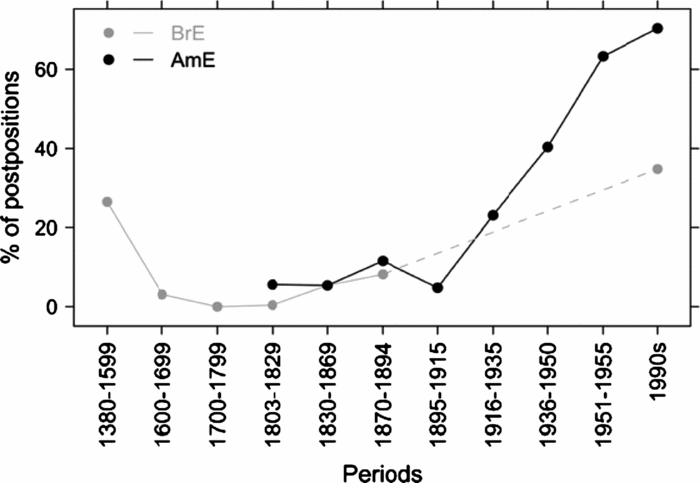
Diachronic changes in the proportion of postpositional notwithstanding (relative to all adpositions) are shown in figure 1, which brings together several findings presented in Berlage (Reference Berlage, Rohdenburg and Schlüter2009) in a single display.Footnote 3 The proportion of postpositions can be seen to first decrease and then to increase again, particularly in AmE. Data in Berlage (Reference Berlage2014: 234–5) confirm that there is a steady increase in the proportion of the postposition in British English (BrE) between the late nineteenth and the late twentieth centuries. Due to the overlapping time spans of corpora it was difficult to include those results in figure 1. The general trend for this period is indicated by a dotted line.
Developments in the relative frequency of postpositional notwithstanding (various corpora; from Berlage Reference Berlage, Rohdenburg and Schlüter2009: 134–6)

The finding that a certain proportion of postpositions was used in late Middle English supports the view that at the time of its introduction, notwithstanding was not fully grammaticalised as a preposition. Even if the word order in the French source language was fixed, it is quite possible that language users adopted the postpositional variant due to its formal similarity to absolute clauses (see section 3). In other words, although nonobstant was already (nearly) fully grammaticalised in French, notwithstanding may have entered the system of the English language at a somewhat lower level of grammaticity.
Berlage (Reference Berlage2014: 238) shows that, much later, ‘short and structurally simple NPs’ favoured the reintroduction of the postposition. Long or complex structures are more likely to resist this trend, since they are more easily parsed if the phrase structure is made explicit by a preposition at an early point (Berlage Reference Berlage, Rohdenburg and Schlüter2009: 138; cf. Berlage Reference Berlage2014: 9; Minugh Reference Minugh, Breivik and Hasselgren2002: 225).Footnote 4 However, the patterns shown by Berlage do not explain what caused this ‘resurrection’ (Berlage Reference Berlage2014: 233) of the postposition in the twentieth century. After all, short and simple NPs may just as easily be coded using prepositional notwithstanding, or the more colloquial in spite of and despite. The question as to what motivated this particular change remains a challenge.
3 Formally similar constructions
There are several constructions in present-day English that bear some formal semblance to those headed by notwithstanding: (i) deverbal ‘marginal prepositions’ (e.g. concerning, considering; see Quirk et al. Reference Quirk, Greenbaum, Leech and Svartvik1985: 667); (ii) subjectless adverbial clauses with coreferential subjects in the matrix clause and a verb in the present participle form; and (iii) absolute clauses with a present participle. On closer inspection, phrases headed by notwithstanding are of course different from all three construction types. For example, notwithstanding is not marginal (i.e. potentially verbal; see below), but always immediately recognisable as an adposition, and its preceding or following nominal complements cannot be interpreted as subjects or objects, due to the semantics of the verb withstand (cf. comment in Huddleston & Pullum Reference Huddleston and Pullum2002: 631–2). However, it is argued that due to their formal similarity the constructions briefly discussed in this section may nevertheless serve as models when choosing post- or prepositional placement of notwithstanding.
Construction type (i) – deverbal ‘marginal prepositions’ – is shown in examples (7)–(8). Quirk et al.’s (Reference Quirk, Greenbaum, Leech and Svartvik1985) classification of items like considering and concerning as ‘marginal’ is based on their multifunctionality. They clearly have a verbal morphology, but can be used both verbally (as a present participle) and as a preposition. In both examples, considering and concerning are used as heads of prepositional phrases with scope over the entire finite clause.
-
(7) Considering his age, he can run remarkably fast.
-
(8) Concerning your future in the company, I shouldn't worry too much.
Examples (9)–(10) are instances of construction type (ii), subjectless adverbial clauses headed by present participles. They can be read as wide-scope adverbials, much like (7)–(8), but it is also possible to interpret them as temporal (‘When she considered his age, Mary decided . . .’) and causal (‘Because it concerns your future, this question . . .’) adverbial clauses, whose subjects can be inferred from the matrix clause (cf. the ‘normal attachment rule’ in Quirk et al. Reference Quirk, Greenbaum, Leech and Svartvik1985: 1121).
-
(9) Considering his age, Mary decided not to respond to Peter's flirtatious advances.
-
(10) Concerning your future in the company, this question is of vital importance.
Phrases headed by preposed notwithstanding may formally look like subjectless non-finite adverbial clauses, but they crucially differ from them in that they do not have an implied subject. Thus, it is not possible to rephrase (11a) as (11b):
-
(11)
-
(a) Notwithstanding his age, Mary encouraged Peter's advances.
-
(b) * When she notwithstood his age, Mary encouraged Peter's advances.
-
Absolute clauses – type (iii) in the list above – are verbless or non-finite clauses that have a subject of their own but are not complements of a subordinating conjunction or a preposition (Quirk et al. Reference Quirk, Greenbaum, Leech and Svartvik1985: 1120).Footnote 5 In examples (12)–(14), the absolute clauses are constructed with their own syntactic subjects (sword, walking stick, weather). The sentence in (14) is an example of what Quirk et al. (Reference Quirk, Greenbaum, Leech and Svartvik1985: 1090) call ‘stereotyped conditional expressions without subordinators’ – stereotyped in the sense that the pattern is hardly productive and occurs mostly in what Chalker & Weiner (Reference Chalker and Weiner1994; s.v. absolute clause) call ‘set phrases’.
-
(12) The knight advanced, sword glistening.
-
(13) Walking stick clattering to the ground, he stopped dead.
-
(14) Weather permitting, we will take a boat to the island tomorrow.
A peculiarity of some absolute participial clauses appears to be the structure of the NP in subject position. In examples (12)–(13), the subjects of the absolute clauses (sword, walking stick) are singular count nouns that would normally require a determiner. In (14), weather is not countable but nevertheless requires a determiner under normal circumstances. Thus, all of those subjects are notionally definite and could be coded as such in non-absolute clauses or prepositional phrases (e.g. with his sword glistening, as his walking stick clattered to the ground, if the weather permits). In finite sentences, some kind of determiner would certainly be required, its omission resulting in a headline-style clause like (15), which is here regarded as ungrammatical:
-
(15) * Walking stick clatters to the ground.
One characteristic of absolute clauses thus seems to be a tendency to use indefinite grammatical coding for definite nominal concepts, which is evident in singular nouns that normally require a determiner (mostly count nouns). As regards notwithstanding, (16a) intuitively even seems to be somewhat more natural and idiomatic than (16b).
-
(16)
-
(a) Bad weather notwithstanding, we set out in a good mood.
-
(b) The bad weather notwithstanding, we set out in a good mood.
-
Thus, it is possible that constructions with postpositional notwithstanding tend to contain an NP of this ‘unmarked definite’ type, and that this type served as a catalyst in the rise of the postposition – a thought that will be pursued further in section 7.
In sum, although on closer inspection they are found to function differently, phrases with postposed notwithstanding formally resemble non-finite absolute clauses with a present participle, while phrases with preposed notwithstanding are similar to prepositional phrases headed by a marginal preposition (in the form of V-ing), or subjectless non-finite adverbial clauses. Irrespective of its grammatical status, notwithstanding clearly has the morphological surface form of a present participle, and the existence of the analogues described in this section may contribute to the syntagmatic flexibility of constructions headed by notwithstanding.
4 Data and methodology
The main analyses in this article are based on data from the Corpus of Historical American English (COHA; Davies Reference Davies2010–), which contains written language in four genres (fiction, non-fiction, magazines, newspapers) arranged in successive decades from the 1810s to the 2000s. There are approximately 406 million words in total in the corpus; the first two decades contain fewer words, but from the 1830s onwards there are over 13 million words per decade, and from the 1880s onwards there are over 20 million words per decade. The dominant text type is fiction, which accounts for approximately 50 per cent of the data throughout the corpus. Finally, newspaper texts feature only from the 1860s onwards, so the first few decades differ somewhat from the rest of the corpus, both in terms of size and composition.
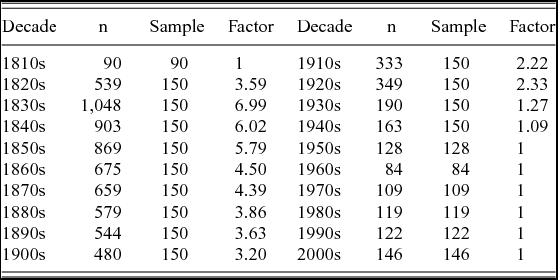
For general inspections of frequency developments of notwithstanding, all occurrences were counted (n = 8,129). If the focus was on particular complementation types (e.g. NPs or that-clauses), manual inspections of the output were based on subsamples from each decade in cases where the number of hits was too large. Downsampling of this kind was applied for all decades in which n > 150, in which case a random selection of 150 tokens was inspected, as shown in table 1. In total, 2,748 out of 8,129 tokens were manually inspected in this way. To gauge the actual frequency of certain uses of notwithstanding, frequencies of individual construction types in the subsample were multiplied by the factor nhits/nsubsample. The resulting frequencies are referred to as projected frequencies in figure 4.
Downsampling notwithstanding from COHA

Reported frequencies are per million words (pmw), normalised within each decade of COHA. For some plots it was helpful to plot normalised frequencies logarithmically. In the data shown in figure 4, some frequencies were very low (or zero). Since log(0) = −∞, it is normally impossible to include zero on a logarithmic scale. Therefore, f = 0 was represented as zero, and the distance between zero and 2 was adjusted so as to correspond to a doubling of frequency. In figure 4, the asterisks flanking the axis (*|*) indicate this artificial compression of the scale at extremely low values.
Some diachronic trends were tested using Kendall's τ, as suggested by Hilpert & Gries (Reference Hilpert and Gries2009). In this approach, the twenty consecutively ordered decades in COHA are correlated with the normalised frequencies of notwithstanding (or certain construction types involving notwithstanding), which indicates whether or not there is a significant trend.
5 Two stages of grammaticalisation in the domain of concessive prepositions
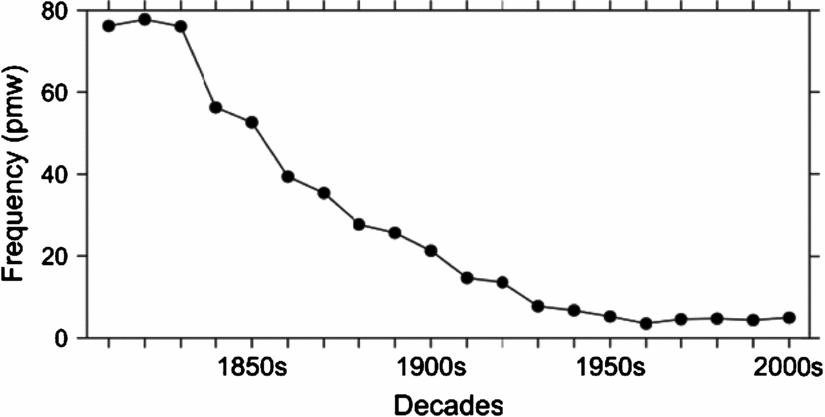
The general pattern that can be observed in the frequency of notwithstanding in written American English from the early nineteenth century to the present day is very clear: As shown in figure 2, there is a steady and statistically significant (τ = −.905; p = .000) decrease that begins to slow down in the 1930s and reaches a relatively stable low level after the 1950s.
Changes in the frequency of notwithstanding in COHA

An informal inspection of data from the diachronic TIME Magazine Corpus (Davies Reference Davies2007–) also revealed no significant trends for notwithstanding from the 1920s onwards and thus fully confirms the stabilisation of frequencies during that period.
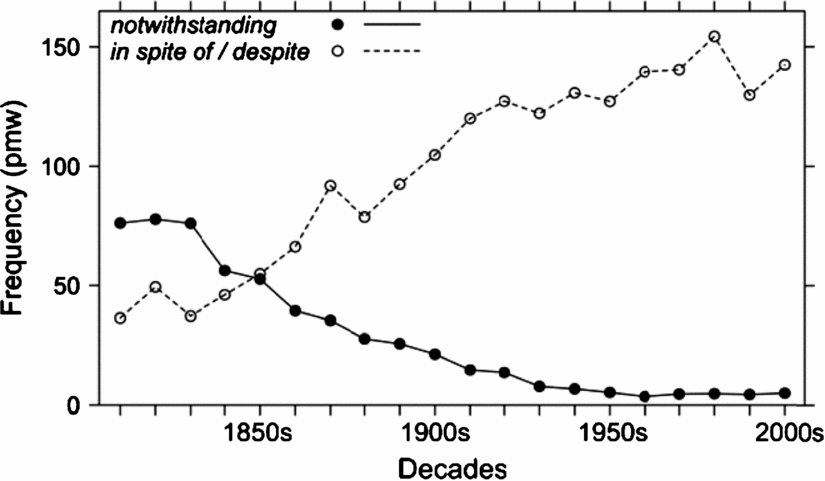
One approach to an explanation of the drastic decrease in frequency of notwithstanding lies in a comparison with the alternative concessive prepositions in spite of and despite (see Rissanen Reference Rissanen, Fischer, Tottie and Lehmann2002). Figure 3 shows that in spite of and despite, which are here treated as a single category, increase considerably in frequency and thus follow an inverse frequency pattern compared to notwithstanding.Footnote 6
Frequencies of in spite of / despite and notwithstanding in COHA

The pattern shown in figure 3 can be interpreted as a symptom of ongoing grammaticalisation within the class of English concessive prepositions, with Hopper's (Reference Hopper, Traugott and Heine1991: 22) first and third principles of grammaticalisation contributing to an explanation. Principle one, layering, states that ‘[w]ithin a broad functional domain, new layers are continually emerging . . . [T]he older layers . . . may remain to coexist with and interact with the newer layers.’ One such (very broadly defined) functional domain is the marking of concessive relations. Prepositions used to mark this semantic relation came to coexist with the conjunctions though (from Old English þeah) and but, which could also be used to this end. More specifically, i.e. looking at a more narrowly defined domain, in spite of, despite and notwithstanding are layers within the class of concessive adpositions in late Middle English (although notwithstanding cannot be classified as an adposition exclusively; see section 1 and below). The developments in frequency shown in figure 3 can be interpreted as symptoms of specialisation, Hopper's (Reference Hopper, Traugott and Heine1991: 22) third principle, whereby the available formal choices within a functional domain decrease and ‘the smaller number of forms selected assume more general grammatical meaning’. In the present article, this case of specialisation seems to favour one set of markers (in spite of / despite) at the expense of notwithstanding. It is not suggested that the grammatical meanings of in spite of / despite or notwithstanding change in the process, but the grammatical function of the former certainly becomes more general, in the sense of ‘more generally applied’, i.e. also in contexts where notwithstanding would have been selected at earlier stages. Specialisation appears to take place as a process of making the domain of concessive prepositions tidier. One catalyst of the particular development of notwithstanding is the economy principle (see Zipf Reference Zipf1949; Krug Reference Krug, Rohdenburg and Mondorf2003: 11–12), according to which frequent items tend to be of long standing and structural simplicity. While the concessive prepositions do not differ significantly in age, notwithstanding is certainly structurally heavier, which probably put it at a disadvantage (see discussion in Rissanen Reference Rissanen, Fischer, Tottie and Lehmann2002). In a more sociolinguistically informed interpretation of the general decline of notwithstanding, Berlage (Reference Berlage2014: 246–7) argues that in a process of colloquialisation, the stylistically rather formal marker decreases in frequency. It is very likely that such socio-stylistic factors combined with and reinforced economy-related factors as well as processes of grammaticalisation.
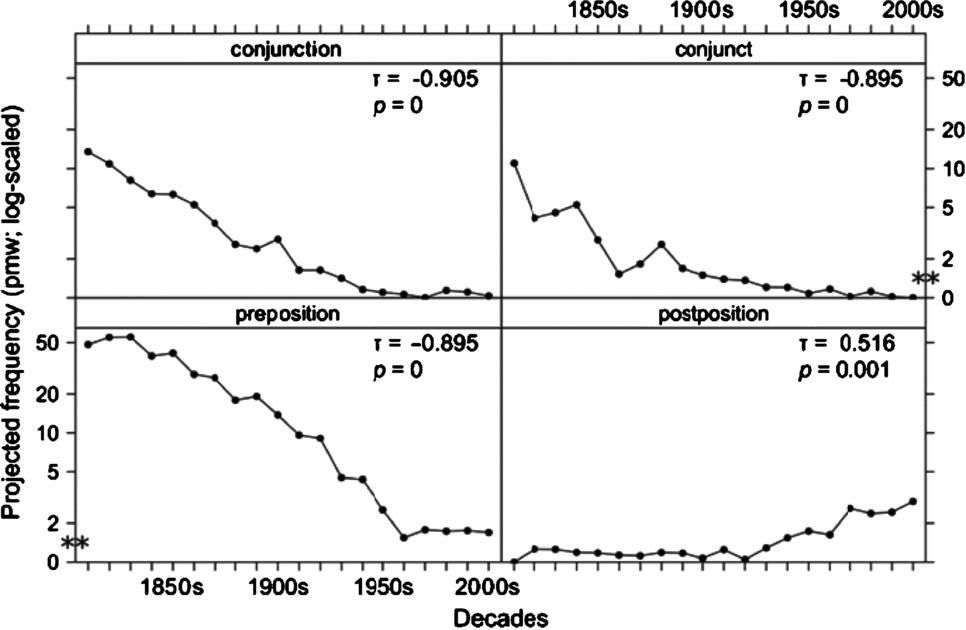
Four different grammatical functions of notwithstanding were tested separately. They correspond to examples (1)–(4) above, presented here in a different order: (i) subordinating conjunction, (ii) conjunct, (iii) preposition and (iv) postposition. Changes in the frequencies of these subtypes from the early nineteenth century to the present day are shown in figure 4.
Changes in the frequencies of four construction types headed by notwithstanding in COHA

All four diachronic tendencies are highly significant and – with the exception of postpositional notwithstanding – roughly follow the general negative trend shown in figure 3. It is from the 1960s onwards that the postpositional realisation is more frequent than its prepositional alternant (see also figure 5). In the early 2000s, postpositional notwithstanding is approximately twice as frequent as the prepositional variant, the normalised frequencies for this decade being 2.95 and 1.39 occurrences per 1 million words, respectively. Uses of notwithstanding as subordinating conjunctions and conjuncts keep occurring sporadically even to the present-day – only for the conjunct there were no occurrences in the latest decade.
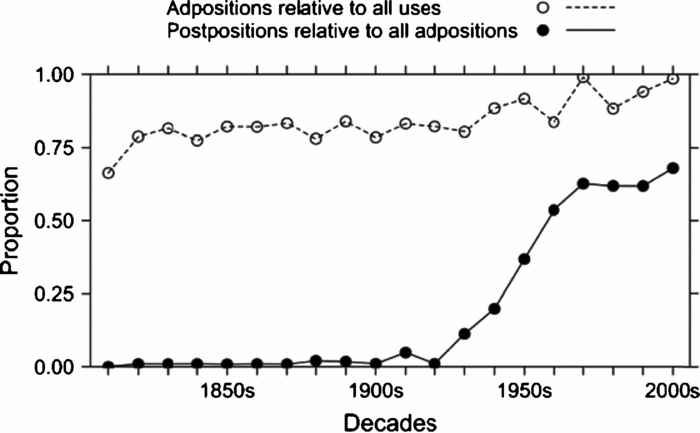
Relative frequencies of constructions with notwithstanding

The process of specialisation that is at work within the connective notwithstanding is illustrated more clearly by the relative frequencies shown in figure 5. This plot shows the proportion of adpositions (relative to all functions of notwithstanding) and the proportion of postpositions (relative to all adpositions). The general decline in frequency shown in figure 2 is accompanied by a steady development towards a near exclusive use of notwithstanding as an adposition. Somewhat later, and much more rapidly and dramatically, an increase in the proportion of postpositional uses takes place. In the latest decade, the frequency of postpositional notwithstanding relative to all adpositions is 68.0 per cent, a value which is astonishingly close to the 70.4 per cent found by Berlage (Reference Berlage, Rohdenburg and Schlüter2009: 134) in American newspapers of roughly the same period (see figure 1). It cannot be emphasised enough, however, that the dramatic increase in relative frequency of the postposition is happening at a very low frequency level.
Krug & Schützler (Reference Krug, Schützler, Aarts, Leech, Close and Wallis2013: 167–8) suggest that the grammaticalisation of an item (or a construction) can be measured both in terms of its frequency and its degree of specialisation.Footnote 7 Against this background, the behaviour of notwithstanding seems paradoxical. On the one hand, its frequency decreases considerably over time; on the other hand, it very clearly specialises, first towards an adposition, second towards a postposition. The strengthening of the postposition is not easily captured as simply another concomitant of grammaticalisation, namely the loss of syntagmatic variability, one of Lehmann's (Reference Lehmann2015: 167–8, 174) well-known parameters of grammaticalisation. Seeing that the preposition used to be far more frequent than the postposition (see figures 4 and 5), it would have been more natural for the latter to become obsolete. The strong label of ‘resurrection’ (Berlage Reference Berlage2014: 233) is in fact quite apt for the phenomenon of a virtually extinct variant returning to the scene and becoming the majority form. One possible explanation would be a process of degrammaticalisation (see Norde Reference Norde2009), i.e. the return to a verbal reading of notwithstanding. In syntactic terms, this seems possible, with absolute participial clauses of the form ‘NP V-ing’ serving as a model. However, this explanation is problematic due to the present-day meaning of the verb withstand and its behaviour as a predicate. First, withstand (v.) requires an object, which would be missing in an absolute clause of the form ‘NP not withstanding’. Second, the intransitive use of withstand – meaning ‘to form an obstacle, to be an obstruction’, which would make this kind of clause possible, is obsolete. And, third (and perhaps trivially), there is no intransitive verb to notwithstand. Thus, while degrammaticalisation cannot be ruled out offhand, it seems unlikely due to the properties of present-day withstand (v.), as well as the strong tendency of grammaticalisation to be unidirectional (see Brinton & Traugott Reference Brinton and Traugott2005: 25; Hopper & Traugott Reference Hopper and Traugott2003: 16, 99–139). The development of notwithstanding towards a postposition seems difficult to explain in a (de-)grammaticalisation framework, and it will therefore be approached from different perspectives in the next two sections.
6 The length of NP complements of notwithstanding
This section follows up on a suggestion made by Berlage (Reference Berlage2014: 249), namely to conduct a diachronic investigation of NP complexity in phrases headed by notwithstanding. The clear tendency of postpositional notwithstanding to combine with relatively short and simple NPs was discussed in section 2, based on research by Berlage (Reference Berlage, Rohdenburg and Schlüter2009, Reference Berlage2014). If this tendency could be shown to have developed (or to have been strengthened) in conjunction with the increase in the frequency of the postpositional variant, a possible causal connection could be explored. In measuring the weight of NP complements, the present article focuses entirely on word counts.
Two extreme cases from COHA are shown in (17)–(18). In the first example, the complement NP is remarkably long (and extremely complex) and follows its head; in the second example, the NP is extremely short (and simple) and precedes the head. Both examples display the expected behaviour, which is that postpositions tend to take shorter complements, and that prepositions will tolerate longer ones.
-
(17) . . . notwithstanding the self-reproach and heaviness I felt, on hearing the particulars of what I can not bear to speak of yet, or even to think of – the death of Luther and his two elder sisters. (COHA, magazines, 1835)
-
(18) The entry soon grew into a triumphal march, and, protests notwithstanding, the horses were unyoked, . . . (COHA, non-fiction, 1882)
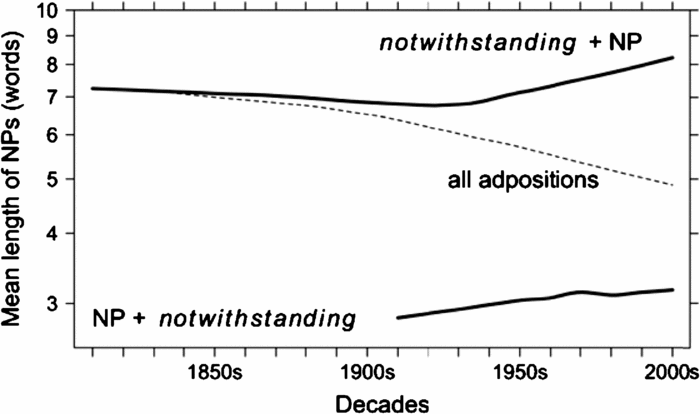
As shown in figure 6, there is a clear general difference between prepositional and postpositional notwithstanding regarding the lengths of their complement NPs in COHA, the former taking complements that are on average more than twice as long. For both variants, there is a slight general increase in the length of their NP complements over time. The thin dotted line indicates an alternative perspective. If no difference between postpositional and prepositional notwithstanding is made, there is a clear tendency for NP complements to become shorter over time. This is a function of the fact that postpositions prefer shorter NPs and increase in frequency.
Length of complements combining with postpositional and prepositional notwithstanding in COHA (solid lines)

There is no tendency for NP complements combining with the postposition to become shorter over time. Thus, while obvious differences in length exist between the complements of prepositions and postpositions, there is no evidence that they have become more different, diachronically. It is possible to interpret the decreasing length of NPs in combination with notwithstanding in general – indicated by the dotted line in figure 6 – as an increase in the number of relevant contexts (short NPs) which Berlage (Reference Berlage2014) identified as points of inception for the reintroduction of postpositional notwithstanding. However, it remains entirely unclear whether shorter NPs were a cause or a consequence of the increasing preference of postpositions. This instantiation of the chicken-or-egg problem makes it necessary to look elsewhere for possible explanations of the syntactic change affecting notwithstanding.
7 Unmarked definite constructions and notwithstanding
In section 3 it was intuitively felt that certain notionally definite nominal concepts may regularly be left uncoded for definiteness in absolute clauses, e.g. sword glistening and walking stick clattering in examples (12)–(13) above. It was hypothesised that this kind of ‘unmarked definite’ construction might serve as a model for constructions in which notwithstanding follows its nominal complement. In support of this hypothesis, it would need to be shown that unmarked definites frequently occur in connection with postpositional notwithstanding, and that they actually lead the change. Example (19) from COHA illustrates this kind of construction once again:
-
(19) . . ., she couldn't passively witness this and make it all right, personal relationship notwithstanding. (COHA, fiction, 2009)
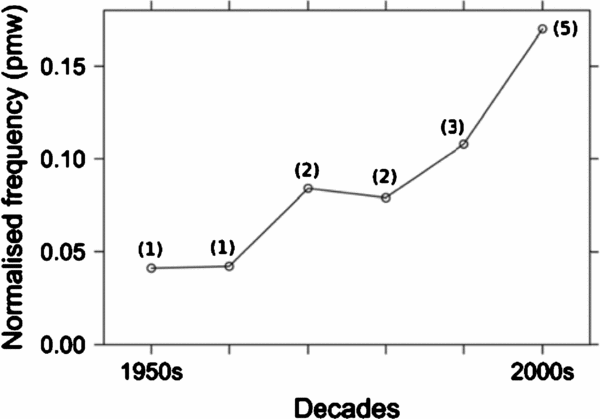
In (19), it is clearly a definite personal relationship (namely ‘her’ personal relationship with third parties) that is of interest. This construction is qualitatively different from sentences in which definiteness is fully coded, and it is possible that it served as a catalyst in the relatively recent development of postpositional notwithstanding. Figure 7 shows the frequencies of this particular ‘unmarked definite’ type in COHA for postpositional notwithstanding in the second half of the twentieth century.
Postpositional notwithstanding complemented by ‘unmarked definites’ in COHA (absolute frequencies in parentheses)

The plot focuses entirely on complements of postpositional notwithstanding, since the construction seems to be restricted to such contexts. There is one case of unmarked definites in combination with the preposition from the year 1850:
-
(20) . . . [N]otwithstanding intimate relationship and mutual dependence, separation became inevitable. (COHA, magazines, 1850)
This, however, is not a clear-cut example, since it consists of two singular NPs in conjunction; it thus acquires an implicit plural quality and can be argued to elude the definition of unmarked definites as singular NPs that normally require a determiner. Other examples that seemed to qualify as prepositional notwithstanding followed by unmarked definites were found to contain nouns that do not strictly require a determiner in the respective contexts (e.g. notwithstanding valiant legislative effort). The unmarked definite construction indeed seems to combine with the postposition exclusively, and its increase largely coincides with the increase of postpositional notwithstanding more generally. Both findings seem to give support to the hypothesis that unmarked definites may have a special role to play in the development of the postpositional variant. However, the development happens at very low frequencies, which is strong evidence against the hypothesis: The unmarked definite in combination with postpositional notwithstanding stays below 0.2 occurrences per million words, while the postposition in general ranges between 1.25 and 2.95 occurrences per million words in the same time period (see bottom right panel in figure 4). The increasing pattern and the (near) exclusive use of such a construction in combination with postpositions are striking, and the construction may also be quite salient. However, due to their low overall frequency it cannot be claimed that unmarked definites are leading the increase in postpositional usages of notwithstanding. To what extent this construction is nevertheless in accordance with a possible explanation will be briefly discussed in the following section.
8 Information-structural motivations for postpositional notwithstanding
The revival of postpositional notwithstanding cannot easily be accounted for in terms of grammaticalisation (section 5), nor does it seem to correlate with the emergence of novel constructions that are characterised by decreasing complement lengths (section 6) or a distinctive and reduced intra-phrasal syntax (section 7). The issue will therefore be approached from a different angle. It will be argued that among concessive adpositions postpositional notwithstanding has a unique function for the structuring of information within a construction, which can be invoked as one factor to account for the dramatic relative increase in postpositional uses observed in the twentieth century.
It is beyond the scope of this article to provide a detailed discussion of information structure from a theoretical perspective (see Chafe Reference Chafe and Li1976; Lambrecht Reference Lambrecht1996; Krifka Reference Krifka2008; Brinton & Brinton Reference Brinton and Brinton2010: 324–9). A workable, non-technical definition is found in Quirk et al. (Reference Quirk, Greenbaum, Leech and Svartvik1985: 1505), according to which the information in clauses will be structured (i.e. arranged) in such a way as ‘to place the semantic and prosodic climax . . . where they would be most effective’. What is called semantic climax by Quirk et al. (Reference Quirk, Greenbaum, Leech and Svartvik1985) is that part of the information expressed by a linguistic structure that needs to be foregrounded, for example because it is new or contrastive, or is given greatest weight for pragmatic reasons. The principle of end-focus states that there is ‘a linear presentation from low to high information value’ (Quirk et al. Reference Quirk, Greenbaum, Leech and Svartvik1985: 1356–7), which means that the semantic climax is generally presented later. An important prosodic consequence of end-focus is that the central accent in an intonation phrase, which is placed on the word with the highest information value (Wells Reference Wells2006: 93), tends to be positioned towards the right of a linguistic structure. With relevance to the present argument, Quirk et al. (Reference Quirk, Greenbaum, Leech and Svartvik1985: 1505–6) point out that information structuring also happens at the phrasal level – in their case within NPs. While end-focus means that important information is presented later, end-weight means that, in addition, information in focus position also tends to be structurally longer or ‘heavier’ (Quirk at al. Reference Quirk, Greenbaum, Leech and Svartvik1985: 1361).
Trivially, prepositional notwithstanding is found in phrase-initial position and is prosodically weak relative to the rest of the intonation phrase. Thus, in (21a) the nuclear stress is placed on the first syllable of weather. If, on the other hand, a postposition is used, the nuclear accent is placed on the third syllable of notwithstanding, as shown in (21b).
-
(21)
-
(a) Notwithˈstanding the bad \/WEAther | we went \OUT.
-
(b) Bad ˈweather notwith\/STANding | we went \OUT.
-
There is a similar effect when a concessive conjunct is used, as in example (22). Here, what Azar (Reference Azar1997: 97) calls the antecedent – i.e. the proposition that constitutes the ‘obstacle’ in a concessive – is found in the preceding discourse (given in parentheses in the example). Similarly to (21b), the connective is prosodically prominent.
-
(22) (The weather was bad.) Neverthe/LESS | we went \OUT.
There are two contexts in which (complex) prepositions like because of or in spite of may be prosodically prominent: they can be used contrastively, as in (23a), or they can be used with a pro-form NP, as in (23b). In (23b), notwithstanding can be substituted for in spite of, resulting in (23c).Footnote 8
-
(23)
-
(a) We went out in\SPITE of the weather | not be\CAUSE of it.
-
(b) In \/SPITE of this | we went \OUT.
-
(c) Notwith\/STANding this | we went \OUT.
-
Like postpositional apart and aside, postpositional notwithstanding is prosodically prominent by default, i.e. it does not require the contexts illustrated in (23) to be assigned focus stress.
The effect of the postpositional variant is to relegate the propositional content of the phrase, e.g. bad weather in (21b), to the background, or at least to present it as less important in the immediate context. The principle of end-focus results in a shift of informational weight from the content of the phrase to the connective. The correlative principle of end-weight results in considerably shorter NP complements (see section 6). Given its average length of four syllables or less (see figure 6 and below), postpositional notwithstanding will regularly be heavier than its preceding complement. The processing-related considerations and the finding that short and simple NPs are contexts of inception for postpositional notwithstanding, all reported variously by Berlage (Reference Berlage, Rohdenburg and Schlüter2009, Reference Berlage2014), combine neatly with the proposed explanation. The information contained in phrases headed by notwithstanding will be de-emphasised if the complement NP cedes the phrase-final syntactic slot to the adposition, and it will be further de-emphasised if the NP itself is relatively short or reduced. Due to the shortness of the NP, the construction as a whole will still be reasonably processable. The unmarked definite construction explored in the previous section fits this pattern quite nicely, since it constitutes an NP that is even further reduced. However, due to its rarity it must be viewed as only one (at present relatively marginal) consequence of the strengthening of the postposition, rather than a leading construction.
Another nuance can be added to the argument based on information structure and prosodic weight if the syntax of the entire clause is considered. As shown in (24), the phrase headed by notwithstanding can be in initial, medial or final position relative to the clause in which it is embedded. The three possible positions can be simplified into final and non-final (i.e. medial or initital; see Wiechmann & Kerz Reference Wiechmann and Kerz2013: 7).
-
(24)
-
(a) . . . [T]his intricacy notwithstanding, the designs as a whole are usually bold and effective. (COHA, non-fiction, 1911)
-
(b) This juxtaposition, its popularity notwithstanding, has no foundation in fact. (COHA, magazines, 1956)
-
(c) . . . Hanoi has on earlier occasions shown its willingness to talk, Washington's disclaimers notwithstanding. (COHA, newspapers, 1966)
-
In concessive constructions – no matter whether they employ subordinating conjunctions, adpositions, or other connectives – it is of prime importance whether the semantic antecedent (or obstacle) is placed in final or non-final position. For instance, if it precedes the main clause, the antecedent will be presented as somewhat less consequential than the following proposition.
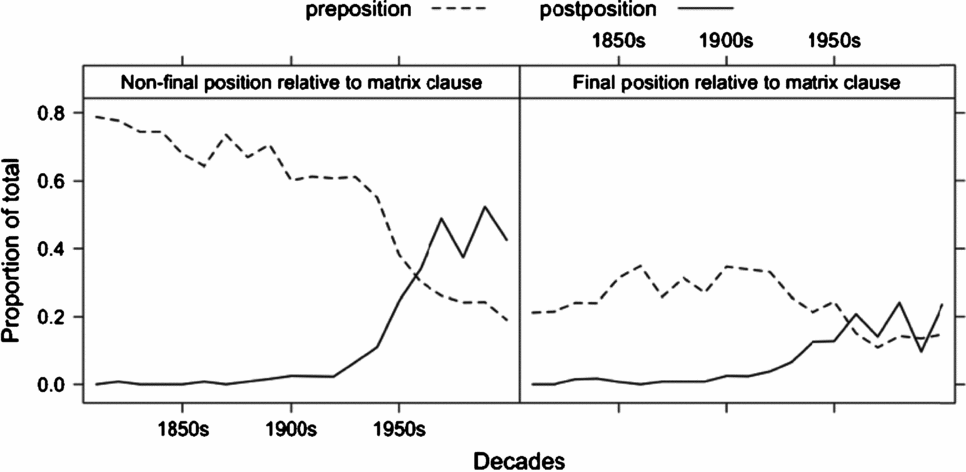
The two panels of figure 8 contrast the occurrence of non-final and final phrases headed by notwithstanding. Additionally, the proportions of prepositional and postpositional variants are indicated in each panel. The values that are plotted refer to all occurrences, i.e. across both panels.
Proportions of pre- and postpositions by phrase placement relative to matrix clause

Beyond the general increase in the proportion of the postposition, and with relevance to the information-structural argument, figure 8 shows that the postposition predominantly gains ground in adverbials that are in non-final sentence position. Thus, propositions in phrases headed by notwithstanding increasingly come to be placed in the earliest possible slot, which is called ‘Slot 1’ in the schematic representation in (25).
-
(25)
-
(a) NP notwithstanding, MAIN CLAUSE. (Slot 1)
-
(b) Notwithstanding NP, MAIN CLAUSE. (Slot 2)
-
(c) MAIN CLAUSE, NP notwithstanding. (Slot 3)
-
(d) MAIN CLAUSE, notwithstanding NP. (Slot 4)
-
In Slot 1, the propositional content of the NP attached to notwithstanding is maximally de-accentuated: the concessive phrase precedes the matrix clause, and within the concessive phrase the adposition is in focus position. The prosodic weakening of the NP in Slot 1 is in accordance with its weight, measured in words: if phrases with postpositional notwithstanding are found in Slot 3, i.e. if the phrase as a whole is in final position, the average NP complement is 3.9 words in length, while NPs in Slot 1 have an even shorter average length of 3.0 words (cf. figure 6, where no such distinction was made).
In sum, a very large part of the increase in postpositional notwithstanding can be traced to a specific syntactic arrangement, in which the semantic antecedent – i.e. the proposition that forms the obstacle in spite of which the consequent proposition holds – is maximally de-accentuated. Other concessive markers, be they prepositions or conjunctions, cannot achieve this in quite the same way, because, at least at the level of the respective phrase or clause, the proposition will be in focus position.
9 Conclusion and outlook
In this article, processes in the historical development of notwithstanding from the early nineteenth century up to the present day were discussed and interpreted, based on written American English corpus data. The three proposed stages or processes are (i) a general decline in frequency (c. 1800–, perhaps starting earlier); (ii) a strengthening of the adpositional (at first mainly prepositional) function relative to other functions (c. 1800–, perhaps starting earlier); and (iii) the remarkable increase in relative frequency of the postposition (c. 1900–).
Stages (i) and (ii) were interpreted as symptoms of ongoing grammaticalisation, as follows. In the domain of connectives with concessive meaning, specialisation, i.e. a reduction in the number of available formal alternatives (Hopper Reference Hopper, Traugott and Heine1991: 22) took place. It was shown, for example, that in spite of and despite gained at the expense of notwithstanding. While the general frequency of notwithstanding declined, its adpositional use increased in relative frequency. This stage of the process could be called ‘embedded’ or ‘nested’ specialisation: notwithstanding itself became less frequent (‘specialisation among concessive markers’), and at the same time the less common uses (conjunction, conjunct) also decreased in relative frequency (see figures 4 and 5). The result was a much less frequent but much ‘tidier’, i.e. functionally restricted, connective, which continued to be used almost exclusively as an adposition.
While the general formal reduction (fewer occurrences of notwithstanding, fewer grammatical functions) is explained as specialisation, a secondary process in grammaticalisation, it is also possible to approach it in sociolinguistic terms. An influential model is the one by Trudgill (Reference Trudgill1986: 107), originally developed for situations of dialect contact. Trudgill argues that a language variety characterised by a mix of functionally equivalent forms becomes more focused through a process of levelling, i.e. a reduction in the number of different forms. Forms may be discarded because they are marked (see Milroy Reference Milroy2002: 7), for example morphologically, phonologically, stylistically, or socially. Compared to its competitors, notwithstanding is obviously phonologically and morphologically more complex. Concerning formality and style, it is very possible that the written genres from which COHA was sampled have undergone colloquialisation over time (Berlage Reference Berlage2014: 246–7; cf. Hundt & Mair Reference Hundt and Mair1999; Mair Reference Mair2006: 187; Smitterberg Reference Smitterberg and Hundt2014; Smitterberg & Kytö Reference Smitterberg, Kytö, Shaw, Erman, Melchers and Sundkvist2015), and that this further contributed to the general decline in the frequency of notwithstanding, a marker perceived to be highly formal (see Quirk et al. Reference Quirk, Greenbaum, Leech and Svartvik1985: 706; Hoffmann Reference Hoffmann2005: 113–14).
In contrast, the establishment of the postposition as the most frequent syntactic variant of notwithstanding is more difficult to account for. As stated in section 5, this development cannot be explained as specialisation or a loss in syntagmatic variability (Lehmann Reference Lehmann2015: 167–8), since a pattern that had already become highly fixed (use of prepositions) increased dramatically in flexibility. It was further argued that the return of the postposition is probably not a symptom of degrammaticalisation.
The explanation proposed in this article is that phrases constructed with postpositional notwithstanding survived and even increased in frequency because they are able to structure the expressed information so that the propositional content is fully stated, but nevertheless maximally de-accentuated. Constructions that lead the observed change not only contain postpositional notwithstanding, but they are also found in non-final position within the matrix clause and contain particularly short NPs. Those NP complements of notwithstanding are therefore least in focus and reduced in weight. Constructions in which the phrase containing postpositional notwithstanding is in non-final position in the sentence could be said to take on some properties of sentence-initial conjuncts (e.g. nevertheless, however). Like conjuncts, notwithstanding is prosodically prominent in such constructions and follows the semantic antecedent (the ‘obstacle proposition’). Further, both non-final, postpositional notwithstanding and conjuncts will normally be realised with rising or fall–rise intonation, and thus heighten the anticipation of the following proposition, the focus of the sentence. An important difference between the conjunct and notwithstanding is that the latter requires a nominal complement, while the conjunct can stand alone. Thus, to repeat, the robustness (and slight increase) in notwithstanding particularly in preposed or medial postpositional phrases may be due to a unique combination of two functions: first, it presents a ‘full’ concessive construction, i.e. one in which both propositions are in place, even if one of them tends to be short or even reduced. Second, it directs maximal importance to the second proposition, much like the conjunct that does not even state the first postposition.
Future research needs to show whether or not the postpositional realisation of notwithstanding continues to increase in relative frequency and will eventually become (near) categorical. Moreover, diachronic data from other varieties of English, particularly British English, need to be inspected. A major problem in this respect is of course the lack of diachronic corpora large enough to enable analyses of this low-frequency item.Footnote 9 Another interesting aspect not addressed by this article is the possible relationship between syntax and semantics. As Rohdenburg (Reference Rohdenburg1996: 152) points out, alternants of a more explicit and more implicit nature (i.e. pre- and postposed notwithstanding, in this case; see section 2) may develop differences in meaning. For example, future research might be able to show that the rise of postpositional notwithstanding is not a purely syntactic phenomenon, but correlates with an increasing preference for certain semantic types of concessives, e.g. content, epistemic or speech-act concessives, as described by Sweetser (Reference Sweetser1990). This would be a case of constructionalisation, i.e. the emergence of a new form–meaning pairing not exhaustively described in syntactic terms. Finally, the notion of ‘unmarked definites’ seems worth returning to. Considering that NP complements of postpositional notwithstanding are prosodically shifted out of focus and considerably shorter, it certainly seems worth investigating their precise syntactic structure in future research.