Introduction
Alzheimer's disease (AD) is a common disorder whose psychosocial impact increases as the proportion of elderly people in the population grows (Suh and Shah., Reference Suh and Shah2001). To date, the most successful therapeutic approaches have involved cholinesterase inhibitors (AChEIs) (Bellelli et al., Reference Bellelli2005; Rozzini et al., Reference Rozzini, Vicini Chilovi, Bellelli, Bertoletti, Trabucchi and Padovani2005).
In elderly subjects depression is a prevalent and serious disorder that is associated with reduced quality of life and increased morbidity and mortality (Blazer et al., Reference Blazer, Hughes and George1987). In elderly subjects and in elderly patients with medical illness or in residential settings the prevalence of depression ranges from 7% to 42% (Bruce et al., Reference Bruce, Seeman, Merrill and Blazer1994). Several placebo-controlled studies on selective serotonin re-uptake inhibitors (SSRIs) have demonstrated their efficacy in improving symptoms of depression (Rapaport et al., Reference Rapaport, Schneider, Dunner, Davies and Pitts2003).
Since approximately 25–40% of AD patients may develop depressive symptoms and since a growing body of research has found cognitive impairment to be a common clinical feature of late life depression (Niederehe et al., Reference Niederehe, Burt and Zembar1995), our aim is to investigate pharmacological strategies to improve and stabilize cognitive functioning in late-life depression and minimize progression of cognitive impairment. To this end we evaluated the role on cognition of combining selective SSRIs with medications used in AD (donepezil, rivastigmine and galantamine), hypothesizing a joint effect that may delay cognitive deterioration.
Methods
Three hundred and sixty-eight Alzheimer patients were enrolled consecutively in two different outpatient clinics (Alzheimer Evaluation Units, UVA, Brescia, Northern Italy) between January 2003 and January 2006. All patients with AD met the National Institute of Neurological and Communicative Disorders and Stroke – Alzheimer's Disease and Related Disorders (NINCDS-ADRDA) criteria for probable AD (McKhann et al., Reference McKhann1984), as judged by an experienced AD research clinician. Diagnostic evaluation included: demographic and clinical features, medical history, physical and neurological examination, neuropsychological testing, routine blood tests (including thyroid hormones, vitamin B12 level, and serological tests for syphilis), and neuroimaging with brain computerized tomography. Duration of the disease was considered at the time of onset of memory disturbances that exceeded the episodic forgetfulness that might have been regarded as usual for the patient, or of other disturbances (language, praxis, orientation, visuo-spatial skills) that were clearly related to the disease.
At baseline, participants were assessed by a neuropsychologist using the Mini-mental State Examination (MMSE; Folstein et al., Reference Folstein, Folstein and McHugh1975), the Alzheimer's Disease Assessment Scale ADAS-Cog (Fioravanti et al., Reference Fioravanti1994) and the global Clinical Dementia Rating (CDR; Hughes et al., Reference Hughes, Berg, Danziger, Coben and Martin1982) to evaluate the global cognitive function; the Instrumental Activities of Daily Living (IADL; Lawton and Brody, Reference Lawton and Brody1969) and Basic Activities of Daily Living (BADL; Katz et al., Reference Katz, Downs, Cash and Grotz1970) to detect impairment in activity functions; the Geriatric Depression Scale (GDS) 15 items (Sheikh and Yesavage, Reference Sheikh, Yesavage and Brink1986) to study the presence of depressive symptoms, and the Neuropsychiatry Inventory (NPI; Cummings et al., Reference Cummings1994), to study psycho-behavioral disturbances. Every concomitant illness and treatment was recorded.
Patients were classified as depressed through clinical and neuropsychiatric investigation with DSM-IV criteria for depression in Alzheimer's disease (American Psychiatric Association, 1994). All subjects and their caregivers were asked, by the clinic doctor, about the symptoms of depressed mood, decrease of interest or pleasure, changes in appetite, changes in sleep, loss of energy, feelings of guilt, worthlessness or that life was not worth living, difficulty in concentrating, and psychomotor agitation or retardation.
From 368 patients recruited, 30 patients were excluded from the analysis during the period of observation: 11 for low compliance (the patients changed to another clinic or they did not want to make the periodic visits), nine for nausea or headache, four for seizures and six patients for institutionalization. No statistical differences on demographic, clinical and neuropsychological characteristics have been observed among the two groups (analyzed vs excluded).
At the start of the study, patients received donepezil (n = 227; 67%), rivastigmine (n = 69; 20%) and galantamine (n = 42; 13%) as per the clinician's judgment; patients took donepezil 5 mg per day, rivastigmine 1.5 mg/bid per day and galantamine 4 mg/bid per day. The effects of treatment were investigated at 1 (T1), 3 (T2) and 9 (T3) months. At each clinical visit the dose of AChEIs was increased according to the investigator's judgment. If the increased dose was not tolerated, it was decreased to the previous well-tolerated dose. All changes were recorded. Patients were allowed to attend the clinic for any problem or adverse effect. At three months the mean dose was 7.5 mg ± 2.5 of donepezil, 6.7 ± 2.1 mg of rivastigmine and 11.8 ± 4.4 mg of galantamine.
To evaluate the role on cognition of combining SSRIs with AChEIs we grouped three different categories of patients: patients not depressed and not treated with SSRIs at baseline, patients depressed and treated with SSRIs at baseline, and patients depressed but not treated with SSRIs. In our sample there were no patients treated with SSRI but not depressed. All patients already taking SSRIs at baseline did not discontinue the therapy during the period of observation (nine months).
Although the consensus for treatment of AD patients addresses the importance of additionally treating behavioral symptoms, the lack of clear guidelines indicating when and how to treat depressive symptoms has led us to decide the prescription of antidepressants in accordance with a clinical global judgment.
The study was approved by institutional review boards and written informed consent was obtained from both the patients and their responsible caregivers.
Statistical analysis
Statistical analysis was performed with the Statistical Package for the Social Sciences (SPSS, 2002). Descriptive statistics at baseline were performed on socio-demographic, clinical, neuropsychological, functional and psycho-behavioral characteristics. Quantitative variables were expressed as mean ± standard deviation. Continuous variables were assessed using analysis of variance (ANOVA) models and the χ2 test for dichotomous ones. Post-hoc comparisons, adjusted using the Bonferroni correction, were used to make comparisons between group means at baseline. The significance of change in three groups (patients not depressed and not treated with SSRIs at baseline, patients depressed and treated with SSRIs at baseline, and patients depressed but not treated with SSRIs) from baseline to 3 and 9 months for MMSE was evaluated through General Linear Model repeated measures (GLM). All tests were 2-tailed at a probability level of 0.05.
Potential confounders (age, sex, education and the total GDS score) were evaluated by entering their values as covariates.
Results
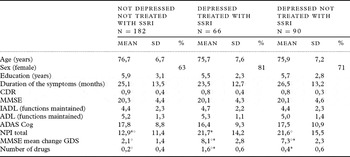
A total of 338 patients with mild to moderate Alzheimer's disease were evaluated for nine months. At baseline, 182 of these were diagnosed as not depressed and not treated with SSRI, 90 were classified as depressed and not treated with SSRI and 66 patients were depressed and treated with SSRI. Of the last group, 38 reported use of citalopram (from 10 to 20 mg per day), 15 of escitalopram (from 5 to 10 mg per day), 10 of setraline (50 mg per day), two of fluoxetine (20 mg per day) and one of paroxetine (20 mg per day). As summarized in Table 1, there were no statistically significant baseline differences between the three groups in terms of sociodemographic characteristics. As expected, not treated and treated (probably not sufficiently because treated by a family doctor not specialist) depressed patients had significantly higher mean NPI and GDS scores and the group of depressed patients treated with SSRIs took a significantly higher number of drugs than the other two groups.
Sociodemographic and clinical characteristics of Alzheimer's patients at baseline treated with cholinesterase inhibitors and divided in three groups on the basis of depression and SSRI treatment

°*p < 0.05 values are based on ANOVA model with post hoc comparisons, adjusted using the Bonferroni correction.
MMSE: Mini-mental State Examination (0–30); ADAS Cog: Alzheimer Disease Assessment Scale, cognitive part (0–70); IADL: Instrumental Activities Daily Living (0–8); BADL: Basic Activities of Daily Living (0–6); CDR: Clinical Dementia Rating Scale (0–5); NPI: Neuropsychiatry Inventory (0–144); GDS: Geriatric Depression Scale (0–15); ApoE: Apolipoprotein E
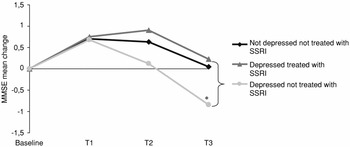
At three months (Figure 1), a cognitive improvement was observed from baseline in non depressed patients not treated with SSRIs (T2 mean MMSE 20.9 ± 5.2 vs baseline 20.3 ± 4.4; p = 0.005), in depressed patients treated with SSRIs (T2 mean MMSE 20.8 ± 5.3 vs baseline 20.1 ± 4.3; p = 0.005) and a cognitive stabilization in depressed patients not treated with SSRIs (T2 mean MMSE 20.7 ± 5.3 vs baseline 20.6 ± 4.6; p = NS). At nine months, cognitive stabilization from baseline characterized non depressed patients not treated with SSRI (T3 mean MMSE 20.4 ± 5.0 vs baseline 20.3 ± 4.4) and depressed patients treated with SSRI (T3 mean MMSE 20.2 ± 5.1 vs baseline 20.1 ± 4.3). In contrast, a cognitive worsening from baseline was observed in depressed patients not treated with SSRIs (T3 mean MMSE 19.8 ± 5.0 vs baseline 20.6 ± 4.6). Finally, the mean change in MMSE score from baseline to nine months demonstrated that depressed patients not treated worsened when compared with patients not depressed and not treated with SSRIs and with patients depressed and treated with SSRIs (mean change −0.8 ± 2.3 vs 0.04 ± 2.9 vs 0.1 ± 2.5; p<0.05 respectively).
Mean change of MMSE after 1, 3 and 9 months of treatment with cholinesterase inhibitors and divided in three groups on the basis of depression and SSRI treatment at baseline.
The significance of change in three groups from baseline to 1, 3, 9 months for MMSE was evaluated using the General Linear Model (GLM).
*Mean change of MMSE in depressed patients not treated with SSRI versus other two different groups; p≤0.05.

Discussion
We observed that use of SSRI medications in people with AD treated with AChEIs may exert some degree of protection against the negative effect of depression on cognition.
A growing body of research has found cognitive impairment to be a common clinical feature of late life depression (Niederehe et al., Reference Niederehe, Burt and Zembar1995). The cognitive impairment appears to be associated with alterations in serotonergic neurotransmission implicated both directly and through interaction with central cholinergic pathways (Kalayam and Alexopoulos, Reference Kalayam and Alexopoulos1999).
Several findings have suggested that SSRIs may improve different aspects of cognition. Rocca and colleagues (Reference Rocca2005) suggest that citalopram may improve cognitive disturbances induced by minor depressive disorder and subsyndromal depressive symptomatology in elderly patients. Other authors demonstrate that low dose citalopram is useful for the treatment of memory deficits and that acute administration of this drug, through the augmentation of serotonergic neurotransmission, facilitates memory consolidation and enhances long-term memory performance (Harmer et al., Reference Harmer, Bhagwagar, Cowen and Goodwin2002). Escitalopram also has been demonstrated to improve cognitive efficiency in complex attention, short- and long-term recall of contextual information, and short-term recall of visual information (Savaskan et al., Reference Savaskan, Müller, Böhringer, Schulz and Schächinger2007). Improvement of cognition with SSRIs was also obtained utilizing sertraline (Constant et al., Reference Constant2005), fluoxetine (Levkovitz et al., Reference Levkovitz2002) and paroxetine (Cassano et al., Reference Cassano, Puca, Scapicchio and Trabucchi2002).
To date, literature analysis does not clarify if the combined effect of SSRIs and AChEIs is synergic or independent (Pelton et al., 2007).
We hypothesize the presence of two potential mechanisms by which antidepressants affect cognition in depression: (i) a direct effect caused by the pharmacologic action of the drugs on specific neurotransmitters, and (ii) a secondary effect caused by improvement of depression. The first hypothesis is sustained by studies demonstrating that SSRIs change the intracellular iron distribution that would be predicted to limit indirectly amyloid precursor protein (APP) expression (e.g. Morse et al., Reference Morse, Payton, Cuny and Rogers2004) and amyloid beta peptide secretion that are involved in the pathogenesis of AD.
In this regard, Pákáski and colleagues (Reference Pákáski2005) indicate that SSRIs are able to interfere with the APP metabolism in vitro and assert that antidepressant medication might be beneficial in AD therapy. The second hypothesis is supported by Vythilingam and colleagues (Reference Vythilingam2004) who demonstrated that treatment with antidepressants significantly improved memory and depression, independently of detectable brain structural changes.
In a recent pilot study, Pelton and colleagues (Reference Pelton2008) proposed that since serotonin deficits are known to be associated with depression that modulates cognitive performance and since the beneficial effects of cholinesterase inhibitors suggest that cholinergic neurotransmitter deficits contribute to the cognitive impairment in AD, the cognitive improvements by combining antidepressants and donepezil may involve independent neurotransmitter systems.
A limitation of this observational study includes the duration of treatment with SSRIs before the baseline; because the SSRI was administered by the family doctor we know the initiation of treatment only in a small group of patients. Another limitation relates to the decision not to treat with SSRIs a number of patients with depressive symptoms. The decision is supported by data demonstrating the possible effect of AChEIs on these symptoms (Rozzini et al., Reference Rozzini, Vicini Chilovi, Bertoletti, Trabucchi and Padovani2007). This option was adopted with the consent of the caregivers in order to reduce the number of drugs prescribed to their relatives.
The results support the clinical experience that treatment of depression with SSRIs in AD patients who are already on AChEIs might have a slightly better outcome in cognitive measures.
Conflict of interest
None.
Description of authors' roles
Luca Rozzini analyzed the data, reviewed the literature and wrote the paper. Barbara Vicini Chilovi, Marta Conti, Erik Bertoletti and Marina Zanetti recruited the study subjects, undertook the administration of multidimensional assessment and assisted with data analysis and the writing of the paper. Marco Trabucchi contributed to the discussion and preparation of the manuscript. Alessandro Padovani contributed to the discussion and preparation of the manuscript