The image of the Guidonian Hand and the related practice of solmisation are perhaps the most enduring topics to be discussed in texts about musical practice throughout the medieval and Renaissance period; these techniques continued to hold relevance as late as the seventeenth and the eighteenth centuries, particularly in the Italian conservatoires. Solmisation also has retained implications for instruction in music up to the present, as in fixed- or moveable-do solfège. The system, of which Guido d'Arezzo is thought to be the founder, is based upon the application of the syllables ut, re, mi, fa, sol and la to the musical notes C D E F G A, and the observation of ‘affinities’ between the degrees D/A/E in one group and F/C/G in another.Footnote 1 Later, this system was expanded to incorporate a series of overlapping deductions – the unit of six syllables (ut, re, mi, fa, sol, la) superimposed onto the space of a major sixth – allowing greater flexibility with the same syllables. These overlapping deductions could allow a singer to move seamlessly across the regular musical space (the gamut) using only the six syllables (voces)Footnote 2 and the associated intervallic pattern, with the mi–fa indicating where a semitone occurs. The alliance of pitch interval and syllables could also have aided the learning of new music, as a choirmaster might have signalled voice parts using the joints of his hand that were related directly to these syllables, though the theoretical evidence is far from unanimous in this regard and its likely usefulness for the performance of polyphony is questionable.Footnote 3 The labelling of the joints are preserved in the numerous diagrams of the Guidonian Hand that populate music theory treatises from across the period; it should be noted from the outset, however, that one has to question the value of such a practice beyond the foundational stages of musical training, particularly with professional singers singing from fully notated music.
Given how much weight is generally attached to the ‘hexachord’ in studies of medieval and Renaissance music, one might be forgiven for thinking that a sort of ‘sixth-ness’ may have dominated contemporary conceptions of scalic patterns, and more broadly, musical space.Footnote 4 Stefano Mengozzi, amongst others, has recently questioned the validity of this view, outlining the significant historical support for the coexistence of octave-duplication and ‘hexachordal’ conceptions of space.Footnote 5 He argues that the hexachord, though probably important in the foundational stages of musical education, was not necessarily the foundation of all conceptions of tonality (for want of a better term) in medieval and Renaissance music.Footnote 6 Notions of octave duplication clearly also underpinned conceptions of musical space, with deductions and octaves coexisting at different intellectual levels of awareness, offering insights into the possible multiple conceptual layers of musical space at this time.Footnote 7 The ways in which foundational material of pitch relations would have undoubtedly informed more sophisticated understanding are difficult to unpick, and thus the issue is certainly a thorny one. The full implications of this issue are worthy of a more detailed exploration elsewhere, and thus it is sufficient for the present discussion to say that the importance of solmisation to medieval and Renaissance musicians working at different levels of experience is now being reconsidered.
By the fifteenth and sixteenth centuries, the six-note sequence offered a fixed interval pattern that the singers could apply to pitches within the gamut, that is, the regular range on the Hand, had been well established. The process of mutation was required to allow singers to shift in a seamless fashion from one deduction, effectively swapping one of Guido's solmisation syllables for a different one on the same sung pitch. Such a process gave the singer full scope to explore the range of the gamut using the same six syllables and intervallic pattern placed on different pitches. In effect, by learning the pattern of the six voces, a singer could (theoretically, at least) move through the entire range of the gamut using only the six-syllable pattern with the mutations acting as pivot points. Outside of mi and fa, unless indicated with ficta, a singer could consider each note to be separated by a tone.Footnote 8
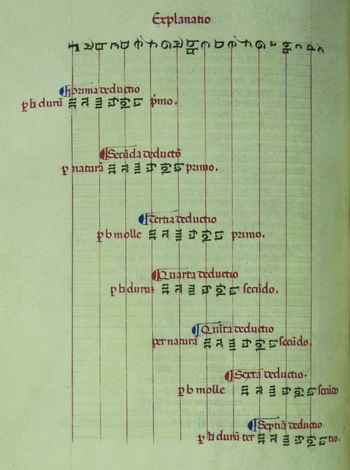
The seven deductions are neatly identified in a diagram from Tinctoris's Expositio manus (c.1472), with the points of overlap implicitly acknowledging the requirement for mutation (Fig. 1).
Diagram showing the possible mutations across the gamut. Johannes Tinctoris, Expositio manus, Valencia, Universitat de València, Biblioteca Històrica, 835, fol. 8v. Reproduced with the kind permission of the Biblioteca Històrica, Universitat de València.

In mutating or changing to a different deduction, a singer effectively shifted the position of this semitone, dictating the series of intervals forming the six-note pattern, and thus the placement of the semitone (mi–fa). Theorists throughout the thirteenth, fourteenth and fifteenth centuries (and beyond) discussed this conceptual shift extensively, and many provided similar types of diagrams, most notably in the ‘Ars musica’ attributed to Magister Lambertus who also provides more focused diagrammatic examples to explicate specific mutations.Footnote 9 The increasing focus upon mutation as an integral part of musical education throughout this time period is evidenced by a number of treatises which discuss the topic of mutation in great detail. Many of these come from the so-called Hollandrinus tradition and are found in central European sources only.Footnote 10 I hope to explore these more fully in a future study, though points which are particularly germane to the present discussion will be highlighted in due course. It should also be noted that approaches towards the process of mutation had changed significantly by the sixteenth century, demonstrating a shift in its importance in conceptualisations of musical space and tonality.
Although the theoretical information had remained largely unchanged across several centuries due to the requirements of the rules, the approaches to its explanation and exemplification did not adhere to a uniform style in music theory treatises. These variations, often significant, can offer important insights into the changing ways that the system was understood, and the manner in which specific theorists approached the topic. In turn, such an understanding will further enhance our appreciation of contemporary perceptions of the solmisation system, and its relationship to the needs of the readership(s) for music theory. The discussion that follows centres on three detailed case studies of three texts from the fourteenth and fifteenth centuries, drawn exclusively from sources and texts related to those of Johannes Tinctoris (c.1435–1511).
Indeed, one of the most important comprehensive treatments of theory pertaining to the Guidonian Hand, including solmisation and mutation, is found in Tinctoris's Expositio manus. The treatises of Johannes Tinctoris are among the most important fifteenth-century writings about musical practice, giving an almost unparalleled insight into many aspects of musical notation and contemporary compositional practice.Footnote 11 He authored works on the musical dot, imperfection and alteration, mensural combinations, musical proportions, and the art of counterpoint. His works are characterised by a systematic rigour that is not always present in the works of his contemporaries, and include more than 600 musical examples across his output.Footnote 12 Given the luxurious presentation nature of two of the sources preserving most of his works, these examples are sometimes more extended than one would normally expect, and set a precedent for exemplarity that is without parallel in the manuscript tradition.Footnote 13
Completed during his time at Naples, the Expositio manus systematically examines each aspect of the solmisation system, offering readers all of the conceptual tools they would need to use the system, even if the treatise is far from explicit about how one might actually use this in practice. Each of the conceptual layers examined in the Expositio manus is accompanied by exemplary content, in this treatise, either diagrammatic figures or unmeasured monophonic notated examples.Footnote 14
Figure 1 shows Tinctoris's approach to showing the possible mutations across the full range of the gamut.Footnote 15 This example, which is common to roughly contemporaneous theoretical works and some earlier texts too, includes all of the information that a singer would need to identify the mutation points.Footnote 16 These would allow a reader to move from one part of the gamut to another by transposing the pattern of six syllables to a new pitch location.
While this example displays the conceptual underpinning of mutation in a clear diagrammatic fashion, it does not bear much resemblance to a realistic scenario where a singer would be required to effect mutations to navigate the gamut: it demonstrates the concept in the abstract. To address this, and the issue of mutation in musical contexts more explicitly, Tinctoris includes a series of musical examples that adopt an interesting and especially pedagogically useful exemplification strategy. In these cases, the examples function in an active role in the theoretical discourse, with each one being an integral part of the text itself.
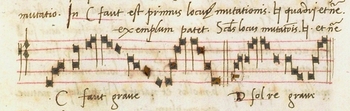
These examples are all found in the seventh chapter of the Expositio manus, ‘De mutationibus’ (‘On mutations’), which consists of a comprehensive list of the possible mutations accompanied by meticulously constructed examples.Footnote 17 Mutation was a topic that was not always demonstrated through notational means in theoretical treatises, with many theorists being satisfied with diagrams akin to that shown in Figure 1: the notational realisation of such a process was seemingly not of prime importance.Footnote 18 Indeed, its conceptual nature meant that it was rarely, if ever, notated explicitly in practical sources, and thus theorists explored many different ways to overcome this challenge.Footnote 19 Because of this, Tinctoris's use of musical notation with additional labels that articulate precise points of change is noteworthy, particularly given that it is usually found in texts of the central European tradition, but not in the texts, predominantly northern, where an explicit influence on Tinctoris's can be detected.Footnote 20 For the sixth example of mutation, Tinctoris lists the six mutations for high A:

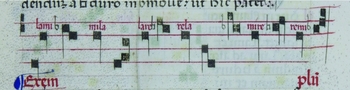
Tinctoris's text describes the six possible mutations on A la–mi–re, grouped into three ascending and descending pairs: la–mi and mi–la; la–re and re–la; mi–re and re–mi. The use of repetitious phraseology, which is applied to each pitch location in this chapter, would have helped the reader to identify the key theoretical point clearly, emphasising the points of change. Closer examination of the accompanying musical example (Fig. 2) reveals that strong links are forged between the text and example that extend beyond the subject matter alone, making this example worthy of further discussion.Footnote 22
Tinctoris, Expositio manus, vii.3. Example showing the six mutations on A la–mi–re, matching the order of the text. Valencia, Universitat de València, Biblioteca Històrica, 835, fol. 11r. Reproduced with the kind permission of the Biblioteca Històrica, Universitat de València.

Tinctoris's example presents the three pairs of mutations in the same order as the text. The strong links forged between text and example allow the user, most likely a singer, to read the text alongside the notation, offering concurrent reading possibilities. This would have almost certainly increased the didactic usefulness of the example, with a quasi-symbiotic text–example relationship being formed: both elements are mutually beneficial to each other. A reader comfortable with the theoretical material could therefore have understood the contents of the notation through the text, and vice versa, following both elements simultaneously. In effect, the reader could understand the theoretical text through engaging with the musical example, rather than requiring an understanding to unpick the notational complexities.
This kind of relationship, in itself, shows evidence of what I would describe as the instantiation model of exemplification:Footnote 23 it occurs wherever the main text describes a theoretical precept, often in a specific sense, that is then accompanied by a musical example that provides instance(s) of such a precept. In this case, additional pitches are placed between the mutation points, forming something of a more realistic musical context for the theoretical point of interest. These additional notes would help to prepare a singer for the manner in which they might encounter mutation in a practical context, as they frame the deductions that the singer or reader is required to mutate to and from, and are thus an important secondary part of the demonstration of mutation: they function in both a contextual and an active role within the example.Footnote 24 Such an approach is pedagogically sound, as the singer would need to be able to identify mutations without the aid of labels in practical musical performance. Thus, Tinctoris's exemplification strategy here seems to strike a balance between didactic handholding and practical reality: his example provides sufficient context and practical guidance.
In addition to these features, Tinctoris provides another element to bring greater clarity to the musical notation forming the main body of the example. This additional element comes in the form of solmisation syllables placed above the points of mutation, in this case centred on A la–mi–re, to indicate the precise mutation taking place. By placing specific syllables above the relevant mutation points, Tinctoris makes the text–example links more explicit, drawing these two elements together into a cohesive pedagogical whole. This approach raises the visual profile of the mutation points, making them obvious to even the most inexperienced of readers, arguably somewhat analogous with the use of signa congruentiae to indicate specific points of dissonance in the later parts of De arte contrapuncti. Footnote 25 Such additions also make the links between the theoretical text and musical example explicit in ways that the approaches of Tinctoris's near contemporaries often do not, a point to which I shall return later in this article.
However, there is one complicating factor. An octave leap takes place in the middle of this example, something that proves problematic for the process of mutation. This leap moves from re in natura to la in b-molle and does not account for the solmisation, leaving no opportunity for the mutation of syllable on any note, even though there is a change of both property – a portion of the gamut spanning a major sixth, commonly referred to as a hexachord in modern times – and deduction.Footnote 26 Tinctoris does not discuss how a singer should deal with this kind of situation anywhere in his theoretical texts or in practical music.Footnote 27
For the present discussion, it will suffice to say that two distinct layers of exemplification are at play here: the main layer – musical notation – makes use of projection; the additional layer – solmisation labels – makes use of a simpler form of instantiation. In combining the two, Tinctoris strengthens the text–example relationship to form a more didactically useful theoretical whole. This approach also activates the musical example as part of the pedagogical progression, facilitating engagement on different levels by raising the visual profile of key points.
Tinctoris's addition of solmisation syllables to a musical example of this sort at the precise points of mutation is rather unusual for texts of the Franco-Flemish and Italian traditions. Indeed, using the texts available on the TML database, which focuses on texts of these origins, I could identify only one other treatise that makes use of similar annotations to indicate solmisation content within musical examples from fifteenth-century treatises, though these labels are deployed differently from those seen in Tinctoris's text. The treatise in question seemingly survives as a unicum in fols. 78vb–140vb of Ghent, Universiteitsbibliotheek, 70 (G, henceforth). G is an intriguing theoretical compendium that contains, amongst other texts, a number of highly unusual readings of some of Tinctoris's treatises on musical notation.Footnote 28 Although this manuscript is dated to 1503–4, the particular treatise in question, Tractatus de musica plana, may well go back to the middle of the fifteenth century, as is suggested by its style and theoretical contents.
This treatise on plainchant is divided into four parts, of which only the last three are given titles in the source: a section on the ‘theory’ of music (the proportional science of pitch relations), one (pertinent to the present discussion) on the Practica musice plane, one on the nature of the eight modes, and an Ars intonandi or tonary. The author was an anonymous (probably Netherlandish) Carthusian; a 200-year-old wild guess that it might have been the great theologian Dionysius Carthusiensis has been perpetuated by the Thesaurus Musicarum Latinarum.Footnote 29 The author of this text will be referred to as the ‘Carthusian anonymous’.
Given that the present discussion centres mostly on practically focused treatises, only Book II of the Carthusian anonymous's treatise will be examined here. It includes seven short examples that incorporate the same kind of staff labels that Tinctoris uses in the Expositio manus, albeit deployed in a different fashion. The Carthusian anonymous writes:

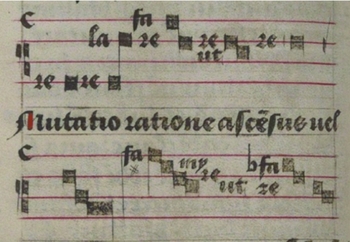
Figure 3 shows the exemplification of some mutations in the Carthusian anonymous's treatise, with this approach being supported by the addition of solmisation content and symbols to show mutation through a change in the type of B: b-fa and b-mi.Footnote 31 Although this approach appears to hold some similarities with Tinctoris's, at least in visual terms, there are a number of significant functional differences.
Carthusian anonymous, Tractatus de musica plana, 2.13. Example showing solmisation syllables placed in the musical notation. Ghent, Universiteitsbibliotheek, 70, fol. 115vb. Reproduced with the kind permission of the Universiteitsbibliotheek, Ghent.

The first of these is that the Carthusian anonymous, or certainly his scribe, places solmisation syllables next to almost every note in the passage. Whilst the incorporation of so many syllables into the musical notation might help to strengthen the links between notes and solmisation syllables, the mutation points are not clearly distinguished from the other notes around them. Thus, the only way that a reader could have differentiated these from non-mutation points would have been to identify points where more than one syllable is placed on a particular staff line or space within the example, which may in itself suggest that some prior knowledge of the solmisation system was presumed by the author.Footnote 32
The second main difference between Tinctoris's approach and that of the Carthusian anonymous is the text–example relationship formed. In Tinctoris's treatise, the rather plain text describes the particular mutations on display in the musical notation, forging a strong relationship between the text and musical notation. The text focuses upon individual cases of mutation, after explicating the general process of mutation in a diagrammatic form only a few pages earlier (see Fig. 1 and Fig. 2).
The text of the Carthusian anonymous's treatise, on the other hand, though discussing mutation, does not specify the mutations that are demonstrated in the musical notation for these specific examples. Instead, it discusses the process of mutation in a more general sense, using an example that does not correspond directly to the mutation on a specific note. The possible mutations, and the ways in which a singer might deploy these in practice,Footnote 33 are subsequently listed in a lengthy text-based explanation, and some are demonstrated in musical notation, though specific solmisation labels to highlight the points of mutation do not accompany these.Footnote 34 This shows a markedly different approach to that seen in Tinctoris's Expositio manus, where the reader is provided with a more systematic account of the mutations that are possible and, by implication, those that are not. Tinctoris's explanation is completed without introducing the concept of mutation at a level of generality through musical notation that might cause confusion.Footnote 35
Therefore, the Carthusian anonymous's text, despite appearing to show a precedent for Tinctoris's use of solmisation labels within musical notation, functions quite differently, though this is not to deny the obvious visual similarities. The Carthusian anonymous clearly had a different pedagogical (and theoretical) goal in mind when composing his text, a point which is worthy of further exploration in its own right. However, it is important to separate the visual similarities from the functional realities of these examples. Tinctoris's use of syllables would have helped to draw the focus of his readership from the theoretical text towards the musical notation in an almost seamless fashion. The text and musical notation could be read side-by-side, improving the reader's comprehension of both aspects, and increasing the clarity of his explanations. The result would be similar to that found in the examples in many of his other foundational texts.
The Carthusian anonymous exhibits a different type of approach towards exemplary content. Indeed, as a general rule, his writing on the practice of music, contained mostly within Book II, is furnished with far fewer examples than those of many other late fifteenth-century texts. Although this could be attributed to limited copying resources or space limitations, it does seem likely that a different conceptual and pedagogical logic underpins the Carthusian anonymous's text that goes some way to account for his difference in approach. In any case, it is intriguing that both authors applied solmisation syllables to staff-based notation, something that is not often seen in the most commonly studied contemporary music theory texts.Footnote 36
Despite their functional differences, both cases show a significant shift in the theoretical approaches towards the exemplification of mutation from the approach taken by Marchetus of Padua in the fourteenth century.Footnote 37 His Lucidarium in arte plane musice was one of the most important music theory treatises of the fourteenth century and marks a major development from the Franconian tradition of mensuration that is coordinate with the French developments of the so-called ‘Ars nova’. These texts were among the first to explore contrapuntal and notational practice, a topic that became increasingly popular across the thirteenth, fourteenth and fifteenth centuries. Even accounting for its focus on monophonic music, the influence of the Lucidarium cannot be underestimated given that it is one of the most widely transmitted music theory texts of its time, and evidence of its influence can be seen as far afield as the works of Tinctoris (written some century and a half later), particularly in regard to tuning practices.Footnote 38 The Lucidarium survives more or less complete in fifteen manuscript sources, and dedicates a whole chapter to the discussion of mutation, demonstrating the characteristic thoroughness with which Marchetus approached theoretical subjects.Footnote 39
VIII.ii of the Lucidarium is entitled ‘De mutatione. Quid sit et ubi fiat’ (‘On mutation. What it is, and where it occurs’) and contains eight monophonic musical examples, each of which shows the mutations on a specific note within a somewhat realistic musical context. Unlike Tinctoris's Expositio manus or the Carthusian anonymous's Tractatus de musica plana, Marchetus elects to define the process of mutation in a general sense by textual means only, with none of the surviving sources of the Lucidarium including a diagram of the type seen in Figure 1. Footnote 40 The process of mutation as follows:

After explaining that mutation is not possible on Γ-ut, A-re,
 -mi, as they only have one syllable for each letter, Marchetus moves onto the first available point of mutation, that on C fa-ut (and later, ut-fa), the point of overlap between the first and second deduction. Marchetus writes:

Marchetus describes the process of mutation in both an ascending and a descending form, outlining the pivot point function of a mutation. This text describes the mutations on display in the musical examples (Figs. 4, 5 and 6) as occurring on the pitch C, with the solmisation syllable being changed from fa to ut, effectively swapping from the first deduction (prima deductio) to the second deduction (secunda deductio). The style and technical precision of Marchetus's text is similar to Tinctoris's in its simplicity and systematic concision, providing a description of the solmisation content that is mutated in the example according to the normal theoretical rules.
Marchetus of Padua, Lucidarium, 8.2.5–7. Mutation on C fa-ut (and ut-fa). Transcribed from Brussels, Bibliothèque Royale. II 4144, fol. 20r.

Marchetus of Padua, Lucidarium, 8.2.5–7. Mutation on C fa-ut (and ut-fa). Transcribed from Milan, Biblioteca Ambrosiana, D.5 inferiore, fol. 63v.

Marchetus of Padua, Lucidarium, 8.2.5–7. Mutation on C fa-ut (and ut-fa). Perugia, Biblioteca comunale Augusta, 1013, fol. 26. Reproduced with the kind permission of the Biblioteca comunale Augusta, Perugia.

While the manuscript sources of the Lucidarium are in almost uniform agreement in textual terms, the degree of variation between the musical examples presented across the manuscript sources is noteworthy. This is manifested in the cross-section shown in Figures 4, 5 and 6. All three sources present different examples, and the Perugia source (Fig. 6) also includes a caption. Such variation may be generally characteristic of the exemplary content of Marchetus's Lucidarium, and indeed a number of other music theory texts of a similar age.Footnote 43 However, the degree of variance between these figures is not so great that Marchetus's theoretical point is lost in most of these examples. The similarity across the sources is sufficient to suggest that the scribes were working from exemplar copies that conveyed the same theoretical effect, if not precisely the same notated content.Footnote 44 Crucially, from a pedagogical perspective, the points of mutation are preserved throughout the examples, showing a partial development from the transmission process of the Ars cantus mensurabilis attributed to Franco of Cologne.Footnote 45
In order to unpick the technical aspects of this example, I will explore the example as it appears in Milan, Biblioteca Ambrosiana, D.5 Inf. (henceforth, M), likely one of the earliest sources (see Fig. 5). This transcription from M is partially different from the version of the example found in the much later Perugia, Biblioteca Comunale Augusta, 1013 [M 36] (1509) (henceforth, Pg), especially in the first part of the example (shown as Fig. 6). I shall return to this point later. If the theoretical points are mapped on to the notation presented here, the first mutation (C fa moving to ut) occurs on the second note of the second ligature, and the second mutation occurs in the second part of the example as the second C after the division line.Footnote 46 In both cases, these mutations are not the most readily identifiable points in the notation, with this being especially true of the second instance of mutation. The clarity of the text would have helped a reader to understand the conceptual shift of the mutation at work more fully.
Marchetus further challenges the reader by including a number of Cs throughout the example where mutation does not take place. This requires a more complex appraisal of the mutational shifts present in the melody that goes beyond merely identifying any note placed on C and assuming that a mutation occurs. However, it should be noted that many of the mutations are followed by a larger interval within the context of a mostly stepwise example, suggesting that some kind of change was to be effected here. Thus, the relationship formed between the text and the example in this instance is more complex than one might assume at first glance, requiring a detailed level of engagement to identify the points at which these conceptual shifts occurred: the visual profiles of these points are not raised in the same fashion as the examples discussed thus far (see Fig. 2 and Fig. 3).
In short, the example demonstrates Marchetus's theoretical point clearly, presenting the two mutations described in the text within a realistic melodic context. However, the manner of presentation, certainly as it survives in some of the earliest sources, does not provide any additional information in the notation to aid the understanding of a reader who had not already understood the theoretical point fully. In placing the two mutations at structurally unimportant positions, Marchetus may have provided a realistic example, whereby the mutation needed to be effected quickly and without delay, that would challenge a reader's understanding. This would have helped to prepare a singer for the contexts where they would encounter such mutations in practical performance, showing that a clear pedagogical logic underpins the construction of this example.
Although the melodic shape implies the mutations in this example, these are not made explicit to the same degree as in Tinctoris's text, where the author's labels offer a visual orientation to work alongside a musical realisation. From a didactic perspective, it is clear that Tinctoris and the Carthusian anonymous, working in a similar style to their contemporaries in other aspects, adopted different (and perhaps more instructionally useful) techniques towards its exemplification from Marchetus. This is not to say that the latter's approach was not instructionally useful, rather that Tinctoris's strategy shows a developed form of the exemplification method deployed by Marchetus here, addressing the balance between didactic need and musical reality in a different way.
The differences between the sources of Marchetus's Lucidarium are not simply restricted to the notational aspects of his musical examples. In Pg, an early sixteenth-century copy that also includes some shorter pedagogical compositions by Tinctoris, each example of this type is accompanied by a caption (see Figure 6), highlighting the specific notes on which mutations take place in the musical notation. The solmisation content of these captions, probably scribal additions given that they are all but unique to this source, is not placed directly in line with the points of mutation, and thus its function does not extend beyond that as a straightforward caption to underscore the theoretical point.Footnote 47
Indeed, almost all of the fifteen complete sources present slightly different musical examples, with the degree of variation ranging significantly across these. For example, M contains a total of twenty-four notes (Fig. 5), whereas the example in the copy of the treatise preserved in Einsiedeln, Benediktinerkloster, 689 (fols. 1r–44r) contains only seven notes.Footnote 48 M includes an identical example to that found in Washington, Library of Congress, Music Division, ML 171.J6, and is remarkably similar to that found in Brussels, Bibliothèque Royale, II 4144, as shown in Figure 4.Footnote 49 In some cases, the degree of variation and the changes made to the examples means that the mutations prescribed are not technically required (i.e. the melodic range does not extend beyond the confines of a sixth), even though they could still be affected for the sake of the theoretical point.
Despite the degree of variation between the sources, it is clear that a similar pedagogical logic underpins all of the examples included to accompany this specific theoretical point. Each example is made up of a short passage of monophonic music, notated in unmeasured square notation. At no point does Marchetus describe the mutation on C fa-ut with any greater specificity than the outline of the technical process involved. Thus, the emphasis is shifted towards the musical example for demonstration. This, in its own way, shows similarities to the other two case studies examined thus far in this article, albeit with many important conceptual differences.
Thus far, the three case studies have been examined in terms of the approaches that their authors take towards the demonstration of mutation. Tinctoris's Expositio manus saw the deployment of a diagram to show the full scope of the gamut and the arrangements of the deductions, including points of overlap, within the gamut, and monophonic examples with solmisation syllables added at key points. The Carthusian Tractatus de musica plana included some short monophonic examples demonstrating the process of mutation in a more general sense, with solmisation syllables added to almost every note. Marchetus of Padua's Lucidarium, more than a century and a half older than the first two, made use of monophonic examples to show mutations, but offered no additional help through solmisation syllables attached to points of mutation: the reader was left to identify the mutations within the example in order to access its meaning. Such an approach was seemingly founded upon the assumption that one had to stay in a deduction for as long as possible, only mutating where absolutely necessary, for the reader to identify points of mutation. The range of approaches in these three texts would seem to suggest a different kind of intended usage for each. Indeed, the changes in music theory across the fourteenth and fifteenth centuries mean that differences between the examples in the treatises of Marchetus, the Carthusian anonymous and Tinctoris are to be expected. It is through these differences that the changes can be better understood at this historical distance.
However, what is intriguing, particularly with Marchetus's Lucidarium and Tinctoris's Expositio manus, is the degree of similarity between specific aspects of their approaches. In effect, the main difference between the exemplification approaches taken by Marchetus and Tinctoris consists in the addition of solmisation syllables in the later treatise, with the main theoretical text remaining remarkably similar. Indeed, Tinctoris was probably not the first to make use of this technique though he was among the first, to my knowledge, to use it so comprehensively in a systematic examination of the possible mutations across the gamut within the context of non-scalic musical examples.
Seemingly one of the earliest proponents of a system of including solmisation content in staff-based notation was Johannes Gallicus, though for quite different theoretical purposes from any of the other theorists discussed above. The Ritus canendi (c.1463), his best-known work, reconsiders the position of Guido's solmisation theory as a central part of musical practice. Gallicus reinterpreted the contemporary view of Guido's theory to suggest that a return to the use of letters would help to simplify musical practice and aid singers in learning its fundamentals. He is critical of the use of the six syllables, stating that they do not form part of the core principles of Guido's teachings and introduce unnecessary complexity to the practice of music:

Gallicus's tone here is undeniably critical of this particular aspect of contemporary musical practice, given that his treatise probably dates from about a decade before the completion of Tinctoris's Expositio manus. Gallicus outlines his disagreement with the system of solmisation, and mutation by implication, on the grounds of its verbosity rather than any specific quarrel with Guido's work itself. Indeed, he argues that this is all additional (and unnecessary) complication added to Guido's concise and manageable system by other theorists and musicians.
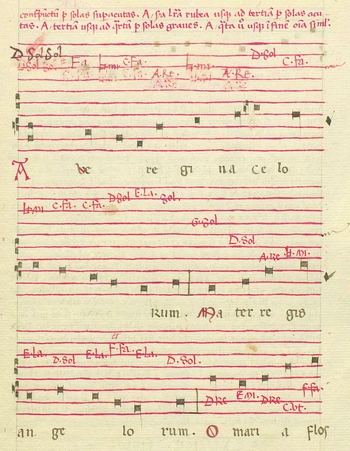
Given this stance, one would expect Gallicus to have avoided solmisation content altogether, opting instead for the letter names alone. Whilst this is true to an extent, one of the final examples in the oldest extant copy of his treatise is interesting from the perspective of exemplification and its use of some solmisation content, albeit cast under Gallicus's interpretation of the Guidonian system.Footnote 51 Although it contains only a single mutation, from G-sol to D-sol at ‘Mater’, it makes use of a notation system that holds some similarities to the solmisation annotations seen in the example from the Carthusian anonymous's treatise (see Fig. 3), and in Tinctoris's Expositio manus (see Fig. 2).
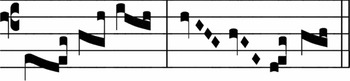
This example includes two notated voice parts, one of which uses unmeasured black-full notation and the other which uses letter names followed by a single solmisation syllable, taken from Gallicus's simplified gamut.Footnote 52 For the majority of the example, the voice part that is notated using letter names is placed above the black-full voice, though the two voices do cross for a brief passage. If one transcribes the two voices to realise the pitches, it is clear that a simple, yet effective, note-against-note setting of the text ‘Ave regina celorum’ forms this example (Fig. 7).Footnote 53
Johannes Gallicus, Ritus canendi. Example showing pitch labels indicating an additional voice. London, British Library, Additional 22315, fol. 59. Reproduced with the kind permission of the British Library, London.

Gallicus's musical example thus includes solmisation content, and goes to considerable effort to fuse solmisation syllables and staff-based notation in a visually appealing way. Despite the anomalous nature of this example, it would seem to suggest, as the musical examples found in the Carthusian anonymous's and Tinctoris's texts do, that fifteenth-century theorists were experimenting with exemplification approaches that could draw together different aspects of the conceptualisation of musical space and musical notation.Footnote 54 Even accounting for the difference in subject matter and theoretical stance on solmisation practice, it is clear that the Carthusian anonymous, Gallicus and Tinctoris, all made attempts to incorporate conceptual labels for pitch within their notated examples in ways rarely seen in practical musical sources.
* * *
The apparent fifteenth-century interest in presenting solmisation content, particularly that relating to the properties and deductions though not necessarily in the context of mutation, as part of musical examples within a theoretical context extended into some sixteenth-century printed volumes of music theory. Two notable examples include Martin Agricola's Ein Kurtz deudsche Musica (1528), which includes musical examples where syllables are placed at specific mutation points of theoretical relevance,Footnote 55 and Sebald Heyden's De arte canendi, which maps solmisation content onto staff lines in a non-mutation context.
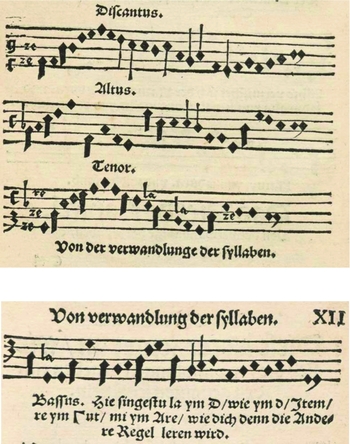
The approach towards solmisation labels in some of the musical examples in Agricola's text holds a great deal of similarity to the approach seen in Tinctoris's Expositio manus. In a number of the examples in Agricola's text, solmisation syllables are added at specific points to indicate the mutation that occurs. Agricola places only a single syllabic label at the point of mutation, showing the new deduction only (Fig. 8). Interestingly, such mutations are deployed in the context of polyphonic examples, something not seen in any of the examples discussed in this article, though much the same pedagogical logic and exemplification strategy is at work.
Martin Agricola, Ein kurz deudsche Musica (Wittenberg: Georg Rhaw, 1528), fols. XIv (above)–XIIr (below). Bayerische Staatsbibliothek München, Mus. Th. 34. Reproduced with the kind permission of Bayerische Staatsbibliothek, München.

Figure 8 shows a four-part polyphonic miniature with solmisation content added to three of these four voices. The Tenor has the most solmisation labels; the Altus, despite having a wide ambitus that would certainly demand mutation, lacks any solmisation content. Across all of the voices with solmisation labels, only the syllables re and la are used and these occur in more than one position, though re always appears when the melody ascends, and la when it descends. Such a practice demonstrates the use of re for ascending mutations and la for descending mutations, a significant simplification from the complex system that Tinctoris presents so exhaustively.Footnote 56 Thus, Agricola's example is probably more indicative of a broader practice than those found in Tinctoris's Expositio manus, which focus upon the mutations possible on a single note, and therefore fulfils a different pedagogical function. It is not supposed to achieve the same level of comprehensiveness as seen in Tinctoris's treatise.
The addition of such solmisation labels, despite its apparent similarities with Tinctoris's examples, create a significant difference. Agricola's examples show the solmisation content only after the mutation, whereas Tinctoris's approach illustrates the process of mutation itself. This discrepancy may reflect the pedagogical orientation of these two theorists, but it is nevertheless an important functional difference; Agricola's usage is more practically focused than Tinctoris's theoretical exposition. Nonetheless, it is clear that the addition of solmisation content to musical examples remained a popular solution to the demonstration of mutation in music theory treatises, and may even be considered part of an exemplary tradition of teaching mutation.
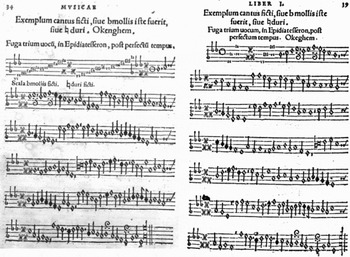
Indeed, a different approach to solmisation labels can be seen in both versions of Heyden's De arte canendi.Footnote 57 Some subtle differences between the two versions of this text notwithstanding, there are a number of examples in both volumes that apply solmisation content to the staff lines of notated musical examples. It should be noted from the outset, however, that the placement of such symbols in these contexts is different from the approach taken by Tinctoris (see Fig. 2); the examples often bypass mutation altogether. Instead of being placed at specific mutation points, as seen in Agricola's example (Fig. 8), solmisation content in the two treatises by Heyden is mapped onto the staff lines and spaces to which they apply in various syllabic configurations at the beginning of the example.Footnote 58 These configurations are indicated with the use of flat and sharp symbols to indicate the canonic entries at the start of the example, leaving the reader to identify the appropriate arrangement within the example itself. Heyden's approach was slightly streamlined in his second edition of the treatise (Fig. 9, right), but the same intention is retained.
(left) Sebald Heyden, Musicae, id est, artis canendi libro duo (Nuremberg, 1537), 34. Bayerische Staatsbibliothek München, BSB Mus. Th. 664. (right) Sebald Heyden, De arte canendi (Nuremberg, 1540), 39. Bayerische Staatsbibliothek München, BSB Mus. Th. 665. Reproduced with the kind permission of Bayerische Staatsbibliothek, München.

In Figure 9, which is taken from Ockeghem's three-part canon Prenez sur moy, the inclusion of solmisation syllables on the staff lines and spaces maps hexachordal practices on to staff notation in a way that draws explicit links with this type of notation.Footnote 59 It perhaps also shows that Tinctoris's rather pedantic notion that notes were the lines and spaces themselves still held relevance at this time, and that solmisation remained an important part of the conceptualisation of musical space, even if in a non-mutation-based context.Footnote 60 However, this process of mapping solmisation content onto staff lines functions in a different way from the other examples seen in this article. Despite these differences, it shows that approaches similar to those seen in Tinctoris's Expositio manus continued to hold weight in the decades that followed, even after the importance of the overlapping conceptual layers of properties, deductions and syllables was revised in musical practice. It may also be indicative of a contemporary trend towards increasing pedagogical specificity in musical examples and the relationships formed to create a theoretical whole.
To summarise, it is clear that there are a number of significant differences between the approaches towards the exemplification of mutation, and solmisation more generally, seen in the case studies set out above. As the examples from Marchetus of Padua's Lucidarium demonstrate, one of the foundational aspects of exemplifying mutation in some writings about the practice of music, even at the beginning of the fourteenth century, was to provide a semi-realistic monophonic context in which to conceive these mutations. This, of course, does not apply universally, but given the fact that elements of the same approach can be seen in texts from more than a century later, such a practice must have exerted a fairly widespread influence.
The treatise attributed to the Carthusian anonymous is an intriguing artefact that is worthy of further exploration in more general terms. However, its approach towards the exemplification of mutation shows some similarities to Marchetus's approach, whilst holding many significant differences. The main element of difference in this theorist's approach is the inclusion of solmisation syllables within the staff-based notation. In the case of this treatise, almost every note in the example is accompanied by a solmisation syllable. The resulting contextual clutter can obscure the points of mutation in places.
This technique is presented in a much more pedagogically refined form in Johannes Tinctoris's Expositio manus, where a series of musical examples are provided, offering a systematic examination of each of the possible mutations. Such an approach bears many similarities to Marchetus's Lucidarium, though there are some important differences in regards to the exemplary content. Tinctoris's text, unlike Marchetus's, is preserved with almost uniform exemplary content across the surviving manuscript sources. In addition to this, Tinctoris chooses to place solmisation syllables above each of the points of mutation specified in the theoretical text. Strong text–example links are formed as Tinctoris matches the ordering of these two elements, facilitating a kind of concurrent reading that would have been more challenging with Marchetus's text.
Similarities in exemplary approach are also seen in the Ritus canendi of Johannes Gallicus, even if views on the theoretical practices pertaining to the Guidonian Hand differ significantly. It is noteworthy that Johannes Gallicus, keen to demonstrate the primacy of the seven letters over the six syllables, would seek to notate a voice part within an example using a mix of letters and solmisation content, rather than simply black-full notation as he does for the other voice. For all it seems, therefore, these added annotations, albeit for different purposes from the other treatises examined in this article, served a conceptual function whereby the reader was expected to conceptualise musical space through more than the staff-based system alone: the sense of the gamut still persisted, even if in a slightly different way in Gallicus's eyes.
The evidence found in Agricola's treatise and both editions of Heyden's treatise on the art of singing further support this increasing shift towards the alliance of solmisation content and the gamut as a kind of conceptual pairing with staff-based notation. In effect, the two systems coexisted in a mutually beneficial fashion, even if Gallicus sought to simplify some of the verbosities he felt had been introduced.
Thus, it is clear that there are significant differences in the ways that music theorists addressed solmisation content and mutation more specifically. However, the degree of similarity in certain aspects of their approach suggests that there is something of a model of exemplarity that can be traced through these texts. The development of a conceptual logic and exemplary approach that can be seen throughout these texts allows us to get a sense of the ways in which contemporary perspectives on mutation shifted across the fourteenth and fifteenth centuries, even if we are still some way off definitive answers.