Introduction
Commensal rodent species thrive in close proximity to agriculture, animal production and human dwellings (Langton et al., Reference Langton, Cowan and Meyer2001). In general, the main commensal species found in both rural and urban areas are the house mouse (Mus musculus), the black rat (Rattus rattus) and the Norway rat (R. norvegicus). These rodents are the cause of extensive economic damage to cultivated fields and, in relation to public health, can transmit, maintain and spread zoonotic agents such as viruses, bacteria and helminths through their faeces, urine, aerosols or ectoparasites (Easterbrook et al., Reference Easterbrook, Kaplan, Vanasco, Reeves, Purcell, Kosoy, Glass, Watson and Klein2007).
Several studies have shown that certain gastrointestinal helminths of commensal rodents represent a risk to public health (Waugh et al., Reference Waugh, Lindo, Foronda, Ángeles- Santana, Lorenzo-Morales and Robinson2006; Hancke et al., Reference Hancke, Navone and Suarez2011). The helminths Hymenolepis nana, H. diminuta and Capillaria hepatica have been reported as zoonotic, and Moniliformis moniliformis and Raillietina sp. as potentially zoonotic species (Stojcevic et al., Reference Stojcevic, Mihaljevic and Marinculic2004; Waugh et al., Reference Waugh, Lindo, Foronda, Ángeles- Santana, Lorenzo-Morales and Robinson2006; Easterbrook et al., Reference Easterbrook, Kaplan, Vanasco, Reeves, Purcell, Kosoy, Glass, Watson and Klein2007; Hancke et al., Reference Hancke, Navone and Suarez2011). Moreover, rodents are the intermediate hosts for Echinococcus multilocularis, Toxocara spp. and Toxoplasma gondii, and may serve as indicators for assessing the occurrence and level of environmental contamination and infection pressure with free-living stages of these zoonotic parasites (Reperant et al., Reference Reperant, Hegglin, Tanner, Fischer and Deplazes2009).
Commensal rodents exhibit great adaptability and behavioural flexibility to anthropogenic ecosystem alterations, exploiting industrial and commercial buildings, households, vacant areas, parks, farms and cultivated fields (Gomez et al., Reference Gomez, Provensal and Polop2009). Households are ideal habitats for rodents, and as a result, rodents are a serious problem in both urban and rural areas (Langton et al., Reference Langton, Cowan and Meyer2001). However, in rural areas, the poor hygiene and housing conditions promote close contact between people and rodents. Epidemiological studies are required in many rural areas of Mexico, especially when we consider that 22.2% of the Mexican population lives in rural areas and 64.9% of these live in poverty (INEGI, 2010; CONEVAL, 2011). Panti-May et al. (Reference Panti-May, Hernández-Betancourt, Ruíz-Piña and Medina-Peralta2012) reported that in a rural locality of Yucatan, Mexico, all households inspected were found to be infested with M. musculus and R. rattus. However, surveys of the intestinal helminths of commensal rodents in Mexico are few and such studies have been conducted on nature reserves (Pulido-Flores et al., Reference Pulido-Flores, Moreno-Flores and Monks2005), or in peri-urban areas (Tay-Zavala et al., Reference Tay-Zavala, Alvarez, Gutiérrez-Quiroz, Sánchez-Vega and Fernández-Presas1999) with few studies carried out in households (Rodríguez-Vivas et al., Reference Rodríguez-Vivas, Panti-May, Parada-López, Hernández-Betancourt and Ruíz-Piña2011). In south-eastern Mexico, only the presence of Cysticercus fasciolaris has been reported in the liver of M. musculus and R. rattus (Rodríguez-Vivas et al., Reference Rodríguez-Vivas, Panti-May, Parada-López, Hernández-Betancourt and Ruíz-Piña2011), and there has never been a comprehensive study of the endoparasite species carried by rodents in rural and urban households.
The aim of this study was to estimate the prevalence and intensity of intestinal helminths in M. musculus and R. rattus trapped in households of a rural community in Yucatan, Mexico. This study will also analyse the demographic and seasonal distribution of helminths with respect to host species, sex, age and season, in order to determine the role of rodents as potential reservoirs for zoonotic parasites.
Materials and methods
Collection and examination of rodents
Rodent sampling was conducted in the community of Molas (20°48′55″ N and 89°37′55″W), located in a rural area of Yucatan, Mexico. Molas is 30,066 m2 in area, has 2014 inhabitants and is located within the ‘Cuxtal’ Ecological Reserve, where the vegetation is representative of a low deciduous tropical forest. The regional climate is warm, sub-humid with a maximum temperature of 36°C in May, a minimum of 16°C in January and an average annual rainfall of 1100 mm (INEGI, 2010).
Sampling was carried out during the 2011 rainy season (October to December) and the 2012 dry season (January to March) in 40 households using Sherman traps (7.5 × 23 × 9 cm; HB Sherman Traps Inc., Tallahassee, Florida, USA) baited with a mixture of oats and vanilla. Monthly, 12 traps were set in each house, distributed throughout the dwelling and/or yard (depending on the wishes of the owners) for three consecutive nights. Trapped animals were transported to laboratory, euthanized by cervical dislocation and dissected according to the guidelines of the American Society of Mammalogists (Sikes et al., 2011). The species, sex and weight of each specimen were recorded. Rodent age was designated as follows: in M. musculus, individuals were classified as subadult ( < 9 g female, < 10 g male) or adult ( ≥ 9 g female, ≥ 10 g male), while in R. rattus, the categories were subadult ( ≤ 70 g female, ≤ 80 g male) or adult (>70 g female,>80 g male) (Panti-May et al., Reference Panti-May, Hernández-Betancourt, Ruíz-Piña and Medina-Peralta2012).
One hundred and fifty-four M. musculus and 46 R. rattus were examined, totalling 100 rodents each for the wet and dry seasons. Viscera were frozen at − 20°C or inspected fresh. The liver, stomach, small and large intestines were placed in Petri dishes containing saline solution. The liver (considered as part of the intestinal tract) was examined for cestode larval capsules while the entire gastrointestinal tract was opened lengthwise and gut content inspected for the presence of helminths using a stereomicroscope. Any helminths found were preserved in 70% ethanol. For identification, nematodes were cleared in lactophenol, while cestodes were stained with Semichon's acetic carmine and mounted in Canada balsam. Vouchers of specimens were deposited in the Helminthological Collection of the Museo de La Plata, Argentina (Nos 6684, 6685, 6686 and 6687).
Data analysis
Prevalence and mean intensity (MI) of helminth infection were calculated (Bush et al., Reference Bush, Lafferty, Lotz and Shostak1997). To evaluate the statistical differences in helminth infection between mice and rats, the chi-squared test was used. The relationship between the prevalence of infection of M. musculus with helminths (regardless of the helminth species) and each helminth species relative to host age, sex and season was also tested by chi-squared and Fisher's exact tests, and to determine differences in MI the Bootstrap test was used (Quantitative Parasitology 3.0 software, Rózsa et al., Reference Rózsa, Reiczigel and Majoros2000). In R. rattus, the relationship between the prevalence and MI of infection relative to host age, sex and season were not tested, due to the small sample size. The dominance level of each species in the component community was estimated [D = (number of individuals of a particular parasite species in a particular host species/total number of parasites in this host species) × 100] according to Morales & Pino (Reference Morales and Pino1987).
Results
Of 154 mice examined, 88 were males and 66 females (127 adults and 27 subadults), while of 46 rats examined, 26 were males and 20 females (25 adults and 21 subadults). The overall prevalence of intestinal helminths in commensal rodents was 77% (95% confidence interval (CI): 70.5–82.5%). Further analysis indicated that the prevalence of helminth infection among M. musculus (84.2%) was significantly higher than in R. rattus (52.2%) (χ2= 20.79, df = 1, P< 0.01). In M. musculus, adults were more likely to be infected with helminths (89%) than subadults (63%) (Fisher's exact test, P< 0.01); however, the prevalence of helminth infection did not show significant differences in relation to host sex and season (P>0.05).
Of 200 rodents examined, 81.8% harboured one species of helminth, 16.2% of animals had two and 1.9% of individuals were infected with three different species. No statistical differences were observed between multiple helminth infections with respect to host species, age, sex and season (P>0.05).
More than 6000 helminths were collected from the intestinal tracts of the rodents, belonging to four helminth species: one cestode, Taenia taeniaeformis Batsch, 1786, larvae; and three nematodes, Nippostrongylus brasiliensis Travassos, 1914, Syphacia muris Yamaguti, 1935, and Trichuris muris Schrank, 1788. Nippostrongylus brasiliensis and T. taeniaeformis were found in both M. musculus and R. rattus, while T. muris was found exclusively in M. musculus and S. muris found only in R. rattus.
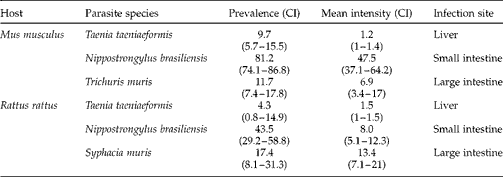
In M. musculus, N. brasiliensis was the most prevalent helminth (81.2%), followed by T. muris (11.7%; table 1). Intensity followed the same trend, with the highest values seen for N. brasiliensis (MI = 47.5) and T. muris (MI = 6.9). Nippostrongylus brasiliensis dominated the component community in mice (D = 97.6%). In R. rattus, N. brasiliensis was the most prevalent helminth (43.5%), followed by S. muris (17.4%). Intensity was low for N. brasiliensis (MI = 8), but higher in S. muris (MI = 13.4). Nippostrongylus brasiliensis (D = 59.3%) and S. muris (D = 39.6%) dominated the component community in rats.
Prevalence (%), mean intensity and site of infection of Taenia taeniaeformis (cysticercus), Nippostrongylus brasiliensis, Trichuris muris and Syphacia muris in Mus musculus (n=154) and Rattus rattus (n=46) from Yucatan, Mexico.
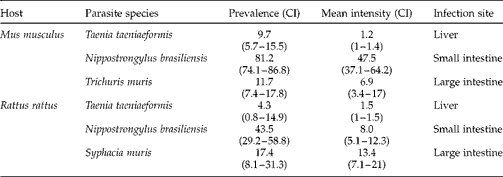
CI, 95% confidence intervals.
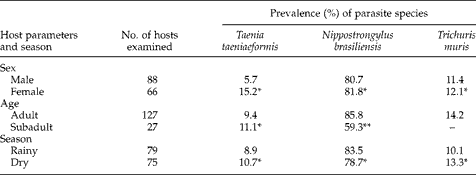
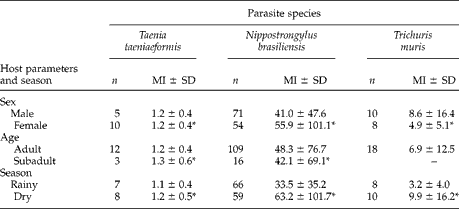
The prevalence of infection of M. musculus with T. taeniaeformis, N. brasiliensis and T. muris relative to host age, sex and season is shown in table 2. Taenia taeniaeformis showed no preference for host age, sex or season (P>0.05); however, N. brasiliensis was present more frequently in adult than in subadult mice (χ2= 7.68, df = 1, P< 0.01) while T. muris was only present in adult mice. In contrast, there were no significant differences in MI of infected M. musculus with T. taeniaeformis, N. brasiliensis and T. muris relative to host age, sex and season (table 3).
The relationship between the prevalence of infection of Mus musculus with Taenia taeniaeformis (cysticercus), Nippostrongylus brasiliensis and Trichuris muris, relative to host sex, age and season from Yucatan, Mexico.
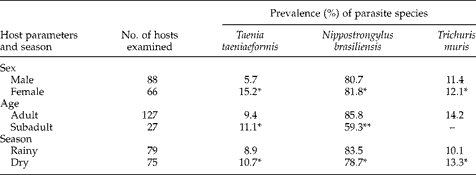
Chi-square exact significance (two-sided test) or Fisher's exact test where>25% of cells have an expected count < 5. *P>0.05; **P< 0.01.
The relationship between the mean intensity (MI) of infection of Mus musculus with Taenia taeniaeformis (cysticercus), Nippostrongylus brasiliensis and Trichuris muris, relative to host sex, age and season from Yucatan, Mexico.
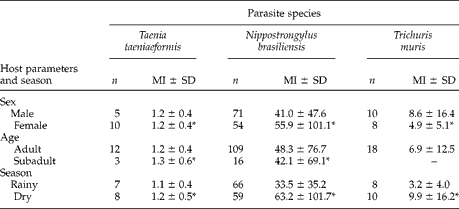
Bootstrap t-test (2-sided), each with 2000 replications.
*P>0.05; SD, standard deviation; n, hosts infected.
Mus musculus had a higher prevalence (χ2= 25.24, df = 1, P< 0.01) and MI (t= 5.6, P< 0.05) of infection with N. brasiliensis than R. rattus; however, both rodents had similar prevalence and MI of T. taeniaeformis (P>0.05).
Discussion
The helminth fauna of commensal rodents has been studied worldwide. However, these studies have been performed primarily on R. norvegicus (Stojcevic et al., Reference Stojcevic, Mihaljevic and Marinculic2004; Gomez Villafañe et al., Reference Gomez Villafañe, Robles and Bush2008; Hancke et al., Reference Hancke, Navone and Suarez2011) with few studies focusing on sympatric M. musculus and R. rattus present in households from rural localities of Mexico (Rodríguez-Vivas et al., Reference Rodríguez-Vivas, Panti-May, Parada-López, Hernández-Betancourt and Ruíz-Piña2011). In this study, we examined the intestinal helminths of two commensal rodents commonly present in rural households of Yucatan, Mexico.
The overall prevalence of helminths in commensal rodents is influenced by different environmental conditions. In our study, 77% of rodents were infected with helminths, as compared to levels reported in Argentina (Hancke et al., Reference Hancke, Navone and Suarez2011), Italy (Milazzo et al., Reference Milazzo, Ribas, Casanova, Cagnin, Geraci and Di Bella2010b), Panama (Calero et al., Reference Calero, Ortiz and De Souza1950), Puerto Rico (de León, Reference de León1964), Jamaica (Waugh et al., Reference Waugh, Lindo, Foronda, Ángeles- Santana, Lorenzo-Morales and Robinson2006) and the USA (Clark, Reference Clark1970), where the prevalence of infected M. musculus, R. rattus and/or R. norvegicus varied from 23.4 to 98.6%. These studies indicate that the prevalence of helminths in commensal rodents is highly variable across locations.
The prevalence of helminth infection found in this study was higher in mice (84.2%) than in rats (52.2%). This is contrary to the findings of Hall et al. (Reference Hall, Sonnenberg and Hodes1955), who reported a higher infection rate in R. norvegicus (80%) than in M. musculus (25.9%) in the USA. Similarly, in Italy, Milazzo et al. (Reference Milazzo, Cagnin, Di Bella, Geraci and Ribas2010a) found that R. rattus (92.7%) was infected to a greater degree than M. musculus (61.6%). These differences in infection rates may be due to particular characteristics of habitat, the helminth species present in the area, as well as the behaviour and relative abundance of the hosts. In this study, the large areas of soil and vegetation present in household yards could provide the ideal environment for the maintenance of infective parasite stages, increasing the infection rate in predominantly ground-dwelling/terrestrial animals (such as mice). Taken in conjunction with the greater abundance of mice reported in the community (Panti-May et al., Reference Panti-May, Hernández-Betancourt, Ruíz-Piña and Medina-Peralta2012), these factors could influence the spread and distribution of parasites among mice, as the number of hosts available for parasite colonization is known to determine the helminth infection rate (Krasnov et al., Reference Krasnov, Poulin, Morand, Morand, Krasnov and Poulin2006).
In the present study, 81.8% of rodents were infected with one species of helminth, while 18.2% of animals carried multiple infections. This is similar to the reports of Waugh et al. (Reference Waugh, Lindo, Foronda, Ángeles- Santana, Lorenzo-Morales and Robinson2006) who found that 80.0% of the infected rats carried one helminth species. Multiple infections did not differ significantly when hosts, sex, age or season were considered.
In M. musculus, age was found to be a significant factor for helminth infection. Relatively higher levels of infection in adult rodents, compared to juveniles or subadults, have been reported previously for R. norvegicus in Croatia (Stojcevic et al., Reference Stojcevic, Mihaljevic and Marinculic2004) and Italy (Milazzo et al., Reference Milazzo, Ribas, Casanova, Cagnin, Geraci and Di Bella2010b) as well as in M. musculus from Portugal (Martins Pereira, Reference Martins Pereira2009). Several mechanisms are cited to explain this pattern, which include parasite-induced mortality, acquired immunity, age-related changes in predisposition to infection (e.g. due to the development of resistance mechanisms that are unrelated to previous exposure to parasites), and age-dependent changes in exposure to parasites (e.g. due to behavioural shifts or seasonality) (Wilson et al., Reference Wilson, Bjornstad, Dobson, Merler, Poglayen, Randolph, Read, Skorping, Hudson, Rizzoli, Grenfell, Heesterbeek and Dobson2002).
Felids (primarily) serve as the final hosts for T. taeniaeformis larvae ( = Cysticercus fasciolaris) and rodents can act as intermediate hosts. This study showed a prevalence of infection in mice of 9.7% and 4.3% in rats, which was similar to that reported by Rodríguez-Vivas et al. (Reference Rodríguez-Vivas, Panti-May, Parada-López, Hernández-Betancourt and Ruíz-Piña2011) in the same community (mice 9%, rats 3.5%). In Sicily, Italy, Milazzo et al. (Reference Milazzo, Cagnin, Di Bella, Geraci and Ribas2010a) reported that 1.4% of mice were infected with T. taeniaeformis while rats were uninfected. However, in Hidalgo, Mexico, Pulido-Flores et al. (Reference Pulido-Flores, Moreno-Flores and Monks2005) only found T. taeniaeformis infection in wild R. rattus. In the area sampled for this study, the uncontrolled reproduction of cats is a serious problem; they roam freely between yards searching for food and contaminating the environment with mature proglottids. We believe that R. rattus is less likely to become infected, as it inhabits tall structures and trees close to houses; this is in contrast to M. musculus which lives in burrows in the immediate vicinity of the dwellings and limits its movements in commensal habitats (King, Reference King1950).
To our knowledge, this study is the first to report the natural infection of M. musculus with N. brasiliensis in Mexico. The presence of N. brasiliensis has been reported previously in wild populations of R. rattus from Hidalgo (Pulido-Flores et al., Reference Pulido-Flores, Moreno-Flores and Monks2005) and in commensal populations of R. norvegicus from Michoacan (Hierro-Huerta, Reference Hierro-Huerta1992) but not in populations of M. musculus (García-Prieto et al., Reference García-Prieto, Falcón-Ordaz and Guzmán-Cornejo2012) in Mexico. Nippostrongylus brasiliensis is common in wild and commensal R. norvegicus throughout the world. It also occurs, albeit much less frequently, in R. rattus and, rarely, in M. musculus (Pulido-Flores et al., Reference Pulido-Flores, Moreno-Flores and Monks2005; Milazzo et al., Reference Milazzo, Cagnin, Di Bella, Geraci and Ribas2010a; Hancke et al., Reference Hancke, Navone and Suarez2011). In several countries of the Caribbean region (e.g. Panama, Puerto Rico, Costa Rica and Jamaica), this parasite is one of the most prevalent in rodents (Calero et al., Reference Calero, Ortiz and De Souza1950; Vives & Zeledón, Reference Vives and Zeledón1957; de León, Reference de León1964; Waugh et al., Reference Waugh, Lindo, Foronda, Ángeles- Santana, Lorenzo-Morales and Robinson2006). Laboratory studies have shown that high moisture conditions are vital for the development of N. brasiliensis, with maximal hatching of eggs occurring at temperatures between 22 and 30°C and larvae tolerating at temperatures of up to 49°C (Haley, Reference Haley1962). These are the predominant conditions in Yucatan (and all tropical areas in general), appearing to provide the ideal environment for maintaining this worm in rodent populations. As infection with N. brasiliensis occurs mainly through larval penetration of the skin of the host, the lower prevalence and intensity in R. rattus (as opposed to M. musculus which has a higher rate of infection) could be explained by the predominantly arboreal habitat and the limited use of the ground (Worth, 1950; Hooker & Innes, Reference Hooker and Innes1995) which could reduce the exposure time to infective larvae.
Syphacia muris is the common pinworm of laboratory, wild and commensal rats. Infection in rats occurs through the ingestion of infective eggs or retrofection (Stahl, Reference Stahl1963) and the grooming behaviour of rats could favour the maintenance of S. muris (Anderson, Reference Anderson2000). In Mexico, S. muris has only been reported in R. rattus from Hidalgo, at a prevalence of 50% (Pulido-Flores et al., Reference Pulido-Flores, Moreno-Flores and Monks2005). The low prevalence recorded in our study (17.4%) was similar to that reported in Argentina (14%, Gomez Villafañe et al., Reference Gomez Villafañe, Robles and Bush2008) and Italy (19.5%, Milazzo et al., Reference Milazzo, Cagnin, Di Bella, Geraci and Ribas2010a).
In America, most studies have reported that natural infection by T. muris is rare or uncommon in R. rattus and R. norvegicus (Panama, Calero et al., Reference Calero, Ortiz and De Souza1950; USA, Hall et al., Reference Hall, Sonnenberg and Hodes1955; Costa Rica, Vives & Zeledón, Reference Vives and Zeledón1957; Mexico, Tay-Zavala et al., Reference Tay-Zavala, Alvarez, Gutiérrez-Quiroz, Sánchez-Vega and Fernández-Presas1999; Jamaica, Waugh et al., Reference Waugh, Lindo, Foronda, Ángeles- Santana, Lorenzo-Morales and Robinson2006; Argentina, Hancke et al., Reference Hancke, Navone and Suarez2011). In our survey, T. muris was only recorded in mice, supporting the findings of Milazzo et al. (Reference Milazzo, Goüy de Bellocq, Cagnin, Casanova, Di Bella, Feliu, Fons, Morand and Santalla2003, Reference Milazzo, Cagnin, Di Bella, Geraci and Ribas2010a) and Pulido-Flores et al. (Reference Pulido-Flores, Moreno-Flores and Monks2005) relating to sympatric M. musculus and R. rattus. This difference in infection between mice and rats lacks a clear explanation, though infection with T. muris is by ingestion of food contaminated with infective eggs (soil-transmitted helminth), and the absence of this parasite in rats could be the result of their arboreal habitat and feeding behaviour. Rattus rattus visits a few recognized feeding locations, in contrast to M. musculus, which has been described as an erratic feeder, visiting many locations during a single foray (sites varying from night to night), potentially contaminating its foraging sites (Clapperton, Reference Clapperton2006). Moreover, the higher infection rate found in the adults compared to subadults, may be related to sexual maturity; the male androgens acting via cytokines to suppress immunity, while lactation has also been shown to suppress the immune response to T. muris (Selby & Wakelin, Reference Selby and Wakelin1975; Hepworth et al., Reference Hepworth, Hardman and Grencis2010).
In this study, we recorded four helminths species in commensal rodents. Similarly, in Mexico, Pulido-Flores et al. (Reference Pulido-Flores, Moreno-Flores and Monks2005) reported that R. rattus and M. musculus from two localities of Hidalgo harboured three and five gastrointestinal helminth species, respectively. In Chile, Landaeta-Aqueveque et al. (Reference Landaeta-Aqueveque, Robles and Cattan2007) found only three helminth species in M. musculus from three sites. However, studies in Panama (Calero et al., Reference Calero, Ortiz and De Souza1950), Costa Rica (Vives & Zeledón, Reference Vives and Zeledón1957), Puerto Rico (de León, Reference de León1964) and Jamaica (Waugh et al., Reference Waugh, Lindo, Foronda, Ángeles- Santana, Lorenzo-Morales and Robinson2006) reported a more diverse helminth fauna. The depauperation of island fauna and flora in free-living organisms as well as parasites is a well-known pattern (Krasnov et al., Reference Krasnov, Poulin, Morand, Morand, Krasnov and Poulin2006). The ‘peninsula effect’ of North America has a similar pattern, observed as a decrease in species diversity (mammals and birds) as one moves from the base to the tip of the peninsula (Taylor & Regal, Reference Taylor and Regal1978; Wiggins, Reference Wiggins1999). We postulate a similar effect on parasite diversity in the study area, which is located at the tip of the peninsula. Additionally, the geographic range of a host can affect the diversity of parasite species (Feliu et al., Reference Feliu, Renaud, Catzeflis, Hugot, Durand and Morand1997), where a reduction in home range for mice and rats in commensal habitats in contrast to natural habitats (Battersby et al., Reference Battersby, Hirschhorn, Amman, Bonnefoy, Kampen and Sweeney2008) could reduce the diversity of parasites. However, in the Yucatan Peninsula, there are no previous studies on species diversity of the parasites infecting rodents, so a more in-depth study of these factors could serve to explain this depauperate helminth fauna.
Among the helminth fauna present in commensal rodents, H. diminuta, H. nana, and C. hepatica are of relevance to public health. In our survey, none of these helminths were found in rodents. On the other hand, T. taeniaeformis is capable of infecting humans (Sterba & Barus, Reference Sterba and Barus1976; Ekanayake et al., Reference Ekanayake, Warnasuriya, Samarakoon, Abewickrama, Kuruppuarachchi and Dissanaike1999) and its occurrence in rodents (as intermediate hosts) indicates that this cestode is enzootic in cats, and may thus represent a public health risk, especially to children. Rodents could also serve as an important sentinel for this cestode. Nippostrongylus brasiliensis, the parasite with the highest prevalence in both rodents, is not reported as being zoonotic, although its impact in densely populated environments is not known (Hancke et al., Reference Hancke, Navone and Suarez2011).
Hymenolepis nana is a parasite with a direct life cycle that is common in both humans and rodents (Hancke et al., Reference Hancke, Navone and Suarez2011). The presence of H. nana has been reported in people of a rural village close to the community of Molas, having a prevalence of 9.6% (Rodríguez-Pérez et al., Reference Rodríguez-Pérez, Pérez-Vega, Cen-Aguilar and Rodríguez-Canul2011). In a previous study in the same community, Panti-May et al. (Reference Panti-May, Hernández-Betancourt, Ruíz-Piña and Medina-Peralta2012) reported an abundance of commensal rodents in households, having access to kitchens, cupboards and food storage. If we consider these conditions, and that commensal rodents are introduced species, the impact of rodent helminths on public health could be underestimated.
In conclusion, our study reports for the first time on the natural infection of commensal rodents in Yucatan with N. brasiliensis, S. muris and T. muris and is the first report of N. brasiliensis infecting M. musculus in Mexico. We found a higher occurrence of helminths in mice than in rats, and the prevalence and intensity of N. brasiliensis infection were higher in M. musculus than in R. rattus. This suggests that the helminth fauna of commensal rodents present in households of Molas constitutes a low potential health risk to people. Nevertheless, it would be advisable to conduct further studies in other rural and urban localities in order to improve our understanding of the public health risks posed by the intestinal helminths of commensal rodents.
Acknowledgements
We would like to thank Julian Parada, Maribel Herrera, Margarita Reyes, Fanny Quijano and Marco Torres for their support with the fieldwork, Teresa Aguilar for her support in the laboratory work, and Graciela Navone for her assistance in the study of cestodes and her support in the CEPAVE laboratory.
Financial support
J.A.P. was supported by a Masters grant from Consejo Nacional de Ciencia y Tecnología. This project was founded by PROMEP-México-Proyecto 103.5/09/1258 (Red epidemiológica de enfermedades zoonóticas y transmitidas por vectores de importancia en salud pública).
Conflict of interest
None.
Ethical standards
The authors assert that all procedures contributing to this work comply with the ethical standards of the guidelines of the American Society of Mammalogists.