Westoll's (Reference Westoll, Jepsen, Mayr and Simpson1949) classic study on the evolution of the Dipnoi concluded that diversity among lungfish was at its greatest in the Devonian, following the origin of the group, and then declined sharply after establishing a body form that was then little changed to the present day. These ideas gained support and influence with the subsequent description of new lungfish from the Devonian of Greenland (Lehman Reference Lehman1959) and North America (Thomson & Campbell Reference Thomson and Campbell1971), and discoveries in Australia (Miles Reference Miles1977) and China (Chang & Yu Reference Chang and Yu1982). Little was published on later Palaeozoic lungfish in the years following Westoll's study, especially in the UK. Thompson (Reference Thomson1965) named and described neglected material from the Lower Carboniferous of Scotland collected in the 19th Century and Smith et al. (1987) redescribed the dentition of Uronemus, but it was not until Jenny Clack supervised a PhD project on British Carboniferous lungfish undertaken by Esther Sharp (Sharp Reference Sharp2007; Clack et al. Reference Clack, Sharp, Long, Jørgensen and Joss2011; Sharp & Clack Reference Sharp and Clack2012, Reference Sharp and Clack2013), that interest was revived. Around the same time, new analyses on the rates of evolution began to question some of the assumptions in Westoll's study, in particular what the impact of mass extinction events had on the trajectory of evolution (e.g., Jablonski Reference Jablonski2001). A re-examination of lungfish evolution by Lloyd et al. (Reference Lloyd, Wang and Brusatte2011) using a higher level of resolution and shorter time bins, found that morphological evolution among lungfish may not have slowed significantly until the Cretaceous (see also Kemp et al. Reference Kemp, Cavin and Guinot2017). The subsequent discovery of a diverse lungfish fauna in the early Mississippian of Scotland (Smithson et al. Reference Smithson, Richards and Clack2016) is consistent with this analysis. Our recent examination of lungfish material from the Serpukhovian of the Scottish Midland Valley in the Natural History Museum (NHM), London, that formed part of a collection purchased from the Traquair estate in 1914, has revealed that the high level of morphological diversity found in the Tournaisian may have continued throughout the Mississippian.
During his time as the Keeper of Natural History at the Museum of Science and Arts in Edinburgh (now National Museums Scotland (NMS)), Ramsay Heatley Traquair cemented his reputation as an eminent Victorian palaeoichthyologist through the procurement of an extensive collection of Palaeozoic fishes from across Scotland. His efforts were aided by local quarrymen and miners, in particular from one very productive locality at Loanhead, near Edinburgh. In a series of papers that began in 1873, Traquair described numerous fossil fish from this Serpukhovian site, including four lungfish taxa: Ctenodus interruptus, Sagenodus quinquecostatus, Uronemus splendens and Ctenodus angustulus (Traquair Reference Traquair1873, Reference Traquair1881, Reference Traquair1882, Reference Traquair1890a, Reference Traquair1890b, Reference Traquair1903). All but C. angustulus are now well known, but C. angustulus did not receive the same attention and was only described briefly and never figured. Here we redescribe this neglected material, together with that of new lungfish specimens from the same locality. The specimens reveal a greater diversity of lungfish than previously recognised and add to the growing evidence of heterodonty among Mississippian taxa.
1. Geological setting
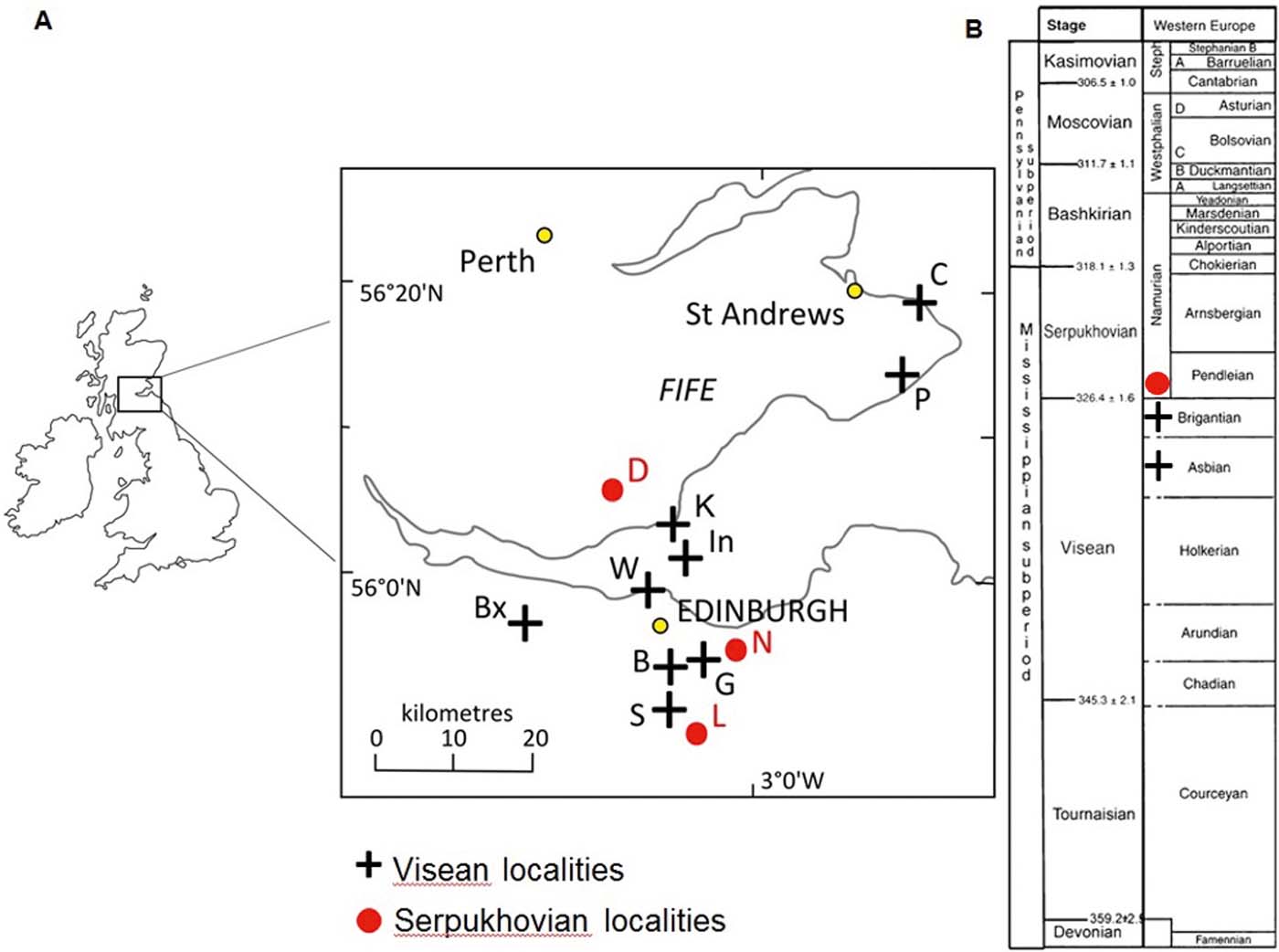
All the material described below was collected in the 1880s from the Blackband Ironstone exposed in the mine workings at Loanhead, Midlothian, Scotland (Fig. 1a). Most specimens were probably recovered at the Burghlee (formerly Borough Lee) colliery, but some may have originated at the Ramsay colliery (Smithson Reference Smithson1985). Following a drafting error in the geological section published by Traquair (Reference Traquair1903), the Blackband Ironstone from Burghlee (Borough Lee Ironstone of Traquair Reference Traquair1881, Reference Traquair1882, Reference Traquair1890a) was, for a long time, erroneously thought to be equivalent to the Loanhead Ironstone No 2. This was shown to be incorrect by Smithson (Reference Smithson1985), who demonstrated that it was instead equivalent to the Rumbles Ironstone or Loanhead Ironstone No 3. This was later verified and confirmed by Andrews and Brand (in Andrews & Carroll Reference Andrews and Carroll1991). The Rumbles Ironstone lies above the Great Seam (Tulloch & Walton Reference Tulloch and Walton1958), near the top of the Limestone Coal Formation in the E1a ammonoid zone of the Pendleian substage of the Namurian in Scotland (Browne et al. Reference Browne, Dean, Hall, McAdam, Monro and Chisholm1999), in the upper part of the Serpukhovian, in the upper Mississippian (Fig. 1b).
Carboniferous geology and late Mississippian lungfish sites in eastern Scotland. (A) Late Mississippian lungfish sites in the Lothians and Fife after Smithson et al. (Reference Smithson, Browne, Davies, Marshall, Millward, Walsh and Clack2017). (B) Carboniferous geology after Smithson et al. (Reference Smithson, Wood, Marshall and Clack2012). Abbreviations: B = Burdiehouse, Edinburgh; Bx = Broxburn; C = new site in E Fife (see Smithson et al. Reference Smithson, Browne, Davies, Marshall, Millward, Walsh and Clack2017); D = Dora, near Cowdenbeath, Fife; G = Gilmerton, Edinburgh; I = Inchkeith; K = Kinghorn, Fife; L = Loanhead, Edinburgh; N = Niddrie, Edinburgh; P = Pitcorthie, Fife; S = Straiton, Edinburgh; W = Wardie, Edinburgh.
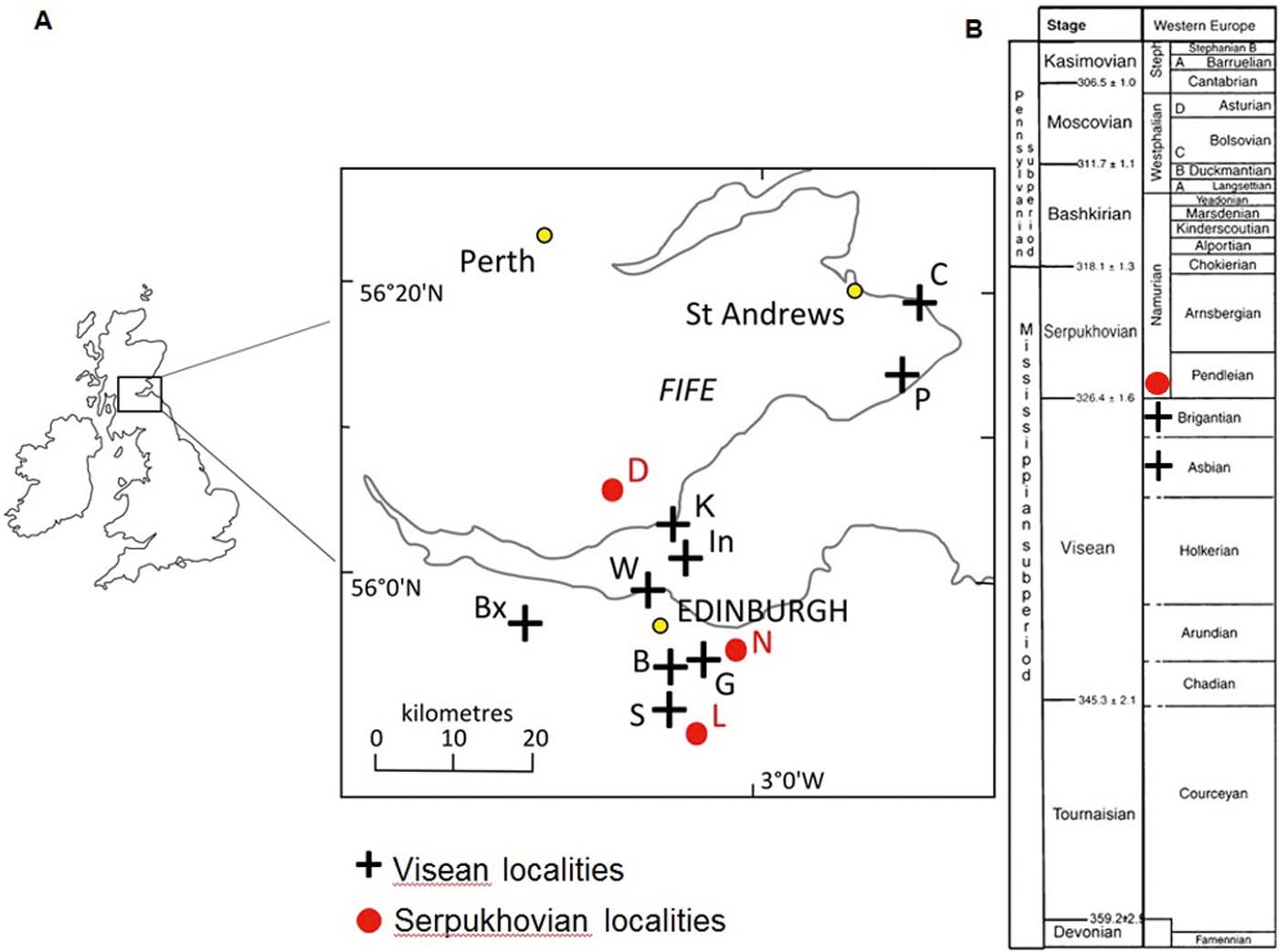
Loanhead is one of four lungfish localities in the Serpukhovian of Scotland; the others are as follows: the Dora opencast site near Cowdenbeath, Fife, lungfish fauna Sagenodus quinquecostatus and Uronemus splendens (Smith et al. Reference Smith, Smithson and Campbell1987); Niddrie near Edinburgh, lungfish fauna Ctenodus interruptus and Sagenodus quinquecostatus (Henrichsen Reference Henrichsen1972), on the eastern side of the Midland Valley (Fig. 1a); and Powgree Burn near Longbar, Glengarnock, in Ayrshire, lungfish fauna Ctenodus interruptus (Sharp & Clack Reference Sharp and Clack2013), on the western side of Scotland.
2. Material and methods
The material described below is housed in the collections of the NHM, London, and NMS, Edinburgh. It is from a single horizon, the Blackband Ironstone of Traquair (Reference Traquair1881), equivalent to the Rumbles Ironstone that was worked extensively during the 1880s, at collieries in the Loanhead area (see Section 1). All the material in the NMS has register numbers beginning 1885 or 1886. The material in the NHM forms part of a collection made by Ward, dated 1894, a collection made by Plant acquired in 1896 or the collection purchased from the Traquair estate in 1914 following Traquair's death in 1912. All the specimens in the NHM labelled ‘Ctenodus' angustulus are correctly identified. In contrast, only one of the specimens at the NMS is identified correctly. Furthermore, ‘C.' angustulus is not listed in their published catalogue (Henrichsen Reference Henrichsen1972). This suggests that the five specimens available when Traquair first described ‘C.' angustulus (Traquair Reference Traquair1881) formed part of the NHM collection purchased from the Traquair estate. In view of this possibility, one of these specimens is identified as the type of the new genus erected in Section 3.
None of the specimens were prepared prior to study because of their small size and delicacy. The terms used by Smithson et al. (Reference Smithson, Richards and Clack2016) to describe lungfish tooth plates are used here. Photographs were taken with a Sony Cyber-shot DSC W-180 camera or a Dino-lite AM1331T. Specimens were micro-computed tomography (CT) scanned using the University Museum of Zoology, Cambridge, X-Tek micro-Ct scanner with the following parameters: X ray power 120–200kv at 120–220μm; number of slices c.1900; at resolutions of between 11.9 and 36.3μm. The scan data were processed using Mimics V19 and segmented using multiple slice threshold editing techniques. Three-dimensional PDFs were created by exporting stereo lithography (STL) files from Mimics segmentation software. All figures were prepared using Adobe Photoshop. Abbreviations used in this study for institutions housing material are as follows: GSL, British Geological Survey, Keyworth; NHMUK, Natural History Museum, London; NMS, National Museums Scotland, Edinburgh; UMZC, University Museum of Zoology, Cambridge.
3. Systematic palaeontology
Osteichthyes Huxley, Reference Huxley1880
Sarcopterygii Romer, Reference Romer1955
Dipnomorpha Ahlberg, Reference Ahlberg1991
Dipnoi Müller, Reference Müller1845
Family undesignated
Genus Clackodus nov.
LSID urn:lsid:zoobank.org:pub:EFFB7007-BE67-495D-B086-5A58AE284B8E
Type species. Clackodus angustulus (Traquair, Reference Traquair1881).
Clackodus angustulus (Traquair, Reference Traquair1881)
(Fig. 2)
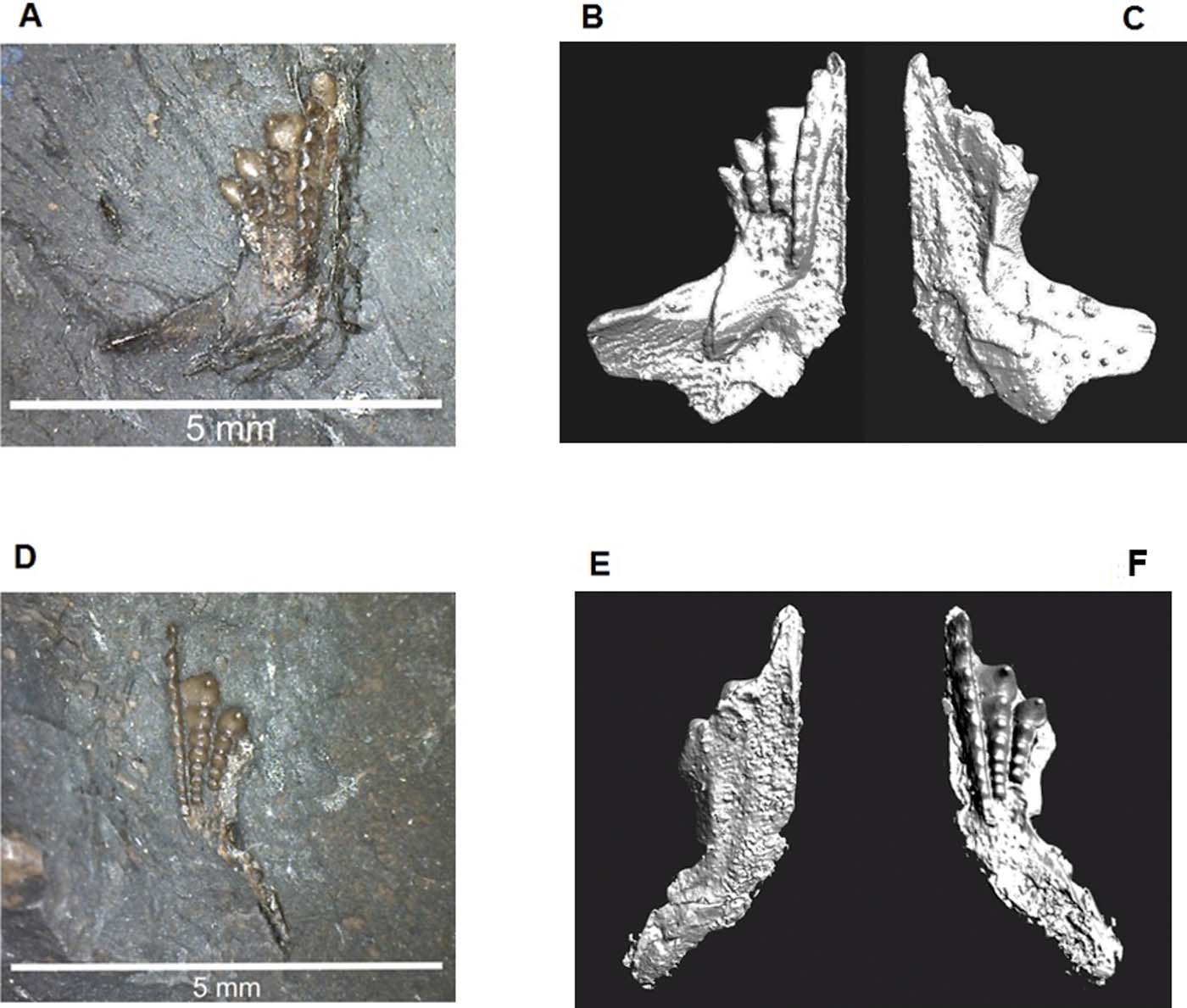
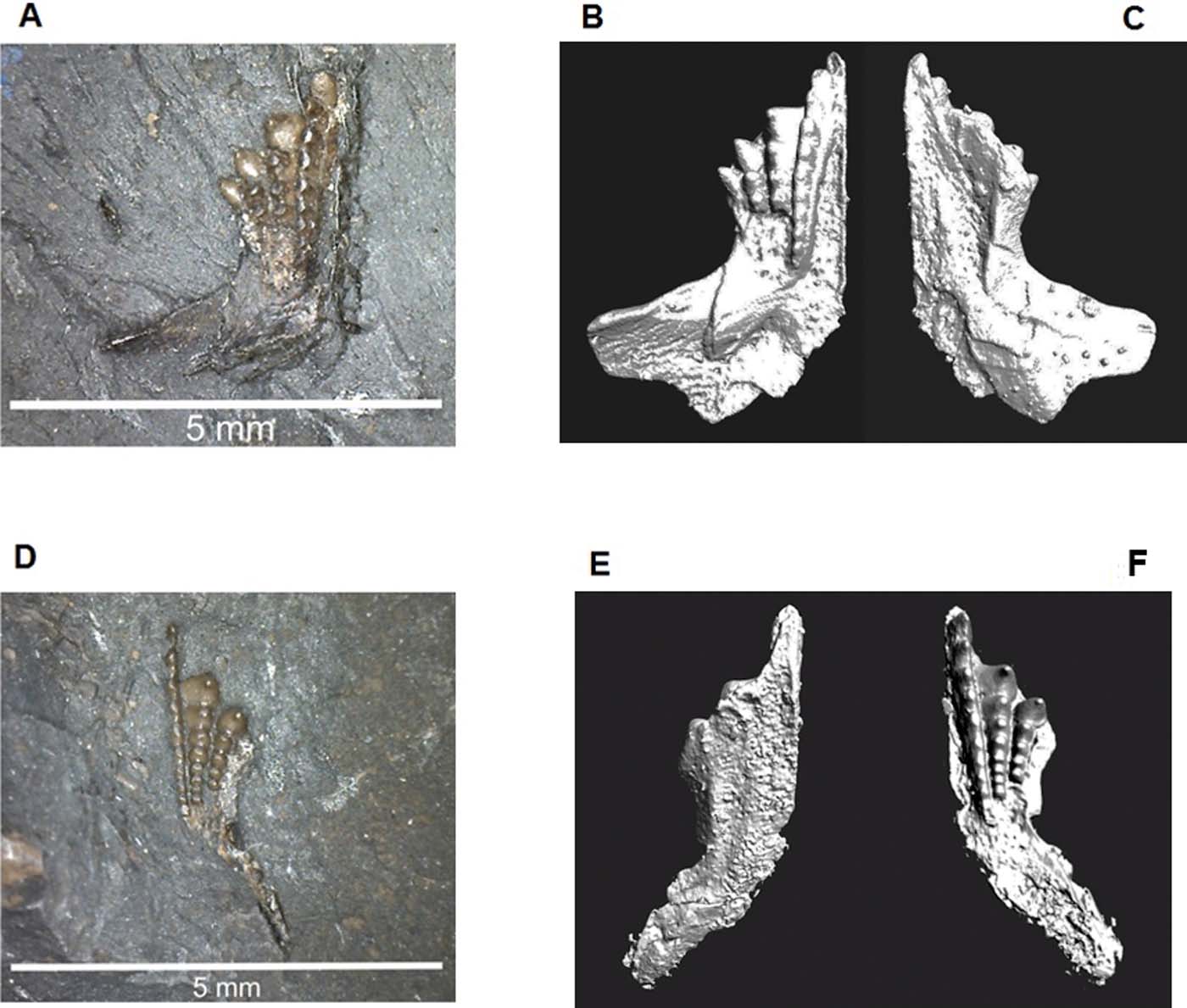
Clackodus angustulus (Traquair, Reference Traquair1881) from Loanhead. (A–C) Right pterygoid NHMUK PVP 11503e. (A) Ventral view. (B, C) Micro-CT scans. (B) Ventral view. (C) Dorsal view. (D–F) Left prearticular NMS G 1886.87.16.4. (D) Dorsal view. (E, F) Micro-CT scans. (E) Ventral view. (F) Dorsal view. Scale bars = 5mm.
Derivation of name. In honour of Professor Jennifer Clack for leading the recent revival of interest in British Carboniferous lungfish and from the Greek ‘odous', meaning tooth.
Type specimen. NHMUK PVP 11503e.
Type locality and horizon. Rumbles Ironstone (see Section 1) at Burghlee Colliery, Loanhead, Midlothian, Scotland, in the Limestone Coal Formation of the Clackmannan Group, ammonoid zone E1a of the Pendelian substage, Serpukhovian, Mississippian (Browne et al. Reference Browne, Dean, Hall, McAdam, Monro and Chisholm1999)
Diagnosis. Small, triangular-shaped tooth plates, maximum length 3.5mm, securely attached to surrounding jaw bones. Length-to-width ratio c.2:1. Four radiating tooth ridges. Tooth ridge angle c.35°. Elongate tooth ridge 1 extends both in front and behind tooth ridge 2 and bears up to ten small, laterally compressed teeth. Other tooth ridges much shorter with fewer, larger conical teeth. The youngest, labial tooth on each ridge is pointed and gently recurved.
Referred specimens. NHMUK PVP 8246, NHMUK PVP 8530, NHMUK PVP 11502a–f, NHMUK PVP 11503a-d, NMS G 1885.38.6, NMS G 1885.51.12, NMS G 1886.84.12, NMS G 1886.85.35.2, NMS G 1886.86.14.1, NMS G 1886.86.14.2, NMS G 1886.87.16.1, NMS G 1886.87.16.2, NMS G 1886.87.16.3, NMS G 1886.87.16.4.
Description.
Pterygoid. With the exception of one prearticular (NMS G 1886.87.16.4), all the available specimens are pterygoids. They are preserved in palatal view. All have suffered damage during collection. The most complete is the type specimen (Fig. 2a–c), a right pterygoid, 4.5mm long and 3.5mm at its widest point. This specimen was micro-CT scanned and details of the dorsal surface are based on the scan (Fig. 2c).
The mesial edge of the pterygoid forms the midline suture. It extends posteriorly to a point level with the widest part of the palate, approximately two thirds the length of the pterygoid. The edge continues posterolaterally to the most posterior point of the pterygoid, which is approximately midway between the lateral and mesial margins. This edge forms the suture with the parasphenoid such that the parasphenoid separates the pterygoids for approximately one third of their total length. The dorsal surface in this area is slightly excavated and probably represents a sutural overlap. The edge of the pterygoid then turns anterolaterally towards the lateral corner. This margin is concave, apart from the most lateral part, which is straight and extends more strongly anteriorly. At this widest part of the pterygoid, the thickened edge of the bone turns anteromesially towards the labial edge of the tooth plate. The ventral surface of the posterolateral part of the pterygoid is slightly concave and pitted. More centrally, the surface is raised. On the dorsal surface, extending posteriorly from near the labial margin of the tooth plate, is a low ridge. Anteriorly, it lies above tooth ridge 3 and runs almost parallel with the mesial edge.
Unlike the tooth plates of Ctenodus interruptus and Sagenodus quinquecostatus from Loanhead, which are typically discrete and separate from the jaw bones, the pterygoid tooth plate of Clackodus is securely attached to the bone, and the junction between the two is not obvious. On the type specimen, the tooth plate is c.2.5mm long and bears four radiating tooth ridges. The tooth ridge angle is c.35° and the length-to-width ratio is c.2:1. Tooth ridge 1 has up to ten small, laterally compressed teeth. All the teeth have worn flattened tips, apart from the most labial teeth which are sharply pointed and recurved. The tooth ridge extends slightly posterolaterally, beyond the end of tooth ridge 2, and makes an angle of c.10° with the midline suture. The teeth on the remaining tooth ridges are cone-shaped and larger than those on tooth ridge 1. They too have flattened tips, apart from those at the labial end of the ridge, which are pointed and recurved. Tooth ridges 2–4 are damaged lingually and only the bases are preserved. The tooth formula on the type specimen is 9, 6, 5, 3, with two teeth on tooth ridge 1 lying in front of tooth ridge 2 and one tooth lying behind. In NHMUK PVP 11502a, the tooth formula is 8, 5, 5, 3, and in NHMUK PVP 11502b, the formula is 7, 7, 6, 5.
Prearticular. NMS G 1886.87.16.4, an incomplete right prearticular (Fig. 2d–f), is the only available specimen. It is c.4.0mm long and 1.2mm wide. The specimen is partially concealed by the matrix and was micro-CT scanned to reveal its morphology (Fig. 2e, f).
The prearticular is a roughly chevron-shaped bone. Its mesial edge is straight and makes up half the length of the bone. At a point just beyond the posterior end of tooth ridge 1, it extends posterolaterally to form the internal edge of the narrow, flat and almost parallel-sided jaw ramus. The posterolateral end is gently curved and from it the lateral edge extends anteromesially towards the labial edge of the tooth plate. The ventral surface is largely flat, apart from a short, low ridge, beneath the lateral edge of the tooth plate.
The prearticular tooth plate is also securely attached to the bone. It is c.2mm long and bears four radiating tooth ridges. Ridges 1–3 are intact, but tooth ridge 4 is damaged and only parts of the tooth bases are preserved. The tooth ridge angle is c.35° and the length-to-width ratio is 2:1. The tooth formula is 10, 8, 5, 3, with two teeth on tooth ridge 1 lying in front of tooth ridge 2 and one behind. The shape of the teeth is like those on the pterygoid tooth plate, with small, laterally compressed teeth on tooth ridge 1 and larger conical teeth on the other ridges. Apart from the labial teeth, all the teeth have worn, flattened tips.
Remarks. An emended diagnosis of Ctenodus, based on tooth plates, was recently presented by Smithson et al. (Reference Smithson, Richards and Clack2016, p. 31): ‘irregular or elliptical in form. 6–23 approximately parallel tooth ridges. Tooth ridge angle less than 40°. Pterygoid tooth plate concave, prearticular tooth plate convex.' Apart from the low tooth ridge angle, the tooth plates of Clackodus angustulus lack all the diagnostic characters of Ctenodus. Instead, they are superficially most like the tooth plates of juvenile Andreyevichthys (Krupina & Reisz Reference Krupina and Reisz1999; Smith & Krupina Reference Smith and Krupina2001). This late Devonian lungfish from Russia is represented by hundreds of tooth plates of different sizes and growth stages. The smallest are 2mm long, the largest at least 50mm long. They have up to seven tooth ridges, with a maximum tooth ridge angle of c.50°. However, unlike Clackodus, all the teeth on the Andreyevichthys tooth plates are the same shape. Clackodus has heterodont tooth plates, with the teeth on tooth ridge 1 smaller, and more laterally compressed than those on the other three tooth ridges. This has not been observed previously in late Mississippian taxa, but is not uncommon in lungfish from the early Mississippian (Smithson et al. Reference Smithson, Richards and Clack2016; see Section 4.2). Despite their small size, there is nothing to suggest that the tooth plates of Clackodus are juvenile. The tooth plates are firmly attached to the surrounding jaw bones and the teeth show extensive wear.
Family undesignated
Genus Conchopoma Kner, 1868
Type species. Conchopoma gadiforme Kner, 1868.
Conchopoma sp.
Material. NHMUK PVP 11516, NMS G 1885.50.50.1, NMS G 1885.50.50.2, NMS G 1885.50.50.4, NMS G 1886.89.49.
Description.
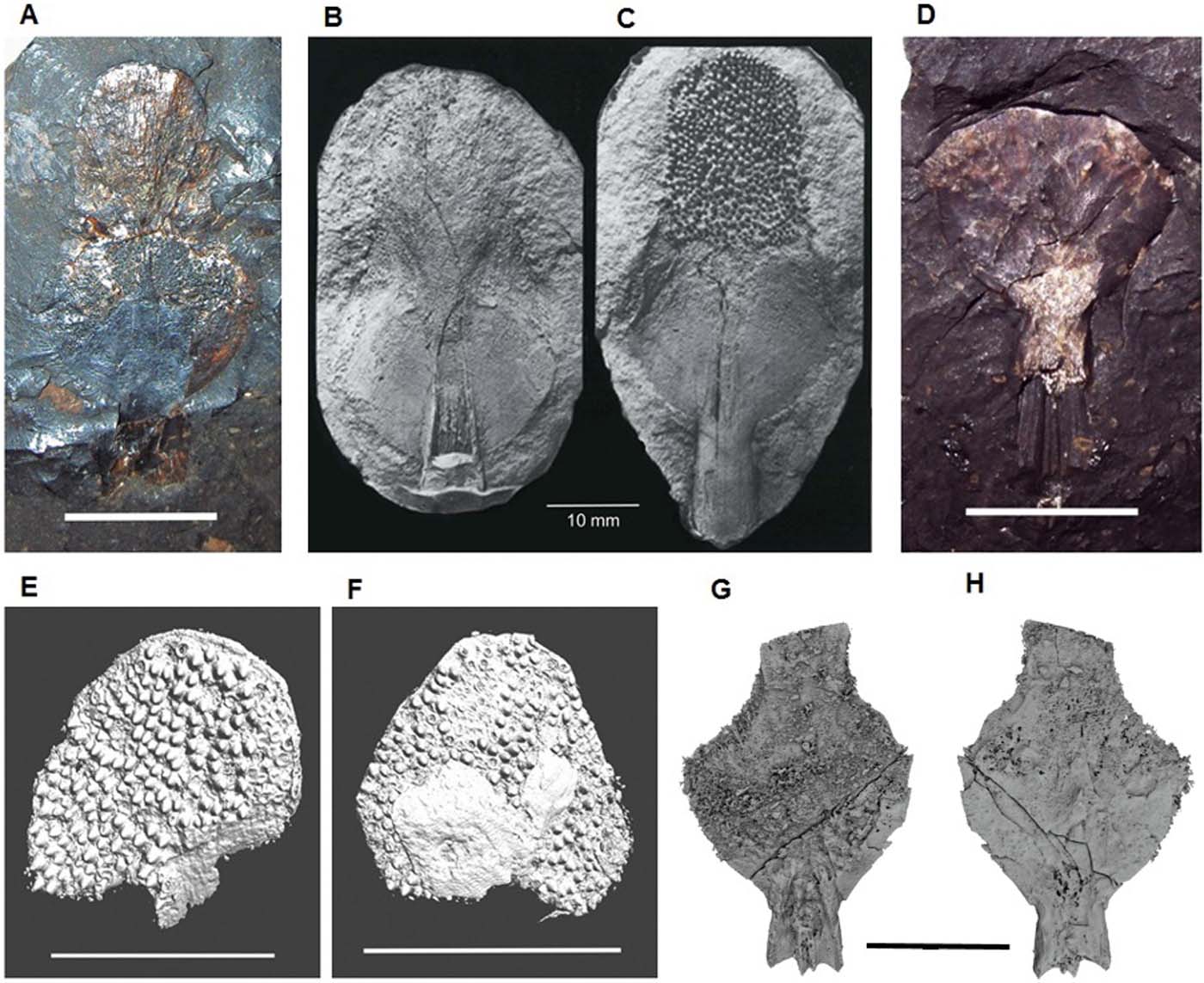
Parasphenoid. An isolated parasphenoid in the collection purchased from the Traquair estate, NHMUK PVP 11516 (Fig. 3a), is very similar to that of Conchopoma edesi (Fig. 3b, c). Preserved in dorsal view, it is c.26mm long and has a maximum width of c.12mm (compared with C. edesi, which is 53mm long and 24mm wide). The posterior left side is damaged and preserved as impression.
Conchopoma from Loanhead and Braidwood, Illinois, USA, and new lungfish parasphenoid from Loanhead. (A) Conchopoma sp. from Loanhead, parasphenoid, NHMUK PVP 11516, dorsal view. (B, C) Conchopoma edesi from Braidwood (reproduced from Schultze Reference Schultze1975, pl. 2 with permission). (B) Dorsal view. (C) Ventral view. (D) Unnamed parasphenoid from Loanhead, NMS G 1885.50.18, ventral view. (E, F) Conchopoma sp. from Loanhead, micro-CT scans, basihyal plates in dorsal view. (E) NMS G 1885.50.50.2. (F) NMS G 1885.50.50.4. (G, H) Unnamed parasphenoid from Loanhead, NMS G 1885.50.18, micro-CT scans. (G) Dorsal view. (H) Ventral view. Scale bars = 10mm (A–D, G, H); 5mm (E, F).
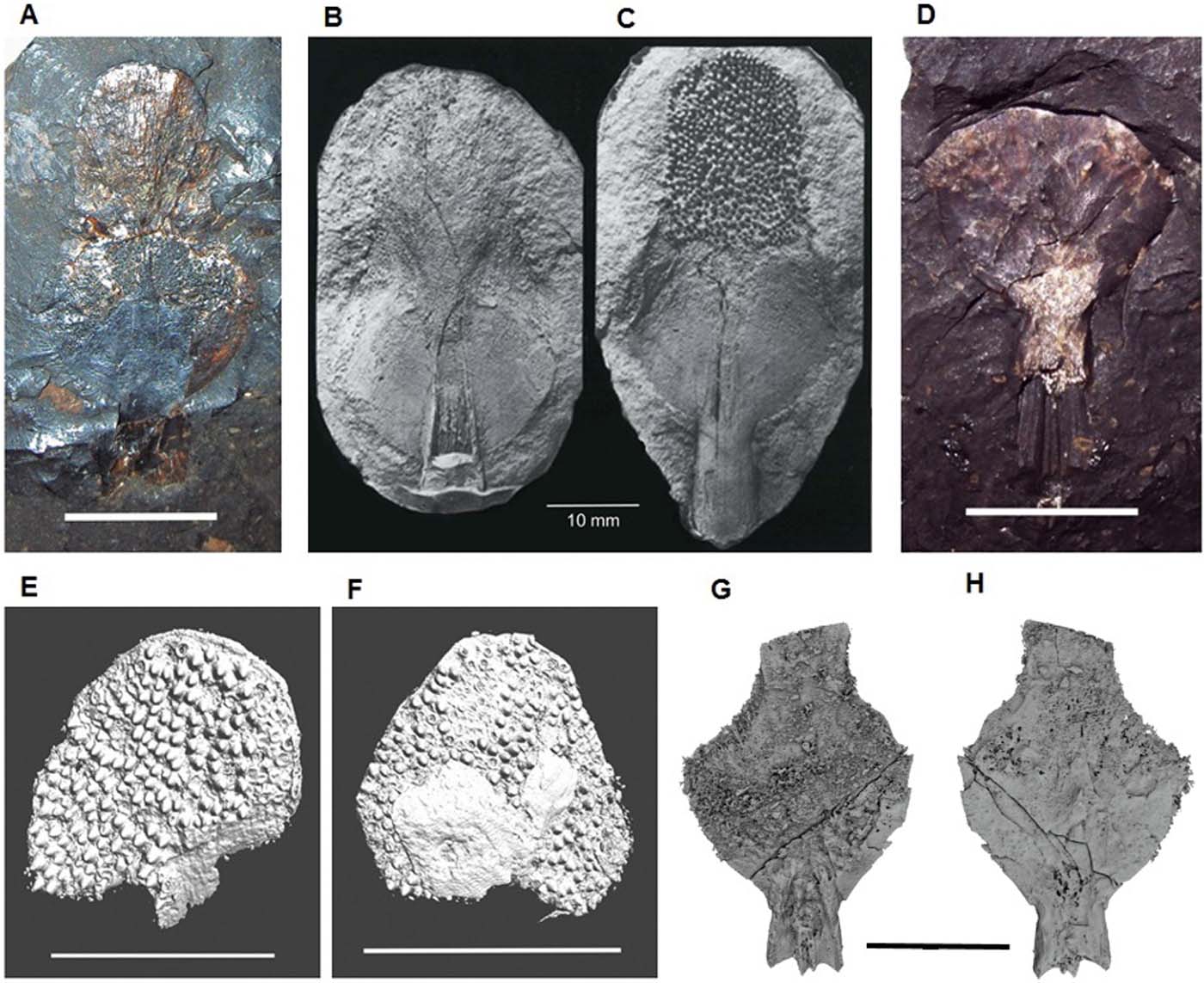
The paraspenoid is spade-shaped with a large, broad corpus. This has a gently rounded anterior margin, almost parallel sides and gently rounded posterior border where it curves to join a short (or incomplete) posterior process. The corpus is relatively much larger than the typical diamond-shaped body of other Carboniferous lungfish, e.g., Ctenodus and Sagenodus (Watson & Gill Reference Watson and Gill1923, figs 10, 25), as it extends forward into the territory normally occupied by the pterygoids. A scan of NHMUK PVP 11516 revealed a shagreen of small denticles on the palatal (ventral) surface. These are smaller than those on the parasphenoid of Conchopoma edesi (Fig. 3c) and on the basihyal plates from Loanhead (see Fig. 3e, f). Impressions of tiny denticles are also preserved where the posterior left side is missing. The preserved portion of the posterior stem is relatively much shorter than those of other Carboniferous taxa, accounting for less than 18% of the total length of the parasphenoid. This compares with c.60% in Sagenodus (Schultze & Chorn Reference Schultze and Chorn1997, fig. 22) and c.50% in Ctenodus (Sharp & Clack Reference Sharp and Clack2013, fig. 16).
Pterygoid. A partially exposed denticulated element NMS G 1886.50.50.1 was micro-CT scanned. This revealed a long, narrow plate, broken into two parts, approximately 8mm long. One surface is partially covered with a band of denticles similar in size to those on the basihyal plates. Unlike the denticles on the pterygoid of Conchopoma gadiforme (Heidtke Reference Heidtke1986, fig. 3), those on NMS G 1886.50.50.1 vary in size. The largest, lateral denticles, have a diameter up to four times that of the smallest, on the medial side. Extending from the area of the medial denticles is a broad shelf, which probably formed an overlap area with the parasphenoid. Extending forward from the denticulated area is a second shelf, which probably formed an overlap area with the vomer. The lateral edge of the bone is gently rounded, marking the lateral extent of the palate.
Vomer. The partially exposed denticulated element NMS G 1886.89.49 was also micro-CT scanned. This revealed an irregular-shaped plate, approximately 3mm long, with broken edges bearing a patch of denticles similar in size to those on the basihyal plate (see description below, Fig. 3e, f). The denticles do not cover the entire surface but are concentrated nearer to one of the longer edges. It is most similar to the vomer of Conchopoma gadiforme figured by Schultze (Reference Schultze1975, fig. 5) and Heidtke (Reference Heidtke1986, fig. 3).
Basihyal Plate. Two denticulated elements, NMS G 1885.50.50.2 and NMS G 1885.50.50.4, were micro-CT scanned. This revealed that each is a thin, subcircular plate (Fig. 3e, f), approximately 6mm (maximum) in diameter. The dorsal surface is covered in denticles of an almost uniform size, approximately twice that of the denticles on the parasphenoid. The plates are very similar to the denticulated, basihyal plates of Conchopoma gadiforme (Heidtke Reference Heidtke1986, fig. 3).
Remarks. The material from Loanhead shares with Conchopoma the characteristic of having denticulated pterygoids, vomers, parasphenoid and basihyal. The denticles were described by Schultze (Reference Schultze1975) as small, conical single teeth, but their histology has not been studied and it is not known if they contain petrodentine, like the teeth on lungfish tooth plates. There is nothing unusual or diagnostic about the new material and it cannot be assigned to any of the known species. Thus, it will be left in open nomenclature until more diagnostic specimens have been found.
Family undesignated
Genus undesignated
Material. NMS G 1885.50.19.
Description.
Parasphenoid. The parasphenoid NMS G 1885.50.19 (Fig. 3d, g, h) is the only known specimen of this new lungfish. It had been recognised as a different genus during an earlier survey of the collection: a typed label attached to the specimen by an unknown curator reads ‘Parasphenoid (not of Ctenodus or Sagenodus)'. The specimen is preserved in ventral view. It is partially concealed by the matrix anteriorly, and much of the posterior process is missing and is represented by an impression of its dorsal surface. The specimen was micro-CT scanned to reveal details of the dorsal surface and anterior end. This showed that it is incomplete anteriorly.
The parasphenoid was, originally, at least 28mm long, with a maximum width of 15mm. The posterior process was 10mm long and 4.5mm wide, and the anterior process was at least 3mm long and 6mm wide. The corpus is essentially diamond-shaped with gently concave edges anteriorly where it met the pterygoids, and gently convex edges posteriorly. The corpus extends anteriorly as a distinct cultriform process with slightly diverging margins. It forms an angle with the corpus of 130°. Posteriorly, it extends to form a relatively short posterior process forming an angle with the corpus of 137°. The posterior process represents around 30% of the total length of the parasphenoid. The ventral surface of the corpus is essentially smooth apart from some slight pitting. Denticles are absent. Towards the centre are two raised tubercles that are probably homologous with the midline ridge in Ctenodus cristatus (Sharp & Clack Reference Sharp and Clack2013, fig. 16B). Posteriorly, part of the ventral surface of the corpus and the incomplete end of the posterior process are damaged. The dorsal surface has a granular appearance in the scan (Fig. 3g), but this is probably an artefact. The left anterolateral edge is slightly furrowed and probably represents an area of sutural overlap with the left pterygoid. This area is less well defined on the right. On the dorsal surface, the edges of the anterior process continue posteriorly as low ridges that form the anterolateral edge of the suture with the pterygoid. The lateral edges of the posterior process are bevelled and diverge slightly. The dorsal surface of the process supports a distinct midline ridge which, judging from the impression, extends along its length. This ridge has a midline groove along its most posterior part. The lateral edges continue forward as low ridges, mirroring the arrangement on the anterior process.
Remarks. A parasphenoid with an anterior process has not previously been described in Carboniferous lungfish. It does not belong to the well-known taxa from Loanhead, Ctenodus, Sagenodus or Uronemus, and as well as being much too large to be the parasphenoid of Clackodus, differences in the shape of the areas of sutural contact on the pterygoids of Clackodus and the parasphenoid indicate they do not belong together. An anterior process is present in a number of distantly related Devonian taxa, including Jarvikia, Orlovichthys, Rhinodipterus stolbovi and Stomiahykus (Friedman Reference Friedman2007), but its phylogenetic significance is unclear.
NMS G 1885.50.19 exhibits several derived characters that indicate it probably originates from a taxon occupying a crownward position in the Devonian–Carboniferous dipnoan tree. These include: a closed buccohypophyseal foramen; parasphenoid overlapping the palate; a rounded lateral angle of the parasphenoid; the presence of a separate, diamond-shaped corpus; the absence of dental material on the ventral surface; and the presence of a furrow on the dorsal surface.
4. Discussion
4.1. Dipnoan diversity in the late Mississippian
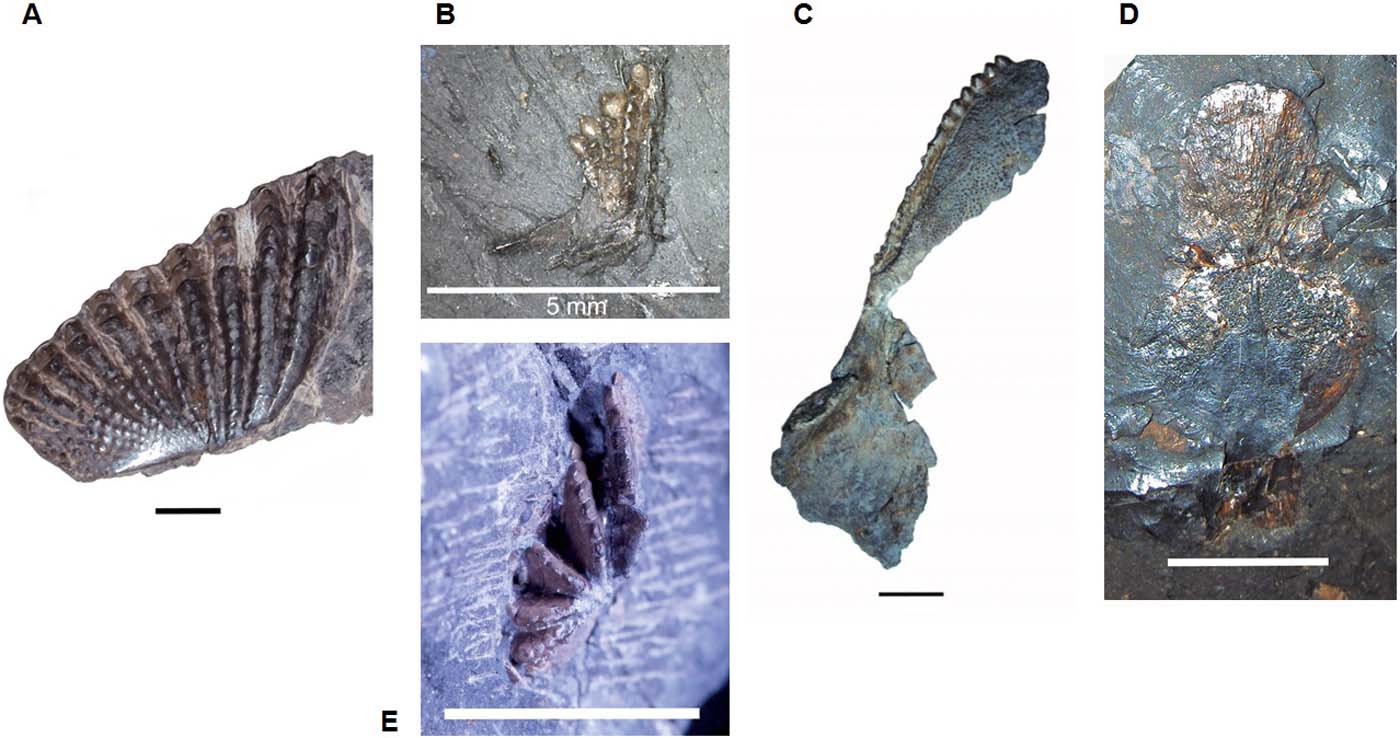
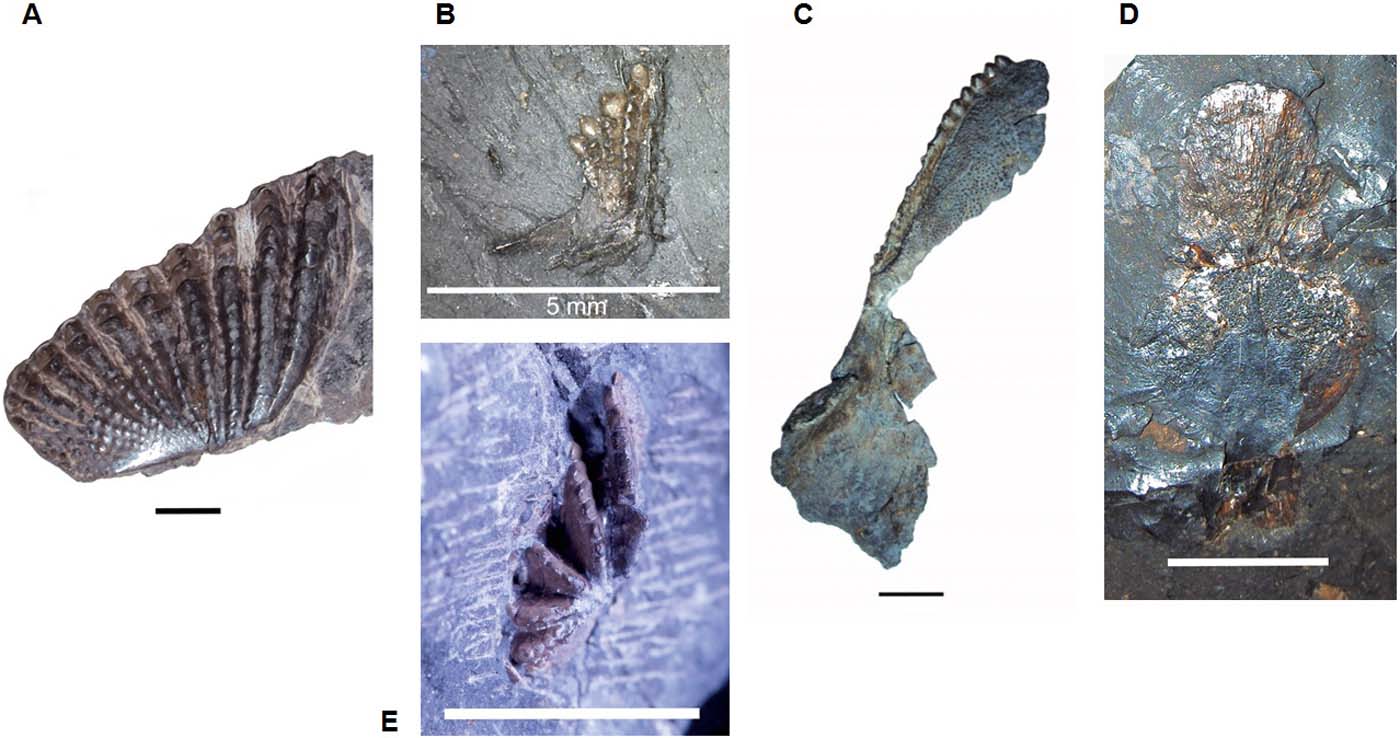
Five lungfish taxa have now been recognised at Loanhead: Ctenodus interruptus, Sagenodus quinquecostatus, Uronemus splendens, Clackodus angustulus and Conchopoma sp. A sixth is represented by an unnamed parasphenoid. Where known, the dentition is notably different in each (Fig. 4). Ctenodus (Fig. 4a) has multiple, almost parallel, tooth ridges with blunt cone-like teeth. Sagenodus (Fig. 4e) has up to six radiating tooth ridges with sharp, laterally compressed teeth, attached to bony ridges, producing a tooth plate with deep furrows between the tooth ridges similar to those of extant lungfish. Uronemus (Fig. 4c) has modified tooth plates with a very long tooth ridge 1 and short lateral ridges – an arrangement that produces a marginal dentition with an accessory segment of denticles on the lingual edge of tooth ridge 1. Clackodus (Fig. 4b) has narrow radiating tooth plates with a heterodont arrangement of teeth on four tooth ridges, and Conchopoma (Fig. 4d) lacks tooth plates and, instead, has a large number of denticles on the bones forming the roof and floor of the mouth. A similar level of morphological disparity is also seen in the body size of the lungfish. The largest, Ctenodus, had an estimated adult length of 40cm, while the smallest, Clackodus, had an estimated adult length of 5cm.
Palatal elements from Loanhead lungfish. (A) Ctenodus interruptus right pterygoid tooth plate, NHMUK PVP 11485. (B) Clackodus angustulus right pterygoid and tooth plate, NHMUK PVP 11503e. (C) Uronemus splendens right pterygoid and tooth plate, NMS G 1976.19.3. (D) Conchopoma sp. parasphenoid, NHMUK PVP 11516. (E) Sagenodus quinquecostatus right pterygoid tooth plate, NMS G 1993.56.118. Scale bars = 10mm (A, C–E); 5mm (B).
This level of lungfish diversity at a single locality is unprecedented in the Carboniferous, and only Gogo in the late Devonian of Australia (Long & Trinajstic Reference Long and Trinajstic2010, and references therein; Clement Reference Clement2012) and Celsius Bjerg in the late Famennian, Upper Devonian, of East Greenland (Lehman Reference Lehman1959; Clack et al. Reference Clack, Challands, Smithson and Smithson2018) can match it. A diverse lungfish fauna has recently been described from sites in the early Carboniferous of the Scottish Midland Valley and Borders (Carpenter et al. Reference Carpenter, Falcon-Lang, Benton and Henderson2014; Smithson et al. Reference Smithson, Richards and Clack2016). Eight species have so far been identified, with others awaiting description (Challands et al. Reference Challands, Bennett, Clack, Fraser, Kearsey, Marshall, Smithson and Walsh2015, Reference Challands, Smithson, Clack, Bennett, Marshall, Wallace-Johnson and Hillin press). It has the same size range of fish and a similar variety of tooth plated-forms. Although Conchopoma has not been identified, small, denticulated plates have been found at Burnmouth and Cove that may belong to a similar lungfish (Smithson, pers. obs. Reference Smithson, Browne, Davies, Marshall, Millward, Walsh and Clack2017). However, no more than two taxa have ever been found in the same horizon at any of these Tournaisian sites. This is typical of Carboniferous localities in the UK. Ctenodus and Sagenodus are commonly found together in the Pennsylvanian (Sharp Reference Sharp2007; Sharp & Clack Reference Sharp and Clack2013), and at the other two Serpukhovian sites in eastern Scotland, Dora and Niddrie, only two lungfish taxa have been described (Sharp Reference Sharp2007). Loanhead is very unusual in having at least five.
The large number of lungfish taxa found throughout the Mississippian of Scotland provides further evidence of a previously unrecorded radiation following the end-Devonian extinction event. Smithson et al. (Reference Smithson, Richards and Clack2016) suggested that this may have been in response to gaps in ecospace and the development of new food sources following the extinction event. Little is known about the diet of Palaeozoic lungfish, but the durophagus dentition is usually taken to indicate that food sources were protected by shells, carapaces or scales (e.g., Johanson & Ahlberg Reference Johanson, Ahlberg, Jørgensen and Joss2013). Extant adult lungfish are largely carnivorous, with a varied diet of vertebrate and invertebrate prey; there is some evidence that they may also ingest plant material (Kemp Reference Kemp, Bemis, Burggren, Kemp and Alan1987). The tooth plates of Sagenodus are most like those of extant lungfish, with blade-like tooth ridges separated by deep furrows; the teeth show little wear. This suggests a diet of relatively soft food items that may have been chewed into smaller pieces before ingestion. In contrast, Clackodus, Ctenodus and Uronemus have tooth plates showing tooth wear. In Clackodus, all but the most labial teeth are worn flat, suggesting that ‘armoured' food items like ostracods or other crustaceans were processed in the mouth before being swallowed. In Ctenodus, the teeth are blunt but not flattened, and there are often pits in the furrows between the tooth ridges, presumably caused during tooth plate occlusion. This suggests a powerful bite that may have been required to deal with the thick carapace or scales protecting their prey. In Uronemus, toothed vomers and dentaries are retained. The long first tooth ridge on the pterygoid plate shows wear on the labial side of the posterior teeth. This is matched by similar wear on the lingual side of the first ridge on the prearticular plate, suggesting a sectorial bite, as in the carnassial teeth of carnivorous mammals, for shearing through flesh. Uronemus was probably an active predator, with the anterior marginal teeth used to capture prey and the posterior teeth used for chewing. Conchopoma lacks teeth and tooth plates. Instead, the roof and floor of the mouth is covered in a shagreen of denticles, which may have helped to hold slippery prey in the mouth before it was swallowed. These different dentitions and feeding strategies hint at a diverse, but unpreserved, invertebrate fauna at Loanhead that matches the rich vertebrate fauna.
A further possibility is that this radiation of lungfish during the early Carboniferous was a response to a move from an essentially marine environment in the Devonian to a coastal floodplain habitat of freshwater and brackish lakes in the Mississippian. Or it may have been due to changes in tooth plate growth, enabling greater variation in dentition (see Section 4.2) and, by extension, diet. Whatever the reason, this shows that lungfish evolution did not slow down significantly among the tooth plated-forms at the end of the Devonian but, contra Westoll (Reference Westoll, Jepsen, Mayr and Simpson1949), continued at a steady rate throughout the Mississippian.
4.2. Tooth plate growth in Carboniferous lungfish
The development and growth of tooth plates in the extant lungfish Neoceratodus was described in detail by Kemp (Reference Kemp1977). A description of their growth in Lepidosiren was given by Bemis (Reference Bemis1984) and observations on Protopterus were added by Smith (Reference Smith1985). In an elegant study on the dentitions of early lungfish, tooth plate formation in living forms was summarised by Ahlberg et al. (Reference Ahlberg, Smith and Johanson2006, pp. 333-34): ‘each of the tooth plates starts from a single pioneer tooth on each bone…. After initiation from a pioneer tooth, each of these dentate regions is regulated autonomously as in a modular type of development. However, the pattern of addition and replacement is quite different from that seen in other osteichthyans. The teeth are not cyclically shed through site-specific dentine resorption: they become permanently incorporated into the tooth plate, although the older teeth may eventually be worn away or lost through resorptive remodelling of the mesial margin of the plate. Furthermore, new teeth are not added lingually as in other osteichthyans but always immediately lateral to existing teeth, causing the plate to develop as a set of tooth rows that give it its characteristic shape.' The pattern of teeth on the tooth plates of most lungfish from the Devonian and many from the Carboniferous can readily be explained by comparison with the way tooth plates grow in extant forms, but some, notably from the Mississippian of Scotland, do not appear to have conformed to this pattern.
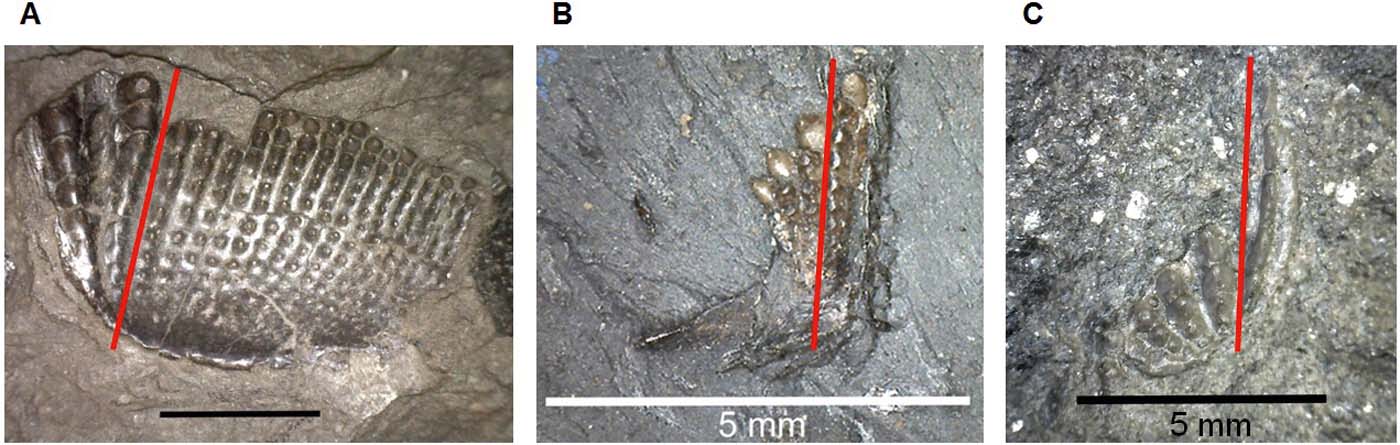
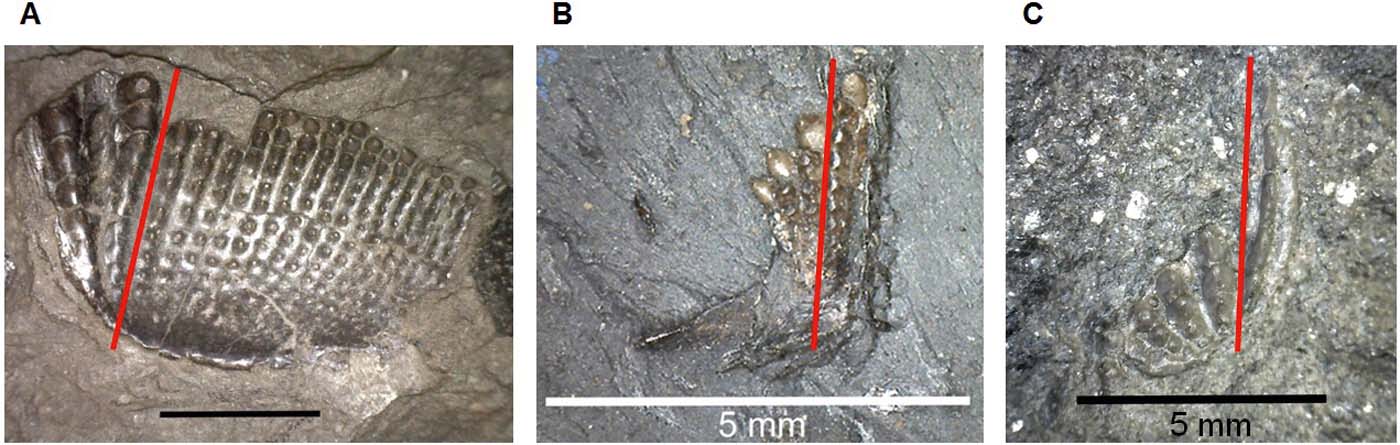
In a number of Scottish Mississippian lungfish, the teeth on tooth ridge 1, and in one case on both tooth ridge 1 and 2, differ from those on the rest of the tooth plate. In Ctenodus williei, a species found at three sites in the Tournaisian of the Scottish Borders (Smithson et al. Reference Smithson, Richards and Clack2016), tooth ridges 1 and 2 of the pterygoid (Fig. 6a) and tooth ridge 1 of the prearticular has up to eight large, labially curved teeth, whilst all the other ridges – 17 on GSL 1312 (Fig. 5a) – have at least 12 small, cone-shaped teeth with labially curved tips where they were unworn. In Xylognathus macrustenus, a species found at two sites in the Scottish Borders (Smithson et al. Reference Smithson, Richards and Clack2016, fig. 5), tooth ridge 1 has up to six large, laterally compressed triangular-shaped teeth in lateral view, with much smaller, cone-shaped teeth on the other three ridges. The younger Clackodus angustulus has up to ten small, laterally compressed, recurved teeth when unworn, on tooth ridge 1 and fewer larger, cone-shaped, recurved teeth when unworn, on the other three tooth ridges (Fig. 5b). A further example is seen in an undescribed tooth plate (UMZC 2018.10.9) from the earliest Carboniferous in the Scottish Borders (Fig. 5c). It was collected from a sandy siltstone c.30m above the Devonian/Carboniferous boundary at Burnmouth (Clack et al. Reference Clack, Bennett, Carpenter, Davies, Fraser, Kearsey, Marshall, Millward, Otoo, Reeves, Ross, Ruta, Smithson, Smithson and Walsh2016). This small specimen has extremely laterally compressed teeth on tooth ridge 1 and cone-shaped teeth on the other four ridges. A variation of the heterodonty described above is found in Uronemus splendens (Smith et al. Reference Smith, Smithson and Campbell1987). Here, all the teeth on the modified tooth plate are similar, but it has an additional segment of denticles on the lingual side of tooth ridge 1 (Fig. 4c; see Smith et al. Reference Smith, Smithson and Campbell1987, fig. 20). Uronemus is the only known Carboniferous lungfish with a dentition consisting of a mix of tooth plates and denticles. This arrangement is not uncommon among Devonian taxa (Ahlberg et al. Reference Ahlberg, Smith and Johanson2006), but in none are the denticles organised into a discrete area on the pterygoid.
Heterodont tooth plates. (A) Ctenodus williei GLS 1312. (B) Clackodus angustulus NHMUK PVP 11503e. (C) Unnamed specimen from Burnmouth UMZC 2018.10.9. Red line separates different types of teeth.
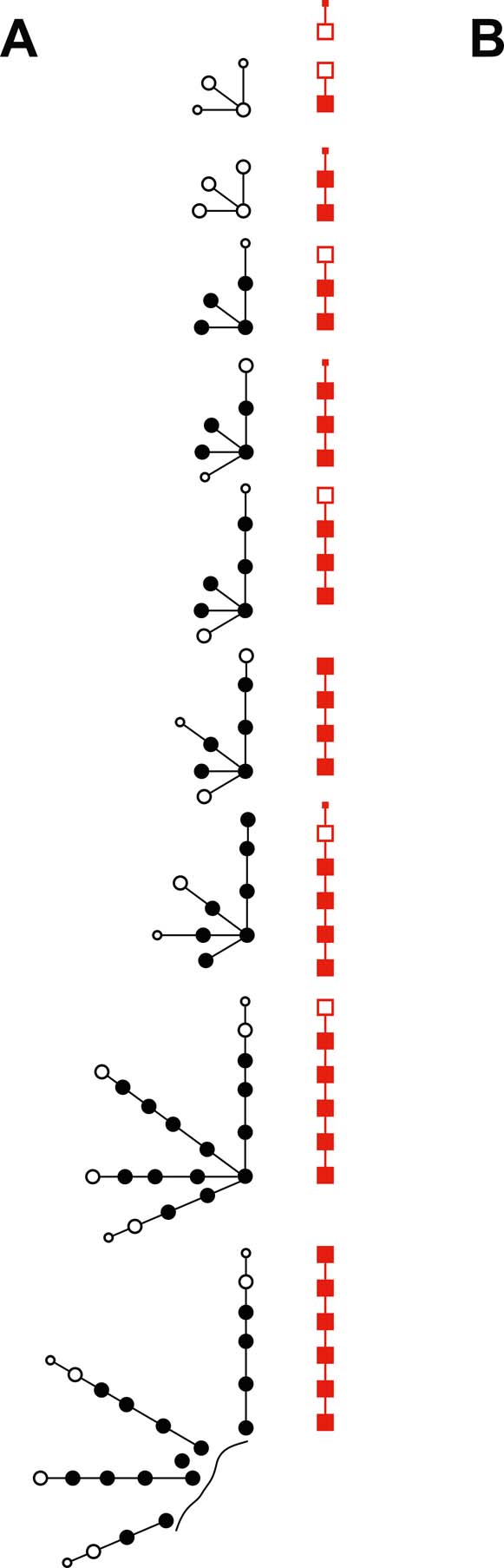
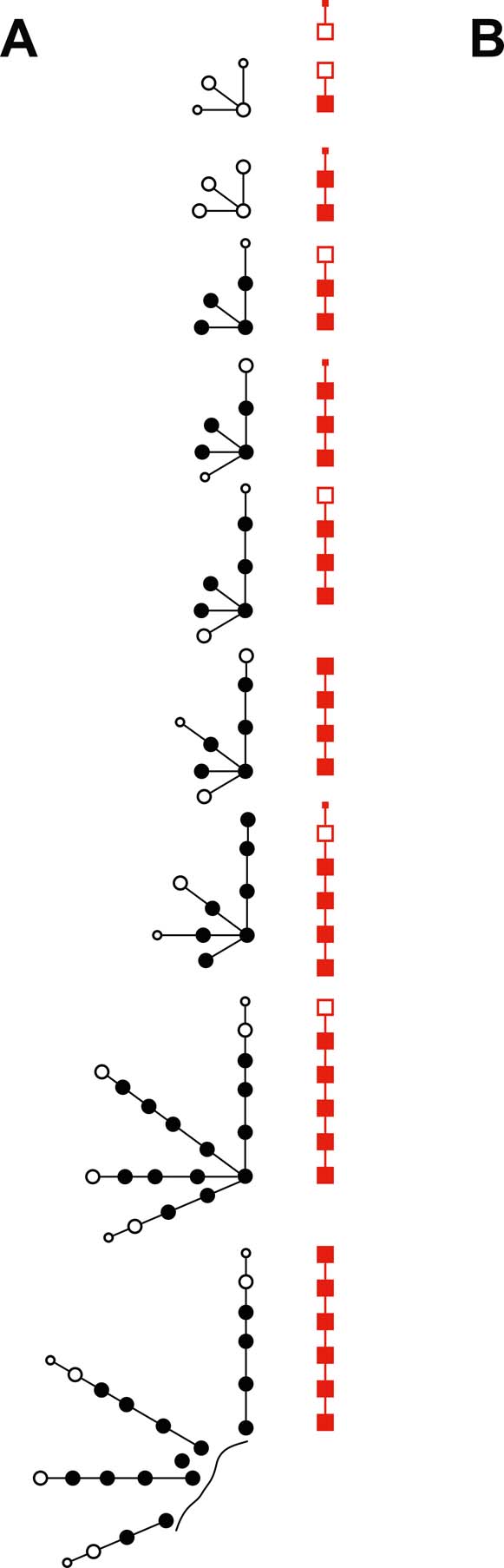
Plan of heterodont tooth plate development assuming the presence of two pioneer teeth. (A) Pattern of development based on a pioneer tooth of the type present in Neoceratodus (after Kemp Reference Kemp1977, fig. 5). Small circle, pioneer tooth or new tooth; large circle, newly functional tooth; large solid circle, functional tooth fused to the tooth ridges. (B) Pattern of development based on the second pioneer tooth. Small square, pioneer tooth; large square, newly functional tooth; large solid square, functional tooth fused to the tooth ridge.
These different heterodont patterns cannot be explained by the manner of tooth plate formation described in Neoceratodus (Kemp Reference Kemp1977), nor by presently recognised developmental anomalies in both fossil and living lungfish (Kemp Reference Kemp2003). These anomalies include the division of tooth ridges, fusion of tooth ridges, growth of medial cusps, loss of growth pattern (typically seen in the Carboniferous form Ctenodus interruptus) and shortened ridges. None of these processes are manifest in the tooth pattern observed in Clackodus or the other heterodont tooth plates from the Tournaisian. The shortening of ridges indicates cessation of growth rather than delayed growth relative to other tooth plates, and in tooth plates where loss of pattern occurs, cusps are still formed but in an irregular way. The cusps in tooth rows 2–4 of Clackodus still maintain the typical fan-shape from the point of their origin, indicating that form loss has not occurred.
Instead, the simplest explanation is that the growth was based around two pioneer teeth on each plate. One pioneer tooth initiated the development and growth of tooth ridge 1 (and tooth ridge 2 on the pterygoid of taxa like Ctenodus williei), whilst the second pioneer tooth initiated the development and growth of the rest of the tooth plate (Fig. 6). In this model, the second pioneer tooth is probably equivalent to the single pioneer tooth in Neoceratodus, producing a number of tooth ridges bearing similar teeth (Fig. 6a): the pioneer tooth initiating the development of tooth ridge 1 is new (Fig. 6b). These examples also suggest that the rate of growth of tooth ridge 1 is independent of that on the other ridges. In Clackodus, growth rate appears to have been quicker on tooth ridge 1, producing a longer row of smaller teeth. In C. williei, the growth rate on the first rows was slower, producing a smaller number of larger teeth. In the undescribed specimen from Burnmouth (UMZC 2018.10.9), the rate of growth appears to have been similar in tooth ridges 1 and 2, producing the same number of teeth on each ridge.
Though still not completely understood, the genetic and molecular mechanism behind dipnoan tooth plate formation has been demonstrated to be homologous with other osteichthyans (Smith et al. Reference Smith, Okabe and Joss2009) with the initial development of a single tooth primordium (pioneer tooth of Ahlberg et al. Reference Ahlberg, Smith and Johanson2006). Smith et al. (Reference Smith, Okabe and Joss2009) demonstrated that tooth induction (i.e., the development of the pioneer tooth) in Neoceratodus was controlled by the timing and location of expression of the Sonic hedgehog (Shh) and pitx genes, as it is in other bony fish. In the trout Oncorhynchus mykiss, the pitx2 gene was previously found to be responsible for commissioning tooth sites before actual induction of the tooth germ occurred (Fraser et al. Reference Fraser, Berkovitz, Graham and Smith2006). In Neoceratodus, the expression of pitx2 is coincident with the regions involved in the earliest stages of tooth induction. In these regions, Shh was shown to be expressed at loci of individual tooth induction. The sequential addition model of Smith (Reference Smith2003) proposes reiterative initiation of the original single tooth primordium in each jaw quadrant to produce the typical left–right pattern from the original medial tooth germ. Under this model, with the presence of two pioneer teeth, the resultant tooth pattern would be anticipated to be two separate regions of radial tooth growth on one individual tooth plate. Clearly this is not the case in Clackodus. However, whereas the pterygoid and prearticular tooth rows grow in a radial pattern, vomerine teeth are restricted to forming just one row (Smith Reference Smith2003; Smith & Johanson Reference Smith, Johanson, Jørgensen and Joss2010). Therefore, it seems likely that under this model, the first tooth row in Clackodus grows by a mechanism typical of the marginal dentitions, whereas the second–fourth rows follow the typical dipnoan pattern. Superficially, the first tooth row of Clackodus does indeed resemble the vomerine tooth plates of, for example, Andreyevichthys (Smith & Krupina Reference Smith and Krupina2001).
An alternative explanation may be provided by comparison with a condition seen in some mice. Zhang et al. (Reference Zhang, Lan, Chai and Jiang2009) showed that a mutant variant of the transcription factor odd-skipped related (Osr2) produced an expanded ontogenetic field that resulted in additional tooth rows. Smith & Johanson (Reference Smith, Johanson, Jørgensen and Joss2010) speculated that a molecular mechanism involving the regular expression of Osr2, as seen in the single-row dentitions of mammals, may have been responsible for the single-row marginal dentitions found in lungfishes. As such, the appearance of a second independent single-tooth row from a second tooth primordium, as in Clackodus, could possibly be a manifestation of such a mutant transcription factor similar to that used by Zhang et al. (Reference Zhang, Lan, Chai and Jiang2009), expanding the ontogenetic field and then moderating tooth growth.
5. Conclusions
The late Mississippian lungfish fauna of Scotland was diverse, with at least five different taxa represented in the Burghlee or Rumbles Ironstone at Loanhead. This discovery is consistent with recent analysis, which has shown that the evolution of lungfish did not slow down significantly among tooth plated-forms at the end of the Devonian but, contra Westoll (Reference Westoll, Jepsen, Mayr and Simpson1949), continued at a steady rate throughout the Mississippian. This may, in part, have been due to the development of heterodonty in some lungfish, enabling teeth of different shapes and sizes to develop on the same tooth plate. This heterodonty may have become possible following the ‘duplication' of part of the developmental mechanism, with two pioneer teeth or tooth primordia present on each tooth plate.
5. Acknowledgements
It is a pleasure to acknowledge and thank Jenny Clack for leading the recent revival of interest in British Carboniferous lungfish, and for her support and guidance in our work together on the Mississippian vertebrate fauna of Scotland. We thank Emma Bernard (NHM) and Stig Walsh (NMS) for the loan of specimens, Esther Sharp for access to her unpublished PhD thesis, Hans-Peter Schultze for permission to reproduce his figure of the parasphenoid of Conchopoma edesi and Rob Asher for help with photography. We are grateful to our reviewers, Alice Clement and Zerina Johanson, for their helpful comments and suggestions that greatly improved the manuscript. Tim Smithson thanks Paul Brakefield, Director, UMZC, for access to research facilities, Thomas Challands thanks Callidus Services Ltd. for financial assistance and Ketura Smithson was supported by a grant from the Leverhulme Trust awarded to Jenny Clack.