Introduction
It is generally accepted that Parkinson's disease (PD) neuropathology affects the frontal-subcortical circuit, which can lead to cognitive and behavior impairments (Zgaljardic, Borod, Foldi, & Mattis, Reference Zgaljardic, Borod, Foldi and Mattis2003). Yet, there is limited research on the relationship between self- and caregiver- reports of behaviors presumed to be mediated by the frontal system, including apathy, disinhibition, and executive dysfunction, in pre- and post-diagnosis nondemented PD. Studies that have investigated these behaviors have found inconsistent results, rendering it questionable whether nondemented individuals with PD develop significant frontal behavior problems (Denheyer, Kiss, & Haffenden, Reference Denheyer, Kiss and Haffenden2009; Mathias, Reference Mathias2003; McKinlay et al., Reference McKinlay, Grace, Dalrymple-Alford, Anderson, Fink and Roger2008; Zgaljardic et al., Reference Zgaljardic, Borod, Foldi, Rocco, Mattis, Gordon and Eidelberg2007). One complicating factor in the evaluation of patient behavior is that behavioral observations are subjective in nature and may vary depending on the reporter. Behavior is primarily evaluated via patient self-assessment and/or caregiver or significant other observation, and these reports are often used interchangeably in both clinical and research settings. However, the agreement between patient and caregiver ratings and the mood, cognitive, and motor symptoms that may influence rating discrepancies is largely unknown. Understanding the concordance of patient-caregiver ratings is critically important as the characterization of patients as well as treatment planning and efficacy often rely on these subjective reports.
The findings of the few studies that have addressed PD patient-caregiver concordance have been mixed. Several studies have found relatively adequate agreement between nondemented PD patients’ and caregivers’ subjective ratings of patient dysexecutive behavior and subjective cognition (Mathias, Reference Mathias2003; Sitek, Soltan, Wieczorek, Robowski, & Slawek, Reference Sitek, Soltan, Wieczorek, Robowski and Slawek2011). However, a recent study found significant differences and low agreement between nondemented PD patients and their caregivers on ratings of current patient disinhibition and executive functioning (percent agreement = 13% and 28%, respectively), with patients reporting more problems (McKinlay et al., Reference McKinlay, Grace, Dalrymple-Alford, Anderson, Fink and Roger2008). This latter study also found that while patient and caregiver ratings of patient apathy were not significantly different, the association was modest (r = .36) and the level of agreement was approximately 50% (McKinlay et al., Reference McKinlay, Grace, Dalrymple-Alford, Anderson, Fink and Roger2008). One critical limitation of the majority of these studies is that they did not assess a baseline agreement on patient behavior before diagnosis. Understanding baseline or prediagnosis behavior is important as it provides a context from which one can gauge current levels of behavior. Prediagnosis (rated retrospectively) and current behavioral rating agreement have been studied, albeit limitedly, in other neurological populations. One such study of multiple sclerosis (MS) patients found that patient and caregivers’ retrospective prediagnosis and current ratings of apathy and executive dysfunction did not differ on a measure of frontal behavior, the Frontal Systems Behavior Scale (FrSBe; Grace & Malloy, Reference Grace and Malloy2001), whereas patients reported significantly more problems with prediagnosis and current levels of disinhibition as compared to caregivers (Chiaravalloti & DeLuca, Reference Chiaravalloti and DeLuca2003).
The reasons for patient-caregiver rating discrepancies, if they do indeed exist, have yet to be determined. However, patient mood, cognition, medication, motor functioning, or disease severity may play a role. Cognitive impairment, including memory and executive dysfunction, as well as depressed mood, often occur in patients with PD. Executive dysfunction in PD may include difficulty in making sound judgments and poor insight, which could impede accurate self-reporting. Moreover, mood state could result in an overendorsement of symptoms (Huprich, Bornstein, & Schmitt, Reference Huprich, Bornstein and Schmitt2011). In support of these concerns, a recent study found an association between self-reported apathy and higher levels of depression and executive dysfunction in nondemented PD patients (Zgaljardic et al., Reference Zgaljardic, Borod, Foldi, Rocco, Mattis, Gordon and Eidelberg2007). In a study of Huntington's disease patients, inter-rater agreement between patients and caregivers’ ratings of apathy decreased with greater cognitive impairment in the patients (Chatterjee, Anderson, Moskowitz, Hauser, & Marder, Reference Chatterjee, Anderson, Moskowitz, Hauser and Marder2005), suggesting cognition may play a role in patient-caregiver behavioral rating discrepancies. Similarly, decrements in patients’ memory and executive function performances as well as PD symptom severity were associated with greater discrepancies in patient-caregiver ratings of patient memory abilities (Sitek et al., Reference Sitek, Soltan, Wieczorek, Robowski and Slawek2011). Another possible factor that may play a role in neurobehavioral rating discrepancies is patient motor symptoms. For example, masked facies, which is common in PD, could be viewed by a caregiver as a mood issue, such as apathy or depression, which could lead to patient-caregiver rating disparities. Perhaps an underappreciated factor in possible discongruity between patient and caregiver reports of behavior is dopaminergic treatment. Frontal behavioral changes such as impulse control disorders have been associated with increased levodopa use in PD patients (Antonini & Cilia, Reference Antonini and Cilia2009). Moreover, it has been suggested that patients may underreport these behavioral changes to their caregivers (Antonini & Cilia, Reference Antonini and Cilia2009), rendering possible inconsistencies in subjective reports. Taken together, these findings suggest that specific patient factors may play a role in the PD patient-caregiver frontal behavioral report discrepancies.
In addition to patient factors, the role of caregiver psychological functioning is also an important consideration in rating discrepancies. Caregiver reports are often favored instead of patient reports. In fact, some studies have used discrepancies between caregiver and patient ratings as an indicator of patient's lack of insight or anosognosia (e.g., Leritz, Loftis, Crucian, Friedman, & Bowers, Reference Leritz, Loftis, Crucian, Friedman and Bowers2004). However, caregivers’ level of distress has been shown to be associated with their endorsement of more PD symptoms (McKinlay et al., Reference McKinlay, Grace, Dalrymple-Alford, Anderson, Fink and Roger2008). While PD symptoms may precipitate caregiver distress, it is equally possible that increased distress may cause caregivers to endorse more severe patient symptoms. Thus, it may be inaccurate to rely only on caregiver reports as the gold standard of patient behavior. Examination of the relationship between caregivers’ psychological status and report discrepancies could yield important information.
The aims of this study were to (1) assess self- and caregiver ratings of PD patient frontal behavior (apathy, disinhibition, and executive functioning) at present compared to before the disease in retrospect; (2) evaluate the concordance between patient and caregiver ratings, and (3) determine if patient-caregiver rating discrepancies are predicted by patients’ cognition, mood, medication levels, motor symptoms, and/or disease severity. As an exploratory aim, the relationships between patient-caregiver rating discrepancies and caregivers’ mood and stress/burden levels were examined. To measure subjective patient behavior, we used the Frontal Systems Behavior Scale (FrSBe), a well-validated patient- and caregiver-rating scale of “frontal behaviors” associated with subjective levels of apathy, disinhibition, and executive dysfunction, behaviors that are believed to be mediated within the frontal-circuitry impacted in PD (Grace & Malloy, Reference Grace and Malloy2001; Zgaljardic et al., Reference Zgaljardic, Borod, Foldi and Mattis2003). Based on prior literature, we hypothesized that (1) patients and caregivers would significantly differ in their ratings of patient apathy, disinhibition, and executive dysfunction; (2) discrepancies in patient-caregiver ratings would be predicted by patient medication levels, disease severity, motor function, cognition, and depressive symptoms; and (3) patient-caregiver rating discrepancies would be associated with caregiver burden and caregiver depressive symptomatology.
Methods
Participants
Participants were 51 nondemented individuals diagnosed with idiopathic PD by a board-certified neurologist specializing in Movement Disorders based on the UK Parkinson's disease society brain bank criteria (Gibb & Lees, Reference Gibb and Lees1989) and 51 caregivers (92% spouses). Participants were part of an ongoing longitudinal study of cognitive outcome in PD and were recruited from the Neurology/Movement Disorders Clinics at the University of California, San Diego (UCSD) and the VA San Diego. PD patients underwent a comprehensive neuropsychological assessment, which included the FrSBe, and a motor exam. This was a retrospective study and data were collected between 2006 and 2011. PD participants were selected based on meeting the following criteria: nondemented based on a clinical assessment using the Diagnostic and Statistical Manual of Mental Disorders-IV (American Psychiatric Association, 1994) criteria and the criteria set forth by Emre et al. (Reference Emre, Aarsland, Brown, Burn, Duyckaerts, Mizuno and Dubois2007), as well as a score of 130 or greater on the Mattis Dementia Rating Scale (MDRS; Mattis, Reference Mattis1988) and non-depressed based on not meeting criteria for depression as described by Marsh, McDonald, Cummings, and Ravina (Reference Marsh, McDonald, Cummings and Ravina2006). Exclusion criteria included a Hoehn & Yahr score greater than 4, the presence of a secondary cause of PD, a history of psychosis, or treatment for substance abuse. All but one of the PD participants were on at least one medication for their PD symptoms and the majority of participants were on a combination of two or more medications. Participants were tested on their normal dosages of medication (see Table 1 for dosage amount). One patient-caregiver dyad was missing FrSBe data for prediagnosis scores. Informed consent was obtained from all participants and this study was approved by the local ethics committee.
Demographic and clinical information

Note. 1Median and range are reported for the Hoehn & Yahr score as recommended by Movement Disorder Society Task Force (Goetz et al., Reference Goetz, Poewe, Rascol, Sampaio, Stebbins, Counsell and Seidl2004).
2Daily levodopa equivalent doses were calculated with the formula published in Tomlinson et al. (Reference Tomlinson, Stowe, Patel, Rick, Gray and Clarke2010).
3n = 26 for caregiver GDS and ZBI scores, as these were measures added later in the study.
MDRS = Mattis Dementia Rating Scale, GDS = Geriatric Depression Scale, ZBI = Zarit Burden Interview, FrSBe = Frontal Systems Behavior Scale; all FrSBe scores are of patient behavior as rated by patients (Self-Rating Form) and caregivers (Family Rating Form) and reported in t-scores derived from the manual (Grace & Malloy, Reference Grace and Malloy2001); Prediagnosis FrSBe scores are based on an n = 50 (data missing for one dyad) and current FrSBe scores are based on an n = 51.
Materials
Subjective Behavior and Cognition
The FrSBe is a brief behavior rating scale with demonstrated validity for the assessment of behavioral disturbances associated with damage to the frontal-subcortical brain circuitry (Grace & Malloy, Reference Grace and Malloy2001) and utility in assessing behavior symptoms associated with PD (Stout, Ready, Grace, Malloy, & Paulsen, Reference Stout, Ready, Grace, Malloy and Paulsen2003). The FrSBe contains two forms: the Self-Rating Form for patients and the Family-Rating Form for caregivers. Each form contains 46 virtually identical questions regarding the patient's behavior rated on a Likert scale from 1 (Almost Never) to 5 (Almost Always). Each behavior item is rated (1) before disease onset; and (2) at the present time. Each form of the FrSBe yields four scores for each time point (i.e., prediagnosis and current): a total score and three subscale scores (“Apathy,” “Disinhibition,” and “Executive Dysfunction”). All FrSBe scores were converted to t-scores corrected for age, education, and gender based on the administration manual (Grace & Malloy, Reference Grace and Malloy2001). The t-scores below 60 indicate normal behavior, 60 to 64 indicate borderline significance, and 65 and above are considered clinically significant. Elevations on the Apathy subscale indicate problems with initiation, psychomotor retardation, spontaneity, drive, persistence, loss of energy and interest, lack of concern about care, and/or blunted affective expression. Elevations on the Disinhibition subscale are indicative of difficulties with inhibitory control, impulsivity, hyperactivity, social inappropriateness or lack of conformity to social convention, excessive emotional expression, emotional lability, explosiveness, and/or irritability. Elevations on the Executive Dysfunction subscale signify problems with sustained attention, working memory, organization, planning, future orientation, sequencing, problem solving, insight, mental flexibility, self-monitoring of ongoing behavior, and/or ability to benefit from feedback or modify behavior following errors (Grace & Malloy, Reference Grace and Malloy2001). According to the FrSBe manual (Grace & Malloy, Reference Grace and Malloy2001), the Total FrSBe score and the three FrSBe subscales have high within-scale reliability for both the Family Rating Form (Cronbach alpha range = .84–.94) and Self-Rating Form (Cronbach alpha range = .78–.92) in a mixed neurological (e.g., Parkinson's, Huntington's and Alzheimer's disease) sample (Stout et al., Reference Stout, Ready, Grace, Malloy and Paulsen2003). High within-scale reliability was also evident on the before (referred to as prediagnosis hereafter) and after (referred to as current hereafter) illness ratings (Cronbach alphas for Family Rating FrSBe Total score = .95) in a mixed sample of frontal lesion patients and controls (Grace, Stout, & Malloy, Reference Grace, Stout and Malloy1999).
Patient Neuropsychological Function, Motor Symptoms, Disease Severity, and Medication
As the FrSBe is a measure of frontal behavior, we assessed patients’ objective executive functioning using the Total Errors from the Wisconsin Card Sorting Test (WCST; Berg, Reference Berg1948; Heaton, Chelune, Talley, Kay, & Curtiss, Reference Heaton, Chelune, Talley, Kay and Curtiss1993) and the Category Switching Accuracy condition of the Verbal Fluency Test from the Delis-Kaplan Executive Function System (D-KEFS; Delis, Kaplan, & Kramer, Reference Delis, Kaplan and Kramer2001). Scores on the executive function tests were converted into standard scores and summed to create a composite score. General cognition of the patients was evaluated with the Mattis Dementia Rating Scale (MDRS; Mattis, Reference Mattis1988), a well-validated measure commonly used in individuals with PD (Brown et al., Reference Brown, Rahill, Gorell, McDonald, Brown, Sillanpaa and Shults1999). All cognitive tests were administered by a trained examiner. The Geriatric Depression Scale (GDS; Yesavage et al., Reference Yesavage, Brink, Rose, Lum, Huang, Adey and Leirer1982), a well-validated measure used often with older populations and individuals with PD (Ertan, Ertan, Kiziltan, & Uygucgil, Reference Ertan, Ertan, Kiziltan and Uygucgil2005), was administered as a self-report measure of mood. Motor functioning was evaluated with the clinician-administered Unified Parkinson's Disease Rating Scale-Part III (UPDRS; Fahn, Elton, the UPDRS Development Committee, Reference Fahn and Elton1987) or the Movement Disorder Society-sponsored revision of Part III of the Unified Parkinson's Disease Rating Scale (MDS-UPDRS; Goetz et al., Reference Goetz, Tilley, Shaftman, Stebbins, Fahn and Martinez-Martin2008). For the analyses, all UPDRS-Part III scores were converted to MDS-UPDRS-Part III scores using the formula derived from Goetz, Stebbins, and Tilley (Reference Goetz, Stebbins and Tilley2012). Disease severity was assessed with the modified Hoehn and Yahr scale (Goetz et al., Reference Goetz, Poewe, Rascol, Sampaio, Stebbins, Counsell and Seidl2004; Hoehn & Yahr, Reference Hoehn and Yahr1967), a clinician evaluation of severity of overall parkinsonism dysfunction based on bilateral motor involvement and the compromise of gait and balance that ranges from least severe (1) to most severe (5). The MDS-UPDRS-Part III and Hoehn & Yahr were administered by the study's neurologists (S.L.L. or D.D.S.). Levodopa equivalents (LED) were calculated using the following formula proposed by Tomlinson et al. (Reference Tomlinson, Stowe, Patel, Rick, Gray and Clarke2010): LED = Immediate release L-dopa dose × 1 + Controlled release L-dopa dose × 0.075 + Entacapone (or Stalevo®) =LD × 0.33 + Tolcapone = LD × 0.5+Duodopa® × 1.11 +Pramipexole (as salt) × 100 + Ropinirole × 20 + Rotigotine ×30 + Selegiline (oral) × 10 + Selegiline (sublingual) × 80 +Rasagiline × 100 + Amatadine × 1 + Apomorphine × 10.
Caregiver Assessment
A subset of caregivers (n = 26) was administered self-report questionnaires to assess their level of depressive symptomatology (GDS; Yesavage et al., 1982) and caregiver burden (Zarit Burden Interview; ZBI, also known as the Caregiver Burden Index; Zarit, Reever, & Bach-Peterson, Reference Zarit, Reever and Bach-Peterson1980). These measures were added later in the study and thus, only a subset of caregivers completed them. The ZBI scale is a 22-item questionnaire that assesses subjective burden by having caregivers rank questions on a 5-point scale ranging from “never” (0) to “nearly always” (4). The scale ranges from 0 to 88, with higher scores indicating greater burden.
Statistical Analyses
Two-sample t tests were used to assess the difference in current demographics between patients and caregivers.
Agreement between patients and caregivers on their ratings of prediagnosis and current patient behavior were assessed with Intraclass Correlation Coefficients (ICC) obtained using a one-way random effects regression model with rating nested within patients (Shoukri, Reference Shoukri2004). The criteria used for interpretation of ICC were the following: ICC ≥ .80 indicates Excellent agreement; ICC < .80 and ≥ .60 indicates Good agreement; ICC < .60 and ≥ .40 indicates Moderate agreement; and ICC < .40 indicates Poor agreement (Fleiss, Reference Fleiss1981). 95% confidence intervals of the ICC were calculated.
Four 2 (group: patient, caregiver) × 2 (time: prediagnosis, current) Repeated Measures Analyses of Variance (RM ANOVAs) using the Apathy, Disinhibition, Executive Dysfunction, and Total scores of the FrSBe as dependent variables were conducted. The Group (patients, caregivers) and Time (prediagnosis, current) factors were both treated as within factors to assess paired relationships between patients and their respective caregivers. Follow-up paired samples t tests were used to compare individual group ratings of prediagnosis and current behaviors.
Linear multiple regression analyses were performed to elucidate the possible patient factors that may contribute to any significant discrepancies in patient and caregiver ratings on the FrSBe subscales. The rating discrepancy scores between patients and caregivers on each of the FrSBe subscales (three prediagnosis and three current) were calculated by taking the absolute value of the difference between each patient's rating and the rating of their respective caregiver and these discrepancy scores were used as the dependent variables in the regression models. The predictor variables were the current levels of patient general cognition (MDRS Total score), objective executive function (composite score), depressive symptomatology (GDS), motor symptoms (MDS-UPDRS-Part III), disease stage (Hoehn & Yahr score), and daily levodopa equivalents. The backward model was used for selection of significant predictors and only variables with p-value < .10 were kept in final model. We further investigated the correlations between significant predictors in the final model and the discrepancy scores in the individual groups (patient group and caregiver group) using Pearson correlation coefficients. Finally, Pearson correlations were conducted between the aforementioned discrepancy ratings and caregiver burden (ZBI) and depression (GDS-caregiver) in a subsample of dyads (n = 26). Due to the exploratory nature of this study and to avoid Type II error, we interpreted p-values < .05 as statistically significant.
RESULTS
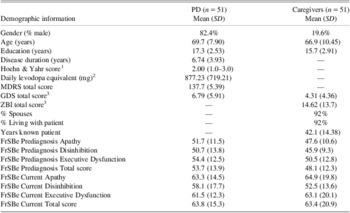
Demographic information is presented in Table 1. Independent samples t tests revealed no significant differences in age or education between caregivers and patients (t = .62; p = .54 and t = 1.52, p = .13, respectively). As the majority of caregivers were spouses, there was a significant difference between the groups in terms of gender, with most PD patients being male. When possible, gender-corrected norms were used to convert scores into standard scores.
Frequency of Borderline and Clinically Significant Neurobehavioral Problems
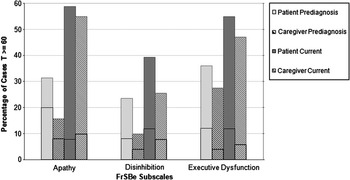
As presented in Table 1, patients and caregivers retrospectively reported all prediagnosis behaviors as normal (subclinical). Both groups reported current behaviors to be at least borderline significant (FrSBe t score ≥ 60), with the exception of disinhibition, which was reported by caregivers and patients as subclinical. In terms of frequency, 31.4% of patients and 15.7% of caregivers reported borderline or clinically significant levels of prediagnosis patient apathy, while 58.8% patients and 54.9% caregivers reported borderline or clinically significant levels of apathy currently. Borderline or clinically significant levels of disinhibition were endorsed by 23.5% of patients and 9.8% of caregivers before diagnosis, while 39.3% of patients and 25.5% of caregivers endorsed these levels at present. Before diagnosis, 36.0% of patients and 27.5% of caregivers endorsed borderline or clinically significant levels of executive dysfunction, while these levels were endorsed by 54.9% patients and 47.1% caregivers at present (Figure 1).
Percentages of patient and caregiver reports of borderline (t-score = 60–64) and clinically significant (t-score ≥ 65) prediagnosis and current behavior on the FrSBe. The area below the solid line within each bar indicates the percentage of borderline scores (t-score = 60–64) and the area above the solid line indicates the percentage of clinically significant scores (t-score ≥ 65)

Comparison of PD and Caregiver Ratings of Prediagnosis and Current Behavior
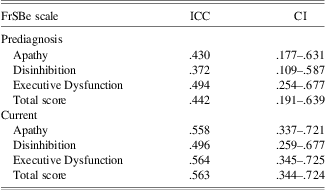
As presented in Table 2, inter-rater agreement on FrSBe ratings between patients and caregivers were all moderate (ICC < .60 and ≥ .40), with the exception of prediagnosis disinhibition, which was poor (ICC < .40).
Intraclass Correlation Coefficients (ICC) for agreement between PD patients’ and caregivers’ FrSBe ratings
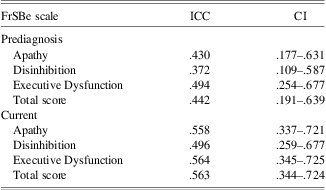
Note. Agreement: Excellent = ICC ≥ .80; Good = ICC < .80 and ≥ .60; Moderate = ICC < .60 and ≥ .40; Poor = ICC < .40 (Fleiss, Reference Fleiss1981); CI =confidence interval.
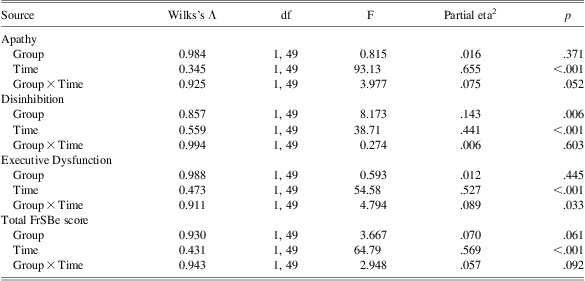
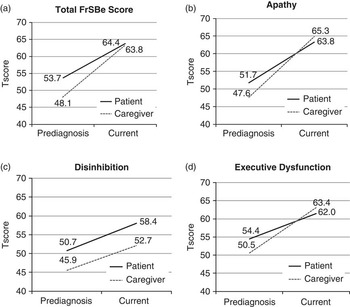
RM ANOVA revealed a main effect of time for the Total FrsBe score and each of the three subscales (all p-values < .001), with higher (more impaired) current scores compared to prediagnosis scores (Table 3). Group effects were only significant for Disinhibition, in which patients endorsed greater impairment compared to their caregivers, although there was a trend for group on the Total score (p = .06). Follow-up paired samples t tests revealed that patients reported more overall prediagnosis problems on the FrSBe compared to the caregivers (t = 3.02; p < .01), but not at present (p > .84). A significant interaction effect was found with the Executive Dysfunction subscale (p = .03) and a marginally significant interaction effect was found with the Apathy subscale (p = .05). Follow-up paired samples t tests revealed that compared to caregivers, patients reported more prediagnosis apathy (t = 2.55; p = .01) and prediagnosis executive dysfunction (t = 2.23; p = .03), while the groups did not differ on current ratings (Figure 2).
Repeated Measures ANOVA results for main effects and interactions of group and time on the three FrSBe subscales of Apathy, Disinhibition, and Executive Dysfunction and Total FrSBe score
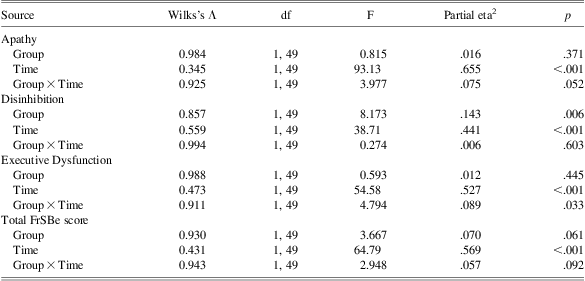
Note. Group = Patients v. Caregivers; Time = Prediagnosis v. Current.
Caregiver and patient prediagnosis and current (a) Total, (b) Apathy, (c) Disinhibition, and (d) Executive Dysfunction FrSBe t-scores.

Patient Predictors of Patient-Caregiver FrSBe Rating Discrepancies
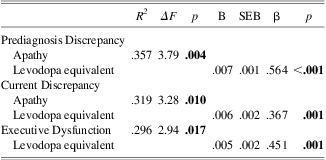
As shown in Table 4, larger discrepancies in prediagnosis and current apathy scores were significantly associated with patient's current levodopa equivalent levels (p ≤ .001). Follow-up Pearson correlations revealed that higher levels of medication were associated with greater endorsement of prediagnosis apathy by the patients (r = .38; p < .01), but not the caregivers. In regards to current apathy, higher levels of levodopa were associated with greater endorsement of current apathy by both the patients and caregivers (r = .35; p = .01; r = .36; p = .01, respectively). Only current levels of medication (p = .001) predicted discrepancies in current executive dysfunction ratings. Follow-up correlations revealed that higher levels of medication were associated with caregivers’ (r = .44; p = .001), but not patients’, ratings of executive dysfunction. No significant patient-related predictors of patient-caregiver rating discrepancies in prediagnosis and current disinhibition or prediagnosis executive dysfunction were found.
Summary for the significant predictors of patient-caregiver discrepancies in FrSBe ratings as determined by backward regression analyses
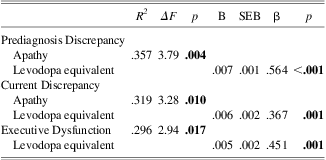
Note. β = Standardized coefficient; B = Estimated Coefficient; SEB =Estimated Standard error; Levodopa equivalent is based on the criteria of Tomlinson et al. (Reference Tomlinson, Stowe, Patel, Rick, Gray and Clarke2010).
Associations Between Caregiver Factors and Patient-Caregiver Rating Discrepancies
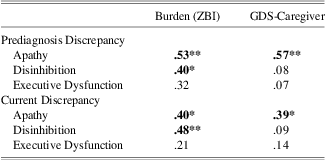
As shown in Table 5, higher levels of caregiver burden and depression were significantly associated with greater discrepancies in prediagnosis and current levels of patient apathy (r's = .39–.57). Higher levels of caregiver burden, but not depression, were significantly associated with greater discrepancies in prediagnosis (r = .40) and current (r = .48) ratings of patient disinhibition. Neither caregiver burden, nor depression was associated with rating discrepancies in patient executive dysfunction before diagnosis or at present.
Correlations between caregiver factors and patient-caregiver rating discrepancies on the FrSBe subscales (n = 26)
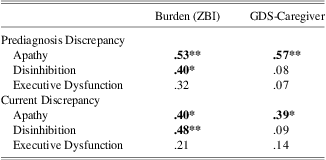
Note. *p < .05; **p ≤ .01; ZBI = Zarit Burden Interview; GDS = Geriatric Depression Scale.
DISCUSSION
PD patient-caregiver pairs demonstrated moderate levels of agreement on their ratings of retrospective prediagnosis and current patient behavior, with the exception of the patient's level of disinhibition before diagnosis, in which inter-rater agreement was poor. Both patients and caregivers reported significantly more problems with patient apathy, disinhibition, and executive dysfunction currently as compared to before PD diagnosis. All behavior before diagnosis was retrospectively reported to be normal, while current apathy and executive dysfunction were reported to be borderline to clinically significant (FrSBe t score ≥ 60). Only patient disinhibition, as reported by both patients and caregivers, remained subclinical at the present time.
Overall, patients retrospectively reported significantly more problems with apathy, disinhibition, and executive dysfunction before diagnosis compared to caregivers. Patients and caregivers did not differ in their current ratings of patient apathy and executive dysfunction, but differed in regards to the current levels of patient disinhibition, with patients reporting more symptoms than caregivers. The latter findings are consistent with those of McKinlay and colleagues (2008), which indicated that PD patients and caregivers endorsed similar levels of current apathy, but differed in their ratings of current disinhibition, with patients endorsing more behavior problems compared to their caregivers. However, unlike McKinlay et al. (Reference McKinlay, Grace, Dalrymple-Alford, Anderson, Fink and Roger2008), we did not find differences between patients and caregivers in their ratings of current patient executive dysfunction. Our results were generally consistent with Chiaravalloti and DeLuca's (2003) study of MS patient-caregiver FrSBe ratings, in that the groups did not differ in their ratings of current apathy and executive dysfunction, while patients reported more current and prediagnosis disinhibition than caregivers. However, unlike the Chiaravalloti and DeLuca (Reference Chiaravalloti and DeLuca2003) study, our sample of PD patients reported significantly more prediagnosis apathy and executive dysfunction compared to caregivers. In combination with these previous studies, our findings suggest that not all behavioral reports are interchangeable between patients and caregivers, especially those related to patient disinhibition and prediagnosis behavior. Our results also argue against dismissing patients’ self reports in favor of caregiver reports due to presumed lack of insight or awareness of their own behavior problems, as patients endorsed more, rather than less, symptoms. Moreover, these findings underscore the importance of assessing baseline or prediagnosis reports, as differences in baseline functioning may account for variations in the reported magnitude of behavioral change between patients and caregivers.
Predictors of Prediagnosis Behavior Discrepancies
None of the current patient factors assessed in this study (depressive symptomatology, cognition, motor symptoms, disease severity, or levodopa dosage) predicted rating discrepancies regarding patient behavior before diagnosis, with the exception of the association between higher levels of current patient levodopa and larger prediagnosis apathy discrepancies. Higher patient ratings, but not caregiver ratings, of prediagnosis apathy were associated with greater use of daily levodopa. While the majority of patient factors did not appear to contribute to prediagnosis rating discrepancies, caregiver factors seemed to be significantly involved in these discrepancies. Specifically, caregiver burden and depressive symptomatology were significantly associated with discrepancies in prediagnosis apathy and caregiver burden was associated with discrepancies in prediagnosis disinhibition. Differences in patient-caregiver ratings of prediagnosis executive dysfunction were the exception, as neither patient, nor caregiver factors were significantly correlated with these discrepancies. Taken together, levodopa medication and caregiver factors may differentially affect certain retrospective behavioral ratings.
Predictors of Current Apathy Rating Discrepancies
Similar to prediagnosis apathy, higher levels of patient medication (levodopa equivalent) predicted larger current apathy rating discrepancies. Yet in contrast to prediagnosis apathy, in which only patient ratings correlated with medication, both caregiver and patient endorsements of apathy were associated with higher levodopa usage. This is somewhat surprising given that levodopa has been purported to ameliorate apathetic symptoms in PD patients (Starkstein & Brockman, Reference Starkstein and Brockman2011). However, consistent with our results, Denheyer et al. (Reference Denheyer, Kiss and Haffenden2009) found that smaller decreases in levodopa were associated with greater apathy in post-deep brain stimulation patients. Differences in the content of specific apathy measures used may account for the disparate findings between studies, while it also plausible that other medications incorporated in levodopa equivalent formulas may be contributing to these conflicting results. Further examination into the specific effects of Parkinsonian medications on behavior could help shed light on the relationship between levodopa equivalents and apathy.
Although we were only able to explore the relationship between rating discrepancies and caregiver factors in a subset of our dyads, our analyses indicated that caregivers’ mental health may play an important role in rating discrepancies, such that higher levels of caregiver burden and caregiver depression were related to larger discrepancies in apathy ratings.
Predictors of Current Disinhibition Rating Discrepancies
None of the patient factors predicted current discrepancies in patient-caregiver ratings of disinhibition. However, specific caregiver factors appear to be important in current disinhibition rating discrepancies, as we found an association between these discrepancies and caregiver burden. Caregiver depressive symptomatology, on the other hand, was not associated with the rating discrepancies. Similar associations were found in a study of caregivers of mildly to moderately mixed etiology dementia patients, in which caregiver-rated prediagnosis and current levels of patient disinhibition were best predicted by caregiver burden (Davis & Tremont, Reference Davis and Tremont2007). Future studies may want to focus on these and additional caregiver symptoms as possible predictors for disinhibition rating disparities.
Predictors of Current Executive Dysfunction Rating Discrepancies
Current levels of patient levodopa best predicted rating discrepancies in current executive dysfunction. Similar to apathy, higher dosages were associated with larger rating discrepancies. In contrast to apathy, higher levels of levodopa were associated with greater endorsement of patient executive dysfunction by caregivers, but not patient ratings. The relationship between levodopa and executive dysfunction in PD has been supported in several studies, which have postulated that aspects of executive dysfunction in PD may be caused by dopaminergic overstimulation of neuroanatomical areas less impacted by the disease process (Gotham, Brown, & Marsden, Reference Gotham, Brown and Marsden1988; Kulisevsky et al., Reference Kulisevsky, Avila, Barbanoj, Antonijoan, Berthier and Gironell1996). Yet, the reason for the dissociation between medication and reports given by either the patient or caregiver remains unclear. It is possible that medication may have a differential effect on the endorsement of behavior that is more externally manifested, such as executive dysfunction, compared to behavior that may be more internally experienced, such as apathy.
As neither caregiver burden, nor distress were associated with discrepancies in current executive dysfunction ratings, patient medication usage appears to be the primary driving force in these rating discrepancies.
Clinical Implications
Our findings suggest that clinicians might expect moderate concordance with most patient and caregiver behavioral reports and anticipate that most reports of patient executive function and apathy will be similar between patients and caregivers. However, clinicians should be especially cautious regarding reports about current levels of patient disinhibition and any retrospective reports about prediagnosis behavior, as these reports may be discrepant between patients and caregivers. If disparities in patient-caregiver reports are evident, clinicians may want to consider the medication levels of the patient as well as the caregiver's level of distress/burden and depression, as these factors may play a specific role in subjective reporting. While higher levels of levodopa may be construed as a marker of advanced disease, it is notable that the gold standard for disease stage, the Hoehn and Yahr, was not predictive of any behavioral rating discrepancies. This suggests that levodopa equivalents have a unique relationship with behavioral rating discrepancies not accounted for by disease status.
It is important to note that the only significant patient variable (levodopa equivalent) in this study captured a modest amount of variance in all of the discrepancy ratings, regardless of the behavior assessed. Moreover, most of the patient variables, such as patient depression, cognition, and motor function, were not associated with patient-caregiver behavioral ratings discrepancies. Future research into the contributions of additional patient and caregiver factors to rating discrepancies may be informative to clinical practice.
Study Limitations
Limitations of this study include the retrospective nature of the FrSBe prediagnosis behaviors. While these are informative in their own right, prospective studies that assess behavior before or at the time of diagnosis could clarify the concordance of patient and caregiver ratings not confounded by recollecting past behavior. In addition, having a third, ideally objective, party (e.g., clinician) could also be beneficial in characterizing patient behavior. Another limitation was our small sample size of caregivers who completed mood and caregiver burden questionnaires (n = 26). Replication of these analyses with a larger sample size as well as with additional patient and caregiver variables (e.g., caregiver cognition) could help elucidate other predictors of patient-caregiver rating discrepancies. Another unavoidable limitation of this study was the gender differences between patients and their caregivers, who were predominantly spouses. It is possible that gender differences may account for some of the findings, but we are confident that they do not explain patient-caregiver differences on the FrSBe scales, as these scores were transformed into standard scores using gender-based norms. Finally, our study included individuals referred by their neurologist who did not meet criteria for clinical depression or dementia; therefore, generalizability of our results to clinically depressed individuals, individuals with dementia, as well as to individuals outside of a primary neurology clinic, is limited.
Taken together, our findings suggest that patient and caregiver behavioral reports may or may not be interchangeable depending on the specific behavior and time point (before or after diagnosis) assessed. These results challenge the use of caregiver reports in lieu or in favor of patient reports in the evaluation of PD behavior and underscore the importance of understanding how specific patient and caregiver factors may play a role in behavior rating discrepancies.
Acknowledgments
This work was supported by a Merit Review grant (J.V.F.) and a Career Development Award (D.M.S.) from the Department of Veterans Affairs. The authors have no financial or other relationships that could be interpreted as a conflict of interest affecting this manuscript.