

Introduction
The Mobility Context
Southeast Asia is increasingly a region ‘on the move’. Urbanisation is being driven largely by rural-urban migration; millions of Southeast Asians cross international borders, mostly to find work; and personal mobility is such that daily movements are growing in both frequency and distance. To date, the greatest attention has been paid to transnational migration streams, not least because they are politically the most sensitive, and also the most visible. In Asia there is a cascade of such flows, reflecting the development contours of the region: hundreds of thousands of Burmese and Lao work in Thailand; Vietnamese in Taiwan and South Korea; Filipinos in Hong Kong and Singapore; and Indonesians and Bangladeshis in Malaysia.Footnote 1 Notwithstanding the scale of regular and irregular transnational movements, these flows are dwarfed – possibly by a factor of six – by intra-national movements. The United Nations Development Program (UNDP 2009) estimated that there were 740 million internal (domestic) migrants across the globe at the beginning of the Millennium, many of them unrecorded sojourners. National censuses often do not pick up such short-term movements and population registers, especially in developing countries, are either lacking or provide only rudimentary coverage: “For the most part, migration data remain patchy, non-comparable and difficult to access” (UNDP 2009: 28). This is further accentuated when it comes to circular migration, for which no global data exist (Newland Reference Newland2009: 10; and see Kundu Reference Kundu2009: 14; UN Habitat 2009: 25).
In a World Bank (2003: 22–3) cross-country study of urban poverty, covering Indonesia, the Philippines and Vietnam, a large portion of the report deals with the question of how to get a better grip on the number, status, and living and working conditions of the urban poor. The report notes that we know far more about the rural poor than the urban poor, not only because historically most attention has been focused on rural areas (the heartland of poverty), but also because the rural poor are more stable and therefore more legible. Beyond migration, increasing levels of mobility more generally adds a further disturbing component to the spatial mix. Improving roads, cheaper public transport, and the growing ubiquity of private means of transport are transforming the possibilities of work and living. In some countries, factories will pick up workers daily over a radius of 100 km; the motorbike has made the transition from coveted luxury to necessity; and the friction of distance has declined dramatically.
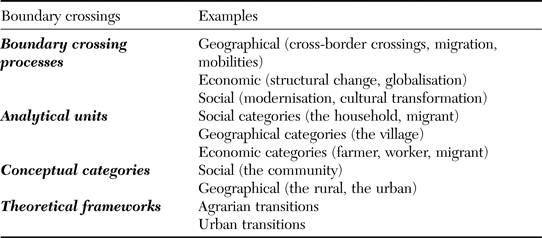
Migration, mobility and movement are the processes which provide the empirical scaffold for this paper. The paper will use this empirical framing to reflect on a set of methodological, conceptual and theoretical challenges (Table 1). To summarise, mobility and associated geographical (spatial) boundary crossing have raised questions about the analytical units we employ in our research; the unsettling of these analytical units challenges whether our conceptual categories still have explanatory purchase; and the fracturing of our conceptual categories has implications for the theoretical frameworks that we have traditionally deployed. The paper ends with a tentative – and necessarily brief – proposal regarding how these perceived shortcomings might be addressed.
Beyond boundaries.

Data and Methods
The arguments presented in this paper draw on four discrete field-based research projects undertaken by the author and co-workers in the Lao PDR, Thailand and Vietnam, augmented by reference to the wider academic and development literatures. The earliest of these field studies on which the paper draws dates from 1982 and the most recent from late 2010. In summary, they comprise:
-
• A longitudinal study of two villages in the northeastern region of Thailand (separately undertaken in 1982/83, 1994 and 2008/9);
-
• a project investigating rural livelihoods in upland and lowland Lao PDR (with fieldwork conducted in 2001–2002);
-
• an investigation into rural change in two very different areas of rural Thailand, Chiang Mai province in the Northern region where the focus was on handicrafts, and Ayuthaya province in the Central Plains where the settlement had become a dormitory village serving nearby factories (carried out in 2005–2006);
-
• and a study of rural migrants and rural-urban relations in Hanoi, Vietnam (with fieldwork undertaken in 2010).Footnote 2
The first and third of these four studies employed mixed methods, combining both survey questionnaires with interviews and community engagement. The second study took a more participatory approach, employing focus groups, key informant interviews and community profiles. The final piece of research in Hanoi, meanwhile, was based almost entirely on interviews with migrants and their families. Fuller details of the methods employed and the research context can be found in, respectively, Rigg and Salamanca (Reference Rigg and Salamanca2011), Bounthong Bouahom et al. (2004), Rigg et al. (Reference Rigg, Veeravongs, Veeravongs and Rohitarachoon2008), and Nguyen et al. (2012). In this paper I use these field studies to provide a grounding for the arguments pursued which are, in turn, linked to other studies (academic and applied) so as to broaden the scope of the paper and embed it in the wider literature. The paper represents, therefore, a melding of primary and secondary research, to become part review and part research paper.
Boundary Crossing and Geographical Space
The Southeast Asian region has experienced a mobility revolution. The temptation, of course, is to set this against the backdrop of a perceived ‘immobile’ past when peasants were confined to their villages, knowledge was local, and households and villages were very largely self-provisioning. This ignores the degree to which there were market relations, intra-regional trade routes, and significant movements of people before the modern period (Pasuk Phongpaichit Reference Phongpaichit1980; Walker Reference Walker1999a, Reference Walker and Evans1999b). Notwithstanding the mobility of the past, however, numerous scholars have noted how mobility patterns have been progressively transformed over the last half century.Footnote 3
One of the first systematic village studies to be undertaken in Thailand – the ‘Village Ayutthaya’ study of 1970 led by Jacques Amyot – describes the horizons of villagers as distinctly limited; theirs, as the study says, was an ‘intimate universe’:
“The physical and social universe of a farmer is relatively simple. Its centre at the most elementary level is the homestead where family life evolves and livelihood activity is organized. Other centres in a wider sphere of social relationships are the wat [monastery] and various meeting places such as stores and so on, as opportunities arise. Likewise, the family and household are the primary focus of social relationships extending outwards to neighbours and friends in the same community. These natural ties constitute the normal basis for cooperation and association for social and economic purposes. This is the intimate universe of the Ayutthaya villagers.” (Amyot Reference Amyot1976: 45)
The paradigm of the immobile peasant is also reflected in a report published in 1973, focusing on Laos:
“Isolated settlement and the peripheral location of all but the southernmost part of Laos…have kept most peasant families out of the monetised economy and in a state of very near self-sufficiency. …throughout the rural areas people build their own houses and make their own furniture from wood and bamboo, weave their own clothes from cotton and silk and make their own baskets and mats.” (ARTEP 1973: 11–15)
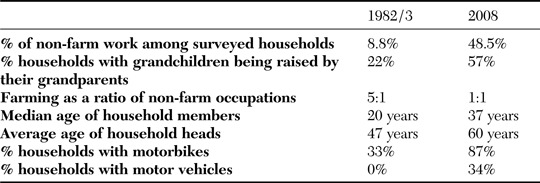
Today it would be hard to describe rural Thailand, or most other rural places in Southeast Asia, as embodying a ‘relatively simple’ physical and social universe. Villagers' horizons, and their ability to reach and transcend those horizons, are markedly different. As a 25-year longitudinal study from Mahasarakham in Northeast Thailand shows, the ownership of private means of transport has mushroomed, households have become multi-sited and stretched over space, and occupations are increasingly non-farm and ex situ (Table 2, and see Rigg and Salamanca Reference Rigg and Salamanca2011). Importantly, what the table does not tell us, are the forces that led to this transformation in everyday living. Do we interpret this mobility revolution as indicative of rural failure, the progressive relative immiseration of the countryside relative to urban areas, the marginalising effects of capitalist penetration, and the concentration of land and wealth in the hands of a small number of wealthy farmers (Davis Reference Davis2004, Reference Davis2006; Glassman Reference Glassman2004)? Or, alternatively, do we see in these transformations the progressive development of rural areas, the opening up of new opportunities made possible by rising levels of education and skills, and an increase in disposable incomes (see the papers in Tapp and Hirsh 2010, and Rigg and Vandergeest Reference Rigg and Vandergeest2012)?
Indices of mobility in Ban Non Tae and Ban Tha Song Korn, 1982/3 and 2008. (Source: surveys 1982/3 and 2008)

Boundary Crossing and Analytical Units
The Village
In the 1970s and 1980s it was usual in rural research to adopt the ‘village study’ approach and use ‘the household’ as the basic unit of analysis. At the time, for most scholars, these appeared to be the elemental societal, economic and geographical building blocks from which to begin a study of agrarian change. The Thai economic historian Chatthip Nartsupha, for example, in his seminal work The Thai village economy in the past (1999) refers several times to the village as a ‘primordial’ community (e.g. on pages 10, 15 and 26). Scholars in anthropology, rural sociology and geography sought to research and uncover, variously, the Asian village, the Thai village and the Javanese village. Notwithstanding critiques from scholars such as Breman in the context of Java (1980) and Kemp in Thailand (1988, 1989, 1991), the village continued – indeed, continues – to define and demarcate much rural research and action. Social movements reify the village; states count, map, educate and develop their populations through the organising principle of the village; and scholars research people and households in villages.
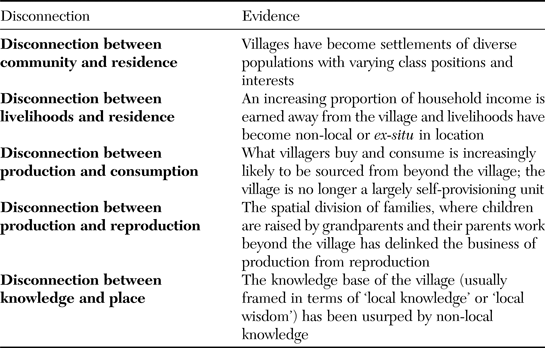
While the progressive disconnections that are introduced below have not occurred everywhere, nor have they occurred at the same time and at the same rate, they do raise questions about the coherence of ‘the village’ as a unit of analysis. The spatial coincidences of community and residence, livelihoods and residence, production and consumption, production and reproduction, and knowledge and place, have all been compromised (Table 3). As Breman et al. write:
“There is clearly a need to investigate the ‘units’ in terms of which rural realities are defined for various purposes, but also to explore the interfaces and interstitial spaces between such nested units. It is paradoxical that in general neither economists nor sociologists or anthropologists, neither those using the large-scale-sample-survey approach nor those who subscribe to the technique of village-level participant observation, have adequately addressed this question in a direct fashion.” (Breman et al. Reference Breman, Kloos and Saith1997: 3)
Disconnecting the village?

The Household
These village-level problems, or difficulties, are reproduced at lower scales, particularly in the context of ‘the household’. Classically, the household was a ‘co-residential dwelling unit’, defined by the propinquity of its members (Bender Reference Bender1967). Yet increasingly, the mobility of individuals in the countries of the region is re-working the spatial signature of living and in so doing raising questions about the spatial ‘essence’ of the household. Households are becoming stretched across space as members reside, live and work in different places, representing something of a challenge to field workers. This spatial re-working of the household reflects not only transformations in the nature and location of livelihoods, but also a re-working of the household in terms of gender and generation. For feminist scholars the problems connected with the household have more to do with how this subsumes women into a unit of analysis that is implicitly headed by a male ‘head of household’. The household is seen as co-residential in spatial terms, but also a unit where income is pooled and production and consumption undertaken jointly (Ekejiuba Reference Ekejiuba and Cornwall2005): into spatial propinquity is also read social and economic propinquity, thus obscuring the (growing) tensions and internal stratifications of the household (see Eder Reference Eder1999) such that referring to ‘household strategies’ or the ‘household economy’ is problematic in the sense that they assume a commonality of interests and purpose.
As with the issue of whether mobility is ‘new’, so too with gender and generational relations. Are such relational changes a product or outcome of social and economic transformations, or are scholars simply more attuned to their presence (a point that Eder Reference Eder1999 makes)? There is, to be sure, substantial evidence that the envelope of accepted practice has been loosened. Young, unmarried women can do things that their mothers could not. They can move outside the village, unaccompanied; they can work in modern sectors of the economy; and they can build lives partly – although rarely entirely – separate and separated from their natal households. Eighteen year-old Gii from Ban Lathahair in Luang Prabang province in upland, northern Laos provides an example of such re-worked gender relations and their spatial implications, which is repeated countless times across the region (Rigg Reference Rigg2007).
Gii heard on the radio that a garment factory in Vientiane required workers and, coincidentally, a monk living in the capital and with relatives in Ban Lathahair also sent word that work was available. Her motivation for leaving home was a combination of a desire to escape the hard work of upland farming and the recognition that agricultural work in such a marginal area would not, in the long run, deliver a sustainable livelihood. Like many other women in the village she also had a skill to sell: her aptitude for weaving. While Gii was enthusiastic about leaving home, her father was not, fearing she might be lured into prostitution. He admitted to us, however, that he could not prevent his daughter from leaving the village. On her recruitment in 2000, Gii was provided with a bed in a dormitory and a salary of 200,000 kip (US$20) per month. In the first year she was able to remit to her parents 300,000 kip (US$30), a not insubstantial sum for a poor, rural, Lao family. When she temporarily returned to the village it was evident that the girl who had left had been transformed into a new, more confident woman, with different tastes in dress and food, and new behaviours. Gii didn't stay long in the village, and before she departed made it clear that she had little wish to marry someone from the village. Gii remained a dutiful daughter to the degree that she remitted money home to her parents; but she was also exerting her independence in a manner that her mother would not have contemplated.
Farmers and Workers, Migrants and Non-migrants
National statistical agencies and multilateral organisations collect data on employment, categorising people according to whether they are farmers or workers. The experience in many countries is that during transition people often not only cross geographical contexts, as described above, but in doing so also cross – and re-cross – sectoral categories. It is not unusual for people to keep a foot on the land even while they step on to the factory floor. This is even truer when we consider occupations at the household level. Individuals and households pursue multi-stranded livelihood strategies (sometimes termed occupational multiplicity) in which they juggle a variety of activities and occupations. In the rural handicraft village of Ban Mor in northern Thailand households sustain an average of 3.7 different productive activities (Rigg et al. Reference Rigg, Rohitarachoon, Veeravongs, Agergaard, Fold and Gough2010a). Self evidently, these households and often the individual household members as well, were not easy to categorise and ‘box’. Most households maintained an intimate link with farming, but at the same time agriculture was often a subsidiary activity in terms of its contribution to household income. From a household point of view, debates over urban (or rural) bias and the balance of terms of trade between agriculture and non-agriculture, and returns to work in farming versus non-farming, became somewhat redundant. For the moment at least, in much of rural Southeast Asia, it is in the combination and the inter-locking of activities across sectors and development spaces that the logic of patterns of living is to be found, and livelihood resilience is founded.
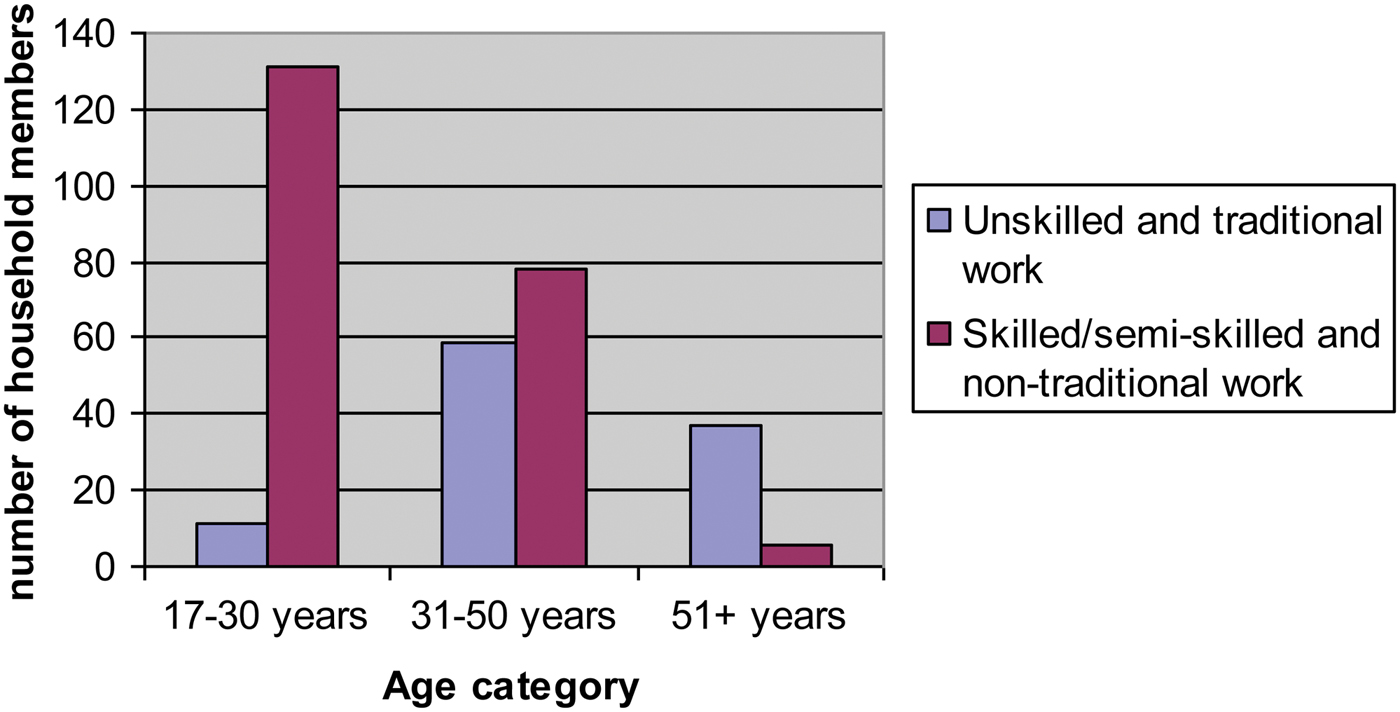
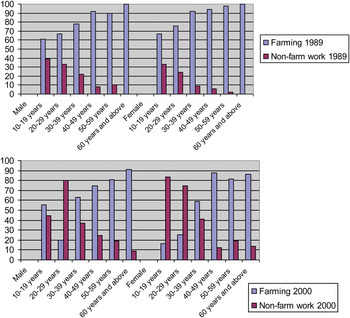
A question which remains outstanding, however, is whether such features will remain durable characteristics of rural Southeast Asia. Will households continue to be characterised by occupational multiplicity; and will we see a continued ageing – or geriatrification – of the agricultural labour force (Rigg et al. Reference Rigg, Veeravongs, Rohitarachoon, Veeravongs, Agergaard, Fold and Gough2010b)? As Figure 1 shows, based on field work in the central Thai province of Ayutthaya, there is a clear generational divide between those engaged in traditional, mainly farm-based pursuits and those who have embraced modern, largely ex situ activities. In Ban Non Tae and Ban Tha Song Korn, in 1982/3 the median age of villagers whose principal occupation was farming was 31 years old; by 2008 it had risen to 48 years (Rigg and Salamanca Reference Rigg and Salamanca2011). Do we see here, era defining changes in the region, or life course adjustments? This point is rendered even clearer in Shigetomi's study of multi-household farming systems in Northeast Thailand (Figure 2) where, in 1989, non-farm work appeared to be linked to the life course, concentrated as it was among men and women under 30 years of age. Ten years later in 2000, we might interpret the evolving data as indicative of a more profound-era defining shift in patterns of work as non-farm work became, first, more ubiquitous; second, moved up to the age profile; and third, became increasingly centred on the female population of the village.
Age and occupational status of adult household members: Ban Khan Haam and Ban Khokmayom, 2005. (Source: survey data, Ayuthaya province, Central Thailand, 2005)

Farm and non-farm work and gender in a Northeastern Thai village, 1989 and 2000. (Source: data extracted from Shigetomi Reference Shigetomi2004)

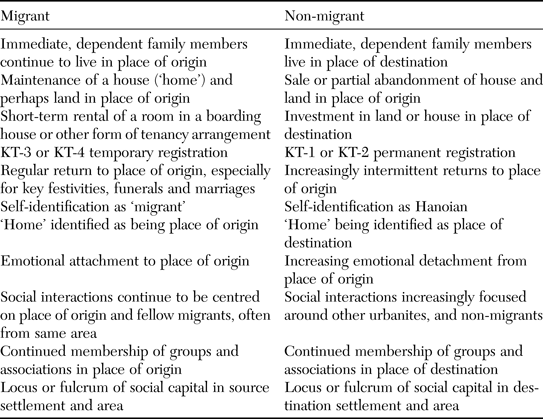
A third transformational issue which is intimately associated with the mobility theme of this paper is the question of the point at which a migrant become a non-migrant (Table 4)? A migrant is a person who has moved from one place to another. Yet over time, a migrant becomes insinuated into a new context and progressively sheds the defining characteristics of what it means to be a migrant. We can hypothesise that there is a transition underway from migrant sojourner to urban denizen to urban citizen. It may seem perverse to call someone a ‘migrant’ when they have lived in a city such as Hanoi for a decade or more; when their children live, have been educated and work in Hanoi; when their social circles and interactions are Hanoi-centred; and when they have invested significantly in the city. But there are also migrants who have resided in a city for 20 years or so more and yet still have not relinquished the characteristics that define them as migrants. Emotional and functional attachments and interactions are primarily to and with the place of origin, rather than that of destination. As we conclude in our study of rural migrants in Hanoi:
“Emotionally, [migrants'] attachment to home remained strong; but very few of our migrants seemed to be desirous to return home to live and work. Homeland had become a space of familial origin and emotional identification. But it was not where people sought necessarily to reside, work, raise their children and build their lives. These sojourning rural folk and their children were on their way to becoming urban.” (Nguyen et al. (2012)
Characteristics of migrants and non-migrants: Hanoi, Vietnam. (Source: interviews, Hanoi 2010)

Analytical Units
As outlined above, mobility has rendered a number of the central organising principles that we use in our research problematic. The village has become blurred, socially, economically and geographically; the household has become increasingly divided along spatial, gender and generational lines; the neat occupational categories into which statistical agencies formerly placed people have dissolved; and identities have become hybrid.
This leaves a practical challenge in tracking the turbulence that almost everyone intuitively knows is part of Southeast Asian development but which is not, often, revealed in government statistics. People may increasingly move from their rural villages to build urban lives and undertake urban work, but one would not always know it from the data. People move but their registration stays put; livelihoods are re-spatialised but their identity may often remain village-centred and rural-based; and those who stay put may become ‘urban’ in their practices and the desires they hold dear. Data on residency and employment are not structured in such a way that they can pick up the nuances of everyday lives and living where households are spatially divided and employment cuts across sectors and spaces in the manner outlined above.
Vietnam's registration system (ho khau), for example, records where people reside against where they are registered (in much the same manner as China's better known hukou registration system):
-
KT1: person registered in the district where he/she resides
-
KT2: person not registered in the district where he/she resides, but registered in another district of the same province or city
-
KT3: person from another province/city who has temporary registration in their place of destination for a period of one year, after which the KT3 registration has to be re-issued
-
KT4: person from another province/city who has temporary registration in their place of destination for a period of six months, after which the KT4 registration has to be re-issued
It is widely known that KT4 registrations in Hanoi and Ho Chi Minh City “are probably gross underestimates due to the fact that they depend on registration through guesthouses and the like…” (GSO 2006: 13). One indication of the size of the ‘floating populations’ of Hanoi and Ho Chi Minh City lies in the disparity between employment data and population data: between 2002 and 2005, the population of Ho Chi Minh City grew by 7.5 per cent; over the same period, the number of workers employed in enterprises in the city expanded by 39 per cent (Dapice et al. Reference Dapice, Gomez-Ibanez and Thanh2010: 3). It has been estimated that, in total, the floating population of Vietnam numbers between 12 and 16 million which, if broadly correct, represents between 13 per cent and 18 per cent of Vietnam's population (UNDP 2010: 5).Footnote 4
In an attempt to get a better grip on the number of rural-urban migrants in Ho Chi Minh City, the World Bank (2008) compared the data derived from the Vietnam Household Living Standards Survey (VHLSS) with that derived from a comprehensive population census in the city. The former estimated that 3.8 per cent of the city's population had temporary registration (KT3 or KT4); the latter put the figure at almost 20 per cent, more than five times higher. Comparing the respective figures for those employed in different industries, by 2004 the VHLSS was undercounting employment in the leather goods industry (including footwear) across the country as a whole by 230,000 workers, and in construction by 420,000 workers (World Bank 2008). These are very large numbers indeed.
Boundary Crossing and Conceptual Categories: Community, The Rural, The Urban
It is not just that we need to be aware of how development processes, reflected in heightened mobilities, are unsettling the categories we deploy in our research, and our confidence in the raw macro-level data. There is also a related set of questions concerning the conceptual categories we use, such as ‘community’, ‘the rural’ and ‘the urban’. Once again, the reasons why these conceptual categories are becoming problematic is because of the boundary crossings that mobility has engendered.
Community
“The peasantry will not disappear. Rural economy and society is still a household economy and community. Villagers are small peasants, clinging to the values of helping one another as the basis of living, rather than conflict and exploitation. The ties of community are strong in village society. Community and the village prevent the rural society breaking up into opposing classes.” (Chatthip Nartsupha 2002, cited in Baker Reference Baker2003: 88)
Ban Khokmayom is a former rice-growing settlement situated close to the Rojana Industrial Park in Thailand's Ayutthaya province. The Rojana Industrial Park's presence here in the historic heart of Thailand's rice growing economy is linked to the Kingdom's fast-track, export-oriented industrialisation. In 2005, the park supported 134 factories, directly employing 43,000 workers (and many more indirectly). Of these factories, 84 per cent were foreign invested, mainly Japanese. In terms of product areas, the park represented the full swathe of the industries that have propelled Thailand's export-oriented industrialisation efforts since the mid-1980s: electronics, automobile parts, car assembly, textiles and apparel, footwear, and food and food processing. The issue which our research in Ban Khokmayom aimed to elucidate (Rigg et al. Reference Rigg, Veeravongs, Veeravongs and Rohitarachoon2008, Reference Rigg, Rohitarachoon, Veeravongs, Agergaard, Fold and Gough2010a, Reference Rigg, Veeravongs, Rohitarachoon, Veeravongs, Agergaard, Fold and Gough2010b), was the effects of such industrialisation processes on a former rice growing village (not very far from Amyot's settlement discussed above) situated within the orbit of the industrial park. How have such villages and their populations been drawn into and implicated in industrialisation processes, directly and indirectly?
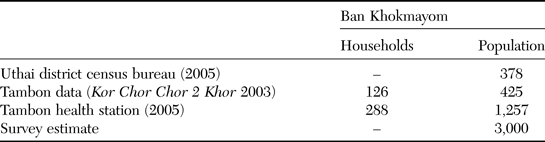
The village of Ban Khokmayom has, indubitably, been re-constituted in population terms – although this is not always easy to track (Table 5). This is because the village of Ban Khokmayom has been infiltrated by migrants, mainly from the poor Northeastern region, who inhabit the physical space of the village, through their habitation of hor pak or dormitories, but do not become part of the village-community. This divides households, but functionally links villages: a large part of the economy of Ban Khokmayom is now dependent on the migrant sojourners; at the same time, the vitality of villages back in the Northeast is tied to remittances generated by work in the factories of the Central Plains.
Demographic turbulence and uncertainty in Ban Khokmayom, Ayuthaya. (Sources: various, as indicated)

To draw on the work of Philip Hirsch (Reference Hirsch and Reynolds2002), we can view the village in two ways. First of all, as a physical unit and identifiable entity with a particular set of characteristics; and second, as a discursive category or notion: the village; and the village. Here I am thinking of the village and the way this interleaves with notions of ‘community’. The ‘village-community’ (the two are often terminologically linked) has become frayed, in large part because villagers' interests have diverged as the settlement has become increasingly heterogeneous (Rigg et al. Reference Rigg, Veeravongs, Veeravongs and Rohitarachoon2008). Without wishing to romanticise the past, the social covenant that use to bind the population of Ban Khokmayom, even in the context of social division, has been fractured, most obviously by the presence of so many migrants who reside in the village, but do not live there. In addition, however, the interests of Ban Khokmayom's ‘core’ population have also diverged with sharpening disparities in wealth and the way in which richer villagers have managed partially to disengage themselves from the settlement.
There is a political angle to the maintenance of the fiction of the village-community, which is perhaps nowhere more resonant than in Thailand where the ethos of ‘community culture’ has partially shaped the way that NGOs, even the state, have thought about rural development, not least through the sufficiency economy or sethakit phorpiang (UNDP 2007). The sufficiency economy stresses the need to insulate livelihoods against the market through the promotion of a measure of self-reliance, echoed at the national level as governments seek to protect countries from the excesses of globalisation. For its critics, however, the sufficiency economy is out of tune with the tenor and direction of development transformations: “A desire for education, urban employment and lifestyle improvement needs to be placed at the core of contemporary rural culture and not marginalised as some sort of false consciousness that is inconsistent with ‘sufficiency’ thinking” (Walker Reference Walker2007: 6).
The village-community has come to be seen as the lodestar that will protect and cushion rural Thailand from the tensions of development. But just as a political and development elite embraces the village-community, so many villagers are building lives away from home and outside farming, transforming the village-community into a village-settlement. Development has not only taken Thailand's rural population out of the village, it has imbued them with a worldliness that is far removed from any peasant identification. As Charles Keyes has remarked (Keyes Reference Keyes2010) a higher percentage of Northeasterners – popularly viewed as country bumpkins in television soaps and comedy sketches – have passports than do the urban lower middle class. Thai historian Attachak writes that the “study of ‘community culture’ is a research field that stresses the never-changing virtue of Thai communities” (Attachak Sattayanurak 2010: 8), while most Thai villages have profoundly moved on (see Rigg and Vandergeest Reference Rigg and Vandergeest2012). This is, furthermore, no arcane academic debate; it is an important thread in how the Thai state thinks about and undertakes the development project. It has, for example, infused the development ethos of the National Economic and Social Development Board (NESDB) and the Kingdom's five year national economic and social development plans (most clearly, the Ninth Plan 2001–2006).
Rural and Urban
The experience of Ban Khokmayom and other villages in Thailand's networked economy and society raises additional questions of what we mean by ‘the rural’ and ‘the urban’. From Ban Khokmayom it is possible to observe a cascade of effects which show how rural and urban, whether denoted as ways of life, patterns of livelihood, or modes of belonging, are breaking loose of their formerly quite secure spatial bonds. Core villagers engage with factory work outside their settlement; the settlement itself is a site of habitation for many hundreds of migrants from other areas of Thailand; surrounding rice fields have been colonised by factories; many of those fields that are still available to farm, stand idle; and modes of living owe more to urban than rural styles. This dismantling of categories is not just of academic interest; it also has significant implications for rural development and development policy. As Dercon writes, “understanding rural poverty changes cannot naively focus only on what happens in the rural sector, or in agriculture…if development has to do with people moving between sectors, then this will often imply spatial movement” (2009: 5, 6). In Ban Khokmayom this concern with the disturbing or unsettling effects of mobility can be taken one step further: such is the degree of inter-weaving permitted by the mobility revolution in the area that the village itself, and not just the people who collectively comprise the village, has been drawn into the functional orbit of the urban.
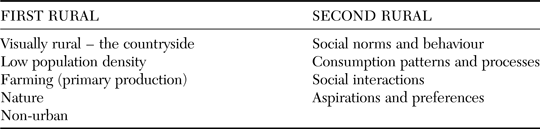
Bell (Reference Bell2007) distinguished between what he terms the ‘first rural’ and the ‘second rural’ which are, essentially, two approaches to thinking about and studying ‘the rural’. The first rural is “…the rural everyone knows as rural, and that we typically regard as prior: the epistemology of rural as space, as lower population density, as (at times) primary production, as nature, as the non-urban which is so plain to see – the material moment of the rural” (Bell Reference Bell2007: 408; see also Halfacree Reference Halfacree2007). To put it another way, the first rural is what we all instinctively sense is rural. The second rural is more slippery, has a hard-to-pin-down quality, and exists independently of the first rural. The second rural is not spatial, cannot easily be measured or grasped in policy terms, and owes much to political, social and economic processes rooted in urban contexts. Building on this classification, it is possible to argue that many villages in Asia have become ‘second urban’, even while they remain first rural (Table 6).
‘First rural’ and ‘second rural’. (Source: adapted from Bell Reference Bell2007)

This approach to thinking about the transforming rural context has been developed and applied largely in Northern (‘developed’ world) contexts. One scholar, however, who has done something similar in Southeast Asia is Eric Thompson, in his work on Malaysia. He has argued that Malaysian villages are, increasingly, ‘socially urban’. With reference to the village of Sungai Siputeh, Thompson argues that migration has led to the ‘dissociation’ of the Malay-peasant complex, taking migrants along multiple paths from Orang Kampung (Villagers) to Melayu Baru (New Malays) (Thompson Reference Thompson2004, Reference Thompson2007). He writes of Sungai Siputeh and the people who live there:
“Sungai Siputeh is not Kuala Lumpur. It is not a city, a town, a kota, bandar or pekan, by any standard interpretation of those terms. Yet in practice, it is in many ways a very urban place, if urban is taken to mean anything other than a place with high population density.” (Thompson Reference Thompson2007: 126)
“Along with Malay culture, residents of Sungai Siputeh and others registered a sense that perhaps the kampung was disappearing as well. … The place itself will not necessarily disappear, but everything that makes it a particular kind of place will fade away.” (Thompson Reference Thompson2007: 194 [all emphases in original])
In villages in Thailand, identities are changing in a similar manner, but the village and villagers are being reworked and restructured in other ways too. This re-working can be brought together and considered in terms of the altered spatialities of production, consumption and identity.
In the early 1980s, if a villager in Ban Non Tae and Ban Tha Song Korn wished to seek an occupation outside farming, or to live a modern and modestly cosmopolitan life, she or he had to leave the village. By the first decade of the 21st century, commuting while maintaining a village base was a real possibility; a degree of urbanity in the rural had been made possible. Villagers could be, if they so wished, moderately urbane ruralites. In 1982 and 1983 when I first interviewed villagers in these two settlements in Northeast Thailand, their instinctive response to ‘who are you’, was chao naa – rice farmers. This denoted their identity, but it was far more than merely symbolic. Rice farming was also the cornerstone of the village economy, of household livelihoods, and of family survival. By the 2000s, most families still owned land and they still grew rice; but they depended on neither. Young men and women were marking out futures that avoided farming, something that parents were only too willing to endorse and support, and they rarely self-identified themselves as chao naa – rice farming peasants.
This means that there is a case that if we think of the urban as a state of mind, as a set of social and cultural practices, and as a way of living, it opens up the possibility for a more thorough-going and pervasive identification of the urban. It also raises the possibility that urban and rural are not mutually exclusive categories, but coexisting and cotemporaneous. How does migration and mobility make rural spaces urban and, for that matter, urban spaces rural? It does so by bringing urban norms and mores to rural villages. Rural producers become urban consumers; peasants become workers and housewives; and peasant children become urban youths. In addition, migration brings remittances that make possible the funding and creation of urban-inspired micro-landscapes from mini-marts to beauty salons. Finally, the urban is present in rural spaces through, paradoxically, absence – namely, the absence of people.
Boundary Crossing: An End and A Beginning
This paper has focused on the shortcomings of our current analytical tools and framings when it comes to understanding development transitions in Southeast Asia. This has been seen to arise, in part, because conceptual, analytical and spatial parameters have been unsettled during a period of profound social and economic change. This questioning of existing approaches is seen as valuable in itself: it raises questions about the accuracy of the raw data which are often conveyed as if it is unproblematic; it highlights possible deficiencies in development interventions; and it poses doubts about whether our interpretation of development transitions in one context can be exported to another. That said, it is at the same time not unreasonable to ask what alternatives there might be, and it is to this question which the paper now turns.
A theme that resonates through the critique above is that existing approaches fail adequately to deal with the hybridity of everyday living across transforming Southeast Asia. One scholar who has attempted to build hybridity and contingency into a new framework of understanding is Terry McGee and his work on ‘extended metropolitan regions’ (EMRs). He has argued that a set of geographical specificities in Asia – densely-settled wet rice growing areas creating a distinctive agro-ecological setting, and resulting dynamic linkages between agriculture and non-agriculture – has made urbanisation region-based, with the peri-urban becoming a central and dynamic component in the city economy's operation, rather than being an edge space in functional as well as geographical terms (McGee Reference McGee, Costa, Dutt, Ma and Noble1989, Reference McGee, Ginsburg, Koppel and McGee1991, Reference McGee2003). At the regional level, Gavin Jones (Reference Jones1997; see also Jones et al. Reference Jones, Tsay and Bajracharya1999) has, in parallel, argued for the ‘thoroughgoing’ urbanisation of East and Southeast Asia, highlighting the way in which patterns of urbanisation are challenging established assumptions about the rural/urban divide, about the mental separation of rural and urban living and lifestyles, and about the geographical location of the proletariat.Footnote 5 But there is more to the distinctiveness of Asia's urban transition than the productivity of rice culture and the special character of the spatial patterning that it can support. It is the social and economic turbulence of rural Asia, as outlined in this paper, which also plays a key role in creating the hermaphrodite spaces of the EMR (see also McGee Reference McGee2009). McGee's theorising of urban transitions in Asia is thoroughly inductive: this is grounded theory emerging from his engagement with people and places in the region. Rather than attempting to shoehorn the Asian experience rather inadequately into existing approaches and framings, he has sought to re-think ‘the [Asian] urban’.
More widely, the discussion above suggests that the empirics of change in the region require that we develop new ways of doing research and thinking about change. For example, instead of focusing on households in space, as scholars have tended to do (and governments have tended to expect and plan for), we should be trying to map out the networked relations that link lives and individuals across national and transnational space. At the governance level, the experience of the region is one where a set of important dynamics associated with societal change, settlement dynamism and sustainability, population turbulence, and evolving cultural preferences operate partly independently – and sometimes against – the development ‘project’ as it is constructed and entertained by the state. There is a case for viewing rural change not as either independent of wider processes (state driven or otherwise) or alternatively as dependent on them, but instead nested within a shifting web of mutual dependencies and interdependencies. The implication of the above takes the issue of hybridity to another level, to emphasise the need for heterodoxy. By this I mean that we should not be seduced into thinking that particular models of change, frameworks of understanding, or approaches to research will necessarily capture the complexities of change on the ground. As Rodrik (Reference Rodrik2007: 85) says of development more widely, and which echoes with the tenor of this paper: “The central economic paradox of our time is that ‘development’ is working while ‘development policy’ is not”. He identifies a disjuncture between the evident development success of many countries in Asia, and the sense that this has not infrequently been achieved in spite of the policies advocated by multilateral organizations, prominent academics, and influential governmental and non-governmental aid agencies. The view of change from the countryside and from the experiences of migrants as discussed here reveals the need continually to benchmark our methods, conceptual frameworks and assumptions about transition and transformation against the empirics of change. Furthermore, this benchmarking should engage not only with large scale surveys and resultant data sets but also with micro-studies based on qualitative approaches. We should be willing to learn from the field and cross, even re-draw our boundaries of work and understanding if we are to keep track with the pace and pattern of change in the region.