The citizen protests that erupted in North Africa and the Middle East during 2011 prompt one to ask what might happen in the aftermath of such events. Long after the news cameras have switched to focus on other stories, how do people enjoy the freedom they have gained? In South Africa the democratic transition was much celebrated worldwide for liberating the previously disenfranchised. But subsequent developments, particularly the switch from the liberation movement's earlier alignment with Moscow to a neo-liberal economy, seemed to imply this would be a freedom less to exercise political choice than to consume. As one prominent African National Congress member – and government spokesman – said, ‘I didn't join the revolution to be poor’ (Posel Reference Posel2009). The media tell us that what are consumed are often glitzy and even kitsch goods and branded products. This outcome sounds different from what many might have expected, although of course it would be paternalistic to want to deny others the right to what is freely available to those in the world of mainstream capitalism. The down side is that this freedom entails, and has been accompanied by, something that looks like a very definite unfreedom: massive levels of consumer indebtedness, growing from more than R350 billion in 2002, with an average interest rate of 26 per cent per annum, to the 2006 level of R680 billion, with an interest rate on short-term loans of 360 per cent per annum. By 2008 the figure had grown to R1.1 trillion (R10=approx £1) (du Plessis Reference du Plessis2007: 79).
This stark picture requires qualification, however. The people who turn out to be most in debt are not the poorest of the poor, but the ‘black diamonds’: the upwardly mobile and fast-growing African middle class, which in 2007 was reported to have grown by 30 per cent in just over a year.Footnote 1 The things for which they get into debt are not only flashy goods and branded clothes, or expensive cars, but often items of much greater long-term worth and value. Investments are deemed necessary in life-course events like marriage (and bridewealth), in death (and funerals). Higher education is now deemed a necessity. The former were long considered essential, but have become more costly. Massively expanded demand for the latter, coupled with an absence of state funding or bursaries, has caused a particularly severe drain on households’ resources. Having undergone the pain of oppression and the exhilaration of freedom, people find that what they value most is also what has caused their considerable indebtedness, with all the attendant unsustainability, anxiety and even shame that this entails.
However global a force, neo-liberalism, with its contradictory intersection of state and market forces, has consequences that differ widely from one setting to another. Those aspects of the liberated life which are valued in South Africa, the debt into which people get in order to acquire these, and the measures undertaken by the state to address this social problem of debt, have a very particular character. Such regulatory measures arise in a society somewhat out of kilter with what is occurring in the rest of the world. As Hobsbawm observed, the end of the twentieth century was a time when all programmes for improving the affairs of the human race seemed to have failed (1994: 563) and when citizens had become increasingly marginalized and unlikely to participate in formal political processes. Yet just at this belated moment South Africans had been offered democracy, and its accompanying restitutive and reform-oriented measures, often with a strong racial underpinning. They were seized by the idea that a state remedy might set right the earlier, racially determined wrongs which had been brought about by state and market in collusion. The discussion of debt in this article is set against the longer history of exploitation of South African black people by the forces of capitalism, in which they were not only paid bottom dollar but also sold low-quality goods, especially furniture, on hire purchase and at high interest.
Before the credit crunch had become a matter of daily discussion in the rest of the world, overindebtedness was a matter of huge concern in South Africa. Its status as a kind of moral panic was evident in the early 2000s from business pages in the major newspapers and from radio phone-in programmes. All contained heart-rending stories of the kind that have now become familiar globally. In a manner that is classically South African, yet recognizably global, proposed solutions revealed a strong ‘market-driven’ orientation, combined with attempts at regulation by both state and society. Both the supply of and the demand for credit received attention. Human rights and civil society organizations strove to curb demand by teaching budgeting skills – implying that if people tightened their belts, stopped spending money on the lottery, and learned to live within their means, all would be well. At the same time, a new piece of legislation, the National Credit Act (2007), was passed. Debated in Parliament over the course of almost a decade – with submissions by churches, trade unions, civil society organizations, human rights and legal aid centres, and citizens’ advice bureaux – it aimed to control supply by curbing ‘reckless lending’. Proposals were formulated to clip the wings of banks, clothing and furniture stores, the recently proliferating microlenders, and even mashonisas (loansharks),Footnote 2 while offering debt counselling to the victims of these lenders.
South Africa was, in the past, a country where the denial or transgression of citizen rights was always quick to excite or provoke a concerted response. Post-apartheid, this remains the case in some respects, as evidenced by multiple protests during the 2000s over lack of ‘service delivery’, or the 2010 nation-wide public sector strike by the trade union body COSATU. But, perhaps unsurprisingly, indebtedness is not the subject of such concerted action. Related to the individualized character of upward mobility and to the competitiveness and envy that are said to accompany this, debt is often considered a problem to be endured in solitude. Its proposed solutions also serve to atomize. Debt counsellors, ombudsmen, and consumer columns in the newspaper make their contribution by aiding individuals who have got into trouble, but none propose collective action.
The broader political/economic context of South Africa is one in which divergent elements merge. Post-apartheid, like post-socialism, means harking after an earlier period with its state-corporate economy, its former large-scale employment for all, and the effectiveness of an authoritarian state which delivered some welfare. The effects of liberalization are combined with, or mediated by, the existence of a redistributive or distributional regime (Seekings and Nattrass Reference Seekings and Nattrass2006; Bähre Reference Bähre2011). Marking the transition to a neo-liberal order most clearly, a period of large-scale employment when migrant remittances were the key source of moneys for ‘distribution’ has given way to mass unemployment and dependence by many on welfare payments (see Ferguson Reference Ferguson2007; Reference Ferguson2009). Ferguson claims that South Africa's newly disconnected poor are petitioning to be reincorporated within the body politic, by making ‘declarations of dependence’: but that welfare payments, although widespread, are unable to create the kind of social belonging for which the poor are petitioning, since they provide only a ‘thin’ incorporation (Reference Ferguson2010). The present article extends the analysis to explore dependence on state salaries alongside welfare payments, and includes, alongside the poorest, the middle-income groups. They, too, have become involved in this distributional regime, but in a quintessentially neo-liberal manner.
THE LONG AND THE SHORT TERMS
Relations of debt and credit in South Africa can be illuminated by Bloch and Parry's idea that, in particular transactional orders, social actors often convert between shorter-term, more money-based exchanges and longer-term, more moral ones (1989). The result is always patchy and plural, and the movement towards complete formality never achieved. Multiple registers coexist, and various logics drive people to attempt to convert relationships into cash-based connections and back again. The way debt relationships modulate between registers that are more and less formal, and more and less personal, may make them more difficult to analyse, however, than those of more instant exchange or balanced reciprocity.
Such relationships fit, in the anthropological canon, alongside others that are said to be quintessentially ‘moral’ – that is, long-term – in character (Bloch and Parry Reference Bloch, Parry, Parry and Bloch1989). Practices relating to marriage and bridewealth are a key case. The protracted and delayed transfer of wealth which occurred in the event of marriage in South African traditional society (E. J. and J. D. Krige 1943) provides an archetype of relations of indebtedness in their most long-term form. This ideal still holds true, as Impalahoek village resident Solomon Mahlaba pointed out:
People have been in debt since time immemorial. … In marriage, when I pay lobola, I don't pay the whole amount. I am in debt – I owe the family of my wife. They have the right to follow me up, and send people, even to send the chief to collect the debt. … They might even allow you to have children, and when your first daughter gets married, you are paid lobola for your daughter, you will then use these cattle to pay your in-laws… .Footnote 3
According to this view, one ought never to borrow money in order to make marriage payments, since these are in and of themselves relations of social obligation. This statement, while revealing the existence of a continuing ideal, conceals changes which have long transformed such relationships. The transformation has accelerated recently, however, with the ready availability of consumer credit. A prospective son-in-law, faced with the need for a momentous cash payment from demanding in-laws, will on occasion borrow from formal financial institutions, and sometimes from illegal moneylenders, in order to be able to meet his obligations. As discussed later, it is not only marriage but a set of other key moments in the life course, especially the need for higher education, which necessitate this.
What was, then, an embedded social arrangement becomes an equally long-term, but more formally exchange-based, interest-bearing and impersonal one. Of note in this contrast is not the commodification of bridewealth itself, but the way it necessitates expenditure for which credit of a less personalized kind may be sought, and granted. What were previously – and are still ideally conceptualized as – investments in social relations, now might require a prospective groom to be ‘in hock’, either to the bank or to informal moneylenders, or both. The delay in payment that previously signified an embedded and trust-based kind of relation has now come to connote payment through formal channels, using the quasi-invisible conduit of the bank account, as I will demonstrate.
CREDIT AND DEBT: ASSUMPTIONS QUESTIONED
In efforts made to tackle the ‘demand’ side of credit, the prevailing rhetoric points to overindebted black consumers as the primary focus of concern and object of state regulatory measures. Recent surveys reveal that the people most indebted after 1995 were those in the middle of the scale. This is
most likely because this is where full-time employed workers enter the labour market. Because these workers earn a regular salary, they qualify for credit, but binding expenditure constraints possibly places pressure on them to borrow at a level that is unsustainable. (Daniels Reference Daniels2004: 842)
Race, here, is not a defining feature. But it is salaried workers, especially the black African recipients of state salaries (nurses, teachers, policemen) in South Africa's new black middle class where public sector employment predominates (Schlemmer Reference Schlemmer2005), and middle-level employees in state-owned enterprises (SOEs), whose ‘problem borrowing’ is of most concern. Members of this group have had the greatest electoral and political influence since the advent of democracy.
If anxiety about problem borrowing was thus focused on the newly enfranchised members of South Africa's public service, the attempted regulation of ‘supply’ focused in particular on a group whose establishment of small-scale lending enterprises had been a response to its own recent disenfranchisement – that is, white Afrikaans-speakers. The moment of South Africa's democracy had been marked by the quite extraordinary liberalizing of credit provision. In 1992, a clause in the Usury Act, limiting the interest rate on small loans under R6,000 with a repayment period of less than thirty-six months, was removed, facilitating a range of aggressive credit-marketing strategies. Besides the large banks, vehicle finance companies, and clothing and food stores, ‘microfinance’ entrepreneurs stepped in to offer a new source of credit through businesses that extended small loans to poorer people. It was to curb these galloping excesses, to which the lifting of the clause had initially given free rein, that the Act now belatedly attempted to shut the stable doors. To state matters simply: the public service had been newly restaffed by black Africans, leaving many of its former white/Afrikaner employees to seek alternative ways of making a living. Many of them did so by moving into the microfinance industry – as well as initiating pyramid schemes (see Krige, this volume). State moneys were flowing into the bank accounts of black civil servants, from which white, mostly Afrikaans, entrepreneurs were trying to divert them. While it achieved some success here, the Act proved unable to regulate the activities of informal loansharks or mashonisas, who became even more ubiquitous, charging higher rates of interest than previously. It is mainly on their activities that this article focuses.
Restitutive ideologies underpin the measures attempted by the state to address the problem of indebtedness; but these measures have foundered, partly because they are based on flawed assumptions which often threaten to derail the very solutions they are proposing. Such measures presume a classic distinction between borrowers and lenders with a separate regulatory strategy appropriate for each, rather than recognizing their interdependence and mutually reinforcing character. They presume that if people are better informed they will behave in a more rational/modern manner. They ignore the fact that illegal and unregistered lending practices, already in existence for a century or more, are continuing or intensifying. Finally, they overlook continuities between earlier causes of indebtedness and current ones, by attributing the latter to the advent of democracy and the financial liberalization and market freedom that accompanied it.
When designing my research, I needed to recognize the fact that an aspirational ethic is neither restricted to the ‘new middle’ or ‘black diamond’ class, nor constrained within primarily urban settings. To rely on objective realities of income would be to ignore that the increased promise since democracy of ‘accelerated social mobility, if not its realization, is a vivid one’ (James Reference James2011: 334). If this middle class was based on longer trajectories of education and investment but has recently had its expectations consolidated and actualized by a paternalistic and patrimonial state (Krige Reference Krige2011), then the ranks of those who long to join it considerably outnumber those who might be said objectively to belong. Research for this article thus involved participant observation and interview-based research in three settings: among members of the new managerial class in South Africa's public service; in the low- to middle-income neighbourhood of Protea Glen in Soweto; and in Impalahoek village in Mpumalanga.Footnote 4
The separation of borrower from lender
Attempts to regulate the credit market presuppose that South African consumers can be subdivided into clearly demarcated and definable categories, and that better understanding each of these segments will allow for appropriate policy on tackling indebtedness for each of them. They assume that microlenders who charge excessive interest – shading at one end into informal moneylenders or mashonisas – are a definable and targetable group, contrasted with those who borrow from them. The tentative continuum outlined below shows that, although such assumptions are partly true, they ignore areas of informal lending where borrowers and lenders merge.
At one end of the continuum are big loansharks, who typically lend amounts of R1,000 (about £100) or more and charge monthly interest of 50 per cent. What distinguishes them is that they lend only to people with regular, mostly civil service salaries, securing the loan by confiscating borrowers' ATM cards and using these to withdraw the money owed to them at month end before returning them to their owners. Typically, borrowers, shorter of money than previously, then borrow again, once again yielding up their ATM cards. This results in a kind of debt-bondage cycle often called ‘working for mashonisa’. Initially borrowers tried to escape by cancelling their ATM cards at the bank and applying for new ones, but loansharks hit back, securing their interests by confiscating borrowers' ID books as well (it is impossible to get a new ATM card without an ID book). Loansharks combine moneylending with other economic activities: one worked as a foreman/manager for a white farmer; another owns a village store; some combine their activities with work in the public service, often lending to fellow workers or positioning themselves outside the gates of labour compounds at month end to offer loans to their inmates.Footnote 5 One borrower went from being an apprentice lender, having owed money to a big loanshark for several years until he finally managed to ‘set himself free’ and start his own, part-time, moneylending business; another became a store owner on the strength of his earnings.
At the other end one might place small-time loansharks, who lend amounts of less than R300 (about £30), charge about 15 per cent interest, are less stringent in the calculation of interest over time, and have no formal system of collateral such as retaining customers’ ATM cards. One Impalahoek lender, Samuel Kgore, had a characteristically complex package of income sources. He started as a gambler in, and later as the ‘owner’ of, a dice-board gambling operation: one of a number of micro-businesses that surround the pay-point on pension day. He loaned people money with which to gamble or, when they borrowed from big mashonisas in order to play dice and were unable to pay back, lent them small amounts to help get them out of trouble. His clients are pensioners, people with ‘piece work’ (hourly paid) jobs herding cattle for pensioners, or self-employed builders or brickmakers. An additional source of income was later provided by his state disability grant, starting in 2007 and serving further to consolidate a complex livelihood strategy, comprising a series of small sequential steps. After receiving the grant, Samuel buys chicken feet to barbecue by the roadside, which generates some money for loaning, the interest on which enables him to buy more chicken feet. The dice game both depends upon but also helps to fund these other income streams. There is a certain logic in his separating of ‘capital’ from ‘interest’: ‘my gains, I just put in my pocket, and the original money that I lent them, I lend again’. Seen in market terms, small lenders do not compete with larger ones; their products are distinct and aimed at a different market.Footnote 6
Positioned somewhere along the scale, a more generalized moneylending is pervasive in urban townships and small-town settings in the former homelands (see Krige Reference Krige2011: 136–81; Roth Reference Roth2004; Siyongwana Reference Siyongwana2004). Its ubiquity – and relative invisibility – became evident when I asked a young woman university student to help me interview a mashonisa in Orange Farm. She returned a few days later, revealing that, previously unbeknown to her, her own mother was lending money informally. Such lenders, operating beyond the system and aware of the illegality of their activities, were nonetheless aiming at greater economic formality themselves. Ironically, policy makers' attempts to ‘bank the unbanked’ (Porteous and Hazelhurst Reference Porteous and Hazelhurst2004; for Ghana, see Breckenridge Reference Breckenridge2010) were here at odds with state regulation of illegal moneylending. Daphney Neke, a teacher of financial literacy, was often asked by small-scale lenders for advice on how to bank their own proceeds and securely store the proceeds of their enterprise without drawing attention to its illicit character.Footnote 7
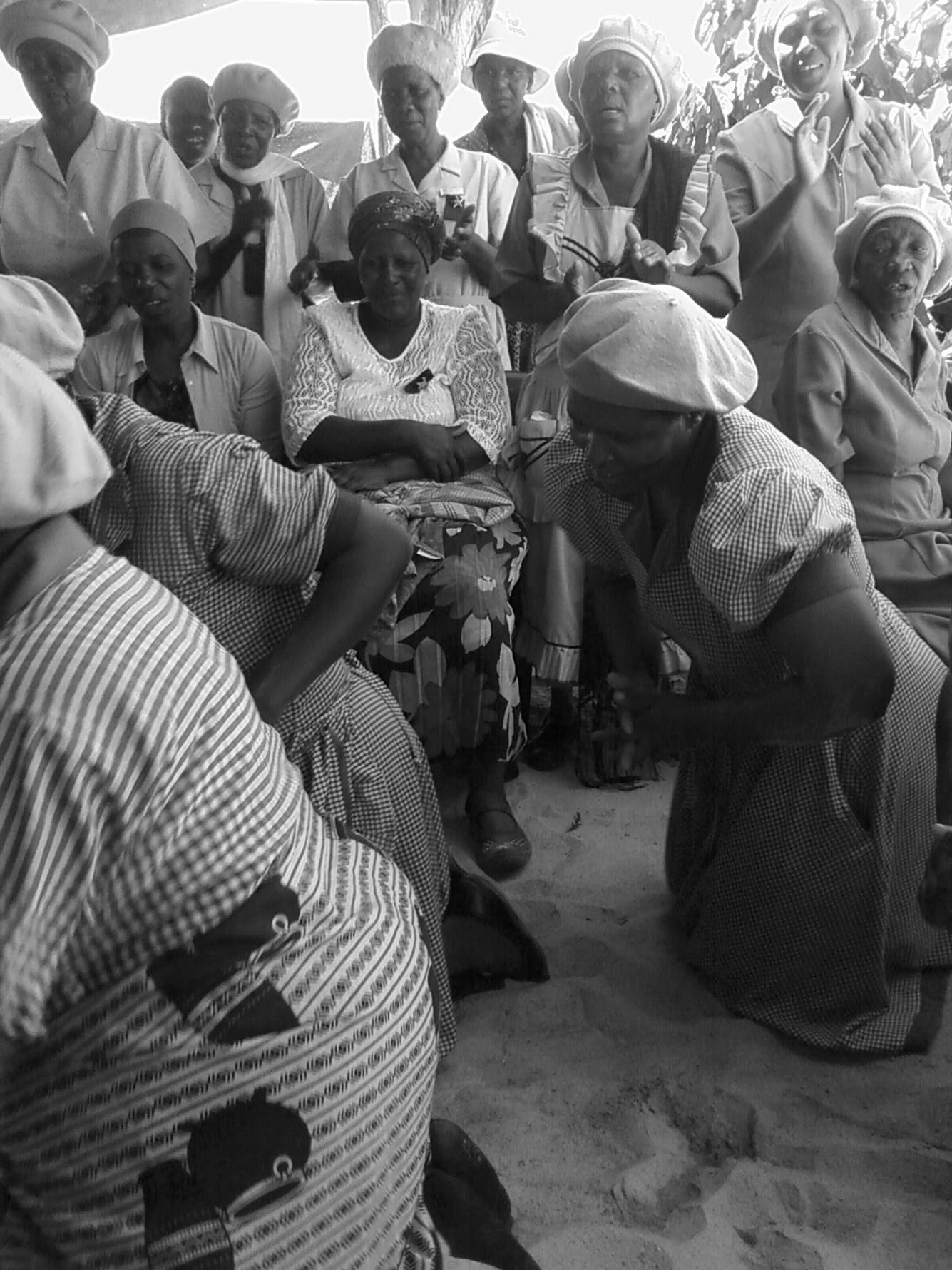
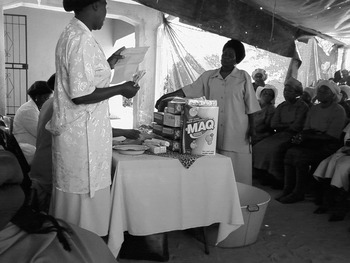
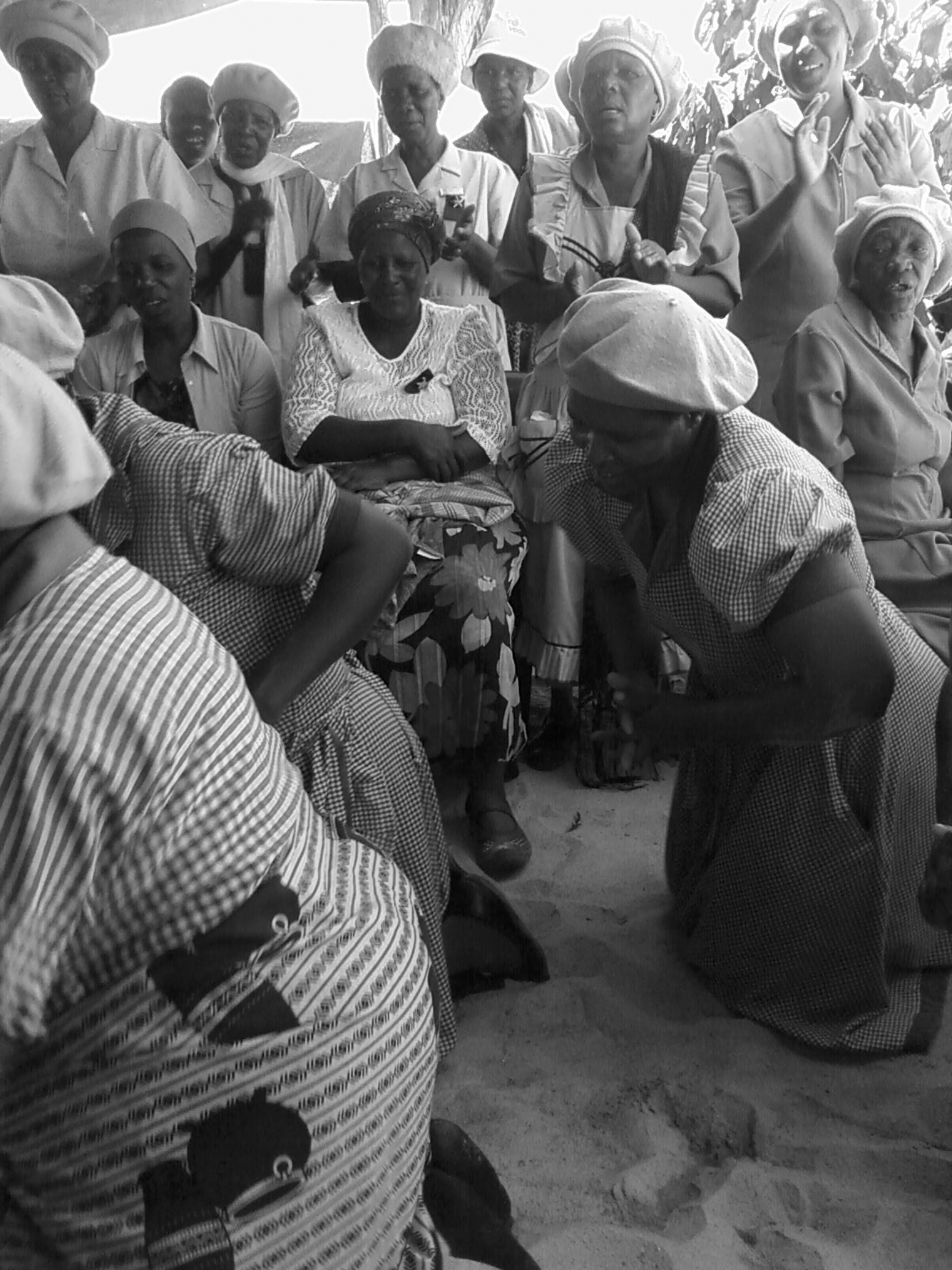
Most comprehensively combining the activities of borrower and lender are credit-granting savings clubs, known as Accumulated Savings and Credit Associations or ASCRAs in the literature (Ardener Reference Ardener2010; Bähre Reference Bähre2007) but locally as stokvel or sesebesebe. Although many such clubs engage in elaborate rituals where they pool commodities such as soap powder (see Figures 1 and 2), others have a more overtly financial orientation and purpose. Explicitly exempted from the NCA, on the grounds of their being embedded in ‘African tradition’ although many were founded recently, they charge interest of around 30 per cent, do not keep borrowers' ATM cards and thus have no collateral other than ‘trust’. In Impalahoek, a range of new savings or rotating credit clubs had been started by government employees, especially female teachers and nurses. Moneys collected on the monthly payday from each member, instead of being simply distributed as a lump sum to each in turn on a rotating basis, were being loaned out, either to members or their friends, colleagues or relatives. ‘Build Yourselves, Relatives’, for example, was started by a teacher. It had nine members, with each contributing R1,000 (£100) a month. Each took it in turn to borrow the pooled money at 30 per cent interest or loan it out to friends or neighbours, and defaulting members were charged next month as though they had borrowed the outstanding amount. Relying on ‘trust’ brings varied results, depending on the group in question: most had experienced problems with fraud, or non-payment by certain members.
Members of an Impalahoek sesebesebe perform a ritual of giving at a member's house
The chairman of an Impalahoek sesebesebe counts up members' contributions of soap powder

From this variety of types of informal lending, it can be seen that, except perhaps at the extreme ends of the continuum, borrowers and lenders cannot be separated easily. Some start as one and later become the other; some are both, but at different times and in different registers. This blurring, somewhat akin to the conversion between longer- and shorter-term registers discussed by Bloch and Parry (Reference Bloch, Parry, Parry and Bloch1989), is widely recognized in the literature on informal financial arrangements (Shipton Reference Shipton2007, Reference Shipton2009; Guyer and Stiansen Reference Guyer and Stiansen1999; Guerin, Morvant-Roux and Servet Reference Guerin, Morvant-Roux, Servet, Armendariz and Labie2010) but is often assumed to apply only in rural communities and among the marginalized. In South Africa it prevails increasingly among the upwardly mobile, and civil servants in particular. The National Credit Act has been largely powerless in the face of informal moneylending and associated informal credit arrangements. Although the existence of the Act, and its associated rhetoric, are widely known, its workings are said not to have ‘reached the Lowveld’ or ‘the townships’, even – or especially – where those involved are from the new middle class.
The novelty of consumer credit
A second key assumption, concerned more with the lending practices of large corporations than with the newer microlenders, is that black consumers were precipitously introduced to financial institutions and formal credit at the moment of democracy: and that, being ‘financially illiterate’, they were powerless at the hands of these predatory institutions. On the contrary, many have had a generation or more of exposure to credit, often in its most rapacious form (Porteous and Hazelhurst Reference Porteous and Hazelhurst2004). (One aspect of this was the widespread granting – often illegally – by magistrates of ‘emoluments attachment’ or ‘garnishee orders’ which enable creditors automatically to deduct payment from debtors’ bank accounts at a 5 per cent charge; see GTZ 2008.) Dogged by these practices of ‘credit apartheid’, and by the charging of extremely high interest, many had nonetheless succeeded in buying furniture, item by item, on hire purchase. It was reforming the terms offered by furniture stores that had been a key aim of the National Credit Act. Although furniture was overtaken in the 1990s by clothing, vehicles and other goods, many of the same practices persist. This experience caused some consumers to ‘retreat’ from formal lending institutions, instead building new institutions for self-reliant borrowing/lending.
One such person was the Impalahoek teacher who had founded ‘Build Yourselves, Relatives’. It had started as a pure savings club with no loan facilities. What had prompted the move into moneylending was members' keenness to escape from the clutches of stores that sell furniture on hire purchase: ‘I wanted to prevent members from buying goods on credit. At the end of the year, you can buy what you want with cash,’ said the founder. He considered himself to have been wronged by a furniture store when a garnishee order had been placed on his bank account – at significant cost – for allegedly missing a monthly repayment. He had contested this, but his enquiries had yielded no results. To avoid such situations in future, he and other members were now aiming to put together a sizeable cash sum on the annual date when each one's turn came, so as to be able to buy items of furniture, electrical appliances, building materials, a car – or (in the case of other members, and reflecting the aspirational character of the times) to pay for summer holidays at beach resorts. At this point they tried a range of banks, and later the Post Office, as a means to pursue their new investment strategy, but never succeeded in being paid the advertised interest on their savings. It was for this reason that they started lending to members, and – in turn – to relatives or friends of those members. They still used their bank account, but as a repository for funds rather than a source of interest.
This aversion to the worst aspects of the formal lending sector was an outcome of the distorted version of the market rooted in an earlier period, before the advent of democracy or the neo-liberal moment proper. Such arrangements caused consumers to distrust the ‘formal’ system, but they did not abandon it completely.
Competitiveness, status and secrecy
Closely linked to the assumption about the effects of the precipitous introduction of credit in the 1990s is another that posits black people as having been newly subjected, at the moment of democracy, to pressures to consume useless and unimportant luxury goods: if only these could be curbed, frugality would prevail and people would start to live within their means. There are some truths in this assumption: but it fails to recognize how the most important kinds of expenditure for the new middle class (glossed as the ‘black diamonds’) are not frivolous but rather encompass investments now regarded as mandatory. These include both the shorter-term expenses of weddings, and the longer-term ones, more like investments, in marriage payments, funerals, and higher education. While some informants were ready to stay single in order to escape from the conspicuous consumption associated with getting married, none denied that the expense occasioned by education to a higher level had been essential to their own success.
Upward mobility, the associated ‘competition’ arising out of status anxiety and the fear of gossip, and the likelihood that marrying out of one's class might exacerbate such anxieties, are in fact longstanding themes in South Africa. The Tikieline Yuppie, a novel by Mehlaleng Mosotho, shows how these processes were experienced in the 1980s. Its Sowetan protagonist, Tseke, the upwardly mobile, university-educated son of a lowly domestic worker mother, has a job as a salesman in a cleaning products corporation. He spends some of his earnings on upgrading his matchbox house, and buys on hire purchase a ‘TV, a music system and carpets for the lounge and the two bedrooms’. As a result his mother decides she could at last invite the members of her savings club back to the house: she says they used to ‘nudge each other’
whenever they came here, saying ‘look at her, this thing with dirty feet that look like the ground they walk on, how can she call us to a house full of furniture that white people threw out for chickens to roost in?’ I want them to see that my son has made me to be like other people.
In his heart, Tseke rejoiced that his mother was going to show those women and shut up the mouths that never stop going up and down (Mosotho Reference Mosotho1998: 66).
His impending marriage to a woman he'd met while at university puts him under immense pressure. His future in-laws have niceties of behaviour and rules about good manners which alert him to the fact that they claim to be of superior status to his own family. This sense of inadequacy makes him vulnerable when he takes his fiancée shopping and she insists on buying shoes and a dress which are inordinately expensive. When he objects, she clinches the argument by saying, ‘I won't allow you to shame me on my wedding day. I don't want township gossips to cure their boredom with my name.’ Experiencing a sense of panic, and against his better judgement, he nonetheless agrees to the purchases, using both the credit card which he had just been granted, and his year-end bonus.
These experiences of peer pressure have been intensified by the strategies of advertisers, more far-reaching now than they were in the 1980s. Consumers now have mobile phones which makes them easy targets for advertisers, and companies are reported to have little compunction about giving out information to other marketers. ‘People are pressurized by competition in the township; if someone has something, someone else will want to have, without considering the cost,’ said one respondent. Another pointed out that ‘some people want to be equal with other people’, while a third stated that ‘people are challenged by other people, the pressure comes from society’. Under such pressures, people were said to relinquish their view of the longer term, abandon prudence and frugality, and spend unearned money: ‘people cannot wait and budget, they are in a hurry for everything’. One person observed that the advantage of credit is ‘you can immediately get what you need without any delays’ while the disadvantage is that ‘you are working backwards instead of progressing. … People are just quick to get things without calculating the cost.’Footnote 8 What distinguishes debt from exchange is a time lapse between the moment of acquisition and the moment of repayment (Hart Reference Hart2000: 200). The delay, the time after the purchase has been made, is when one might regret one's action in buying the longed-for item.
A well-paid officer in a government department put these consumerist aspirations down to the fact that people want to be seen to have the same things as other people. Where his view was that ‘some of us are too inclined to worry about what others think’, Sophie Chevalier (personal communication) found that those consuming a new range of commodities can be uncertain about what to buy, taking refuge in repeating the choices of others around them. She compares this to the behaviour of new consumers in the US in the 1920s who were keen to ‘belong’.
Accompanying conspicuous consumption is a sense of shame about getting into debt; and particularly about having the furniture store come to one's house to repossess a fridge, stove, or, more recently, car. ‘People are ashamed and so would not share their experiences with others’ said someone who was trying to explain the individualizing character of consumerism and its failure to generate a collective sense of ‘rights’. A correlative to the intense ‘competition’, of which many speak even if not all give in to it, is the secrecy and stigma that accompanies indebtedness. The same pride and desire for respectability that motivated Tseke's mother at last to invite her club members to the house once it had decent furniture, means that those who find themselves ‘in over their heads’ are reluctant to talk about it or to establish – in conversation with others – a commonality of experience. This is one reason why various extraordinarily unscrupulous practices of those glossed as ‘credit providers’ go unchallenged.
While acknowledging the very real sense of peer pressure which these various examples suggest, and while recognizing the temptations offered by ready loans, one should also be wary of the stereotypes. Although there is a prevalent idea that ‘black diamonds’ get into debt because of excessive, even ill-considered expenditure and ‘competition’, several informants, while bemoaning these horrors of consumerism, displayed sage and prudent financial acumen in their own lives. Many who had taken out personal loans had done so to pay for their own or their children's education rather than because of yielding to the pressures of ‘competition’ over possession of sofas or shoes with brand names.
Take Mrs Magubane. She and her husband are waged employees of the state-owned enterprise (SOE) Spoornet, and parents of two children of schoolgoing age and one postgraduate student. (He, incidentally, is also a loanshark.) She spoke with frustration of being bombarded with offers of store cards, insurance deals and ‘free’ mobile phone airtime by a variety of companies. She had not, however, fallen prey to any of these. On the contrary, she was aware of the dangers of rampant consumerism and of the credit required to sustain it. She described friends with
wallets full of store cards – Foschini, Truworths – and it is a problem when the end of the month comes. … They only earn R3,000 a month. Go to Truworths, they wear nice clothes, fashions … now, it is summer, there are winter sales. … One person in Truworths has R5,000 credit, at Foschini another R3,000. When they count, they will owe R50,000. When it comes to groceries, it is the 15th, 16th of the month, they will have no money.
Such consumers, she said, are reduced to buying food on credit: they ‘swipe the card – even for bread’. She, in contrast, had chosen to pursue a prudent strategy of investing in the education of her children above all else.
My first priority is that ‘you must go to school. I want to be proud of you.’ They criticize me for what I wear. But … I want to be proud of my children. I try by all means to pay the little money I can.
It was these priorities that typically got people in over their heads. Keen to help educate the children, she had been persuaded by a salesman to buy a series of books on Maths Literacy on hire purchase. After she had almost completed the instalment payments, the debit orders mysteriously ceased – only to recommence some years later, when she was told she owed R5,000. It was the most far-sighted expenditures, ones which in Bloch and Parry's terms represent an ‘investment’ in the long term, which had the very real potential to land people in unsustainable levels of debt. In order to engage in such morally significant transactions, they were ending up with long-term, less-than-moral ones, laden with neighbourhood opprobrium.
In their attempts to rectify the situation, people were being forced into further indebtedness at the hands of loansharks. This gives the lie to another common stereotype: that those modern or well-off enough to have credit cards and vehicle finance have no need of loans from informal lenders. On the contrary, people often use such a lender as a last resort: the final option when all others have already been explored, undertaken in addition to, not instead of these other options. It is these new, non-optative forms of expenditure which pressurize them into doing so. Most expensively, it is higher or further education that is now considered mandatory, and which can involve taking out loans from moneylenders once other sources of credit prove impossible to access. The major difference between this and the previous generation, and the biggest single new expenditure making credit a necessity, was that many in Mpumalanga and Soweto had not had further or higher education, but virtually all felt it was mandatory to send three or four children to college or university. This was what induced one schoolteacher to approach a loanshark, after having exhausted all other more formal sources of credit, and in addition to her loans from these sources. It was those families whose parents had not themselves been middle-class, property-owning, or well-educated who seemed to be most likely to get into serious debt on this account.
General profligacy is thus acknowledged and condemned, but disavowed in particular cases. Jonathan, working in a well-paid managerial job in a government department, spoke of what he saw as a skewed value system that led his cousins to spend huge amounts on prestige items like expensive cars while continuing to live crammed together in a small township house. He claimed to prefer a more modest style of living. His friends had mocked him for continuing to drive an old Toyota rather than buying a Mercedes. Echoing Tseke in The Tikieline Yuppie, he wistfully pointed out, however, that particular pressure to spend was most intensely exerted by prospective marriage partners. He had more or less resigned himself to steering clear, at least in the short term, of marriage for precisely this reason. In an attempt to remain free of formal/impersonal debt bondage, he would now be steering clear of ‘long-term’, more moral connections of the kind that might have tied him to future in-laws.
The solution: small-scale independent enterprise
Alongside frugality and belt tightening, the central rhetoric advocated as a means to avoid indebtedness – and hence one means through which credit ‘demand’ is tackled – is that people should earn their own money through individual initiative and enterprise (see Krige, this volume) and become productive members of society independent of the state. This tacitly denies, but is perhaps also aimed at transforming, the crucial fact that many of the people in this upwardly mobile group are in fact public servants. But there are obstacles to becoming an entrepreneur. Promising ‘business opportunities’ are undermined, causing many to turn instead to moneylending, a more reliable source of income. Difficulties in moving upwards, except via loansharking, are almost overdetermined.
One obstacle is the tenuousness of making a living which relies on the sale of, and the willingness of other upwardly mobile to buy, the new ‘financial products’ which are the topic of this article. The case of insurance salesmen is a good illustration (see Bähre, this volume). While many township dwellers have been ready to buy insurance policies, they are also likely to cancel these when times are tough, as when they need a lump sum, or during the recession of the late 2000s. This inconstancy has disastrous effects on the economic situation of the middlemen, often landing them in debt. Several people who had recently approached Sisinyana Pholo, a debt counsellor, for advice, were insurance salesmen. When their clients had cancelled policies, these brokers had fallen into arrears with their payments on cars, houses and the like.Footnote 9
A second obstacle to making a living as an entrepreneur is linked to ‘credit apartheid’, and to the dual character of property ownership which obtained before the advent of democracy in 1994, with Africans’ property rights severely restricted. As was the case in other transitional societies such as those in post-socialist Europe, the rapid social change that accompanied South Africa's democratization and liberalization entailed a marked change in property relations. Where plots and houses were formerly held on a communal (in the former homelands) or leasehold (in townships) basis, there has been a stated intention, especially in the latter case, to switch to private property ownership. Families formerly holding ‘old style’ council-built and -owned houses on the basis of a 99-year lease have been given the title deeds. The effects have made for unevenness. On the one hand the transfer of property from the state into householders’ hands has led to a new market in real estate and a reported property boom in some township areas. On the other, property has been ‘ringfenced’ by restraints such as banks’ reluctance to grant mortgages on some township properties. Most importantly for the present argument, the transfer of properties into private hands has been the basis of fierce and bitter conflicts in families, with former council houses now being viewed as family property, and with the right of any single individual in such a family to ‘own’ a house being hotly disputed (Krige Reference Krige2011: 130–1).
With the advent of democracy, as aspirant homeowners scrambled to get on the property ladder (after having previously restricted their borrowing to lesser items such as furniture), involvement in market relations was sudden and precipitous. The results were disastrous for those trying to make a living in property sales.
Frank Pule, an aspirant entrepreneur in Soweto, was trying to set up such a business. He bought houses on auction in formerly white areas, where townhouses in clusters were being sold off in the early 2000s, especially in areas south of Johannesburg close to Soweto. That such houses were on the market he put down to the aspirations – sometimes unrealistic – of the newly salaried classes who had recently moved out of Soweto, and to their desire for upward mobility. They had ‘got in over their heads’ and their new houses had been repossessed. ‘People don't know what it is like buying a house. They think “because I am working at SABC, I will afford this house”.’ The ready availability of credit after 1994 had been a factor inclining people to buy houses without giving it much thought. The sudden bubble in the availability of credit just after democracy – a concomitant of political and economic freedom – fuelled this process.
His buying and selling of these repossessed townhouses had originally seemed to have considerable promise, but he in turn soon encountered problems. The indebtedness of an initial swathe of house buyers had originally meant the ready availability of such properties, but problems of debt had now worked their way through the system. There were now fewer potential buyers in a second swathe looking for townhouses. He was stuck with several which he was unable to sell. African buyers had no further lines of credit, while white buyers no longer wanted to live in the area.
He turned instead to buying and selling houses in Soweto. But memories of family entitlement during apartheid spurred popular opposition to, and vigilante action to prevent, any attempt to commoditize these ‘family houses’. What had made some families newly vulnerable to repossession was the use of such houses as surety when taking out subsequent mortgages to build extensions, and then defaulting on them. While this sounds potentially traumatic for the occupants of the putative house, it was more likely to spell disaster for an entrepreneur, such as Frank, trying to profit from the entry of such property onto the open market. He and others in a similar position had quickly learnt the error of trying to sell a repossessed Soweto house: ‘the history of that house keeps you out’. The family ‘won't want to leave’. Neighbours knew the house as having belonged to a family over several generations, and the owner, sensitive to matters of status and competition, would have been secretive about having borrowed money from the bank. ‘Now if the bank comes and says “we're taking the house”, people look and say “Hey, we know the great grandmother, et cetera, and now this is the fourth, fifth generation, there is no way these people can owe money.” ’ To attempt to sell such a repossessed house was to invite the wrath of local vigilantes, as Frank had found to his cost in one such case. Community activists had registered their displeasure by dancing the toyi-toyi (an anti-apartheid activist dance) outside the door, the owners had refused to move, and the sale had been aborted.Footnote 10 Frustrated by the failure of his new real estate endeavour, one of the strategies to which Frank had resorted recently was the lending of money in the manner which I have described as pervasive.
It is puzzling that, while communal activism, or at least vigilantism, can be expected in defence of the rights of former beneficiaries of apartheid's skewed form of state welfare, which provided houses, no similarly communal defence of the rights of post-apartheid's present-day beneficiaries, of a different type of state patronage (that involving public service salaries), is in evidence. Where state-provided houses were effectively ringfenced by community refusal to envisage their sale on the open market, state salaries, supposedly a sign of political freedom for those now newly employed in the public service, were not. Instead, the recipients of these salaries were fair game to moneylenders and ‘credit providers’ of all kinds: ranging from informal loansharks to the furniture stores and other unscrupulous corporations to whom many Africans had long been exposed, from which those able to escape them had been warned off, but to which many remained vulnerable.
There is an implicit assumption in accounts critical of ‘financialization’, described elsewhere in the world, that money ought rather to be made from production (as in classic accounts of capitalism) rather than through investment, lending, and the like. But moneymaking opportunities that are not somehow dependent on ‘recruiting people’ in order to tap into their accounts are extremely few and far between. Here is an unusual permutation of the famous ‘wealth in people’ (Guyer Reference Guyer1993) for which Africa is known.
MAKING MONEY FROM NOTHING: THE MONEY-GO-ROUND
Market surveys show that it is generally salaried or waged people, often civil servants in middle income brackets, who have been most liable to indebtedness. One explanation for this is that both formal and illegal credit providers, reluctant to expose themselves to the risk of non-repayment, are willing to lend only to those who have a regular income. The former require a ‘payslip’ before agreeing to offer credit, or can procure a ‘garnishee order’ from a magistrate. The latter do the equivalent after the event, by confiscating the borrower's ATM card (and ID book) and withdrawing the money owed to them directly from the bank. What these surveys less often reveal – since this happens below the radar – is that the lenders to whom these salaried people are indebted are often salaried people too. On the middle ground of the ‘lender continuum’ I mentioned earlier, people are both borrowers and lenders simultaneously. But some important expenditures – life cycle events like marriage, and funerals, or the need to put several children through higher education – can tip a lender into being a borrower in the longer term, and more inexorably. For such borrowers, a regular income stream turns them into ‘prey’, with their salary being plundered at the end of every month. Conversely, a regular stream of income becomes a basis for further extending that income by those who lend money.
In this process of ‘making money from nothing’ on the ‘money-go-round’, it is not simply the case, then, that money flows outwards from the state to the bank accounts of civil servants and thereafter trickles further downwards and outwards to credit providers, both formal and informal. Things are more complicated, in that the most regular loan turnovers are offered by mashonisas, many themselves in state employ, who are ‘reinvesting’ their state salaries (or, in the case of small-scale lenders, their grants) in order to make these grow yet further. The line between borrowers and lenders that is blurred in some senses, hardens into a more definite division between them at the extreme ends of the scale. One needs a steady stream of income (a state salary, or income grant), not only to get into debt, but also – conversely – to procure the basis for growing and expanding an income based on other's indebtedness.
Has the National Credit Act, with its twin aims of disciplining borrowers and curbing the excesses of lenders, affected such processes? Its consequences for the activities of the iniquitous furniture stores, or on those of the burgeoning new microfinance businesses that made such a killing in the first few years after the interest rate cap was removed, have been relatively small. In a minority of cases, a bank or microlender has been found guilty in court of ‘reckless lending’ and a borrower's debt cancelled as a result. But the majority of big firms have been able to hire the best lawyers, whereas debt counsellors are often poorly paid and unable to benefit from legal representation in court (see du Plessis Reference du Plessis2007). But the Act has had even less effect on the activities of informal borrowers and lenders. If an indebted person goes to a debt counsellor, as recommended in the Act, their various creditors – furniture stores, vehicle finance companies, banks and microlenders – can be contacted by email or letter to suggest alternative schemas for repayment. In contrast, loans from mashonisas are subject to no such negotiation. The only thing a debt counsellor can advise is to ‘pay it off and walk away’.Footnote 11
In this respect, informal and formal lenders seem to differ markedly. But in other ways the differences between informal and formal creditors are not as marked as they might seem. The readiness with which both are able to reach into one's bank account and take the money owed – whether with confiscated ATM cards or ‘garnishee’ orders – make them almost indistinguishable in the eyes of the overindebted. Daphney Neke, an NGO community education officer, told me how many people had been driven simply to abandon their bank accounts and to open new ones: a practice that had become endemic and was often repeated as creditors continued to pursue them from one account to the next.Footnote 12 There is, then, little difference between the informal/illegal moneylender and the formal/legal furniture store or microfinance business which ensures repayments directly from a borrower's account.
CONCLUSION
This article has criticized some of the assumptions that underpin policy measures taken to regulate microfinance and other lending practices in South Africa, focusing in particular on loans from informal moneylenders. Explaining their ineffectiveness, it is not simply that ‘that law has not reached the Lowveld’ or ‘the township’, as some maintain, but also that informalization has intensified as various means have been devised to tap into state resources. Neo-liberal means serve to ensure the ever-wider spread of redistribution, but with the apparent result, ultimately, of concentrating resources in the hands of fewer.
One point of view has it that debt and credit relationships are essential to progress and growth, and indeed to capitalism itself (N. Ferguson Reference Ferguson2008) – or, in a more Foucauldian sense, ‘productive’ of state-like arrangements (Roitman Reference Roitman2003). Taking a similarly positive perception, borrowers themselves invariably point to the fact that moneylenders are ‘doing a service’, that they are the friends rather than mere ‘clients’ of such lenders (Krige Reference Krige2011: 146), and that they, the borrowers, are to blame for their neediness. At the same time, the inexorable ‘formalization’ of people's relations, especially to these bigger loansharks, does make for unsustainability, and for social and psychological damage. In this sense, indebtedness constitutes a definite ‘harm’ rather than something facilitative or fruitful. The point of view that bemoans debt as damaging is the one that predominates in policy circles in post-1994 South Africa. Such a view appears not only to repudiate the positive perspective just mentioned, but also to underplay the negotiability and personal ties of relatedness which often characterize informal financial relations in settings more marginal to mainstream capitalism (see Guerin, Morvant-Roux and Servet Reference Guerin, Morvant-Roux, Servet, Armendariz and Labie2010; Shipton Reference Shipton2007, Reference Shipton2009). My article has shown that some of the practices of ‘financial informality’ that these authors describe for poorer and/or rural people are indeed, in South Africa, percolating upwards to be drawn on by the ‘newly becoming rich’. But Guerin et al. warn against the danger of ‘idealizing’ such relationships and practices (2010). In the case of the larger moneylenders who draw money out of people's accounts, forms of social collateral like trust are simply not required. Instead, the system relies upon the inexorable and unstoppable flow of money, mostly from the state into the bank accounts that so many are now enjoined to use. The voluntary yielding up to the moneylender of the ATM card by its owner is serving irrevocably to ‘formalize’ credit relations. It is this that substantiates my earlier claim: that previously personalized and morally laden forms of relationship, often regarded in terms of long-term investment in social relations, are tending – albeit with a veneer of social embeddedness – to change into cash-based ones.
To sum up: the categories invented and surveys conducted by market researchers and advertisers cannot be assumed to reflect the nuanced reality of consumer experience or to expose in full the character of indebtedness. Nor can solutions based on these stark figures be effective in solving this problem. Many who are assumed to have been plunged into debt with the advent of democracy had been involved in relationships of debt over several generations of family history; many who have achieved rapid mobility (and many who have not) have a sober and prudent attitude to matters of investment and are all too aware of the need to save money where possible. Rather than requiring ‘financial literacy’ classes, they know what kinds of investments might bring returns in the longer term. At the same time, however, considerable obstacles exist to moving up the ladder at a slow and steady pace. Property relationships continue to be ringfenced, and other attempts to earn an income involve the kinds of strategies commonly described as ‘rent seeking’. Lending is one such strategy often resorted to, but many lenders are borrowers too – all are scrabbling to access the steady trickle of funds that come from secure employment in the state.
Under such circumstances it is difficult to get off the money-go-round.
ACKNOWLEDGEMENTS
This research was funded by a grant from the Economic and Social Research Council of the UK (award RES-062-23-1290), which I gratefully acknowledge. Opinions expressed are my own. Thanks to Isak Niehaus for introducing me to friends in Impalahoek, to Sputla Thobela and Rosemary Ngunyula for assistance, and to those with whom I held discussions in the three research settings. I also thank Andreas Dafinger, Laura Bear, Sophie Day, Gerhard Anders, Holly High and Karen Sykes for inviting me to present the paper on which this article is based in anthropology departments at the LSE, Central European University in Budapest, Goldsmiths College, and the universities of Zurich, Oxford and Columbia; and at the 2011 workshops on ‘Debt’ (University of Cambridge) and ‘The Value Question’ (University of Manchester).