


1. INTRODUCTION
Harmonic generation is a prominent nonlinear effect in higher power electromagnetic wave matter interaction. Extensive studies of second and third harmonic generation have been carried out at microwave and laser wavelengths. Recently, Verma and Sharma have studied second harmonic generation from gas jet targets in the presence of strong azimuthal magnetic fields, observed in many laser plasma experiments. Sharma and Sharma have studied second harmonic generation in a laser filament in plasma. The second harmonic spectrum is broadened due to filamentation. In dielectrics, the nonlinearity responsible for harmonic generation arises due to nonlinear polarizability, whereas in semiconductors and plasmas it arises due to ponderomotive force, ohmic heating, and relativistic mass variation (Panwar & Sharma, Reference Panwar and Sharma2009; Verma & Sharma, Reference Verma and Sharma2009; Kaur et al., Reference Kaur and Sharma2008; Foldes et al., Reference Foldes, Kocsis, Racz, Szatmari and Veres2003).
Efficiency of energy conversion is limited by wave number mismatch. The third harmonic wave number k 3z, for instance, exceeds three times the wave number of the laser (k 3z > 3k z), making harmonic generation a non-resonant process. It has been suggested (Parashar and Pandey, Reference Parashar and Pandey1992; Rax and Fisch, Reference Rax and Fisch1992) that the application of a density ripple of wave number q = k 3z − 3k z can turn the third harmonic generation into a resonant process, greatly enhancing the efficiency. Sidick et al. (Reference Sidick, Knoesen and Dienes1994) have analyzed ultra-short pulse (<50 fs) second harmonic generation in quasi-phase-matched dispersive media in the regime of weak conversion with phase mismatch, group-velocity mismatch, and linear absorption accounted for. In addition to the expected increase in conversion efficiency, the quasi-phase-matched structure is shown to counteract pulse distortions.
Kuo et al. (Reference Kuo, Pai, Lin, Lee, Lin, Wang and Chan2007) and Pai et al. (Reference Pai, Kuo, Lin, Wang, Chan and Lin2006) have observed one order of magnitude enhancement in third harmonic generation of a 0.8 µm laser from a gas jet target with an electron density ripple created by using a machining laser beam. Liu and Tripathi (Reference Liu and Tripathi2008) have developed an analytical formalism of resonant third harmonic generation in rippled density plasma and explained their results. Recently, Dahiya et al. (Reference Dahiya, Sajal and Sharma2007) have observed similar behavior in their particle in cell simulations.
Teubner et al. (Reference Teubner, Eidmann, Wagner, Pisani, Tsakiris, Meyer-Ter-Vehn, Schlegel and Forster2004) observed harmonics from the rear-side of thin solid over-dense foils of carbon and aluminum, employing 150 fs, 395 nm, 1018 Wcm−2 laser. They observe harmonics from the front-side in the specular reflection direction and harmonics up to tenth order along with the fundamental from the rear-side. The intensity of the harmonics proportional inversely to some power of harmonic number n (in some region it goes as n −2). They have found that such behavior is due to the Brunel (Reference Brunel1987) mechanism. Liu and Parasher (Reference Liu and Parashar2005) have developed a theory for harmonic generation from oblique incident laser on a thin metal foil, employing the Brunel model. The harmonic generation is strongly sensitive to angle of incidence.
Khurgin (Reference Khurgin1995) has theoretically shown that the flows of direct current in a semiconductor can double the frequency of the optical radiation. The second order susceptibility, proportional to current is calculated to be in the 10−14–10−13 m/V range. Ozaki et al. (Reference Ozaki, Elouga Bom, Ganeev, Kietter, Suzuki and Kuroda2007) have studied intensive harmonic generation from silver ablation. Tsang (Reference Tsang1995) has reported a 103 signal enhancement of third harmonic generation that is due to the excitation of a surface plasmon in thin silver films by attenuated total internal reflection geometry. Because the third harmonic generation signal depend on the cube of the incident intensity and the second harmonic generation depends on the square of the intensity, the third harmonic generation overtakes the second harmonic generation at laser intensities beyond 6 × 10¹¹ Wcm−2.
Ganeev et al. (Reference Ganeev, Chakera and Raghuramaiah2001) have studied harmonic generation from solid surfaces irradiated by 27 ps Nd: glass laser pulses in the intensity range 1013–1015 W/cm2. Harmonic emission up to fourth order is observed in specular reflection direction with conversion efficiencies of 22 × 10−8, 10−10 and 5 ×10⁻¹² for second, third, and fourth harmonic respectively, for a p-polarized pump beam at 1015 W/cm2. Dromey et al. (Reference Dromey, Bellei, Carroll, Clarke, Green, Kar, Kneip, Markey, Nagel, Willingale, Mckenna, Neely, Najmudin, Krushelnick, Norreys and Nazmudin2009) have given a simple technique for characterizing the spatial profile of a laser spot size obtained on a solid target during an interaction in the target focus regime (<10−5 m) by imaging the interaction region in third harmonic order (3ωlaser). Nearly linear intensity dependence of 3ωlaser generation for interaction 1019 Wcm−2 is demonstrated experimentally and shown to provide the basis for an effective focus diagnostic.
Serebryannikov et al. (Reference Serebryannikov, Fedotov, Zheltikov, Ivanov, Alfimov, Beloglazov, Skibina, Skryabin, Yulin and Knight2006) have proposed that the Raman-shifted solitons in a photonic crystal fiber can serve as a pump field for phase matched third harmonic generation in a higher-order guided mode of the same fiber. Phase matching for this solitons-dispersive–wave mixing process differs in its physics and in its formal notation from the conventional phase matching for third harmonic generation with a dispersive pump.
In this paper, we study the generation of third harmonic of laser radiation in semiconductor waveguide having density ripple in the direction of laser propagation. The ripple provides the uncompensated momentum between the harmonic photon and combining fundamental photons and consequently leads to resonant enhancement of harmonic power. The physics of the harmonic generation process is as follows. A linearly polarized Eigen mode laser of frequency ω and wave vector k z, propagating through the semiconductor waveguide imparts an oscillatory velocity υω,k z to electrons. It also exerts a ponderomotive force on them at the second harmonic, producing oscillatory velocity υ2ω,2k z.The latter beats with the density ripple n q of wave number q to produce a density oscillation n 2ω,2k z+q. This density beats with υω,k z to produce a nonlinear current, resonantly driving the third harmonic when 3k z + q equal the third harmonic wave number.
In Section 2, we deduce the mode structure equation for the laser in a semiconductor waveguide and obtain mode structure and dispersion relation of a symmetrical TM mode. In Section 3, we study the third harmonic generation of a laser beam in ripple density semiconductor waveguide. In section 4, we discuss the results.
2. SUB-MILLIMETER/LASER EIGEN MODES OF A SEMICONDUCTOR SLAB
Consider a parallel plane n-type semiconductor guide of width 2a (see Fig. 1), and electron density n = n 00 + n q; n q = n 0qe iqz. A far-infrared laser or a sub-millimeter wave propagates through it in the symmetric TM mode with

Propagation of Infrared laser beam in semiconductor wave guide of finite width 2a.

The wave equation governing E z is

where

ɛp is the dielectric constant of the semiconductor slab, ɛL is the lattice permittivity, ν is collision frequency, ωp = (4π n ooe 2/m)1/2 and –e and m are the charge and effective mass of an electron. One may write ∇2 = ∂2/∂x 2 − k z2 in Eq. (2) and solve it inside and outside the slab separately. For the symmetric mode (E Z (−x) = E Z (x)) one obtains

where

The x component of the electric field can be obtained from 

The continuity of E z and ɛ′ E x at (x = +a) give


leading to the dispersion relation

This dispersion relation is valid for third harmonic as well. The phase matching in a third harmonic process is achieved by a density ripple in the semiconductor wave guide that acts as a virtual photon of zero quantum energy and momentum  (where
 is the wave vector of the density ripple) to resonantly excite the third harmonic. When
 the extra momentum required for the generation of the third harmonic photon is exactly provided by the virtual photon. Figures 2 and 3 show the variation of dimensionless laser frequency versus k xa and k za, respectively, in the fundamental mode of laser beam. As the value of plasma frequency ωp increases, the laser frequency slowly increases with k xa and tends toward infinite at a particular value of k xa. Figures 4 and 5 shows the variation of dimensionless laser frequency versus k xa and k za respectively in the second and the third mode of laser beam. The upper and lower curve of Figure 5 represents the third and second mode of the laser beam, respectively.
(Color online) Variation of dimensionless laser frequency ωa/c versus dimensionless propagation vector kxa in the fundamental mode of laser beam.

(Color online) Variation of dimensionless laser frequency ωa/c versus dimensionless propagation vector kza in the fundamental mode of laser beam.

(Color online) Variation of dimensionless laser frequency ωa/c versus dimensionless propagation vector kza in the second and the third mode of laser beam.

(Color online) Variation of dimensionless laser frequency ωa/c versus dimensionless propagation vector kxa in the second and the third mode of laser beam.

The magnetic field of the laser in different regions is

where k 2 = k x2 + k z2.
3. NONLINEAR CURRENT DENSITY AND THIRD HARMONIC GENERATION
The electric field of the laser Eigen mode induces an oscillatory velocity on electron

and exerts a ponderomotive force on them at (2ω, 2k z),

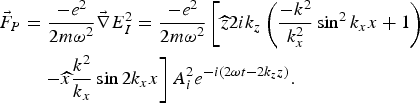
This ponderomotive force induces oscillatory velocity at the second harmonic, which on solving the equation of motion turns out to be

 beats with the density ripple to produce density perturbation at 2ω, 2k z + q. Using Eq. (10) in the equation of continuity
 we get
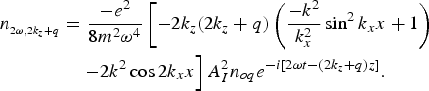
The third harmonic nonlinear current density at 3ω, 3k z + q can be written as
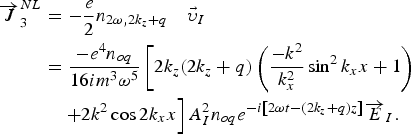
The third harmonic current density produces the third harmonic field  at 3ω, 3k z + q. The self consistent third harmonic field at 3ω, 3k z + q produces linear third harmonic current density,

The wave equation for the electric field of third harmonic can be written as

where

Taking divergence of Eq. (14), we obtain, inside the semiconductor slab,

Using Eq. (15), Eq. (14) can be written as

where

If one ignores  , Eq. (16) on replacing ∂2/∂z 2 by k 3z2 =−(3k z + q )2, give for the z component

where

The solution of Eq. (17) for the symmetric mode can be written as

At x = a, the tangential component of E 3Z is continuous, hence

The E 3Z field of the third harmonic in different regions is thus

where

With  , we presume that the mode structure of the third harmonic remains unmodified; only amplitude acquires slow z dependence,

Then the wave equation, presuming phase matching, takes the form

where


At phase matching, the ∂2ψ3/∂x 2 term exactly cancels with the last term on left-hand-side. Multiplying Eq. (21) by ψ3*dx and integrating from −∞ to +∞ we obtain

where
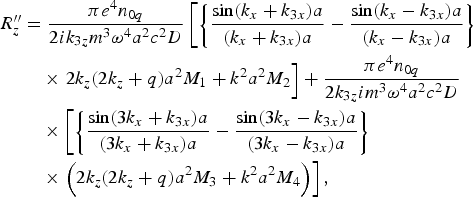
and
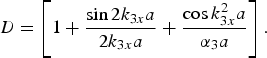
If there is absorption of the third harmonic in the semiconductor wave guide, we can replace ∂/∂z by (k 3i ) and write

where k 3i (=ωp2 ν/6c 2 ω k 3z ) is the imaginary part of the wave number of the third harmonic.
We have numerically evaluated the field amplitude ratio |A 3/A I| for following parameters:
(e A I/mω c) = 10−2, 10−3; (n oq/n oo) = 0.3; (ν/ω) = 1.5 × 10⁻³; (ωp a/c) = 1 − 3;(ω a/c) = 1; ɛL = 14.
Figure 6 and Eq. (23) shows that the ratio of the amplitude of the third harmonic wave and the laser beam decreases as the plasma frequency increases, i.e., the efficiency of the third harmonic generation decreases as plasma frequency increases in semiconductor.
(Color online) Variation of the ratio of the amplitude of the third harmonic wave and the laser beam with plasma frequency.

4. DISCUSSION
In a semiconductor slab with suitable density ripple, one can have resonant third harmonic generation. The guided modes have a non-uniform transverse mode structure. For the pump wave in the fundamental mode, third harmonic is produced in the third order mode. Since the damping rate is proportional to plasma frequency and inversely proportional to laser frequency ω and k 3z, it increases as plasma frequency increases but decreases with ω. The efficiency of harmonic generation is limited only by the linear damping of the third harmonic and can attain a value of the order of 0.2 % for laser intensity of 1012 Wcm−2 in a semiconductor like n type germanium.
A semiconductor wave guide yields remarkably high efficiency of third harmonic generation of laser when phase matching condition is satisfied. The non-uniform mode structure of the pump laser leads to much more sharply localized third harmonic. At exact phase matching, the linear damping rate of the third harmonic is a major limiting factor for efficiency of harmonic generation.
Semiconductors with non-parabolic energy bands (e.g., n-InSb) have energy dependent free carrier mass and introduce and additional source of nonlinearity. The materials like bismuth have non-spherical energy surfaces. The free carrier masses in such materials are tensors and so is the effective plasma permittivity of the medium. The propagation of fundamental as well as harmonic waves in such materials is influenced by this anisotropy.
The fabrication of semiconductor with a density ripple, indeed, is difficult. Hazra et al. (Reference Hazra, Chini, Sanyal, Grenzer and Pietsch2004) have created surface ripples over crystalline structures by using ion beams. Bulk ripple may be created via laser machining. A short wavelength laser, with hν greater than band gap energy, if passed through a grating and then impinged on the semiconductor slab normally, it will produce e-h pairs with spatial periodicity, giving a free carrier density ripple. Such a technique has been employed on gas jet targets (Kuo et al., Reference Kuo, Pai, Lin, Lee, Lin, Wang and Chan2007) and 10-fold enhancements in harmonic generation efficiency have been attained. Of course this will be a ripple transient in time. For a permanent ripple one may have to devise another scheme.
ACKNOWLEDGMENT
The author Vijay Garg is very thankful to Dr. A. K. Garg, Department of Physics, N. A. S. P. G College Meerut for the valuable research support in this work.



