Cerithium scabridum Philippi, 1848
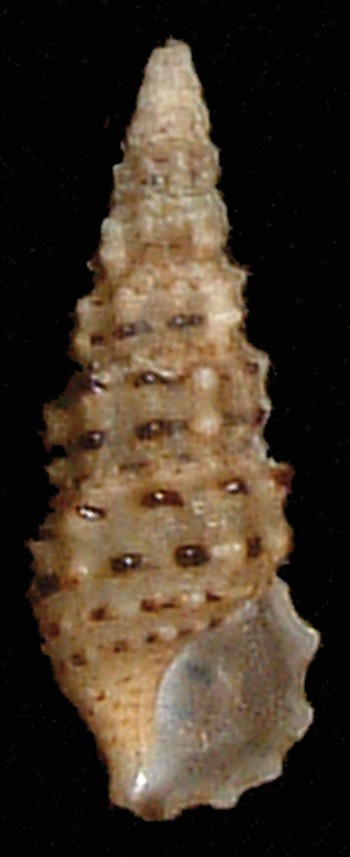
Cerithium scabridum Philippi, 1848 is a species belonging to the family Cerithiidae with a solid shell, high-spired and sculptured on the spire whorls of three strong, raised spiral cords with interspaces as broad as the cords, and weak axial folds which determine strong knobs at their intersection with the cords. It is brownish-coloured with a contrasting pattern of white and dark brown mottles on the cords (Figure 1).
Cerithium scabridum (6 × 14 mm) from Vibo Valentia (VV).

It originally comes from the Red Sea, Persian Gulf, Arabian Sea and India (Zenetos et al., Reference Zenetos, Gofas, Russo, Templado and Briand2004a), but was one of the lessepsian molluscs first recorded from the Suez Canal and then in the Mediterranean, from Egypt, Israel, Lebanon and Syria, where this species, confined to shallow waters, was very common and considered a permanent inhabitant in the Mediterranean Sea since the beginning of 1900 (Keller, Reference Keller1883; Pallary, Reference Pallary1912, Reference Pallary1938; Gruvel & Moazzo, Reference Gruvel, Moazzo and Gruvel1931; Haas, Reference Haas1937, Reference Haas1948; Barash & Danin, Reference Barash and Danin1972, Reference Barash and Danin1977, 1982, 1986; Ghisotti, Reference Ghisotti1974; Bogi & Khairallah, Reference Bogi and Khairallah1987).
More recently this species was found in southern Turkey, where it seems to be very common from the Iskenderun Gulf to the Antalya Gulf (Barash & Danin, Reference Barash and Danin1982; Lindner, Reference Lindner1987; Enzeross et al., 1990; Tringali & Villa, Reference Tringali and Villa1989; Engl, Reference Engl1995; Buzzurro & Greppi, Reference Buzzurro and Greppi1996; Demir, Reference Demir2003), and also in northern Turkey, although only one specimen was obtained on stone at a depth of 9 m from 22 stations at Imbros Island (Albayrak, Reference Albayrak2001). It was also recorded in Cyprus (Cecalupo & Quadri, Reference Cecalupo and Quadri1996), where it is considered living and very common (Buzzurro & Greppi, Reference Buzzurro and Greppi1997) and in Tunisia (Enzeross & Enzeross, 2001), where it is common from Zarzis to Zarat and abundant in the Gulf of Tunis and its adjoining Tunis Lagoon (Ben Souissi et al., Reference Ben Souissi, Trigui El Menif, Mahjoub, Méjri, Zaouali and Capapé2005).
In Italy C. scabridum was first reported from the east coast of Sicily (Barash & Danin, Reference Barash and Danin1977), where it is common in the area of Siracusa, beached and living on sandy-muddy and rocky bottoms in shallow waters on Posidonia oceanica, Zostera nana or Cymodocea nodosa (Di Natale, Reference Di Natale1978, 1982; Piani, Reference Piani1979; Garilli & Caruso, Reference Garilli and Caruso2004). Di Natale (Reference Di Natale1978) also reported a specimen of 49 × 18 mm from Milazzo Bay (Messina) and, even though Barash confirmed its determination, the reproduced drawing, its sizes, and the depth of finding with its associated species suggest that it was another species belonging to the genus Cerithium. After many years this species was also seen in Trapani (San Vito Lo Capo) and Palermo (Mondello and Capo Gallo), where several living and crabbed specimens were found (Garilli & Caruso, Reference Garilli and Caruso2004). Cerithium scabridum was also dubiously recorded from the Gulf of Naples from specimens in the collection of Giorgio S. Coen, received from Bellini. Coen added to Bellini's ‘Gulf of Naples’ the following data: ‘Capri, picked up between 1920 and 1930’ (Mienis, Reference Mienis1985). Bellini, however, in his two papers on the fauna of the Gulf of Naples (Reference Bellini1901, Reference Bellini1929) did not refer to this species or to a particular form of Cerithium; moreover, in the early 19th Century local malacologists already knew this alien species thanks to specimens from Jaffa (Israel) donated by Monterosato and located in the collection of the Zoological Museum of Naples (Praus Franceschini, Reference Praus Franceschini1906). Bellini's malacological collection was also donated to the Zoological Museum of Naples, but it was preserved mixed with several others and could not be isolated. A review of Cerithiidae in the collections of malacologists from Capri and surveys and SCUBA diving in areas of Capri forever excludes such a finding, or, if the species had been present in the area, it did not survive. Cerithium scabridum, moreover, is expanding in the southern Adriatic Sea, where it has been found living at shallow depths in Otranto Harbour (Albano & Trono, Reference Albano and Trono2008) and also reported for Monopoli (de Jong, Reference Jong2006), even if in this last paper no pictures were added and Littorina saxatilis was also reported for this area, a relict species actually distributed along the Italian coasts only in Venice lagoons and neighbouring areas (Torelli, Reference Torelli1978, Reference Torelli1981; Vio & De Min, Reference Vio and De Min1996). This last record needs confirmation.
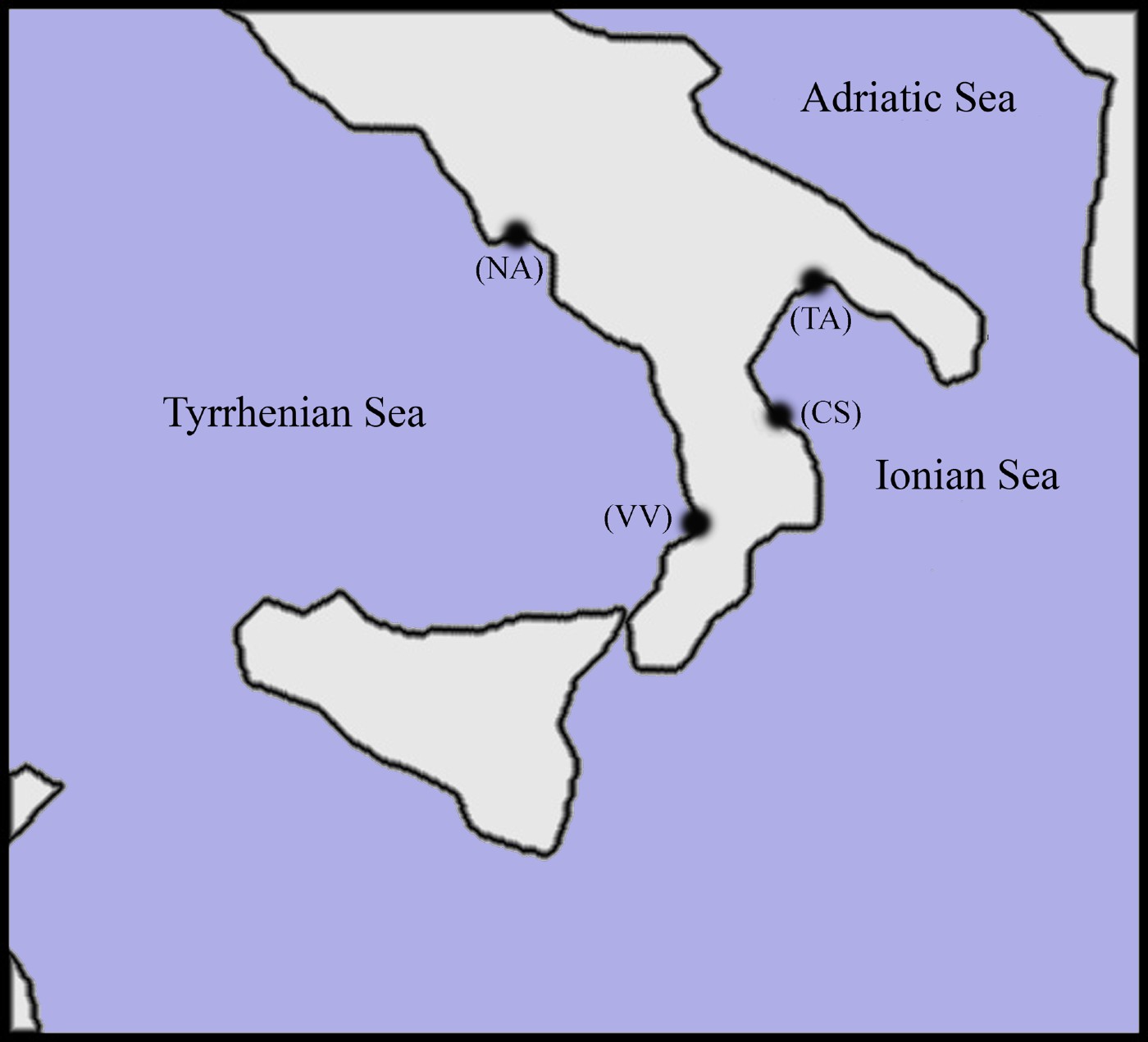
We report, for the first time, more than 150 dead specimens of Cerithium scabridum from Vibo Valentia Harbour (VV) (Figure 5), characterized by the presence of sandy-muddy bottoms with occasional algae. This record is the furthest north-west Tyrrhenian station known for C. scabridum. These specimens (3–7 mm in width and 5–17 mm in height) were found beached from 2006 together with Cerithium vulgatum Bruguière, 1792, Bittium reticulatum (da Costa, 1778), Epitonium clathrus (Linné, 1758), Hexaplex trunculus (Linné, 1758), Ocinebrina edwardsii (Payraudeau, 1826), Nassarius cuvierii (Payraudeau, 1826), Nassarius incrassatus (Ström, 1768), Nassarius pygmaeus (Lamarck, 1822), Bulla striata Bruguière, 1792, Brachidontes pharaonis (Fischer P., 1870), already observed from Vibo Valentia Harbour (Di Natale, Reference Di Natale1982), Abra alba (Wood W., 1802), Ruditapes decussatus (Linné, 1758), Corbula gibba (Olivi, 1792) and Antalis vulgaris (da Costa, 1778). The area is characterized by sandy-muddy bottoms with rare algae, and the presence of a living population is clear, but a specific authorization to SCUBA dive in the harbour area is required to confirm it.
Anadara demiri (Piani, Reference Piani1981)
Anadara demiri (Piani, Reference Piani1981) is a species belonging to the family Arcidae with a solid shell, inequivalve and inequilateral (right valve larger than left one) with an approximately rectangular outline, longer than high. It is whitish-coloured with a dark brown persistent periostracum (Zenetos et al., Reference Zenetos, Gofas, Russo, Templado and Briand2004a).
This species seems to originate from the China seas (Demir, Reference Demir1977; Piani, Reference Piani1981), and was first recorded in the Mediterranean from the harbour of Izmir, along the Turkish coast, as Arca amygdalum (Demir, Reference Demir1977), where more than 500 specimens of 6–33 mm were found from 5 to 15 m of depth in sandy-muddy and muddy bottoms. Its spotty presence, limited to the extremely polluted area of Izmir Harbour, was confirmed for Turkish waters also by Barash & Danin (Reference Barash and Danin1986) and Engl (Reference Engl1995), and Demir (Reference Demir2003), in his check-list of shells collected from the seas of Turkey, reported Anadara demiri for the Aegean Sea only. In addition, from surveys in the extreme of Izmir Bay carried out with a van Veen grab between January and September 2004, the species seems to dominate this polluted area constituting 38% of the total biomass in grab samples (Çinar et al., Reference Çinar, Katagan, Öztürk, Egemen, Ergen, Kocatas, Önen, Kirkim, Bakir, Kurt, Dagli, Kaymakçi, Açik, Dogan and Özcan2006).
Less than 20 years from the first Mediterranean record A. demiri was commonly found (about 180 specimens/m2) in the Thermaikos Gulf and Bay of Thessaloniki (North Aegean Sea), at depths of 15–22 m in muddy-sandy substrata (Zenetos, Reference Zenetos1994). In 2000–2001 it was finally observed along the Italian coasts, where a large number of specimens were collected in the central Adriatic Sea (Palombina di Ancona and Porto Recanati) on sandy bottoms at depths of 10–11 m (Morello & Solustri, Reference Morello and Solustri2001) and beached at Zadina di Cesenatico (FC) (Rinaldi, Reference Rinaldi2001) and in the northern Adriatic Sea at low depth on sandy bottoms near meadows of Zostera noltii and Cymodocea nodosa (Mizzan, Reference Mizzan2002). At the moment this species seems to be abundant in the northern (Mizzan, Reference Mizzan2007) and central Adriatic in the external belt of the SFBC biocoenosis (Pérès & Picard, Reference Pérès and Picard1964), with sporadic occurrence in the southern Adriatic Sea (Zenetos et al., Reference Zenetos, Gofas, Russo, Templado and Briand2004a; Morello et al., Reference Morello, Solustri, Antolini and Frogli2004a,Reference Morello, Solustri and Frogliab).
So, this species, that seems well adapted to harbour conditions and can even prosper and dominate in heavily contaminated areas or degraded benthic ecosystems, was probably introduced to the Mediterranean Sea by shipping, but its recent findings along the central Adriatic do not exclude other introduction modes (Zenetos et al., Reference Zenetos, Koutsoubas and Vardala-Theodorou2004b). Anadara demiri lives principally buried within the sediment on muddy and sandy-muddy bottoms, but, as other Arcidae, a further competitive advantage could be conferred to by its ability, retained into adult life, of attaching by means of byssus threads to all kinds of hard substrata that range from natural rocks to plastic materials or living molluscs (Solustri et al., Reference Solustri, Morello and Froglia2003).
We report, for the first time, two dead specimens of Anadara demiri in the Gulf of Naples and five living specimens in the Ionian Sea (Figure 5). These records, even if they consist of just a few samples, may be indicative of a future colonization of the above mentioned areas and extend the actual known distribution of this species in the Italian seas.
The first fresh dead specimen (22 × 15 mm) was found beached at Case Vecchie of Bacoli (NA) on December 2005 together with Gibbula adansonii (Payraudeau, 1826), Cerithium vulgatum Bruguière, 1792, Bittium reticulatum (da Costa, 1778), Epitonium turtonis (Turton, 1819), Aporrhais pespelecani (Linné, 1758), Natica stercusmuscarum (Gmelin, 1791), Natica hebraea (Martyn, 1784), Bolinus brandaris (Linné, 1758), Hexaplex trunculus (Linné, 1758), Ocinebrina edwardsii (Payraudeau, 1826), Euthria cornea (Linné, 1758), Nassarius incrassatus (Ström, 1768), Nassarius mutabilis (Linné, 1758), Nassarius unifasciatus (Kiener, 1834), Fusinus syracusanus (Linné, 1758), Conus mediterraneus Hwass in Bruguière, 1792, Bulla striata Bruguière, 1792, Haminoea fusari (Alvarez, Garcia & Villani, 1983), Arca noae Linné, 1758, Mytilus galloprovincialis Lamarck, 1819, Chlamys varia (Linné, 1758), Loripes lacteus (Linné, 1758), Cerastoderma glaucum (Poiret, 1789), Gastrana fragilis (Linné, 1758), Dosinia lupinus (Linné, 1758) Ruditapes decussatus (Linné, 1758), Ruditapes philippinarum (Adams & Reeve, 1850), already reported from Campania (Cesari & Pellizzato, Reference Cesari, Pellizzato, Agostini and Alessandra1990) and Venerupis aurea (Gmelin, 1791). The area is characterized by the mouth of the Miseno brackish lagoon and shallow muddy bottoms with some anchoring cement rocks and mussel farms, so this finding of Anadara demiri could be explained by mussel imports from the Adriatic Sea. It could be considered a SFMC biocoenosis (Pérès & Picard, Reference Pérès and Picard1964) with abundance of the decapod Carcinus aestuarii.
The second fresh dead specimen (19 × 15 mm) was found beached at Torregaveta (NA) in 2005 together with Turritella communis Risso, 1826, Epitonium clathrus (Linné, 1758), Gyroscala lamellose (Lamarck, 1822), Aporrhais pespelecani (Linné, 1758), Natica stercusmuscarum (Gmelin, 1791), Natica hebraea (Martyn, 1784), Neverita josephinia Risso, 1826, Bolinus brandaris (Linné, 1758), Nassarius incrassatus (Ström, 1768), Nassarius mutabilis (Linné, 1758), Nassarius unifasciatus (Kiener, 1834), Acteon tornatilis (Linné, 1758), Glycymeris violacescens (Lamarck, 1819), Acanthocardia aculeata (Linné, 1758), Acanthocardia tuberculata (Linné, 1758), Fulvia fragilis (Forskål, 1775), Mactra stultorum (Linné, 1758), Spisula subtruncata (da Costa, 1778), Lutraria lutraria (Linné, 1758), Lutraria magna (da Costa, 1778), Solen marginatus Pulteney, 1799, Pharus legumen (Linné, 1758), Ensis minor (Chenu, 1843), Tellina incarnata Linné, 1758, Tellina planata Linné, 1758, Tellina tenuis da Costa, 1778, Macoma cumana (Costa O.G., 1829), Donax trunculus Linné, 1758, Solecurtus strigillatus (Linné, 1758), Chamelea gallina (Linné, 1758), Ruditapes decussatus (Linné, 1758), Ruditapes philippinarum (Adams & Reeve, 1850), Venerupis aurea (Gmelin, 1791), Lentidium mediterraneum (Costa, 1829) and Thracia papyracea (Poli, 1791). Torregaveta, close to Bacoli, is characterized by shallow sandy bottoms that reach about 200 m from the coastline without depth increase and by the presence of SFS and SFBC biocoenosis sensu Pérès & Picard (Reference Pérès and Picard1964). The finding of Anadara demiri shows that the species, starting from the former site, is colonizing the neighbouring areas.
Two live specimens of 11 × 8 mm and 21 × 13 mm were found on 15 April and on 23 August 2007 while SCUBA diving at Schiavonea di Corigliano Calabro (CS), at a depth of 3–8 m on a muddy bottom in association with Jujubinus exasperatus (Pennant, 1777), Gibbula varia (Linné, 1758), Cerithium vulgatum Bruguière, 1792, Hexaplex trunculus (Linné, 1758), Nassarius cuvierii (Payraudeau, 1826), Nassarius incrassatus (Ström, 1768), Modiolarca subpicta (Cantraine, 1835), Chlamys glabra (Linné, 1758), Parvicardium exiguum (Gmelin, 1791), Ruditapes decussatus (Linné, 1758) and Venerupis aurea (Gmelin, 1791). This station is situated near Corigliano Harbour.
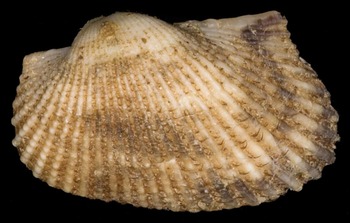
Three live specimens of 12 × 8 mm, 13 × 9 mm and 15 × 10 mm (Figure 2) were found beached and to 5 m depth on 30 September and on 6 October 2007 at Castellaneta Marina (TA) in association with Turritella communis Risso, 1826, Epitonium clathrus (Linné, 1758), Epitonium turtonis (Turton, 1819), Aporrhais pespelecani (Linné, 1758), Natica stercusmuscarum (Gmelin, 1791), Neverita josephinia Risso, 1826, Tonna galea (Linné, 1758), Phalium granulatum (Born, 1778), Bolinus brandaris (Linné, 1758), Nassarius mutabilis (Linné, 1758), Acteon tornatilis (Linné, 1758), Aplysia depilans Gmelin, 1791, Glycymeris violacescens (Lamarck, 1819), Pinna nobilis Linné, 1758, Chlamys glabra (Linné, 1758), Ostrea edulis Linné, 1758, Venericardia antiquata (Linné, 1758), Acanthocardia echinata (Linné, 1758), Acanthocardia tuberculata (Linné, 1758), Acanthocardia paucicostata (Sowerby G.B. II, 1841), Laevicardium oblongum (Gmelin, 1791), Cerastoderma glaucum (Poiret, 1789), Fulvia fragilis (Forskål, 1775), Mactra stultorum (Linné, 1758), Donacilla cornea (Poli, 1791), Solen marginatus Pulteney, 1799, Pharus legumen (Linné, 1758), Ensis ensis (Linné, 1758), Ensis minor (Chenu, 1843) Tellina fabula Gmelin, 1791, Tellina incarnata Linné, 1758, Tellina nitida Poli, 1791, Tellina planata Linné, 1758, Tellina pulchella Lamarck, 1818, Tellina tenuis da Costa, 1778, Donax semistriatus Poli, 1795, Donax trunculus Linné, 1758, Solecurtus strigillatus (Linné, 1758), Chamelea gallina (Linné, 1758), Dosinia lupinus (Linné, 1758) Ruditapes decussates (Linné, 1758), Ruditapes philippinarum (Adams & Reeve, 1850), already recorded in the Taranto Gulf (Cesari & Pellizzato, Reference Cesari, Pellizzato, Agostini and Alessandra1990), Venerupis aurea (Gmelin, 1791), Thracia papyracea (Poli, 1791), Pandora inaequivalvis (Linné, 1758) and Argonauta argo Linné, 1758. The investigated area is located between Castellaneta Marina Lido (TA) and the mouth of the Lato River and characterized by sandy bottoms and biocoenosis similar to Torregaveta (NA).
Anadara demiri (15 × 10 mm) from Castellaneta Marina (TA).

Finally, because of the high intraspecific variability of Anadara spp., since the first record of this species from Mediterranean Sea taxonomical problems arose about its similarity with Anadara transversa (Say, 1822). Rinaldi (Reference Rinaldi2006), only a few years ago, re-proposed this question hoping genetic analysis on the two species could solve it.
Fulvia fragilis (Forskål, 1775)
Fulvia fragilis (Forskål, 1775) is a species belonging to the family Cardiidae with a fragile shell, which is equivalve and slightly inequilateral. Externally whitish-beige to yellow-coloured with a purple stain only on the umbo, it has a thin golden periostracum.
It is a typical species of Indo-Pacific areas and was first recorded alive in the Mediterranean Sea in 1955 from Israel (Haifa Bay), where three specimens were found on gravel at a depth of 30 m, although it was published about 20 years later erroneously as Papyridea papyracea (Barash & Danin, Reference Barash and Danin1972). The authors reported this species as rather common in the benthos of the continental shelf, and Ghisotti (Reference Ghisotti1974) and Barash & Danin (Reference Barash and Danin1977) confirmed its common presence as live species along Israeli coasts. This species was then recorded from Kizkalesi, in Turkey (Lindner, Reference Lindner1988), where its presence from various sites was also listed in other papers (Enzenross et al., Reference Enzenross, Enzenross and Niederhöfer1990; Niederhöfer et al., Reference Niederhöfer, Enzenross and Enzenross1991; Engl, Reference Engl1995; Buzzurro & Greppi, Reference Buzzurro and Greppi1996), and from Tunisia, where six live and one dead juvenile specimens were sampled at Barzec at 1 m depth on a sandy bottom with Zostera sp. (Passamonti, Reference Passamonti1996). Several other specimens (more than 50 in a single station) were found in different places of the Gulf of Gabes (Enzenross & Enzenross, Reference Enzenross and Enzenross2001) and in the lagoon of Tunis, where it has gradually invaded the ecosystem and the presence of juveniles and adults reaching around 60 mm width was recorded (Ben Souissi et al., Reference Ben Souissi, Rezig and Zaouali2003). In the last ten years F. fragilis has also been found in Greece, in Elefsis Bay in the Saronikos Gulf (Vardala-Theodorou, Reference Vardala-Theodorou1999), at Poros and Methana (Zenetos et al., Reference Zenetos, Vardala-Theodorou and Alexandrakis2005) and off Chalkoutsi in the Evvoikos Gulf (Zenetos et al., Reference Zenetos, Vassilopoulou, Salomidi and Poursanidis2007), in Spain (Zenetos et al., Reference Zenetos, Gofas, Russo, Templado and Briand2004a), and confirmed for Turkey (Öztürk & Poutiers, Reference Öztürk and Poutiers2005), where this species forms dense populations (Çinar et al., Reference Çinar, Katagan, Öztürk, Egemen, Ergen, Kocatas, Önen, Kirkim, Bakir, Kurt, Dagli, Kaymakçi, Açik, Dogan and Özcan2006) and finally in Italy, where one live and two dead specimens were found beached at Calambrone (LI) and in fishermen's nets at Pozzuoli (NA), coming from sandy and sandy-muddy bottoms at a low depth (Crocetta, Reference Crocetta2005).
This species seems to be well established in the whole Mediterranean Sea and its diffusion is due both to natural and shipping causes (Zenetos et al., Reference Zenetos, Koutsoubas and Vardala-Theodorou2004b).
We report several live and dead specimens for the Gulf of Naples and slightly fewer than 700 specimens, most of them live, for the Ionian Sea (Figure 5). These records confirm the presence of Fulvia fragilis in the Gulf of Naples and extend the known distribution of this species in the Italian Seas.
At the end of 2005 and the beginning of 2006, during the analysis to evaluate its real diffusion in the Gulf of Naples, several fresh loose valves, both dead and living specimens of F. fragilis were found at Pozzuoli (NA) in fishermen's nets, at Torregaveta (NA) (in association with Anadara demiri) and in Naples (Coroglio). In February 2006, during a scientific SCUBA dive into the commercial harbour of Pozzuoli (NA), 83 dead and two live specimens (in a range of 20–50 mm maximum width × 22–45 maximum height) were found on a muddy bottom at 10–15 m of depth in association with Natica hebraea (Martyn, 1784), Bolinus brandaris (Linné, 1758), Hexaplex trunculus (Linné, 1758), Chlamys varia (Linné, 1758), Limaria tuberculata (Olivi, 1792), Acanthocardia tuberculata (Linné, 1758) and Acanthocardia paucicostata (Sowerby G.B. II, 1841). The high number of specimens picked up within the harbour attests to the arrival of the alien species via ballast water as previously hypothesized (Crocetta, Reference Crocetta2005).
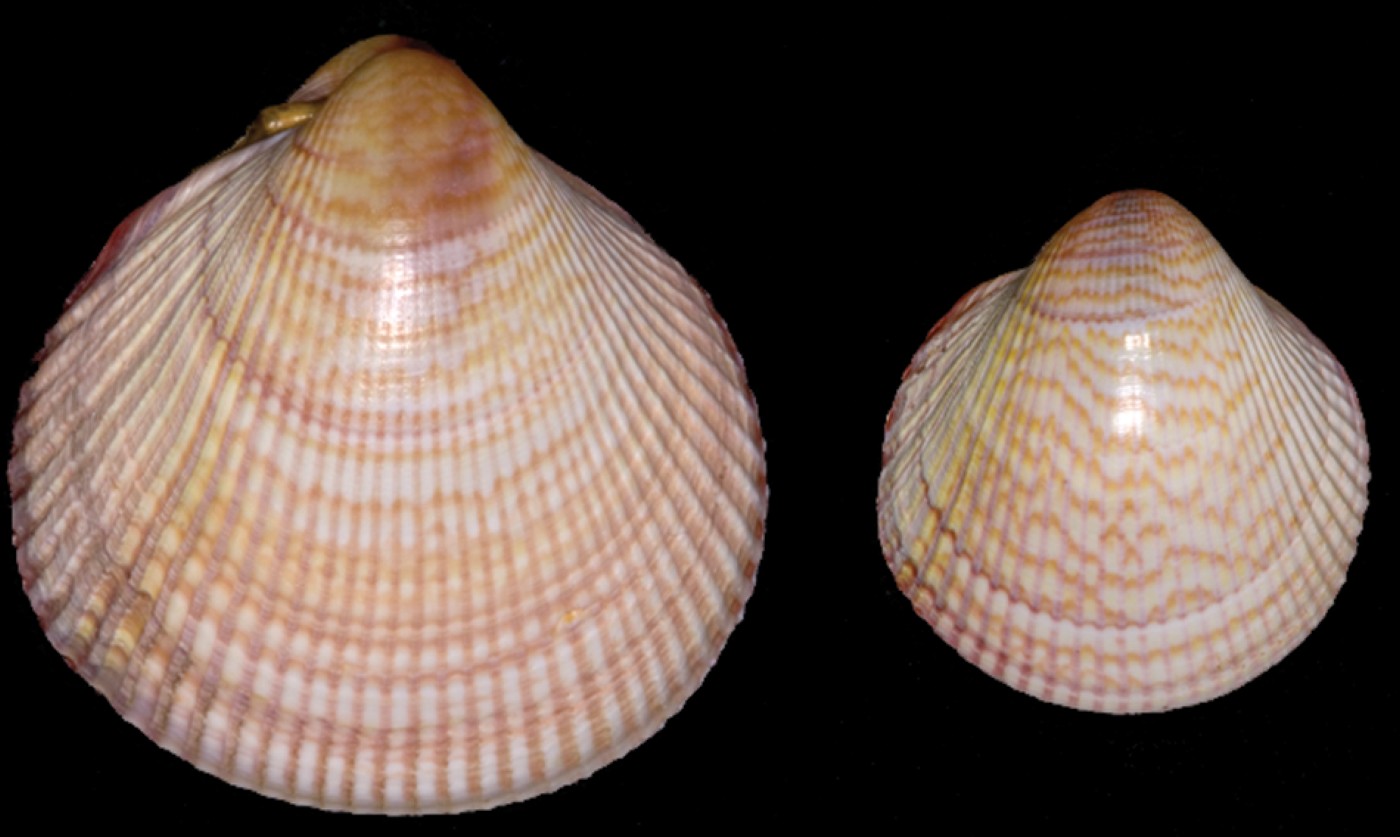
Fulvia fragilis was also sampled at Castellaneta Marina (TA) in association with Anadara demiri. The first specimen, taken on 26 August 2007, was a dead juvenile shell (14 × 16 mm). In the next month some live and dead specimens (20–29 mm × 19–24 mm) were found beached and at 1 m depth in the same station. On 6 October this species became abundant; 36 live and 30 dead specimens were found, in a dimensional range of 19–42 mm maximum width and 20–40 mm maximum height, while, on 20 October, some other specimens were observed on sand in shallow water. On 1 November 2007, during a sirocco storm, nearly 200 live F. fragilis were thrown on the beach by the wind, several others in December and about 300 specimens, mostly live, were found on 12 January 2008 of which 10% were larger than 40 mm including the largest sample of all, about 46 × 46 mm (Figure 3).
Fulvia fragilis (46 × 46 mm and 23 × 28 mm) from Castellaneta Marina (TA).

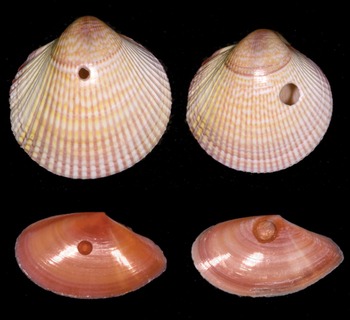
Several specimens from the Gulf of Naples and Castellaneta Marina, moreover, were observed drilled, indicating that the species is well integrated into the local food chains (Figure 4).
Fulvia fragilis and Tellina incarnata drilled from Castellaneta Marina (TA).

The locations where alien molluscs were found.

The contemporary presence of Fulvia fragilis and Anadara demiri in two geographically separated areas characterized approximately by the same biocoenosis seems to be not accidental. These two alien species have proven able to survive, even if only F. fragilis has been very successful with respect to the local species.
ACKNOWLEDGEMENTS
We are grateful to Enzo Campani, Alberto Cecalupo, Paolo Crovato, Giuseppe Fasulo, Carlo Froglia, Vittorio Garilli, Betulla Morello, Hans-Jörg Niederhöfer, Ermanno Quaggiotto, Mouna Rifi, Daniele Trono and Maurizio Sosso for helping in bibliographic research, to Michele Difonzo for taking photographs of some specimens and to Professor Giuliano Orel for useful comments.