Introduction
The adverse effects of excessive alcohol consumption on mental health are widely recognized (Dawson et al. Reference Dawson, Grant and Li2005 a, Room et al. Reference Room, Babor and Rehm2005; Cargiulo, Reference Cargiulo2007). Comparatively little is known about moderate alcohol consumption (Rodgers et al. Reference Rodgers, Korten, Jorm, Christensen, Henderson and Jacomb2000 a), although several reports have shown associations between alcohol abstinence, or very low consumption, and poor mental health (Lipton, Reference Lipton1994; Rodgers et al. Reference Rodgers, Korten, Jorm, Christensen, Henderson and Jacomb2000 a, Reference Rodgers, Korten, Jorm, Jacomb, Christensen and Hendersonb; Alati et al. Reference Alati, Kinner, Najman, Fowler, Watt and Green2004; Sareen et al. Reference Sareen, McWilliams, Cox and Stein2004; El-Guebaly, Reference El-Guebaly2007). For example, Rodgers and colleagues found that there was a U-shaped relationship between alcohol consumption and both anxiety and depression in a large Australian community sample (Rodgers et al. Reference Rodgers, Korten, Jorm, Christensen, Henderson and Jacomb2000 a, Reference Rodgers, Korten, Jorm, Jacomb, Christensen and Hendersonb) and the British 1958 birth cohort study also identified a U-shaped association between alcohol consumption and mental distress (Power et al. Reference Power, Rodgers and Hope1998).
So far, this research has mainly been restricted to anxiety and depression, or non-specific mental distress. Some studies have shown differences in measures of personality between abstainers, moderate drinkers and heavy drinkers (Moos et al. Reference Moos, Moos and Kulik1976, Reference Moos, Moos and Kulik1977; Pape & Hammer, Reference Pape and Hammer1996; Cook et al. Reference Cook, Young, Talyor and Bedford1998; Koppes et al. Reference Koppes, Twisk, Snel, de Vente and Kemper2001; Mortensen et al. Reference Mortensen, Jensen, Sanders and Reinisch2006). Pape & Hammer (Reference Pape and Hammer1996) proposed that adolescent abstinence can be viewed as social deviance in many Western cultures and this was supported by their finding of signs of psychosocial maladjustment in male adolescent abstainers. A Danish study found that abstinence was associated with higher levels of social inhibition and less need for others' recognition and approval (Mortensen et al. Reference Mortensen, Jensen, Sanders and Reinisch2006) and Koppes and colleagues (Reference Koppes, Twisk, Snel, de Vente and Kemper2001) reported higher levels of social inadequacy and rigid personality style in association with abstinence. To the best of our knowledge, no previous research has investigated the relationship between DSM- or ICD-defined personality disorders (PDs) and alcohol abstinence or low alcohol consumption.
Reasons for the increased risk of mental disorder or PD among abstainers and occasional consumers remain unclear (El-Guebaly, Reference El-Guebaly2007). However, insights into possible mechanisms are important because of the large volume of literature suggesting that moderate (compared with low or absent) alcohol consumption is associated with a lower risk of a variety of adverse outcomes (Rehm et al. Reference Rehm, Bondy, Sempos and Vuong1997; Ruitenberg et al. Reference Ruitenberg, van Swieten, Witteman, Mehta, van Duijn, Hofman and Breteler2002; Kloner & Rezkalla, Reference Kloner and Rezkalla2007). There has, however, been a general failure to consider potential confounding factors. Rodgers and colleagues (2000 a) argued that non-drinkers have a range of characteristics known to be associated with anxiety and depression (e.g. low socio-economic status, lack of social support and recent stressful life events) and suggested these as important explanatory factors. On the other hand, a systematic misclassification might account for the increased risk of poor mental health in the abstention group by inclusion of previous heavy consumers. (Alati et al. Reference Alati, Lawlor, Najman, Williams, Bor and O'Callaghan2005; Manninen et al. Reference Manninen, Poikolainen, Vartiainen and Laatikainen2006; El-Guebaly, Reference El-Guebaly2007). In support of this hypothesis, Dawson and colleagues (2005 b) found that both drinkers and previous drinkers were at increased risk for mood, anxiety and PDs compared with lifelong abstainers. However, this has not been a universal finding (Power et al. Reference Power, Rodgers and Hope1998; Alati et al. Reference Alati, Lawlor, Najman, Williams, Bor and O'Callaghan2005) and remains controversial.
In a national probability sample of 8580 adults, we investigated the relationship between abstinence and both PD categories and a range of common mental disorder (CMD) symptoms, including anxiety and depression, to clarify the specificity of the association with poor mental health. Specifically, we tested the hypothesis that there would be an increased risk of both CMDs and PDs among abstainers compared with individuals reporting current consumption. Because we wished to focus on non-hazardous levels of consumption, participants with hazardous drinking were excluded a priori. For this analysis, current abstainers were divided into lifelong abstainers and abstainers who had previously consumed alcohol (‘previous consumers’), with further subdivision of the previous consumers according to reasons given for discontinuing alcohol consumption.
Methods
The sample
The analyses described here were carried out using data from the second National Survey of Psychiatric Morbidity of British adults aged 16–74 years (Singleton et al. Reference Singleton, Lee and Meltzer2000). This survey comprised a sample of adults living in private households and was carried out in 2000 by the Office for National Statistics in England, Wales and Scotland. Ethical approval was given by the London Multi-Centre Research Ethics committee and all relevant local research ethics committees were informed. The selection of primary sampling units (postal sectors) was based on the British Small Users Postcode Address File, stratified for region and social class composition in order to create a nationally representative sample on those criteria. From each postal sector, households were randomly selected and, subsequently, one person from each household within the target age range was randomly selected and invited to participate. This procedure yielded 12 792 potential respondents, of whom 8580 (67%) agreed to participate. For our analysis, we excluded 2117 participants defined as having hazardous drinking on the Alcohol Use Disorders Identification Test (applying a cut-off of ⩾8 for exclusion) (Babor et al. Reference Babor, de la Fuente, Saunders and Grant1992), together with those with missing data (n=676, 10.5%), leaving 5787 in the analysed sample.
Measurement of alcohol consumption and related variables
In preparation for the full schedule of questions on current alcohol consumption, all participants in the survey were asked whether they currently consumed any alcohol. The following supplementary question was asked if the response was negative: ‘Could I just check, does that mean you never have an alcoholic drink nowadays, or do you have an alcoholic drink very occasionally, perhaps for medicinal purposes or on special occasions like Christmas or New Year?’ Responses were coded as ‘never’ or ‘very occasionally’ and, for this analysis, abstinence was defined on the basis of a ‘never’ response. Participants with this response were asked a supplementary question on whether they had always been a non-drinker or whether they had stopped drinking for some reason, abstinence as an outcome being divided in line with their response. Finally, participants were asked about their reasons for lifelong abstinence or for stopping drinking, selecting from the following categories: ‘religious reasons’; ‘don't like it’; ‘parent's advice/influence’; health reasons; ‘can't afford it’; an open category (‘other’). Responses to this question were used for descriptive purposes and, in secondary analyses, to divide previous consumers into those who had stopped for health or for some other reason.
Measurement of PD and CMD
The screening questionnaire of the Structured Interview for Axis II Personality Disorders (SCID-II) was administered to all participants and was used to identify possible cases of DSM-IV PD (First et al. Reference First, Gibbon, Spitzer, William and Benjamin1997). Participants entered binary responses (yes/no) to 116 screening questions on a laptop computer. Apart from conduct disorder, all questions addressing the criteria of the 10 DSM-IV PDs referred to lifetime experiences. Based on this information, categories of Axis II disorder were established using algorithms developed during a previous survey. In total, 10 categories of Axis II disorder were created from continuous data by imposing cut-off points that had been previously identified in a large, cross-sectional survey of prissoners (Singleton et al. Reference Singleton, Meltzer, Gatward, Coid and Deasy1998; Ullrich et al. Reference Ullrich, Deasy, Smith, Johnson, Clarke, Broughton and Coid2008). In that study, diagnostic categories retained good internal consistency with improved discrimination between PDs and other clinical syndromes. The respective sensitivity and specificity coefficients for the SCID-II screen against clinical diagnosis in the 2000 British household survey analysed here were 0.79/0.93 for avoidant, 0.67/0.97 for dependent, 0.83/0.88 for obsessive-compulsive, 0.71/0.86 for paranoid, 1.00/0.93 for schizotypal, 1.00/0.83 for schizoid, 0.62/0.94 for borderline and 0.80/0.88 for antisocial PD (Coid et al. Reference Coid, Yang, Bebbington, Moran, Brugha, Jenkins, Farrell, Singleton and Ullrich2009). As the prevalence of histrionic and narcissistic PD was very low, it was not possible to calculate sensitivity for these two diagnoses. In addition to cases of the individual disorders, an ‘overall’ category of ‘any PD’ was used.
The revised version of the Clinical Interview Schedule (CIS-R) (Lewis & Pelosi, Reference Lewis and Pelosi1990) was administered to all participants. This widely used instrument distinguishes between 14 symptom areas, generating scores of 0–4 for the domains: somatic symptoms; fatigue; concentration and forgetfulness; sleep problems; irritability; worry about physical health; depression; depressive ideas; worry; anxiety; phobias; panic; compulsions and obsessions; and 0–5 for depressive ideas. Scores of ⩾2 are conventionally used to define significant symptomatology within each domain. An overall category of CMD was defined using standard procedures for this instrument, applying a ⩾12 cut-off to the sum of all individual symptom scores (Lewis & Pelosi, Reference Lewis and Pelosi1990). In addition, corresponding ICD-10 categories for depressive episode, generalized anxiety disorder, panic disorder and mixed anxiety/depression disorder were derived from the CIS-R scores.
Other covariates
Covariates were selected a priori on the basis of supposed associations with the independent and the dependent variables. Age and gender were recorded. Information about education was dichotomized into ‘no qualifications’ and ‘GCSE levels or above’ (equivalent to 10 years of full-time education) and information about ethnic origin was divided into ‘white’ and ‘non-white’. Further information about socio-economic profile included employment status (unemployed and employed), type of occupation (manual and non-manual) and, in the context of a questionnaire on financial circumstances, the reported number of debts. Smoking status was dichotomized (current or previous smokers versus never smoked). Participants were divided by whether they reported lifetime use of any illegal drug. General health was measured on an ordinal scale based on number of reported long-standing health problems. Verbal IQ score was estimated using the National Adult Reading Test (Nelson, Reference Nelson1982). A binary variable was derived on the basis of any life event within the last 6 months from a standard checklist (Brugha et al. Reference Brugha, Bebbington, Tennant and Hurry1985). An ordinal scale derived from summed scores from seven questions on the quality of close relationships was used to assess social support.
Statistical procedure
All analyses were carried out employing Stata 10 (StataCorp, 2009), with standard weighting procedures to account for the stratified, clustered sampling and non-response (Singleton & Lewis, Reference Singleton and Lewis2003). Two independent variables were generated for analysis, one comparing participants reporting lifetime abstinence with non-abstainers and another comparing those reporting current but not lifetime abstinence with non-abstainers. After description of the sample, unadjusted associations between any CMD, any PD and these independent variables were calculated. Logistic regression models were then used in order to adjust for covariates. For previous consumers, a secondary analysis was carried out, splitting the outcome into those who stopped for health reasons and for those who stopped for other reasons. Prior to regression analyses, covariates were assessed using the Stata collin syntax to check for collinearity. In summary, all calculated variance inflation factors were <2 and all tolerance statistics were >0.5, indicating no substantial risk of multi-collinearity in the models chosen.
Results
The mean age of the analysed sample was 45.2 years (s.e.=0.24); 58.5% were female and 95.7% were white. Mean IQ was 101.7 (s.e.=0.28) and 27.8% reported no educational qualifications. In total, 38.0% were in manual occupations, 33.5% were either unemployed or economically inactive and 4.8% reported having more than one debt. Current or previous smoking was reported by 71.3% and 20.2% reported lifetime use of any illegal drug. A total of 41.0% reported one or more chronic illness, lack of social support was reported by 26.5% and 24.4% had experienced a recent life event. With regard to psychopathology, case level CMD was present in 14.9% and 27.7% screened positively for a PD of some kind.
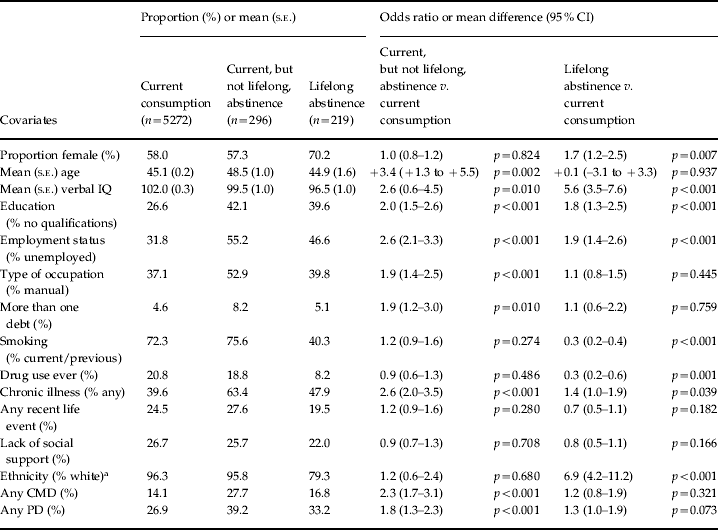
Unadjusted associations with abstinence are displayed in Table 1. Current abstinence characterized 515 (8.9%) of 5787 participants in the analysed sample, of whom 219 (3.8%) reported lifelong abstinence and 296 (5.1%) reported previous alcohol consumption. Current, but not lifelong, abstinence was associated with increased age, lower educational attainment, current unemployment, manual occupation, presence of debt, presence of a chronic illness and presence of CMD and PD. Reported lifelong abstinence was more common in women than men, in people from non-white ethnic groups and was associated with lower educational attainment, current unemployment and reportedly never smoking or using illegal drugs. It was more regularly reported by participants screening positive for any PD but was not associated with CMD.
Descriptive statistics for covariates and unadjusted associations with alcohol abstinence

CI, Confidence interval; CMD, common mental disorder; PD, personality disorder.
a Missing information about ethnicity (n=2) was recoded as white.
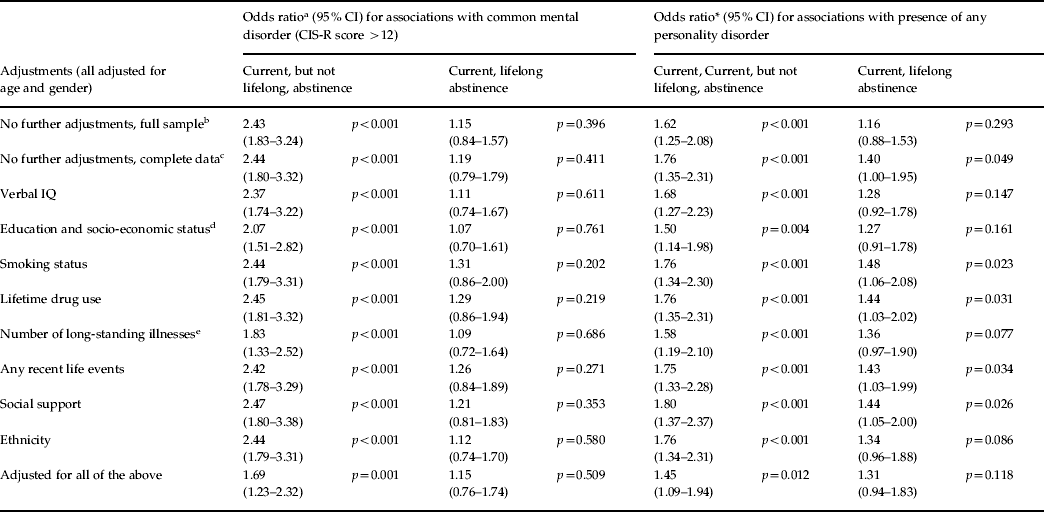
Logistic regression models for CMD and PD are summarized in Table 2. Current, but not lifelong, abstinence was positively associated with both outcomes after full adjustment, with education and socio-economic status having the largest, albeit not substantial, effect on the associations of interest. Associations with lifelong abstinence were weak and remained below conventional levels of significance after adjustment, with no evidence of confounding.
Logistic regression analysis of associations between alcohol abstinence, common mental disorder and any personality disorder

CI, Confidence interval; CIS-R, Clinical Interview Schedule.
a The reference group for all analyses is the remainder of the sample without current abstinence.
b Full sample (n=6347) not excluding participants with missing information on covariates.
c Analysed sample (n=5787) with data on all covariates used for this and all subsequent analyses.
d Model including employment status, type of occupation and number of debts.
e Number of reported chronic health conditions entered as an ordinal variable.
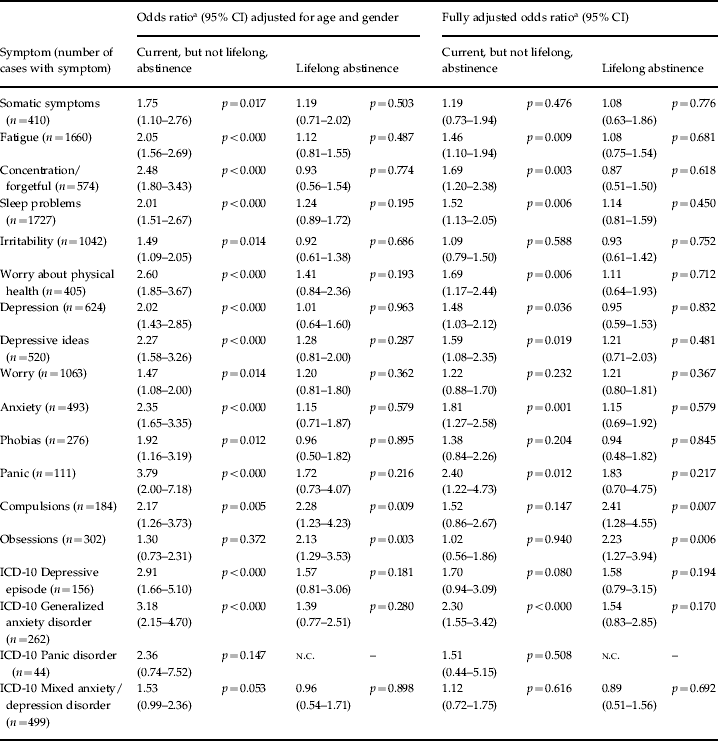
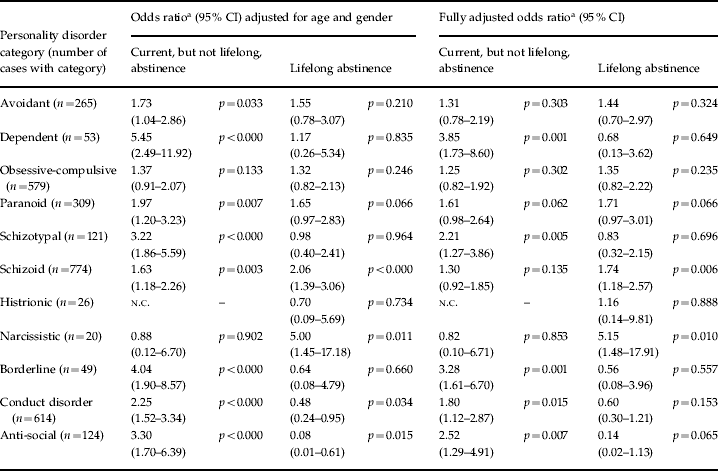
Further analyses of CMD symptoms are summarized in Table 3, including corresponding ICD-10 categories. In fully adjusted models, lifelong abstinence was only associated with obsessive and compulsive symptoms, whereas former consumers were more likely to have all symptoms apart from somatic symptoms, irritability, phobias and obsessions. Further analyses of PD subtypes are summarized in Table 4 and showed a similar pattern. For these, lifelong abstinence was only significantly associated with schizoid and narcissistic categories after adjustment, while current but not lifelong abstinence was associated with a larger number of categories: dependent, schizotypal, borderline, antisocial and conduct disorder.
Association between specific Clinical Interview Symptoms and alcohol abstinence

CI, Confidence interval; n.c., odds ratio not calculable in regression model.
a The reference group for all analyses is the remainder of the sample without current abstinence.
Association between specific personality disorder categories and alcohol abstinence

CI, Confidence interval; n.c., odds ratio not calculable in regression model.
a The reference group for all analyses is the remainder of the sample without current abstinence.
For previous consumers, the main reason reported for stopping was health reasons (50.7%), while, for lifelong abstainers, the most common reported reason was dislike of alcohol (46.3%). In a secondary analyses of previous consumers, using fully adjusted models as previously described, abstinence for health reasons remained strongly associated with CMD [odds ratio (OR) 2.07, 95% confidence interval (CI) 1.39–3.09] and PD (OR 1.63, 95% CI 1.10–2.42), while associations with abstinence on other grounds were weaker and non-significant (OR 1.35, 95% CI 0.85–2.14; OR 1.27, 95% CI 0.81–2.00, respectively).
Discussion
In a survey of 8580 community dwelling adults, we investigated associations between current alcohol abstinence and both CMD and PD symptoms. Hypothesized associations with both were supported, but consistently so only for former consumers, particularly those who had stopped consumption for health reasons.
Advantages of the study include the large, well-characterized and nationally representative survey population, Abstinence was defined from detailed questions that confirmed current abstinence, determined whether abstinence had been lifelong and elicited reasons for abstinence. This level of detail was particularly informative. Participants with hazardous drinking were excluded from the analysed sample using a standard cut-point from a widely used screening instrument for alcohol use disorder. The two outcomes, CMD and PD, were derived from comprehensive standardized schedules. These allowed analysis not merely of accurately ascertained overall categories, but also of associations with specific symptoms and personality profiles. A large number of potential confounding factors were taken into account and participants with harmful alcohol use were excluded from the analysed sample using a standard cut-point from a widely used screening instrument for alcohol use disorder. The ability to differentiate between previous consumers and lifetime abstainers, as well as to measure a range of relevant mental health outcomes and account for numerous potential confounding factors is a marked improvement compared with most previous research. The principal limitation is the cross-sectional nature of the data, which do not allow the direction of cause and effect to be inferred, although reported lifetime abstinence is more likely to precede CMD than vice versa. In addition, there was no information in the dataset on previous levels of alcohol consumption in former consumers, reported to be associated with increased risk for anxiety and depression (Skogen et al. Reference Skogen, Harvey, Henderson, Stordal and Mykletun2009). This group might have thus contained previously heavy consumers, although the lack of association with previous smoking or drug use makes this less likely, assuming these were reported correctly. Finally, it is important to bear in mind that PD and its individual subcategories were derived from a structured questionnaire and do not equate to diagnostic criteria. In the analyses, PD categories thus represent a propensity to particular traits rather than ‘personality disorders’ as such. A strength of this study was the generalizability of the sample at a national level. However, generalizability to within-nation minority groups or internationally cannot be assumed.
As summarized earlier, several studies have suggested associations between poor mental health and alcohol abstinence or low consumption. These investigations have tended to focus on depression and anxiety (Rodgers et al. Reference Rodgers, Korten, Jorm, Christensen, Henderson and Jacomb2000 a, Reference Rodgers, Korten, Jorm, Jacomb, Christensen and Hendersonb; Skogen et al. Reference Skogen, Harvey, Henderson, Stordal and Mykletun2009) and global outcomes such as mental distress (Power et al. Reference Power, Rodgers and Hope1998), but have also included dysthymia and somatoform disorder (Mortensen et al. Reference Mortensen, Jensen, Sanders and Reinisch2006) and measures of personality (Moos et al. Reference Moos, Moos and Kulik1976, Reference Moos, Moos and Kulik1977; Pape & Hammer, Reference Pape and Hammer1996; Cook et al. Reference Cook, Young, Talyor and Bedford1998; Koppes et al. Reference Koppes, Twisk, Snel, de Vente and Kemper2001; Mortensen et al. Reference Mortensen, Jensen, Sanders and Reinisch2006) although so far not PD per se. Our findings are at once corroborative and novel, identifying associations not only with overall categories of CMD and PD, but also with many of the underlying symptoms and subcategories.
The association between alcohol abstinence and mental disorder symptoms is important because of the frequently observed J- or U-shaped associations between alcohol consumption and a variety of adverse outcomes, including mortality, cardiovascular disease and dementia (Rehm et al. Reference Rehm, Bondy, Sempos and Vuong1997; Ruitenberg et al. Reference Ruitenberg, van Swieten, Witteman, Mehta, van Duijn, Hofman and Breteler2002; Kloner & Rezkalla Reference Kloner and Rezkalla2007), as well as adverse mental health, as discussed earlier. Although supported by biological evidence suggesting beneficial effects of alcohol on some underlying risk factors, these studies tend to rely on the difference between abstinence and moderate consumption to define the nadir of the ‘J’ or ‘U’. Mental status is rarely taken into account in interpreting these associations, or is measured only by brief screening instruments. However, prospective associations between depressive symptoms and increased risk of mortality are widely recognized and appear to hold true for a number of causes of death (Mykletun et al. Reference Mykletun, Bjerkeset, Dewey, Prince, Øverland and Stewart2007). Other analyses based on the National Survey of Psychiatric Morbidity have shown associations of PD categories with self-reported ischaemic heart disease and stroke (Moran et al. Reference Moran, Stewart, Brugha, Bebbington, Bhugra, Jenkins and Coid2007). Because these indicators of poor mental health are positively associated with alcohol abstinence, they represent potentially important but often underestimated confounding factors in associations between moderate alcohol consumption and health outcomes.
Causal pathways underlying the association between alcohol abstinence and impaired mental health are likely to be multiple and inference from cross-sectional designs is constrained. It has been argued that socio-economic factors may underlie the association (Rodgers et al. Reference Rodgers, Korten, Jorm, Christensen, Henderson and Jacomb2000 a), although we found no evidence of substantial confounding in this respect. We did, however, find that associations between alcohol abstinence and CMD or PD were principally confined to previous consumers rather than lifelong abstainers. In general, the latter were similar to current non-hazardous consumers in age, type of occupation, number of debts, recent life events and levels of social support. Nor did they differ substantially with regard to CMD and PD. Significant associations were limited to specific symptoms or subgroups, not entirely consistently (for example, associations with obsessive symptoms of CMD, but not with the obsessive PD category). Previous but not current consumption, on the other hand, was more consistently associated with lower education and socio-economic status, worse general health and a higher prevalence of both CMD and PD. Given that associations of interest were also principally confined to participants who reported ceasing alcohol consumption for health reasons, these findings support the notion of a systematic misclassification error (Manninen et al. Reference Manninen, Poikolainen, Vartiainen and Laatikainen2006; El-Guebaly, Reference El-Guebaly2007), where current low alcohol consumption is inappropriately viewed as reflecting lifetime low consumption patterns. Although it is possible, as mentioned earlier, that these comprise previous heavy consumers who have stopped because of deteriorating health, we speculate that at a population level moderate consumers may also become abstainers due to concerns about drug interactions or unpleasant symptoms associated with drinking. Also, previous studies on the natural history of alcohol consumption have implicated significant life transitions (Miller-Tutzauer et al. Reference Miller-Tutzauer, Leonard and Windle1991; Cunningham et al. Reference Cunningham, Blomqvist, Koski-Jännes and Cordingley2005), personal maturation (Chen & Kandel, Reference Chen and Kandel1995), social compliance and increased worry about the negative effects of alcohol (Knupfer, Reference Knupfer, Roff, Robins and Pollack1972) as important when explaining abstinence or decrease in consumption. These potential underlying mechanisms cannot be distinguished in this dataset and further research is required into reasons for abstinence. In another recent paper reporting on this dataset, the relationship between moderate alcohol intake and improved cognitive function in older participants was no longer present after adjustment for physical health and intelligence (Cooper et al. Reference Cooper, Bebbington, Meltzer, Jenkins, Brugha, Lindesay and Livingston2009).
The observed associations with PD subtypes are, we believe, novel findings and therefore require replication. However, some possible explanations can be proposed for further evaluation. Associations between lifelong abstinence and both schizoid and narcissistic PD may be explained by limited social activity in the former and, possibly, by competitiveness and a determination to succeed in the latter, leading to a decision to remain abstinent. Associations with current but not lifelong abstinence are likely to be accounted for by more varied pathways. Current abstinence in conduct disorder, borderline and antisocial PD may reflect an attempt to control previous alcohol misuse. In participants with dependent and schizotypal PD, on the other hand, it may reflect advice from a general practitioner, possibly because of intensification of depressive or psychotic-like symptoms when intoxicated.
In conclusion, our analyses reveal associations between current alcohol abstinence and a large number of symptoms consistent with adverse mental health. However, these associations were restricted to groups who reported having discontinued alcohol consumption for health reasons. Moderate alcohol consumption is frequently claimed to be ‘protective’ for a variety of adverse health outcomes on the basis that these are more common in abstainers than current moderate consumers. Our findings indicate potential unmeasured confounding and suggest that such inferences should be drawn with more caution.
Acknowledgements
R.S. is funded by the NIHR Specialist Biomedical Research Centre for Mental Health at the South London and Maudsley NHS Foundation Trust and Institute of Psychiatry, King's College London.
Declaration of interest
None.