A large, extant body of research demonstrates concurrent and longitudinal associations from parental hostility to children's peer problems during late childhood and adolescence. Emanating from a significant body of work by Dishion and colleagues in the 1980s and 1990s that examined connections between coercive family processes and children's affiliation with antisocial peers, this research has shown that coercive interactions that begin in the family can spill over to the peer context, predicting negative or deviant peer interactions (e.g., Ary, Duncan, Duncan, & Hops, Reference Ary, Duncan, Duncan and Hops1999; Dishion, Duncan, Eddy, Fagot, & Fetrow, Reference Dishion, Duncan, Eddy, Fagot and Fetrow1994; Dishion, Patterson, Stoolmiller, & Skinner, Reference Dishion, Patterson, Stoolmiller and Skinner1991; Patterson & Dishion, Reference Patterson and Dishion1985; Patterson, Reid, & Dishion, Reference Patterson, Reid and Dishion1992; Snyder, Dishion, & Patterson, Reference Snyder, Dishion and Patterson1986). We sought to extend the work of Dishion and his colleagues by examining links between parenting and peer relationships prior to adolescence, and by more fully examining the role of child characteristics, particularly those that may be genetically influenced. To do so, we examined longitudinal associations between parental hostility and children's peer problems during middle childhood in a unique sample of genetically related sibling pairs who had been reared apart since birth.
A Multilevel Framework for Examining Pathways to Peer Problems in Middle Childhood
The conceptual model that guided our study integrates multiple conceptual frameworks to further the understanding of the mechanisms underlying the development of peer problems in middle childhood, including the conflux of individual and family predictors. As described by Cicchetti and colleagues, an individual's developmental trajectory is influenced by a range of socioemotional, genetic, familial, and societal influences that are layered and transactional (Cicchetti, Reference Cicchetti2016; Cicchetti & Lynch, Reference Cicchetti and Lynch1993; Cicchetti & Toth, Reference Cicchetti, Toth and Cicchetti2016; Masten & Cicchetti, Reference Masten and Cicchetti2010). A multilevel framework can be useful to better understand the conflux of individual and family predictors, and inform targets for preventive interventions.
One conceptual framework that is foundational to understanding connections between parent and peer processes is coercion theory (Patterson, Reference Patterson1982). It posits a social-interactional model of development wherein challenging child behavior, disrupted parenting, and coercive parent–child interactions that begin in early childhood (Shaw & Bell, Reference Shaw and Bell1993), and continue in middle childhood, reinforce and maintain children's problem behavior, escalating negative parent–child interactions within the family over time. Children initially experience coercive patterns in the home with parents and siblings, due in part to their own challenging behaviors (e.g., whining, hitting, and noncompliance) and parents’ attempts to stop such behaviors. Children then “practice” similar coercive interactional styles outside of the home, in a cycle of “deviancy training.” Negative interactions with deviant peers during early adolescence are then posited to shape new and more serious forms of problem behavior (e.g., substance use, antisocial behavior, or high-risk sexual behavior; Dishion, Patterson, & Griesler, Reference Dishion, Patterson, Griesler and Huesmann1994; Patterson, Forgatch, Yoerger, & Stoolmiller, Reference Patterson, Forgatch, Yoerger and Stoolmiller1998). A core assumption of coercion theory is that, in response to challenging child behaviors, disrupted parenting behaviors, such as more hostile and less warm parenting, escalate child behavior problems over time that then spill over into the peer realm. Theoretically, parental hostility is reinforced after repeated attempts to shape the child's behaviors are met with child compliance. This coercive process in the home serves to model hostile interactions as appropriate behavior for the child, which are then played out in the child's interactions with peers outside of the home.
In addition to the parent–child social-interactional pathways from coercion theory that are hypothesized to lead to negative peer behavior, individual child characteristics are also relevant to the development of peer problems. Beginning with Bell's seminal work on child effects on socialization processes (Bell, Reference Bell1968, Reference Bell1979, Reference Bell, Laursen and Zukauskiene2017; Bell & Chapman, Reference Bell and Chapman1986; Shaw & Bell, Reference Shaw and Bell1993), a large and growing body of research has shown that not only do parents socialize their children, but children play an active role in influencing their social context and parenting environments. Support for Bell's model of reciprocal effects comes from longitudinal studies that have examined child and parent behavior over time and found, for example, bidirectional effects between child antisocial behavior and parental negativity from child age 4 to 7 years (Larsson, Viding, Rijsdijk, & Plomin, Reference Larsson, Viding, Rijsdijk and Plomin2008), bidirectional effects from conduct problems to changes in parenting behavior from child age 6 to 16 (Pardini, Fite, & Burke, Reference Pardini, Fite and Burke2008), and bidirectional effects between children's antisocial behavior and parents’ depressive symptoms from childhood to adolescence (Gross, Shaw, Burwell, & Nagin, Reference Gross, Shaw, Burwell and Nagin2009). In addition, as reviewed in greater detail later in this article, researchers have used genetically informed study designs to illustrate how variation in child behavior that is genetic in origin can influence environmental factors, such as parenting behaviors (Plomin, DeFries, & Loehlin, Reference Plomin, DeFries and Loehlin1977; Neiderhiser, Reiss, Hetherington, & Plomin, Reference Neiderhiser, Reiss, Hetherington and Plomin1999; Scarr & McCartney, Reference Scarr and McCartney1983). Thus, in addition to a focus on parenting behaviors as a predictor of peer problems, our study included a measure of children's inhibitory control as a child characteristic that is genetically influenced (Polderman et al., Reference Polderman, de Geus, Hoekstra, Bartels, van Leeuwen, Verhulst and Boomsma2009) and may predict hostile parenting and peer problems.
Prediction of Peer Problems: Parental Hostility
A large body of evidence indicates that parental hostility is associated with children's problematic peer relationships (Brown & Bakken, Reference Brown and Bakken2011). The vast majority of this research has been conducted with children age 9 and older and has reliably found concurrent and prospective associations between disrupted parenting (e.g., hostile discipline, poor monitoring, and low level of warmth) and peer problems (e.g., affiliation with delinquent peers, peer rejection, and poor peer social skills; Allen, Hauser, O'Connor, & Bell, Reference Allen, Hauser, O'Connor and Bell2002; Ary et al., Reference Ary, Duncan, Duncan and Hops1999; Bank, Burraston, & Snyder, Reference Bank, Burraston and Snyder2004; Benson & Buehler, Reference Benson and Buehler2012; Brody et al., Reference Brody, Conger, Gibbons, Ge, McBride Murry, Gerrard and Simons2001; Dishion, Reference Dishion1990; Dishion et al., Reference Dishion, Patterson, Stoolmiller and Skinner1991; Patterson & Dishion, Reference Patterson and Dishion1985).
Although substantially less research has been conducted on the prediction of peer problems from hostile parenting in children younger than age 9, a small number of studies has found a similar pattern of associations during middle childhood. For example, in a community sample of children followed longitudinally from ages 5 to 9, researchers found that poor parental discipline (e.g., hostile parenting) exacerbated the association between peer delinquency and later child antisocial behavior, suggesting that hostile parenting increased the sensitivity of children to the effects of peer delinquency (Snyder et al., Reference Snyder, McEachern, Schrepferman, Just, Jenkins, Roberts and Lofgreen2010). Another school-based sample of children ages 6–10 found that children's coercive interactions with their parents were associated with their antisocial behavior with peers (Dishion, Duncan, et al., Reference Dishion, Duncan, Eddy, Fagot and Fetrow1994). Two rigorous intervention studies provided additional support for the association between hostile parenting and peer problems in middle childhood. First, Forgatch et al. (Reference Forgatch, Snyder, Patterson, Pauldine, Chaw, Elish and Richardson2016) examined 6-year follow-up data from a preventive intervention study of divorced mothers and their 5- to 8-year-old sons. They found a significant intervention effect on changes in parenting (more-effective discipline), which was then associated with a reduction in children's affiliation with delinquent peers. Second, Chang, Shaw, Shelleby, Dishion, and Wilson (Reference Chang, Shaw, Shelleby, Dishion and Wilson2017) showed intervention effects on positive parent–child interaction during early childhood (ages 3–5) that led to greater peer acceptance and less peer rejection at ages 7–10, via increases in children's effortful control. In other words, the intervention indirectly predicted peer preference by sequentially improving parent–child interactions and children's effortful control. Although the body of work conducted among children in middle childhood is substantially smaller than that conducted in late childhood and adolescence, it provides evidence for the link between hostile parenting and peer problems and suggests that it is modifiable during middle childhood.
Prediction of Peer Problems: Low Child Inhibitory Control
There is also evidence that specific child characteristics are predictive of peer problems during middle childhood. In particular, children who have more difficulty controlling their own behavior or inhibiting impulses may be more likely to have difficulty establishing prosocial peer relationships. Eisenberg has proposed that inhibitory control deficits can affect peer relations by undermining children's social competence, as indexed by prosocial peer interactions and behavioral problems (Eisenberg, Hofer, & Vaughan, Reference Eisenberg, Hofer, Vaughan and Gross2007; Eisenberg et al., Reference Eisenberg, Sadovsky, Spinrad, Fabes, Losoya, Valiente and Shepard2005). In this model, inhibitory control is defined as the ability to willfully inhibit a prepotent behavior, especially when a child prefers not to do so but should, to adapt to the context or to achieve a goal (Rothbart & Bates, Reference Rothbart, Bates, Damon and Eisenberg2006). Inhibitory control can facilitate children's ability to engage in prosocial interactions with peers, such as sharing an attractive toy or game, or turn taking.
Conversely, low inhibitory control may reduce children's ability to cooperate, share, and turn take, particularly when it means putting others’ needs and interests ahead of one's own immediate interests. The association between poor inhibitory control and later behavior problems is well documented (Nigg & Huang-Pollack, Reference Nigg, Huang-Pollock, Lahey, Moffitt and Caspi2003), with lower levels of inhibitory control predicting behavior problems in early and middle childhood (Eisenberg et al., Reference Eisenberg, Sadovsky, Spinrad, Fabes, Losoya, Valiente and Shepard2005; Kochanska & Knaack, Reference Kochanska and Knaack2003; Olson, Sameroff, Kerr, Lopez, & Wellman, Reference Olson, Sameroff, Kerr, Lopez and Wellman2005). Poor inhibitory control also appears to moderate the association between affiliation with delinquent peers and later antisocial behavior, in that youth with lower levels of inhibitory control are more susceptible to the negative influence of delinquent peers (Dishion & Patterson, Reference Dishion, Patterson, Cicchetti and Cohen2006; Gardner, Dishion, & Connell, Reference Gardner, Dishion and Connell2008). In a study of 8- to 10-year-old boys, Trentacosta and Shaw (Reference Trentacosta and Shaw2009) found a direct association between children's inability to actively distract themselves during a temptation task (indicating lower inhibitory control) and peer rejection, suggesting that higher inhibitory control skills may protect children from developing peer problems. This pattern of findings was replicated in a large longitudinal study with a national sample of children studied from age 4.5 to age 15 that found that better inhibitory control skills reduced the likelihood of experiencing peer problems later in childhood and in middle adolescence (Holmes, Kim-Spoon, & Deater-Deckard, Reference Holmes, Kim-Spoon and Deater-Deckard2016).
Children's inhibitory control skills have also been shown to be a partial mediator of the association between parenting and children's later social competence (Spinrad et al., Reference Spinrad, Eisenberg, Gaertner, Popp, Smith, Kupfer and Hofer2007), highlighting the connection between inhibitory control and parenting and peer relationships. Findings from a meta-analysis revealed concurrent associations between children's self-regulation (including inhibitory control) measured via observation and questionnaire, and more positive, less negative parenting behavior, also measured via observation and questionnaire (Karreman, Van Tuijl, van Aken, & Deković, Reference Karreman, Van Tuijl, van Aken and Deković2006). Longitudinal studies have demonstrated that inhibitory control in middle childhood is predictive of decreases in maternal rejection (Lengua, Reference Lengua2006), even when earlier parenting is controlled for. This finding is consistent with those of child effects models of development, with studies showing that children's inhibitory control deficits can elicit hostile parenting (Bates, Schermerhorn, & Petersen, Reference Bates, Schermerhorn, Petersen, Zentner and Shiner2012), ultimately leading to poor peer relations (Holmes et al., Reference Holmes, Kim-Spoon and Deater-Deckard2016; Kiff, Lengua, & Zalewski, Reference Kiff, Lengua and Zalewski2011). Our study extended this line of research through the use of a siblings-reared-apart design, to test whether the pattern of associations between child inhibitory control, hostile parenting, and peer problems has heritable origins. For reasons discussed in the next two sections, our study's innovative genetically informed design facilitated an investigation of whether heritable child characteristics are, in part, responsible for evoking hostile parenting and peer problems, and also whether genes shared between family members who are living together contribute to the magnitude of associations between inhibitory control, harsh parenting, and peer problems (passive gene–environment correlation, discussed later in this article).
Genetic Influences on Inhibitory Control, Hostile Parenting, and Peer Problems
As noted earlier, the multilevel framework applied in our study also incorporates the role of genetic influences on development and parent–peer processes. We considered whether there are direct genetic influences on child behavior, including children's inhibitory control and children's behavior with their peers. There is clear evidence that inhibitory control is influenced, in part, by genetic factors; findings from a study of 9-year-old twins reported that genetic factors accounted for 39% of the total variance for inhibitory control (Polderman et al., Reference Polderman, de Geus, Hoekstra, Bartels, van Leeuwen, Verhulst and Boomsma2009) and similar findings were found for a sample of 2-year-old twin pairs (38% of the variance was due to genetic factors; Gagne & Saudino, Reference Gagne and Saudino2016). A meta-analysis of 58 independent samples from twin, family, and adoption studies estimated that about half of the total variance was accounted for by genetic influences on impulsivity, with individual-specific environmental influences accounting for the remaining variance (shared environmental influences were not significant in the meta-analysis; Bezdjian, Baker, & Tuvblad, Reference Bezdjian, Baker and Tuvblad2011).
A handful of genetically informed studies has also examined genetic influences on peer relationships during middle childhood, and found that both genetic and nonshared environmental influences accounted for individual differences in peer difficulties for children ages 5 to 7 years (Boivin et al., Reference Boivin, Brendgen, Vitaro, Forget-Dubois, Feng, Tremblay and Dionne2013). Similarly, genetic and nonshared environmental influences account for individual differences in peer delinquency (Beaver, Wright, & DeLisi, Reference Beaver, Wright and DeLisi2008; Bullock, Deater-Deckard, & Leve, Reference Bullock, Deater-Deckard and Leve2006; Iervolino et al., Reference Iervolino, Pike, Manke, Reiss, Hetherington and Plomin2002) and peer interaction (Pike & Atzaba-Poria, Reference Pike and Atzaba-Poria2003) during late childhood and adolescence.
In addition to the direct contribution of genetic factors to children's inhibitory control and peer problems, it is likely that child behaviors that are genetically influenced may evoke more harsh negative responses from parents and peers. That is, a child's behavior may evoke a particular behavioral response from others in the environment, and this response can be explained, in part, by the child's genotype (Plomin et al., Reference Plomin, DeFries and Loehlin1977; Scarr & McCartney, Reference Scarr and McCartney1983), a process known as evocative gene–environment correlation. For example, a child with a genetically influenced predisposition toward lower inhibitory control may be more likely to evoke harsh parenting from a parent over time and more negative peer behavior than a child with a genetic predisposition to higher inhibitory control. There is ample evidence for the presence of evocative gene–environment correlation with regard to parenting behavior, particularly during adolescence (Ayoub et al., Reference Ayoub, Briley, Grotzinger, Patterson, Engelhardt, Tackett and Tucker-Drob2018; Ge et al., Reference Ge, Conger, Cadoret, Neiderhiser, Yates, Troughton and Stewart1996; Klahr & Burt, Reference Klahr and Burt2014; Knafo & Jaffee, Reference Knafo and Jaffee2013; Narusyte et al., Reference Narusyte, Neiderhiser, D'Onofrio, Reiss, Spotts, Ganiban and Lichtenstein2008; Neiderhiser et al., Reference Neiderhiser, Reiss, Hetherington and Plomin1999; O'Connor, Deater-Deckard, Fulker, Rutter, & Plomin, Reference O'Connor, Deater-Deckard, Fulker, Rutter and Plomin1998; Reiss, Neiderhiser, Hetherington, & Plomin, Reference Reiss, Neiderhiser, Hetherington and Plomin2000).
Specific to middle childhood, a study of adoptees ages 7–12 found that children at genetic risk based on the antisocial behavior of their birth mothers were more likely to receive negative parenting from their adoptive parents than were children not at genetic risk (O'Connor et al., Reference O'Connor, Deater-Deckard, Fulker, Rutter and Plomin1998). However, this study also showed that most of the association between negative parenting and children's externalizing behavior was not explained by evocative gene–environment correlation and that additional environmentally mediated parenting effects on children's behavior were plausible. There is also some evidence for evocative gene–environment correlation with regard to children's peer relationships. For example, a study that included some of the same participants as in our study examined children's disruptive peer behavior at age 4.5 and found that heritable influences on children's low social responsivity to parenting attempts predicted adoptive mother–child and father–child hostility, which then indirectly predicted children's later disruptive behavior with peers (Elam et al., Reference Elam, Harold, Neiderhiser, Reiss, Shaw, Natsuaki and Leve2014). This finding suggests that evocative gene–environment correlation via child effects on hostile parenting is one pathway to peer problems earlier in development. Although additional evidence for evocative gene–environment correlation with regard to peer problems has been found in later adolescence and young adulthood (e.g., Brendgen, Reference Brendgen2012; Burt, McGue, & Iacono, Reference Burt, McGue and Iacono2009; Manke, McGuire, Reiss, Hetherligton, & Plomin, Reference Manke, McGuire, Reiss, Hetherington and Plomin1995; Tarantino et al., Reference Tarantino, Tully, Garcia, South, Iacono and McGue2014), research on this topic during middle childhood is quite sparse. In our study, we sought to fill this gap.
The Sibling-Adoption Design
Our study combined data from a study of children adopted at birth by genetically unrelated parents with data from a study of the adoptees’ biological siblings who remained in the care of the birth mother. In the adoption sample, because the adoptees were genetically unrelated to their rearing parents, associations between a parenting behavior and a child behavior cannot be attributed to shared genes, commonly known as passive gene–environment correlation. Conversely, the biological siblings were reared by their birth parent(s), and thus children shared 50% of their genes with their rearing parent(s). By including both adoptees and biological siblings in a single study and including parenting data from their respective rearing parents (i.e., adoptive parents or birth parents), we could examine the possible role of passive gene–environment correlation underlying associations between a child behavior and a parent behavior. An additional feature of the adoption design portion of this study was the ability to trace evocative gene–environment correlation via a characteristic in birth parents, to a child characteristic, to an evoked effect on a parenting variable. Finally, a third novel feature of the sibling-adoption design was the ability to examine the behavioral similarity of biological sibling pairs (i.e., siblings who share at least one biological parent) who are reared apart. If biological siblings who are reared apart resemble one another on a given behavior, then genetic factors are a valid explanation for this similarity, particularly if full biological siblings reared apart resemble one another more than do half biological siblings reared apart. If biological siblings reared apart differ from one another, the role of the family and contextual environment are implicated as important contributors to the unique sibling behavior.
Consistent with the multilevel analytical approach in this Special Issue, we used longitudinal data (two time points) from the sibling-adoption design to test three primary hypotheses and one exploratory hypothesis related to the development of peer problems in middle childhood. First, we tested a conventional cross-lagged model of the paths between hostile parenting and peer problems and hypothesized that the cross-lagged path from parenting to later peer problems that has been rigorously documented in studies of older youth would be detectable in middle childhood. In doing so, we attempted a replication of many studies, not informed by genetic designs, reviewed earlier in this manuscript. Second, extending many previous analyses focusing on parenting effects, we hypothesized that when child inhibitory control is added to the conventional cross-lagged model, it would predict later parental hostility and peer problems. After accounting for the effects of parenting and peers, we further hypothesized that inhibitory control would be genetically influenced and would mediate associations between birth parent psychopathology and later parent hostility and peer problems. Third, as adoptees were not genetically related to their rearing parents (the adoptive parents) and the biological siblings were genetically related to their rearing parents (the birth parents), we hypothesized that the paths from birth mother psychopathology to child inhibitory control would be stronger in birth homes than in adoptive homes. Fourth, to augment the multilevel analytic approach used in our study, we tested an exploratory fourth hypothesis using within-sibling pair analyses that examined sibling similarity. Specifically, because previous research has identified genetic contributions to inhibitory control, peer problems, and parental hostility, we explored if the magnitude of cross-sibling correlations for these constructs depended on the siblings’ genetic relatedness to one another. We hypothesized that biological siblings reared apart would be correlated on their inhibitory control and peer problem behavior scores, and that cross-sibling correlations would be greater for full biological siblings than for half siblings, indicating genetic influences on these constructs.
Method
Participants and procedures
Study participants were a subsample of linked adoptive and birth families (N = 138 linked families, with 177 linked sibling sets) from two related studies: the Early Growth and Development Study (EGDS), which is a prospective parent–child adoption study (Leve et al., Reference Leve, Neiderhiser, Shaw, Ganiban, Natsuaki and Reiss2013), and its companion study, Early Parenting of Children (EPoCh), which includes siblings of the EGDS adoptees who are reared by the birth mother (Leve et al., Reference Leve, Neiderhiser, Harold, Natsuaki, Bohannan and Cresko2018). The full EGDS sample consists of 561 linked sets of adoptive families (adopted child, adoptive parents, and birth parents) that were recruited through 45 adoption agencies from 15 states throughout the United States. Eligibility criteria for participation in the original EGDS study included (a) the adoption placement was domestic, (b) the infant was adopted within 3 months of birth (M = 5.58 days, SD = 11.32 days), (c) the infant was placed with a nonrelative, (d) both the birth parents and the adoptive parents had at least an eighth-grade education, and (e) the infant did not have any major medical conditions. The EGDS participants were recruited shortly after the birth of the adoptee and followed longitudinally until early adolescence.
The full EPoCh sample consists of 217 biological children who were raised with their birth family. The EPoCH eligibility criteria included (a) birth mother enrolled in EGDS between 2003 and 2009 following the birth of the EGDS adoptee, (b) birth mother was parenting a biological sibling of an EGDS adoptee, and (c) this biological sibling was born between 2005 and 2012. The EPoCh participants were recruited at biological sibling age 7 and assessed one additional time in late childhood. All EGDS and EPoCh families in our study were assessed with in-person and web-based interviews at child age 7 (Time 1; T1) and via web-based or phone interview at the subsequent assessment approximately 2.5 years later (Time 2; T2). Assessments covered a wide range of topics, including parenting, child psychosocial behavior, peer relationships, and cognitive development.
Our study focused on a subsample of EGDS/EPoCh sibling pairs reared apart who completed a follow-up phone assessment during 2014–2018 as part of separate, follow-up studies. This resulted in 138 linked adoptive–birth families that included adopted children living with their adoptive parent(s) (n = 138 adoptees) and their biological sibling(s) living with their birth families (n = 191 biological siblings), resulting in a total of 329 children (49.8% males). The sample size of biological siblings was larger than that of adoptees because 38 birth parents were parenting multiple children who were genetically related to the adoptee. The sample thus included 177 linked sibling pairs and 14 additional biological children who were missing the linked adoptive home data but had full data on the linked birth parent and biological sibling. Of the linked sibling pairs, there were 33 pairs of full siblings and 144 pairs of half siblings; 97 sibling pairs were the same sex and 80 pairs were opposite sex. Data were collected from 138 adoptive mothers, 129 adoptive fathers, 134 birth mothers, and 74 birth fathers. In the adoptive homes, 10 sets of parents were same-sex couples (2 male–male couples and 8 female–female couples). The adoptee and the linked biological siblings were assessed at age 7 (T1: M = 7.25; SD = 0.61) and age 9.5 (T2: M = 9.70; SD = 1.59).
In the analytic sample of families in our study, the median total annual household income at T1 for adoptive families was between $100,001 and $125,000. The median educational attainment for adoptive mothers and adoptive fathers was at least a 4-year college degree. Most adoptive mothers and adoptive fathers were Caucasian (91.3% and 90.6%, respectively); others were African American (2.9% and 0.9%, respectively), Latinx (1.4% and 2.6%, respectively), more than one race/ethnicity (2.2% and 0.9%, respectively), and other/unknown (2.1% and 4.3%, respectively). Adoptive mothers and adoptive fathers were M = 44.01 (SD = 5.79) and M = 45.04 (SD = 5.77) years old, respectively, at the T1 assessment.
For birth families, the median total annual household income at T1 was $25,001–$40,000. The median educational attainment was a high school diploma for birth mothers and birth fathers. The majority of birth mothers and birth fathers were Caucasian (64.2% and 58.1.5%, respectively); others were African American (20.9% and 25.7%, respectively), Latinx (9% and 4.1%, respectively), more than one race/ethnicity (3% and 10.8%, respectively), and other/unknown (2.9% and 1.4%, respectively). Birth mothers and birth fathers were M = 32.78 (SD = 4.97) and M = 35.51 (SD = 7.25) years old at T1, respectively. The T1 assessment was conducted in the home and via web-based questionnaires, and the T2 assessment was conducted by phone and web questionnaire. All research activities were approved by the institutional review boards of the participating institutions. All adult participants provided consent, and all children provided assent to participate in the research activities.
Measures
Inhibitory control
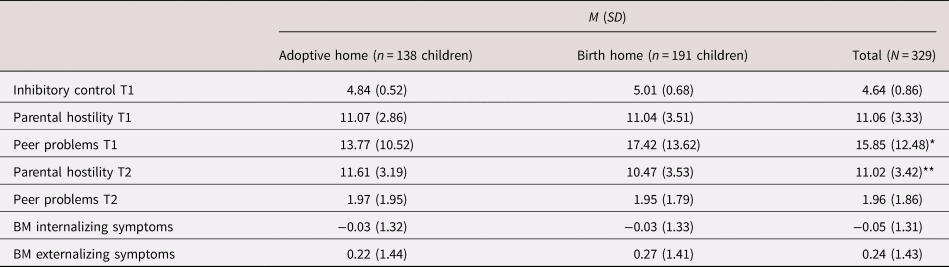
Child inhibitory control was assessed for adoptees and biological siblings at T1 with the 13-item inhibitory control scale from the short form of the Children's Behavior Questionnaire (Putnam & Rothbart, Reference Putnam and Rothbart2006; Rothbart, Ahadi, Hershey, & Fisher, Reference Rothbart, Ahadi, Hershey and Fisher2001). Items were rated by the child's rearing parent(s) on a 7-point Likert scale ranging from extremely untrue of your child to extremely true of your child. When data were available from both rearing parents (n = 166 children), a mean score of both parents was used (interparental r = .51, p < 001). The inhibitory control scale measures children's capacity to plan and to suppress inappropriate responses under instructions or in novel or uncertain situations. In our study, this measure was reverse coded so that higher scores indicated poorer inhibitory control. The scale demonstrated acceptable reliability across reporters (Cronbach's α = .76–.86). See Table 1 for means and standard deviations for all study variables.
Means and standard deviations of study variables

Note: *p < .05 and **p < .01 group difference between children in adoptive home versus birth home. The total sample (n = 329 children) included 177 linked sibling pairs and 14 additional biological siblings who were missing the linked adopted child data but had linked birth parent data. BM, birth mother.
Parental hostility
Parental hostility to the study child was assessed for adoptive and birth parents at T1 and T2 with the 5-item hostility scale from the Iowa Family Interaction Scales (Melby & Conger, Reference Melby, Conger, Kerig and Lindahl2001). Items were rated by the rearing parent(s) on the 7-point Likert scale ranging from always to never, with higher scores indicating greater hostility. Items assessed the parent's hostility toward the child, for example, how often did you criticize him/her or his/her ideas. The scale demonstrated acceptable reliability in our study (Cronbach's α = .79–.95). Interparental ratings were correlated (T1: r = .36, p < .01; T2: r = .44, p < .01), and thus when data were available from both parents (T1: n = 168 children, T2: n = 78 children), a mean score was used.
Child peer problems
At T1, adoptee and biological sibling peer problems were assessed using rearing parent(s)’ report on the Walker–McConnell Peer-Preferred Social Behavior Scale (PSBQ; Walker & McConnell, Reference Walker and McConnell1988). Intended to measure peer-related social behaviors that are highly valued by peers, the PSBQ is a 17-item parent report that ranges from 1 (never) to 5 (frequently). Example items include offers to help peers when needed, makes friends easily, and plays games and activities skillfully. The scale demonstrated acceptable reliability in our study (Cronbach's α = .94–.95). There was high consistency in parental ratings (r = .71, p < .001), and thus when both parents completed the PSBQ (n = 171 children), a mean score was used. In our study, this measure was reverse coded so that higher scores indicated more peer problems/fewer peer skills.
At T2, rearing parents or the child responded to the peer scale of the Strengths and Difficulties Questionnaire (SDQ; Goodman, Reference Goodman2001) using a 5-item scale ranging from 0 (not true) to 2 (certainly true). The SDQ peer scale includes items such as tends to play alone, has at least one good friend, and generally liked by other children. The SDQ was administered to either the child (n = 74) or a rearing parent (n = 215), depending on the particular assessment protocols for the T2 assessment, with children born earlier in the course of the study completing the SDQ via child report and those born later having parent report data. Although in no case did a child have both parent-report and child-report data, the mean-level scores on the SDQ did not differ as a function of reporter (child report M = 2.01, SD = 1.83; parent report M = 1.94, SD = 1.89), t (250) = 0.29, p = .77. Although the study used different measures of peer problems at T1 (PSBQ) and T2 (SDQ), the two measures had somewhat comparable items, suggesting that they measured similar underlying constructs, and they were significantly correlated (r = .51, p < .001).
Genetic risk inherited from birth mothers
Birth mother psychopathology was used as a broadband indicator of genetic risk for child behavior problems (e.g., low inhibitory control or peer problems). It was measured using composite externalizing and internalizing scores previously created in this study (Marceau et al., Reference Marceau, Rolan, Leve, Ganiban, Reiss, Shaw and Neiderhiser2019). Four indicators relating to internalizing and externalizing problems, which took into account symptoms, age of onset, and family history, were used to compute separate scores for birth mother internalizing and externalizing problems. The indicators were derived from birth mothers’ self-report data 18 and 54 months after the birth of the adoptee. For the first three indicators, the Composite International Diagnostic Instrument (Kessler & Ustun, Reference Kessler and Ustun2004) and the Diagnostic Interview Schedule (Robins, Helzer, Croughan, & Ratcliff, Reference Robins, Helzer, Croughan and Ratcliff1981) were used to create birth mother counts for (a) number of disorders on the diagnostic interview, (b) number of symptoms endorsed on the diagnostic interview, and (c) age of onset of each disorder. For internalizing disorders, the diagnostic categories surveyed included major depression, brief recurrent depression, dysthymia, separation anxiety, adult separation anxiety, social phobia, agoraphobia (with and without panic), panic disorder, specific phobia, and generalized anxiety. For externalizing disorders, the diagnostic categories surveyed included antisocial personality, conduct disorder, alcohol abuse and dependence, drug abuse and dependence, and tobacco dependence. For both externalizing and internalizing scores, episodes of prenatal symptoms were excluded.
The fourth indicator comprised the number of first-degree relatives (mother, father, and up to three siblings) who had ever been diagnosed with an internalizing or externalizing disorder, assessed by birth mother reports for each relative, derived from the Family History–Research Diagnostic Criteria (Andreasen, Endicott, Spitzer, & Winokur, Reference Andreasen, Endicott, Spitzer and Winokur1977). This indicator was calculated as the maximum proportion of first-degree relatives rated by the birth mother as having externalizing or internalizing problems. The composite scores for internalizing and externalizing problems were intended to be more robust measures of inherited psychopathology than any single measure, as internalizing and externalizing disorders load highly onto separate liability factors and show strong genetic overlap in adulthood (Caspi et al., Reference Caspi, Houts, Belsky, Goldman-Mellor, Harrington, Israel and Moffitt2014; Kendler et al., Reference Kendler, Aggen, Knudsen, Røysamb, Neale and Reichborn-Kjeennerud2011; Krueger & Markon, Reference Krueger and Markon2006; Waszczuk, Zavos, Gregory, & Eley, Reference Waszczuk, Zavos, Gregory and Eley2014). Indicators were entered into a principal component analysis separately for each disorder, and extracted factor scores were aggregated to create a composite score for internalizing symptoms and for externalizing symptoms.
Covariate: Household income
Self-reported annual household income in adoptive and birth homes was assessed at T1 on an 11-point Likert scale: 1 = less than $15,000; 2 = $15,001–$25,000; 3 = $25,001–$40,000; 4 = $40,001–$55,000; 5 = $55,001–$70,000; 6 = $70,001–$100,000; 7 = $100,001–$125,000; 8 = $125,001–$150,000; 9 = $150,001–$200,000; 10 = $200,001–$300,000; and 11 = more than $300,000. None of the correlations between household income and the independent variables (birth mother externalizing composite, birth mother internalizing composite, T1 parental hostility, T1 peer problems, and T1 child inhibitory control) was significant. As expected, income differed significantly by home type, with higher income levels in adoptive homes than in birth homes (adoptive home M = 6.82, SD = 2.12; birth parent home M = 2.83, SD = 1.70), t (303) = 18.16, p < .01. Models accounted for differences between adoptive and birth parent household income by regressing each study variable on income and using the standardized residuals in subsequent analyses.
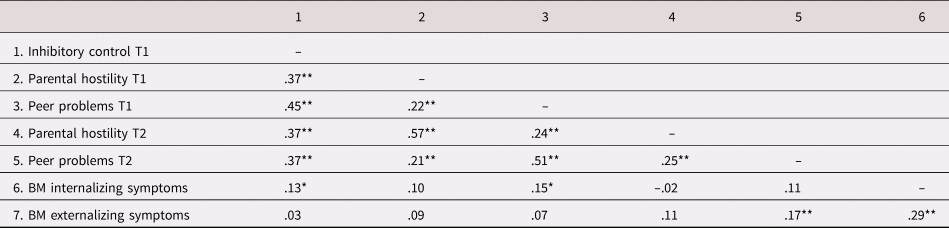
In addition, we examined whether there were differences in study variables by child sex. Child sex was not significantly correlated with any of the study variables and there were no mean-level differences by sex, and thus child sex was not considered further. Means and standard deviations for all study variables are presented in Table 1 and the correlation matrix is shown in Table 2.
Correlation matrix of study variables after controlling for income

Note: BM, birth mother. *p < .05. **p < .01.
Analytic plan
Analyses were conducted using the Mplus 6.1 software (Muthén & Muthén, Reference Muthén and Muthén1998–2010). Model 1 tested a model that examined the cross-lagged paths between parental hostility and peer problem pathways at T1 and T2 (Hypothesis 1), including the potential for genetic effects via birth parent internalizing and externalizing symptoms on T1 parental hostility and T1 peer problems. Model 2 added child inhibitory control to the model as a child characteristic that may be genetically influenced, in part, and was hypothesized to be associated with later parental hostility and peer problems. This allowed us to examine Hypothesis 2: (a) the association between children's genetic risk for behavior problems (birth mother externalizing and internalizing symptoms) and poor inhibitory control, (b) the longitudinal paths from child poor inhibitory control to T2 parent hostility and T2 peer problems, and (c) the indirect effect of children's genetic risk for behavior problems on T2 outcomes via child inhibitory control. Model 3 then tested the invariance between adoptive and birth homes for path estimates to examine Hypothesis 3, that the association between birth parent characteristics and child inhibitory control would be stronger in the biological sibling group than in the adoptee group.
Fit was assessed using the comparative fit index (CFI), Tucker–Lewis index (TLI), root mean square error of approximation (RMSEA), and maximum likelihood and adjusted Satorra–Benter chi-square values (Satorra & Bentler, Reference Satorra and Bentler2010). The CFI and TLI range in value from 0 to 1 indicates the proportion of improvement in the overall fit of the hypothesized model relative to a null model in which all covariances between variables are zero. Values of .95 or greater are desirable for the CFI and TLI (Bentler, Reference Bentler1990; Hu & Bentler, Reference Hu and Bentler1999). The RMSEA is a measure of lack of fit per degrees of freedom; values that range upward from 0 through to .05 indicate a good fit, and up to .08, a fair fit (Browne & Cudeck, Reference Browne and Cudeck1993). Because the chi-square is highly sensitive to sample size and distributional assumptions (Hu & Bentler, Reference Hu, Bentler and Hoyle1995), three other measures of the overall goodness of fit were used.
Following the model fitting, which examined between-family differences, we conducted exploratory analyses to examine within–sibling pair differences (Hypothesis 4). Specifically, we conducted a descriptive examination of the biological sibling pair correlations, where we correlated scores for the member of the sibling pair who was living in the adoptive home (adoptee) with scores for the child in the birth home (biological sibling). These intraclass correlations were computed for each adoptee–biological sibling pair, separately by the type of sibling (full siblings who share 50% of their segregating genes, on average, or half siblings who share 25% of their segregating genes, on average). If sibling correlations decrease with decreasing genetic similarity (e.g., full-sibling correlations are larger than half-sibling correlations) then genetic influences are suggested. Model fitting was not conducted for the within-sibling pair analyses because of the exploratory nature of this hypothesis and the small sample size for full-sibling pairs.
Models were also examined with only one child per birth home, to account for multiple siblings in the same birth home. The pattern of associations across all paths remained the same, and thus the full sample was retained in the current study.
Results
Prior to analyses, we examined whether there were mean differences in the study variables based on rearing environment. Two significant differences were identified: children in birth homes had more peer problems than did children in adoptive homes at T1, t (265) = 2.4, p = .02, and adoptive parents reported more parental hostility than did birth parents at T2, t (293) = 2.91, p = .004; see Table 1. As shown in Table 2, after controlling for household income, most of the rearing parent and child variables were significantly correlated with one another. Specifically, poor child inhibitory control (r = .37, p < .01), more parental hostility (r = .57, p < .01), and more peer problems (r = .24, p < .01) at T1 were robustly correlated with more parental hostility at T2. In addition, poor child inhibitory control (r = .37, p < .01), more parental hostility (r = .21, p < .01), and more peer problems (r = .51, p < .01) at T1 were correlated with more peer problems at T2. In addition, T1 variables were correlated with one another, T2 variables were correlated with one another, birth parent internalizing symptoms were correlated with T1 inhibitory control and T1 peer problems, and birth parent externalizing symptoms were correlated with T2 peer problems.
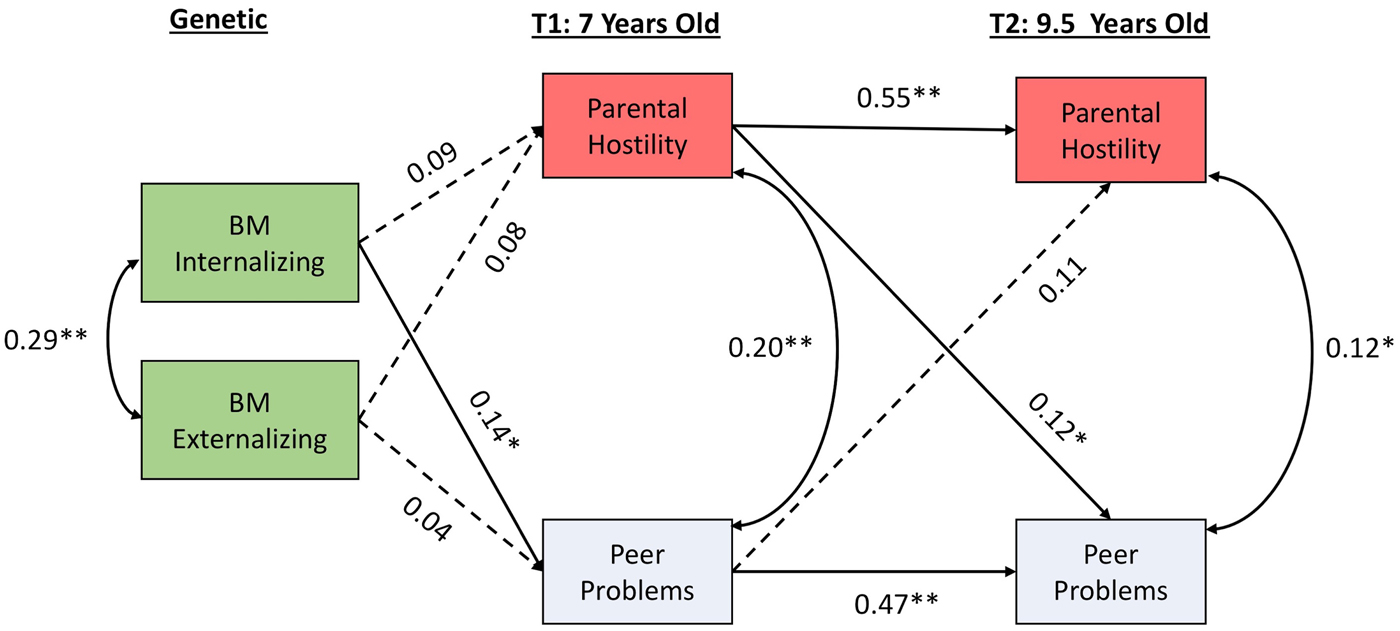
Next, we proceeded with modeling testing. Model 1, which tested the reciprocal cross-lagged paths between parental hostility and peer problems, is displayed in Figure 1. In addition to stability in parental hostility from T1 to T2 (b = 0.55, p < .01) and peer problems from T1 to T2 (b = 0.47, p < .01), T1 parental hostility was associated with T2 peer problems (b = 0.12, p < .05), consistent with Hypothesis 1. T1 peer problems were not significantly associated with T2 parental hostility (b = 0.11, ns). Birth mother internalizing and externalizing symptoms were not directly associated with T1 parental hostility (b = 0.09, ns and b = 0.08, ns, respectively). However, birth mother internalizing symptoms were associated with T1 peer problems (b = 0.14, p < .01); externalizing symptoms were not (b = 0.04, ns).
Conventional cross-lagged model testing the competing effects of parental hostility and peer problems. Solid black lines indicate significant paths, dashed lines indicate nonsignificant paths, and curved paths depict correlations. BM, birth mother. χ2 (4) = 7.56, p =.11; CFI = .98; TLI = .94; RMSEA = .05; SRMR = .03. *p < .05. **p < .01.

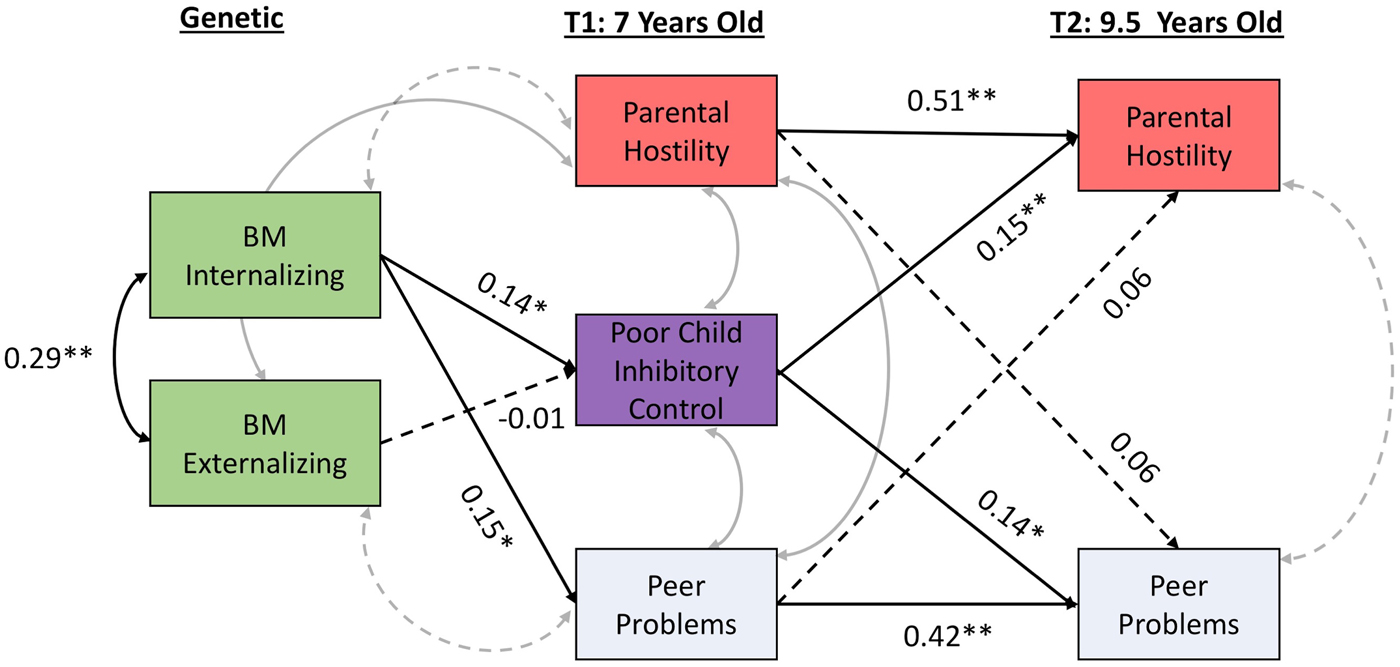
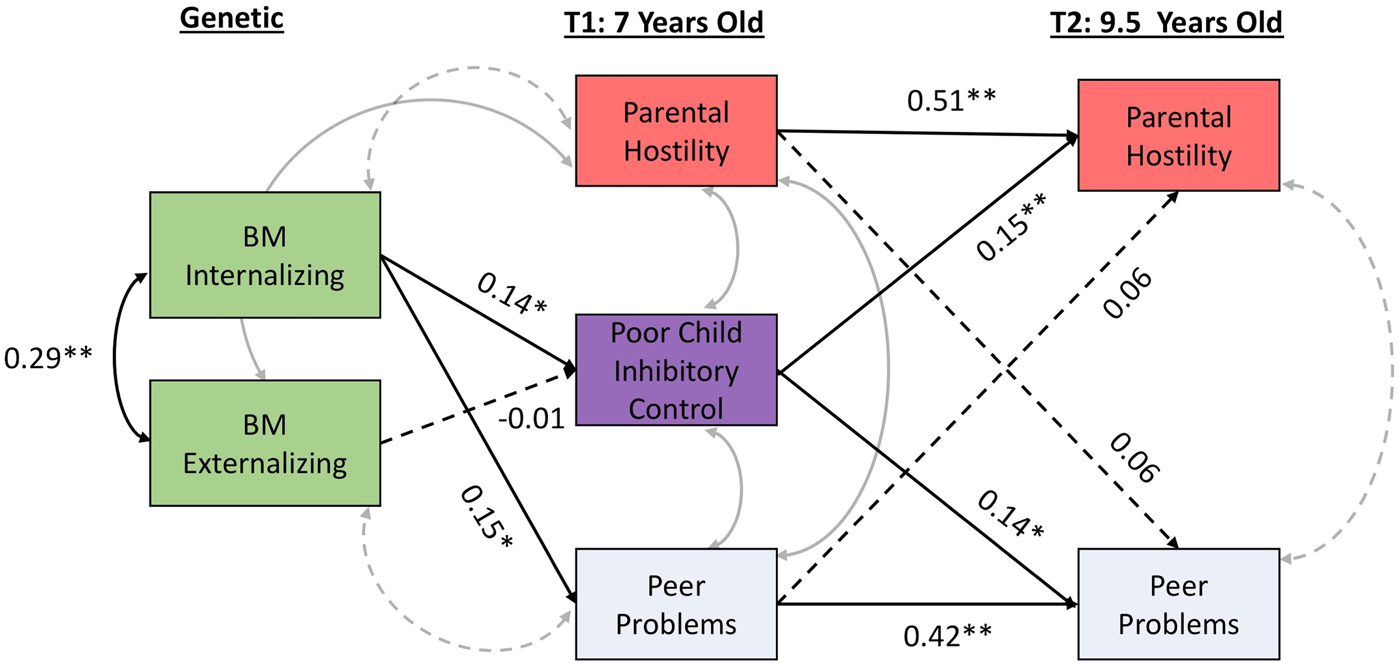
Model 2 (shown in Figure 2) built on Model 1 by examining T1 child poor inhibitory control as a child characteristic that may be genetically influenced and predict parental hostility and peer problems at T2. Model 2 included the association between birth mother internalizing symptoms and T1 peer problems (b = 0.15, p < .05), but dropped the nonsignificant birth mother externalizing and internalizing symptoms paths from Model 1, accounting for their effect as correlations to present the most parsimonious model. In Model 2, birth mother internalizing symptoms were associated with T1 child inhibitory control (b = 0.14, p < .05), but birth mother externalizing symptoms were not (b = –0.01, ns). In addition, child inhibitory control predicted T2 parental hostility (b = 0.15, p < .01) and T2 peer problems (b = 0.14, p < .05). There was a significant indirect effect from birth mother internalizing symptoms through T1 peer problems to T2 peer problems (b = 0.06, p < .01). In addition, consistent with Hypothesis 2, there was a trending indirect effect from birth mother internalizing symptoms through T1 inhibitory control to T2 parental hostility (b = 0.02, p = .09).
Cross-lagged model that incorporates the association between child inhibitory control (T1) on T2 outcomes. Solid black lines indicate significant paths, dashed lines indicate nonsignificant paths, and curved paths depict correlations. BM, birth mother. χ2 (5) = 9.36, p = .10; CFI = .98; TLI = .94; RMSEA = .05; SRMR = .03. *p < .05. **p < .01.
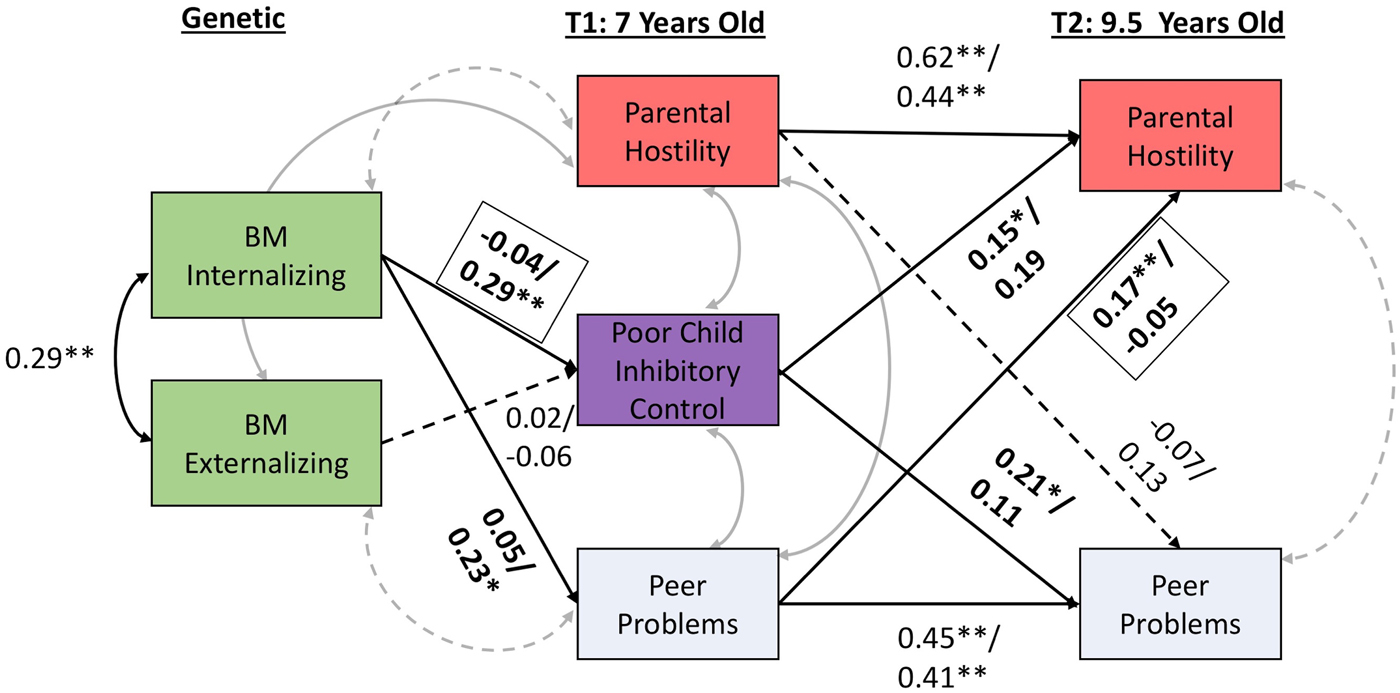
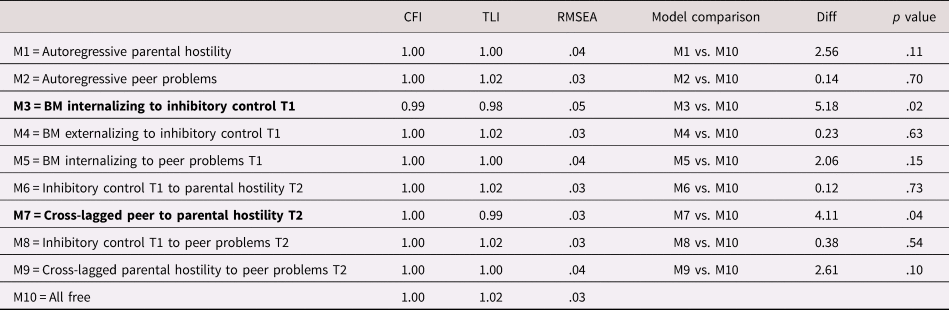
Model 3 presents group differences by adoptive and birth homes for paths estimated in Model 2. With the exception of the correlation between birth mother externalizing and internalizing symptoms, which was fixed to be the same across groups because the children had the same birth mother, all other paths were allowed to vary (shown in Figure 3). This model allows for a test of whether passive gene–environment correlation may be present, suggested when correlations for children reared in birth homes are larger than those for children reared in adoptive homes. Figure 3 shows that for path estimates in adoptive and birth homes, the magnitude of parameter estimates differed in significance level for birth mother internalizing symptoms to T1 inhibitory control, birth mother internalizing symptoms to T1 peer problems, T1 inhibitory control to T2 parent hostility and T2 peer problems, and T1 peer problems to T2 parental hostility (designated by numbers in bold in Figure 3). We used the adjusted Satorra–Bentler scaled chi-square difference test to examine invariance by constraining path coefficients to be equal/free to vary (shown in Table 3). There was a significant detriment to model fit when parameter estimates were constrained to be equal from birth mother internalizing symptoms to T1 inhibitory control, χdiff2 (1) = 5.18, p = .02. The magnitude of the parameter estimate for the path from birth mother internalizing symptoms to T1 inhibitory control was significantly higher in birth parent–reared homes (b = 0.29, p < .01) than in adoptive homes (b = –0.04, ns), indicating the possible presence of passive gene–environment correlation. In addition, there was significant detriment to model fit when parameter estimates were constrained to be equal from T1 peer problems to T2 parental hostility, χdiff2 (1) = 4.11, p = .04. In this case, there was a stronger association between T1 peer problems and T2 parental hostility in adoptive homes (b = 0.17, p < .01), suggesting a stronger effect of the adoptees’ peer problems on their rearing parents’ hostility than of birth-reared children's peer problems on their rearing parents’ hostility (b = –0.05, ns).
Multigroup model that tests path invariance in Figure 2 by allowing paths to vary for adoptees versus birth parent–reared children. Solid black lines indicate significant paths, dashed lines indicate nonsignificant paths, and curved paths depict correlations. Bolded coefficients indicate that the significance level of the two parameter estimates differed in magnitude (e.g., one path was p < .01 and one path was p < .05). Parameter estimates with a box around them were statistically significantly different from one another as indicated in Table 3. Path coefficients presented as adoptive parent home/birth parent home. χ2 (16) = 14.04, p = .60; CFI = 1.00; TLI = 1.02; RMSEA = .00; SRMR = .03. *p < .05. **p < .01.

Tests of model fit path estimate differences between adoptive and birth home, corresponding to the model shown in Figure 3

Note: BOLD represents significant differences between adoptive and birth home at p < .05. Differences in path estimates were tested with adjusted chi-square using the Satorra–Bentler scaling correction. CFI, comparative fit index. TLI, Tucker–Lewis index. RMSEA, root mean square error of approximation. M, model. BM, birth mother.
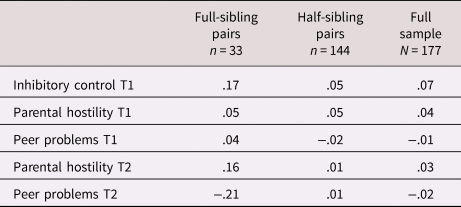
To examine exploratory Hypothesis 4, we present the means, standard deviations (Table 1), and correlations (Table 4) of the paired-household dyads as part of exploratory analyses to test within–sibling pair differences. As shown in Table 4, there were no significant correlations between siblings reared apart with regard to their inhibitory control levels, parental hostility scores at T1 or T2, or peer problem scores at T1 or T2, regardless of full-sibling or half-sibling status. Although the correlations were higher for full- versus half-sibling pairs in some cases, none of the correlations or correlation differences was significant.
Within-sibling-pair correlations by genetic relatedness, for rearing parent and child variables

Discussion
Our study used data from a set of linked adoptee and biological sibling studies that, together, facilitated an innovative approach to examining the prediction of peer problems in middle childhood. In addition to testing a conventional cross-lagged model that examines the cross-over effects from parental hostility to later peer problems, we were able to examine child effects on these pathways. This included an examination of whether children's low inhibitory control predicted later peer problems and parental hostility, and if such pathways existed, whether they were, in part, the result of genetic influences on child inhibitory control. Further, because we could compare the path coefficients from birth mother internalizing and externalizing problems to the adoptees’ and biological siblings’ inhibitory control, we were able to examine whether passive gene–environment correlations may be present in associations between birth parent psychopathology and child inhibitory control.
The primary findings from this study replicate and extend Dishion's foundational research describing how coercive family processes in the home can spill over into the peer realm (Dishion et al., Reference Dishion, Patterson, Stoolmiller and Skinner1991; Patterson & Dishion, Reference Patterson and Dishion1985; Patterson et al., Reference Patterson, Reid and Dishion1992; Snyder et al., Reference Snyder, Dishion and Patterson1986). Yet, the findings also pose new questions and challenges for future research and intervention activities focused on understanding and preventing the pathways to peer problems. Consistent with our first hypothesis, results from the conventional cross-lagged model replicated findings from prior studies of adolescents showing that higher levels of parental hostility to the child are linked with an increase in children's peer problems later in development (e.g., Ary et al., Reference Ary, Duncan, Duncan and Hops1999; Patterson et al., Reference Patterson, Reid and Dishion1992). The downward extension of this finding to ages 7–9.5 years expands the evidence base on the applicability of Dishion's deviancy training model to younger children and suggests that parenting interventions delivered during middle childhood may be well timed to prevent the spillover from coercive processes in the home to negative or delinquent interactions with peers. Of note, although the reverse path (i.e., from T1 peer problems to T2 parental hostility) was not significant in our test of the conventional cross-lagged model, it was also not significantly different than the T1 parental hostility to T2 peer problems path, suggesting that this pathway may also be worth attending to when considering family–peer process pathways.
When we added children's inhibitory control to the cross-lag model, it signficantly predicted later parental hostility and later peer problems. This finding provided support for one aspect of our second hypothesis (i.e., that low inhibitory control can impair children's abilities to develop positive peer relationships and taxes parents’ ability to refrain from hostile interactions with their child). The addition of child inhibitory control paths to the cross-lagged model also resulted in a change in significance for the initial cross-lagged path from parental hostility to peer problems; that is, it became nonsignificant. This was unexpected and may indicate that the previously identified and replicated pathway from parental hostility to child peer problems may, in part, be confounded with child characteristics that were not measured in some of the prior studies. Child inhibitory control has been shown to mediate associations between maternal behavior (depression) and later child behavior (oppostional behavior) in other studies of young children (Choe, Shaw, Brennan, Dishion, & Wilson, Reference Choe, Shaw, Brennan, Dishion and Wilson2014), suggesting the plausibility of this explanation.
We also examined the possible role of genetic influences on parent–peer pathways via genetic influences on children's inhibitory control. If an association was found from birth mother psychopathology to children's inhibitory control in the adoptee group, it would suggest a heritable association. Our results identified a significant association between birth mother internalizing problems and children's inhibitory control, supporting our second study hypothesis. However, when estimates from the subsequent multigroup analysis tested for invariance in this path coefficient between adoptees and biological siblings, the fit estimates indicated that the association between birth mother internalizing symptoms and child inhibitory control differed by group, with a stronger association in the biological sibling group than in the adoptee group. Although this supported our third hypothesis (i.e., that passive gene–environment correlation may explain a portion of the association between rearing parents’ characteristics and a child's charactersitic), that the association between birth parent psychopathology and adoptee inhibitory control was not signficant suggests that we did not capture a heritable aspect of children's inhibitory control. One potential reason for this null finding is that our study relied on birth mother data to ascertain genetic influences on child inhibitory control. This was because of the lack of birth father data for the majority of the children. In the absence of birth father data, only 50% of the possible genetic contributions to child characteristics can be modeled. Because prior twin studies (e.g., Polderman at el., 2009) have shown genetic influences on children's inhibitory control, it may also be that our birth parent mesaures (internalizing and externalizing symptoms) were not ideal for detecting an intergenerational genetic signal between parent and child.
Consistent with our second set of study hypotheses, there was partial support (trend level) for an indirect effect of birth mother internalizing symptoms on parental hostility, via lower levels of child inhibitory control. Considered together with the aforementioned result showing that the birth parent internalizing–child inhibitory control link was present only in the biological sibling group, this chain of associations from birth parent psychopathology, to child low inhibitory control, to parental hostility may ultimately reflect an underlying shared genetic predisposition toward behavior that is maladaptive, rather than a causal association from child inhibitory control to parental hostility. This identification of a possible passive gene–environment correlation warrants additional research with larger sample sizes and more rigorous measurement, or intervention designs, to further examine this pattern of results.
The multigroup analysis also revealed an additional group difference: the path from age 7 peer problems to age 9.5 parental hostility differed between adoptees and biological siblings and was significant in the former, but not the latter. This group difference was not anticipated, in part because when passive gene–environment correlation is present, it is expected to increase the similarities among biological family members. However, in our study, peer problems in adoptees were associated with later adoptive parent hostility, but this association was not seen in the biological siblings. In addition, examination of the mean-level differences (Table 1) indicated that birth parents rated the biological siblings as having more peer problems at age 7 than adoptive parents rated the adoptees as having, and yet by age 9.5, adoptive parents rated themselves as more hostile toward their child than birth parents rated themselves. Together, this set of findings may indicate that shifts in the level of peer problems as children progress through middle childhood can be taxing for parents. In the case of the adoptees, in which the mean levels of peer problems were very low at age 7 but of the same magnitude as those of the biological siblings at age 9.5, this increase may elicit more hostile parenting strategies from rearing parents, potentially as part of a normative shift in parenting that becomes necessary as children develop new skills and challenges as they enter new developmental periods. An alternative explantion is that perhaps biological parents in our study (who were younger and lower income than adoptive parents) perceived higher levels of peer problems as more normative than did adoptive parents, and thus such behaviors at age 9.5 were less taxing on their parenting. Additional follow-ups of this sample are planned when the children are adolescents, which will enable a more refined examination of whether this apparent perturbation in adoptive parent hostility at age 9.5 is temporary or whether it persists into later stages of development.
Our final set of analyses was exploratory; rather than a between-home comparison as was used in the earlier analyses, we sought to link the biological sibling data aross homes, and examine sibling pair similarities in inhibitory control, peer problems, and hostile parenting. Because the siblings were reared apart since birth, in the absence of contact between adoptive and birth families, similarities in their behaviors can be considered to reflect genetic (or shared prenatal) influences. We hypothesized that biological sibling pairs would be correlated for their behaviors, and that the correlations would be higher in full-sibling pairs than in half-sibling pairs. However, the correlations suggested that, by and large, the siblings were not significantly correlated for any study variable. None of the associations was significant, and the largest correlation was negative (r = –.21 for full siblings’ T2 peer problems), indicating that when one sibling scored high on peer problems, the other sibling scored low. The absence of similarities between biologically related children in a sibling pair suggests that the unique environments that children are reared in serve as an important predictor of behavior, including peer problems. This has important implications for the development of preventive interventions, because it suggests that children can develop unique developmental trajectories as a function of the family and context within which they reside. This does not mean that genetic influences are not important. Given the small numbers of full- and half-sibling pairs in the current sample, our analyses are underpowered to detect small genetic effects. Examination of the magnitude of correlations suggests that full-sibling pairs tend to have more similar levels of inhibitory control than half-sibling pairs (r = .17 vs. r = .05). If larger samples were available, it is possible that a genetic signal would be more apparent.
Nevertheless, our findings highlight the importance of environmental influences on children's peer problems. The contexts that the adoptees and biological siblings lived in differed on a large number of qualities, including income and education (e.g., Natsuaki et al., Reference Natsuaki, Neiderhiser, Harold, Shaw, Reiss and Leve2019), and yet many of the associations tested in our study were not significantly different between birth and adoptive homes. For example, the stability of parental hostility and peer problems and the associations between child inhibitory control and parental hostility and peer problems were similar for adoptees and biological siblings. This suggests underlying parallels in associations between inhibitory control, parenting, and peer problems, regardless of the other aspects of the family context. It also suggests the relevance of the unique environment that every child experiences as key in shaping sibling differences. Additional follow-up of this sample into adolescence will provide an opportunity to examine whether the siblings reared apart grow more similar as they enter adolescence, or further diverge, commensurate with the large body of literature on the importance of nonshared environment influences during adolescence (e.g., Reiss et al., Reference Reiss, Neiderhiser, Hetherington and Plomin2000).
Implications for theory and prevention
Although the current study was not experimental in nature, the pattern of findings provides some new leads for theory development and the development of preventive interventions aimed at reducing children's peer problems. The results support the notion that Dishion's peer deviancy training theory and model could be expanded to include a more prominent role for child factors, in particular inhibitory control, in the cascade of coercive interactions originating in the family and continuing into the peer realm. Our study tested direct and mediated effects, but it is likely that interactions between children's inhibitory control problems, parental hostility, and peer problems exist. Such models could also incorporate measured genetic contributions into this cascade via inclusion of polygenic risk scores, along the lines that Dishion was beginning to pursue in the final months of his remarkable career (e.g., Lemery-Chalfant, Clifford, Dishion, Shaw, & Wilson, Reference Lemery-Chalfant, Clifford, Dishion, Shaw and Wilson2018). Given the possibility of passive gene–environment correlations in the association between parent psychopathology and child inhibitory control, expanded iterations of Dishion's peer deviancy training model might also benefit from considering how shared genetic liabilities may fuel coercive processes in the home during childhood.
The current study's suggestion of shared genetic liabilities also has implications for the development of preventive interventions. Where both biological parent and child have a predisposition toward low inhibitory control, it may be useful to directly coach the parent about this shared challenge, and discuss how this shared attribute can prompt parent–child interactions to easily escalate into noncompliance and/or hostile interactions. Strategies could be discussed with parents for how to recognize this coercive cycle, and parents could be guided on the use of effective parenting approaches to prevent escalation (e.g., time-out, and calm and consistent responses). Teaching parents to use such parenting strategies may also help prevent the cross-lagged effect we found from children's peer problems to later hostile parenting in adoptive families, and to prevent the elicited effect from child inhibitory control challenges to parental hostility seen in both biological and adoptive families. Furthermore, the very modest levels of behavioral similarity between biological siblings reared apart suggests that the family and local context that each child lives in are important contributors to variation in children's peer problems. Although a wide range of parenting and context variables were not included in the current study, as thus the precise mechanism of action is not discernable, the pattern of results generally suggests that the experiences children have in their homes and communities are influential forces that help shape their peer problems. This provides additional support for preventive interventions that focus on strengthening family relationships, building child skills, and/or increasing community supports (e.g., Hawkins et al., Reference Hawkins, Brown, Oesterle, Arthur, Abbott and Catalano2008; Leve & Chamberlain, Reference Leve and Chamberlain2005; Shaw, Dishion, Supplee, Gardner, & Arnds, Reference Shaw, Dishion, Supplee, Gardner and Arnds2006) and suggests their relevance for preventing the cascade from low child inhibitory control to parental hostility and peer problems.
Study limitations and future directions
Our study had a number of limitations that should be considered when evaluating the results. First, the study did not contain observational data for the constructs measured here, and thus parent- and child-report data were used. Although we used aggregate mother–father reports when available, the correlation between our primary variables may be inflated because of rater bias issues when the same individuals are rating both themselves (parental hostility) and their child (peer problems). Relatedly, teacher or peer reports of children's peer behavior would provide a more ecologically valid measure of peer problems. A related measurement limitation is that the levels of parental hostility were fairly low for both groups, which may limit the clinical significance of the study.
Second, we had only two time points of data for this subsample of families. Although that enabled us to examine behavior change across an understudied period of development, we could not examine trajectories or earlier precursors of parent–peer cross-over effects. The extant literature on associations between parenting and peer problems suggests that there is a normative surge in peer delinquency during adolescence that is not captured by our study (Patterson et al., Reference Patterson, Reid and Dishion1992). Further, longitudinal research that has been conducted earlier in development suggests that peer relations during this period can have long-term associations with later well-being, and that parent–child relationship quality earlier in development measured using attachment paradigms also predicts subsequent peer relations (Acar, Rudasill, Molfese, Torquati, & Prokasky, Reference Acar, Rudasill, Molfese, Torquati and Prokasky2015; Ettekal & Ladd, Reference Ettekal and Ladd2015; Groh, Fearon, van IJzendoorn, Bakermans-Kranenburg, & Roisman, Reference Groh, Fearon, van IJzendoorn, Bakermans-Kranenburg and Roisman2017; Parke & Ladd, Reference Parke and Ladd2016).
Third, unmeasured variables could have played an important role in the pathways studied. For example, we did not have a robust measure of prenatal risk exposure, which is important to help disentangle genetic from prenatal influences in our study design. These data are forthcoming in future data collection activities and will be incorporated in subsequent studies with this sample. We also did not have a measure of child externalizing problems that came from a measure different than our T2 peer problems measure. Child externalizing problems are an important mechanistic component of Dishion's deviancy training model (e.g., Dishion, Reference Dishion1990; Patterson et al., Reference Patterson, Forgatch, Yoerger and Stoolmiller1998), and its absence in our study is notable. As noted earlier, data from birth fathers were also lacking, which resulted in a study approach that could test only 50% of genetic contributions to child inhibitory control and child peer problems. In addition, adoptive and birth families likely varied on many unmeasured variables that could be important in explaining the between-family differences found in our multigroup analysis. For example, in addition to the between-group income difference reported here, earlier reports from some of the adoptive and birth families in our study indicate significant differences in maternal depressive symptoms, education level, and guiding parenting (Natsuaki et al., Reference Natsuaki, Neiderhiser, Harold, Shaw, Reiss and Leve2019). These and other unmeasured variables such as the neighborhood or school context that might interact with hostile parenting in its associations with children's inhibitory control or peer problems. Fourth and finally, the sample size for full-sibling sets was small, which reduced our power to detect genetic influences in the within-sibling pair exploratory analyses. Future data collection plans include obtaining longitudinal data from many different types of siblings in this sample (e.g., genetically unrelated or genetically related living together), thus increasing the power for detecting genetic and shared environmental influences on child behavior.
Despite these limitations, our study provides new evidence that the well-known association from parental hostility to peer problems exists in middle childhood, but it may result in part from inhibitory control challenges that children may have that precipitate peer problems and parental hostility toward the child. Further, common genes that are shared between parents and children who live in the same household may also underlie associations between child inhibitory control and parent and peer relations. Finally, an important takeaway from our study is that in addition to the role of inhibitory control on peer and parent processes, the unique family context that each child resides in makes an important contribution to peer relations. The effect of the family context is such that full siblings who are reared apart in very different households since birth tend not to highly resemble one another in terms of their inhibitory control, peer problems, or parental hostility received. These findings provide promise for improved family- and context-based interventions to prevent the cascade from coercive family processes to peer problems across childhood and adolescence.
Financial Support
This project was supported by Grants R01 HD042608 from the National Institute of Child Health and Human Development and the National Institute on Drug Abuse (PI Years 1–5: Reiss; PI Years 6–10: Leve), UG3 OD023389 and UH3 OD023389 from the Office of the Director (PIs: Leve, Neiderhiser, Ganiban), R01 MH092118 from the National Institute of Mental Health (PIs: Neiderhiser, Leve), R01 DA020585 from the National Institute on Drug Abuse (PI: Neiderhiser), and R01 DA035062 from the National Institute on Drug Abuse (PI: Leve). Amanda Griffin's work was supported by a training grant (F32 HD093347A). The content is solely the responsibility of the authors and does not necessarily represent the official views of the Eunice Kennedy Shriver National Institute of Child Health and Human Development or the National Institutes of Health.