Introduction
Cover crops are an essential part of many conservation tillage systems, but they have to be managed appropriately to obtain their full benefitReference Ashford and Reeves1, Reference Brady and Weil2. In the southern United States, cereal rye (Secale cereale L.) is commonly used as a winter cover crop. Mechanical rollers have been used in some conservation systems to terminate cover cropsReference Derpsch, Roth, Sidiras and Köpke3, but excessive vibration and low operating speeds associated with current roller designs have contributed to a low rate of adoption by US farmersReference Raper, Simionescu, Kornecki, Price and Reeves4.
In some conservation systems, especially in the southeastern US, terminating cover crops 3 weeks prior to planting the cash crop is a standard agricultural extension recommendationReference Ashford and Reeves1. Termination is achieved mainly by the use of herbicides, since spraying is relatively fast and effective. The effectiveness of different mechanical termination methods for cover crops without using herbicides was considered in a previous research. The performance of an undercutter in terminating cover crops by severing the roots of cover crops while flattening the plants for subsequent weeds suppression was considered in one studyReference Creamer, Plassman, Bennett, Wood, Stinner and Cardina5. Although cover crop mortalities following an undercutter were high (95%), the process disturbed soil, was slow, and required more power compared with other termination methodsReference Creamer and Dabney6. Creamer and DabneyReference Creamer and Dabney6 evaluated various cover crop kill methods such as residue incorporation by disking, flail mowing, mowing, undercutting, rolling chopping and rolling. They concluded that rolling alone using a rolling basket without crimping bars was less effective in killing cover crops compared with undercutting. However, compared with cover crop incorporation, rolling and other termination methods that maintained residue on the soil surface provided much better weed suppression.
Mowing and most other methods for terminating cover crops mechanically rely on detaching aboveground cover crop vegetation from the roots and mixing, chopping and shredding residue on the soil surface. However, for a cover crop such as rye that is relatively tall and can lodge in multiple directions, planting efficiency can be reduced due to a need for frequent stops to clean accumulated cover crop residue stuck in the planting units. In addition, non-rolled residue may cause ‘hair-pinning’, a condition where lodged residue prevents adequate seed-soil contact, thus reducing a cash crop stand. Mowing of cover crops especially in early growth stages may trigger significant re-growth. Wilkins and BellinderReference Wilkins and Bellinder7 studied re-growth of rye and wheat after mowing at different plant growth stages. They found that when rye was mowed at the first node growth stage (Zadoks growth stage=31; Zadoks et al.Reference Zadoks, Chang and Konzak8), re-growth biomass was 4340 and 8470 kg ha−1, 4 and 8 weeks after mowing, respectively. These findings indicate that after mowing at vegetative growth stages, rye cover crops still compete for nutrients and water resources in spring when cash crops are planted. Rye cover crop termination should be delayed until near-maximum biomass production for full soil coverage and to ensure minimal potential for re-growth is assured.
The practice of using rollers/crimpers to terminate cover crops mechanically without herbicides originated in BrazilReference Derpsch, Roth, Sidiras and Köpke3. This technology is receiving increased attention in the United States. Ashford and ReevesReference Ashford and Reeves1 indicated that when rolling was conducted at the appropriate plant growth stage (i.e., early milk to soft dough, Zadoks growth stages 70–85); rollers were as effective as synthetic herbicides at terminating a cover crop (94%). They concluded that rye mortality above 90% was sufficient to begin cash crop planting due to accelerated rye senescenceReference Ashford and Reeves1. Another important aspect of rolling cover crops is that a flat mat is created that lies in the direction of travel. The cover crop planting operation can then be conducted in a direction parallel to the rolled cover crop. This allows proper plant establishment by minimizing interference between the residue and planter.
Some North American producers have reported problems with roller implementsReference Raper, Simionescu, Kornecki, Price and Reeves4, Reference Kornecki, Price and Raper9. The main complaint has been the excessive vibration generated by the rollers. Vibration generated during the roller crimper operation is related to crimping frequencies, firmness and uniformity of the soil surface, and roller design/quality of fabrication. The types of vibration that producers most complain about are generated from the crimping action by the original straight bar roller designReference Kornecki, Price and Raper9. Research has shown that vibration generated by agricultural equipment can have detrimental effects on the operator's health, including increased heart rate, headache, stomach pain, lower back pain and long-term vibration exposure, leading to spinal degenerationReference Bovenzi10–Reference Toren, Obreg, Lembke, Enlund and Anderson12. The International Standard Office (ISO)13 developed vibration limits that are harmful to the human body. Vibration between 0.5 and 1.0 m s−2 is classified as ‘fairly uncomfortable’ and from 0.8 to 1.6 m s−2 is considered ‘uncomfortable’. Vibration above 2.0 m s−2 is described as ‘extremely uncomfortable’. Australian Standards developed limits for 8-h human exposure to vibration; for comfort limit, fatigue limit and health limit (detrimental effect) vibrations levels should be 0.1, 0.315 and 0.63 m s−2, respectivelyReference Mabbott, Foster and McPhee14.
The most effective method of alleviating roller vibration has been to reduce travel speed. Previous researchReference Kornecki, Price and Raper9 evaluated vibrations transferred to a tractor's frame from 1.8-m wide original straight bar roller design. When operating speed was reduced from 8 to 4.8 km h−1, vibration on the tractor frame was reduced 8 times, from 5.7 to 0.7 m s−2. However, most US producers find speed reduction to be an unacceptable solution due to the much higher operating speeds that they were able to use previously when spraying herbicides onto cover crops.
To address vibration problems generated by the original straight bar roller, in 2004 a new family of rollers was developed at the National Soil Dynamics Laboratory (NSDL). The first concept was a cylindrical roller with curved or elliptical crimping barsReference Raper, Simionescu, Kornecki, Price and Reeves4, and the second was a smooth roller drum with an oscillating crimping bar providing ten crimps per revolution. Results from previous research that compared the original roller design with a curved bar roller and a smooth roller with crimping bar showed that these rollers generated significantly less vibration compared with the original concept while maintaining high termination rates for cover cropsReference Kornecki, Price and Raper9. In 2006, two additional roller designs were developed: a modified smooth roller crimper providing eight crimps per revolution and a two-stage roller crimper to offer effective roller solutions needed by smaller farming communities. The present research evaluated performance of all rollers developed at the NSDL during 2004–2008.
Six roller types were tested to determine their effect on cover crop mortality, soil volumetric water content and vibration. The specific objectives were to determine: (1) the effectiveness of different roller designs for terminating a rye cover crop; (2) the operating speed effect on mortality for different roller designs; (3) rye rolling/crimping effects on soil volumetric moisture content (VMC); and (4) vibration levels generated by different roller designs at different operating speeds.
Materials and Methods
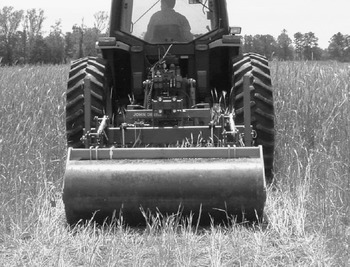
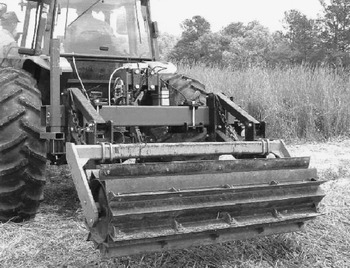
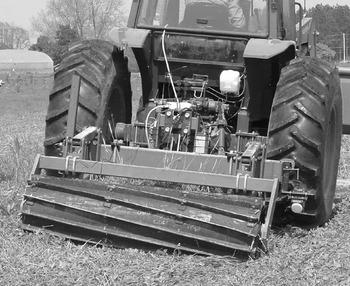
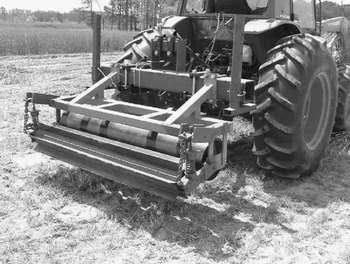
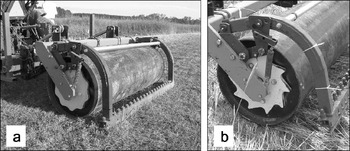
Six 1.8-m wide rollers developed at the NSDL were compared in replicated field experiments during 2006, 2007 and 2008 at the Alabama Agricultural Experiment Station's E.V. Smith Research Station on a Compass loamy sandy soil (thermic Plinthic Paleudults) near Auburn, Alabama, USA. Rollers utilized in the experiment were: a smooth drum with and without glyphosate (Roundup™, WeatherMax) (Fig. 1), a roller with straight bars (Fig. 2), a roller with curved bars (Fig. 3), a new two-stage roller (Fig. 4), a smooth roller crimper with an original cam mechanism (Fig. 5a) and a new smooth roller crimper with a modified cam mechanism (Fig. 5b). The two-stage roller and the smooth roller crimper with the modified cam mechanism (patent pending) were developed for the 2006 growing season. The two-stage roller crimper is comprised of a smooth drum that functions to flatten the cover crop and serves as a vibration damper (generated by the second drum). The second drum has six crimping bars and is preloaded by two springs for more effective crimping. This roller is suitable for smaller farming operations, i.e., vegetable farms where producers have smaller tractors with less horsepower. The modified smooth roller with an oscillating crimping bar provides more aggressive crimping action compared with the original cam design. It provides eight crimps per revolution (instead of ten crimps provided by the original cam mechanism) to generate more aggressive crimping action. This results from the unique geometry of the cam mechanism and patented crimping bar design, which accounts for non-uniform soil surfaces across the crimping width. Rollers were tested at operating speeds of 3.2 and 6.4 km h−1. The 6.4 km h−1 speed was chosen to match speeds commonly used in field chemical applications.
Smooth drum roller.

Straight bar roller crimper.

Curved bar roller crimper.

Two-stage roller crimper.

Smooth roller crimper: (a) original cam and (b) modified cam mechanism.

All six roller designs were evaluated alone and, in addition, the smooth drum roller without crimping bars was evaluated in combination with glyphosate applied at the rate of 1.12 kg ha−1 (active ingredient), with spraying following the rolling operation on the same day. Non-rolled rye was used as a control (check). The treatments were replicated four times and arranged in a randomized complete block design. Each experimental unit was 15-m long and 1.8-m wide. ‘Elbon’ winter rye was drilled in the fall of 2005 (November 3), 2006 (October 25) and 2007 (November 15) using a John Deere 1700 grain drill at a seeding rate of 95 kg ha−1. To optimize rye growth, ammonium nitrate (33-0-0) was broadcast onto the cover crop at a rate of 33 kg ha−1 N during both mid-November and mid-February. Rye plants were rolled at the soft dough growth stage (Zadoks growth stage 85) in 2006 (April 18), and at the early milk growth stage (Zadoks growth stage 73) in both 2007 (April 17) and 2008 (April 21). The rye was rolled parallel to the direction that the cover crop was seeded.
VMC was measured the day of rolling and after the first, second and third week using a portable TDR moisture meter from Spectrum Technologies (Plainfield, Illinois). The sensor was equipped with 12-cm long rods and was inserted vertically into the soil surface. The length of rods was selected to measure soil VMC at a shallow depth, available for germination of cash crop seeds planted into the residue cover. Five readings were taken close to the middle of each plot at marked locations spaced about 2.5 m apart.
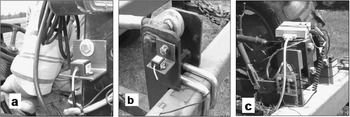
Accelerometers from Crossbow Technology Inc. (San Jose, California) were mounted on the tractor frame to measure vibration levels to which the driver was subjected (Fig. 6a) and on the roller frame to measure vibration due to roller motion (Fig. 6b). Vibration data from the accelerometers were recorded to a computer using special software with a custom made ‘on board’ data acquisition system mounted on the tool bar (Fig. 6c).
Placement of one-dimensional (z-axis) accelerometer from Crossbow Technology: (a) tractor frame, (b) roller frame, and (c) ‘on board’ data acquisition system.

The day before rolling/crimping, rye height and biomass were determined from each plot. The height was measured at ten different randomly chosen locations throughout the plot using a custom-made scale rod and then averaged. The biomass was collected from three different locations of each plot using a 0.25 m2 area (0.5 m×0.5 m square) frame. The collected rye biomass was oven dried for 72 h at 55°C using an electric oven (Model No. SC-350 from Grieve Corporation, Round Lake, Illinois). Rye termination, based on visual desiccation, was estimated on a scale of 0 (no desiccation) to 100 (complete desiccation all plants)Reference Frans, Talbert, Marx, Crowley and Camper15, and was evaluated on a weekly basis at 1, 2 and 3 weeks after rolling.
Percentages of rye mortality were transformed using an arcsine square-root transformation methodReference Steel and Torrie16, but this transformation did not result in a change in the analysis of variance (ANOVA). Thus, non-transformed means are presented. Rolling treatments were considered fixed effects and years were considered random effects. For vibration analysis, original vibration data were used. All acceleration data are reported in RMS values. ANOVA was performed on rye biomass, height, termination rates, VMC and vibrations, using SAS17. Treatment means were separated by the Fisher's protected LSD test at the 0.10 probability level. Where interactions between treatments and years occurred, data were presented separately and where no interactions were present, data were combined.
Results
Rye height and biomass
Interactions between years and roller treatments were not detected for biomass production and plant height of the rye cover crop (data not presented). Rye plant height was similar across all 3 years and averaged 167 cm. In contrast, biomass production before rolling was greater at 7688 kg ha−1 in 2006, and 7811 kg ha−1 in 2007, than in 2008 when production totaled 6800 kg ha−1 (P<0.01).
Rye termination
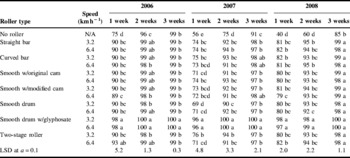
Interactions between years and rolling treatments were detected for rye termination rates (P<0.0001), so years were analyzed separately. In 2006, 1 week after rolling, highest rye mortality (98%) resulted when the smooth drum plus glyphosate was used at either speed (Table 1). Between 89 and 93% mortality resulted when the smooth drum and other roller types were used without herbicide. For non-rolled rye, the mortality rate was 75%. Two weeks after rolling, rye termination was 100% for the smooth drum plus glyphosate at both speeds, and at least 98% for the other roller treatments. Mortality for non-rolled rye was 96%. Three weeks after rolling, all rolling treatments resulted in at least 99% rye mortality.
Rye mortality (%) for roller types and operating speeds. The same letters indicate no significant differences within each column.

In 2007, 1 week after rolling, highest mortality (96%) was reported for the smooth drum with glyphosate at both speeds (Table 1). A lower mortality (69%) was reported for the smooth drum by itself at both speeds. The two-stage roller at 3.2 km h−1 and the straight bar roller at both speeds resulted in 76 and 74% mortality, respectively. Other roller types at both speeds caused rye mortality ranging from 71 to 74%. For the non-rolled rye control, mortality was 56%. Two weeks after rolling, 100% mortality was reported for the smooth drum plus glyphosate, and from 90 to 94% for roller treatments without herbicide. Mortality of non-rolled rye was 75%. Rye mortality was at least 97% 3 weeks after rolling.
In 2008, 1 week after rolling, mortality for the smooth drum with glyphosate was 98% at 3.2 km h−1 and 97% at 6.4 km h−1 (Table 1). Other roller treatments resulted in mortality rates between 79 and 82%. For non-rolled rye, the mortality rate was 40%. Two weeks after rolling, a 99% mortality rate was reported for the smooth drum plus glyphosate at 6.4 km h−1, and 98% at 3 km h−1. For rollers without herbicide, the mortality rate was between 92 and 95%. The mortality rate for the non-rolled rye treatment was 60%. The mortality rate was at least 98% 3 weeks after rye was rolled.
It should be noted that rye mortality was at least 90% by 2 weeks after roller treatments were imposed in each year of this study. Previous researchReference Ashford and Reeves1 suggests that this mortality rate was high enough for successful establishment of a cash crop into the rye residue. Our results suggest that cash crop seeding can proceed within 14 days of terminating a rye cover crop using the roller types evaluated in this study and under similar environmental conditions.
Volumetric soil moisture content
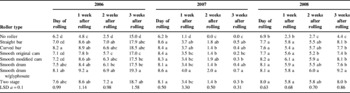
Interactions between years and treatments for VMC were detected (P=0.03), so years were analyzed separately. No significant differences in VMC occurred between operating speeds in any year on the four sampling dates, so VMC is reported for each roller type as an average across both operating speeds (Table 2). Volumetric soil moisture content varied from 6.2% for non-rolled rye to 8.2% for the curved bars roller on the day of the rolling operation in 2006. Even though VMC was measured on the same day after the rolling treatments were applied, there was a 6-h delay between when treatments were applied and when VMC was determined. The lower VMC for non-rolled rye might be associated with higher water evapotranspiration of living plants and a partially exposed bare soil surface compared with rolled rye, which created a residue mat (mulch) that provided complete soil protection after rolling and better conservation of soil moisture. Additionally, the mat formed by the rolled residue seemed to protect the soil from crusting and evaporation, and restrict weed emergence. Also, there probably was limited, if any, water and nutrient uptake by rolled plants, since stems were injured by the crimping action of the rollers.
Volumetric soil moisture content averaged over operating speeds (%) for roller types. Same letters indicate no significant differences within each column.

One week after rolling, VMC ranged from 7.8% for the smooth drum with the original cam to 9.2% for the smooth drum plus glyphosate (Table 2). Differences in VMC were not detected between other roller treatments. VMC was 4.8% and lower in non-rolled than rolled rye plots. Two weeks after rolling, VMC ranged from 5.7% for the smooth roller with the original cam to 7.2% for the two-stage roller. For non-rolled rye, soil moisture decreased to 2.5%, suggesting that rolled rye residue provided an effective surface cover. Three weeks after rolling, increased VMC (from 15 to 19.3%) across treatments was associated with a rainfall event prior to data collection.
In spring of 2007, a drought occurred in Alabama causing a severe soil moisture deficit, and in some locations complete soil–water depletion. The day of rolling operations, all rolled rye treatments kept VMC between 8.1 and 8.6%, whereas VMC for standing rye was significantly lower (6.2%) (Table 2). One week after rolling, the VMC for rolled rye residue measured between 3.4 and 4%, while for standing rye the VMC dropped to 1.1%. At 2 weeks after rolling, VMC was between 1.4 and 2% in rolled rye plots, and less than 1% (from 0.2 to 0.7%) at 3 weeks after rolling. During the drought period in 2007, at 2 weeks after rolling and beyond, VMC for non-rolled standing rye consistently measured 0%.
In 2008, VMC for standing rye on the day of rolling was 6.9% and was significantly lower compared with all rolled rye treatments, which ranged from 7.7 to 8.2%. No significant difference in VMC was found between the rolled treatments. One week after rolling, VMC was 2.3% for non-rolled standing rye compared with 5.4 and 6.1% for rolled rye, depending on the treatment. Similar to VMC measured at the day of treatment application, no significant difference in VMC was found between the roller treatments. Two weeks after rolling, the VMC was similar to that measured 1 week after rolling; VMC measured 2.7% for non-rolled rye and between 5.2 and 6.0% for rolled rye treatments. Three weeks after rolling, VMC ranged from 4.4% for standing rye to 9.2% for the smooth roller plus glyphosate treatment. The increase in VMC was associated with rainfall, which occurred after the second and before the third week after rolling. Data from 3 years were consistent and suggested that rolled residue protected the soil from moisture loss by creating a mulch effect. During the severe drought in 2007, the rolled rye residue cover provided effective surface mulch that limited evaporation for up to 1 week after rye termination.
Vibration
Roller frame vibration
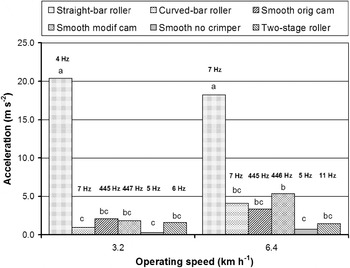
At both operating speeds, the straight bar roller generated significantly higher acceleration levels on the roller frame (18.2–20.3 m s−2) in comparison with the other roller designs (0.2–5.3 m s−2). Vibration generated by the straight bar roller was approximately ten times higher at 3.2 km h−1 and four times higher at 6.4 km h−1 in comparison with other roller designs. With increased operating speed, acceleration level on the roller frame did not increase significantly for all roller designs, although numerical values of acceleration were higher at 6.4 km h−1 than at 3.2 km h−1 (Fig. 7). With increased operating speed, there was no significant difference in acceleration level on the straight bar roller frame (20.3 m s−2, 3.5 Hz at 3.2 km h−1; and 18.2 m s−2, 7 Hz at 6.4 km h−1). The doubling in vibration frequency for the straight bar roller was most likely associated with the increased crimping frequency from the higher operating speed.
Vertical acceleration level (RMS) measured on the roller frame for different roller types and operating speeds. Different letters indicate differences between treatments within and across operating speeds. The same letters represent no significant differences between treatments, LSD=4.2 at a=0.1 of significance level.

Vibration frequency for the two-stage roller increased with increasing operating speed (i.e., 1.4 m s−2, 6 Hz at 3.2 km h−1, and 1.2 m s−2, 11 Hz at 6.4 km h−1), indicating an increase in crimping frequency for the two-stage roller. Vibration frequencies for the curved roller (7 Hz at both speeds) and for the smooth roller drum without crimper (5 Hz at both speeds) indicate an absence of vibratory crimping motion resulting in smoother operation. The smooth roller with the original and modified cam mechanisms exhibited very high vibration frequencies from 445 to 447 Hz. These high frequencies might be associated with the natural frequency of the crimping arm assembly from crimping against a non-uniform soil surface.
Newer roller designs generated substantially less vibration on the roller frame compared with the original straight bar. At 6.4 km h−1, the lowest acceleration level on roller frame was reported for the smooth roller drum and the two-stage roller, although no significant differences in acceleration were found between these two rollers, the curved roller and the smooth roller with the original cam mechanism.
Tractor frame vibration
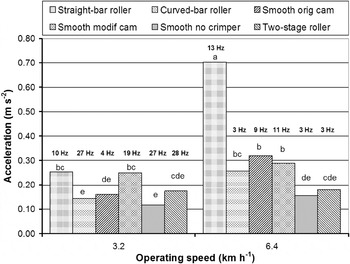
When comparing the original straight bar roller design with the other roller designs, there was a significant difference in acceleration level averaged over operating speed between straight bar roller and other roller types (P<0.01). With increased operating speed, the acceleration level measured on the tractor frame also increased. There was a significant difference in average acceleration level generated on the tractor frame of 0.17 m s−2 at 3.2 km h−1 and 0.30 m s−2 at 6.4 km h−1 (P<0.01). Specifically, the highest increase of 173% in acceleration level from 0.26 m s−2, 10 Hz, at 3.2 km h−1 to 0.71 m s−2, 13 Hz at 6.4 km h−1 was observed for the straight bar roller. Acceleration generated by this roller at 6.4 km h−1 was significantly higher compared with other rollers. This level of vibration is classified by ISO No. 2631-1 standard13 as ‘fairly uncomfortable’ to the operator. The level of acceleration generated on the tractor frame by the straight bar roller also exceeded health limits established by Australian StandardsReference Mabbott, Foster and McPhee14. A significant increase in acceleration of 99% was also observed for the smooth roller with the original cam mechanism 0.17 m s−2, 4 Hz at 3.2 km h−1 and 0.32 m s−2, 9 Hz at 6.4 km h−1. The doubling in vibration frequency by this roller was most likely associated with crimping frequency of the crimping arm (Fig. 8).
Vertical acceleration level (RMS) measured on the tractor frame for each roller type and operating speed. Different letters indicate differences between treatments within and across operating speeds. The same letters indicate no significant difference between treatments, LSD=0.085 at a=0.1 of significance level.

At 3.2 km h−1, vibration frequencies for the curved roller, the smooth roller drum and for the two-stage roller ranged from 27 to 28 Hz. Because acceleration levels measured on the tractor frame with these rollers were low (0.14–0.17 m s−2), the recorded frequencies could be associated with the engine vibration frequency at 1700 rpm (28.8 Hz) rather than with roller vibrations. In contrast, vibration frequencies for these three rollers at 6.4 km h−1 were lower (3 Hz) and most likely were associated with roller vibrations that were transferred to the tractor frame. The lowest acceleration levels on the tractor frame at 6.4 km h−1 were generated by the smooth drum (0.16 m s−2, 3 Hz) and the two-stage roller (0.18 m s−2, 3 Hz). No significant difference in acceleration level due to increased speed was found for the smooth roller drum without crimper, smooth roller with modified cam mechanism and the two-stage roller. Overall (except for the straight bar roller), the new roller designs generated from 0.12 to 0.32 m s−2 on the tractor frame (classified by ISO13 as a ‘little or not uncomfortable’). These acceleration levels were also below health limits established by Australian standardsReference Mabbott, Foster and McPhee14.
Summary and Conclusion
All tested roller designs resulted in at least 98% mortality of rye plants 2 weeks after rolling in 2006, 90% in 2007 and 92% in 2008. A relatively minor but sometimes statistically significant increase in rye mortality resulted when roller use was combined with the application of glyphosate and termination was evaluated 2 weeks after rolling. By comparison, mortality of non-rolled standing rye was 96% in 2006, but only 75% in 2007 and 60% in 2008. The speed at which rolling occurred did not affect the rye mortality rate. These results indicate that a rye cover crop can be terminated effectively within 14 days when rolling is delayed until the early kernel formation stage of reproductive growth.
Increasing the rolling operating speed did not affect VMC. Generally, rolled rye provided better protection in preserving soil moisture compared with non-rolled standing rye. In 2007, when a severe drought condition occurred, rolled rye residue effectively protected soil from losing moisture up to 1 week after rolling, whereas soil water depletion was virtually completed in non-rolled standing rye. In 2 of 3 years (with the exception of 2007 when a severe drought occurred), rainfall occurring after 2 weeks following rolling was adequate to replenish soil moisture enough for the planting operation to occur.
At both operating speeds, the straight bar roller generated significantly higher acceleration levels on the roller's frame (18.2–20.3 m s−2) in comparison with other roller designs (0.2–5.3 m s−2). At 6.4 km h−1, significantly lower acceleration levels on the roller frame were reported for the smooth roller drum and the two-stage roller compared with the smooth roller with modified cam mechanism and the straight bar roller. The lower vibration generated by the two-stage roller might be attributed to an effective isolation of the drum with crimping bars from the roller frame using rubber isolators.
With increased operating speed, the highest acceleration increase on the tractor frame was recorded with the straight bar original design, compared with newer roller designs. At 6.4 km h−1, acceleration level (0.7 m s−2) generated by the straight bar roller was classified as ‘fairly uncomfortable’ by ISO standards for vibration exposure and exceeded the health limit based on Australian standards. At both speeds, acceleration levels for newer roller designs were below comfort and health limits established by International standards.
Overall, all roller designs effectively terminated rye. Speed did not affect mortality and VMC, but did increase vibration levels on the tractor frame. Compared with the original straight-bar roller, the new roller crimper concepts (especially the curved and the two-stage roller) significantly reduced vibration both on the tractor's and roller's frames, while maintaining or exceeding mortality provided by the original straight bar roller design. Additional research is needed to determine the effectiveness of different roller designs in terminating cereal cover crops at their different (earlier) growth stages to select the best roller design.
Disclaimer
This manuscript has not been published elsewhere and it has not been submitted for publication elsewhere. The use of trade names or company names does not imply endorsement by the USDA-Agricultural Research Service.
Acknowledgement
We acknowledge Mr Dexter LaGrand and Mr Eric Schwab for their technical assistance.