Introduction
On the evening of October 29, 2012, Hurricane Sandy made landfall in New York City and the surrounding areas. Although city and state personnel made efforts to prepare for this “superstorm,” the heavy rain and gale-force winds led to widespread problems in the city, including power outages, flooding, and closures of bridges and tunnels, suspension of public transportation, as well as closure and emergency evacuations of health care facilities.Reference Redlener and Reilly 1 , Reference Davies 2 These situations caused major disruptions in the daily lives of New York residents, especially in vulnerable populations, such as the elderly and people with multiple comorbidities.
One vulnerable population known to be affected was patients with chronic renal failure requiring hemodialysis (HD).Reference Abdel-Kader and Unruh 3 The HD patients were greatly impacted by the storm since they had to travel to dialysis centers in severe weather to receive their treatments three times a week. During Hurricane Katrina in 2005, many dialysis services located in New Orleans (Louisiana USA) were disrupted, and many dialysis centers were forced to close.Reference Kleinpeter, Norman and Krane 4 As a result, close to 50% of the dialysis patients missed dialysis sessions.Reference Anderson, Cohen, Kutner, Kopp, Kimmel and Muntner 5 These missed treatments did not have a significant impact on the mortality of HD patients during this event.Reference Kutner, Muntner and Huang 6 Nonetheless, as a result of the missed sessions, these HD patients were adversely impacted with morbidities including hypertensive emergencies, electrolyte imbalance, fluid overload, and respiratory failure, and the hospitalization rate due to missed dialysis was increased.Reference Anderson, Cohen, Kutner, Kopp, Kimmel and Muntner 5 - Reference Howard, Zhang, Huang and Kutner 7 All of these may result in long-term deleterious effects.Reference Saran, Bragg-Gresham and Rayner 8
It has been reported that over 133 dialysis facilities, and more than 11,000 dialysis patients, were in the path of Hurricane Sandy in the states of New York and New Jersey (USA). 9 Closures of free-standing dialysis centers due to flooding and power outage forced HD patients to seek dialysis treatments elsewhere. 9 These patients are termed “transient HD patients” because they were able to return to their usual dialysis facilities once they were operable. 9 Many of these transient patients presented with or without complications to hospital emergency departments, where they were assessed and then referred to hospital dialysis units. As a result, this created patient surge in the emergency departments and hospital dialysis services during and after the storm.
The aims of this study were to determine the extent of transient HD patient surge in hospital dialysis units from closed dialysis facilities during the storm and its immediate aftermath, to explore difficulties encountered by hospital dialysis services in dealing with the patient surge in the setting of severe weather conditions, and to identify effective methods for increasing surge capacity of hospital dialysis services.
Methods
Study Design
A retrospective survey of hospital-based dialysis services was conducted in the borough of Brooklyn, four months after Hurricane Sandy made landfall on October 29, 2012.
Participants
Sixteen hospital centers with dialysis services were identified in the borough of Brooklyn. All 16 hospitals have inpatient dialysis units, and five of these hospitals have affiliated outpatient dialysis centers nearby that received extra dialysis patients during the event. Permission to conduct the survey was requested from each hospital administration office, chief nursing officer, chief renal physician, or institutional review boards (IRBs). After permission was granted, the nurse manager of each hospital dialysis unit was asked to participate in the study and to answer a questionnaire.
Sample Size
In order to minimize selection bias and maximize the validity of this study, the required sample size was calculated with a confidence level of 95% and a five percent margin of error; the result was 15 hospitals. This sample size was achieved in this study.
Questionnaire
A questionnaire (Appendix, online only) was developed following an in-depth interview two months after the storm with the dialysis unit nurse manager of one Brooklyn hospital, regarding the experience of the unit during Hurricane Sandy. The questionnaire was reviewed by the department research members who were not involved in this study, as well as the IRB to minimize leading questions. A pretest survey was administered to two of the study hospitals. Modifications were made and the actual survey was conducted four months after Hurricane Sandy.
There were four main parts to the questionnaire: 1) the normal operating state of the dialysis unit, which included questions regarding the average number of patients dialyzed per day in the unit, number of dialysis machines in-use and for backup, and the normal operating hours of the unit; 2) the activation of emergency plans, which recorded the date of emergency plan activation and the methods for increasing surge capacity of the unit (options for increasing surge capacity included shortening treatment time, extending operating hours, using extra dialysis machines, and having extra staff); 3) the number and the outcomes of the transient HD patients, defined as HD patients who were unable to have dialysis in their usual chronic facilities and had to present to hospitals for dialysis October 28 through November 5, 2012 (this part asked about the total number of transient HD patient dialysis sessions performed overall and per day, whether patients brought any treatment documentation for dialysis, methods used to determine the treatment regimens if the patients did not have treatment documentation, and the number of these transient patients who were admitted to the hospital due to renal complications such as hyperkalemia, hypertension, fluid overload, seizure, and death); and 4) difficulties in staffing, transportation, and communication encountered by the dialysis units during the storm (this section explored staff shortages, staff and patient transportation difficulties, and communication gaps between the dialysis unit and external facilities and agencies, such as freestanding dialysis centers and the official organizations (eg, the End-stage Renal Disease (ESRD) Network (Lake Success, New York USA) and the New York City Office of Emergency Management (OEM, Brooklyn, New York USA)).
Data Analysis
The number of transient HD patients presenting to each hospital dialysis facility was recorded for all the participating hospitals. The transient HD patient count was then grouped according to hospital locations: Northwestern, Northern, Central, Southwestern, and Southern Brooklyn regions.
Parts of the questionnaire, such as early emergency plan activation, methods of increasing surge capacity, dialysis treatment documentation, transportation, staffing, and communication difficulties, contained binary or categorical answers, and the results were expressed as percentages of all the participating hospital dialysis facilities.
To detect possible differences in population and in transient HD patient counts among the five geographic regions, the population per region was estimated from the 2010 New York City Census 10 and was divided by the number of hospitals in the region to calculate the average population served by a hospital in the region. Furthermore, one-way analysis of variance (ANOVA) was performed on the number of transient HD patients accommodated and the number of patients admitted secondary to renal complications in the five regions. When differences were detected (P < .05), pair-wise comparisons were performed by using Bonferroni correction.
Finally, to determine the factors that led to the increased surge capacity for dialysis units, a linear regression model was used. The number of transient HD patients accommodated in a particular hospital was used as the response variable, as it is an indicator of surge capacity. Possible factors, such the average number of patients dialyzed in the center per day in nondisaster settings, early emergency plan activation, the ability of affiliated outpatient dialysis to share the patient load during disasters, shortened dialysis treatment duration, extended operating hours, utilization of extra dialysis machines, and having extra staff or overtime, were used as independent variables. One hospital dialysis facility was excluded in this analysis due to evacuation. Statistical analysis was performed by Stata/IC 12 (StataCorp LP, College Station, Texas USA).
Results
Fifteen of the 16 (93.75%) Brooklyn hospital dialysis services completed the questionnaire. The remaining one hospital center did not respond to the survey. Thirteen of these 15 Brooklyn hospitals received transient HD patients during Hurricane Sandy and its aftermath. Five of these hospital dialysis centers had affiliated outpatient centers that shared the load of transient HD patients. One hospital was closed due to flooding, and one hospital inpatient dialysis unit did not have the capacity to receive transient HD patients. Four of the five geographic regions have three hospitals; Central Brooklyn has four hospitals. The nonparticipating hospital was in the Southern region.
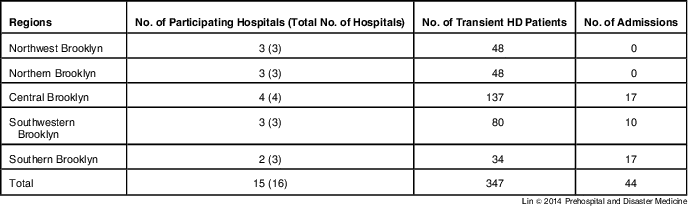
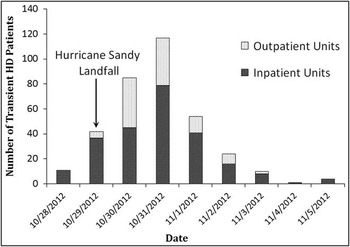
The dialysis facilities reported the average daily number of inpatient dialysis sessions performed, prior to Hurricane Sandy, as the indicator of their usual capacities. The numbers ranged from six to 30 sessions per day, with a total of 214 sessions per day throughout all 15 participating inpatient services (an average of 14.3 sessions per service, per day). This usual demand consisted of patients who had already been admitted to the hospital and required urgent dialysis as part of the presenting illnesses or required routine dialysis for end-stage renal failure. In addition, there was no report of patients who would fall into the definition of transient HD patients presenting to these services during nondisaster periods. As Hurricane Sandy approached, transient HD patients started presenting to the hospitals. In total, 347 transient HD patient sessions were performed in the 13 receiving hospitals in Brooklyn during this event (Table 1). The transient patient influx started on October 28, 2012, before landfall. It rapidly increased after landfall on October 29th, and reached the peak on October 31st. Subsequently, the influx gradually decreased in the first week of November (Figure 1).
Number of Transient HD Patients Presenting to Hospital Dialysis Facilities and Percentages of Surge Compared to Normal Capacities, by Region and Total

Abbreviation: HD, hemodialysis.
Transient HD Patients Who Received Dialysis Treatment in Inpatient Units or Hospital-affiliated Outpatient Centers in Brooklyn, New York USA, by date. Abbreviation: HD, hemodialysis.

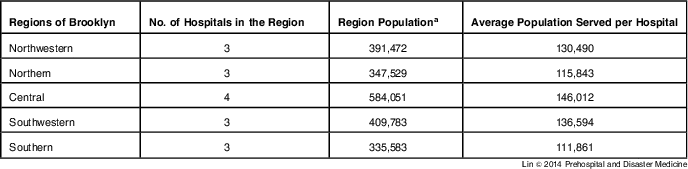
Regionally, Central Brooklyn hospitals performed 137 transient patient dialysis sessions (Table 1), which was the highest number of patients received across all five geographic regions. Southern Brooklyn performed 34 transient patient sessions, which was the lowest number of patients received in any of the five geographic regions. Central Brooklyn had the highest average population per hospital (146,012), while Southern Brooklyn had the lowest (111,861) (Table 2). Although the regional difference between the highest and lowest average populations served per hospital and the number of transient HD patients that received hospital dialysis treatments in the five regions seem large, there was no significant difference in the average number of transient HD patients per hospital among the regions (one-way ANOVA P value = .75). Similarly, there was no significant difference in the number of transient HD patients admitted with renal complications among the five regions (one-way ANOVA P value = .37). Therefore, for the purposes of this study, it was assumed that there was no significant difference in the characteristics of these transient HD patients throughout the five regions, and that the amount of transient HD patients presented for dialysis was proportional to the number of hospitals in all five regions.
Population Per Region and the Average Population Served Per Hospital

a Population data from New York City, New York USA census 2010; Retrieved April 11, 2013.
When a transient HD patient arrives in a hospital dialysis facility, the staff needs to determine the dialysis treatment regimen, such as amount of fluid to remove. Of the 13 receiving dialysis facilities, 12 (92.3%) reported that the majority of these transient HD patients did not have documentation on the details of their usual treatment details and hepatitis status. In this setting, self-reported information (83.3%), laboratory tests (83.3%), information from usual facilities (33.3%), and previous hospital records (25%) were used in order to determine their treatment regimens.
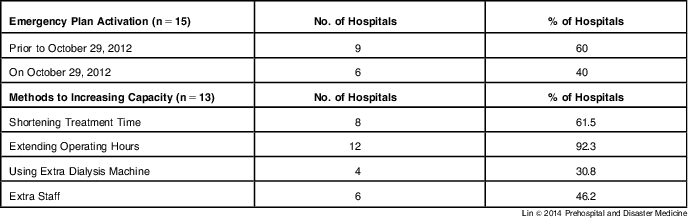
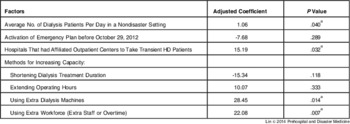
The ability for a hospital dialysis facility to increase surge capacity can be measured by the amount of transient HD patients dialyzed in the facility during this event. On the peak day, the inpatient dialysis units that received transient patients, on average, took 50.9% more patients than they usually dialyze per day in a nondisaster setting. Two hospitals had to redirect transient HD patients to other facilities because their inpatient units reached the maximum capacity. During the peak day on October 31st, there were 117 transient patients presenting to the 13 dialysis units in total. This equated to an average of an additional nine sessions per dialysis unit, a 150% increase in demand in smaller units with the usual demand of six sessions per day, and a 30% increase in larger units with the usual demand of 30 sessions per day. The methods used by these hospital dialysis facilities to increase surge capacity included early activation of emergency plans prior to the date of landfall, shortening treatment time from four to five hours to three to three and a half hours, extending operating hours of the dialysis units, using extra dialysis machines that the units have, and utilizing extra staff, such as nurses and technicians (Table 3). The factors that significantly enhanced surge capacity included the normal capacity of the facility, indicated by the average number of dialysis patients per day during a nondisaster setting (P = .040), having affiliated outpatient dialysis centers that shared the patient load (P = .032), utilization of extra dialysis machines (P = .014), and having extra workforce, such as extra staff or overtime in existing staff (P = .007) (Table 4). Activating the emergency plan before the day of landfall (P = .289), shortening dialysis treatment duration (P = .118), and extending operating hours (P = .333) did not significantly affect the surge capacity in this linear regression analysis. To assess the independence of having extra dialysis machines and having extra workforce, an interaction term was generated and computed, which showed no statistical significant interaction between these two factors (P = .509).
The Timing of Emergency Plans Activation and the Methods Used to Increase Surge Capacity of the Facilities

Multiple Linear Regression for Determining Factors that Allowed Hospitals to Increase Surge Capacity

a P < .05.
During the storm, the dialysis units experienced difficulties that prevented the units to function efficiently. In the 14 operating hospital dialysis facilities, including the hospital with no extra capacity to receive transient HD patients, seven (50%) reported shortage of staff during the event. Staff of 10 (71.4%) dialysis facilities reported that reaching the facilities was an issue, and they had difficulties with driving their own cars (80%), riding the subway (50%), and riding the bus (40%). Five (35.7%) facilities reported that staff had to stay overnight in the facilities due to transportation difficulties. Furthermore, transportation for patients who had dialysis in these hospital facilities was challenging. All five affiliated outpatient dialysis centers reported difficulties communicating with ambulette service providers; this resulted in delays in transferring patients from the emergency departments to several outpatient facilities, and bringing dialysis patients to and from their residences. Finally, hospital dialysis facilities raised an issue that communication with other organizations or agency also was challenging. Eight (53.3%) of the 15 participating facilities were unable to get required information from free-standing dialysis centers due to the closure of many centers, and two (13.3%) facilities had trouble receiving updated information or requesting resources from the official organizations, such as the New York City OEM.
Discussion
Hurricane Sandy brought disruptions to the routine dialysis services provided to HD patients. As a result, HD patients in the affected areas sought alternative treatment locations in hospitals.Reference Jangi 11 , Reference Evans, Carlson, Barr, Kutscher and Zigmond 12 The “epidemic curve” of the 347 transient HD presentations (Figure 1) indicated that the transient HD patients started presenting to hospitals before the hurricane landfall, and the presentations increased sharply immediately after the landfall. The early presentations before the landfall were likely due to planned closures of chronic dialysis facilities, such as free-standing clinics and hospital outpatient centers, where flooding and transportation difficulties were predicted. The trend of transient HD presentations throughout this event suggests that hospital emergency departments and dialysis services should be prepared for an early surge of transient patients before the hurricane landfall, as well as the maximum surge immediately after.
The surge capacities of the dialysis services at receiving hospitals determine the number of transient HD patients they can receive without overwhelming the system. Significant factors, such as a larger inpatient unit capacity, having affiliated outpatient dialysis centers, having extra dialysis machines, and having extra workforce, understandably produce better surge capacities by offering more dialysis space and treatment opportunities for transient HD patients. The extra dialysis machines were mostly operated in the units with extra staffing during Hurricane Sandy, but there were circumstances in which dialysis units had to operate more machines with the same level of staffing. Therefore, these two factors could be regarded as independent factors, and this was supported by the results of the statistical analysis in this study.
Early activation of dialysis emergency plans and shortening dialysis treatment time did not necessarily improve surge capacity in hospital dialysis services. One possible explanation is that, before the landfall, the actual patient surge was small compared to the capacity created by the early emergency plan activation. With the method used in estimating the surge capacity in this study, this data does not reflect the actual surge capacity in the prelandfall period. Additionally, recent literatureReference Lacson and Brunelli 13 , Reference Marshall, Byrne, Kerr and McDonald 14 showed lower mortality rates in HD patients receiving four or more hours of treatment, indicating the usefulness for further examination of the significance and necessity of shortening dialysis treatment time in disaster settings.
These significant factors identified can be used in determining potential improvements for hospital dialysis services to increase surge capacity. Possible short-term solutions include developing mutual relationships with nearby freestanding dialysis clinics for patient transfer and staff credentialing to maximize the size of the dialysis facility, and preparing emergency roster plans for dialysis staff in advance to ensure adequate or extra dialysis workforce. Long-term solutions might include expanding inpatient dialysis units and purchasing extra dialysis machines in order to increase the physical capacity of the dialysis facilities.
Patient identification and essential medical information, such as dialysis prescription and hepatitis status, are critical for the receiving dialysis facilities to increase efficiency in treating transient HD patients, as this information streamlines the treatment by reducing waiting time for blood tests, contacting patients’ usual facilities, and disinfecting machines for patients with unknown hepatitis status. Despite recommendations by the Centers for Medicare & Medicaid Services (Baltimore, Maryland USA) and the Kidney Community Emergency Response Coalition (Lake Success, New York USA) that chronic dialysis facilities provide this information for their patients, 15 , Reference Kopp, Ball and Cohen 16 the majority of the transient patients lacked this information when presenting to the receiving hospital dialysis services during Hurricane Sandy. In this study, the reasons for transient HD patients not presenting with dialysis prescription or medical information were not able to be identified. This would require further detailed surveying of HD patients and chronic dialysis facilities staff to determine the obstacles to following this recommendation.
Difficulties in three main areas in communication were experienced by the hospital dialysis services during this event. First, due to the closure of many freestanding centers and the lack of backup contact methods, many inpatient dialysis units could not contact freestanding dialysis centers through landline phones for patient information. This led to extra steps for determining dialysis treatment regimens for transient HD patients, and hence, delays in receiving their treatments. Second, the hospital dialysis services, especially the ones with affiliated outpatient dialysis centers, experienced difficulties requesting ambulette services for patient transport from the emergency departments to the outpatient centers for treatments, or between hospitals and patients’ homes, due to reduced availability of ambulettes from private providers. Third, the incident command centers of a few hospitals encountered communication issues with city agencies or organizations, such as the Emergency Operations Center (EOC) and the Health Facility Evacuation Center (HEC) at the city OEM through landline phones and radio-frequency devices. The issues included inconsistent information and lack of updates on incoming dialysis patients transferred from other health facilities, as well as delays in or absence of response to hospitals’ transportation requests within the city's multi-agency incident command system. These issues could be addressed by developing an electronic patient tracking system for the HEC and by improving information coordination among the multiple agencies in the EOC.
Limitations
Limitations of the current study include possible sampling bias and the weakness of the retrospective study method. The nonparticipation of the Southern Brooklyn hospital may have affected the regional comparison, as well as the analysis of the surge capacity factors, as the hospital may have received many transient patients due to the closure of another hospital in the same region. Additionally, a few hospitals provided limited HD in their emergency departments, and therefore, these transient patients were not included in the dialysis unit registry. The retrospective study method potentially could include confounders and recall bias, and hence, have affected the validity of the analysis. Further studies focusing on prestorm comparisons of these surge capacity factors in various hospital dialysis services, and analysis including emergency departments and hospital dialysis units in a wider geographic area, would be helpful to minimize these limitations. Moreover, due to limited resources, it was difficult to obtain data from all freestanding dialysis centers in Brooklyn regarding the length of closure, the number of regular HD patients they served, and the preparedness level of the dialysis centers. This information may have provided the explanation of the different numbers of transient patients presenting to the hospitals.
Conclusion
Hurricane Sandy greatly stressed the dialysis system in Brooklyn, New York with numerous closures of freestanding dialysis centers and the influx of HD patients to nearby hospitals for routine dialysis. Problems in patient identification, staffing, transportation, and communications were reported. Significant factors for enhancing surge capacities, such as larger usual capacity, affiliated outpatient dialysis centers, extra dialysis machines, and extra workforce, were identified. These factors s provide potential improvement options for hospital dialysis facilities to consider in preparation for future events.