It has been named a heritage revolution, a heritage crusade, the ascent of history, and a heritage revival. These trendy expressions signify one and the same phenomenon: the growing significance attributed to our valued past. Growth has recently been witnessed in both interest and concern for heritage, as expressed by a variety of groups such as local communities; governments; academics; owners; business entities; developers; tourists; and others identified as heritage stakeholders, users, or markets of heritage. To this increased number of people “having share in heritage now,” Lowenthal attributes the so-observed “heritage expansion” and its “ubiquitous reach,” because heritage is increasingly perceived as human centered, socially constructed, more of a public than a private good, and a common legacy belonging to all mankind.1
Lowenthal, The Heritage Crusade, 10, 3.
The increase in heritage-interested groups has brought a growing number of viewpoints, opinions, definitions, and attitudes to heritage, which has further complicated its concept and field of study and increased the number of relevant issues to deal with in theory as well as practice. The new reality has necessitated the birth of heritage studies, another multidisciplinary field exploring the impact of heritage on the present, and the development of new holistic approaches to address the complexities and challenges related to heritage. However, cultural heritage still “lacks a strong disciplined presence and correspondingly an agreed framework of reference and research,” which can be considered a problem of critical importance in the field.2
Pearce, “The Construction and Analysis,” 4:1.
Focusing in this particular direction, the article makes space for the future establishment of such a conceptual framework on the basis of evaluating and integrating various perspectives. It suggests an updated and expanded vision of heritage3
The terms heritage and cultural heritage are used synonymously throughout the article for readability.
THE EVOLVING CULTURAL HERITAGE CONCEPT
The concept of heritage is susceptible to change and is actually changing. The new environment and developments in heritage coupled with a variety of other societal factors have contributed toward the evolution and expansion of the cultural heritage concept in both scope and direction. Heritage is increasingly described as an evolutionary notion, possessing a multifaceted construct, with dynamism, complexity, and multiplicity as its primary features.
Defining Heritage
Starting from its very definition, plenty of examples prove the many existing interpretations, tensions, and subjectivity in searching for a more precise definition for heritage. The vague label all things to all people and the general lack of an accepted theory and ethic in heritage conservation are considered significant problems in heritage planning.4
Larkham, “Heritage as Planned and Conserved,” 85.
Graham, “Heritage as Knowledge,” 39:1004.
In regard to definition, heritage practitioners most often rely on broad descriptive demarcation of heritage, accounting for its many categories. UNESCO6
The Difficult Types of Cultural Heritage at UNESCO Culture Portal, available at 〈www.unesco.org/culture/heritage〉, accessed August 17, 2005.
- Cultural Heritage Sites
- Historic Cities
- Cultural Landscapes
- Natural Sacred Sites
- The Underwater Cultural Heritage
- Museums
- The Movable Cultural Heritage
- Handicrafts
- The Documentary and Digital Heritage
- The Cinematographic Heritage
- Oral Traditions
- Languages
- Festive Events
- Rites and Beliefs
- Music and Song
- The Performing Arts
- Traditional Medicine
- Literature
- Culinary Traditions
- Traditional Sports and Games
Furthermore, many other interpretative definitions focus on different aspects of heritage. An illustration can be found in the chapter titles of the recent books on heritage where it is correspondingly examined in a spatial context (in relation to place, leisure, and tourism), as historical reality, literary place, national identity, planned and conserved, informal and formal education, business, and finally design.7
Herbert, Heritage, Tourism and Society.
Merriman, Beyond the Glass Case, 8.
Dynamism and Elasticity of the Concept
Yet instead of going deeper into defining heritage, I will focus on several representative features of the heritage concept that can serve as markers in its substantive outlining and support further argument for conceptual revision. The most typical features are dynamism and elasticity. The definition of what makes up heritage is said to be “elastic” at its broadest, including “anything inherited from the past,” and at its narrowest comprised of items of historic or cultural significance, as judged by heritage experts and professionals; it is also referred to as a “dynamic phenomenon growing and changing its structure over time” or “continuous process during which new meaning and values are always being discovered.”9
Throsby, Economics and Culture, 75; Murty and Suchetam, Cultural Heritage: A Fusion, 1.
Daher, “Dismantling a Community's Heritage,” 105–28; Harvey, “Heritage Pasts and Heritage Presents,” 7:320.
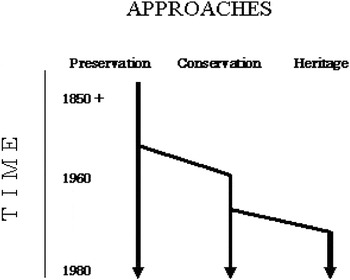
Dynamism and elasticity of cultural heritage are not new aspects and can be traced through time following the different periods of its conceptual development. The last is illustrated in the scheme provided by Ashworth and Larkham, who even in a limited temporal dimension well summarize the changing approaches toward heritage (Fig. 1).

Steps in the evolutionary process: historical monument to heritage product.
The preservation approaches dominant in the first hundred years (1850–1960), when the objects of preservation were separate artifacts and buildings from the past, are gradually replaced by bigger entities like ensembles and whole areas, including their modern functions as well. Thus, the conceptual focus has switched to conservation, defined by Burke in 1976 as “preserving purposefully.” Heritage represents the final contemporary perception in this evolution, where the relics of history are already perceived as products, formed as a result of selection, inevitably including the respective consumer demand toward them. The latter process is known as “the commodification of the past,” in which various “heritage products” intended for consumption by already specified markets are being purposefully created or “assembled” through “interpretation and packaging” out of the existing stock of “heritage resources.”11
Ashworth and Larkham, Building a New Heritage, 16.
Tunbridge and Ashworth, Dissonant Heritage, 20.
In fact, it is this dominant and persistent, constantly updated, contemporary link in the modern perceptions of heritage that has defined it first as a product of the present with an unbounded capacity to grow and expand; and it further complicates attempts for a clearer and comprehensive conceptualization of heritage. Rather, it presumes the continuous and ongoing evolution in the heritage conceptual development.
Multiplicity and Dissonance
Multiplicity is another often-discussed feature of cultural heritage that can be observed in different aspects. First, it may refer to the mere notion of heritage, which so far has significantly broadened in meaning and range and is further expanding. Already in 1979, with the launching of the Heritage Year in France, the French Minister for Culture and Communication Jean-Philippe Lecat proclaimed a new inclusive vision of heritage: “Heritage is no longer cold stones or the glass separating us from exhibits in a museum. It is also the village lavoir, the little country church, local dialects, the charm of family photos, skills and techniques, language, written and oral tradition, humble architecture.” His view was later restated by France's former President Valerie Giscard D'Estaing: “[Cultural heritage] embraces everything that human effort has left us during the course of history, music, dance and song, literature and folk customs, paintings and archives—in short, everything that bears witness to humanity down the path of time.”13
See Poirrier, “Heritage and Cultural Policy in France,” 9:219.
To more precisely and descriptively outline the broad definitional scope of cultural heritage, scholars have identified several different heritage areas: landscapes, monuments, artifacts, people, and activities, which can be further subdivided into secondary categories. For example, heritage can be classified as built heritage (historic cities, cathedrals, monuments, castles), living cultural heritage (people, fashions, foods, customs), industrial heritage (industries and activities typical of a region or place, like coal mining, lumber, textiles, etc.), personal heritage (regional aspects that have value and significance to individuals or groups of people, like personal objects, cemeteries, religious sites, etc.), or the so-called dark heritage (places of war, wartime relics, etc.).14
See Timothy and Boyd, Heritage Tourism, 3.
Apart from the definitional scope of heritage, multiplicity is also typical of some other dimensions of the complex heritage construct, such as scales (world, national, local, and personal), sectors of involvement in heritage conservation and development (international, public, private, voluntary, professional, and amateur), and markets or users of heritage (owners, locals, governments, visitors, and academics).15
Ashworth and Howard, European Heritage Planning and Management, 16, 30, 60.
Multiplicity growing into contestation and conflict is a theme conceptualized as the theory of heritage dissonance. Dissonance is said to be “intrinsic to the nature of heritage”; and rather than an “unforeseen and unfortunate by-product of the heritage assembly process,” it should be regarded as an “inevitable” part of a “system where selection is unavoidable.”16
Tunbridge and Ashworth, Dissonant Heritage, 21.
Graham, Ashworth, and Tunbridge, A Geography of Heritage, 22.
The preceding discussion briefly outlined the heritage matrix with its multiple dimensions, agents, interactions, and intrinsic dissonance. Although it is an elaborate and difficult formation to balance and maintain in harmony, nevertheless, it seems wiser to agree with the argument that still “most heritage, most of the time, and for most people [should be] harmoniously experienced, nondissonant and an essential enrichment of their lives.”18
Graham, Ashworth, and Tunbridge, A Geography of Heritage, 26.
THE FUNCTIONAL HERITAGE
Currently, heritage is often identified as “the contemporary purposes of the past” or “that part of the past that we select in the present for contemporary purposes, be they economic, cultural, political or social.”19
Graham, Ashworth, and Tunbridge, A Geography of Heritage, 2.
Graham, Ashworth, and Tunbridge, A Geography of Heritage, 17.
The following text demonstrates that the concept of heritage evolves in accordance with the changing needs and demands people convey toward it and that there is a clear omnipresent move toward a people-centered, functional approach in regard to heritage.21
The use of the term functional differs from the known functionalism perspective in anthropology; and it is closer to the anthropological semiotic conception of culture, where culture is perceived not so much as “things” but as “symbolic processes.” Hence, the cultural links to the past, rather than being “physical” are conceived as “semiotic,” existing “only in the present and only within present day semiotic activities.” Handler, “Cultural Property,” 3:355.
From Monuments to People
With the democratization of culture and its newly expanded socioanthropological definition (according to which almost every human activity can be equally cultural, and where every human product can be equally worth preserving) the distance between cultural heritage as monuments and people as its creators, guardians, and users has been significantly reduced. Making a point for “a heritage of transience,” and against the historically dominant, outdated “cult of the [objectified] monument,” heritage practitioner Miles Glendinning notes that the recognition of heritage as a “social construction” and “a testament to change” rather than a symbol of material endurance allows us to see it “with a new lightness.”22
Glendinning, “Beyond the Cult of the Monument,” 70:15.
Turpenny, “Cultural Heritage, an Ill-defined Concept?” 10.
Graham, “Heritage as Knowledge,” 39:1003, 1006.
Merriman, Beyond the Glass Case, 1991.
Indeed, cultural heritage has gradually gained the attribution of a surprisingly wide variety of contemporary human values, thus predetermining the aforementioned shift in its conceptual development. Heritage is identified as such “only because its heritage quality is valued by the contemporary generation, both for itself and for passing on to the future.”26
Lichfield, Economics in Urban Conservation, 167.
Clark and Drury, “From Monuments to People,” 114.
Clark, “From Regulation to Participation,” 104.
Bender, “Time and Landscape,” 43:S103.
Meskell, “Negative Heritage,” 75:558.
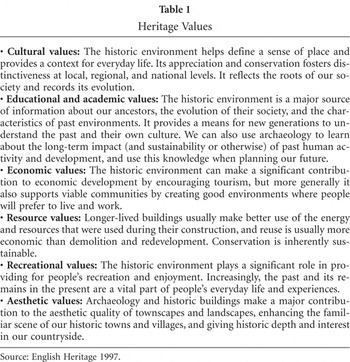
Four main areas of heritage values or significance are commonly recognized: economic, social, political, and scientific. English Heritage is the government agency responsible for all aspects of the historic environment in England. One of its key documents from 1997, Sustaining the Historic Environment, accounts for a richer specter of values that can be attributed to heritage, broadly defined as “historic environment” (Table 1).
Heritage Values

Another important trend worth mentioning in the attributed significance grows out of the newly ascribed links between cultural heritage and sustainable human development, which by definition has its philosophy rooted in the reconciliation between conservation and development goals and the better balance between economic, social, and environmental aspects of development. In this context the meaning of heritage expands even further to be conceived as an “integral part of the environment,” contributing to “human well-being,” and becoming an important indicator of the “quality of life.” With the acknowledgement that the environment has an inherent cultural dimension inseparable from nature, conserving the natural environment and cultural environment are logically considered parts of the same process. Hence, the emphasis in conservation has accordingly shifted from “the conservation of discrete monuments in isolation to the sustainable management of towns, cities and landscapes as a whole.”31
See Clark and Drury, “From Monuments to People,” 114.
Although traditionally the preservation of cultural heritage was deprived of any social meaning and largely an objective in itself, now it is boldly redefined as an “essential tool for making concrete the global objective of sustainable development of society, at the economic, social and environmental level.”32
Pickard, European Cultural Heritage, 90.
Greffe, Arts and Artists, 163.
Pendlebury, Townsend, and Gilroy, “The Conservation of English Cultural Built Heritage,” 10:11.
Loulanski, Cultural Heritage in the Context of Sustainable Development, 2005.
It is beyond the scope of this article to investigate and fully describe the wide-ranging, value-based diversity of heritage. Rather, it is important to accept the implication that it is necessary to be aware and recognize the coexistence of these simultaneous values and be flexible in adopting different perspectives, rather than simply claiming greater significance of one at the expense of another.
From Objects to Functions
It must be acknowledged that the aforesaid human-centered view has become influential just recently and has not traditionally been the lingua franca in the field of heritage protection. Understandably, it can be rather uncomfortable and is actually contested by scholars who focus on the primacy of the heritage object, considering that it has a value existing independently of people that should not be susceptible to any change. In this regard, for a more accurate positioning of the previously presented thesis, it is necessary to mention the existence of two different academic streams that totally conflict on the concept of heritage protection: object-centrism versus functionalism.
Muller provides a concise discussion on both sides' arguments. Although object-centrism prioritizes the cultural object and views its protection as a value in its own right, functionalism argues that cultural heritage cannot be identified as such without referring to society and its meaning for societal processes. Object-centrists insist that it is impossible to determine the function of a cultural object in society, because “taking human interest and taste as a prime criterion means leaving the selection of cultural heritage to subjective judgments.”36
As quoted in Muller, “Cultural Heritage Protection,” 7:397.
Muller, “Cultural Heritage Protection,” 7:398.
And here start the grounds for the opposite functionalist view. Functionalists argue that cultural heritage cannot exist independently of people, because it is a “purely human construction,” made and defined by people. In other words, we live in a world that is “socially constructed and so are the meanings and functions that are assigned to objects.”38
Muller, “Cultural Heritage Protection,” 7:398.
Glass, “Return to Sender,” 9:134.
Avrami, “Values and Heritage Conservation,” 15:19.
Muller, “Cultural Heritage Protection,” 7:399.
Although the object-centric approach seems more sensible for guaranteeing the rights of existence for all cultural heritage, and modern because it prioritizes the integrity of cultural heritage, it proves to be somewhat illogical and unrealistic; it would be impossible to define heritage or culture independently from humans and their history.42
Muller, “Cultural Heritage Protection,” 7:405.
See Fechner, “The Fundamental Aims,” 7:378; Glass, “Return to Sender,” 9:126; and Prott, “The International Movement of Cultural Objects,” 12:231.
Prott, “The International Movement of Cultural Objects,” 12:236.
In the end, we may need to reiterate that the perspective of heritage is inevitably rooted in the present and is much more about interaction with than preservation of the past. It is more about people of the present as creators of heritage, who attribute meaning, value, and functions and select what is to become heritage from “the infinity of the past.”45
Graham, “Heritage as Knowledge,” 39:1004.
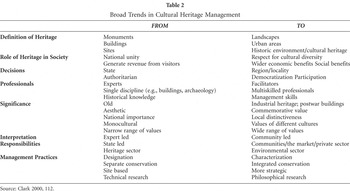
Functionalism proves to be the commonly accepted course of action in the realm of heritage policy and practice as well, executed on all local, national, and international levels. To illustrate, a recent key document of the Council of Europe, Forward Planning: The Functions of Cultural Heritage in a Changing Europe, proves the preceding tendency and provides some updated, operational definitions of heritage46
See Clark, “From Regulation to Participation,” 112.
Broad Trends in Cultural Heritage Management

The report explicitly emphasizes that the formulated new concepts and definitions add to the older ones and do not replace them. The trends reveal a movement toward wider definitions and a much wider role of heritage in society. From separate objects—architecture, archaeology, and movables—heritage has expanded to landscapes, urban and rural areas, historic environment, and even place. Following anthropology's (though not exclusive to it) new trend of breaking the traditional boundaries between time, things, people, places, and spaces, cultural heritage is similarly being reinvented, repositioned and reworked within a new, globally and locally activated “dense and complex web of people/things/places.”47
Bender, “Landscapes On-The-Move,” 76.
As quoted in Poirrier, “Heritage and Cultural Policy in France,” 9:219.
An indicative example is the parallel between current trends in heritage in Japan and France, where common temporal and spatial features in each country's heritagization process are observed. One is the recent phenomenon of the approaching past, where a heritage status is equally being attributed to things very old, old, and not so old; “it is all past, no matter if it has happened two thousand years ago, fifty years ago, or two days ago,”49
Ogino, The Sociology of Cultural Heritage, xv, my translation.
Ogino, The Sociology of Cultural Heritage, 14.
Going back to the trends outlined in the report, the roles of heritage, seen before in the narrow meaning of symbols of national unity and national pride, have grown into a broader phenomenon, which can contribute to political ideals, economic prosperity, social cohesion, and cultural diversity. Alongside it, heritage has become more democratic and a matter of public concern. Once top-down, authoritarian in style, and largely made by experts, decisions related to heritage have become more open and transparent, participatory, and locally and community centered.51
See Clark, “From Regulation to Participation,” 112.
Apparently, the aforesaid trends look at heritage from a more practical viewpoint, recognizing its increasing functional potential. They can be indicators of updated heritage thinking, aimed at better articulating the heritage concept, reflecting more truthfully its complexity and width, as well as its modern implications. However, there are certain inevitable and significant differences between countries and regions of the world in terms of the definition and meaning of heritage. For example, some cultures in Africa, Asia, and the Americas attribute much higher value to intangible than tangible aspect of heritage. Even in Europe alone, there is a unique domestic nuance in the heritage terminology used in the different countries; “French patrimoine is more personal than English heritage, German Erbgut more patriotic than Italian lascito.”52
Lowenthal, The Heritage Crusade, 4.
The functional approach finds legitimation and additional support in some novel theoretic notions originating from the social sciences' domain, mainly from economics and geography that are gaining recognition, even by the traditionally opposing economists and culturalists in the field of heritage studies, and are considered promising for the establishment of a new agreed conceptual framework. Among them are total social and economic values of heritage, heritage as a multivalent resource, heritage as social and cultural capital, and heritage as a factor in socioeconomic development to name but a few.
TOWARD PURPOSEFUL PRESERVATION, SUSTAINABLE USE, AND DEVELOPMENT
The current shift in the cultural heritage concept is characterized previously all by the recognition that like other parts of human culture, heritage has an important resource value. And although resource is a difficult term, being “one of those words which are liberally used but elusive of definition,” it could be described as “an attribute of the environment appraised by man to be of value over time within constraints imposed by his social, political, economic and institutional framework.”53
Lichfield and O'Riordan in Lichfield, Economics in Urban Conservation, 318.
Graham, Ashworth, and Tunbridge, A Geography of Heritage, 17.
Tunbridge and Ashworth provide a summary on the resource perspective of heritage, defining it as “resource upon which extensive activities or industries have been constructed.” First, they describe it as a “cultural resource,” because it is either “incorporated into culture,” because “the artistic and craft productivity of the past is included alongside modern artistic creativity in what is identified as culture,” or “because culture more broadly defined, … whenever it was produced, is viewed as heritage in the sense that it is regarded … suitable for assembly, preservation and transmission to future generations as inheritance,” as in the case of museums. Second, heritage is identified as a “political resource in the creation or support of states at various spatial jurisdictional scales and the legitimation of their governments and governing ideologies.” And third, it is an “economic resource supporting economic activities, either directly as an industry in itself or indirectly as a contributor to the locational preferences of other economic activities.”55
Tunbridge and Ashworth, Dissonant Heritage, 34–35.
The perception of heritage as a multivalent resource logically leads to the issue of its use. Heritage assets are increasingly used in their capacity of resources for a variety of modern purposes. There are also critics who consider use among the biggest threats to heritage, possibly leading to commercialization, exploitation, devaluation, and destruction; however, there are others who contend that “the greatest successes in heritage preservation can occur when the heritage element is in actual use, and thus capable of generating revenue to pay for its preservation” and that “many if not most of the benefits [derived from cultural heritage] are realized only in the course of [its] actual use.”56
See Netzer, “The Economic Implications of Heritage,” 4:4; and Koboldt, “Optimizing the Use of Cultural Heritage,” 56.
Serageldin, “Financing the Adaptive Reuse,” 70.
WHAT HERITAGE USE?
Cultural heritage can be used in a variety of ways. Sometimes the use can mean a restoration and renovation of a symbolic building to stand as a landmark or show community achievements, as in the case of an old factory in Birmingham, England, transformed into a multimedia center employing 300 people; at other times it can mean developing local festivals, as in Spoleto, Italy.58
Landry, “Forward to the Past,” 4:8, 28.
See The Grassic Gribbon Centre in Arbuthnott at 〈http://www.grassicgibbon.com/centreinfo.htm〉, accessed June 9, 2005.
See English Heritage, Picture Palaces, 17.
Pignataro and Rizzo, “The Political Economy of Rehabilitation,” 91–106.
It is essential to note that cultural heritage allows various kinds of direct and indirect use, generating variety of benefits. Transforming the interior of a heritage building into a museum, hotel, or restaurant is not the only possible way of using heritage. In a key policy document to promote heritage use, the Japanese Agency of Cultural Affairs (the government body responsible for cultural heritage matters in Japan) emphasizes the public nature of heritage and releases comprehensive guidelines about what heritage use should mean. According to these guidelines, the public exhibit, provision of access, and dissemination of heritage with the maintenance of traditional heritage functions and utilities (as the continuous use of a heritage house for residential purposes or of a temple for religious events), with new-purpose heritage uses and functions, are all considered appropriate ways of using heritage.62
See Japanese Agency for Cultural Affairs, Guidelines.
Most recently, the great potential of information and communication technologies (e.g., digitization) has been widely discussed in the context of further “unlocking the value” of cultural heritage and inventing new sustainable ways of using it. These new developments may prove to have a substantial influence on the heritage industry and business in general, as revealed in The DigiCult Report of the European Commission, “Technological Landscapes for Tomorrow's Cultural Economy: Unlocking the Value of Cultural Heritage.” In this report scholars and professionals have suggested as relevant both offline and online (e.g., Internet) markets for heritage and made an overview of a variety of possible heritage-based products and services (licensing images, copyright fees on reproductions, cultural CD-ROMs, etc.) that could be supplied to both businesses and individual consumers. Recently, the emergence of the virtual heritage has further elevated the expectations and imagination of heritage theorists and practitioners, posing one more challenge for scholars. Virtual heritage is identified as an “object of knowledge,” which “has the right to exist per se and has value independent of the material existence of heritage … can bring new flows of goods (virtual goods) and services, thus creating economic opportunities to communities.”63
Zancheti, “Values, Built Heritage and Cyberspace,” 215:26.
Zancheti, “Values, Built Heritage and Cyberspace,” 215:25.
THE CASE OF HERITAGIZED JAPANESE MEDIEVAL FOLDING SCREENS RAKUCHU RAKUGAI
The following text refers to a somewhat peculiar but telling example from Japan to demonstrate the increasing social relevance and functional potential of heritage and its various uses. In Japan the intangible aspect of heritage has been traditionally regarded as equally important, if not more so, compared to the tangible. The object has always been behind the primacy of cultural and social meanings, historical narratives, traditional and modern functions, transfer of knowledge, and skills necessary for its interminable re-creation in the future. Japanese historic buildings, which are repeatedly rebuilt with traditional materials and in traditional ways without compromising their authenticity, well illustrate that attitude.
The example that follows features the specific case of objects of art traditionally deemed incompatible with any practical applications or modern uses. The cultural heritage in mention is a unique category of medieval paintings, usually executed on large folding screens, presenting views of Kyoto and its suburbs. They are known as Rakuchu Rakugai screens, translated as “Inside-and-Outside-of-Kyoto” paintings. They are considered one of the most brilliant genres of Japanese art, depicting the old capital and its environs from a bird's-eye perspective, with historic landmarks, colorful festivals, and vivid street life portrayed in astonishing detail. These encyclopedic visualizations include not only famous scenic spots and important monuments but also people from all walks of life: men, women, children, and elderly engaged in various routines of work, mercantile, and leisure activities with their specific customs, costumes, and modes of transportation. They served as settings for seasonal activities, festivals, and entertainments in Kyoto and were inventively used as space and time dividers in the dark halls of the military lords' castles and later in rich merchants' houses. Lavishly decorated with gold, they symbolized power, political legitimacy, and ultimate supremacy of the warlords who have commissioned their creation. Although the style of the screens has changed through the years, reflecting changes in political power and society under consecutive rules, invariably the great masters of painting have continually sought to immortalize the city in its most glorious times and truthfully portray its various stages, moods, and shapes. Thus, now we can become witnesses of Kyoto reviving from the ashes after long-lasting civil wars, Kyoto rapidly developing, Kyoto maturing, and eventually Kyoto declining and transforming.
Drawing on Greffe's view of the expanded contemporary role of art and its beneficial effect on the overall development of regions and countries, it can be demonstrated that apart from their artistic, aesthetic, and cultural value, the screens possess a unique development value in economic and social terms, plus an activity value, with art as the starting point of different chains of activities.65
Greffe, Arts and Artists from an Economic Perspective, 20.
The screens as a motif prove efficient in the tourism industry as well where they are employed as miniatures of the place and the city and symbols of its unique character and distinctiveness. They appear as replicas in different public places such as thematic museums, subway stations, municipal buildings, hotels, and galleries. Another peculiar area of new use for Rakuchu Rakugai is in science and education where they have already become a common subject for research and a cross point to join specialists working in isolated areas in multidisciplinary projects. The screens are gaining acclaim as valuable and reliable historic records and indispensable data sources among scholars and researchers in history, archaeology and geography, sociology and anthropology, cultural studies and art history, architecture and town planning, design, and the like. Furthermore, they inspire and creatively empower contemporary Japanese artists and artisans, who find the city theme meaningful and compelling. Among them are a distinguished modern artist, who has devoted nearly 10 years to create a series of modern versions of the original screens, and a traditional textile dyer from Kyoto, who in reaction to the rapid modernization of the cityscape has endeavored to recreate the classic image of a strong and powerful yet delicate old Kyoto using traditional techniques. The latter has accomplished a collection of 17 different designs and patterns, depicting famous scenic spots and landmarks that decorate official and ceremonial kimonos and obi sashes.
The case of medieval Japanese folding screens has illustrated the widening spectrum of modern uses for heritage, as well as the increasing awareness and drive to refer and build on it, which develops the heritage value even further. It has shown that heritage is actually more about the present than the past and that it must be alive and functional to retain its worth and integrity. To reiterate Handler, to save it and conserve it for the future, we need to do something new today.66
Handler, “Cultural Property and Culture Theory,” 3:355.
RECONCILING HERITAGE AND DEVELOPMENT
The Rakuchu Rakugai example demonstrates the transformation of heritage from single isolated objects, silently housed between museum walls, to much bigger, all-encompassing representations of the whole city and its people, with a meaning for society's present and future. Undoubtedly, if put together for a common goal, these locally powered and locality-empowering initiatives could serve the formation of a wider integrative community-based development strategy and could testify for an even bigger role for heritage in local, regional, and wider developmental contexts. And indeed, more than just “the contemporary uses of the past,” heritage is further identified as a powerful economic and social resource, a development asset that can catalyze local-level development, provide employment, generate income, revitalize local urban and rural areas, enhance environmental protection, and strengthen communities' social capital.67
World Bank. “Culture in Sustainable Development,” 15.
With the context and meaning of development rapidly evolving and culture moving to center stage, the old commodity-centered notion of economic development, traditionally measured by the advancement of material well-being, is giving way to a new people-centered strategy of human development, with environmental, social, and cultural development regarded as part of a bigger whole and defined as sustainable human development. In this new context, the traditional divide between heritage preservation and socioeconomic development (it is either historic preservation or development)68
Rypkema, Culture, Historic Preservation.
Rypkema, Culture, Historic Preservation.
See Cernea, Cultural Heritage and Development, 45; and Ogino, The Sociology of Cultural Heritage, 277.
From an economic perspective, heritage is recognized as both engine and catalyst of socioeconomic development in a theoretical framework, focusing on three main economic dimensions. First, heritage is identified as “economic sector in itself,” often referred to as “the heritage industry … using resources, producing products, and generating returns in profits, [incomes] and jobs.” Second, it is also considered “one element in economic development alongside others, frequently exercising a catalytic or integrating role in development projects,” because of its capacity to attract economic activities and accommodate economic functions. Finally, it is defined as an “instrument in the management of economies at various spatial scales from the international to the local, as for example in the creation and promotion of place images for dominant economic purposes.”71
Graham, Ashworth, and Tunbridge, A Geography of Heritage, 155.
See Graham, “Heritage as Knowledge,” 39:1016; and Throsby, “Cultural Heritage as Financial Asset,” 3.
Nevertheless, the developmental role of heritage, especially in its economic aspect, still shows to be a controversial theme among scholars. The idea of relating heritage to development and employing it for achieving development objectives is considered inappropriate, absurd, or simply dangerous. Some critics argue that economic development could have a parasitical effect on culture and that the heritage value in economic development can devalue other intrinsic heritage values; others look at heritage and development as antagonistic and impossible to reconcile, considering the growing interest in heritage more as a symptom of a climate of decline, and society's failure to face the economic challenges of the present and build a different future.73
See Mosetto, Moody, and Hewison as quoted in Graham, Ashworth, and Tunbridge, A Geography of Heritage,155–156.
The critic's arguments are understandable and should not be ignored. Indeed, to argue that cultural heritage can only enhance socioeconomic development, or that development and increasing heritage investments can only foster heritage preservation would be an oversimplification. Plenty of empirical evidence indicates that cultural heritage can “both stimulate and retard socio-economic development,” as also development may both “support and destroy heritage resources.”74
Graham, Ashworth, and Tunbridge, A Geography of Heritage, 156.
Such ideas have become widespread, particularly in the field of regional and urban planning, with the growing recognition that heritage conservation is an inherent dimension of sustainable development in both industrialized and developing countries. A common perception among urban planners is that the sustainable future of any historic place should be intrinsically linked to its past, not just in the continuity of its tangible and intangible heritage but also in its living culture that has created and still continues to shape its distinct character, townscape, and way of life.75
See Nasser, “Planning for Urban Heritage Places,” 17:467–479.
Available at Kyoto National Highway Office webpage (in Japanese) at 〈http://www.kyoto.kkr.mlit.go.jp/〉 accessed February 17, 2006.
Apparently the artistic creations referred to here have transcended to a higher pluralistic semantic level and transformed into a unique hybrid type of heritage, containing both tangible (artifacts) and intangible aspects (lively visualizing social practices, community life, values, beliefs, etc.). Dissimilarly to Lowenthal's claim of the past's foreignness, the past revealed through the Japanese Rakuchu Rakugai is not a “foreign country” anymore.77
Lowenthal, The Past is a Foreign Country.
CONCLUDING THOUGHTS
This article, located within the vast and controversial realm of heritage conceptualization, has tried to outline the concept of heritage as a constantly evolving and complex unity of perceptions, with dynamism, elasticity and multiplicity emerging as its primary intrinsic features. Drawing on Brett's comments about history being “a verb” and “not an abstract noun,” which is “not given, but made,” heritage is identified as a “cultural process,” and a “human condition” with people always at its center.78
As quoted in Harvey, “Heritage Pasts and Heritage Presents,” 7:336.
Bender, “Introduction: Landscape-Meaning and Action,” 3.
Glendinning, “Beyond the Cult of the Monument,” 70:15.
Already a territory of different domains—cultural, social, economic, and environmental—the reexamination and readaptation of the heritage conceptual framework would inevitably need to introduce and integrate multiple perspectives of heritage, applying multidisciplinary methods and analytical tools. Although the socioeconomic research of heritage is recent, updated integrative concepts like some of those mentioned could significantly contribute for such a framework and are likely to address the problem of undertheorization in the field. Already here, it is undeniable that heritage not only exists but is also tightly bound within societal and economic realities as well, having significant socioeconomic dimension and functions. The latter should not be neglected as a fact by either heritage theorists or practitioners, because as cultural economists agree, “economic factors shape the possibilities of heritage conservation's practice in fundamental ways, by influencing decisions, shaping policy, encouraging or discouraging the use of heritage, enabling conservation through financing, giving incentives to stewardship, and so on.”81
See Mason, “Economics and Heritage Conservation,” 4.
Bridges between academic disciplines as well as between heritage stakeholders, sectors, and scales are to be built to achieve a better understanding of the complex nature of heritage and its multiple interactions. Only then it could become possible to control, plan, manage, and sustain heritage; otherwise, “it will control us,” notes Lowenthal, recognizing the huge potential of heritage for both good and evil.82
Lowenthal, “The Heritage Crusade,” 2–3.